Here’s a sobering statistic: the average B2B SaaS demo converts just 25% of the time. That means 3 out of 4 product demonstrations end without a deal. If you’re running a SaaS sales process in 2026, this number should keep you up at night.
But here’s the thing — it doesn’t have to be this way. Top-performing SaaS companies are hitting demo-to-close rates of 40% or higher. They’re not doing it through luck. They’re following a systematic playbook that turns product demonstrations from feature tours into revenue-generating conversations.
I’ve spent years analyzing what separates demo winners from demo losers. The patterns are clear: most demos fail before they even start, and the ones that succeed follow a predictable formula. In this guide, I’ll break down the exact playbook that’s driving 30-40% demo-to-close rates in 2026, backed by data from 939 B2B companies.
What Is Demo-to-Close Rate (And Why It Matters)
Demo-to-close rate measures how many completed product demos turn into closed-won deals. The math is simple: divide your closed-won deals by completed demos, multiply by 100.
But here’s what most SaaS teams get wrong — they measure demos scheduled, not demos completed. That’s a critical distinction. Completed demos isolate your presentation performance from no-show problems. If you’re tracking scheduled demos, you’re blending two very different issues.
Why does this metric matter so much? Because demos are expensive. Between sales engineering time, account executive hours, and opportunity cost, a single enterprise demo can cost $2,000-$5,000 to deliver. At a 25% close rate, you’re spending $8,000-$20,000 to acquire one customer. Improve that to 40%, and your cost per acquisition drops to $5,000-$12,500.
2026 SaaS Demo Benchmarks: Where Do You Stand?
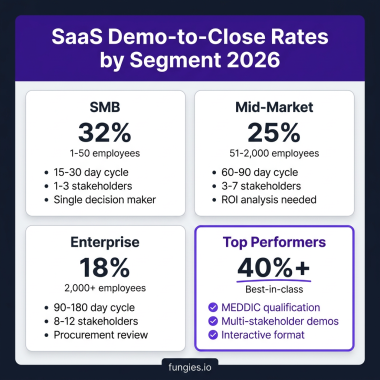
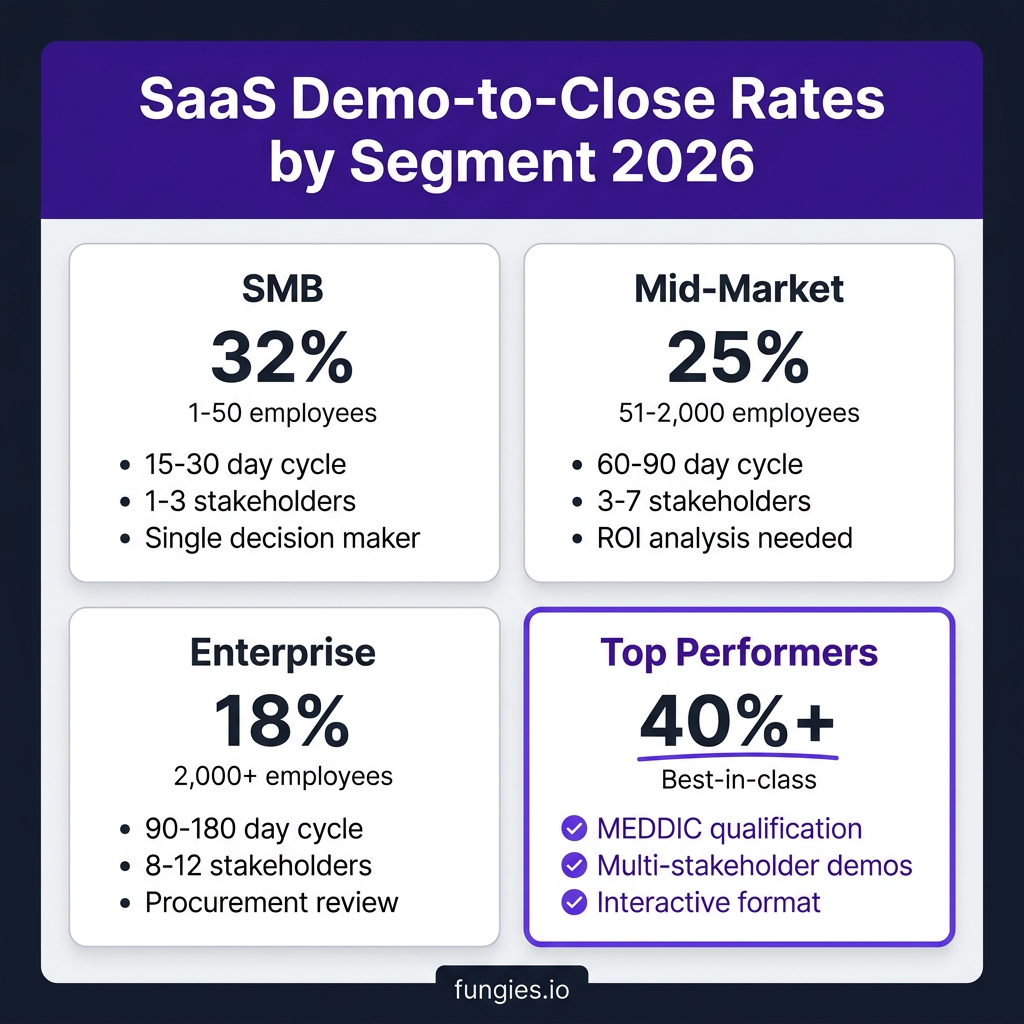
Before we dive into tactics, let’s establish what “good” actually looks like. According to 2026 benchmark data from 939 B2B companies, here’s where the industry stands:
| Segment | Average Rate | Top Performer Target | Sales Cycle |
|---|---|---|---|
| SMB (1-50 employees) | 32% | 40%+ | 15-30 days |
| Mid-Market (51-2,000) | 25% | 35%+ | 60-90 days |
| Enterprise (2,000+) | 18% | 30%+ | 90-180 days |
The pattern is clear: as deal size increases, close rates decrease. Enterprise deals involve 8-12 stakeholders, procurement reviews, and security audits. That’s not a flaw in your pitch — it’s the reality of complex B2B buying. Your job is to navigate it efficiently, not fight it.
Here’s another critical insight: demo format dramatically impacts conversion. Generic screen shares convert at just 18%. Interactive demos where prospects drive the experience? They hit 38% — a 111% improvement. Live implementation POCs with real customer data? Those push 42%.
The 7-Step SaaS Demo Playbook for 2026
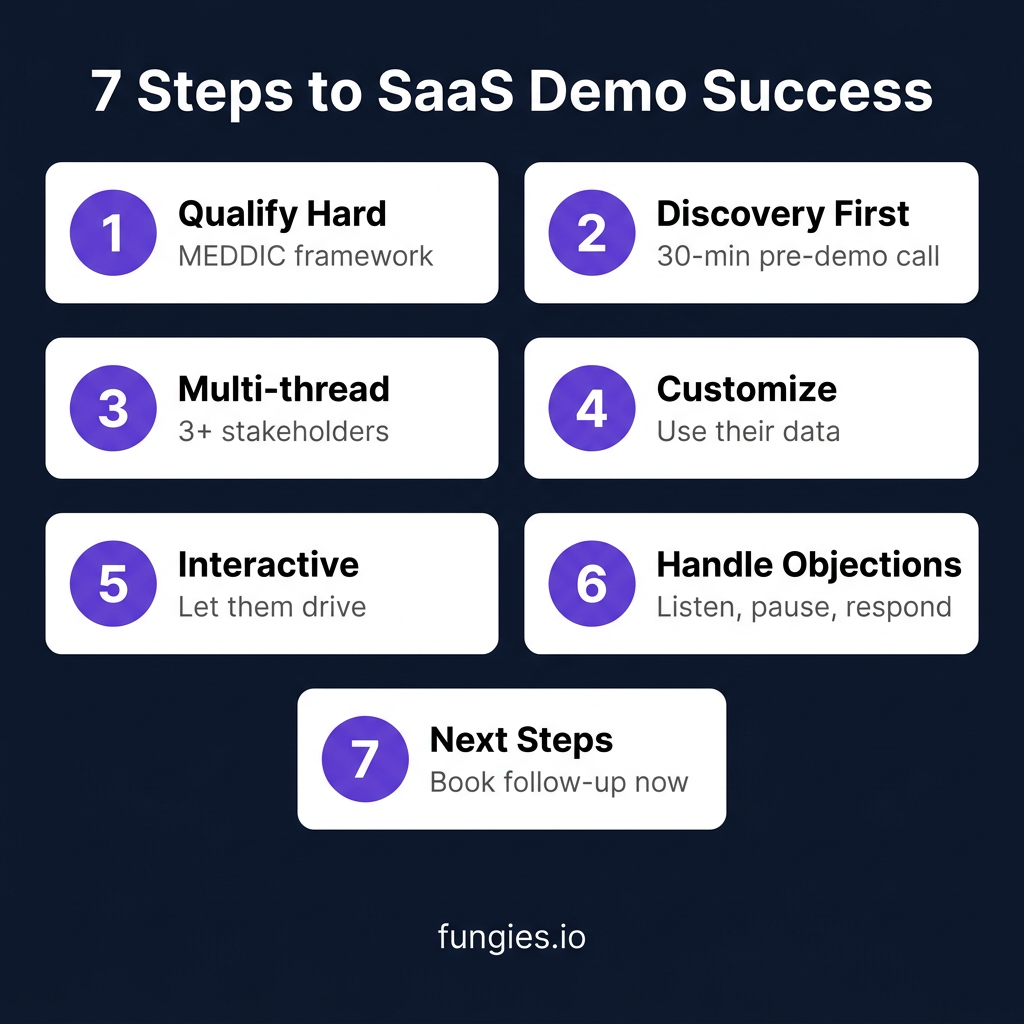
Now let’s get tactical. Here’s the exact playbook top performers use to hit 40%+ demo-to-close rates.
Step 1: Qualify Hard Before the Demo
Honestly, most demo problems start with bad qualification. When SDRs prioritize meeting volume over meeting quality, unqualified leads flood your pipeline. This inflates your denominator (completed demos) and drags your close rate down.
Top performers use the MEDDIC framework to qualify opportunities:
- Metrics: What quantifiable outcomes does the prospect need?
- Economic Buyer: Who controls the budget and can say yes?
- Decision Criteria: What factors will they use to evaluate solutions?
- Decision Process: How do they actually buy? What’s the timeline?
- Identify Pain: What business problem are they solving?
- Champion: Who internally will fight for your solution?
If you can’t answer these six questions before the demo, you’re not ready to present. Period.
Step 2: Run Discovery Before You Demo
This might surprise you: the best demos don’t start with screen sharing. They start with a 30-minute discovery call where you understand the prospect’s pain points, current workflow, and success criteria.
Here’s why this matters. If you don’t know what business pain your product solves for this specific prospect, you’ll bore them to death with features they don’t care about. Discovery lets you customize the demo to show only the capabilities that address their specific challenges.
Key discovery questions to ask:
- “What triggered your search for a solution right now?”
- “How are you handling [problem] today?”
- “What’s the cost of not solving this?”
- “Who else is affected by this problem?”
- “What does success look like 6 months from now?”
Step 3: Multi-Thread Every Deal
Single-threaded deals die. In 2026, enterprise deals average 13 decision-makers. If your demo only has one person on the call, you’re setting yourself up for failure.
Top performers aim for 3+ stakeholders on every demo call:
- Champion: The person who wants your solution to win
- Economic Buyer: The person who can sign the check
- End Users: The people who will actually use the product daily
Each stakeholder has different concerns. Your champion cares about features. The economic buyer cares about ROI. End users care about ease of use. A demo that addresses all three perspectives converts at 31% — 72% higher than single-stakeholder demos.
Step 4: Customize With Their Data
Generic demos convert at 18%. Customized demos using the prospect’s industry terminology and use cases? They hit 25%+. But demos with the prospect’s actual data imported? Those push conversion rates even higher.
Here’s what customization looks like in practice:
- Use their company logo and branding in the demo environment
- Import sample data that matches their industry (healthcare, finance, retail)
- Show workflows that mirror their actual processes
- Use their terminology, not yours
The “aha” moment happens when prospects see their specific problem being solved with their specific data. That’s when the abstract becomes concrete.
Step 5: Make It Interactive
This is where the data gets really interesting. Interactive demos — where prospects click around and drive the experience themselves — convert at 38%. That’s more than double the 18% rate for passive screen shares.
Interactive demo software like Navattic, Walnut, and Demostack let you create sandbox environments where prospects can explore without risk. They can click buttons, enter data, and see results — all without accessing your production environment.
The psychology here is simple: people value what they participate in creating. When a prospect drives the demo, they’re mentally taking ownership of the solution. That’s powerful.
Step 6: Handle Objections Like a Pro
Objections aren’t dealbreakers — they’re buying signals. When a prospect raises a concern, they’re engaging with your solution. The key is handling those objections correctly.
Most objections fall into four categories:
| Objection Type | Example | Response Strategy |
|---|---|---|
| Budget | “This is too expensive” | Reframe around ROI and cost of inaction |
| Timing | “Not right now” | Uncover urgency drivers and consequences of delay |
| Authority | “I need to check with my team” | Multi-thread and equip your champion with materials |
| Need | “We’re good with what we have” | Quantify pain points and show contrast |
The best objection-handling technique? Listen, pause, and ask clarifying questions before responding. Most reps rush to defend their product. Top performers seek to understand the “why” behind the objection first.
Step 7: Lock in Next Steps Before You Hang Up
Here’s a mistake I see constantly: demos end with “I’ll send you a follow-up email and we can reconnect next week.” That’s a momentum killer.
Top performers book the next meeting while still on the demo call. Before you hang up, you should have:
- A specific next step agreed upon (technical review, stakeholder meeting, pilot)
- A date and time on the calendar
- Clear action items for both sides
- Calendar invites sent before ending the call
Momentum is everything in SaaS sales. Every day between your demo and the next touchpoint is an opportunity for competitors to sneak in, priorities to shift, or budgets to get reallocated.
Top 5 Interactive Demo Software Tools for 2026
If you’re serious about improving demo conversion rates, you need the right tools. Here are the top 5 interactive demo platforms for SaaS teams in 2026:
| Tool | Best For | Key Feature | Starting Price |
|---|---|---|---|
| Walnut | Enterprise teams | AI-powered personalization at scale | Custom |
| Navattic | Sales and SE teams | Modular, reusable demo flows | $500/mo |
| Storylane | Quick deployment | AI-assisted demo creation | $40/mo |
| Reprise | Large presales teams | Scalable demo environments | Custom |
| Arcade | Product marketing | Easy screenshot-based tours | Free tier |
These tools let you create interactive, self-guided demos that prospects can explore on their own time. They’re particularly valuable for top-of-funnel education and follow-up after live demos.
Common Demo Mistakes (And How to Fix Them)
Before we wrap up, let’s address the most common demo mistakes I see SaaS teams make:
Mistake #1: The Feature Dump
Reps walk through every feature in the product, regardless of whether the prospect cares. The fix: Use discovery to identify 3-5 key capabilities that solve their specific pain points. Demo only those.
Mistake #2: Talking Too Much
The best demos are conversations, not presentations. Aim for 60% prospect talking, 40% you talking. Ask questions. Pause for input. Make it interactive.
Mistake #3: No Clear Agenda
Prospects show up not knowing what to expect. Send a clear agenda 24 hours before the demo. Set expectations. Confirm who will attend. This alone can improve show rates and engagement.
Mistake #4: Ignoring the Competition
Your prospects are evaluating 3-5 solutions. If you don’t address how you’re different, they’ll make up their own (often incorrect) conclusions. Be proactive about differentiation.
Mistake #5: Weak Close
Demos end with “Any questions?” instead of a clear path forward. Always end with proposed next steps and get agreement before hanging up.
FAQ: SaaS Demo Best Practices
What’s a good demo-to-close rate for B2B SaaS?
A good demo-to-close rate is 30% or higher. The industry average is 25%, but top performers hit 40%+. Rates vary by segment: SMB averages 32%, mid-market 25%, and enterprise 18%.
How long should a SaaS demo be?
30-45 minutes is the sweet spot. Shorter than 30 minutes and you can’t show enough value. Longer than 45 minutes and attention drops significantly. Reserve 60-minute slots for enterprise deals with multiple stakeholders.
Should I do live demos or recorded demos?
Both have their place. Live demos are best for qualified opportunities in active sales cycles. Recorded/interactive demos work well for top-of-funnel education, follow-up, and prospects who aren’t ready to talk to sales yet.
How do I handle “I need to think about it”?
This usually means you haven’t created enough urgency or the prospect isn’t the decision-maker. Ask: “What specific concerns do you need to think through?” and “Who else needs to be involved in this decision?”
What’s the best demo software for SaaS?
For enterprise teams, Walnut offers the most advanced AI-powered personalization. For mid-market, Navattic provides excellent modular demo flows. For quick starts, Storylane has the fastest time-to-value.
Conclusion: Your Demo Is Your Differentiator
In 2026, product features are increasingly commoditized. Your competitors can copy functionality, but they can’t copy how you sell. A world-class demo experience is one of the last sustainable competitive advantages in SaaS.
The data is clear: companies that follow this playbook — hard qualification, discovery-first, multi-threading, customization, interactivity, objection handling, and momentum management — consistently hit 35-40% demo-to-close rates.
Your demo isn’t just a product tour. It’s the moment when prospects decide whether you’re the partner they want to work with for the next 3-5 years. Make it count.
Ready to streamline your SaaS billing and focus on what matters? Get started with Fungies.io — the Merchant of Record platform that handles global tax compliance so you can focus on closing more deals.
Sources
- Optifai Sales Ops Benchmark Study (Q2 2025-Q1 2026, N=939 companies)
- Puppydog.io Demo-to-Close Rate Analysis (2026)
- First Page Sage B2B SaaS Sales Benchmarks (2026)
- Highspot Objection Handling Research (2026)
- Klozers SaaS Sales Training Data (2026)