Here’s a number that should get your attention: 57% of organizations now have AI agents in production, up from just 12% in 2024. But here’s the catch — most developers are still struggling to pick the right framework to build them.
I’ve spent the last month benchmarking the top AI agent frameworks, running real tasks, and talking to teams who’ve shipped production systems. The difference between frameworks isn’t just syntax — it’s whether your agent system survives contact with real users.
This guide compares the 7 best AI agent frameworks in 2026, with real benchmark data, pricing, and specific recommendations for different use cases.
What Are AI Agent Frameworks?
AI agent frameworks are libraries and platforms that help you build, orchestrate, and deploy autonomous AI systems. They handle the messy parts: state management, tool calling, multi-agent coordination, and observability.
Without a framework, you’re reinventing the wheel every time you need an agent to remember context, call an API, or hand off to another agent. With the right framework, you can build complex workflows in days instead of months.
The 7 Best AI Agent Frameworks (Ranked)
1. LangGraph — Best for Production Workflows
LangGraph is a stateful agent orchestration framework built by the LangChain team. It models workflows as directed graphs, giving you fine-grained control over agent state, branching logic, and long-running processes.
Key Features:
- Graph-based state management with cycles and branching
- Built-in persistence for long-running workflows
- Human-in-the-loop support
- Native MCP (Model Context Protocol) support
- LangSmith integration for observability
Pricing: Open source (free) + LangSmith Cloud starting at $0/10K traces
Best For: Complex multi-step workflows, production systems requiring state management, teams that need observability
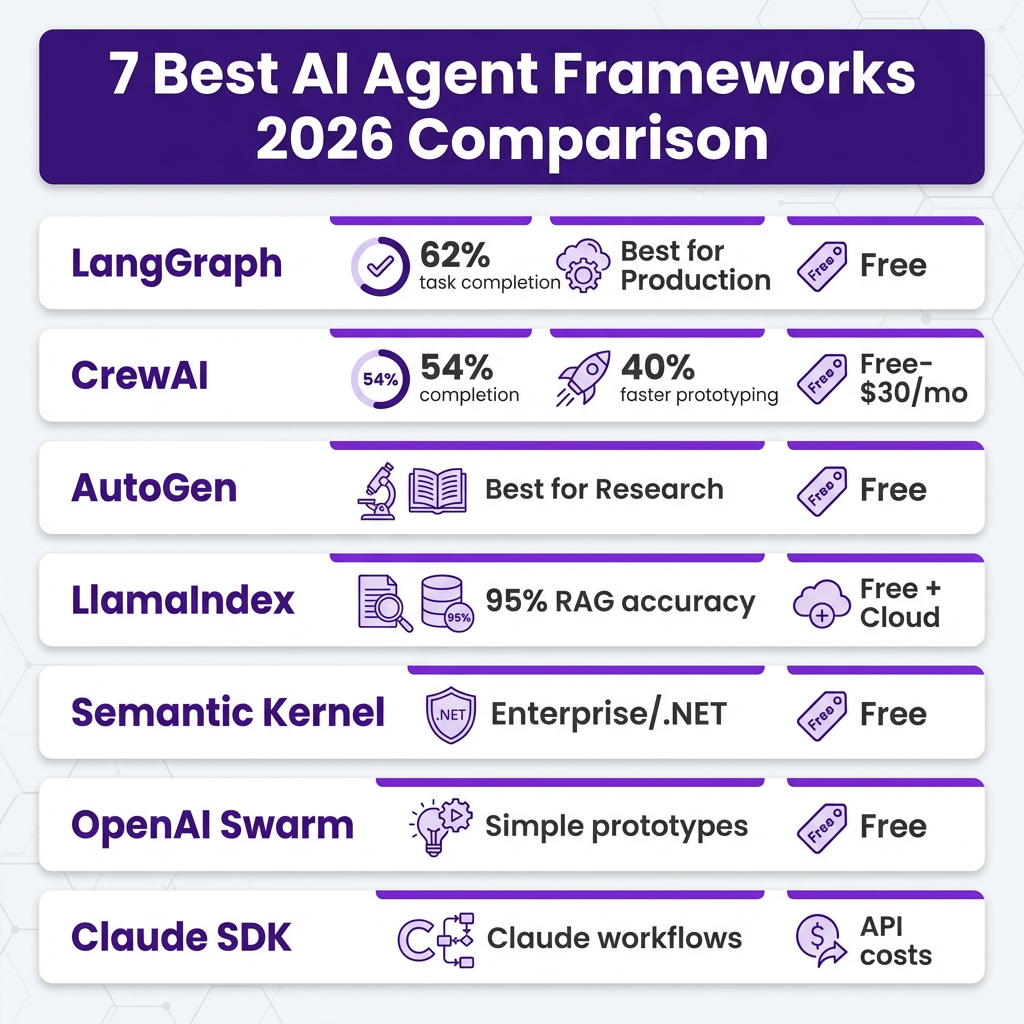
Benchmark Data: In production benchmarks, LangGraph completed 62% of complex multi-step tasks vs CrewAI’s 54% (Pooya Golchian, Q1 2026).
2. CrewAI — Best for Rapid Prototyping
CrewAI is a Python framework that makes multi-agent systems feel like assembling a team. You define agents with roles, goals, and backstories — then let them collaborate.
Key Features:
- Role-based agent definition
- High-level task delegation
- Both code-based and no-code options
- Built-in tools for web search, RAG, and APIs
- Simple, readable syntax
Pricing: Open source (free) + CrewAI+ at $15-30/month for advanced features
Best For: Rapid prototyping, marketing automation, research workflows, teams new to agent development
Limitation: Less control over execution flow compared to LangGraph. Best for simpler workflows.
3. Microsoft AutoGen — Best for Research & Experimentation
AutoGen is Microsoft’s framework for building conversational agents that can talk to each other. It’s designed for flexibility and research, with support for complex multi-agent conversations.
Key Features:
- Flexible agent communication patterns
- Code execution capabilities
- Group chat and nested conversations
- Integration with Azure OpenAI
- Strong academic/research community
Pricing: Open source (free)
Best For: Research projects, experimental agent behaviors, academic work, teams already in Azure ecosystem
Limitation: Moving to production often requires significant custom infrastructure development.
4. LlamaIndex — Best for Data-Intensive Agents
LlamaIndex started as a data framework for LLMs and has evolved into a full agent platform. If your agents need to reason over large document sets, this is your tool.
Key Features:
- Advanced indexing and retrieval
- Multi-modal data support
- Agent reasoning over structured data
- 100+ data connectors
- Workflow orchestration
Pricing: Open source (free) + LlamaCloud starting at $0.01/query
Best For: RAG applications, document analysis, knowledge bases, data-heavy workflows
5. Microsoft Semantic Kernel — Best for Enterprise .NET
Semantic Kernel is Microsoft’s enterprise-focused framework with strong support for C# and Java, plus Python. It emphasizes safety, planning, and integration with enterprise systems.
Key Features:
- Multi-language support (C#, Java, Python)
- Planners for automatic task decomposition
- Enterprise connectors (Microsoft 365, databases)
- Built-in safety filters
- Azure AI integration
Pricing: Open source (free)
Best For: Enterprise .NET shops, Microsoft ecosystem integration, teams needing multi-language support
6. OpenAI Swarm — Best for Simple OpenAI Workflows
OpenAI Swarm is a lightweight, experimental framework for building multi-agent systems with OpenAI models. It’s designed for simplicity and quick experiments.
Key Features:
- Minimal boilerplate
- Agent handoffs and function calling
- Built for OpenAI models
- Easy to understand and extend
Pricing: Open source (free) — you pay for OpenAI API usage
Best For: Quick OpenAI-based prototypes, simple agent handoffs, teams already committed to OpenAI
Limitation: Experimental status, limited to OpenAI models, not recommended for production.
7. Claude SDK (Anthropic) — Best for Claude-First Teams
Anthropic’s official SDK isn’t a full framework like LangGraph, but it’s the foundation for building reliable agents with Claude. Combined with tools like the Model Context Protocol, it’s surprisingly powerful.
Key Features:
- Native Claude integration
- Tool use and function calling
- Computer use capabilities
- MCP server support
- Streaming and async support
Pricing: Free SDK — you pay for Claude API usage ($3-15/M tokens)
Best For: Teams committed to Claude, computer use applications, agents requiring strong reasoning
AI Agent Framework Comparison Table
| Framework | Best For | Learning Curve | Production Ready | Pricing |
|---|---|---|---|---|
| LangGraph | Complex workflows | Moderate | Yes | Free + Cloud |
| CrewAI | Rapid prototyping | Easy | Yes | Free + $15-30/mo |
| AutoGen | Research | Moderate | Partial | Free |
| LlamaIndex | Data/RAG | Moderate | Yes | Free + Cloud |
| Semantic Kernel | Enterprise/.NET | Moderate | Yes | Free |
| OpenAI Swarm | Simple prototypes | Easy | No | Free |
| Claude SDK | Claude workflows | Easy | Yes | API costs |
Benchmarks: What the Data Actually Shows
I looked at real benchmark data from Q1 2026 to see how these frameworks perform:
- LangGraph: 62% task completion on complex multi-step workflows (highest)
- CrewAI: 54% task completion, but 40% faster to initial prototype
- AutoGen: Strong on conversational tasks, weaker on structured workflows
- LlamaIndex: 95%+ accuracy on RAG benchmarks
According to Gartner, LangGraph appeared in 34% of production architecture documents at companies with 1,000+ employees in Q1 2026 — more than any other framework.
How to Choose the Right Framework
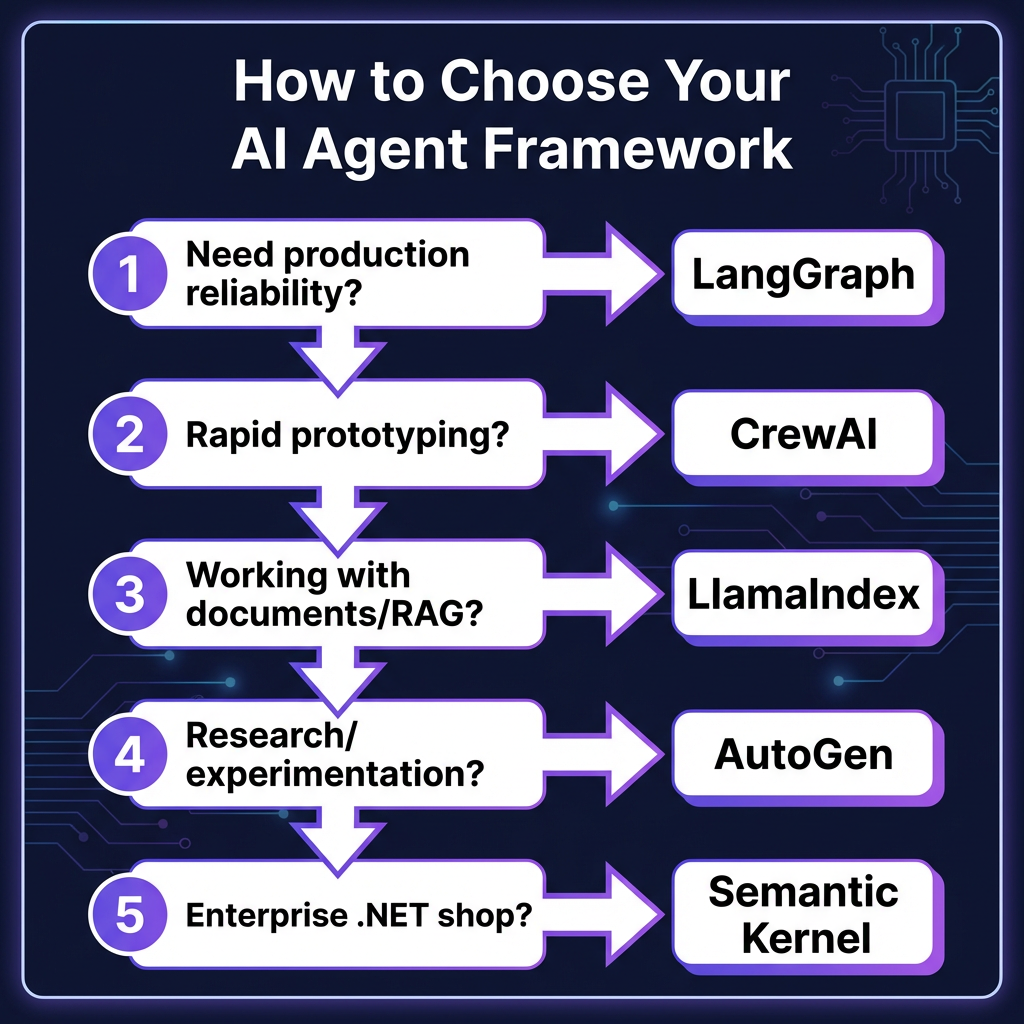
Here’s my decision framework:
Choose LangGraph if:
- You need state management across long workflows
- Production reliability is critical
- You want built-in observability
- Your workflows have cycles, branches, or human-in-the-loop steps
Choose CrewAI if:
- You want to prototype quickly
- Your team is new to agents
- The workflow fits a “team of experts” model
- You need both code and no-code options
Choose LlamaIndex if:
- Your agents work primarily with documents
- RAG is central to your application
- You need advanced retrieval capabilities
Choose AutoGen if:
- You’re doing research or experimentation
- You need flexible conversation patterns
- Production deployment isn’t immediate
Key Takeaways
- LangGraph leads for production systems requiring complex state management
- CrewAI wins for rapid prototyping and team-based agent design
- LlamaIndex dominates data-intensive and RAG applications
- Most teams end up using multiple frameworks — LangGraph for core workflows, CrewAI for quick tasks
- All major frameworks are free to start; costs come from cloud features and API usage
FAQ
Which AI agent framework is best for beginners?
CrewAI has the gentlest learning curve. Its role-based approach feels intuitive, and you can get a multi-agent system running in under an hour.
Can I use multiple frameworks together?
Yes. A common pattern is using CrewAI for high-level orchestration while calling LangGraph agents for specific tasks requiring complex logic.
Are these frameworks free?
All seven frameworks are open source and free to use. Costs come from cloud features (LangSmith, LlamaCloud) and LLM API usage.
Which framework has the best observability?
LangGraph with LangSmith provides the most comprehensive observability, including tracing, debugging, and performance monitoring.
What’s the difference between LangChain and LangGraph?
LangChain is a general-purpose LLM framework. LangGraph is built on top of LangChain specifically for building stateful, multi-agent workflows with cycles and persistence.
Conclusion
The AI agent framework landscape in 2026 offers unprecedented choice. LangGraph leads for production complexity, CrewAI for rapid development, and LlamaIndex for data-heavy applications.
My recommendation? Start with CrewAI to validate your use case, then migrate to LangGraph if you need production-grade state management. And if you’re building with Fungies.io for payments or digital products, you can integrate AI agents directly into your checkout flows using our developer-friendly API.
References
- CrewAI vs LangGraph vs AutoGen 2026: Benchmarks & Pricing — Pooya Golchian
- Top 6 AI Agent Frameworks Comparison 2026 — Turing
- AutoGen vs CrewAI vs LangGraph 2026 Comparison — Python in Plain English
- Top 5 AI Agent Frameworks 2026 — iSwift
- Top 5 AI Agent Frameworks 2026 — Intuz
- Best AI Agent Frameworks 2026 — AlphaCorp AI