Here’s a number that should keep every SaaS founder up at night: the median customer acquisition cost (CAC) ratio hit $2.00 in 2024. That means you’re spending two dollars for every new dollar of ARR you bring in. Meanwhile, increasing customer retention by just 5% can boost profits by 25% to 95%. The math is brutal but simple — keeping existing customers is significantly cheaper than finding new ones.
Yet most SaaS companies still treat retention as an afterthought. They pour resources into marketing and sales while their existing customers quietly churn away. The best-in-class SaaS businesses maintain an 87% customer retention rate and push net revenue retention (NRR) above 120%. They’re not doing this through luck — they’re using specialized customer retention software to identify at-risk accounts, automate interventions, and systematically reduce churn.
What Is Customer Retention Software?
Customer retention software is a category of tools designed to help SaaS companies monitor customer health, predict churn risk, and take proactive steps to keep customers engaged and subscribed. These platforms consolidate data from your CRM, product analytics, billing system, and support tickets to create a unified view of each customer’s journey.
Honestly, if you’re still managing customer success through spreadsheets and gut feeling, you’re flying blind. Modern retention software uses AI to spot patterns humans miss — like a subtle drop in login frequency or a decrease in feature usage that historically precedes cancellation. The best tools don’t just tell you who’s at risk; they tell you why and what to do about it.
Why Customer Retention Matters More Than Ever in 2026
The SaaS landscape has shifted dramatically. With AI lowering barriers to entry, competition is fiercer than ever. Customers have more options and less patience. The median annual B2B SaaS retention sits around 88-90%, but that’s not good enough anymore.
Here’s what the data tells us: SaaS businesses with a net retention rate above 100% grow 43.6% per year on average. Those below 60%? They’re fighting an uphill battle. In my experience working with dozens of SaaS companies, the ones that break through the $10M ARR barrier almost always have one thing in common — they’ve built a systematic approach to retention using the right software stack.
The economic environment has made this even more critical. With tighter budgets and longer procurement cycles, every existing customer relationship is worth protecting. A single enterprise churn can wipe out months of new business progress.
10 Best Customer Retention Software for SaaS in 2026
I’ve evaluated dozens of retention tools across different categories, price points, and use cases. These ten stand out for their ability to deliver measurable results. Whether you’re a seed-stage startup or scaling toward IPO, there’s a solution here for your needs.
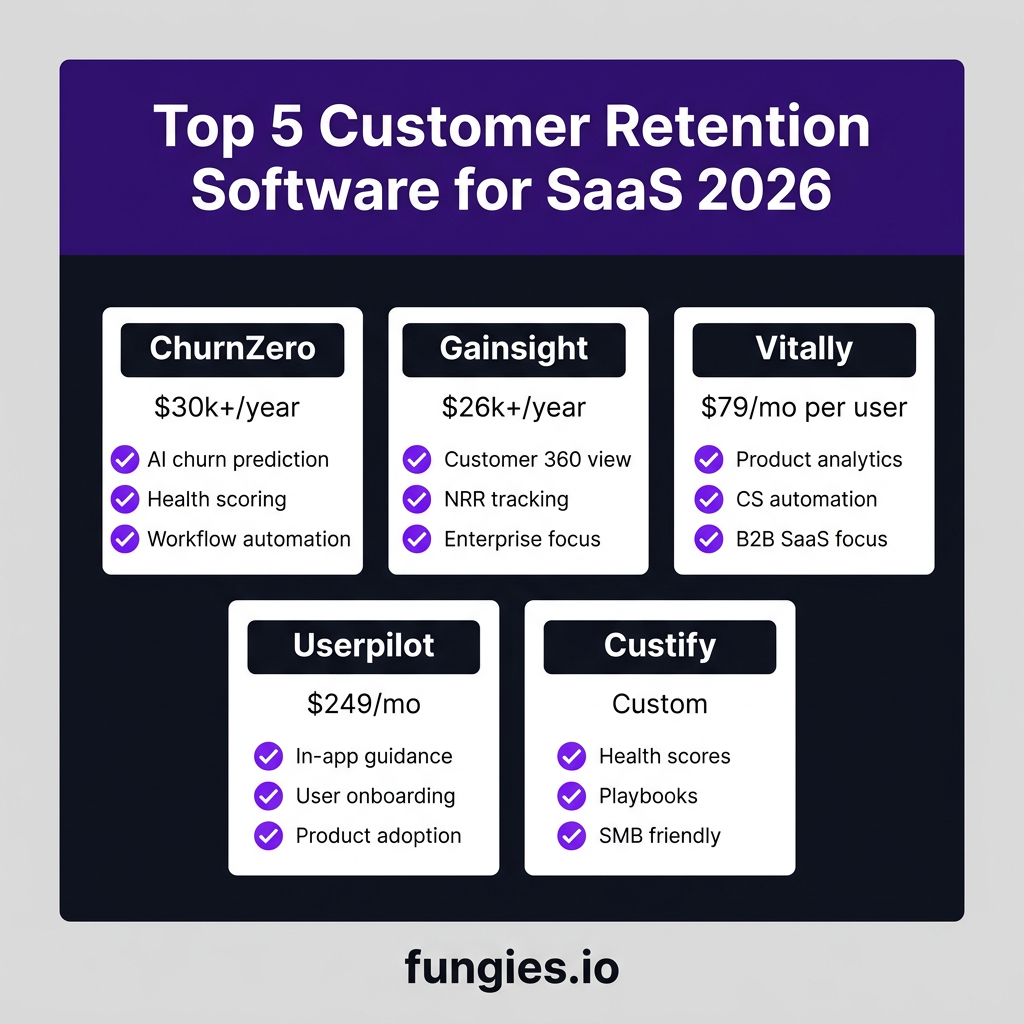
1. ChurnZero — Best for AI-Powered Churn Prevention
ChurnZero has emerged as the leader in AI-driven customer success. The platform uses machine learning to analyze behavioral patterns and predict churn before it happens. What sets it apart is its AI agents that can automate routine tasks between touchpoints, freeing your team to focus on high-value conversations.
Key Features:
- AI-powered health scoring and churn prediction
- Automated workflow triggers based on behavioral signals
- In-app engagement tools and walkthroughs
- Revenue forecasting and expansion opportunity identification
Pricing: Custom enterprise pricing starting around $30,000/year. The platform fee plus per-user licenses typically run $1,400+ per seat annually.
Best For: Mid-market to enterprise SaaS companies with dedicated customer success teams who need predictive analytics and automation at scale.
2. Gainsight — Best for Enterprise Customer Success
Gainsight is the category leader that essentially created the customer success software market. It’s a comprehensive platform that unifies customer data across every touchpoint. The 360-degree customer view is genuinely impressive — you can see product usage, support tickets, survey responses, and revenue data all in one place.
Key Features:
- Comprehensive Customer 360 dashboard
- Advanced health scoring with customizable models
- Journey orchestration and automation
- Product experience analytics and in-app guidance
Pricing: Enterprise-focused with custom pricing. Recent data shows approximately $26,000/year for teams with 10 CSMs, 5 viewer+ seats, and 3 viewer seats.
Best For: Large enterprises with complex customer journeys, multiple product lines, and mature customer success operations.
3. Vitally — Best for Product-Led Growth Companies
Vitally takes a different approach, building specifically for B2B SaaS companies with a product-led growth motion. The tight integration between product analytics and customer success workflows is what makes it special. You can see exactly how customers are using your product and trigger automated responses based on usage patterns.
Key Features:
- Deep product analytics integration
- Automated customer success playbooks
- Real-time health scoring based on product usage
- Collaborative workspace for CS teams
Pricing: Starting at $79/month per user with transparent, startup-friendly pricing. Scales based on features and user count.
Best For: PLG-focused SaaS companies that need to bridge the gap between product analytics and customer success workflows.
4. Userpilot — Best for User Onboarding and Product Adoption
Userpilot focuses on the critical early-stage retention driver: onboarding. The platform lets you build in-app guidance, checklists, and walkthroughs without writing code. What I’ve seen work particularly well is using Userpilot to drive users to their “aha moment” faster — that critical point where they experience real value from your product.
Key Features:
- No-code in-app guidance and tooltips
- Onboarding checklists and progress tracking
- Feature adoption analytics
- Segmentation and targeting based on user behavior
Pricing: Starting at $249/month for the Growth plan. Higher tiers add more MAUs and advanced features.
Best For: SaaS companies struggling with early-stage churn or low activation rates who need to improve their onboarding experience.
5. Custify — Best for SMB and Mid-Market SaaS
Custify is built specifically for B2B SaaS companies with subscription models. It’s more approachable than enterprise solutions like Gainsight but still delivers powerful automation and health scoring. The playbook automation is particularly strong — you can set up triggers that automatically assign tasks, send emails, or create alerts based on customer behavior.
Key Features:
- Customer health scoring with multiple data sources
- Automated playbooks for common scenarios
- 360-degree customer profiles
- Revenue tracking and expansion alerts
Pricing: Custom pricing based on customer count. Generally more affordable than enterprise alternatives.
Best For: SMB to mid-market SaaS companies that need core customer success functionality without enterprise complexity or pricing.
6. Planhat — Best for Customer Lifecycle Management
Planhat positions itself as “the customer platform” rather than just a CS tool. It covers the entire customer lifecycle from onboarding through renewal and expansion. The workflow automation is sophisticated, and the UI is genuinely pleasant to use — something that matters when your team lives in the tool daily.
Key Features:
- End-to-end customer lifecycle management
- Configurable workflows and automation
- Revenue intelligence and forecasting
- Collaborative customer workspaces
Pricing: License-based pricing varies by customer count and feature tier. Contact sales for specific quotes.
Best For: SaaS companies that want a unified platform covering the entire customer journey, not just retention.
7. ChartMogul — Best for Subscription Analytics and Churn Analysis
ChartMogul isn’t a traditional customer success platform, but it’s essential for retention-focused SaaS companies. It provides deep analytics into your subscription metrics — MRR, ARR, churn, LTV, and cohort retention. The free tier up to $10K MRR makes it accessible for early-stage companies.
Key Features:
- Real-time subscription metrics and dashboards
- Cohort analysis and retention curves
- Churn rate tracking by segment
- Revenue recognition and forecasting
Pricing: Free up to $10K MRR. Paid plans scale with your revenue.
Best For: Data-driven SaaS companies that need deep visibility into subscription metrics and churn patterns.
8. Baremetrics — Best for Dunning and Revenue Recovery
Baremetrics focuses on a specific but critical retention challenge: failed payments and involuntary churn. Their Recover product automatically handles dunning — retrying failed cards, sending personalized emails, and providing self-service update options. For many SaaS companies, involuntary churn accounts for 20-40% of total churn, making this a high-ROI investment.
Key Features:
- Automated dunning and payment recovery
- Subscription analytics and forecasting
- Cancellation insights and exit surveys
- Benchmarking against similar companies
Pricing: Tiered pricing based on your MRR. The Recover add-on is priced separately.
Best For: SaaS companies with subscription billing who want to reduce involuntary churn and recover failed payments.
9. Intercom — Best for Customer Communication and Engagement
Intercom has evolved from a simple chat widget into a comprehensive customer engagement platform. Their AI-powered helpdesk and proactive messaging capabilities make it valuable for retention. You can trigger targeted messages based on user behavior, onboard new users with personalized sequences, and provide support at scale.
Key Features:
- AI-powered customer service automation
- Proactive messaging and campaigns
- In-app messaging and chat
- Customer data platform and segmentation
Pricing: Starts at $29/month per agent but scales quickly with AI resolution fees and add-ons. Most businesses pay $600-2,000+ monthly.
Best For: SaaS companies that prioritize customer communication and want to combine support, marketing, and retention in one platform.
10. Zendesk — Best for Support-Driven Retention
Zendesk remains the leader in customer support software, and support interactions are critical retention moments. A bad support experience is one of the top reasons customers churn. Zendesk’s AI features, automation, and omnichannel capabilities help you resolve issues faster and turn support into a retention driver rather than a cost center.
Key Features:
- Omnichannel support (email, chat, phone, social)
- AI-powered ticket routing and suggestions
- Self-service knowledge base
- Advanced analytics and CSAT tracking
Pricing: Suite plans range from $55 to $169 per agent/month. Support-only plans start at $19.
Best For: SaaS companies with high support volumes who need a mature, scalable support platform.
Comparison Table: Customer Retention Software at a Glance
| Tool | Best For | Starting Price | Key Strength |
|---|---|---|---|
| ChurnZero | Enterprise AI churn prevention | $30k+/year | AI-powered predictions |
| Gainsight | Large enterprises | $26k+/year | 360° customer view |
| Vitally | PLG SaaS | $79/mo/user | Product analytics integration |
| Userpilot | Onboarding optimization | $249/mo | No-code in-app guidance |
| Custify | SMB/Mid-market | Custom | Automated playbooks |
| Planhat | Lifecycle management | Custom | End-to-end workflows |
| ChartMogul | Analytics-focused | Free to $10K MRR | Deep subscription metrics |
| Baremetrics | Dunning/recovery | Based on MRR | Payment failure recovery |
| Intercom | Communication | $29/mo/agent | AI messaging automation |
| Zendesk | Support teams | $19/mo/agent | Omnichannel support |
How to Choose the Right Customer Retention Software
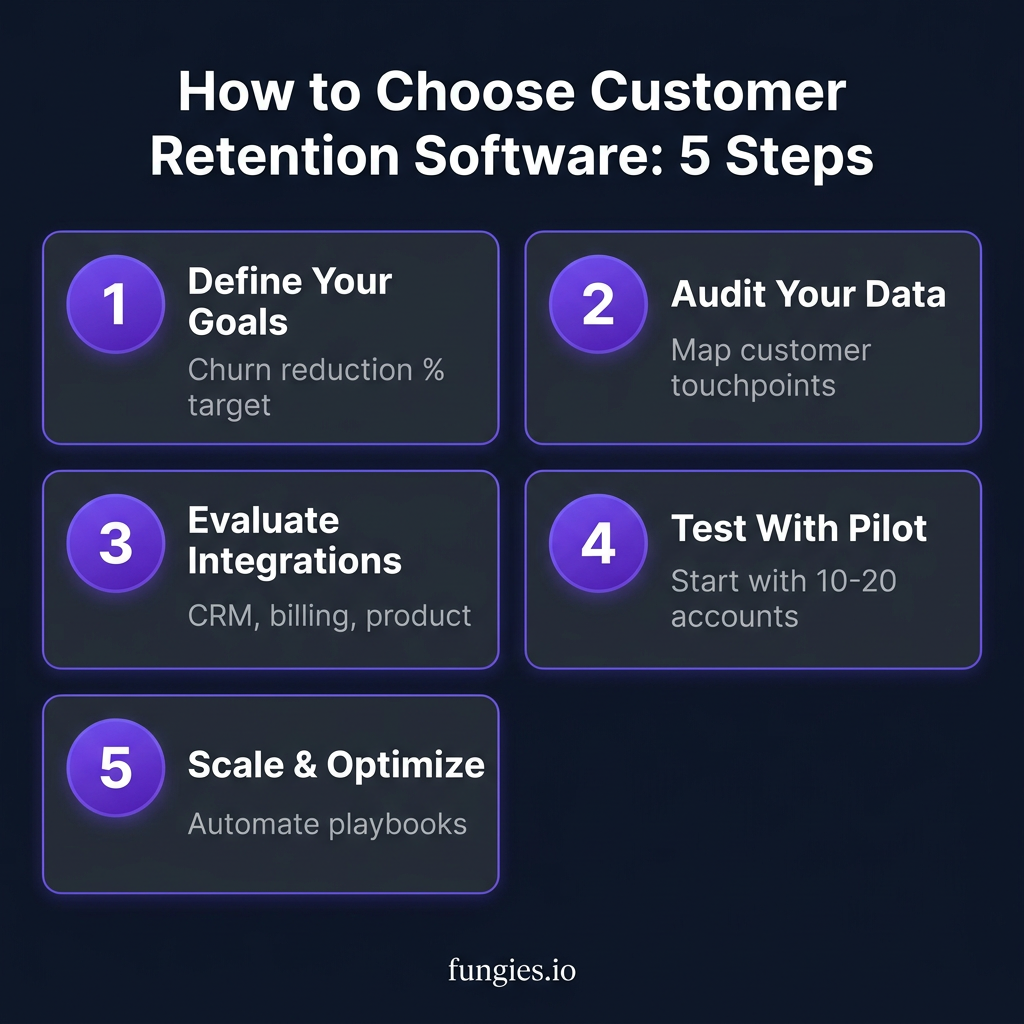
With so many options, how do you pick the right tool? Here’s the framework I use when advising SaaS companies:
1. Define your primary retention challenge. Are you struggling with early-stage activation, mid-lifecycle engagement, or renewal time? Different tools excel at different stages. Userpilot is fantastic for onboarding, while ChurnZero shines at predicting renewal risk.
2. Audit your data infrastructure. Customer retention software is only as good as the data you feed it. Make sure your chosen tool integrates with your CRM, billing system, product analytics, and support platform. Gaps in data mean gaps in your customer understanding.
3. Consider your team size and maturity. Enterprise tools like Gainsight require dedicated administrators and CS teams to extract value. If you’re a 10-person startup, something like Vitally or Custify will be more appropriate.
4. Evaluate total cost of ownership. Look beyond the sticker price. Implementation costs, training time, integration work, and ongoing administration all factor into the real cost. A “cheap” tool that requires 40 hours of engineering time may be more expensive than a pricier alternative.
Key Customer Retention Metrics to Track
Whatever tool you choose, make sure it helps you track these essential metrics:
- Customer Retention Rate (CRR): The percentage of customers you keep over a period. Best-in-class SaaS hits 87%+.
- Net Revenue Retention (NRR): Revenue from existing customers including expansions and contractions. Top performers exceed 120%.
- Gross Revenue Retention (GRR): Revenue retention without expansions. 85%+ is considered good.
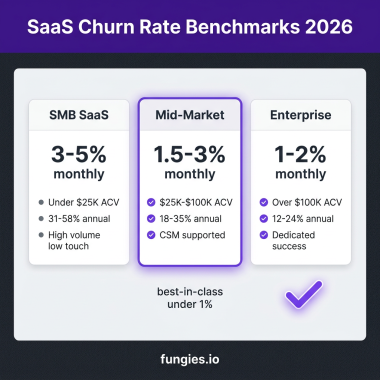
- Logo Churn: The percentage of customers who cancel. Keep this under 5% monthly for SMB, under 2% for enterprise.
- Time-to-Value (TTV): How quickly new users reach their first “aha moment.”
- Product Adoption Score: Measures depth of feature usage across your customer base.
FAQ: Customer Retention Software
What’s the difference between customer retention software and a CRM?
A CRM tracks your sales pipeline and customer relationships. Customer retention software focuses specifically on preventing churn and driving expansion revenue. While there’s overlap — both store customer data — retention tools include features like health scoring, product usage analytics, and automated playbooks that most CRMs lack. Think of retention software as a specialized layer on top of your CRM.
When should a SaaS company invest in customer retention software?
You should consider retention software when you have at least 50-100 paying customers and churn becomes a measurable problem. Before that, you can usually manage retention through personal relationships and manual outreach. Once you hit product-market fit and start scaling, the cost of churn compounds quickly — that’s when these tools become essential.
Can I use multiple retention tools together?
Absolutely. Many SaaS companies use a stack approach — ChartMogul for analytics, Userpilot for onboarding, and ChurnZero for ongoing health monitoring. The key is ensuring they integrate well and feed data to each other. Your retention software should create a unified view, not more silos.
How long does it take to see ROI from retention software?
Most companies see initial results within 90 days, but full ROI typically takes 6-12 months. The first wins usually come from identifying and saving at-risk accounts that would have otherwise churned. Longer-term benefits include improved expansion revenue and reduced CAC through better customer advocacy.
Is AI really necessary for customer retention?
AI isn’t mandatory, but it’s becoming increasingly valuable. The best AI features in retention software spot patterns humans miss — subtle behavioral changes that predict churn, optimal timing for outreach, and personalized recommendations for each customer. That said, start with solid fundamentals (good data, clear processes) before investing heavily in AI features.
Conclusion: Invest in Retention Before You Need It
Here’s the truth most SaaS founders learn too late: by the time churn becomes a crisis, the damage is already done. Customer retention software isn’t a luxury for mature companies — it’s an essential investment for any SaaS business that wants to scale sustainably.
The tools I’ve covered here represent the best options available in 2026, but the “right” choice depends on your specific situation. Start by understanding your retention challenges, audit your data infrastructure, and choose a tool that fits your team size and budget.
Remember: a 5% improvement in retention can drive 25-95% profit growth. That’s the kind of leverage that separates sustainable SaaS businesses from those that burn out chasing new customers to replace the ones they’ve lost.
Ready to build a SaaS business with world-class retention? Start by implementing the right billing infrastructure that supports your growth. Create your free Fungies account today and get the foundation you need to scale.