The digital creator economy has officially outgrown its “side hustle” origins. In 2026, this $313 billion global industry represents one of the fastest-growing economic sectors, reshaping how content is produced, consumed, and monetized across every corner of the internet. With over 207 million active creators worldwide and influencer marketing spend exceeding $32 billion this year alone, the creator economy has become a permanent fixture in global marketing strategies—not an experimental channel, but a primary revenue driver for brands and independent operators alike.
What started as a hobby for passionate individuals sharing videos, photos, and thoughts online has evolved into a sophisticated ecosystem where creators function as multi-platform media brands. The lines between traditional media and creator content have blurred beyond recognition. Today, a YouTuber with a niche audience can command more influence than a television network, and a Substack writer with 10,000 paid subscribers can out-earn many professional journalists.

Market Overview: The $313 Billion Ecosystem
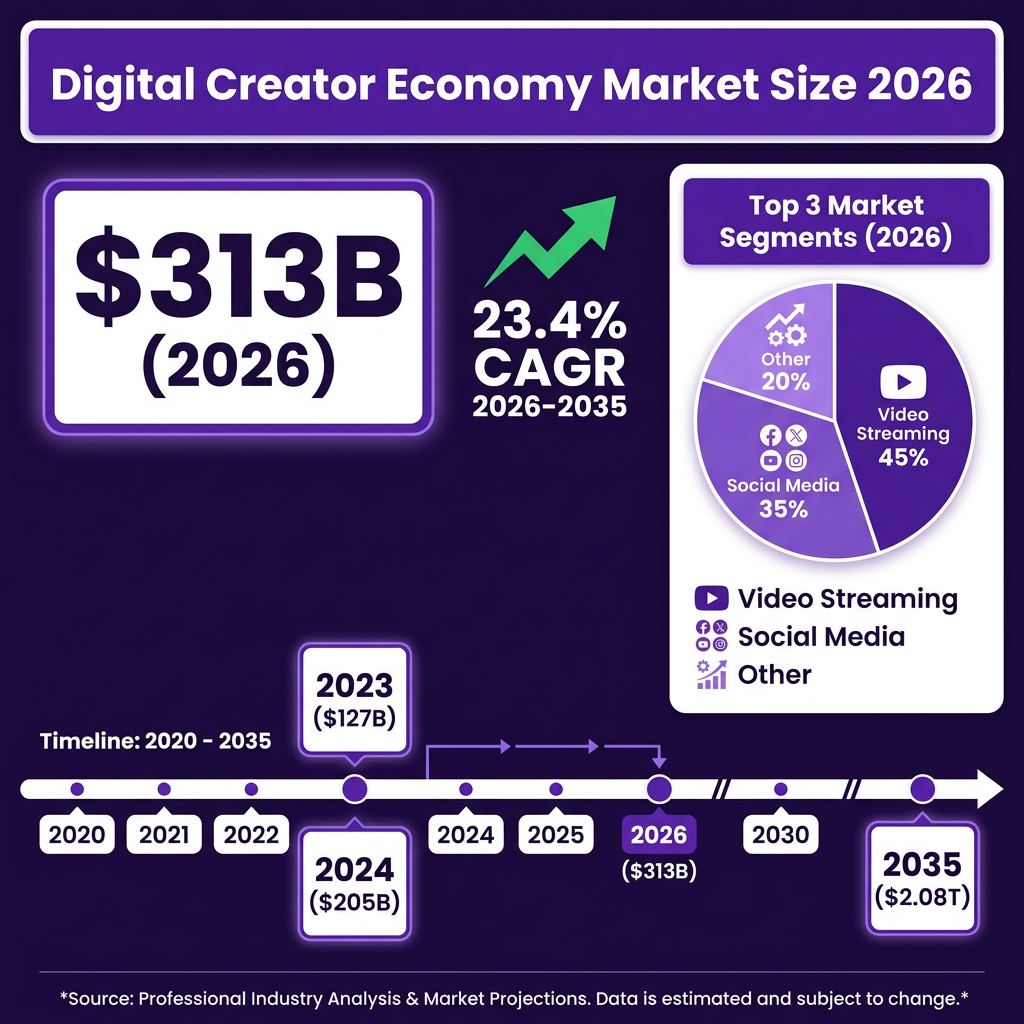
The creator economy’s growth trajectory is nothing short of extraordinary. According to multiple industry analyses, the global creator economy market size reached approximately $205 billion in 2024 and is projected to hit $313 billion by the end of 2026. This represents a compound annual growth rate (CAGR) of 22.4% to 23.4%, positioning the industry to potentially exceed $2 trillion by 2035.
Precedence Research provides one of the most comprehensive forecasts, estimating the market at $254.4 billion in 2025, growing to $313.95 billion in 2026, and ultimately reaching $2.08 trillion by 2035. Research Nester offers similarly bullish projections, valuing the market at $178.4 billion in 2025 with expectations to exceed $1.35 trillion by 2035 at a 22.4% CAGR. Meanwhile, Goldman Sachs has estimated the creator economy at roughly $250 billion in 2024, projecting it could approach half a trillion dollars by 2027.
The U.S. market alone was valued at $50.9 billion in 2024, with projections pointing to $297.3 billion by 2034 at a 19.3% CAGR. North America currently holds the largest regional share of the global creator economy at approximately 38.9%, but Asia-Pacific is emerging as the fastest-growing region, driven by massive mobile-first populations and the explosive growth of short-form video platforms.
What’s fueling this growth? Several converging factors: the widespread penetration of smartphones and high-speed internet, the emergence of user-friendly content creation platforms, shifting consumer preferences toward authentic, personality-driven content, and the professionalization of creator tools and monetization infrastructure. The pandemic accelerated these trends, but they’ve proven durable as the economy has normalized.
The creator economy isn’t just about individual success stories—it’s a fundamental restructuring of how media is produced and consumed. Traditional gatekeepers (publishers, record labels, television networks) are being replaced by algorithmic distribution systems that reward authenticity, consistency, and audience connection. This democratization has created opportunities for voices that would never have found platforms in the old media landscape.
Key Statistics and Data: The Numbers Behind the Movement
Understanding the creator economy requires diving deep into the data that defines this industry. Here are the most significant statistics for 2026, compiled from leading research firms and industry reports:
Market Size and Growth
- The global creator economy is valued at $313 billion in 2026, up from $254 billion in 2025
- Projected to reach $480-528 billion by 2030 at a 22.5% CAGR
- Could approach $2 trillion by 2035 according to bullish forecasts
- The industry has more than tripled since 2020
- Between 2023 and 2030, predicted to grow from $127.65 billion to $528.39 billion
Creator Population
- Over 207 million active creators worldwide
- Approximately 1 in 40 people globally identify as creators
- 55% of creators are now full-time business owners
- The average creator takes 6.5 months to earn their first dollar
- Only 54% of creators offered paid memberships in 2025
- 41% relied on recurring subscriptions as a revenue source
Platform and Engagement Metrics
- TikTok averaged 3.70% engagement rate in 2025, up 49% year-over-year
- Instagram engagement rate: 0.48% (significantly lower than TikTok)
- YouTube remains the highest-paying platform for creators
- Substack has over 35 million monthly active subscribers
- More than 5 million paid subscriptions on Substack
- 17,000+ active paid writers on Substack
Revenue and Monetization
- Average content creator income in 2026: $61,980 per year
- Influencer marketing industry: $32.55 billion in 2025, projected $34-40 billion in 2026
- Brands earn an average of $5.78 for every $1 invested in influencer marketing
- Top-performing campaigns reach $11-18 ROI per dollar spent
- Subscription and membership platforms market: $5.67 billion in 2026, projected $18.94 billion by 2036
- 80% of influencer marketing spend now flows to micro and nano-creators
AI and Technology Adoption
- 84% of creators report using generative AI tools in their workflows
- 66.4% of marketers report improved campaign results through AI implementation
- 60.2% actively use AI for influencer identification and optimization
- 36.67% of brands use AI for creator discovery
- 27% of creators rely on six or more tools to manage their business
Consumer Behavior
- 71% of consumers trust creator content over traditional advertising
- 69% of creators prioritize member transformation as their primary growth driver
- 78% of creators report burnout impacting their motivation and health
- Consumer enthusiasm for AI-generated creator content declined to 26% (from 60%)
- 87.49% of brands expect to increase influencer marketing budgets in 2026
- 72.22% of brands plan budget increases of 50% or more
Major Trends Shaping the Digital Creator Economy in 2026
The creator economy is evolving rapidly, with several key trends defining the landscape in 2026. Understanding these trends is essential for creators looking to build sustainable businesses and for brands seeking to leverage creator partnerships effectively.
1. AI-Powered Content Creation Goes Mainstream
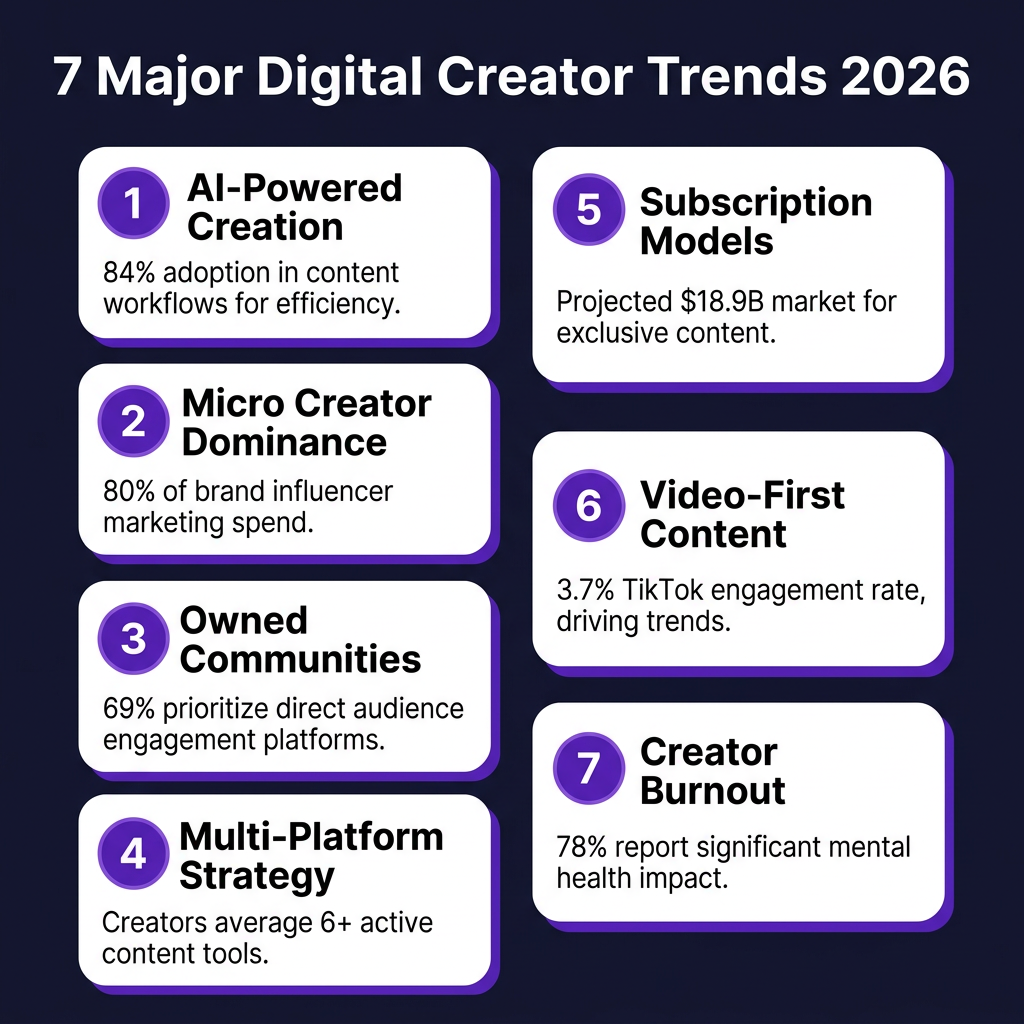
Artificial intelligence has transitioned from experimental tool to essential infrastructure for creators. With 84% of creators now using generative AI in their workflows, the technology is reshaping every aspect of content production—from ideation and scripting to editing, captioning, and repurposing. AI tools like CapCut, OpusClip, and various generative platforms enable creators to produce more content in less time, test multiple variations, and optimize for different platforms simultaneously.
However, this trend comes with caveats. Consumer enthusiasm for AI-generated creator content has actually declined from 60% to 26%, suggesting audiences value authentic human connection over algorithmic efficiency. The most successful creators in 2026 are those who use AI to handle repetitive tasks while preserving their unique voice and perspective in the final output. AI is the co-pilot, not the pilot.
2. The Rise of Micro and Nano Creators
The era of mega-influencers dominating brand partnerships is giving way to a more distributed model. Micro creators (10,000-100,000 followers) and nano creators (1,000-10,000 followers) now command 80% of influencer marketing spend. Why? Because smaller creators typically deliver higher engagement rates, more authentic audience relationships, and better ROI for brands.
A creator with 50,000 highly engaged followers in a specific niche often outperforms a generalist with 5 million passive followers. Brands have recognized that reach without relevance is expensive vanity. The shift toward micro and nano creators also democratizes opportunity—more people can build viable creator businesses without needing celebrity-level fame.
3. Owned Communities Over Rented Platforms
Perhaps the most significant strategic shift in 2026 is creators prioritizing platforms they control over those they merely occupy. With algorithm changes constantly threatening reach on social platforms, savvy creators are building email lists, paid communities, and proprietary platforms where they own the relationship with their audience.
Survey data shows that 69% of creators now prioritize “member transformation”—helping their audience achieve specific outcomes—as their primary driver of retention and growth. This represents a move away from transactional content models (views for ad revenue) toward sustained, member-first businesses where creators are accountable for delivering real value. Platforms like Circle, Substack, Patreon, and Beehiiv are thriving because they enable this owned-community model.
4. Multi-Platform Strategy Becomes Essential
The average creator now uses six or more tools to manage their business. This isn’t inefficiency—it’s necessity. Platform diversification protects creators from algorithm changes, policy shifts, or outright bans on any single platform. The most successful creators in 2026 maintain presence across YouTube (long-form), TikTok (short-form discovery), Instagram (community), and owned channels (newsletters, communities, websites).
Each platform serves a different function in the creator’s ecosystem: TikTok for viral discovery, YouTube for deep engagement and ad revenue, Instagram for brand partnerships, and owned platforms for monetization. Creators who try to build entirely on “rented” platforms are finding their businesses increasingly fragile.
5. Subscription and Membership Models Mature
The subscription and membership platform market is projected to grow from $5.67 billion in 2026 to $18.94 billion by 2036 at a 12.8% CAGR. This growth reflects creators’ increasing sophistication in monetization. Rather than relying solely on unpredictable brand deals or platform ad revenue, creators are building predictable recurring revenue through paid newsletters, exclusive communities, and tiered membership programs.
Substack’s success—with over 35 million monthly active subscribers and more than 5 million paid subscriptions—demonstrates that audiences will pay directly for valuable content. Patreon continues to thrive for video and audio creators. The lesson is clear: the most sustainable creator businesses have diversified revenue streams, with subscriptions providing the foundation.
6. Video-First Content Dominance
Video remains the most engaging content format, with TikTok’s 3.70% engagement rate dramatically outpacing other formats. YouTube continues to be the highest-paying platform for creators, with multiple revenue streams including ads, memberships, Super Chats, and YouTube Premium. The platform’s revenue share model rewards consistent watch time and provides creators with several ways to earn simultaneously.
Short-form video (TikTok, YouTube Shorts, Instagram Reels) serves as the top-of-funnel discovery mechanism, while long-form video (YouTube, podcasts) builds deeper audience relationships and generates higher revenue per view. The creators winning in 2026 have mastered both formats, using short-form to attract new audiences and long-form to monetize them.
7. Creator Burnout and Mental Health Crisis
The dark side of the creator economy is impossible to ignore: 78% of creators report burnout impacting their motivation and mental health. The pressure to constantly produce content, chase algorithms, and maintain public visibility takes a severe toll. The average creator spends less than 10 hours per week on content production because they need other income sources to survive.
This trend is fueling demand for creator-specific support services, mental health resources, and more sustainable workflows. The industry is beginning to recognize that creator longevity requires systems that don’t depend on constant personal output. Automation, team building, and content repurposing are becoming essential strategies for avoiding burnout.
Key Players and Competitive Landscape
The creator economy ecosystem comprises multiple categories of players, each serving different functions in the value chain. Understanding this landscape is crucial for both creators choosing their platforms and investors evaluating opportunities.
Content Platforms
YouTube remains the dominant long-form video platform and the highest-paying for creators. Its Partner Program, revenue share model, and multiple monetization options (ads, memberships, Super Chats, Premium) make it the foundation of many creator businesses. YouTube’s algorithm rewards watch time and consistency, favoring creators who can produce engaging long-form content regularly.
TikTok has revolutionized content discovery with its algorithmic feed that can make unknown creators viral overnight. While its Creator Fund payouts have been criticized as insufficient, TikTok excels as a top-of-funnel discovery platform. Its 3.70% engagement rate is unmatched, making it essential for reaching new audiences.
Instagram has evolved from photo-sharing to a comprehensive creator platform with Reels, Stories, and shopping features. While its 0.48% engagement rate lags behind TikTok, Instagram remains crucial for brand partnerships and lifestyle content. The platform’s shopping integrations make it particularly valuable for product-focused creators.
Substack has become the dominant platform for written content monetization. With over 35 million monthly active subscribers and 5 million paid subscriptions, it has proven that audiences will pay for quality writing. Substack’s simplicity—write, publish, get paid—has attracted journalists, analysts, and thought leaders.
Patreon pioneered the membership model for creators and remains the leading platform for video, audio, and art creators seeking recurring revenue. Its tiered subscription system allows creators to offer different levels of access and rewards.
Creator Tools and Infrastructure
CapCut, developed by ByteDance, has become the dominant AI-powered editing platform for short-form video. Its integration with TikTok and powerful editing features make it essential for creators producing high volumes of short-form content.
Beehiiv is emerging as a leading newsletter platform, offering creators sophisticated analytics, monetization options, and growth tools. Its focus on creator success has made it a serious competitor to Substack.
Stan Store and Fourthwall are building the next generation of creator commerce platforms, enabling creators to sell products, courses, and services directly to their audiences without complex technical setup.
Spotter provides capital to creators in exchange for future revenue, allowing them to invest in production quality and business growth. This model of creator financing is becoming more common as the industry matures.
Brand-Creator Marketplaces
ShopMy connects creators with brands for affiliate partnerships, enabling creators to earn commissions on products they recommend. The platform has become particularly popular among lifestyle and fashion creators.
The Influencer Marketing Factory and similar agencies help brands navigate the creator economy with data-driven creator discovery, campaign management, and performance analytics. As the industry matures, these intermediaries are becoming more sophisticated, using AI to match brands with optimal creator partners.

Challenges and Pain Points
Despite its growth and promise, the creator economy faces significant challenges that threaten its sustainability and accessibility. Understanding these pain points is essential for anyone entering this space.
1. Platform Dependency and Algorithm Volatility
The most significant risk facing creators is their dependence on platforms they don’t control. Algorithm changes can decimate reach overnight. Policy updates can demonetize content without warning. Account bans—sometimes erroneous—can destroy years of work in moments. The creators who survive long-term are those who diversify across platforms and build owned audiences through email lists and communities.
Recent data shows that engagement rates are declining across platforms as competition intensifies. For the first time in nearly a decade, social users are spending less time on social apps. This saturation means creators must work harder for the same results, increasing pressure and burnout.
2. Income Inequality and Sustainability
The creator economy follows a power law distribution: a small percentage of creators earn the vast majority of revenue. While the average creator income is $61,980, this number masks enormous variation. Many creators earn little to nothing, while top performers earn millions. The average creator takes 6.5 months to earn their first dollar, and most spend less than 10 hours per week on content creation because they need other income sources to survive.
This inequality raises questions about whether the creator economy can truly support the 207 million people who identify as creators. The reality is that most creator activity remains hobby-level, and only a fraction generates sustainable full-time income.
3. Creator Burnout and Mental Health
The 78% burnout rate among creators is a crisis that threatens the industry’s long-term viability. The pressure to constantly produce content, maintain public visibility, and chase algorithmic favor creates unsustainable working conditions. Unlike traditional employment, there’s no paid time off, no separation between work and personal life, and no guarantee that today’s success will continue tomorrow.
The solo nature of creator work also contributes to isolation. While typically the creator economy is a solo entrepreneur role where it’s very self-isolating, creators need peer interaction, collaboration, and community to sustain their work over time.
4. Brand-Creator Alignment Issues
Research shows that only 27% of creator content is strongly tied to the brands they promote. This misalignment damages credibility and effectiveness. Creators often feel pressure to accept brand deals that don’t align with their values or audience interests simply to pay bills. Brands, meanwhile, struggle to measure ROI and often default to vanity metrics like follower count rather than meaningful engagement or conversion.
The industry is maturing beyond this transactional phase, with more sophisticated measurement tools and longer-term partnerships replacing one-off sponsored posts. But alignment remains a significant challenge.
Opportunities and Growth Strategies
Despite these challenges, the creator economy offers enormous opportunities for those who approach it strategically. Here are the key growth strategies for 2026 and beyond:
1. Build Owned Assets First
The most successful creators prioritize platforms they control. An email list is the most valuable asset a creator can build—it’s algorithm-proof, portable, and directly monetizable. Paid communities on platforms like Circle or Skool create recurring revenue and deeper audience relationships. Before investing heavily in social media growth, creators should establish their owned infrastructure.
2. Embrace AI as a Multiplier, Not a Replacement
With 84% of creators already using AI tools, the question isn’t whether to adopt AI but how to use it effectively. The winning strategy is using AI for repetitive tasks—editing, captioning, repurposing, analytics—while preserving human creativity for the work that matters. Creators who can produce 10x the content without losing their unique voice will dominate those who resist automation.
3. Specialize Deeply
The era of generalist creators is ending. The most successful creators in 2026 have deep expertise in specific niches—personal finance, fitness for busy professionals, vintage watch collecting, sustainable gardening. Specialization enables higher pricing for brand partnerships, stronger audience loyalty, and more effective monetization through courses, consulting, and products.
4. Diversify Revenue Streams
Creators relying on a single revenue source are vulnerable. The most resilient creator businesses combine multiple streams: platform ad revenue, brand partnerships, affiliate marketing, paid subscriptions, digital products, courses, consulting, and merchandise. When one stream underperforms, others provide stability.
5. Focus on Transformation, Not Just Content
The 69% of creators who prioritize member transformation are building more sustainable businesses than those focused purely on entertainment. When creators help their audiences achieve specific outcomes—learning a skill, improving their health, growing their business—the relationship becomes more valuable and durable. Transformation justifies premium pricing and creates advocates who drive organic growth.
Case Studies and Success Stories
Examining successful creators reveals patterns that aspiring creators can emulate. While specific names and detailed financials are often private, the strategies are visible and replicable.
Case Study 1: The Newsletter Entrepreneur
A former journalist launched a Substack newsletter focused on technology and policy analysis. Starting with zero subscribers in 2022, they grew to over 100,000 free subscribers and 15,000 paid subscribers by 2026. At $10/month average subscription price, this generates approximately $1.8 million in annual recurring revenue.
Key success factors: Deep expertise in a valuable niche, consistent daily publishing, exclusive paid content that justifies the subscription, and leveraging Twitter/X for discovery while driving subscribers to the owned newsletter platform. The creator resisted the temptation to diversify into video, instead doubling down on written analysis where they had comparative advantage.
Case Study 2: The Multi-Platform Educator
A personal finance creator built a business across YouTube, TikTok, and a proprietary course platform. YouTube long-form videos (20-30 minutes) generate $50,000+ monthly in ad revenue and drive course sales. TikTok shorts provide discovery, with some videos reaching 10 million+ views. The creator’s flagship course on investing has generated over $5 million in sales.
Key success factors: Each platform serves a specific function—TikTok for discovery, YouTube for depth and ad revenue, owned platform for high-ticket monetization. The creator invested early in production quality, hiring editors and researchers to maintain output without burning out. Transformation-focused content (helping viewers actually improve their finances) justifies premium pricing.
Case Study 3: The Community-First Creator
A fitness creator built a paid community on Circle with over 5,000 members paying $30/month—generating $1.8 million in annual recurring revenue. Rather than competing for attention on social platforms, the creator focused on delivering transformation: members who followed the program achieved measurable fitness results.
Key success factors: The creator used social platforms only for discovery, immediately funneling interested audiences into the paid community. Inside the community, the focus was on member success and peer connection rather than the creator’s personal brand. High retention rates (85% annual) demonstrated the value delivered. The creator built a team to handle community management, avoiding the burnout that plagues solo operators.
Future Outlook and Predictions
The creator economy’s trajectory points toward continued growth and professionalization. Here are the key predictions for 2026-2030:
Market Size Projections
The creator economy is projected to reach $480-528 billion by 2030, with some forecasts suggesting it could approach $600 billion or even $2 trillion by 2035 depending on how broadly the category is defined. The 22-23% CAGR suggests the industry will more than double in the next five years. North America will remain the largest market, but Asia-Pacific will see the fastest growth as mobile-first populations come online.
Industry Maturation and Consolidation
2026 marks the beginning of what Forbes calls “the era of consolidation” in the creator economy. Independent creators, boutique managers, influencer agencies, and software vendors that grew in parallel are now converging. Creator and influencer marketing represent permanent line items in global marketing budgets, not experimental channels.
Leading creators now function like multi-platform media brands, with teams handling production, business development, and operations. The companies best positioned combine talent management, brand services, and technology within unified structures. AI is moving from a feature to an operating layer across the industry.
Platform Evolution
Platforms are in their “copycat era,” with each major player adopting features from competitors. YouTube has Shorts to compete with TikTok. TikTok is expanding longer content. Instagram continues iterating on Reels. This convergence means creators need fewer platform-specific strategies and can focus on content quality that translates across platforms.
At the same time, new platforms will emerge targeting specific creator niches or offering better monetization terms. The history of the creator economy suggests that platform dominance is never permanent—new entrants can disrupt established players by offering creators better economics or tools.
Creator Professionalization
The stereotype of the creator as a teenager in their bedroom is outdated. Today’s successful creators are sophisticated business operators with teams, financial advisors, and legal representation. The industry is developing professional standards, educational programs, and career paths that treat creator work as legitimate employment rather than a hobby.
This professionalization will accelerate as the industry matures. We’ll see more creator unions or guilds advocating for fair treatment, standardized contracts, and platform accountability. The wild west phase is ending; the regulated industry phase is beginning.
Technology Integration
AI will continue transforming creator workflows, with 84% adoption likely reaching near-universal levels. But the more significant shift may be in how creators use AI not just for production but for personalization—delivering customized content experiences to different audience segments. The creators who master AI-assisted personalization while maintaining authentic
human connection will have significant advantages.
Regulatory Environment
As the creator economy grows, regulatory attention will increase. Issues like disclosure requirements for sponsored content, data privacy in creator-audience relationships, and platform accountability for algorithmic decisions will likely see increased legislation. Creators and platforms that proactively address these concerns will be better positioned than those that resist regulation.
Monetization Models: How Creators Actually Make Money
Understanding the creator economy requires examining the diverse monetization strategies that power this $313 billion industry. While platform ad revenue and brand partnerships dominate headlines, successful creators typically combine multiple revenue streams to build resilient businesses.
Platform Revenue Share Programs
YouTube’s Partner Program remains the gold standard for platform monetization, sharing 55% of ad revenue with creators. A single 10-minute video with 1 million views in a strong niche like personal finance can generate $2,000-$7,000 depending on location and engagement. YouTube Premium revenue, channel memberships, Super Chats during livestreams, and Content ID for music usage provide additional income layers. This stacked approach means creators can earn from the same video through multiple channels simultaneously.
TikTok’s monetization has evolved significantly, though it remains less lucrative per view than YouTube. The Creator Fund, Creator Marketplace for brand deals, LIVE gifts, and TikTok Shop commissions provide multiple paths to revenue. However, TikTok’s primary value remains discovery—its algorithm can make unknown creators viral overnight, building audiences that can be monetized elsewhere.
Instagram’s monetization tools include Reels Play bonuses, subscriptions, badges in Live, and shopping commissions. While individual payouts are typically lower than YouTube, Instagram’s shopping integrations make it particularly valuable for product-focused creators and lifestyle influencers.
Brand Partnerships and Sponsored Content
Brand partnerships represent the largest revenue source for many professional creators. With the influencer marketing industry reaching $32.55 billion in 2025 and projected to exceed $40 billion in 2026, brands are allocating significant budgets to creator collaborations. The shift toward micro and nano creators reflects a maturation in brand thinking—reach without relevance is expensive vanity.
Pricing for brand partnerships varies dramatically based on platform, audience size, engagement rates, and niche. A micro creator with 50,000 engaged followers in a valuable niche like finance or B2B software might command $2,000-$5,000 per sponsored post, while a generalist creator with 500,000 followers might struggle to command similar rates due to lower engagement and less targeted audiences.
Long-term brand ambassadorships are replacing one-off sponsored posts as the preferred partnership model. These arrangements provide creators with predictable income while giving brands deeper integration with creator audiences. The most successful partnerships feel authentic to the creator’s existing content rather than disruptive advertisements.
Subscription and Membership Revenue
Direct audience support through subscriptions has emerged as one of the most sustainable monetization models. Substack’s 35 million monthly active subscribers and 5 million paid subscriptions demonstrate that audiences will pay directly for valuable content. The average paid newsletter subscription ranges from $5-$15 monthly, with premium offerings commanding $30-$100 or more for specialized business or investment content.
Patreon enables creators to offer tiered memberships with different benefits at each level. A podcaster might offer early access at $5/month, bonus episodes at $10/month, and monthly Q&A calls at $25/month. This tiered approach maximizes revenue by capturing different willingness-to-pay levels within the audience.
Community platforms like Circle and Skool enable creators to build paid communities around shared interests or transformation goals. These communities command higher prices—typically $30-$100 monthly—because they offer ongoing value through peer connection, exclusive content, and direct creator access.
Digital Products and Courses
Digital products represent high-margin revenue for creators with expertise to share. Online courses, ebooks, templates, and tools can generate significant income with minimal ongoing effort after creation. A creator who sells a $500 course to just 1,000 customers generates $500,000 in revenue—often more than years of platform ad revenue.
The key to successful digital product monetization is alignment with the creator’s core content. A fitness creator selling workout programs, a finance creator selling investment courses, or a design creator selling templates all leverage existing audience trust and demonstrated expertise. Products that don’t align with the creator’s brand typically underperform.
Affiliate Marketing
Affiliate marketing enables creators to earn commissions on products they recommend. Platforms like ShopMy, LTK, and Amazon Associates provide infrastructure for tracking sales and managing relationships. Commission rates vary from 1-10% for physical products to 30-50% or more for digital products and software.
The most successful affiliate marketers focus on products they genuinely use and can authentically recommend. Audiences can detect inauthentic recommendations, and credibility is difficult to rebuild once lost. Transparency about affiliate relationships is both legally required and ethically essential for maintaining audience trust.
Regional Variations in the Creator Economy
While the creator economy is global, significant regional variations exist in market size, platform preferences, and monetization strategies. Understanding these differences is essential for creators targeting international audiences and brands planning global campaigns.
North America
North America remains the largest creator economy market, accounting for approximately 38.9% of global value. The U.S. market alone was valued at $50.9 billion in 2024, with projections pointing to $297.3 billion by 2034. YouTube, Instagram, and TikTok dominate the platform landscape, with Substack and Patreon leading in subscription monetization.
American creators benefit from mature advertising markets, high consumer spending power, and sophisticated brand partnership infrastructure. However, the market is also highly saturated, making discovery and growth more challenging than in emerging markets.
Asia-Pacific
Asia-Pacific is the fastest-growing region for the creator economy, driven by massive mobile-first populations and the explosive growth of short-form video. China’s creator economy operates largely on domestic platforms like Douyin (TikTok’s Chinese version), Xiaohongshu (Little Red Book), and Bilibili. India’s creator economy is expanding rapidly with platforms like ShareChat, Moj, and Josh competing with global players.
Southeast Asian markets show particular promise, with high social media penetration and growing digital payment infrastructure enabling monetization. The region’s diversity—spanning developed economies like Singapore and emerging markets like Indonesia and Vietnam—creates varied opportunities for creators with localized content.
Europe
Europe’s creator economy is characterized by strong regulatory frameworks, including GDPR privacy requirements and emerging platform regulations. The UK’s creator economy is the largest in Europe, followed by Germany and France. European creators often face lower CPMs (cost per thousand impressions) than their American counterparts due to smaller advertising markets and privacy regulations limiting targeting.
However, European audiences show strong willingness to pay for content, making subscription models particularly viable. The EU’s Digital Services Act and forthcoming AI regulations will likely shape how platforms operate and how creators monetize in the region.
Latin America and Middle East
Latin America’s creator economy is growing rapidly, with Brazil and Mexico leading the region. WhatsApp plays a unique role in Latin American creator-fan relationships, often serving as a direct communication channel that doesn’t exist in other regions. The Middle East, particularly the UAE and Saudi Arabia, has seen significant investment in creator infrastructure as part of broader economic diversification efforts.
The Role of AI in the Creator Economy
Artificial intelligence has become the defining technology of the 2026 creator economy, with 84% of creators reporting use of generative AI tools in their workflows. This adoption is transforming every aspect of content creation, from ideation to distribution.
Content Production
AI tools have dramatically reduced the time required for content production. CapCut’s AI-powered editing features enable creators to produce professional-quality short-form videos in minutes rather than hours. OpusClip and similar tools automatically repurpose long-form content into platform-optimized shorts. Generative AI assists with scripting, thumbnail creation, and caption writing.
For written content creators, AI assists with research, outlining, and editing while the creator focuses on unique insights and voice. This division of labor—AI handling repetitive tasks, humans providing creative direction—enables creators to produce more content without sacrificing quality.
Analytics and Optimization
AI-powered analytics tools help creators understand what content resonates with their audiences. Platforms like Spotter Studio analyze millions of videos to identify trending topics, optimal posting times, and successful content patterns. This data-driven approach replaces guesswork with evidence-based content strategy.
A/B testing tools enable creators to test multiple thumbnails, titles, and content variations to optimize performance. What would have required expensive market research is now available to individual creators through AI-powered platforms.
Brand-Creator Matching
AI is transforming how brands identify and partner with creators. With 60.2% of marketers using AI for influencer identification, algorithms now analyze audience demographics, engagement patterns, content themes, and historical performance to recommend optimal creator partnerships. This data-driven matching benefits both parties—brands find creators who genuinely align with their target audiences, and creators receive partnership opportunities suited to their content.
The Authenticity Challenge
Despite AI’s benefits, the technology creates challenges for creator authenticity. Consumer enthusiasm for AI-generated creator content declined from 60% to 26%, indicating audiences value human connection over algorithmic efficiency. Creators who rely too heavily on AI risk losing the authenticity that built their audiences.
The winning approach uses AI as a multiplier rather than a replacement—handling repetitive tasks while preserving human creativity for the work that matters. Creators must be transparent about AI usage where relevant and ensure their unique voice remains central to their content.
Key Takeaways
- The digital creator economy reached $313 billion in 2026 and is projected to exceed $500 billion by 2030
- 207 million active creators worldwide are reshaping how content is produced and consumed
- AI adoption has reached 84% among creators, transforming workflows while raising authenticity concerns
- Micro and nano creators now command 80% of influencer marketing spend, outperforming mega-influencers on ROI
- Owned communities and subscription models are replacing platform-dependent monetization strategies
- Creator burnout affects 78% of creators, threatening industry sustainability without systemic changes
- Brands earn an average of $5.78 for every $1 invested in influencer marketing
- The industry is entering an era of consolidation and professionalization
Sources and Citations
- Precedence Research – Creator Economy Market Size and Forecast 2026-2035: https://www.precedenceresearch.com/creator-economy-market
- Research Nester – Creator Economy Market Report: https://www.researchnester.com/reports/creator-economy-market/5691
- Goldman Sachs – The creator economy could approach half-a-trillion dollars by 2027: https://www.goldmansachs.com/insights/articles/the-creator-economy-could-approach-half-a-trillion-dollars-by-2027
- Yahoo Finance – Creator Economy Statistics 2026: https://finance.yahoo.com/news/creator-economy-statistics-2026-120-150000105.html
- Companies History – Creator Economy Statistics And Market Size 2026: https://www.companieshistory.com/creator-economy-market-size/
- Circle Blog – Creator Economy Statistics for 2026: https://circle.so/blog/creator-economy-statistics
- Forbes – The Creator Economy In 2026: The Era Of Consolidation: https://www.forbes.com/sites/jasondavis/2026/01/26/the-creator-economy-in-2026—the-era-of-consolidation/
- Stan Store – 8 Trends That Will Define the Creator Economy in 2026: https://stan.store/blog/creator-economy-trends-2026/
- Uscreen – Content Creator Income in 2026: https://www.uscreen.tv/blog/content-creator-income/
- Archive – Influencer Marketing Growth Statistics for 2026: https://archive.com/blog/influencer-marketing-growth-statistics
- Sup – Influencer Marketing Statistics 2026: https://www.sup.co/blog/influencer-marketing-statistics-2026-50-stats-you-need-to-know
- GI Research – Subscription & Membership Platforms Market Forecast: https://www.giiresearch.com/report/meti1936184-subscription-membership-platforms-content-creators.html
- Fueler – Substack Usage, Revenue, Valuation & Growth Statistics: https://fueler.io/blog/substack-usage-revenue-valuation-growth-statistics
- Automateed – Future of AI Tools for the Creator Economy in 2026: https://www.automateed.com/future-of-ai-tools-for-the-creator-economy
- NAB Show – What the Creator Economy is Starting to Look Like in 2026: https://www.nabshow.com/article/what-the-creator-economy-is-starting-to-look-like-in-2026/