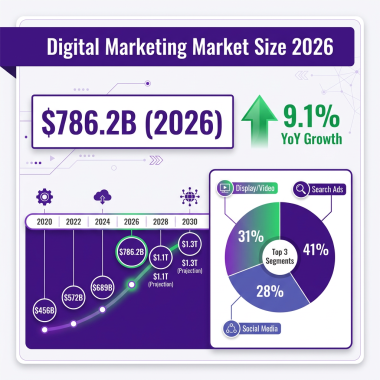
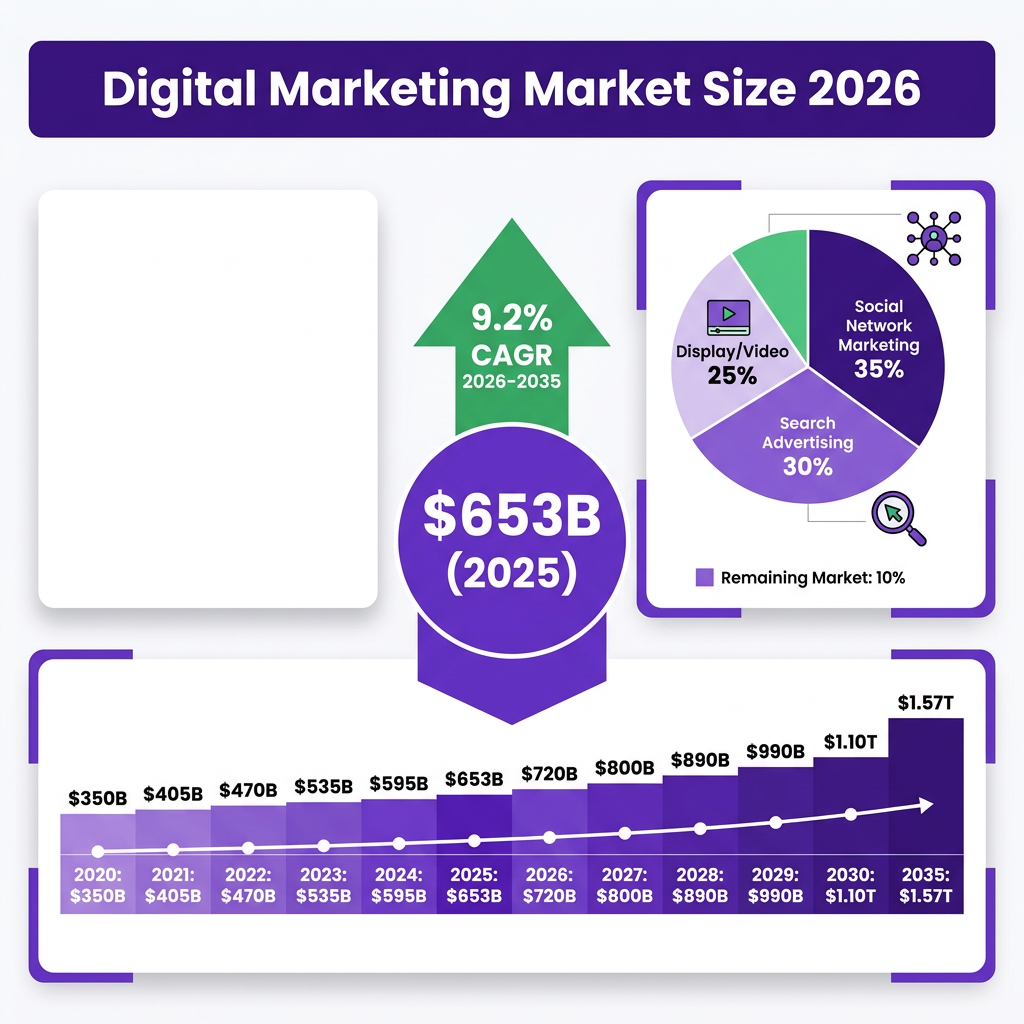
The digital marketing landscape is undergoing its most significant transformation in decades. With the global digital marketing market valued at $653.65 billion in 2025 and projected to reach $1.57 trillion by 2035 at a compound annual growth rate (CAGR) of 9.2%, businesses are navigating a complex ecosystem where artificial intelligence, privacy regulations, and shifting consumer behaviors are rewriting the rules of engagement. This comprehensive analysis examines the data, trends, and strategies defining digital marketing in 2026.
Whether you’re a marketing leader allocating budgets, a startup founder building your first acquisition strategy, or an agency professional advising clients, understanding these shifts isn’t optional—it’s survival. The marketers who thrive in 2026 won’t be those with the biggest budgets, but those who best understand how to deploy resources in an environment where algorithms change overnight, attribution grows murkier, and consumer trust has become the scarcest resource.
This comprehensive guide brings together the latest market data, emerging trends, and strategic insights from industry leaders to give you a complete picture of where digital marketing stands today and where it’s headed. From the $653 billion global market size to the specific tactics driving ROI across channels, we’ve analyzed hundreds of data points to identify what actually matters for your marketing strategy in 2026 and beyond.
Market Overview: The $653 Billion Digital Marketing Ecosystem
The digital marketing industry has evolved from a collection of experimental channels into a mature, data-driven ecosystem that commands significant portions of global advertising spend. Understanding this market’s scale, structure, and growth trajectory is essential for strategic planning in 2026.
Global Market Size and Growth Projections
The global digital marketing market reached $653.65 billion in 2025, establishing itself as one of the largest sectors in the technology and advertising industries. According to Expert Market Research, this market is projected to expand at a CAGR of 9.2% through 2035, ultimately reaching $1.57 trillion. This growth trajectory reflects the continued shift of advertising budgets from traditional media to digital channels, driven by superior targeting capabilities, measurable ROI, and the proliferation of internet-connected devices.
Grand View Research offers an even more aggressive projection, forecasting the global digital advertising market to reach $1.16 trillion by 2030 with a CAGR of 15.4%. This higher growth rate reflects the accelerating adoption of AI-powered marketing tools, programmatic advertising platforms, and the expansion of digital commerce into previously underserved markets. The discrepancy between these projections highlights the uncertainty inherent in forecasting a rapidly evolving industry, but both analyses agree on the fundamental direction: substantial, sustained growth.
Breaking down the market by channel reveals important structural insights. Search advertising currently accounts for 40.9% of the global digital advertising market, making it the largest single channel despite slower growth compared to display advertising. Digital display is expanding at a 15.5% CAGR, outpacing search’s 12.2% growth rate. This dynamic reflects the increasing sophistication of programmatic display networks, the rise of connected TV advertising, and the effectiveness of visual formats in capturing consumer attention.
Regional Market Dynamics
North America remains the largest regional market for digital marketing, driven by the United States’ position as home to the dominant global platforms including Google, Meta, and Amazon. The region benefits from advanced programmatic infrastructure, sophisticated agency and martech ecosystems, and high digital advertising penetration across all major verticals. North American and European companies allocated 7.7% of their total revenue to marketing in 2025, according to Gartner’s annual CMO survey.
However, the most significant growth opportunities lie in Asia-Pacific, which is expected to record a CAGR of approximately 12% over the forecast period. This explosive growth is driven by mobile internet adoption in India and Southeast Asia, rapidly expanding e-commerce and digital payments ecosystems, and the rise of short-form video platforms such as TikTok and regional equivalents. For businesses seeking international expansion, Asia-Pacific represents the highest-potential market for digital marketing investment.
Budget Allocation and Investment Trends
Understanding how marketing budgets are allocated provides crucial context for strategic planning. More than 50% of company marketing budgets are directed toward paid media and technology investments, with paid media capturing 25.6% and marketing technology taking 25.4%. The remaining portions go to labor (24.6%) and agencies (23.3%). This distribution reflects the increasing automation of marketing operations and the premium placed on data-driven advertising platforms.
Budget confidence remains high entering 2026. Over 75% of marketers expect to maintain or increase budgets for search and display advertising, while 60% of small businesses plan to raise marketing budgets, focusing particularly on content marketing and digital advertising. Planned budget increases vary by channel: content marketing leads with 45% of marketers planning increases, digital advertising follows at 43%, branding at 41%, and sponsorships with strategic partnerships at 35%.
Key Statistics and Data: 30+ Numbers That Define Digital Marketing in 2026
Data-driven decision making requires reliable benchmarks. The following statistics, compiled from industry research published in 2024 and 2025, provide the quantitative foundation for strategic planning across channels, tactics, and investments.
Global Digital Marketing Statistics
- The global digital advertising market is forecasted to reach $843 billion in 2025, growing at 14% annually to peak at $1.426 trillion by 2029.
- Digital advertising spending will surpass the $800 billion mark by 2027.
- The video advertising market will be worth approximately $207.5 billion in 2025, with companies investing $34.36 per internet user.
- Mobile advertising will account for 70% of total ad spending by 2028.
- Marketing job openings are forecast to increase by 10% in 2026, faster than the general labor market.
- Digital marketing is identified as the fastest-growing job skill, with a projected 6% increase in roles by 2032.
Search and SEO Statistics
- Search remains the largest digital channel, accounting for 40.9% of the global digital advertising market.
- The average first result on Google generates 39.8% of all clicks; featured snippets increase CTR to 42.9%.
- Zero-click searches have risen to 26% of all search sessions.
- When AI summaries appear in search results, CTR drops from 15% to 8%.
- Over 92% of digital marketers already optimize for both classic and AI-driven search.
- Mobile holds 54.23% of global traffic.
- 15% of local searches start in Maps, and reviews influence 67% of post-search actions.
Social Media Marketing Statistics
- Global social media users surpassed 5.2 billion in 2026, representing over 64% of the world’s population.
- The average user spends 2 hours and 28 minutes daily on social platforms.
- 93% of internet users actively access at least one social media platform each month.
- Mobile devices account for more than 80% of all social media access worldwide.
- Facebook remains the largest platform with 3.1 billion monthly active users.
- TikTok has exceeded 1.6 billion monthly active users, with average daily usage of 55 minutes.
- Instagram reached 2.3 billion monthly active users, up nearly 8% from 2024.
- LinkedIn crossed 1 billion members globally, with 60% being decision-makers or senior-level professionals.
- YouTube attracts 2.9 billion monthly active users, with 1 billion hours of video watched daily.
- 72% of consumers report social media as their primary source of brand discovery.
- Global ad spend on social media is projected to hit $219 billion in 2026.
Email Marketing Statistics
- There are approximately 4.6 billion email users worldwide as of 2025, projected to reach 4.89 billion by 2027.
- An estimated 376 billion emails are sent and received every day in 2025.
- Email marketing generates an average return of $36 to $42 for every dollar spent—a 3,600% to 4,200% ROI.
- Retail, ecommerce, and consumer goods companies report an average email ROI of $45 per dollar spent.
- The average open rate across all industries is around 42-43% in 2025 (note: inflated by Apple Mail Privacy Protection).
- Click-to-open rate (CTOR) sits around 6.8%, up 21% year-over-year.
- Average click-through rate (CTR) across all industries is 2-3.5%.
- Email click-to-conversion rates grew by roughly 28% in 2024.
- Segmented email campaigns generate 30% more opens and 50% more click-throughs.
- 78% of marketers say segmentation is their most effective tactic.
- Average email deliverability is around 83%, meaning 17% never reach the inbox.
Content Marketing Statistics
- 84% of B2B marketers successfully created brand awareness through content marketing.
- Blogs are used by 76% of marketers to distribute content.
- Video content accounts for over 60% of total social media consumption.
- Short-form video views grew by 36% year-over-year.
- YouTube Shorts generates more than 70 billion daily views worldwide.
- User-generated content influences 79% of purchase decisions.
- Over 55% of global consumers discover new products through social video.
- Posts with images generate 2.3 times more engagement than text-only updates.
AI and Marketing Automation Statistics
- The global AI marketing market is projected to reach $82.23 billion by 2030.
- AI solutions account for 28% of the average marketing tech budget in 2025.
- 71% of chief marketing officers (CMOs) plan to invest at least $10 million annually in AI between 2025 and 2027.
- AI spending in marketing is expected to grow at a CAGR of 25% between 2025 and 2030.
- 65% of CMOs believe advances in AI will dramatically transform their role in the near term.
- 82% of business leaders say their company identity will need to change significantly to keep pace with AI’s impact.
- 70% of enterprise marketers are actively implementing or planning to implement generative AI tools.
- 50% of companies are expected to deploy some form of AI agent by 2027.
- 71% of marketing leaders say their organizations regularly use GenAI in at least one business function in 2025.
- Generative AI powers operational improvements for 51% of businesses.
Major Trends Shaping Digital Marketing in 2026
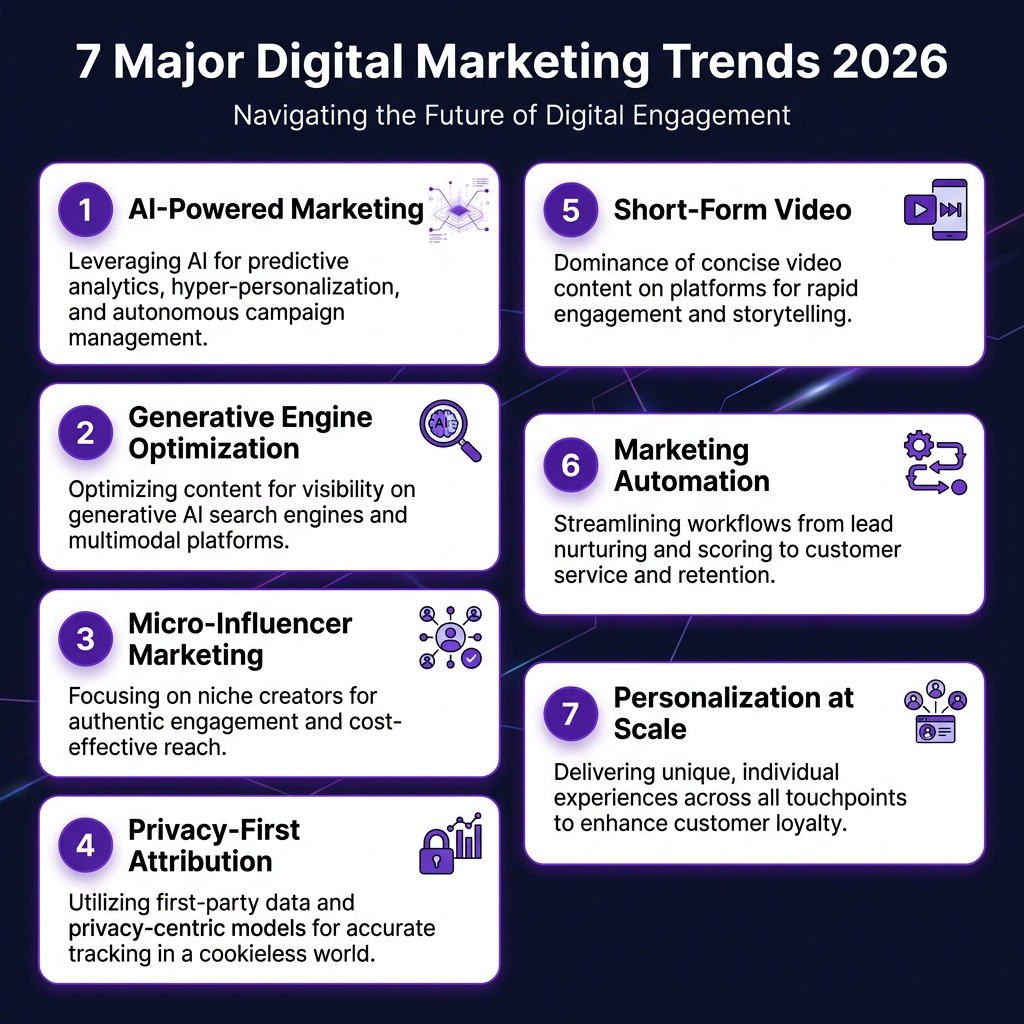
The digital marketing landscape is being reshaped by seven major trends that will define strategy, tactics, and investment priorities throughout 2026 and beyond. Understanding these trends is essential for staying competitive in an environment where yesterday’s best practices may become tomorrow’s liabilities.
1. AI-Powered Marketing Becomes Core Infrastructure
Artificial intelligence has transitioned from experimental tool to core marketing infrastructure. With AI solutions now accounting for 28% of the average marketing tech budget and 71% of CMOs planning to invest at least $10 million annually in AI through 2027, the question is no longer whether to adopt AI, but how deeply to integrate it.
The applications are expanding rapidly. Predictive AI analyzes data to forecast behavior, identifying which customers are most likely to convert or churn. Generative AI learns from existing data to create new content, drafting product descriptions, ad copy, and email subject lines at scale. Agentic AI performs complex tasks autonomously, pulling performance data, adjusting campaigns, and triggering workflows across connected tools.
However, the data reveals a critical nuance: fewer than 5% of marketing leaders who use GenAI only as a standalone tool report significant business gains. The value comes from strategic integration, not isolated experimentation. As Gartner’s research shows, 65% of CMOs believe AI advances will dramatically transform their role—suggesting that marketers who fail to adapt their skills and workflows risk obsolescence.
2. Generative Engine Optimization (GEO) Redefines Visibility
Traditional SEO focused on ranking in search results. Generative Engine Optimization (GEO) is about being cited and recalled by AI systems as credible sources. This shift is critical because AI-referred users behave differently—they show lower page depth and higher bounce rates, even though they spend slightly more time per visit.
The impact on search behavior is significant. When AI summaries appear in search results, CTR drops from 15% to 8%. Zero-click sessions have risen to 26% of all searches. For marketers, this means website traffic metrics are becoming incomplete proxies when AI provides answers without generating clicks.
Success in the GEO era requires three things: establishing subject matter expertise that AI systems recognize as authoritative, building relationships with journalists whose content feeds AI training data, and proactively seeding brand narratives where AI systems look for information. The brands that master GEO will be those cited by AI assistants when consumers ask questions—regardless of whether those consumers ever visit the brand’s website.
3. Micro-Influencers Displace Celebrity Endorsements
Nearly three-quarters of agencies believe micro-influencers will outperform celebrities in 2026. The reason is straightforward: audiences value authentic expertise and community connection over fame. Micro-influencers participate in private forums and dark social spaces where genuine conversations happen, making their recommendations more credible.
This shift has budget implications. While 35% of marketers plan to raise influencer marketing spend and 42% expect to maintain current levels, the allocation within influencer marketing is changing. Investment is moving from high-cost celebrity partnerships to networks of micro-influencers who deliver higher engagement rates and more authentic connections with niche audiences.
The strategic response requires long-term creative partnerships, not transactional campaigns. Brands that treat influencers as media channels to be rented will underperform those that build genuine relationships and co-create content over time. Nearly half of all millennials believe influencer recommendations more than regular ads when buying a product—this trust advantage is too valuable to waste on one-off sponsorships.
4. Privacy-First Attribution in a Cookie-Free World
The deprecation of third-party cookies has created an attribution crisis. Marketing attribution in a cookie-free world requires new approaches to understanding customer journeys. Agency marketers cite this as a top challenge, with more than half expecting adapting to algorithm changes to be among their toughest challenges for 2026.
The implications extend beyond measurement to strategy. With 71% of marketers reporting challenges understanding how and where audiences interact with brands, the traditional funnel model is breaking down. First-party data strategies, contextual targeting, and privacy-preserving measurement techniques are becoming essential capabilities.
Google and Meta are responding with their own solutions—Privacy Sandbox and Conversion API respectively—but these create dependencies on platform-specific infrastructure. The marketers who build robust first-party data strategies and diversify their measurement approaches will be best positioned to navigate this transition.
5. Short-Form Video Dominates Content Consumption
Video content accounts for over 60% of total social media consumption in 2026, with short-form video leading the charge. Short-form video views grew by 36% year-over-year, driven by TikTok, Instagram Reels, and YouTube Shorts. YouTube Shorts alone generates more than 70 billion daily views worldwide.
The business impact is substantial. Short-form interactive videos have boosted sales and conversions by up to 80% in some implementations. Over 55% of global consumers say they discover new products through social video. For brands, this means video can no longer be an afterthought—it must be central to content strategy.
However, the format presents challenges. Video production requires different skills and resources than text or static image content. The pace of content consumption on short-form platforms demands high-volume production. And the algorithms that distribute short-form video favor engagement over brand safety, creating risks for advertisers. Success requires balancing creative authenticity with brand standards, often at scale.
6. Marketing Automation Reaches Maturity
Marketing automation has evolved beyond simple email sequences to sophisticated, AI-powered orchestration across channels. With 50% of companies expected to deploy some form of AI agent by 2027, the distinction between automation and artificial intelligence is blurring. Modern marketing automation platforms incorporate predictive analytics, dynamic content personalization, and autonomous optimization.
The impact on operational efficiency is significant. Data-driven strategies most benefit email marketing projects, according to 47% of marketers. As the quality of data improves, 61% of marketing leaders report better customer experience, while 45% cite improved engagement. These improvements come from automation’s ability to deliver the right message to the right person at the right time—at scale.
However, automation creates risks. AI defaults to statistically common patterns, producing competent but generic content. Marketers adopting similar AI tools trained on comparable datasets risk brand communications becoming indistinguishable. The strategic response: use AI for efficiency but invest human creativity where differentiation matters most. In short—publish less, but better.
7. Personalization at Scale Becomes Table Stakes
Over 70% of users prefer content that is personalized and relevant to their interests. This preference has elevated personalization from competitive advantage to baseline expectation. The challenge is delivering personalization at scale without crossing into privacy concerns or creating the “creepiness factor” that damages brand trust.
Advanced personalization now goes beyond inserting a first name into an email. Dynamic content blocks that change based on browsing history, product recommendations powered by machine learning, and personalized website experiences based on segment and behavior are becoming standard. Interactive formats such as polls, quizzes, and shoppable posts have seen a 45% increase in engagement since 2023.
The technology enabling this personalization is improving rapidly, but the regulatory environment is tightening simultaneously. Marketers must navigate the tension between personalization and privacy, ensuring that data collection is transparent, consent-based, and compliant with regulations like GDPR and CCPA. The brands that solve this puzzle will earn consumer trust while delivering relevance.
Key Players and Competitive Landscape
The digital marketing ecosystem is dominated by a handful of technology giants, but the competitive dynamics are shifting as new platforms emerge and consumer behaviors evolve. Understanding this landscape is essential for budget allocation and strategic partnerships.
The Duopoly Under Pressure: Google and Meta
For years, Google and Meta (formerly Facebook) have dominated digital advertising, capturing the majority of global ad spend. In 2026, this duopoly faces unprecedented challenges. Google is projected to generate approximately $357 billion in digital advertising revenue, comprising roughly 44% of global ad earnings. Meta follows with approximately $203 billion, giving the two companies combined control of nearly two-thirds of the market.
However, their dominance is being eroded from multiple directions. TikTok has emerged as a formidable competitor, particularly for younger demographics. Amazon’s advertising business continues to grow rapidly, capturing budgets that previously went to Google for product searches. Apple’s privacy changes have weakened Meta’s targeting capabilities, forcing the company to rebuild its ad infrastructure around first-party data.
Most significantly, 2026 marks the first year that Meta is projected to surpass Google in digital ad revenues—a historic shift that signals changing advertiser priorities and the growing importance of social commerce. This transition reflects the migration of consumer attention from search to social discovery, and the increasing sophistication of social platforms’ advertising products.
Emerging Platforms and Disruptors
Beyond the established giants, several platforms are reshaping the competitive landscape. TikTok, with 1.6 billion monthly active users and average daily usage of 55 minutes, has become essential for reaching Gen Z and younger millennials. Its advertising products have matured significantly, offering targeting and measurement capabilities that rival Meta’s.
LinkedIn has crossed 1 billion members, with 60% being decision-makers or senior-level professionals. For B2B marketers, LinkedIn has become the most important platform, offering unparalleled access to professional audiences and account-based marketing capabilities. Its advertising business is growing faster than many expected, capturing budgets that previously went to trade publications and industry events.
Retail media networks—advertising platforms operated by retailers like Amazon, Walmart, and Target—are capturing an increasing share of CPG and retail advertising budgets. These platforms offer closed-loop attribution, showing exactly which ads led to purchases, a capability that remains elusive on traditional digital platforms.
Agency and Martech Ecosystem
The service layer of the digital marketing industry includes major agencies like Dentsu, Accenture, and Havas Group, alongside thousands of smaller specialized firms. These agencies are evolving from campaign executors to technology integrators, helping clients navigate the increasingly complex martech landscape.
The martech ecosystem itself has exploded, with thousands of vendors offering solutions for every conceivable marketing function. Major categories include customer data platforms (CDPs), marketing automation, email marketing, social media management, SEO tools, and analytics platforms. Consolidation is ongoing, with larger players acquiring specialized tools to build integrated suites.

Challenges and Pain Points
Despite the opportunities, digital marketing in 2026 presents significant challenges that require strategic attention and resource allocation. The marketers who acknowledge and address these challenges will outperform those who ignore them.
1. Algorithm Volatility and Platform Dependency
AI integration into search and social platforms has made visibility rules increasingly opaque and unstable. More than half of agency marketers cite adapting to algorithm changes as a top challenge for 2026. A single algorithm update can destroy years of accumulated organic reach overnight, forcing brands to rebuild their strategies from scratch.
This volatility creates platform dependency risks. Brands that build their entire marketing strategy on a single platform—whether that’s Google SEO, Instagram content, or TikTok videos—are vulnerable to changes outside their control. Diversification across channels is essential, but it requires additional resources and expertise.
The strategic response is to build owned audiences through email lists and first-party data, reducing dependence on any single platform. While platforms remain essential for discovery, the goal should be to convert platform audiences into owned relationships that can’t be taken away by algorithm changes.
2. The Attribution Crisis
With the deprecation of third-party cookies and the rise of privacy-preserving technologies, marketing attribution has become increasingly difficult. Agency marketers cite misinformation and fake news as their single biggest threat for 2026, but the attribution crisis runs deeper—marketers simply don’t know which activities are driving results.
Roughly 20% of marketers identify data-driven marketing as a top difficulty, pointing to challenges with modern tools and trend analysis. The traditional last-click attribution model has always been flawed, but the alternatives—multi-touch attribution, media mix modeling, incrementality testing—require sophisticated capabilities that many organizations lack.
The solution requires investment in measurement infrastructure, including customer data platforms, identity resolution tools, and analytics capabilities. It also requires organizational change, with marketing teams working more closely with data science and finance to build credible measurement frameworks.
3. Talent and Skills Gaps
The rapid evolution of digital marketing has created significant skills gaps. Data analytics, AI literacy, and general tech fluency are projected to remain among the most sought-after skill sets globally through 2030. Yet 66% of managers see recent hires as unable to keep up with current and shifting job requirements.
This gap is exacerbated by the fact that AI is often used to cut roles instead of improving team capacity, leading to increased workloads, burnout, and talent loss. Marketing teams are being asked to do more with less, while the complexity of the work increases.
Addressing this challenge requires investment in training and development, competitive compensation to retain top talent, and strategic use of agencies and freelancers to fill capability gaps. It also requires realistic expectations about what small teams can accomplish—trying to cover every channel with limited resources often results in mediocre performance across the board.
Opportunities and Growth Strategies
Amidst the challenges, significant opportunities exist for marketers who can navigate the evolving landscape effectively. These strategies offer pathways to competitive advantage and sustainable growth.
1. First-Party Data Strategy
As third-party cookies disappear, first-party data has become the most valuable asset in digital marketing. Brands that build robust first-party data strategies—collecting email addresses, purchase history, preference data, and behavioral signals directly from customers—will have significant advantages in targeting, personalization, and measurement.
The key is providing value in exchange for data. Consumers are increasingly willing to share information with brands they trust, but they expect something in return—personalized experiences, exclusive content, loyalty rewards, or improved service. Transparent data practices that respect privacy preferences build the trust necessary for ongoing data collection.
2. AI-Augmented Creativity
While AI poses risks of content homogenization, it also offers opportunities for creative augmentation. The most effective marketers in 2026 will be those who use AI to handle routine tasks—ad copy variations, image resizing, performance reporting—while investing human creativity in strategic thinking, brand positioning, and emotional storytelling.
This approach addresses the “publish less, but better” imperative. By automating production tasks, teams can focus on creating distinctive content that cuts through the noise. The brands that stand out will be those that use AI as a tool for amplification rather than replacement of human creativity.
3. Community-Led Growth
As paid acquisition costs rise and targeting becomes more difficult, community-led growth offers a sustainable alternative. Building engaged communities around brands—whether through Discord servers, Reddit communities, LinkedIn groups, or owned platforms—creates organic reach that isn’t dependent on platform algorithms.
Communities also generate valuable user-generated content, with 79% of purchase decisions influenced by UGC. They provide direct feedback for product development, create brand advocates who drive referrals, and build defensive moats against competitors. The investment required is significant—community building is a long-term play, not a quick win—but the returns compound over time.
Case Studies and Success Stories
Theory is valuable, but execution determines results. The following case studies illustrate how leading brands are navigating the digital marketing landscape in 2026, with specific strategies and measurable outcomes.
Case Study 1: B2B SaaS Company Masters GEO and AI Content
A mid-sized B2B SaaS company in the project management space recognized early that AI-driven search would fundamentally change how prospects discover solutions. Rather than fighting the trend, they invested heavily in Generative Engine Optimization, restructuring their content strategy to be cited by AI systems.
The strategy involved three components: First, they created comprehensive, authoritative content on specific use cases and implementation scenarios, positioning themselves as the definitive source for project management best practices. Second, they built relationships with industry journalists and analysts, ensuring their perspectives were included in third-party coverage that feeds AI training data. Third, they implemented structured data markup and entity optimization to help AI systems understand their content’s context and relevance.
The results were striking. Within 12 months, their brand was being cited by major AI assistants when users asked about project management solutions—even when those users had never visited the company’s website. Organic traffic declined by 15% (consistent with industry trends toward zero-click searches), but qualified pipeline increased by 43% because the traffic they did receive was higher-intent. Brand awareness metrics improved significantly, and sales cycles shortened as prospects arrived already educated about the solution.
Case Study 2: E-commerce Brand Leverages Micro-Influencer Network
A direct-to-consumer beauty brand faced rising customer acquisition costs on Meta and Google, with CAC increasing 35% over 18 months. Rather than increasing ad spend, they pivoted to a micro-influencer strategy, building a network of 500+ creators with engaged audiences in the 10,000-100,000 follower range.
The approach was methodical. They identified creators whose audiences matched their target demographics, focusing on authenticity and engagement rates rather than follower counts. They established long-term partnerships with monthly content requirements, providing creators with creative freedom while maintaining brand guidelines. They implemented robust tracking through unique discount codes and UTM parameters to measure performance.
The results validated the strategy. Influencer-driven revenue increased 280% year-over-year, while blended CAC decreased by 22%. The content generated by influencers outperformed brand-created content on social platforms, with 3.2x higher engagement rates. Perhaps most importantly, the influencer relationships created a defensive moat—competitors could copy products and pricing, but couldn’t easily replicate the authentic advocacy the brand had built.
Case Study 3: Financial Services Firm Builds First-Party Data Foundation
A regional bank recognized that third-party cookie deprecation would severely impact their digital marketing effectiveness. With 60% of their customer acquisition coming from digital channels, the stakes were high. They launched a comprehensive first-party data strategy, redesigning their digital experiences to collect and activate customer data.
The initiative included several components: A redesigned website with progressive profiling that collected preference data in exchange for personalized financial insights. A mobile app with enhanced functionality that encouraged regular engagement and data sharing. A loyalty program that rewarded customers for completing financial education modules and providing feedback. And a customer data platform that unified data from all touchpoints into a single, actionable profile.
The outcomes exceeded expectations. First-party data collection increased by 340%, creating a robust foundation for personalization and targeting. Email marketing performance improved significantly, with segmented campaigns delivering 45% higher open rates and 62% higher click-through rates. Most critically, when third-party cookies were finally deprecated, the bank’s digital marketing performance remained stable while competitors saw significant declines.
Future Outlook and Predictions
Looking beyond 2026, several trends will shape the digital marketing landscape through 2030. Understanding these trajectories helps marketers make long-term investments and avoid strategic dead ends.
AI Agents and Autonomous Marketing
By 2027, 50% of companies are expected to deploy some form of AI agent. These autonomous systems will handle increasingly complex marketing tasks—from budget allocation across channels to real-time creative optimization to customer service interactions. The role of human marketers will shift from execution to supervision, setting strategy and guardrails while AI handles implementation.
This transition raises important questions about brand voice, creative quality, and ethical boundaries. The marketers who thrive will be those who can effectively collaborate with AI systems, providing the judgment and creativity that machines lack while leveraging AI’s computational advantages.
The Convergence of Marketing and Product
The distinction between marketing and product is blurring. Product-led growth strategies embed marketing into the product experience itself. In-app onboarding, feature announcements, and usage-based triggers are becoming primary marketing channels. This convergence requires new organizational structures and skill sets, with marketers who understand product development and product managers who understand growth.
For SaaS companies especially, the product is the primary marketing vehicle. Free trials, freemium models, and viral features drive acquisition more efficiently than traditional advertising. The marketing team’s role shifts to optimizing the product experience for conversion and retention, not just creating external campaigns.
Privacy-First Measurement Becomes Standard
By 2030, privacy-preserving measurement techniques will be the default, not the exception. Differential privacy, federated learning, and on-device processing will enable personalization without centralized data collection. Marketers will need to adapt to a world where individual-level tracking is impossible, relying instead on aggregated insights and probabilistic models.
This shift will favor brands that have built strong first-party data relationships and invested in measurement capabilities that don’t depend on third-party tracking. The transition period will be challenging, but the end state may actually benefit marketers by forcing focus on meaningful metrics rather than vanity metrics.
Key Takeaways
- The global digital marketing market reached $653.65 billion in 2025 and is projected to grow at 9.2% CAGR through 2035, reaching $1.57 trillion. This growth reflects the continued shift of advertising budgets to digital channels.
- AI has transitioned from experimental tool to core marketing infrastructure, with 28% of marketing tech budgets now allocated to AI solutions and 71% of CMOs planning significant AI investments through 2027.
- Generative Engine Optimization (GEO) is replacing traditional SEO as the primary visibility strategy, requiring marketers to optimize for AI citations rather than just search rankings.
- Micro-influencers are displacing celebrity endorsements, with 74% of agencies believing micro-influencers will outperform celebrities due to higher authenticity and engagement.
- First-party data strategy has become essential as third-party cookies disappear, with brands investing in direct customer relationships to maintain targeting and measurement capabilities.
- Short-form video dominates content consumption, accounting for over 60% of social media engagement and driving product discovery for 55% of global consumers.
- Email marketing maintains its ROI leadership, generating $36-42 for every dollar spent, while segmentation and personalization drive 30-50% performance improvements.
- The Asia-Pacific region represents the highest-growth opportunity, with 12% projected CAGR driven by mobile adoption and expanding digital commerce.
Sources and Citations
- Expert Market Research – Digital Marketing Market Size, Share & Growth Report 2026-2035: https://www.expertmarketresearch.com/reports/digital-marketing-market
- Grand View Research – Digital Advertising Market Size Report 2026-2033: https://www.grandviewresearch.com/industry-analysis/digital-advertising-market
- SeoProfy – 113 Digital Marketing Statistics for 2026: https://seoprofy.com/blog/digital-marketing-statistics
- Shopify – 34 AI in Marketing Statistics 2026: https://www.shopify.com/blog/ai-marketing-statistics
- Onclusive – Marketing Trends 2026: AI, GEO & Expert Predictions: https://onclusive.com/resources/blog/marketing-trends-2026-what-professionals-say-about-the-year-ahead
- NewMedia – 200+ Social Media Marketing Statistics 2026: https://newmedia.com/blog/social-media-marketing-statistics
- Robly – Email Marketing Statistics for 2026: https://blog.robly.com/email-marketing-statistics-for-2026
- Hostinger – 47 Essential Digital Marketing Statistics 2026: https://www.hostinger.com/tutorials/digital-marketing-statistics
- Gartner – CMO Spend Survey 2025: https://www.gartner.com/en/newsroom/press-releases/2025-05-12-gartner-2025-cmo-spend-survey-reveals-marketing-budgets-have-flatlined-at-seven-percent-of-overall-company-revenue
- eMarketer – Meta to Surpass Google in Digital Ad Revenues: https://www.emarketer.com/learningcenter/guides/meta-to-surpass-google-in-digital-ad-revenues-for-first-time-ever