9 Best Revenue Management Tools for SaaS in 2026: Complete Comparison
Compare the 9 best revenue management tools for SaaS in 2026. Baremetrics, ChartMogul, Paddle, Mixpanel, Amplitude & more. Pricing, features, and real recommendations for every stage.
If you’re running a SaaS business in 2026 and not tracking your revenue metrics daily, you’re basically flying blind. I’ve seen too many founders make this mistake — focusing on vanity metrics like signups while their actual MRR stagnates or churn eats away at growth.
The right revenue management tool doesn’t just show you numbers. It tells you why your revenue is moving, where you’re losing customers, and what to do about it. After analyzing 15+ platforms and talking to dozens of SaaS founders, I’ve narrowed down the 9 best revenue management tools that actually deliver actionable insights.
What Are Revenue Management Tools for SaaS?
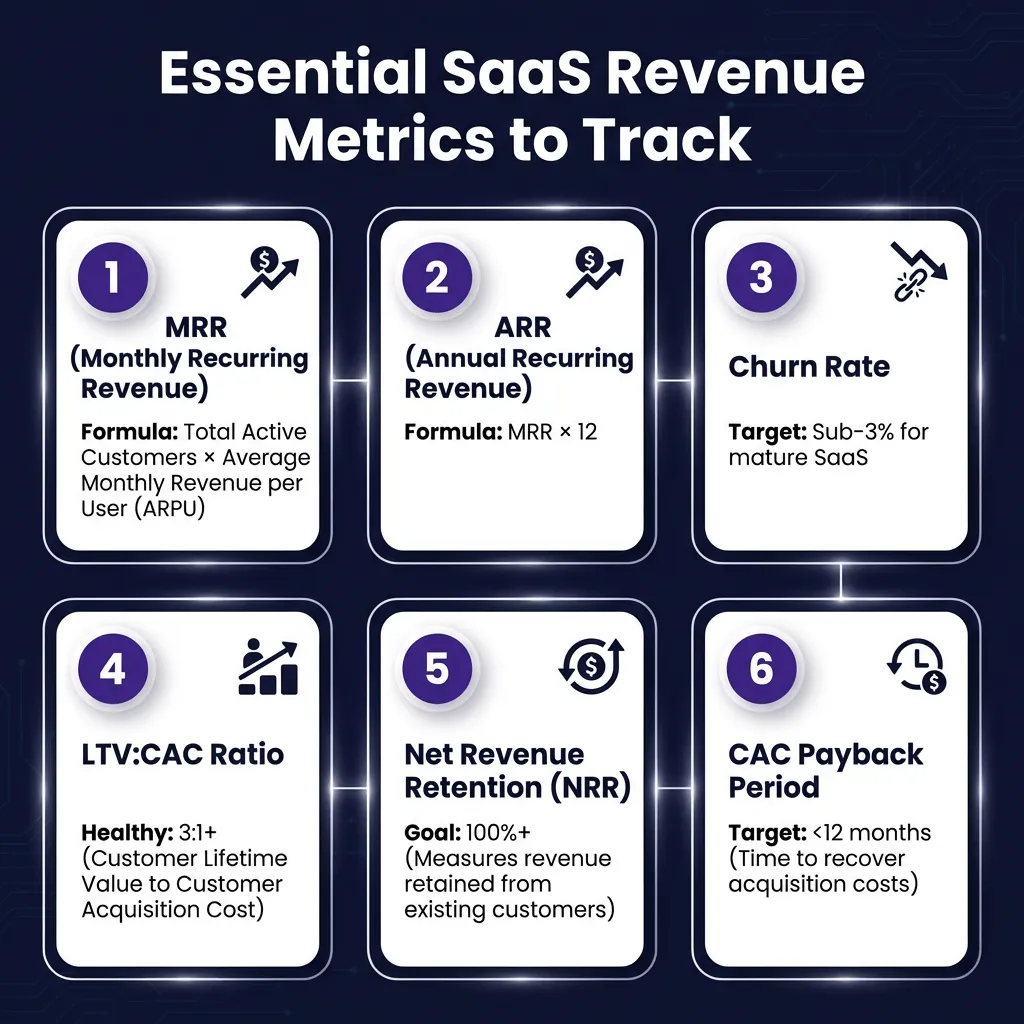
Revenue management tools for SaaS are analytics platforms designed specifically for subscription businesses. Unlike generic analytics tools, they automatically calculate critical metrics like MRR (Monthly Recurring Revenue), ARR (Annual Recurring Revenue), churn rate, LTV (Lifetime Value), and CAC (Customer Acquisition Cost) directly from your billing data.
These tools connect to payment processors like Stripe, Braintree, or Chargebee, then transform raw transaction data into investor-ready dashboards and forecasts. The best ones go further — they identify churn risks, recover failed payments, and help you model different pricing scenarios before you commit.
Why Revenue Management Tools Matter (With Real Data)
Here’s what most SaaS founders don’t realize: companies lose an average of 9% of MRR monthly due to failed payments alone — and that’s before voluntary churn even enters the picture. Without proper revenue analytics, you won’t know if your growth is healthy or if you’re just replacing leaking customers.
According to 2026 SaaS benchmarks, mature companies ($100K+ MRR) maintain sub-3% monthly churn, while early-stage startups ($1K-$10K MRR) average 5-8%. The difference? Better visibility into cohort behavior and proactive retention strategies powered by revenue analytics.
Revenue management tools help you:
- Track MRR movements — new business, expansion, contraction, and churn
- Forecast revenue — predict cash flow 6-12 months out based on current cohorts
- Identify churn risks — spot at-risk customers before they cancel
- Optimize pricing — test different models and see impact on LTV
- Report to investors — generate board-ready metrics automatically
9 Best Revenue Management Tools for SaaS in 2026
Let’s dive into the actual tools. I’ve tested each of these, compared pricing, and talked to real users about what works (and what doesn’t).
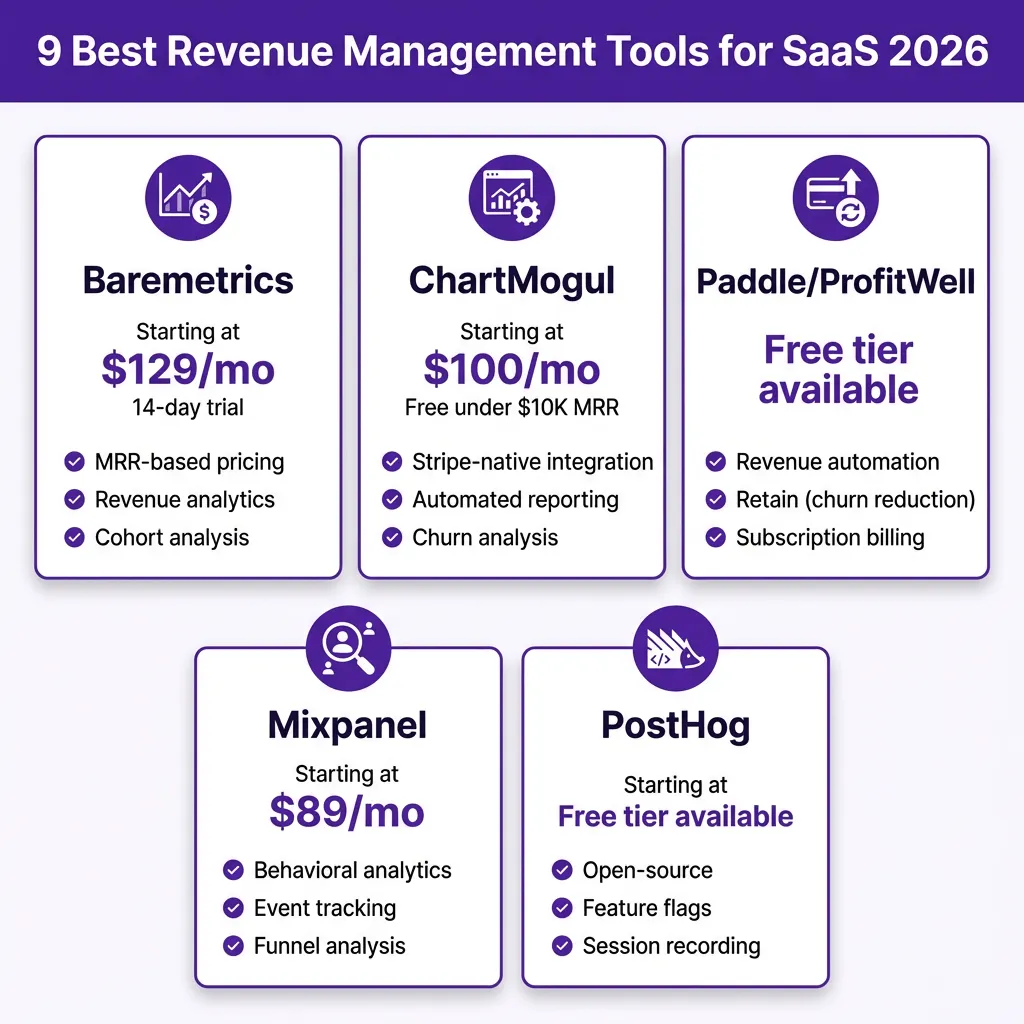
1. Baremetrics — Best All-in-One Revenue Analytics
Baremetrics is the most comprehensive revenue analytics platform for subscription businesses. It combines metrics tracking, dunning (failed payment recovery), churn insights, and financial forecasting in one dashboard.
Key Features:
- Real-time MRR, ARR, churn, and LTV tracking
- Recover automated dunning with customizable email sequences
- Cancellation Insights — surveys churned customers to learn why they left
- Financial forecasting with scenario planning
- 25+ segmentation attributes for cohort analysis
Pricing: Free for businesses under $30K/month MRR. Core features start at $129/month. Full suite with Recover and Cancellation Insights starts at $327/month.
Best for: Growing SaaS companies ($30K-$500K MRR) that want actionable insights, not just dashboards.
2. ChartMogul — Best for Stripe-Native Analytics
ChartMogul excels at pulling subscription data from Stripe and other billing platforms to calculate accurate MRR, churn, and LTV. It’s particularly strong for companies that want clean, investor-ready metrics without complex setup.
Key Features:
- One-click Stripe, Braintree, Recurly, and Chargebee integrations
- Cohort-based LTV calculations and retention curves
- Customer segmentation by tags and attributes
- HubSpot and Salesforce CRM integrations
- Committed MRR forecasting
Pricing: Free for businesses under $10K/month MRR. Paid plans start at $100/month, scaling with MRR tiers.
Best for: Stripe-based SaaS companies that need accurate revenue reporting for investors and board meetings.
3. Paddle (ProfitWell) — Best Free Tier with Built-In Billing
After Paddle acquired ProfitWell in 2024, the combined platform offers both Merchant of Record services and revenue analytics. The free metrics tier is genuinely useful — not a crippled trial.
Key Features:
- Free MRR, churn, and LTV tracking (no MRR cap)
- Retain churn reduction tools (paid add-on)
- Price Intelligently for pricing optimization (paid add-on)
- Native integration with Paddle billing (no setup required)
- Basic cohort analysis and segmentation
Pricing: Metrics dashboard is free. Retain starts at variable pricing based on revenue recovered. Price Intelligently starts at $15K/month.
Best for: Bootstrapped startups and companies already using Paddle as their Merchant of Record.
4. Mixpanel — Best for Connecting Behavior to Revenue
Mixpanel isn’t a traditional revenue tool, but it excels at connecting user behavior to revenue outcomes. If you need to understand why certain cohorts churn or expand, Mixpanel’s behavioral analytics are unmatched.
Key Features:
- Deep cohort analysis linking features to retention
- Funnel analysis for trial-to-paid conversion
- Real-time event tracking and user segmentation
- A/B testing integration
- Revenue event tracking (custom implementation)
Pricing: Free tier up to 100K monthly tracked users. Paid plans start at $89/month.
Best for: Product-led SaaS companies that need to tie feature usage to revenue metrics.
5. Amplitude — Best for AI-Powered Churn Prediction
Amplitude leads in AI-enhanced behavioral analytics. Its 2026 update added predictive churn modeling that flags at-risk users based on behavior patterns — before they even think about canceling.
Key Features:
- AI-powered churn prediction with risk scores
- Advanced cohort analysis with behavioral triggers
- Customer journey mapping across touchpoints
- Integration with CRM and marketing automation
- Custom metric definitions and calculations
Pricing: Free tier available. Growth plan starts at $995/month (better for scale-ups than early-stage startups).
Best for: Series A+ SaaS companies with dedicated data teams and complex retention challenges.
6. PostHog — Best Open-Source Option for Startups
PostHog combines product analytics, feature flags, session recording, and A/B testing in an open-source platform. For startups watching burn rate, the free tier is incredibly generous.
Key Features:
- Product analytics with funnels and cohorts
- Feature flags and A/B testing built-in
- Session recording for qualitative insights
- Self-hosted option (no per-event pricing)
- Revenue event tracking (manual setup)
Pricing: Free tier includes 1 million events/month. Paid plans start at $0 (usage-based) up to ~$450/month for typical startups.
Best for: Bootstrapped and seed-stage startups that need comprehensive analytics without breaking the bank.
7. Heap — Best for Auto-Tracking Without Developer Overhead
Heap’s automatic event capture is a game-changer for teams that don’t have engineering bandwidth for analytics implementation. Every click, form submission, and pageview is tracked automatically.
Key Features:
- Automatic event tracking (no code required)
- Retroactive analytics (define events after they happen)
- User journey and funnel analysis
- Session replays for qualitative context
- Integration with data warehouses
Pricing: Free starter plan up to 10K sessions/month. Paid plans start at ~$300/month.
Best for: Fast-moving teams that ship weekly and can’t afford analytics implementation delays.
8. Customer.io — Best for Journey-Based Revenue Analytics
Customer.io blends behavioral tracking with automated messaging, creating a unified view of user journeys and revenue impact. It’s particularly strong for companies running retention campaigns.
Key Features:
- Behavioral tracking across email, in-app, and web
- Automated messaging based on revenue events
- Trial-to-paid conversion tracking
- Churn risk segmentation
- Revenue attribution by campaign
Pricing: Starts at $150/month for up to 10K MAUs. Scales with active user count.
Best for: SaaS companies running sophisticated retention and lifecycle marketing campaigns.
9. Maxio — Best for Enterprise Billing + Revenue Ops
Maxio (formerly SaaSOptics + ChargeOver) is built for B2B SaaS companies with complex billing needs — think enterprise contracts, usage-based pricing, and revenue recognition compliance.
Key Features:
- Subscription and usage-based billing
- ASC 606 revenue recognition compliance
- Automated invoicing and dunning
- Revenue analytics and forecasting
- Integration with NetSuite, Salesforce, and ERP systems
Pricing: Custom pricing (typically $2K+/month for enterprise deployments).
Best for: Enterprise B2B SaaS companies with complex contracts and compliance requirements.
Revenue Management Tools Comparison Table
| Tool | Starting Price | Free Tier | Best For | Key Strength |
|---|---|---|---|---|
| Baremetrics | $129/mo | Under $30K MRR | Growing SaaS | All-in-one analytics + dunning |
| ChartMogul | $100/mo | Under $10K MRR | Stripe users | Investor-ready metrics |
| Paddle (ProfitWell) | Free | Unlimited | Bootstrapped | Free tier + MoR integration |
| Mixpanel | $89/mo | 100K MTU | Product-led | Behavior to revenue connection |
| Amplitude | $995/mo | Limited | Series A+ | AI churn prediction |
| PostHog | $0 | 1M events | Startups | Open-source, all-in-one |
| Heap | ~$300/mo | 10K sessions | Fast teams | Auto-tracking, no code |
| Customer.io | $150/mo | Trial | Retention focus | Journey + messaging |
| Maxio | Custom | No | Enterprise | Complex billing + compliance |
How to Choose the Right Revenue Management Tool
Here’s the framework I use when advising Fungies merchants on analytics stack:
By Company Stage
- Pre-seed/Bootstrapped (<$10K MRR): Start with Paddle (ProfitWell) free tier or PostHog. Both give you solid metrics without burning cash.
- Seed/Series A ($10K-$100K MRR): Upgrade to Baremetrics or ChartMogul. You need better forecasting and churn insights at this stage.
- Series B+ ($100K+ MRR): Consider Amplitude for behavioral depth or Maxio if you have enterprise billing complexity.
By Business Model
- B2B SaaS with contracts: Maxio or Baremetrics (for contract-level tracking)
- Product-led growth: Mixpanel or Amplitude (behavioral insights)
- Usage-based pricing: Maxio or Baremetrics with usage integrations
- Simple subscription SaaS: ChartMogul or Paddle (straightforward MRR tracking)
FAQs About SaaS Revenue Management Tools
What’s the difference between revenue analytics and product analytics?
Revenue analytics tools (Baremetrics, ChartMogul) focus on subscription metrics like MRR, churn, and LTV calculated from billing data. Product analytics tools (Mixpanel, Amplitude) track user behavior inside your application. The best SaaS companies use both — revenue tools for financial health, product tools for understanding why users convert or churn.
Do I need a revenue management tool if I use Stripe?
Stripe’s native dashboard shows basic metrics, but it lacks cohort analysis, churn breakdowns, and forecasting. If you’re serious about SaaS growth, a dedicated tool like Baremetrics or ChartMogul provides insights Stripe can’t. That said, Paddle (ProfitWell) offers a free alternative that works alongside Stripe.
How much should I spend on revenue analytics?
Rule of thumb: 0.5-1% of MRR is reasonable for analytics tools. At $50K MRR, that’s $250-$500/month — well within range of Baremetrics or ChartMogul. Before $10K MRR, stick with free tiers (Paddle, PostHog, ChartMogul free plan).
Can these tools handle usage-based billing?
Yes, but with caveats. Baremetrics and ChartMogul support usage-based metrics through integrations. Maxio is purpose-built for complex usage billing. For AI companies billing on token consumption, consider pairing a usage metering tool (like OpenMeter) with revenue analytics.
What metrics should I track daily vs. weekly?
Daily: MRR movements, failed payments, new signups. Weekly: Churn rate, trial conversions, cohort retention. Monthly: LTV:CAC ratio, NRR (Net Revenue Retention), CAC payback period. Most tools automate these reports — set them up once and review consistently.
Final Thoughts: Pick One and Start Tracking
Honestly, the biggest mistake I see isn’t choosing the wrong tool — it’s not using any tool at all. Too many SaaS founders wing it with Stripe dashboards and spreadsheets until it’s too late.
Here’s my recommendation:
- If you’re under $10K MRR: Start with Paddle (ProfitWell) free tier
- If you’re $10K-$100K MRR: Go with Baremetrics or ChartMogul
- If you’re $100K+ MRR: Consider Amplitude for behavioral depth or Maxio for enterprise needs
The tool matters less than actually using it. Pick one, integrate it this week, and start making decisions based on real revenue data — not gut feel.
Need help setting up payment infrastructure that feeds clean data into your analytics stack? Fungies handles payments, tax compliance, and checkout — so you can focus on growth, not payment plumbing.
Sources
- Baremetrics vs. ChartMogul vs. ProfitWell comparison — baremetrics.com/blog/baremetrics-vs-chartmogul-vs-profitwell
- SaaS Metrics Benchmarks for 2026 — bigideasdb.com/saas-metrics-benchmarks-2026
- Best SaaS Analytics Tools 2026 — saashero.net/customer-retention/best-saas-analytics-tools-2026
- Top SaaS Billing Automation Platforms 2026 — blog.cfi.co/finance/2026/02/10-best-saas-billing-automation-platforms-for-2026
- Best SaaS Metrics Dashboard Tools — quantledger.app/blog/best-saas-metrics-dashboard