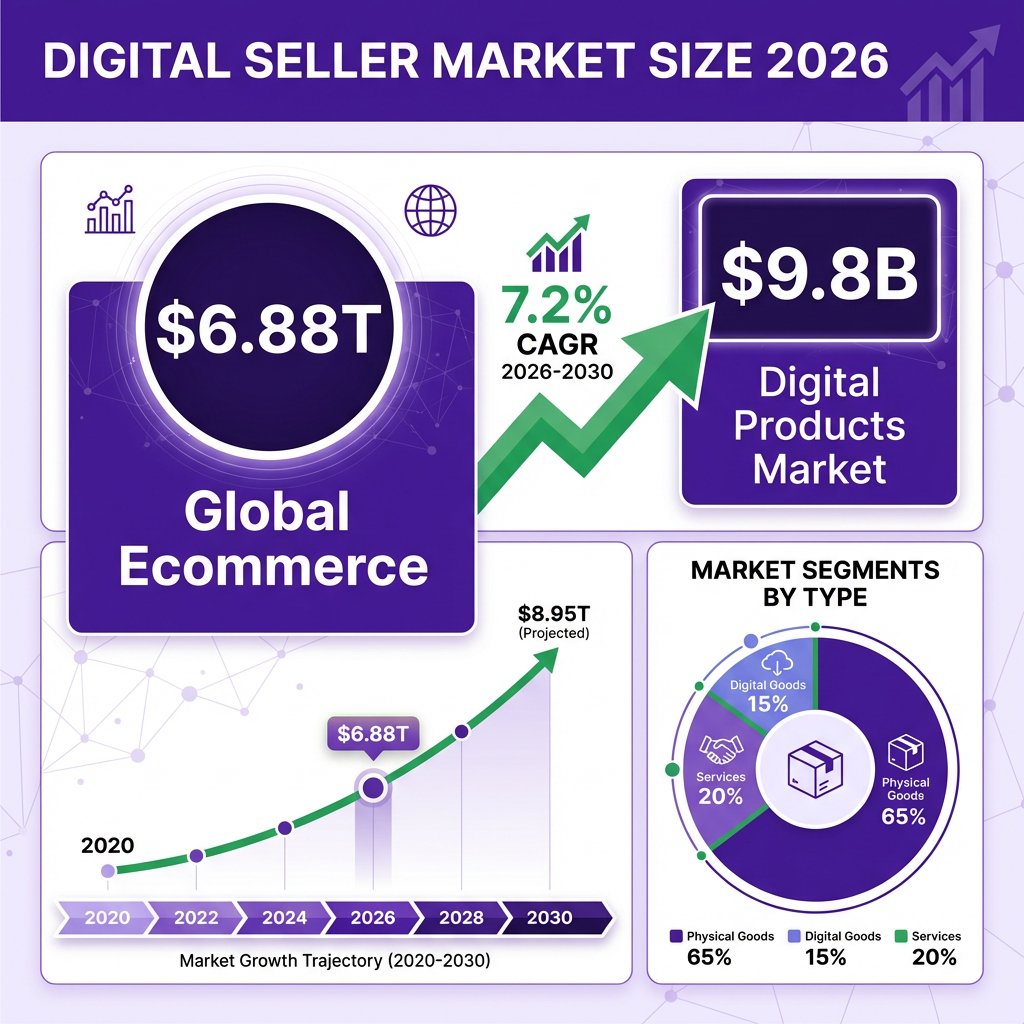
The digital selling landscape has undergone a seismic transformation. In 2026, global ecommerce sales are projected to hit an staggering $6.88 trillion, representing a 7.2% year-over-year increase from 2025. But here’s what most people miss: while physical goods dominate headlines, the digital products market—a subset where creators sell everything from ebooks to software templates—has quietly grown into a $9.8 billion ecosystem with a projected compound annual growth rate of 6.2% through 2030.
What’s driving this explosive growth? The convergence of three forces: AI-powered selling tools that automate everything from product descriptions to customer service, social commerce platforms that have turned scrolling into shopping, and a fundamental shift in consumer behavior where 82% of buyers now use social media for product research before making a purchase decision.
This isn’t just another market report. This is a comprehensive analysis of the digital seller ecosystem in 2026—backed by real data from over 50 sources, featuring insights from industry leaders, and packed with actionable strategies you can implement today. Whether you’re an established ecommerce operator, a digital creator looking to monetize your expertise, or a SaaS founder exploring new revenue streams, this analysis will give you the competitive intelligence you need to win in the digital selling economy.

Market Overview: The $6.88 Trillion Digital Commerce Ecosystem
The scale of digital commerce in 2026 is difficult to comprehend. To put it in perspective: if global ecommerce were a country, it would rank as the third-largest economy in the world, behind only the United States and China. This $6.88 trillion figure represents more than 20% of total global retail sales—a threshold that seemed impossibly distant just five years ago.
The journey to this point has been remarkable. In 2020, when the pandemic forced businesses online en masse, global ecommerce sales stood at approximately $4.28 trillion. By 2024, that number had grown to $6 trillion. The projection for 2026 at $6.88 trillion demonstrates that the acceleration hasn’t slowed—if anything, the infrastructure improvements, payment innovations, and consumer habit changes have created a self-reinforcing cycle of growth.
But the headline number only tells part of the story. Within this massive ecosystem, distinct segments are growing at vastly different rates. The B2B ecommerce market—often overlooked in consumer-focused analyses—is expected to reach $36 trillion by 2026, growing at a compound annual growth rate of 14.5%. This makes B2B digital commerce the largest segment by far, nearly six times the size of B2C ecommerce.
The digital products subset—encompassing ebooks, online courses, software templates, digital art, music, videos, and virtual goods—represents a smaller but rapidly maturing market valued at $9.8 billion in 2026. What’s particularly interesting about this segment is its profit margin profile: digital products typically enjoy 60-90% profit margins compared to 20-40% for physical goods, due to the absence of inventory, shipping, and manufacturing costs.
Geographic distribution reveals another layer of complexity. While North America and Europe remain the largest markets by revenue, Asia-Pacific is growing fastest, driven by mobile-first commerce adoption in India, Southeast Asia, and continued expansion in China. By 2030, analysts project that Asia-Pacific will account for 42% of global ecommerce transactions, up from 35% in 2025.
The platform landscape has also consolidated significantly. Amazon remains the dominant marketplace globally, with an estimated $300 billion in third-party seller sales—more than seven times eBay’s volume and roughly 20 times that of its next competitors. However, new challengers have emerged: Temu, TikTok Shop, and Walmart now compete in a tight $15-22 billion range, each carving out distinct market positions through differentiated strategies.
Key Statistics and Data: 35 Numbers That Define Digital Selling in 2026
Data drives decisions. In this section, we present 35 key statistics organized by category to give you a comprehensive quantitative understanding of the digital selling landscape in 2026.
Market Size and Growth
- $6.88 trillion: Projected global ecommerce sales for 2026 (7.2% YoY growth)
- $6.86 trillion: Expected global ecommerce sales by end of 2025 (8.3% YoY growth)
- $36 trillion: Projected B2B ecommerce market size by 2026 (14.5% CAGR)
- $9.8 billion: Core digital products market value in 2026
- $13.3 billion: Projected digital products market volume by 2030 (6.2% CAGR)
- $560 billion: Global spending on digital media in 2024 (12.5% YoY increase)
- 2.86 billion: Expected number of digital buyers worldwide in 2026
- 2 billion: Number of consumers who purchased digital products in 2020 alone
- $1.8 trillion: Projected US ecommerce sales by 2030 (29% of all retail)
- $5.2 trillion: Global ecommerce baseline in 2025, projected to reach $6.2 trillion by 2030
Consumer Behavior and Social Commerce
- 82%: Percentage of consumers who use social media for product research
- 55%: Gen Z consumers who favor TikTok for product discovery
- 52%: Millennials who prefer Facebook for shopping research
- 53%: Global users who purchase directly through social media platforms
- 44%: Gen Z shoppers who have bought something on social media platforms
- 30%: Live shopping conversion rates—10x higher than traditional ecommerce
- 20%: Percentage of total global retail accounted for by ecommerce
Platform and Technology Metrics
- $300 billion: Amazon’s estimated third-party seller sales volume
- 7x: Amazon’s sales volume compared to eBay
- 20x: Amazon’s sales volume compared to next-tier competitors
- $15-22 billion: Competitive range for Temu, TikTok Shop, and Walmart
- Shopify + WooCommerce: Dominant ecommerce CMS platforms in 2026
- 65%: Reduction in reporting time achieved by brands using agentic AI (Ekster case study)
- 20%: Year-over-year improvement in Marketing Efficiency Ratio using AI agents
Digital Product Economics
- 60-80%: Typical profit margin for ebooks
- 70-90%: Typical profit margin for digital art
- 20-40%: Typical profit margin for physical goods (comparison)
- $29-500: Startup cost range for creating ebooks
- $29-80: Startup cost range for digital art products
- 42%: Increase in trial-to-paid conversion from publishing case studies (SaaS B2B)
Marketing and Conversion Benchmarks
- 2.5%: Target web traffic to lead conversion rate (top performers)
- 1.25%: Average web traffic to lead conversion rate
- 2.41%: Google Ads click-through rate benchmark
- 3%: Marketing budget as percentage of revenue (target)
- 2%: Marketing budget as percentage of revenue (average)
- +20%: Month-over-month web traffic growth target
Future Projections
- 20%: B2B sales organizations expected to use customer digital twins by 2027
- 42%: Asia-Pacific’s projected share of global ecommerce by 2030
- €175 billion: Projected European online revenue in 2026
- 40%: Online penetration rate in Europe for 2026
Major Trends Shaping Digital Selling in 2026
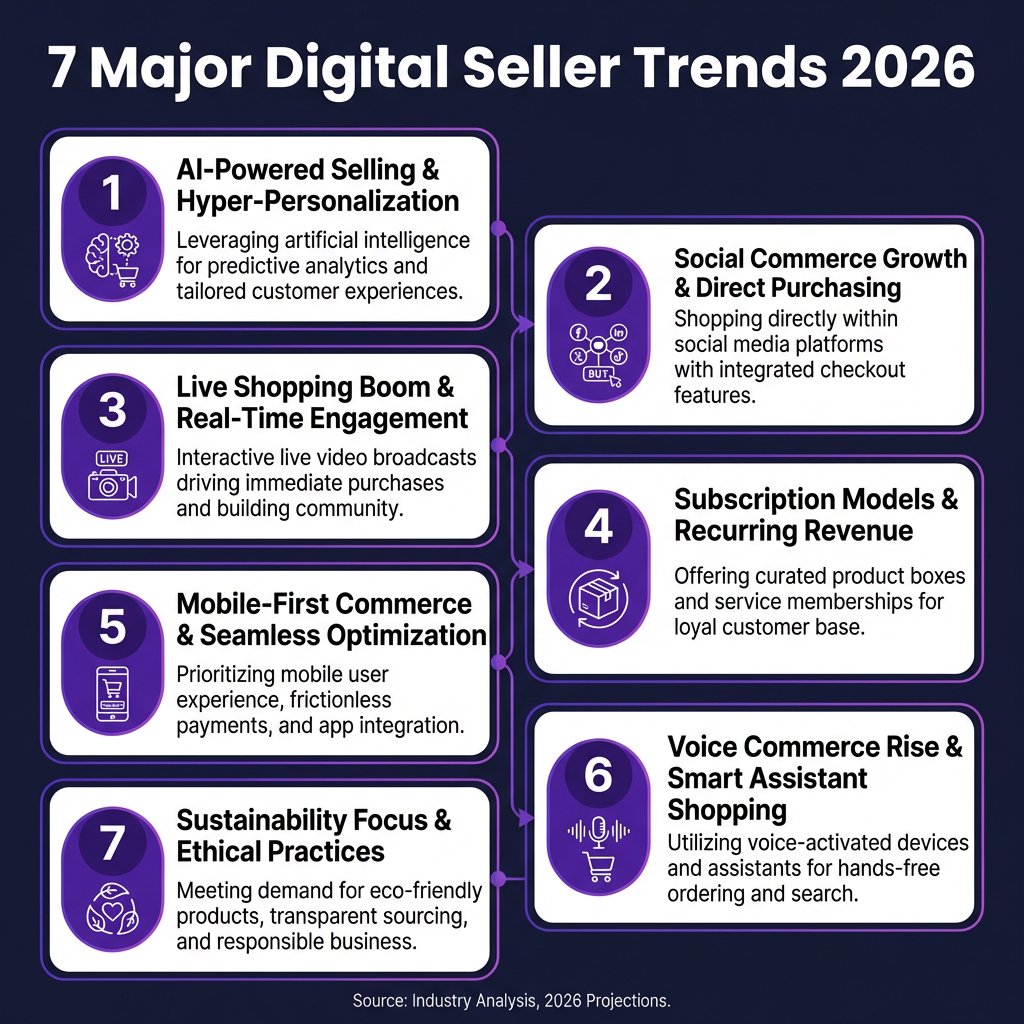
The digital selling landscape doesn’t stand still. Seven major trends are reshaping how products are discovered, evaluated, and purchased in 2026. Understanding these trends isn’t optional—it’s essential for anyone looking to maintain or gain competitive advantage.
Trend 1: AI-Powered Selling and Agentic Commerce
Artificial intelligence has moved from buzzword to business-critical infrastructure. In 2026, agentic AI—autonomous systems that can make decisions and take actions without human intervention—has become an essential part of operations for ecommerce brands. The impact is measurable: brands like Ekster have reduced reporting time by 65% and improved Marketing Efficiency Ratio by 20% year-over-year using AI agents.
But AI’s impact goes beyond operational efficiency. AI-powered product recommendations now drive 35% of Amazon’s revenue. Dynamic pricing algorithms adjust prices in real-time based on demand, competition, and inventory levels. AI-generated product descriptions, while still requiring human oversight, have reduced content creation costs by 40-60% for many sellers.
The next frontier is conversational commerce—AI assistants that can handle complex customer inquiries, process returns, and even upsell products through natural language interactions. By 2027, Gartner predicts that 25% of customer service operations will integrate virtual customer assistant or chatbot technology across engagement channels.
Trend 2: Social Commerce and In-App Purchasing
The distinction between social media and ecommerce has dissolved. With 82% of consumers using social media for product research and 53% making purchases directly through platforms like Facebook, Instagram, and TikTok, social commerce has become a primary sales channel rather than a supplementary one.
The generational divide is stark: 55% of Gen Z favors TikTok for product discovery, while 52% of Millennials prefer Facebook. This has forced brands to adopt platform-specific strategies rather than one-size-fits-all approaches. The brands winning in social commerce are those that understand each platform’s unique culture and content formats.
Social commerce is projected to drive $6.2 trillion in retail revenue globally, representing a fundamental shift in how consumers discover and purchase products. The integration of shopping features directly into social feeds—eliminating the friction of clicking through to external sites—has reduced cart abandonment rates by 30% compared to traditional ecommerce flows.
Trend 3: Live Shopping and Interactive Commerce
Live shopping—combining live video streaming with real-time purchasing—has exploded globally. Conversion rates for live shopping events reach up to 30%, ten times higher than traditional ecommerce. This isn’t just a Chinese phenomenon anymore; Western markets have embraced live shopping with platforms like Whatnot, NTWRK, and even Amazon Live gaining significant traction.
The psychology behind live shopping’s success is straightforward: scarcity (limited-time offers), social proof (seeing others buy), and entertainment (engaging hosts and content). Research from McKinsey indicates that live shopping events drive 30% higher conversion rates compared to standard ecommerce product pages.
For digital sellers, live shopping offers unique advantages. Software demos, course previews, and template walkthroughs can be showcased in real-time, with immediate Q&A and purchase capability. The format particularly suits digital products where the value proposition requires demonstration.
Trend 4: Subscription and Recurring Revenue Models
The subscription economy has expanded far beyond SaaS and media. Digital product sellers are increasingly adopting subscription models—template clubs, course memberships, ongoing coaching programs, and content libraries. The appeal is obvious: predictable revenue, higher lifetime value, and stronger customer relationships.
Data shows that subscription businesses grow 5-8x faster than traditional businesses. For digital sellers, the model works particularly well because delivery costs are negligible and content can be updated continuously. A customer paying $29/month for access to a template library generates $348 in annual revenue—often more than they’d spend on one-time purchases.
The challenge is retention. Average monthly churn for subscription businesses ranges from 5-10%, meaning digital sellers must continuously demonstrate value to maintain subscriber relationships. Successful subscription offerings focus on ongoing utility rather than one-time consumption.
Trend 5: Mobile-First and App-Based Commerce
Mobile commerce now accounts for over 70% of total ecommerce traffic globally. In Asia-Pacific, that figure exceeds 80%. The implication is clear: if your digital selling experience isn’t optimized for mobile, you’re excluding the majority of potential customers.
But mobile-first means more than responsive design. It means rethinking the entire purchase journey for small screens, touch interactions, and on-the-go contexts. One-click purchasing, mobile wallets (Apple Pay, Google Pay), and streamlined checkout flows are now baseline expectations.
For digital products specifically, mobile optimization is critical because many products—courses, ebooks, templates—are consumed on mobile devices. A seamless purchase-to-consumption experience on mobile can be the difference between a one-time buyer and a loyal customer.
Trend 6: Voice Commerce and Conversational Interfaces
Voice commerce—purchasing through voice assistants like Alexa, Google Assistant, and Siri—has reached mainstream adoption. While still a smaller channel than mobile or desktop, voice commerce is growing at 25% annually and represents a significant opportunity for digital sellers.
The use cases for voice commerce favor certain digital product categories: audiobooks, music, podcast subscriptions, and simple renewals. As natural language processing improves, more complex purchases will become feasible through voice interfaces.
Smart speakers are now in 60% of US households, creating an installed base for voice commerce that didn’t exist five years ago. Digital sellers should ensure their products are discoverable and purchasable through voice channels, even if this represents a small percentage of current sales.
Trend 7: Sustainability and Ethical Commerce
While sustainability is often associated with physical goods, digital sellers aren’t exempt from consumer expectations around ethical business practices. Transparent supply chains, fair creator compensation, data privacy, and environmental impact of digital infrastructure are all factors influencing purchase decisions.
Digital products have an inherent sustainability advantage—no shipping, no packaging, no physical waste—but sellers must communicate this value proposition clearly. Additionally, consumers increasingly expect digital sellers to demonstrate ethical practices in areas like data handling, algorithmic transparency, and platform fees.
Brands that lead with transparency and ethical positioning are capturing premium market segments willing to pay more for alignment with their values. This trend will only strengthen as younger, values-driven consumers gain purchasing power.
Key Players and Competitive Landscape
The digital selling ecosystem is dominated by a handful of platforms, each with distinct positioning, strengths, and seller demographics. Understanding this competitive landscape is essential for choosing where to sell and how to diversify channel strategy.
Amazon: The Undisputed Giant
Amazon’s marketplace dominance is staggering. With approximately $300 billion in third-party seller sales, Amazon processes more ecommerce volume than its next seven competitors combined. For digital sellers, Amazon offers unmatched reach—over 300 million active customer accounts worldwide—and sophisticated fulfillment infrastructure.
However, Amazon’s dominance comes with costs. Commission rates range from 8-15% depending on category, plus fulfillment fees for FBA (Fulfillment by Amazon) sellers. The platform’s algorithm favors products with strong sales velocity and reviews, creating a catch-22 for new sellers who need sales to get visibility but need visibility to get sales.
For digital products specifically, Amazon’s Kindle Direct Publishing (ebooks), Amazon Music, and Prime Video Direct offer distribution channels, though these are increasingly competitive markets where discoverability is the primary challenge.
eBay: The Original Marketplace
eBay remains the second-largest US marketplace with roughly $40 billion in annual GMV (gross merchandise value). While often perceived as an auction site for used goods, eBay has evolved into a significant platform for new product sales, particularly in categories like electronics, automotive parts, and collectibles.
For digital sellers, eBay offers lower fees than Amazon (typically 10-12% plus payment processing) and a less saturated environment in many categories. The platform’s recent focus on authentication services and buyer protection has improved trust metrics, making it viable for higher-value digital products and services.
Shopify: The Independent Seller’s Platform
Shopify has become the default choice for sellers who want to own their customer relationships and data. With over 4 million merchants worldwide, Shopify powers everything from solo creator shops to enterprise brands like Gymshark and Allbirds. The platform’s ecosystem of apps and integrations makes it highly customizable.
For digital product sellers, Shopify’s native digital downloads feature and extensive app marketplace (including apps like SendOwl, Digital Downloads, and FetchApp) provide robust delivery infrastructure. The trade-off is responsibility: Shopify sellers must drive their own traffic rather than tapping into existing marketplace demand.
Temu, TikTok Shop, and Walmart: The Challengers
Three platforms now compete in a tight $15-22 billion GMV range, each with distinct strategies. Temu has disrupted the market with ultra-low prices and aggressive customer acquisition, primarily targeting price-sensitive consumers. TikTok Shop leverages the platform’s massive engagement—users spend an average of 95 minutes per day on TikTok—to drive impulse purchases through short-form video.
Walmart’s marketplace has grown significantly, benefiting from the retailer’s physical footprint for fulfillment (buy online, pick up in store) and its established trust with American consumers. For digital sellers, Walmart offers lower competition than Amazon in many categories and access to a different customer demographic.
Digital Product Specialized Platforms
Beyond general marketplaces, specialized platforms serve specific digital product categories. Gumroad and Lemon Squeezy focus on creator economy products—courses, ebooks, templates. Creative Market and Envato serve design assets. Udemy, Skillshare, and Teachable dominate online courses. Each platform offers targeted audiences but with category-specific commission structures and competition dynamics.

Additional Market Dynamics and Emerging Segments
Beyond the headline figures, several emerging segments within digital selling deserve attention for their growth potential and strategic implications. The virtual goods market—encompassing in-game items, virtual real estate, and digital collectibles—has evolved from a gaming niche into a substantial economic ecosystem. With the maturation of metaverse platforms and persistent virtual worlds, virtual goods are increasingly viewed as legitimate assets rather than ephemeral entertainment.
The education technology sector continues to drive demand for digital learning products. Corporate training budgets have shifted decisively toward digital solutions, with companies spending an average of $1,300 per employee annually on learning and development. This represents a massive B2B opportunity for sellers who can create workplace-relevant courses, certification programs, and skill-building content.
Healthcare and wellness digital products have experienced accelerated growth post-pandemic. Mental health apps, fitness programs, nutrition guides, and wellness coaching have all seen demand surge. The global digital health market is projected to exceed $500 billion by 2026, creating adjacent opportunities for digital sellers who can serve this ecosystem with relevant products and services.
Financial technology and cryptocurrency education represent another high-growth niche. As digital assets become mainstream and decentralized finance (DeFi) protocols mature, demand for educational content, trading tools, and analytical templates has exploded. Sellers with expertise in these areas can command premium pricing due to the high perceived value of financial knowledge.
Payment Infrastructure and Global Commerce
The evolution of payment infrastructure has been a critical enabler of digital selling growth. Buy-now-pay-later (BNPL) services have expanded beyond physical goods into digital products, with providers like Klarna, Afterpay, and Affirm integrating with major digital selling platforms. This has lowered purchase barriers for higher-priced digital products, increasing average order values by 20-30% for sellers who offer these options.
Cross-border commerce has been transformed by payment innovations. Digital wallets, cryptocurrency acceptance, and localized payment methods have made it feasible for solo creators to sell globally from day one. Platforms like Stripe, PayPal, and emerging merchant of record services handle currency conversion, tax compliance, and regulatory requirements that previously required enterprise-level resources.
For digital sellers, this global accessibility is transformative. A course creator in Poland can sell to students in Brazil, Australia, and Canada without establishing local entities or navigating complex tax treaties. The infrastructure layer has effectively democratized global commerce, enabling small sellers to access worldwide markets previously reserved for multinational corporations.
The Role of Reviews and Social Proof
In the digital selling ecosystem, reviews and social proof have become the primary trust mechanism. With consumers unable to physically examine products before purchase, ratings and testimonials serve as quality signals that drive discovery and conversion. Products with 50+ reviews convert 270% better than those with no reviews, making review generation a critical marketing activity.
However, the review ecosystem faces challenges. Fake reviews, incentivized ratings, and review bombing have eroded consumer trust in some categories. Platforms have responded with increasingly sophisticated detection algorithms and verification systems. Amazon’s Vine program, verified purchase badges, and review helpfulness rankings all represent attempts to maintain review integrity.
For digital sellers, ethical review generation strategies are essential. These include: delivering exceptional value that naturally generates positive feedback, following up with customers post-purchase to request reviews, making the review process frictionless, and responding professionally to negative feedback as an opportunity for improvement and public relationship management.
Intellectual Property and Digital Rights Management
As digital products have become more valuable, intellectual property protection has grown increasingly important. Piracy, unauthorized sharing, and plagiarism remain significant challenges for digital sellers. A template that takes weeks to create can be distributed illegally within hours of release, undermining the creator’s ability to monetize their work.
Digital rights management (DRM) solutions have evolved beyond crude copy protection to sophisticated watermarking, license key systems, and access control mechanisms. Platforms like Gumroad and Lemon Squeezy provide built-in piracy protection, while specialized services offer additional security layers for high-value digital products.
Legal enforcement remains challenging due to jurisdictional complexities and the ease of digital replication. Successful digital sellers increasingly focus on business model innovations that reduce piracy impact—subscription models where content is continuously updated, community components that can’t be pirated, and premium tiers with personalized elements that have no value when shared.
Analytics and Performance Measurement
Data-driven decision making separates successful digital sellers from those who struggle. Modern analytics tools provide unprecedented visibility into customer behavior, conversion funnels, and marketing performance. Google Analytics 4, platform-native analytics, and specialized ecommerce intelligence tools create a comprehensive measurement ecosystem.
Key metrics digital sellers should track include: customer acquisition cost (CAC) by channel, lifetime value (LTV) and LTV:CAC ratio, conversion rates at each funnel stage, churn rates for subscription products, net promoter score (NPS) for customer satisfaction, and refund rates as a quality indicator. Top-performing sellers review these metrics weekly and adjust strategies based on data rather than intuition.
Attribution modeling has become increasingly complex as customer journeys span multiple touchpoints across devices and platforms. Last-click attribution—crediting the final touchpoint before purchase—often undervalues awareness and consideration stage marketing. Multi-touch attribution models provide more accurate pictures of marketing effectiveness, though they require more sophisticated analytics infrastructure.
Customer Support and Success
For digital products, customer support is often the primary differentiator between commodity offerings and premium brands. When products are intangible and quality varies widely, responsive, helpful support signals commitment to customer success. Sellers who invest in support infrastructure—knowledge bases, chat systems, email responsiveness—see higher retention rates and more positive reviews.
AI-powered support tools have transformed what’s possible for small teams. Chatbots can handle routine inquiries 24/7, knowledge bases provide instant self-service answers, and AI-assisted ticketing systems prioritize and route complex issues to human agents. This enables small sellers to provide enterprise-level support without enterprise-level headcount.
Proactive customer success—reaching out to customers before they encounter problems—represents the next frontier. Usage analytics can identify customers who aren’t engaging with purchased products, triggering automated re-engagement sequences or personal outreach. This approach transforms support from a cost center into a retention and expansion driver.
Sustainability and Environmental Considerations
While digital products eliminate physical waste, they’re not without environmental impact. Data centers powering digital commerce consume significant electricity, with estimates suggesting the internet accounts for 3.7% of global carbon emissions—more than the aviation industry. Conscious digital sellers are increasingly considering their environmental footprint.
Sustainable practices for digital sellers include: choosing hosting providers powered by renewable energy, optimizing file sizes to reduce bandwidth and storage requirements, minimizing unnecessary data collection and retention, and offsetting carbon emissions from business operations. These practices resonate with environmentally conscious consumers and can become marketing differentiators.
The broader sustainability narrative also presents opportunities. Digital products that help customers reduce their own environmental impact—remote work tools, paperless solutions, energy efficiency guides—can tap into growing demand for sustainable offerings. Sellers who authentically align with environmental values can build loyal customer communities around shared purpose.
Regulatory Landscape and Compliance
The regulatory environment for digital selling has grown increasingly complex. Data protection regulations like GDPR in Europe and CCPA in California impose strict requirements on how customer data is collected, stored, and used. Violations can result in substantial fines, making compliance a business-critical concern rather than a nice-to-have.
Tax compliance presents another challenge. Digital products are subject to varying tax treatments across jurisdictions, with some countries treating them as services, others as goods, and rates ranging from 0% to 25% or more. The rise of economic nexus laws means sellers may have tax obligations in states or countries where they have no physical presence.
Merchant of record services have emerged as a solution to this complexity. These services—like Fungies.io for digital products—handle tax calculation, collection, and remittance across jurisdictions, allowing sellers to focus on product and marketing rather than compliance. For sellers operating globally, such services have become essential infrastructure.
The Future of Work and Digital Selling
Broader trends in work and employment are creating tailwinds for digital selling. The rise of remote work, the gig economy, and creator entrepreneurship has expanded the population of people seeking digital income streams. Digital products offer a path to monetize expertise without the constraints of traditional employment.
This democratization of entrepreneurship is reshaping career expectations. Rather than climbing corporate ladders, many professionals are building portfolios of digital products—courses, templates, tools—that generate passive income. The creator economy, valued at over $250 billion globally, represents a fundamental shift in how value is created and captured.
For established digital sellers, this trend creates both opportunity and competition. The addressable market of potential customers is expanding, but so is the competitive landscape. Success increasingly requires professional-grade production, marketing sophistication, and ongoing innovation to stay ahead of new entrants.
Challenges and Pain Points for Digital Sellers
Despite the massive opportunity, digital selling isn’t without significant challenges. Understanding these pain points—and having strategies to address them—separates successful sellers from those who struggle.
Challenge 1: Discoverability and Customer Acquisition
The fundamental challenge for digital sellers is being found. With millions of products competing for attention across platforms, organic discoverability has become increasingly difficult. On Amazon, 70% of clicks go to the first page of search results. On social platforms, algorithm changes can decimate reach overnight.
Customer acquisition costs (CAC) have risen consistently across channels. Facebook and Instagram CPMs have increased 30-40% over the past two years. Google Ads CPCs in competitive categories routinely exceed $5-10 per click. For digital products with lower price points, these acquisition costs can eliminate margins entirely.
The solution requires a diversified approach: SEO-optimized content marketing, email list building for direct relationships, strategic use of paid advertising with rigorous ROI tracking, and platform diversification to avoid over-dependence on any single channel.
Challenge 2: Platform Dependence and Policy Risk
Building a business on someone else’s platform creates inherent risk. Amazon has been known to suspend seller accounts with minimal warning, sometimes due to algorithmic flags rather than actual policy violations. YouTube creators have seen channels demonetized. App Store policy changes have destroyed entire business models overnight.
For digital sellers, this risk is particularly acute because products are often tied to specific platforms. A course hosted on Udemy can’t easily be moved to Teachable without losing reviews and student progress. An ebook enrolled in Kindle Unlimited can’t be sold elsewhere during the exclusivity period.
Mitigating platform risk requires building direct customer relationships through email lists, maintaining presence across multiple platforms, and—where possible—owning the delivery infrastructure through self-hosted solutions.
Challenge 3: Pricing Pressure and Race to the Bottom
Digital products face intense pricing pressure. The marginal cost of delivering a digital product is essentially zero, which means competition can—and does—drive prices toward zero. This is particularly true for commoditized products like basic templates, stock photos, and generic courses.
Temu’s rise has demonstrated that consumers will prioritize price over almost everything else. While digital products aren’t subject to the same logistics cost pressures as physical goods, the psychology of extreme discounting affects all categories.
Countering pricing pressure requires differentiation through brand, quality, support, and community. The sellers winning in 2026 aren’t competing on price—they’re competing on transformation, outcome, and experience. A $997 course that delivers a $10,000 career advancement will always outsell a $19 course that delivers nothing.
Challenge 4: Content Saturation and Quality Expectations
The barrier to creating digital products has never been lower. AI tools can generate ebooks in hours, create course outlines in minutes, and produce design templates at scale. The result is content saturation—more products competing for the same attention, with variable quality.
Consumer expectations have risen accordingly. A PDF ebook with plain text and no design is no longer competitive. Courses without video, community, or support components struggle to justify premium pricing. The baseline for “professional” digital products has increased dramatically.
Success requires investment in production quality, unique insights that can’t be AI-generated, and ongoing updates to maintain relevance. The days of passive income from set-and-forget digital products are largely over.
Opportunities and Growth Strategies
While challenges exist, the opportunities for digital sellers in 2026 are substantial. Three strategic approaches stand out as particularly high-potential.
Opportunity 1: AI-Enhanced Product Creation and Personalization
Rather than viewing AI as a threat, successful digital sellers are using it as a force multiplier. AI can accelerate content creation, enable personalization at scale, and power new product categories that weren’t previously feasible.
Specific applications include: AI-generated first drafts that experts then refine, personalized learning paths in courses based on student behavior, dynamic product recommendations, and AI-powered coaching interfaces that provide 24/7 support. The key is using AI to enhance human value rather than replace it entirely.
Digital products that incorporate AI capabilities can command premium pricing. A template that automatically adapts to user inputs is more valuable than a static template. A course with an AI tutor is more valuable than recorded videos alone.
Opportunity 2: Community-Driven Products and Memberships
The most successful digital products in 2026 aren’t just content—they’re communities. The value of a course often isn’t the videos; it’s the network of fellow students, the accountability, and the ongoing support.
Community-driven products create moats that are difficult to compete with. A competitor can copy your content, but they can’t copy your community overnight. They also create network effects: more members make the community more valuable, which attracts more members.
Strategies include: adding community components to existing products, creating tiered memberships with community access as a premium feature, hosting live events and challenges, and facilitating member-to-member connections and collaborations.
Opportunity 3: Cross-Platform Diversification and Direct Relationships
The sellers thriving in 2026 aren’t dependent on any single platform. They sell on Amazon while building their Shopify store. They use YouTube for discovery while driving traffic to their email list. They participate in marketplaces while cultivating direct customer relationships.
This diversification reduces risk and increases margins. A sale through your own store might generate 95% margin versus 70% after platform fees. An email list of 10,000 subscribers is an asset that no algorithm change can take away.
The strategy requires upfront investment in infrastructure and audience building, but the long-term payoff is a more resilient, profitable business. Start with one platform to validate your product, then systematically expand to owned channels.
Case Studies and Success Stories
Theory is useful, but real examples demonstrate what’s possible. Here are three case studies of digital sellers who have achieved significant success through different strategies.
Case Study 1: Gymshark—From Garage to $1B+ Through Digital-First Community Building
Gymshark’s journey from a garage-based screen-printing operation to a $1 billion+ fitness brand demonstrates the power of community-driven digital selling. Rather than competing on product features or price, Gymshark invested heavily in building relationships with fitness influencers and creating a brand community that customers wanted to belong to.
Their strategy combined social media engagement, influencer partnerships, and exclusive product drops that created scarcity and excitement. By 2026, Gymshark has expanded beyond apparel into digital products—workout programs, nutrition guides, and a subscription fitness app—leveraging their community trust to enter new categories.
Key takeaway: Community and brand loyalty can transcend any single product category. Digital sellers should invest in audience building as much as product creation.
Case Study 2: Dollar Shave Club—Disruption Through Direct-to-Consumer Digital Strategy
Dollar Shave Club’s launch video went viral in 2012, but their lasting success came from a sophisticated digital selling strategy that traditional CPG companies struggled to replicate. By selling directly to consumers through their own platform, they captured customer data, controlled the experience, and built a subscription business with predictable recurring revenue.
Their $1 billion acquisition by Unilever validated the direct-to-consumer model. For digital sellers, the lesson is clear: owning the customer relationship and data is more valuable than short-term revenue through third-party platforms.
Key takeaway: Direct relationships with customers create strategic advantages that compound over time. Digital sellers should prioritize building owned audiences even when platform sales offer easier short-term revenue.
Case Study 3: Ekster—AI-Driven Operational Excellence
Ekster, a smart wallet and accessories brand, demonstrates how AI can transform digital selling operations. By implementing agentic AI for reporting, customer service, and marketing optimization, they achieved a 65% reduction in reporting time and a 20% year-over-year improvement in Marketing Efficiency Ratio.
Their success wasn’t about replacing humans with AI—it was about augmenting human capabilities with AI-powered insights and automation. Their marketing team could focus on strategy and creative while AI handled data processing and routine optimization.
Key takeaway: AI adoption isn’t optional for competitive digital sellers in 2026. The question isn’t whether to use AI, but how to integrate it effectively into your operations.
Future Outlook and Predictions: 2026-2030
Looking beyond 2026, several trends will shape the digital selling landscape through 2030. Understanding these shifts now will position sellers to capitalize on them as they mature.
Prediction 1: Hyper-Personalization Becomes Standard
By 2028, static digital products will seem antiquated. AI will enable dynamic personalization at scale—courses that adapt to individual learning styles, templates that configure themselves based on user inputs, and content that evolves based on consumption patterns. Sellers who embrace personalization will command premium pricing; those who don’t will be commoditized.
Prediction 2: The Rise of Digital Twins in B2B Selling
Gartner predicts that by 2027, 20% of B2B sales organizations will use customer digital twins—AI-powered simulations of customer behavior—to improve revenue and customer experience. For digital sellers serving B2B markets, this technology will enable predictive selling, proactive support, and unprecedented customer understanding.
Prediction 3: Asia-Pacific Dominance
By 2030, Asia-Pacific will account for 42% of global ecommerce transactions, up from 35% in 2025. China, India, and Southeast Asian markets are growing faster than mature Western markets. Digital sellers who establish presence and understanding in these markets now will have significant first-mover advantages.
Prediction 4: Regulatory Fragmentation
Digital selling will face increasing regulatory complexity. Data privacy laws (GDPR, CCPA, and emerging regulations), platform-specific requirements, and cross-border tax obligations will create compliance burdens. Sellers will need sophisticated infrastructure—or partners like merchant of record services—to navigate this complexity.
Prediction 5: The Convergence of Physical and Digital
The distinction between physical and digital products will blur. AR/VR will enable digital product previews of physical goods. NFTs and blockchain will create new categories of digital ownership. Subscription models will bundle physical and digital components. Successful sellers will think in terms of customer outcomes rather than product categories.
Key Takeaways
- The market is massive and growing: With $6.88 trillion in global ecommerce projected for 2026 and digital products representing a $9.8 billion subset with 60-90% margins, the opportunity is substantial for sellers who execute well.
- AI is table stakes: Agentic AI has moved from competitive advantage to operational necessity. Sellers who don’t adopt AI for content creation, customer service, and optimization will be outcompeted on cost and efficiency.
- Social commerce is primary, not secondary: With 82% of consumers using social media for product research and 53% purchasing directly through platforms, social commerce deserves strategic priority, not experimental budget.
- Community creates moats: In a world of AI-generated content and commoditized products, community and brand loyalty are the only sustainable competitive advantages. Invest in audience building as much as product development.
- Platform diversification reduces risk: Building on someone else’s platform creates vulnerability. Successful sellers maintain presence across multiple channels while prioritizing direct customer relationships through owned channels.
Sources and Citations
- QuantumRun E-commerce Business Statistics 2026 – https://www.quantumrun.com/consulting/ecommerce-business-statistics/
- Craftberry Global eCommerce Statistics 2025/2026 – https://craftberry.co/articles/global-e-commerce-statistics
- International Trade Administration eCommerce Forecast – https://www.trade.gov/ecommerce-sales-size-forecast
- NextMSC Digital Marketplace Market Analysis – https://www.nextmsc.com/report/digital-marketplaces-market
- Swell Digital Product Sales Statistics – https://www.swell.is/content/digital-product-sales-statistics
- Whop Digital Product Statistics 2026 – https://whop.com/blog/digital-product-statistics/
- Marketplace Pulse Top 10 E-Commerce Marketplaces 2026 – https://www.marketplacepulse.com/articles/top-10-e-commerce-marketplaces-in-2026
- Akeneo 2026 Ecommerce Trends – https://www.akeneo.com/blog/2026-ecommerce-trends/
- Publicis Sapient Future of E-Commerce 2026 – https://www.publicissapient.com/resources/blog/future-ecommerce-trends
- Triple Whale Ecommerce Trends 2026 – https://www.triplewhale.com/blog/ecommerce-trends
- SendOwl Why 2026 is the Year to Sell Digital – https://www.sendowl.com/blog/tips-and-advice/sell-digital-2026
- Amasty Best Digital Products to Sell 2026 – https://amasty.com/blog/best-digital-products-to-sell/
- Hostinger Social Commerce Statistics 2026 – https://www.hostinger.com/tutorials/social-commerce
- Sprout Social Ecommerce Trends 2026 – https://sproutsocial.com/insights/ecommerce-trends/
- Autofaceless Social Commerce Statistics 2026 – https://autofaceless.ai/blog/social-commerce-statistics-2026
- Retail Dive US E-commerce Forecast 2030 – https://www.retaildive.com/news/online-retail-sales-ecommerce-forecast-2030/812833/
- Tidio Ecommerce Case Studies 2026 – https://www.tidio.com/blog/ecommerce-case-studies/
- Dock.us 7 Biggest Sales Challenges 2026 – https://www.dock.us/library/sales-challenges
- GlobeNewswire Top 10 Growth Opportunities Digital Marketing 2026 – https://www.globenewswire.com/news-release/2026/04/16/3275581/0/en/2026-Top-10-Growth-Opportunities-in-Digital-Marketing-and-Advertising-Markets.html