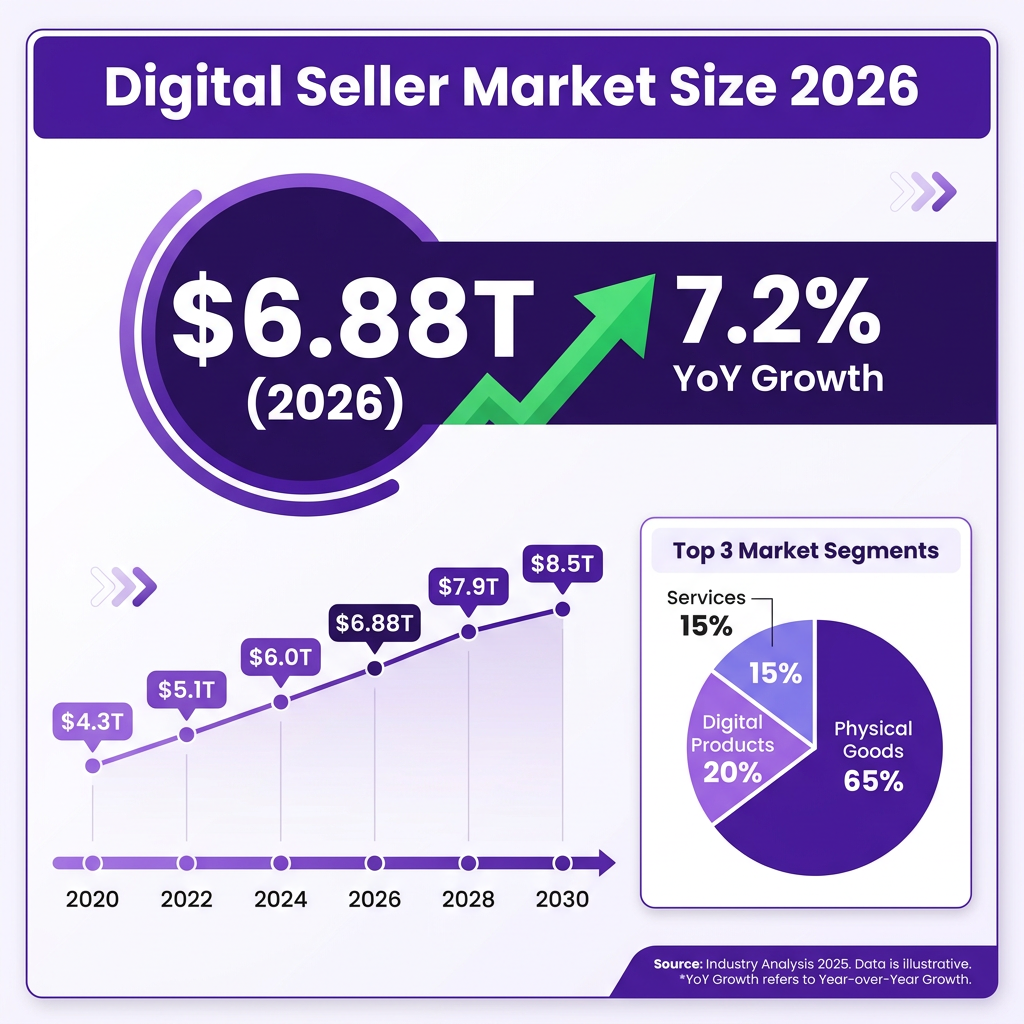
The digital seller landscape has undergone a seismic transformation. In 2026, global e-commerce sales are projected to reach an unprecedented $6.88 trillion, representing a 7.2% year-over-year increase from 2025’s $6.42 trillion figure. With over 2.86 billion digital buyers expected to make purchases online this year, the digital seller ecosystem has become the dominant force in global retail, accounting for more than 20% of total global retail sales.
For entrepreneurs, established businesses, and independent creators, understanding the digital seller landscape in 2026 isn’t optional—it’s survival. The barriers to entry have never been lower, yet the competition has never been fiercer. This comprehensive analysis dives deep into the market data, emerging trends, key players, challenges, and opportunities that define digital selling in 2026.

Market Overview: The $6.88 Trillion E-Commerce Ecosystem
What began as a novel way to sell products through websites has blossomed into a complex, multi-channel ecosystem encompassing everything from social commerce and mobile shopping to AI-powered personalization and cross-border trade. The digital seller market in 2026 represents one of the most dynamic sectors of the global economy, with growth trajectories that continue to outpace traditional retail by significant margins.
The United States e-commerce market alone is expected to reach $1.8 trillion by 2030, representing 29% of all retail sales in the country. This sector’s growth is driven by the digital transformation of procurement processes, the rise of B2B marketplaces, and the increasing comfort of business buyers with online purchasing. The Asia Pacific region continues to dominate the global market with the largest revenue share of 45.0% in 2025, driven by massive populations in China, India, and Southeast Asia embracing digital commerce.
The digital products segment specifically has emerged as a powerhouse within the broader e-commerce ecosystem. Globally, internet users spent over $560 billion on digital media in 2024, up 12.5% year-over-year. The global software market generated revenue of over $742 billion in 2025, a 5.5% increase from 2024. The global mobile app market was valued at $330.6 billion in 2025 and is expected to grow at a CAGR of 14.3% to reach $1.1 trillion by 2034.
According to HTF Market Insights, the global digital products market reached $9.8 billion in 2025 and projects growth to $18.3 billion by 2033. While it is difficult to measure precisely due to the fragmented nature of digital products, the overall market exceeds $600 billion globally when accounting for all digital goods including software, courses, ebooks, templates, and digital media.
The B2B e-commerce segment deserves special attention as it represents the fastest-growing portion of the digital seller ecosystem. The global business-to-business e-commerce market is expected to grow at a CAGR of 14.5 percent through 2026, according to the International Trade Administration. This growth is fueled by the digital transformation of procurement processes, the rise of B2B marketplaces, and the increasing comfort of business buyers with online purchasing.
Key Statistics and Data: The Numbers Behind Digital Selling
The digital seller market is defined by staggering numbers that illustrate both its current dominance and future potential. Understanding these statistics is crucial for anyone looking to enter or expand within this ecosystem. The scale of digital commerce has reached levels that would have seemed impossible just a decade ago, and the trajectory suggests continued expansion across all segments.
Global Market Size: Global e-commerce sales are projected to hit $6.88 trillion in 2026, up 7.2% from the prior year. This represents a continuation of the steady growth trajectory that has defined the industry for the past decade. By 2027, the e-commerce market is projected to exceed $7.9 trillion, with nearly 34% of shoppers engaging in online shopping at least once a week. This growth is not merely a temporary shift caused by external factors—it represents a fundamental restructuring of how commerce happens globally.
Digital Buyer Population: With 2.86 billion digital buyers expected in 2026, nearly 36% of the world’s population will purchase goods and services online this year. User penetration in the e-commerce market will be 54.3% in 2026 and is expected to hit 58.1% by 2030. The number of users is expected to amount to 4.1 billion users by 2030. This massive audience represents virtually every demographic, geography, and interest category, creating opportunities for sellers of all types.
Regional Breakdown: The United States leads in revenue generation with a projected market volume of $1.22 trillion in 2026. The average revenue per user (ARPU) is expected to amount to $1.10k globally. Asia Pacific e-commerce dominated the global market with the largest revenue share of 45.0% in 2025, driven by massive adoption in China, India, and Southeast Asian markets. Europe represents the second-largest regional market, while Latin America and Africa show the fastest growth rates from smaller bases.
Digital Products Specifics: In 2020 alone, 2 billion consumers purchased digital products. Globally, revenue in the digital products space is expected to grow at a CAGR of 6.2%, leading to an estimated market volume of $13.3 billion in 2030. The global video streaming market exceeded $119 billion in 2025. Global revenue in the online games market was $29 billion in 2025, up 5.4% from 2024. These figures demonstrate that digital products have moved from niche to mainstream, with consumers increasingly comfortable paying for intangible goods.
Mobile Commerce: Mobile e-commerce continues to dominate and will account for nearly 60% of all sales in 2026. With mobile sales dominating online purchases, brands must adopt fast, intuitive mobile checkout experiences to remain competitive. The smartphone has become the primary shopping device for most consumers, and sellers who fail to optimize for mobile are effectively excluding themselves from the majority of the market.
Social Commerce: Social commerce grows at 30% per year and is expected to be worth €2.9 trillion by 2026. US social commerce has crossed $100 billion for the first time this year, growing 18% year over year. 83% of consumers discover products via Instagram, making it the platform with the highest social commerce conversion. The integration of shopping into social media platforms has eliminated friction in the discovery-to-purchase journey.
Consumer Behavior: 68% of internet users pay for digital content monthly. Transaction volumes surged nearly 70% between 2022 and 2024, demonstrating the rapid acceleration of digital purchasing behavior. The average person can now launch a professional online store for $500-$2,000 and reach a global audience through platforms like Shopify, WooCommerce, and emerging solutions. This democratization of e-commerce has lowered barriers to entry while increasing competition.
AI in E-commerce: The AI-in-eCommerce market is projected to reach $9.9 billion in 2026, reflecting how seriously businesses are investing in personalization technology. AI referral traffic to eCommerce sites grew twelve times in seven months, and 72% of consumers who use AI for shopping now make it their primary search tool. Artificial intelligence is reshaping every aspect of the seller journey, from inventory management to customer service.
Long-term Projections: According to Juniper Research, the eCommerce market will surpass $13 trillion by 2030 globally. The global e-commerce market size was estimated at USD 33.91 trillion in 2025 and is projected to reach USD 155.98 trillion by 2033, growing at a CAGR of 21.6% from 2026 to 2033 when including all forms of digital commerce. These projections suggest that the digital transformation of commerce is still in its early stages, with decades of growth ahead.
Major Trends Shaping Digital Selling in 2026
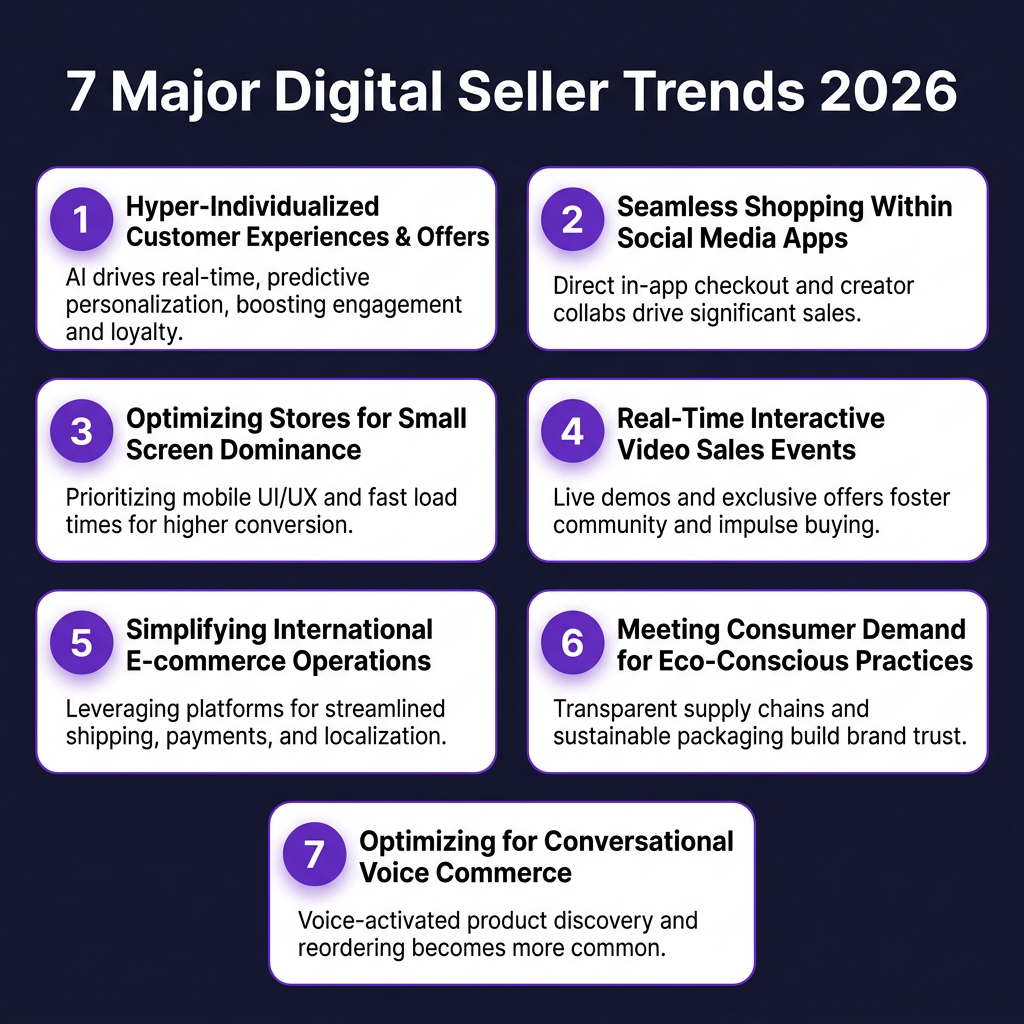
The digital seller landscape is being reshaped by powerful trends that are redefining how businesses connect with customers, process transactions, and build sustainable revenue streams. Understanding these trends is essential for any seller looking to thrive in 2026. The pace of change has accelerated, with new technologies and consumer behaviors emerging faster than ever before.
1. AI-Powered Personalization at Scale
Artificial intelligence has moved from experimental technology to core infrastructure for digital sellers. AI is more than an e-commerce trend—it can make teams more productive and customers more satisfied. Commerce teams have been using the technology for years to automate and personalize product recommendations, chatbot activity, and more. The difference in 2026 is that AI has become accessible to sellers of all sizes, not just enterprise giants.
In 2026, AI agents are poised to become personal shoppers that browse and buy on behalf of consumers. The key for sellers is starting with one area where personalization has the highest impact on revenue—usually product recommendations or post-purchase communication—and expanding from there. Optimizing product data for generative engine optimization (GEO) is the new competitive advantage. Sellers who can make their products discoverable by AI assistants will capture an increasing share of automated purchasing decisions.
The practical applications of AI in e-commerce have expanded dramatically. Dynamic pricing algorithms adjust prices in real-time based on demand, competition, and inventory levels. Visual search allows customers to find products by uploading images rather than typing descriptions. Predictive analytics help sellers anticipate demand fluctuations and optimize inventory accordingly. Customer service chatbots handle routine inquiries 24/7, freeing human agents for complex issues.
2. Social Commerce and Livestream Shopping
Social commerce has evolved from a novelty to a primary revenue channel. In Mexico, TikTok Shop reported an exponential 34x increase in average daily sales just eight months after launch, leveraging Live Videos and Shoppable In-Feed Videos. Livestream selling continues to disrupt the retail landscape, driven by rapid adoption of AI-powered personalization, new social commerce features, and interactive content across major platforms.
Where traditional e-commerce redirects customers to external webshops, buyers can now complete purchases directly within social media platforms. Micro-influencers deliver the best ROI—those with 1,000-100,000 followers have higher engagement than macro-influencers. Average ROI of 300-500% is achievable with well-executed social commerce strategies within 12 months. The authenticity and trust that micro-influencers build with their audiences translate directly to conversion rates.
The livestream shopping phenomenon, which originated in China, has gone global. Platforms now offer integrated shopping experiences where viewers can purchase products featured in live broadcasts with a single tap. This format combines entertainment, social proof, and urgency in ways that traditional e-commerce cannot replicate. Sellers who master livestream commerce are building engaged communities that drive repeat purchases.
3. Mobile-First Shopping Experiences
Mobile commerce isn’t just growing—it’s becoming the default. With mobile sales dominating online purchases, brands must adopt fast, intuitive mobile checkout experiences. This means optimizing for mobile or digital wallet payments, ensuring fast load times, and creating seamless mobile browsing experiences. The mobile experience is no longer a subset of e-commerce—it is e-commerce.
Sellers who fail to prioritize mobile optimization are effectively turning away more than half their potential customers. The mobile-first approach extends beyond just responsive design to encompass mobile-specific features like one-tap purchasing, mobile wallets, and app-based loyalty programs. Progressive web apps (PWAs) have emerged as a cost-effective way to deliver app-like experiences without the friction of app store downloads.
Mobile payment adoption has accelerated dramatically. Digital wallets, buy-now-pay-later options, and one-click checkout have reduced friction in the mobile purchasing process. Sellers who offer multiple payment options and streamline the checkout flow are seeing significant improvements in conversion rates. The expectation of a seamless mobile experience has become universal across all demographics.
4. Cross-Border E-Commerce Expansion
International expansion has become more accessible than ever. Key strategies for international e-commerce expansion in 2026 include selecting the right international markets, tailoring products and services to local preferences, optimizing global payment systems, and ensuring efficient logistics and compliance with international laws. The infrastructure for cross-border selling has matured significantly, reducing the barriers that once limited sellers to domestic markets.
Expanding beyond domestic borders is about meaningful growth embracing diversity, tapping into emerging trends, and finding new customers who genuinely value what you offer. Identifying and supporting the right local payment methods for each developing market will be critical to enabling international merchant growth. Local payment preferences vary dramatically by region, and supporting them can be the difference between success and failure in new markets.
Currency conversion, tax compliance, and shipping logistics have been simplified by platforms and services designed specifically for cross-border sellers. The ability to offer local pricing, display prices in local currencies, and provide transparent shipping costs has become table stakes for international selling. Sellers who invest in localization—from language to cultural nuances—are outperforming those who simply translate their domestic stores.
5. Sustainability and Ethical Branding
Consumers increasingly make purchasing decisions based on environmental and social impact. ESG and sustainability adoption in e-commerce has become a differentiator rather than a nice-to-have. Sellers who can demonstrate genuine commitment to sustainable practices—from carbon-neutral shipping to ethical sourcing—are capturing market share from competitors who ignore these concerns. Sustainability has moved from marketing buzzword to purchase driver.
The Digital Product Passport (DPP) is emerging as a quietly revolutionary change in e-commerce, providing transparency into product origins and environmental impact. Starting with sustainable and environmentally responsible business practices is becoming a baseline expectation. Younger consumers in particular are willing to pay premium prices for products that align with their values.
Carbon-neutral shipping options, sustainable packaging, and transparent supply chains have become competitive advantages. Sellers who can tell authentic stories about their environmental and social impact are building deeper connections with their customers. The rise of resale and circular commerce models reflects growing consumer interest in sustainable consumption patterns.
6. Voice Search and Conversational Commerce
Voice search optimization has become critical as more consumers use voice assistants to shop. E-commerce trends to look out for include voice search alongside virtual and augmented reality, mobile shopping, more payment solutions, AI, and subscription models. The way consumers search for products is evolving, and sellers must adapt their content strategies accordingly.
Sellers need to optimize their product listings and content for voice search queries, which tend to be more conversational and question-based than text searches. This requires a fundamental shift in SEO strategy and product description writing. Natural language processing has improved to the point where voice commerce is becoming practical for routine purchases.
Smart speakers and voice assistants have become common in homes, and consumers are increasingly comfortable making purchases through voice commands. The convenience of reordering household staples or checking order status through voice has driven adoption. Sellers who optimize for voice discovery are positioning themselves for this growing channel.
7. Subscription and Recurring Revenue Models
Subscription models have expanded beyond software and media into physical products, creating predictable revenue streams for sellers. The subscription e-commerce market continues to grow as consumers appreciate the convenience of automated recurring purchases. From meal kits to pet supplies to personal care products, subscriptions have permeated virtually every product category.
For digital sellers specifically, subscription models provide stable cash flow and higher customer lifetime value. From software-as-a-service to membership sites and content subscriptions, recurring revenue has become a cornerstone of sustainable digital businesses. The predictability of subscription revenue makes business planning easier and increases company valuations.
The key to successful subscription models is delivering ongoing value that justifies the recurring charge. Sellers who treat subscriptions as relationships rather than transactions are seeing higher retention rates. Flexibility in subscription management—easy pausing, customization, and cancellation—has become essential for customer satisfaction.
Key Players and Competitive Landscape
The digital seller ecosystem is dominated by several massive platforms, but the landscape is more nuanced than it might appear at first glance. Understanding the competitive dynamics between these players is crucial for sellers choosing where to build their businesses. Each platform offers distinct advantages and trade-offs that sellers must evaluate based on their specific circumstances.
Amazon: The Undisputed Giant
Amazon leads globally with a $2.4 trillion market cap, controlling over 40% of the US eCommerce market and generating $690 billion in GMV. Amazon held rank 1 every single day of Q1 2026 according to Cloudflare Radar traffic data. With a market cap of over two trillion U.S. dollars, Amazon ranks first among the leading large-cap e-commerce companies worldwide. The scale of Amazon’s operation is unmatched in the industry.
For third-party sellers, Amazon represents both opportunity and risk. The platform provides access to hundreds of millions of customers but at the cost of significant fees and limited control over the customer relationship. Amazon’s dominance in logistics and fulfillment sets the standard that other platforms must match. The Fulfillment by Amazon (FBA) program has enabled countless sellers to offer Prime shipping without maintaining their own warehouses.
However, Amazon’s marketplace has become increasingly competitive, with rising advertising costs and algorithm changes that can dramatically impact seller visibility. Many successful Amazon sellers are diversifying to other channels while maintaining their Amazon presence. The platform remains essential for many categories but is no longer the only path to e-commerce success.
Shopify: Empowering Independent Sellers
Shopify has emerged as the champion of independent sellers and direct-to-consumer brands. Together, Amazon and Shopify control 49.7% of US e-commerce in 2026. Shopify’s platform enables entrepreneurs to build professional online stores without technical expertise, and its ecosystem of apps and integrations provides flexibility that marketplace selling cannot match. The company’s mission to make commerce better for everyone has resonated with millions of merchants.
Shopify’s growth reflects a broader trend: sellers increasingly want to own their customer relationships rather than renting access to them through marketplaces. The platform’s focus on enabling independent commerce has made it the go-to choice for brands building sustainable, long-term businesses. Shopify Payments, Shopify Shipping, and Shopify Fulfillment Network have created an integrated ecosystem that rivals Amazon’s convenience.
The Shopify App Store offers thousands of integrations that extend platform functionality, from email marketing to inventory management to customer service. This extensibility allows sellers to customize their tech stack to their specific needs. Shopify’s recent moves into B2B commerce and point-of-sale systems demonstrate its ambition to serve merchants across all channels.
Alibaba: The APAC Powerhouse
Alibaba ($378B market cap) dominates China and APAC with massive livestream commerce ($84B GMV in one day during Singles’ Day). While less relevant for Western sellers, Alibaba’s influence on global e-commerce cannot be overstated. The company’s innovations in livestream shopping and social commerce are being replicated worldwide. Alibaba’s platforms connect manufacturers, wholesalers, and consumers in ways that have transformed global trade.
For sellers looking to source products or enter Asian markets, Alibaba’s various platforms offer unmatched access. AliExpress has become a significant player in cross-border e-commerce, while Taobao and Tmall dominate Chinese domestic commerce. The company’s logistics arm, Cainiao, has built a global network that rivals traditional shipping carriers.
Emerging Players and Regional Champions
The e-commerce landscape extends far beyond the big three. Emerging leaders like Shopee and MercadoLibre lead mobile-first, gamified, and fintech-driven markets in Southeast Asia and Latin America. Temu has expanded globally with aggressive pricing and DTC strategies, disrupting established players. These regional champions often understand local markets better than global players, giving them significant advantages.
Walmart has re-emerged in the General E-Commerce top 10, leveraging its physical store network for omnichannel advantages. Trendyol has risen to #2 globally in Fast Fashion, demonstrating the rise of regional specialists. DHgate has locked in at Low-Cost #5, serving price-sensitive consumers worldwide. The diversity of successful platforms demonstrates that e-commerce is not a winner-take-all market.
Etsy has carved out a dominant position in handmade and vintage goods, while StockX and GOAT have created massive marketplaces for sneakers and collectibles. These specialized platforms demonstrate the power of focus over breadth. Sellers who find the right platform for their specific products often achieve better results than those spreading themselves across every available channel.

Challenges and Pain Points for Digital Sellers
Despite the massive opportunities, digital sellers face significant challenges that can make or break their businesses. Understanding these pain points is the first step toward overcoming them. The same forces that have made e-commerce accessible to everyone have also intensified competition and raised customer expectations.
1. Meeting Elevated Customer Expectations
Smaller businesses face the challenge of matching the expectations set by Amazon and other giants. Customers now expect fast, free shipping, seamless returns, and personalized experiences regardless of the seller’s size. The eCommerce fulfillment services market has grown rapidly, reflecting how much businesses invest to meet customer delivery expectations. Meeting these expectations requires significant investment in logistics and technology.
Knowing what other businesses are doing regarding pricing, product offerings, marketing strategies, and customer service helps sellers make decisions about how to position themselves in the marketplace. The competitive intelligence required to stay relevant has become a significant operational burden. Sellers must constantly monitor competitors while maintaining focus on their own value proposition.
The expectation of free and fast shipping has put pressure on margins across the industry. Many sellers struggle to offer shipping speeds that compete with Amazon Prime while maintaining profitability. Creative solutions, such as minimum order thresholds for free shipping or strategic warehouse placement, have become essential for competing on delivery speed.
2. Demand Uncertainty and Inventory Management
Uncertainty around whether demand will hold represents a major challenge for e-commerce brands in 2026. New capital requirements as inventory fluctuates create cash flow pressures, particularly for smaller sellers. Bifurcated consumer spending—where some segments spend freely while others cut back—makes demand forecasting increasingly difficult. The economic uncertainty of recent years has made inventory planning a high-stakes exercise.
Overstocking ties up capital and can lead to discounting that damages margins, while understocking results in lost sales and disappointed customers. The rise of just-in-time manufacturing and dropshipping has helped some sellers reduce inventory risk, but these approaches come with their own challenges around quality control and margins. Finding the right balance requires sophisticated demand forecasting and flexible supply chain relationships.
3. Digital Transformation Complexity
Nine critical digital transformation challenges face e-commerce businesses: legacy system integration, data silos, organizational resistance to change, skills gaps, cybersecurity concerns, compliance requirements, platform selection, customer experience consistency, and scaling operations efficiently. The technology stack required to run a modern e-commerce business has become increasingly complex.
Modern commerce platforms built for transformation create sustained value over time, but migrating to these platforms requires significant investment and expertise. Organizations with complex requirements need solutions that support headless implementations through robust APIs, allowing teams to unify back-end operations while customizing front-end experiences. The technical debt accumulated by older systems can become a significant competitive disadvantage.
Cybersecurity has become a critical concern as e-commerce businesses handle increasing volumes of sensitive customer data. The cost of data breaches extends beyond immediate financial losses to include reputational damage and regulatory penalties. Sellers must invest in security infrastructure and practices while maintaining the seamless user experiences that customers expect.
4. Cart Abandonment and Conversion Optimization
Cart abandonment remains a persistent challenge, with mobile users particularly likely to abandon purchases if the checkout experience is friction-filled. Sellers must offer mobile-optimized user experiences and make use of various e-commerce marketing tools to examine their websites and obtain fresh perspectives for upcoming enhancements. The average cart abandonment rate across e-commerce remains above 70%, representing massive lost revenue.
Building customer trust is essential. There are steps to overcome this e-commerce business challenge and guarantee that customers feel secure when shopping: clear return policies, secure payment options, customer reviews, and transparent pricing including all fees upfront. Unexpected costs at checkout, particularly shipping fees, remain the primary driver of cart abandonment.
Email recovery campaigns, retargeting ads, and exit-intent offers have become standard tools for combating cart abandonment. However, the most effective approach is preventing abandonment in the first place through streamlined checkout processes and transparent pricing. Guest checkout options, multiple payment methods, and progress indicators can all reduce friction in the purchase process.
Opportunities and Growth Strategies
For sellers who can navigate the challenges, the opportunities in 2026 are substantial. Here are the key strategies driving growth for successful digital sellers. The sellers who thrive are those who combine strategic focus with operational excellence and genuine customer obsession.
1. Niche Specialization
In 2026, the most successful eCommerce entrepreneurs focus on underserved niches where they can build brand loyalty, command premium pricing, and develop defensible market positions. Rather than competing on commodity items sold by Amazon and Walmart, successful sellers identify specific customer problems and solve them through carefully curated product offerings. The long tail of e-commerce has never been more accessible.
This shift creates exceptional opportunities for thoughtful entrepreneurs willing to go deep on specific customer segments. The average person can now launch a professional online store for $500-$2,000, but success requires differentiation that goes beyond price. Sellers who become true experts in their niche can offer value that generalist competitors cannot match.
Niche specialization also enables more efficient marketing. Rather than competing for broad keywords with massive budgets, niche sellers can target specific communities and long-tail search terms. Content marketing becomes more effective when directed at a well-defined audience with specific interests and pain points.
2. AI-Driven Efficiency
E-commerce growth in 2026 belongs to businesses that optimize fundamentals, execute with clarity, and focus on efficiency over volume. AI can drive product recommendations based on past behavior, boosting Average Order Value (AOV) and engagement. The businesses that successfully implement AI tools for automation, customer service, and personalization are achieving operational efficiencies that translate directly to competitive advantage.
Use AI to drive product recommendations based on past behavior, boosting Average Order Value (AOV) and engagement. The businesses that successfully implement AI tools for automation, customer service, and personalization are achieving operational efficiencies that translate directly to competitive advantage. AI-powered tools can handle routine tasks, freeing human team members to focus on higher-value activities.
Beyond customer-facing applications, AI is transforming backend operations. Demand forecasting, inventory optimization, and pricing strategy can all be enhanced with machine learning. Sellers who leverage these tools effectively can operate with leaner teams while delivering better results than competitors relying on manual processes.
3. Marketplace Diversification
2026 will be a defining year for brands and sellers navigating marketplace expansion. Success requires more than just adding new sales channels—it demands strategic selection of platforms that align with the brand’s target customers and operational capabilities. Each marketplace has its own audience, fee structure, and competitive dynamics that must be understood.
From the rise of AI-powered shopping to the hidden costs of multichannel complexity, success requires understanding the structural shifts in how consumers discover and purchase products. Every brand and seller must adapt, compete, and grow sustainably in 2026 by carefully selecting which marketplaces deserve their investment. Spreading too thin across too many channels can be as damaging as relying on a single platform.
Successful multi-channel sellers develop platform-specific strategies rather than simply replicating their Amazon listings everywhere. Each marketplace has unique search algorithms, customer expectations, and promotional opportunities. Investment in platform expertise pays dividends in the form of higher visibility and conversion rates.
Case Study 1: TikTok Shop’s Explosive Growth in Mexico
In Mexico, TikTok Shop reported an exponential 34x increase in average daily sales just eight months after launch, leveraging Live Videos and Shoppable In-Feed Videos. This success demonstrates the power of social commerce when combined with localized strategies and platform-native content. The growth rate represents one of the fastest platform adoption curves in e-commerce history.
The key lessons: meet customers where they already spend time, make purchasing frictionless, and leverage the unique features of each platform. TikTok Shop’s success wasn’t about replicating traditional e-commerce—it was about creating a native shopping experience within entertainment content. The integration of shopping into the content consumption experience eliminated the traditional funnel friction.
Sellers who have embraced TikTok Shop early have benefited from lower competition and algorithm favoritism toward new features. The platform’s emphasis on authentic, creator-driven content has leveled the playing field between established brands and emerging sellers. Success on TikTok Shop requires understanding the platform’s unique culture and content formats.
Case Study 2: From Hobby to $4,000/Month Business
Noah Kagan helped Daniel Bliss, a postal worker, turn his hobby into a real eCommerce business making $4,000 a month. The case study demonstrates how individuals with deep domain expertise in their fields can build successful online businesses by identifying specific customer needs. This transformation from side hobby to substantial income represents the dream that draws many to digital selling.
The biggest business problem most entrepreneurs face is making the jump to entrepreneurship without understanding that many successful entrepreneurs had built up deep domain expertise before starting a company. This case illustrates the power of starting with expertise and finding the market fit. The product-market fit was achieved not through extensive market research but through deep understanding of a specific customer problem.
The journey from first sale to consistent $4,000 monthly revenue involved iterative product improvement, customer feedback integration, and gradual marketing expansion. The business was built on a foundation of genuine expertise rather than trend-chasing, providing resilience against competitive pressure. This case demonstrates that sustainable e-commerce businesses can be built around passion and expertise.
Case Study 3: Micro-Influencer Driven Growth
Brands leveraging micro-influencers with 1,000-100,000 followers are achieving higher engagement than macro-influencers, with average ROI of 300-500% within 12 months. These success stories demonstrate that influencer marketing at scale doesn’t require celebrity budgets. The authenticity and trust that micro-influencers have built with their audiences translate directly to conversion rates.
The replication of physical shopping experiences in online stores has led companies to improve customer satisfaction and conversion rates. By treating social commerce as relationship-building rather than pure advertising, successful sellers are creating sustainable growth engines. Micro-influencers often have highly engaged niche audiences that align perfectly with specific product categories.
Successful micro-influencer campaigns focus on long-term partnerships rather than one-off posts. When influencers genuinely integrate products into their content over time, the recommendations carry more weight with their audiences. The most effective campaigns give influencers creative freedom rather than dictating specific messaging.
Future Outlook and Predictions (2026-2030)
The digital seller market will continue its rapid evolution through the remainder of this decade. Here are the key projections that should inform strategic planning. The sellers who thrive will be those who anticipate these changes and position themselves accordingly.
Market Growth Trajectory
By 2028, online retail is projected to account for 23.7% of total retail sales globally. US e-commerce sales will reach $1.8 trillion by 2030, though over 70% of retail sales will still come from physical stores. The eCommerce market will surpass $13 trillion by 2030 globally according to Juniper Research. These figures suggest that while e-commerce will continue growing, physical retail will remain significant.
Historical data from 2015 to 2024 and forecast data from 2025-2030 show total retail rising from $3.1T in 2015 to a forecasted $6.2T in 2030, in-store sales increasing to $4.4T, and US retail e-commerce reaching $1.8T, or 29% of total retail. The growth of e-commerce doesn’t mean the death of physical retail—it means an increasingly integrated commerce landscape.
Technology-Driven Transformation
AI agents will become standard shopping assistants, handling everything from product research to purchase execution. Virtual and augmented reality will transform product visualization, particularly for furniture, fashion, and home goods. Voice commerce will become a significant channel as smart speaker adoption continues. The technology that seems experimental today will become baseline expectation within years.
The global e-commerce market is projected to reach USD 155.98 trillion by 2033, growing at a CAGR of 21.6% from 2026 to 2033 when including all forms of digital commerce. This growth will be driven by rapid expansion of internet penetration and smartphone adoption, particularly in emerging economies across Asia Pacific, Latin America, and Africa. The next billion online consumers will come primarily from these regions.
Evolving Consumer Expectations
As consumer expectations rise and digital technologies evolve rapidly, online selling is changing faster than ever. Success will depend on personalized experiences, smart use of emerging technologies, and a strong customer-first approach. The digital transformation of commerce is not a one-time event but a continuous process of adaptation. Sellers must build organizational capabilities for continuous change.
Retailers’ top five initiatives center on enhancing the in-store experience through technology, reflecting the omnichannel reality that digital and physical commerce are increasingly indistinguishable from the customer’s perspective. The boundary between online and offline will continue to blur, with successful sellers delivering seamless experiences across all touchpoints.
Key Takeaways
- Massive Market Opportunity: The $6.88 trillion global e-commerce market in 2026 represents unprecedented opportunity for digital sellers of all sizes, with 2.86 billion digital buyers worldwide.
- Mobile-First Imperative: With nearly 60% of sales happening on mobile devices, optimizing for mobile commerce is no longer optional—it’s essential for survival.
- AI as Competitive Advantage: Sellers leveraging AI for personalization, customer service, and operational efficiency are achieving 300-500% ROI and creating sustainable competitive advantages.
- Social Commerce Explosion: Social commerce growing at 30% annually and crossing $100 billion in the US demonstrates the power of meeting customers where they already spend time.
- Niche Over Commodity: Success in 2026 belongs to sellers who specialize in underserved niches rather than competing on price with Amazon and Walmart.
Sources and Citations
- Quantumrun – E-commerce Business Statistics 2026
- Craftberry – Global eCommerce Statistics 2025/2026
- Grand View Research – E-commerce Market Size Report
- Statista – eCommerce Worldwide Market Forecast
- Whop – 100+ Digital Products Statistics for 2026
- Swell – 32 Digital Product Sales Statistics
- DesignRush – Top eCommerce Companies 2026
- NovaData – Amazon and Shopify Control 50% of US E-Commerce
- TechnologyChecker – Ecommerce Marketplace Market Share Q1 2026
- eDesk – Top 5 eCommerce Challenges 2026
- Forbes – 4 Key Challenges Facing Consumer E-Commerce Brands
- Coursera – E-Commerce Trends for 2026
- Publicis Sapient – 8 Trends Accelerating the Future of E-Commerce
- Juniper Research – eCommerce Market to Surpass $13 Trillion by 2030
- Forrester – US Retail E-Commerce Forecast 2025-2030
- LinkedIn/Bernard Marr – 7 E-Commerce Trends Transforming Shopping
- LA Times – Social Commerce Trends 2026
- ClickForest – Social Commerce Strategies 2026
- GenAIEmbed – Social Commerce Strategy 2026
- Pinnacle Growth Consulting – Global E-commerce Expansion Strategies
- Tidio – 15 Best Ecommerce Case Studies
- MobileAppDevelopmentCompany – Profitable eCommerce Business Ideas 2026