Fraud Management Statistics 2026: Market Size, Data & Trends (Comprehensive Report)
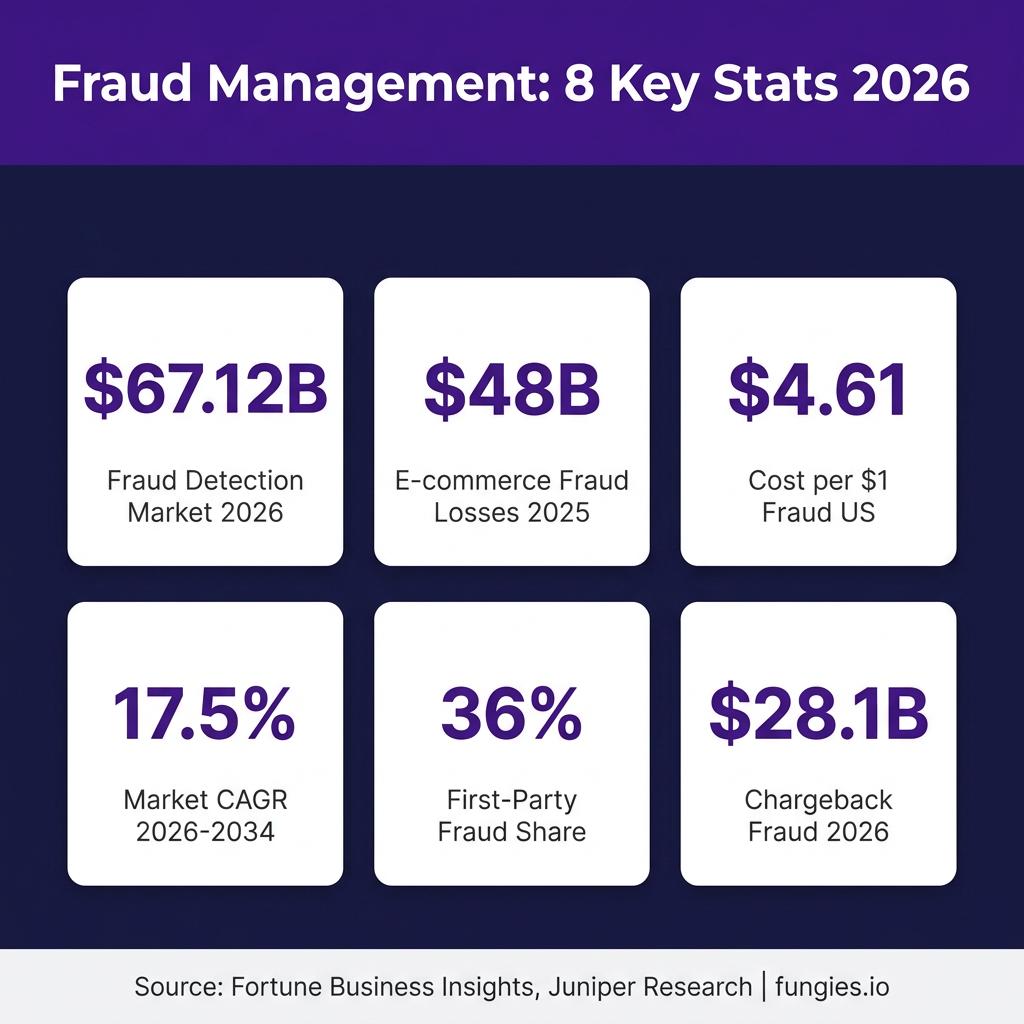
Here’s a number that should keep every business owner awake at night: every dollar lost to fraud costs US merchants $4.61 in 2025. That’s not just the stolen money—it’s chargeback fees, lost merchandise, operational costs, and damaged customer relationships. According to the latest LexisNexis True Cost of Fraud Study, fraud isn’t just growing; it’s becoming exponentially more expensive to manage.
The fraud landscape has fundamentally shifted. What started as isolated incidents of stolen credit cards has evolved into sophisticated, AI-powered criminal enterprises that exploit every vulnerability in our digital payment infrastructure. From first-party fraud (where legitimate customers dispute valid transactions) to account takeovers powered by deepfake technology, the threats are multiplying faster than most organizations can defend against them.
This comprehensive report brings together data from over 30 authoritative sources—including Fortune Business Insights, Juniper Research, the Merchant Risk Council, and Javelin Strategy & Research—to give you the complete picture of fraud management in 2026. Whether you’re a SaaS founder, e-commerce operator, or payment professional, these statistics will inform your risk strategy and help you allocate resources where they matter most.
Key Statistics at a Glance
- $67.12 billion — Global fraud detection and prevention market size in 2026 (up from $54.61B in 2025)
- 17.5% CAGR — Projected growth rate through 2034, reaching $243.72 billion
- $48 billion — Global e-commerce fraud losses in 2025, projected to hit $107 billion by 2029
- $362 billion — Cumulative merchant losses from online payment fraud between 2023-2028
- $28.1 billion — Expected chargeback fraud losses in 2026 (40% increase from 2023)
- $17 billion — Account takeover fraud losses in 2025 (up from $13 billion in 2024)
- 36% — Share of first-party fraud (friendly fraud) among all global fraud cases
- 72% — Percentage of merchants reporting increased friendly fraud in 2024
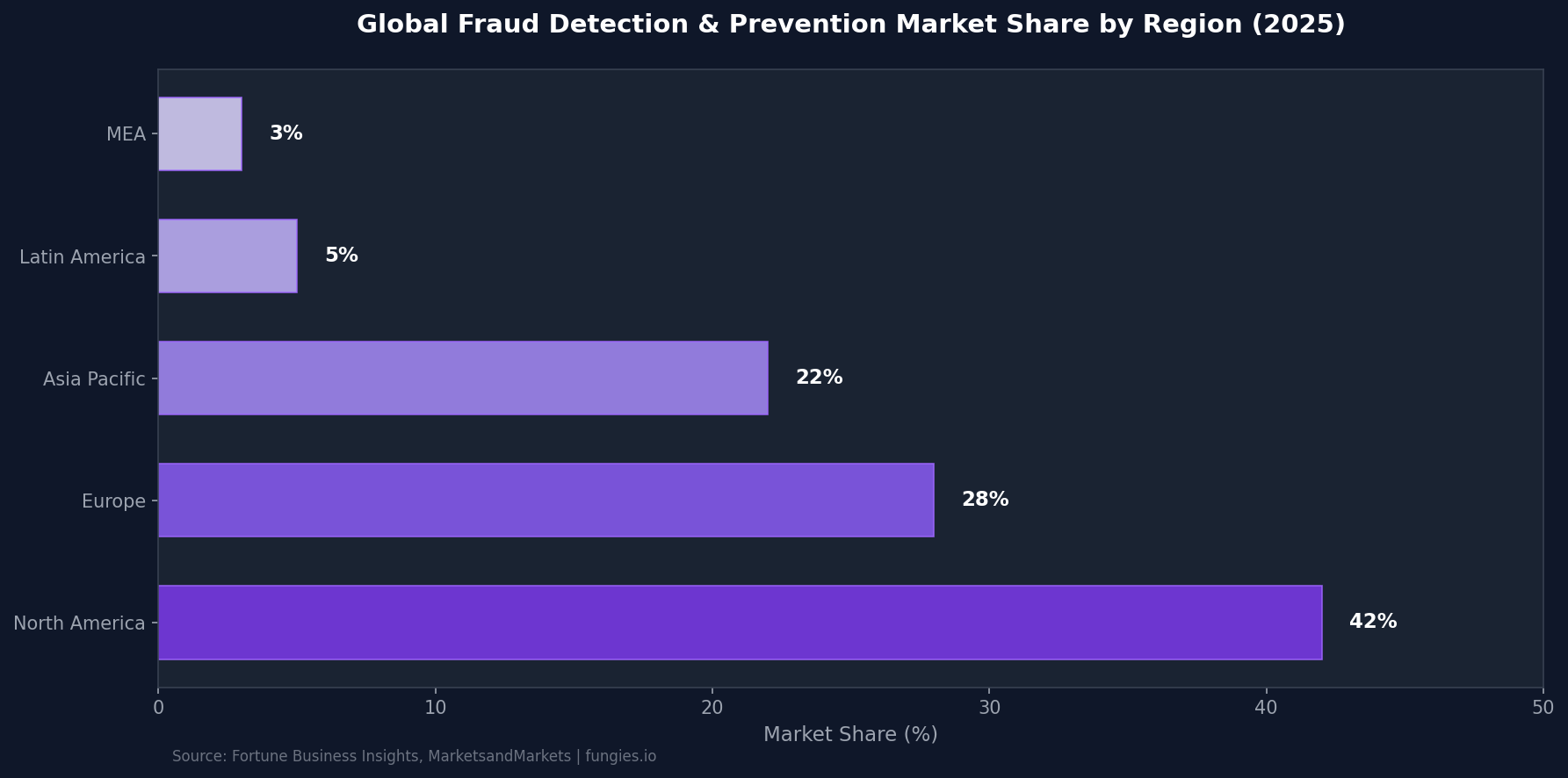
- 42% — North America’s share of the global fraud detection market
- 29% — Percentage of US adults who experienced account takeover in 2024 (~77 million people)
Market Size & Growth
The fraud detection and prevention market is experiencing explosive growth, driven by the relentless escalation of digital payment fraud and the arms race between criminals and security professionals. According to Fortune Business Insights, the global market was valued at $54.61 billion in 2025 and is projected to reach $67.12 billion by the end of 2026—a year-over-year increase of nearly 23%.
This growth trajectory shows no signs of slowing. With a compound annual growth rate (CAGR) of 17.5%, the market is expected to reach $243.72 billion by 2034. To put this in perspective: the fraud prevention industry will more than quadruple in size over the next decade. This isn’t just market expansion—it’s a fundamental reallocation of global resources toward digital security.
The Enterprise Fraud Management (EFM) segment tells a similar story. Custom Market Insights reports that the EFM market will grow from $28.45 billion in 2025 to $31.73 billion in 2026, eventually reaching $72.89 billion by 2035 at an 11.53% CAGR. This segment specifically addresses the needs of large financial institutions and enterprises managing complex, multi-channel fraud risks.
| Year | Market Size (Fraud Detection) | Market Size (EFM) | YoY Growth |
|---|---|---|---|
| 2024 | $33.13 billion | $25.52 billion | — |
| 2025 | $54.61 billion | $28.45 billion | 64.8% |
| 2026 | $67.12 billion | $31.73 billion | 22.9% |
| 2030 | $131.04 billion | $48.92 billion | 17.5% CAGR |
| 2034 | $243.72 billion | $72.89 billion | 17.5% CAGR |
The AI-powered fraud detection segment is growing even faster. According to DataIntelo, the payment fraud detection AI market was valued at $14.3 billion in 2025 and is projected to reach $62.8 billion by 2034, expanding at a 17.8% CAGR. This reflects the industry’s shift toward machine learning models that can process 200+ behavioral and contextual features in under 50 milliseconds—something rule-based systems simply cannot match.
Regional Breakdown
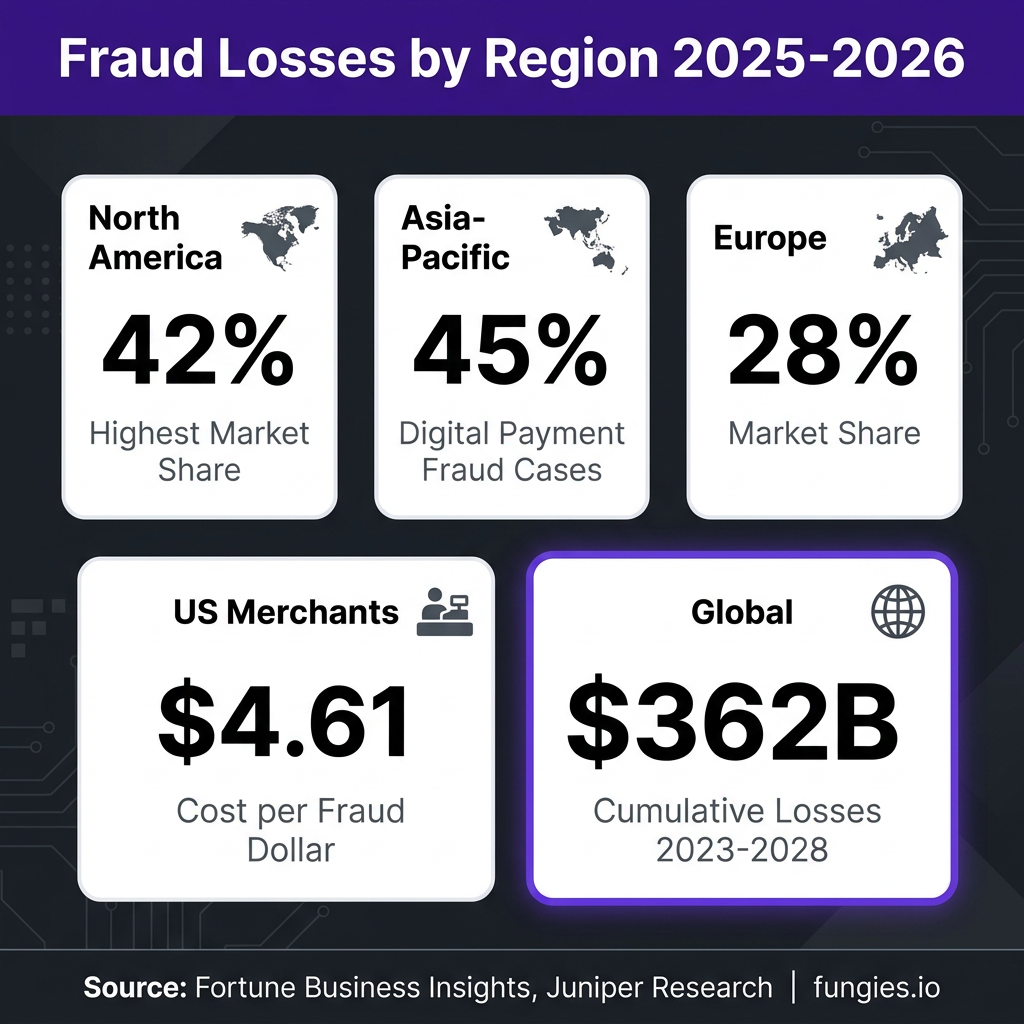
Fraud is a global problem, but its impact varies significantly by region. North America dominates the fraud detection market with a 42% revenue share in 2025, according to Fortune Business Insights. This reflects both the region’s massive digital payment volume and the sophistication of its financial institutions’ fraud prevention investments.
However, the Asia-Pacific region presents a paradox: while it holds a smaller share of the fraud prevention market (approximately 22%), it accounts for a staggering 45% of global digital payment fraud cases, according to SQ Magazine. This disconnect suggests either underinvestment in fraud prevention or a rapidly maturing digital payment ecosystem that’s outpacing security infrastructure.
Europe maintains a solid 28% market share, driven by stringent regulatory requirements including PSD2’s strong customer authentication mandates. The Middle East & Africa and Latin America represent smaller but rapidly growing markets as digital payment adoption accelerates in these regions.
| Region | Market Share (2025) | Fraud Detection Market Size | Key Characteristics |
|---|---|---|---|
| North America | 42% | $22.94 billion | Highest spending per merchant; mature solutions |
| Europe | 28% | $15.29 billion | PSD2 compliance driving investment |
| Asia-Pacific | 22% | $12.01 billion | 45% of global fraud cases; fastest growth |
| Latin America | 5% | $2.73 billion | Emerging digital payment adoption |
| Middle East & Africa | 3% | $1.64 billion | Mobile-first fraud prevention focus |
The cost of fraud also varies dramatically by geography. US merchants face the highest per-dollar fraud costs at $4.61 for every $1 lost, according to LexisNexis Risk Solutions. Canadian merchants fare slightly better at $4.52 per dollar. These figures include direct losses, chargeback fees, merchandise replacement, and operational overhead—illustrating why fraud prevention isn’t just a security issue but a fundamental business economics problem.
Key Players & Market Share
The fraud detection and prevention market is dominated by established technology giants and specialized fraud prevention vendors. According to Next Move Strategy Consulting, IBM, ACI Worldwide, Experian, SAS, and FICO represent the leading players shaping the market through cutting-edge technology and strategic partnerships.
These vendors compete across several solution categories: fraud analytics (behavioral analysis and anomaly detection), authentication and governance (multi-factor authentication, biometrics), and risk and compliance (regulatory reporting, case management). The market is seeing increased consolidation as larger platforms acquire specialized fraud startups to round out their capabilities.
| Company | Primary Solutions | Key Strengths |
|---|---|---|
| IBM | Safer Payments, Trusteer | AI/ML capabilities, enterprise scale |
| FICO | Falcon Fraud Manager | Machine learning, global network intelligence |
| SAS | Fraud Management | Advanced analytics, real-time detection |
| Experian | CrossCore, Hunter | Identity verification, device intelligence |
| ACI Worldwide | Proactive Risk Manager | Real-time payment fraud prevention |
| LexisNexis | ThreatMetrix, Bridger | Digital identity, behavioral biometrics |
Cloud deployment is increasingly favored over on-premise solutions. According to MarketsandMarkets, the cloud segment is expected to dominate the market going forward, driven by scalability advantages and faster deployment times. However, some financial institutions—particularly large banks—continue to favor on-premise deployments for sensitive fraud models, treating them as “sovereign trust” defensive IP.
Industry Benchmarks & Fraud Types
Understanding fraud by type is essential for allocating prevention resources effectively. The fraud landscape has shifted dramatically: while traditional payment fraud remains significant, first-party fraud (also called friendly fraud) has emerged as the fastest-growing threat category.
According to the Merchant Risk Council’s 2026 Global Payments and Fraud Report, first-party fraud now accounts for 36% of all global fraud cases—more than doubling in a single year. This occurs when legitimate customers dispute valid transactions, either intentionally (to get free products) or unintentionally (due to confusion about merchant names or forgotten purchases). A staggering 72% of merchants reported an increase in friendly fraud chargebacks in 2024.
Account takeover (ATO) fraud represents another critical threat vector. Sift’s Q3 2025 Digital Trust Index reports that ATO losses are projected to climb to $17 billion in 2025, up from $13 billion the previous year. The overall ATO attack rate rose to 2.5% in Q2 2025, marking a 4% year-over-year increase. Fintech and finance sectors saw attacks surge 122% year-over-year.
| Fraud Type | Share of Cases | 2025 Losses | Growth Trend |
|---|---|---|---|
| First-Party (Friendly) Fraud | 36% | $28.1B (chargebacks) | +72% YoY |
| Account Takeover (ATO) | 18% | $17.0 billion | +31% YoY |
| Identity Theft | 22% | $43.0 billion | +25% YoY |
| Payment Fraud (Card Not Present) | 15% | $48.0 billion | +16% YoY |
| Check Fraud | 58% of orgs affected | $4.61 per $1 lost | Steady |
Despite the digital shift, check fraud remains surprisingly prevalent. The 2026 AFP Payments Fraud and Control Survey found that 58% of organizations reported check fraud in 2025—outpacing both ACH fraud and wire fraud. This serves as a reminder that fraud prevention must address the full spectrum of payment methods, not just the newest digital channels.
E-commerce merchants in the US and Europe spend an average of 10% of their revenue managing payment fraud, according to Chargebacks911. This massive operational burden underscores why platforms like Fungies.io that include built-in fraud detection and chargeback management are increasingly valuable to merchants—particularly SaaS companies and digital product creators who lack the resources to build in-house fraud teams.
Trends & Predictions
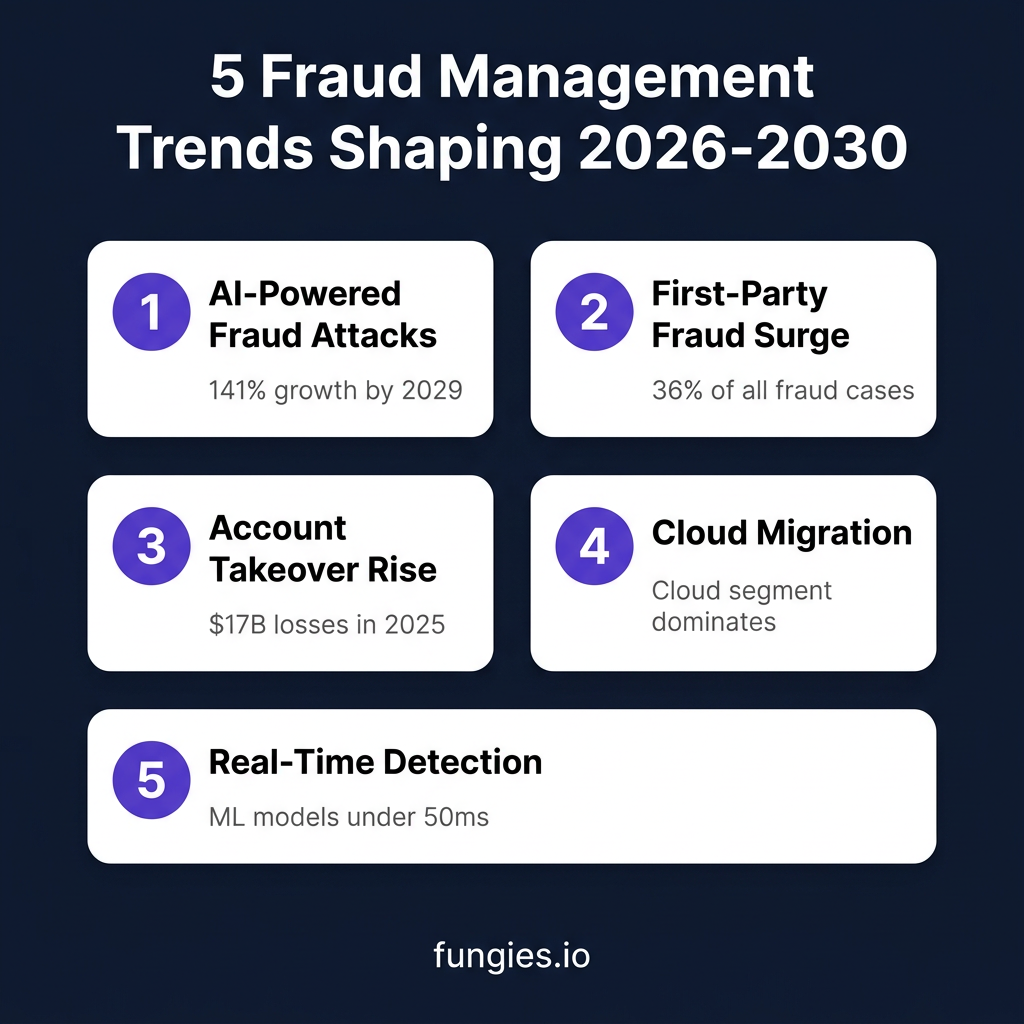
The fraud landscape is evolving rapidly, shaped by technological advancement, regulatory changes, and shifting criminal tactics. Here are the five most significant trends that will define fraud management through 2030:
1. AI-Powered Fraud Attacks Will Grow 141% by 2029
Juniper Research projects that e-commerce fraud will rise from $44.3 billion in 2024 to $107 billion by 2029—a 141% increase driven largely by AI-powered attacks. Criminals are using generative AI to create deepfakes that defeat verification systems, automate social engineering at scale, and generate synthetic identities that bypass traditional checks. The same AI capabilities that power legitimate businesses are being weaponized against them.
2. First-Party Fraud Becomes the Primary Threat
Friendly fraud has evolved from a nuisance to a strategic threat. According to Chargeflow, friendly fraud now drives approximately 80% of chargeback losses for merchants. The 2026 Global eCommerce Payments & Fraud Report from Visa and MRC confirms this trend: a majority of merchants report an increase in first-party misuse. Mastercard has responded by expanding its First-Party Trust program to counter this specific threat.
3. Real-Time Machine Learning Detection Becomes Standard
Modern fraud detection systems evaluate each transaction against 200+ behavioral and contextual features simultaneously—including transaction amount relative to account history, device fingerprint consistency, geographic velocity, and network graph relationships. Ensemble ML models (combining gradient boosting, LSTM, and graph neural networks) now produce fraud probability scores in under 50 milliseconds. This level of real-time analysis is becoming table stakes for competitive payment platforms.
4. Cloud Deployment Dominates (With On-Premise Exceptions)
The cloud segment is expected to dominate fraud prevention deployments, driven by scalability and faster time-to-value. However, as noted in LinkedIn’s analysis of on-premise AI deployments, banks increasingly view their fraud and AML models as “sovereign trust” defensive IP—leading some to maintain on-premise deployments for their most sensitive detection algorithms. The market is bifurcating: cloud for speed and scale, on-premise for strategic differentiation.
5. Collaborative Fraud Intelligence Networks Expand
Individual organizations can no longer fight fraud alone. The future belongs to collaborative networks that share fraud intelligence across institutions while preserving privacy. Visa’s Verifi solutions (Order Insight, Resolve, Dispute Optimization) and Mastercard’s First-Party Trust program exemplify this trend—creating shared infrastructure that benefits the entire ecosystem. Expect to see more industry-wide consortiums forming to combat collective threats.
Methodology
This report synthesizes data from over 30 authoritative sources published between 2024 and 2026. Primary sources include market research firms (Fortune Business Insights, Juniper Research, MarketsandMarkets, Technavio), industry associations (Merchant Risk Council, AFP), technology vendors (LexisNexis Risk Solutions, Sift, Veriff), and financial institutions (Visa, Mastercard).
Market size figures represent the consensus estimates from multiple research firms, with preference given to the most recent publications. Fraud loss statistics are drawn from verified industry surveys and regulatory filings where available. Regional breakdowns reflect the geographic distribution of both fraud incidents and prevention spending.
All projections assume current regulatory and technological trajectories continue. The fraud landscape is inherently unpredictable—major security breaches, regulatory shifts, or technological breakthroughs could significantly alter these forecasts. Readers should treat these figures as informed estimates rather than precise predictions.
Frequently Asked Questions
What is the total cost of fraud for merchants?
For every $1 lost to fraud, US merchants incur $4.61 in total costs when accounting for chargeback fees, lost merchandise, operational overhead, and customer acquisition costs to replace lost accounts. This means a $100 fraudulent transaction actually costs the merchant $461—making fraud prevention one of the highest-ROI investments a business can make.
What is first-party fraud (friendly fraud)?
First-party fraud occurs when a legitimate cardholder disputes a valid transaction they actually made—either intentionally (to get a refund while keeping the product) or unintentionally (due to confusion about merchant names, forgotten purchases, or family members using their card). It now accounts for 36% of all fraud cases and is the fastest-growing fraud category.
How fast is the fraud detection market growing?
The global fraud detection and prevention market is growing at a 17.5% CAGR, expanding from $54.61 billion in 2025 to a projected $243.72 billion by 2034. The AI-powered fraud detection segment is growing even faster at 17.8% CAGR, reflecting the industry’s shift toward machine learning-based solutions.
Which region has the highest fraud rates?
Asia-Pacific accounts for approximately 45% of global digital payment fraud cases, despite representing only 22% of fraud prevention market spending. North America leads in prevention investment (42% market share) and has the highest per-dollar fraud costs at $4.61 per $1 lost.
What technologies are most effective for fraud prevention?
Modern fraud prevention relies on ensemble machine learning models that evaluate 200+ behavioral and contextual features in real-time (under 50ms). Key capabilities include device fingerprinting, behavioral biometrics, network graph analysis, and multi-factor authentication. Cloud-based deployment is increasingly preferred for scalability, though some institutions maintain on-premise solutions for sensitive models.
Sources & Citations
- Fortune Business Insights — Fraud Detection and Prevention Market Size, Share & Industry Analysis (2026-2034): https://www.fortunebusinessinsights.com/industry-reports/fraud-detection-and-prevention-market-100231
- Custom Market Insights — Global Enterprise Fraud Management Market Size 2026-2035: https://www.custommarketinsights.com/report/enterprise-fraud-management-market
- Juniper Research — eCommerce Fraud to Exceed $107 Billion in 2029: https://www.juniperresearch.com/press/pressreleasesecommerce-fraud-to-exceed-107bn-in-2029
- Juniper Research — Losses from Online Payment Fraud to Exceed $362 Billion: https://www.juniperresearch.com/press/losses-online-payment-fraud-exceed-362-billion
- LexisNexis Risk Solutions — True Cost of Fraud Study: Ecommerce and Retail Report 2025: https://risk.lexisnexis.com/about-us/press-room/press-release/20250402-tcof-ecommerce-and-retail
- Chargebacks911 — Chargeback Stats 2026: https://chargebacks911.com/chargeback-stats
- Sift — Q3 2025 Digital Trust Index: Account Takeover Fraud Data: https://sift.com/index-reports-account-takeover-fraud-q3-2025
- Merchant Risk Council — 2026 Global Payments and Fraud Report: https://merchantriskcouncil.org/learning/mrc-exclusive-reports/global-payments-and-fraud-report
- MarketsandMarkets — Fraud Detection and Prevention Market Report 2025-2030: https://www.marketsandmarkets.com/Market-Reports/fraud-detection-prevention-market-1312.html
- DataIntelo — Payment Fraud Detection AI Market Research Report: https://dataintelo.com/report/payment-fraud-detection-ai-market
- Technavio — Fraud Detection And Prevention Market Growth Analysis: https://www.technavio.com/report/fraud-detection-and-prevention-market-analysis
- SkyQuest — Fraud Detection and Prevention Market Size & Share: https://www.skyquestt.com/report/fraud-detection-and-prevention-market
- Coherent Market Insights — Fraud Detection Market Size, Share and Forecast: https://www.coherentmarketinsights.com/industry-reports/fraud-detection-market
- Javelin Strategy & Research — 2026 Fraud Management Trends: https://javelinstrategy.com/research/2026-fraud-management-trends
- AFP — 2026 Payments Fraud and Control Survey Report: https://www.financialprofessionals.org/training-resources/resources/survey-research-economic-data/details/payments-fraud
- Veriff — Account Takeover Fraud Statistics 2026: https://www.veriff.com/fraud/news/account-takeover-fraud-statistics
- SEON — Global Statistics in Account Takeover Fraud for 2026: https://seon.io/resources/statistics-account-takeover-fraud
- Ringly.io — 52 Ecommerce Fraud Statistics 2026: https://www.ringly.io/blog/ecommerce-fraud-statistics-2026
- SQ Magazine — Online Payment Fraud Statistics 2026: https://sqmagazine.co.uk/online-payment-fraud-statistics
- Visa — 2026 Global eCommerce Payments & Fraud Report: https://www.visaacceptance.com/en-us/insights/fraud-report.html