Indie Developer Market 2026: The Complete Industry Analysis with Data, Trends and Forecasts
Indie developers now command 25% of Steam revenue. Explore the $5.8B market, key trends, top games like Schedule I ($151M), and predictions through 2030.
The indie developer market has reached an inflection point in 2026. What was once a niche corner of the gaming industry has transformed into a $5.8 billion powerhouse that commands 25% of Steam’s total revenue. Independent developers are no longer the underdogs—they’re setting trends, breaking records, and reshaping how we think about game creation and distribution.
According to Alinea Analytics, the top five indie games released in 2025 alone generated over $500 million in combined revenue. That is not a typo. Five games. Half a billion dollars. And they were not backed by massive publishers or billion-dollar marketing campaigns. They were built by small teams—sometimes just one or two people—who understood their audience and delivered experiences that resonated.
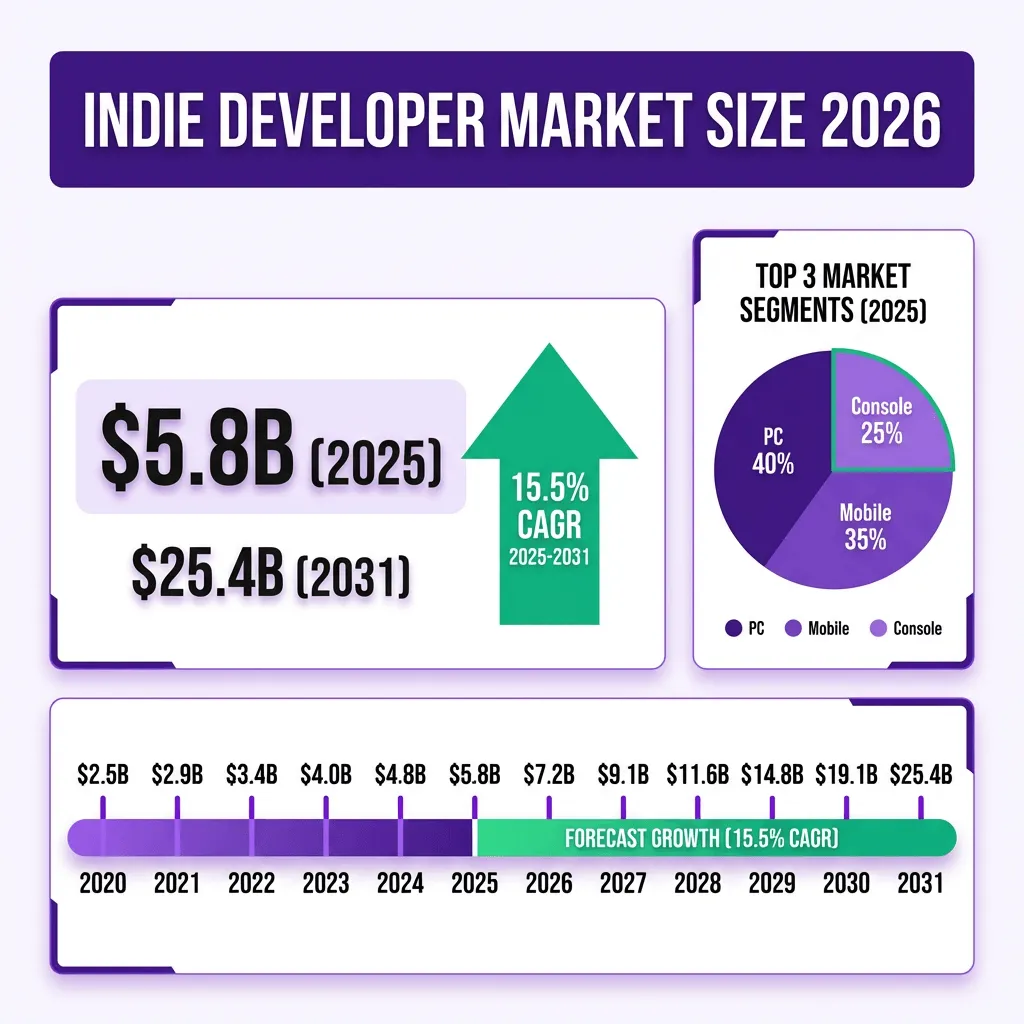
But here is what makes this moment truly remarkable: the indie game publishing market is projected to grow from $5.8 billion in 2025 to $25.4 billion by 2031, representing a compound annual growth rate (CAGR) of 15.5%. This is not just growth—it is explosive expansion that outpaces many traditional sectors.

Market Overview: The $5.8 Billion Indie Ecosystem
To understand where the indie developer market stands in 2026, we need to look at how it evolved. The indie game revolution did not happen overnight. It was built on the backs of platforms like Steam, itch.io, and the App Store, which democratized distribution and gave creators direct access to audiences.
In 2025, the global indie game market was valued at $4.85 billion according to industry analysts. By early 2026, that figure had already climbed to $5.8 billion, driven by a perfect storm of factors: accessible development tools, growing player appetite for unique experiences, and the continued maturation of digital distribution platforms.
The market segmentation reveals interesting patterns. PC remains the dominant platform for indie developers, with 80% of developers focusing their efforts on the PC market according to the GDC 2025 State of the Game Industry Report. This is not surprising—Steam’s ecosystem is particularly friendly to indie developers, offering fair revenue splits, robust discovery tools, and a player base that actively seeks out unique experiences.
Mobile represents the second-largest segment, though it is becoming increasingly challenging for new entrants. The mobile gaming market generated approximately $92 billion globally in 2025, but the vast majority of this revenue goes to established publishers with massive user acquisition budgets. For indie developers, mobile is becoming a platform of opportunity for specific genres—particularly hyper-casual and idle games—rather than a general-purpose distribution channel.
Console distribution has opened up significantly in recent years. Nintendo’s Switch platform has been particularly indie-friendly, with games like Hollow Knight, Stardew Valley, and Celeste finding massive audiences. The upcoming Switch 2 is expected to continue this trend, with many indie developers already seeking dev kits to prepare for launch.
Geographically, North America and Europe remain the largest markets for indie games, but Asia is showing explosive growth. Regional platforms in India, Southeast Asia, and the Middle East are actively courting indie developers with favorable revenue splits and localized support. This global expansion is a key driver of the projected 15.5% CAGR through 2031.
The business models within the indie space have also evolved. While premium (one-time purchase) games still dominate on PC and console, free-to-play with microtransactions has become viable for certain genres. Subscription models and DLC strategies are increasingly common, allowing developers to build sustainable revenue streams from successful titles.
Key Statistics and Data Points
The numbers behind the indie developer market tell a story of both incredible opportunity and stark reality. Let us break down the key statistics that define this ecosystem in 2026:
Market Size and Growth: The indie game publishing market reached $5.8 billion in 2025 and is projected to hit $25.4 billion by 2031. This represents a CAGR of 15.5%, significantly outpacing the overall gaming industry growth rate. The global gaming market is expected to reach $353 billion by 2030, with indie games capturing an increasingly significant share.
Steam Revenue Share: Indie games accounted for 25% of Steam’s total revenue in 2025—approximately $4.5 billion of the platform’s estimated $18 billion in total revenue. This is a historic high and demonstrates the commercial viability of independent development on PC.
Release Volume: Around 20,000 games were released on Steam in 2025, the vast majority being indie titles. This represents both the accessibility of the platform and the challenge of discoverability that developers face.
Success Rate: Of those 20,000 games released, only around 300 generated over $1 million in revenue. That is a 1.5% success rate for hitting seven-figure revenues. However, the top 5 indie games of 2025 alone generated over $500 million combined.
Top Performers: Schedule I led the pack with approximately $151 million in revenue. R.E.P.O., a cooperative horror title, reached nearly 19.6 million players. PEAK, a physics-driven climbing game, surpassed 15 million players on Steam alone.
Platform Distribution: 80% of developers are focused on PC, according to the GDC 2025 report. Mobile represents approximately 35% of the indie market by revenue, with console capturing around 25%.
Development Team Size: Half of all developers are self-funding their games, indicating a significant portion of the indie ecosystem operates without external investment. The average successful indie team has 2-5 members, with solo developers responsible for some of the biggest hits.
AI Adoption: One in three developers are now using generative AI to streamline game development, according to GDC’s 2025 report. This represents a fundamental shift in how games are made, with AI being used for everything from asset generation to NPC dialogue.
Funding Landscape: Gaming VC funding dropped to $2.54 billion in 2024—down 80% from the $12.5 billion peak in 2021. However, specialized funds like Blue Ocean Games have launched $30 million funds specifically targeting indie developers, providing $100,000-$300,000 per team.
Genre Performance: Strategy/4X was the only mobile category with positive growth across all three metrics—revenue, downloads, and user time spent—in 2025. On PC, cooperative games and horror titles have shown particularly strong performance.
Regional Growth: Asia and MENA video game market reached $89 billion in 2025, up 2.7% year-over-year. Mobile games revenue is expected to grow 3.8% YoY across Asia and MENA in 2026.
Development Tools: JetBrains Rider emerged as the top IDE for indie developers in 2025, surpassing both Visual Studio and VS Code. Unity and Unreal Engine remain the dominant game engines, though Godot has gained significant traction among indie developers.
Revenue Concentration: Premium games accounted for roughly 78% of Steam’s revenue in 2025, showing that paid releases remain a major part of the PC market despite the rise of free-to-play models elsewhere.
Wishlist Conversion: Strong wishlist numbers remain the best predictor of launch success. Games with 50,000+ wishlists at launch have a significantly higher probability of generating $100,000+ in first-month revenue.
Marketing Channels: TikTok organic reach has declined significantly for game promotion, while Discord community building and Steam Next Fest participation have become critical marketing channels for indie developers.
Major Trends Shaping Indie Development in 2026
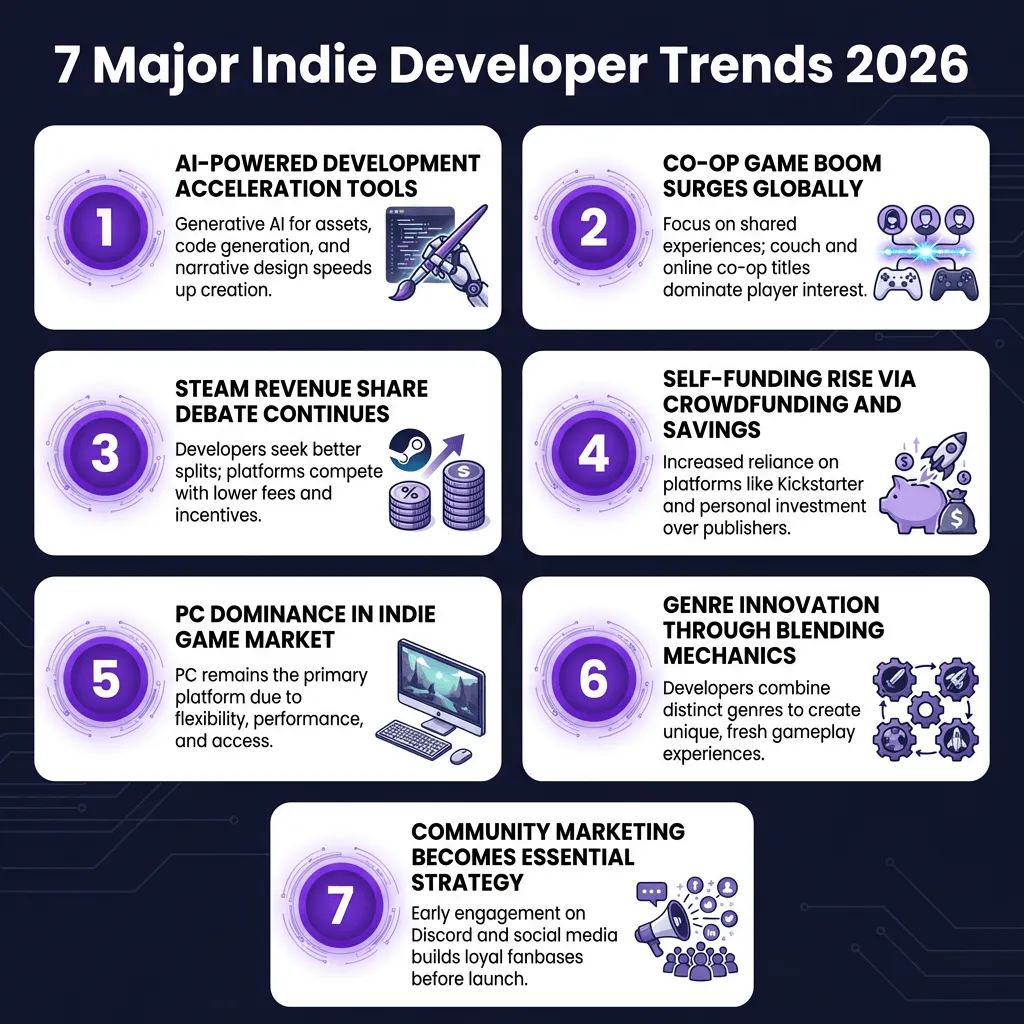
The indie development landscape is being reshaped by seven major trends that are defining success and failure in 2026. Understanding these trends is essential for anyone looking to enter or compete in this market.
1. The AI-Powered Development Revolution
Generative AI has moved from experimental tool to essential workflow component. One in three developers now use GenAI in their development process, and this number is growing rapidly. AI is being used for concept art generation, texture creation, dialogue writing, voice synthesis, and even code generation.
However, this trend comes with controversy. Steam now requires developers to disclose whether their games use AI-generated content. Some developers worry about an “AI arms race” where productivity expectations rise to unsustainable levels. As indie developer Claire Morwood noted, “The more AI is relied on as a tool, the harder it will become not to use it, since the baseline of productivity is pushed higher.”
Despite concerns, the efficiency gains are undeniable. Small teams can now produce content that would have required significantly larger teams just a few years ago. The key is using AI as a multiplier of human creativity rather than a replacement.
2. The Cooperative Game Boom
Cooperative multiplayer games have emerged as the breakout genre of 2025-2026. Titles like R.E.P.O. have demonstrated that players are hungry for shared experiences that emphasize collaboration over competition. These games benefit from organic marketing—players bring their friends, who bring their friends.
The “weirdo indie co-op” trend—games with quirky mechanics, physics-based interactions, and proximity voice chat—has proven particularly successful. These games generate shareable moments that spread naturally on social media, reducing the need for expensive user acquisition campaigns.
The economics are compelling. Co-op games often have longer session times, better retention, and higher viral coefficients than single-player experiences. For indie developers with limited marketing budgets, this organic growth potential is invaluable.
3. The Rise of Self-Funding
Half of all game developers are now self-funding their projects, according to the GDC 2025 report. This represents a significant shift from the early 2020s when venture capital flowed freely into game development. The collapse of funding after COVID-era highs has forced developers to be more resourceful.
This trend has both positive and negative implications. On the positive side, self-funded developers maintain complete creative control and are not beholden to investor expectations. On the negative side, it means fewer developers can afford to take big risks or spend years polishing ambitious projects.
The “Great Conjunction”—a term coined by industry analyst Chris Zukowski—describes the current period where genres that are easier to make (co-op party games, horror, idle/incremental) are also the games that Steam players are hungry for. This alignment allows self-funded developers to compete effectively.
4. Platform Diversification Strategies
Successful indie developers are no longer launching on a single platform. Multi-platform releases—PC, console, and sometimes mobile—have become the standard for maximizing revenue potential. However, the strategy has evolved beyond simple porting.
Developers are now thinking about platform-specific features and audiences from the beginning. A game might emphasize different aspects on Switch (portable play, local multiplayer) versus PC (mod support, high-end graphics) versus mobile (shorter sessions, touch controls).
HTML5 and web-based distribution are also seeing renewed interest. With GameDistribution’s reach across 4,000+ portals and 350 million monthly users, HTML5 games offer frictionless access that can complement traditional platform releases.
5. Community-First Marketing
The era of buying your way to success through user acquisition is ending for most indie developers. With rising ad costs and declining organic reach on platforms like TikTok, developers are shifting to community-first marketing strategies.
Discord has become the central hub for indie game communities. Successful developers build their communities early—sometimes years before launch—and treat them as co-creators rather than just customers. Beta testers, feedback providers, and evangelists all come from this core community.
Steam Next Fest participation has become almost mandatory for visibility. The festival generates millions of wishlists for participating games and can make or break a launch. Developers now plan their development schedules around Next Fest dates.
6. Genre Innovation and Hybridization
Standing out in a market of 20,000 annual releases requires innovation. Successful indie games are increasingly genre hybrids—combining elements from multiple genres to create unique experiences that cannot be easily categorized.
Roguelike deckbuilders, automation games with narrative elements, and cozy management sims represent just a few of the hybrid genres finding audiences. The key is identifying underserved niches where player interest exceeds supply.
Indie developers are also reviving and reinventing classic genres. The “boomer shooter” revival, pixel art RPGs with modern mechanics, and point-and-click adventures with contemporary storytelling all demonstrate that innovation does not always mean inventing new genres.
7. The Premium Experience Renaissance
Despite the dominance of free-to-play in mobile and live-service games in AAA, premium (one-time purchase) games are thriving in the indie space. Premium games accounted for 78% of Steam’s revenue in 2025, and players are increasingly willing to pay upfront for quality experiences without microtransactions.
This trend aligns with player fatigue over aggressive monetization in free-to-play games. Indie developers can differentiate themselves by offering complete, polished experiences for a fair upfront price. Games like Hades, Celeste, and Stardew Valley have proven that the premium model can generate massive returns when the quality is there.
Key Players and Competitive Landscape
The indie development ecosystem comprises thousands of individual developers and small studios, but certain players have emerged as particularly influential in shaping the market.
Top Performing Indie Studios
Team Cherry (Australia): Creators of Hollow Knight and the upcoming Silksong, Team Cherry represents the gold standard for indie success. Hollow Knight has sold over 5 million copies, generating an estimated $100+ million in revenue. Their success demonstrates the power of combining tight gameplay mechanics with distinctive art direction.
ConcernedApe (Eric Barone): The solo developer behind Stardew Valley has become legendary in indie circles. Stardew Valley has sold over 20 million copies and continues to generate significant revenue years after release. Barone’s commitment to free updates has built incredible player loyalty.
Supergiant Games: With titles including Bastion, Transistor, Pyre, and Hades, Supergiant has established a reputation for narrative excellence and artistic innovation. Hades sold over 1 million copies in its first week of full release and has won numerous Game of the Year awards.
Mossmouth (Derek Yu): Creator of Spelunky and Spelunky 2, Derek Yu has influenced an entire generation of roguelike developers. His games demonstrate how procedural generation and high difficulty can combine to create endlessly replayable experiences.
Studio MDHR: The creators of Cuphead proved that distinctive visual style can be a major differentiator. Cuphead’s 1930s animation aesthetic required massive effort but created an instantly recognizable brand that translated to commercial success.
Platform Holders and Publishers
Valve/Steam: Steam remains the dominant platform for PC indie games, and Valve’s policies significantly shape the market. The 30% revenue share (reduced to 20% after $50 million in sales) has been controversial but remains industry standard. Steam’s discovery algorithms, curation features, and seasonal sales events are critical to indie success.
Devolver Digital: One of the most successful indie publishers, Devolver has built a brand around quirky, innovative titles. Their marketing approach—irreverent and attention-grabbing—has helped numerous indie games find audiences.
Annapurna Interactive: Focused on artistic, narrative-driven games, Annapurna has published critical darlings including Outer Wilds, What Remains of Edith Finch, and Stray. Their focus on prestige titles has carved out a distinct niche in the publishing landscape.
Raw Fury: This publisher has built a reputation for supporting innovative indie projects, including Kingdom, Night Call, and Atomicrops. Their developer-friendly approach and focus on long-term relationships have made them a preferred partner for many indies.
Investment and Funding Entities
Blue Ocean Games: Backed by Krafton, this $30 million fund focuses on early-stage indie developers, providing $100,000-$300,000 per team through their SAIL (Structured Agreement for Indie Launch) instrument.
a16z Games: Andreessen Horowitz’s gaming fund has $1.2 billion across two funds and has been particularly active in the Speedrun accelerator program, investing in early-stage gaming startups.
BITKRAFT Ventures: With $1.05 billion under management, BITKRAFT focuses on seed to Series B investments in gaming, AI x gaming, and UGC platforms.
Griffin Gaming Partners: This $1.5 billion multi-stage fund invests across the gaming ecosystem, from studios to platforms to infrastructure.
Hiro Capital: Europe’s leading gaming and spatial computing investor with approximately $650 million AUM, focusing on the intersection of gaming and emerging technologies.

Challenges and Pain Points
Despite the success stories and market growth, indie developers face significant challenges that can make or break their projects. Understanding these pain points is crucial for navigating this competitive landscape.
1. The Discoverability Crisis
With 20,000 games released on Steam in 2025 alone, getting noticed is harder than ever. The “Steam invisibility” problem affects the vast majority of releases—games that launch without significant marketing support often fail to generate even $1,000 in revenue.
The wishlist economy has become brutal. Developers report that organic wishlist growth has slowed significantly, with many games struggling to reach the 10,000 wishlist threshold that Steam’s algorithm uses as a signal for featuring. Without strong wishlists at launch, games enter a death spiral of low visibility leading to low sales leading to lower visibility.
Platform algorithms are opaque and constantly changing. A game that might have been featured in 2020 now competes with thousands more titles for the same slots. Even positive reviews do not guarantee visibility if the game has not already achieved critical mass.
2. Rising Development Costs and Expectations
Player expectations for indie games have risen dramatically. What passed for acceptable polish five years ago is now considered subpar. Players expect professional-quality art, sound, and UI even from one-person teams.
This creates a paradox: tools have made development more accessible, but expectations have risen faster than accessibility. A solo developer in 2020 could compete with modest production values. In 2026, the same developer faces games with professional art direction, full voice acting, and complex systems.
The cost of AI tools has also surprised many developers. While AI can accelerate development, agentic tools can cost $200-$2,000+ per engineer per month in token spend. For small teams, these costs add up quickly and can strain limited budgets.
3. Marketing and User Acquisition Challenges
The “TikTok organic cliff” has hit indie developers hard. What was once a reliable channel for free marketing has become pay-to-play, with organic reach declining dramatically. Developers who built their marketing strategies around viral TikTok content have had to pivot rapidly.
Traditional user acquisition through paid advertising is prohibitively expensive for most indie games. With customer acquisition costs (CAC) running $140+ per user for some genres, the math simply does not work for games priced at $10-$30.
This forces developers to rely on community building, influencer outreach, and platform featuring—all of which require significant time investment and offer no guarantees. Many developers report spending 30-50% of their development time on marketing activities.
Opportunities and Growth Strategies
Despite the challenges, significant opportunities exist for indie developers who approach the market strategically. Here are the key growth strategies showing results in 2026:
1. Embrace the Great Conjunction
The alignment of developer-friendly genres with player demand creates a unique window of opportunity. Co-op party games, horror titles, and idle/incremental games can be developed with smaller teams while still finding substantial audiences.
Developers should consider: Can your core concept be prototyped in weeks rather than months? Does it generate shareable moments? Can players experience the core loop within the first few minutes? Games that answer yes to these questions are well-positioned for the current market.
2. Build Community Before Product
The most successful indie launches of 2025-2026 all had one thing in common: substantial pre-existing communities. Developers shared development progress on social media, ran Discord servers, participated in game jams, and built relationships with content creators.
This community becomes your marketing engine. They provide feedback during development, create content at launch, and sustain word-of-mouth growth post-release. Start building your community at least 12-18 months before your planned launch.
3. Leverage Platform Programs
Steam Next Fest, console ID@Xbox/PlayStation Indies programs, and various publisher initiatives offer opportunities for visibility that independent marketing cannot match. Plan your development schedule around these opportunities.
Steam Next Fest in particular has become essential. Games that participate with polished demos consistently report 50,000-200,000+ wishlist additions during the event. This single week can determine the success of your entire launch.
Case Studies and Success Stories
Case Study 1: Schedule I — The Breakout Hit
Schedule I generated approximately $151 million in revenue in 2025, making it the top indie release of the year. What made this game successful? It combined a unique concept (drug empire management) with accessible gameplay and significant viral potential.
The game generated endless content for streamers and YouTubers, with players sharing their most ridiculous empire configurations and failures. This organic content creation drove sales without significant marketing spend.
Key takeaway: Games that generate stories—whether through emergent gameplay, humor, or shocking moments—earn free marketing from content creators.
Case Study 2: R.E.P.O. — Cooperative Horror Excellence
R.E.P.O. reached nearly 19.6 million players by leveraging the cooperative horror trend. The game’s physics-based interactions and proximity voice chat created hilarious, shareable moments that spread across social media.
The developers focused on a tight core loop that could be experienced immediately, with minimal tutorial or setup. Players could jump in and start having fun within minutes, crucial for maintaining engagement in today’s attention economy.
Key takeaway: Focus on the first five minutes. If players are not experiencing your core value proposition immediately, you are losing potential fans.
Case Study 3: PEAK — Physics-Driven Innovation
PEAK surpassed 15 million players by taking a simple concept—climbing—and executing it with exceptional physics simulation. The game’s difficulty curve and satisfying mechanics created the “just one more try” effect that drives retention.
The developers leveraged Steam’s wishlist system effectively, building anticipation through regular development updates and community engagement. By launch, they had a substantial audience ready to purchase.
Key takeaway: Simple concepts executed exceptionally well can outperform complex games with broader scope but lesser polish.
Future Outlook and Predictions (2026-2030)
The indie development landscape will continue evolving rapidly through the remainder of the decade. Here are the key predictions for 2026-2030:
Market Growth Trajectory
The indie game publishing market is projected to reach $25.4 billion by 2031, growing at 15.5% CAGR. This growth will be driven by continued platform expansion, emerging markets in Asia and MENA, and the increasing cultural acceptance of gaming as mainstream entertainment.
By 2030, indie games could represent 30-35% of total gaming revenue, up from 25% today. This shift reflects both indie market growth and potential stagnation in the AAA sector, where development costs have ballooned and innovation has slowed.
Technology Disruption
AI will continue transforming development workflows. By 2028, we expect 70%+ of developers to use AI tools in their pipeline. The question is not whether to use AI, but how to use it effectively while maintaining creative vision.
Cloud gaming and streaming could democratize access further, allowing players to experience high-end indie games on any device. This removes hardware barriers and expands the potential audience for visually ambitious indie projects.
Platform Evolution
The Switch 2 launch will likely create new opportunities for indie developers, continuing Nintendo’s tradition of indie-friendly policies. We expect to see significant indie representation in the console’s launch window and beyond.
Steam will face increasing competition from Epic Games Store, GOG, and other platforms. This competition should benefit developers through better revenue splits and more favorable terms.
Business Model Innovation
Subscription services like Xbox Game Pass and PlayStation Plus will continue growing, providing alternative revenue streams for indie developers. However, the terms of these deals will become increasingly important as they represent a larger portion of indie revenue.
Direct-to-consumer sales through developer websites and Patreon-style support will grow in importance. The most successful indies will build sustainable businesses that are not entirely dependent on platform algorithms.
Key Takeaways
- The indie developer market reached $5.8 billion in 2025 and is projected to grow to $25.4 billion by 2031 at 15.5% CAGR
- Indie games now account for 25% of Steam’s revenue, with the top 5 titles generating over $500 million in 2025
- AI-powered development, cooperative games, and self-funding are the dominant trends shaping the industry
- Discoverability remains the biggest challenge, with only 300 of 20,000 annual releases hitting $1M+ revenue
- Community-first marketing and Steam Next Fest participation have become essential for success
- The “Great Conjunction” creates opportunities for developers in co-op, horror, and idle/incremental genres
- Premium games (one-time purchase) continue to thrive on PC, accounting for 78% of Steam revenue
- By 2030, indie games could represent 30-35% of total gaming revenue as the sector outpaces AAA growth
Sources and Citations
- Alinea Analytics – Steam Revenue Report 2025: https://www.notebookcheck.net/Indie-games-accounted-for-25-of-Steam-s-revenue-in-2025.1189429.0.html
- GDC 2025 State of the Game Industry Report: https://reg.gdconf.com/state-of-game-industry-2025
- LinkedIn – Indie Game Publishing Market Analysis: https://www.linkedin.com/posts/real-time-data-stats_indiegamepublishing-indiegamemarket-indiegamedevelopers
- Accio – 2025 Indie Game Trends: https://www.accio.com/business/2025-indie-game-trends
- Mordor Intelligence – Indie Game Market Forecast: https://www.mordorintelligence.com/industry-reports/indie-game-market
- Peony – Gaming Investors 2026: https://www.peony.ink/blog/top-gaming-investors
- GamesIndustry.biz – Investment Trends 2026: https://www.gamesindustry.biz/korean-acquisitions-buying-for-back-catalogue
- Creative Bloq – 2026 Game Design Predictions: https://www.creativebloq.com/3d/video-game-design/10-ways-2026-will-be-a-turning-point
- DEV Community – 2026 Game Market Analysis: https://dev.to/linou518/2026-game-market-mobile-is-maturing
- Deconstructor of Fun – Gaming Predictions 2026: https://www.deconstructoroffun.com/blog/2025/12/31/12-gaming-predictions-for-2026
- Niko Partners – 2026 Predictions: https://nikopartners.com/niko-partners-2026-predictions/
- How To Market A Game – Indie Golden Age: https://howtomarketagame.com/2025/11/04/the-optimistic-case-that-indie-games-are-in-a-golden-age
- Entalto Studios – Indie Success 2026: https://entaltostudios.com/what-makes-indie-game-successful/
- IndieGameBusiness – Future of Indie Devs: https://indiegamebusiness.com/indiegamebusiness-2026-future-for-indie-devs/
Regional Market Analysis
The indie developer market varies significantly by region, with different opportunities and challenges across North America, Europe, Asia, and emerging markets. Understanding these regional dynamics is crucial for developers looking to maximize their global reach.
North America
North America remains the largest market for indie games, with the United States accounting for the majority of Steam’s revenue. The region benefits from high disposable income, mature gaming culture, and strong English-language content consumption. Canadian developers have also made significant contributions, with cities like Montreal, Toronto, and Vancouver hosting vibrant indie communities.
The North American market shows strong preference for narrative-driven experiences, roguelikes, and cooperative multiplayer games. Premium pricing is generally accepted, with $15-25 price points performing well for quality titles.
Europe
Europe represents a diverse and fragmented market. Nordic countries (Sweden, Norway, Finland, Denmark) punch above their weight in game development, producing hits like Minecraft, Candy Crush Saga, and Battlefield. The UK maintains a strong indie scene centered around London and Brighton.
Eastern European developers have gained recognition for technical excellence and competitive pricing. Studios from Poland, Ukraine, and Romania increasingly compete on the global stage, often offering high quality at lower development costs.
Localization is critical for European success. While English suffices for many markets, German, French, Spanish, and Russian localization can significantly expand reach. Cultural preferences vary—simulation and strategy games perform particularly well in Germany, while narrative adventures find audiences in France and Southern Europe.
Asia-Pacific
Asia represents both the largest opportunity and the most complex challenge for indie developers. Japan, South Korea, and China each have distinct gaming cultures and regulatory environments.
Japan’s indie scene has grown significantly, with events like BitSummit showcasing local talent. Japanese players appreciate attention to detail and polish, making the market challenging but rewarding for developers who invest in localization and cultural adaptation.
South Korea’s PC gaming culture, centered around PC bangs (internet cafes), creates opportunities for multiplayer-focused indies. However, the market is dominated by free-to-play titles, making premium games a harder sell.
China represents the largest single gaming market globally, but regulatory requirements and platform restrictions make it difficult for foreign indies to enter. Working with local publishers is often essential for success.
Southeast Asia (Indonesia, Thailand, Vietnam, Philippines) shows explosive growth in mobile gaming. These markets favor free-to-play models with low-price cosmetics and battle passes.
MENA and Emerging Markets
The Middle East and North Africa region is increasingly important, with Saudi Arabia investing heavily in gaming as part of its Vision 2030 diversification strategy. The UAE serves as a regional hub for game development and publishing.
Latin America and Africa represent emerging opportunities. Brazil has a passionate gaming community and growing developer ecosystem. Mobile-first strategies are essential in these markets, where smartphone penetration exceeds PC ownership.
Development Tools and Technology Stack
The tools available to indie developers have never been more powerful or accessible. The right technology stack can significantly impact development speed, quality, and ultimately, commercial success.
Game Engines
Unity remains the most popular engine among indie developers, offering a balance of power, flexibility, and ease of use. The recent runtime fee controversy caused significant backlash, but Unity remains dominant, particularly for mobile and 2D games.
Unreal Engine has become increasingly accessible to indies, especially with the success of games like Hades and Sifu. Its visual scripting (Blueprints) allows non-programmers to create complex gameplay, while its rendering capabilities enable AAA-quality visuals.
Godot has emerged as a popular open-source alternative. Its lightweight nature, intuitive node-based architecture, and completely free licensing make it attractive for hobbyists and commercial developers alike. The Godot community has grown rapidly, creating a robust ecosystem of tutorials and plugins.
GameMaker and Construct serve specific niches—2D games and non-programmers, respectively. These engines trade flexibility for rapid development, enabling small teams to ship polished games quickly.
AI and Productivity Tools
AI tools have become essential parts of the indie workflow. Image generation tools like Midjourney, Stable Diffusion, and DALL-E accelerate concept art and texture creation. Code assistants like GitHub Copilot and Claude Code speed up programming tasks.
However, developers must navigate disclosure requirements and ethical considerations. Steam’s AI content disclosure policy requires transparency about AI usage, and some players react negatively to obvious AI-generated content.
Development Environment
JetBrains Rider has overtaken Visual Studio as the preferred IDE for game development, offering superior performance and Unity/Unreal integration. VS Code remains popular for its lightweight nature and extensive plugin ecosystem.
Version control is non-negotiable for professional development. Git with GitHub, GitLab, or Bitbucket hosting has become standard. Perforce remains common in larger indie teams working with large binary assets.
Monetization Strategies for Indie Developers
Choosing the right monetization strategy can determine whether an indie game becomes a sustainable business or a financial disappointment. Each approach has distinct advantages and trade-offs.
Premium (One-Time Purchase)
The premium model remains dominant on PC and console, accounting for 78% of Steam revenue. Players pay once and own the game permanently. This model aligns player and developer incentives—success comes from creating a game worth buying, not from extracting ongoing payments.
Pricing strategy is critical. $10-20 represents the sweet spot for most indie games, though exceptional titles can command $25-40. Regional pricing is essential—Steam’s suggested regional prices help, but manual adjustment can optimize revenue in key markets.
Free-to-Play with Microtransactions
Free-to-play works best for games with strong retention and social features. Cosmetics, battle passes, and convenience items can generate significant revenue from engaged players. However, this model requires substantial ongoing content creation and live operations expertise.
For indies, free-to-play is high-risk, high-reward. Success requires either exceptional viral potential or significant marketing budget for user acquisition. Most successful indie free-to-play games focus on cosmetics-only monetization to avoid pay-to-win accusations.
DLC and Expansion Model
Releasing a base game and supporting it with paid DLC can extend revenue over years. Stardew Valley’s free updates built incredible goodwill, while games like Hades and Dead Cells used paid DLC to fund ongoing development.
This model requires planning for post-launch content from the beginning. Successful DLC strategies deliver meaningful content that justifies the price while maintaining the base game’s accessibility.
Subscription and Service Models
Xbox Game Pass, PlayStation Plus, and Apple Arcade offer upfront payments for inclusion in subscription libraries. These deals provide guaranteed revenue and exposure to large audiences, but at the cost of per-unit sales.
For indie developers, subscription deals can de-risk development and provide marketing that would otherwise be unaffordable. However, over-reliance on subscription revenue creates vulnerability to platform decisions and deal terms.