# LLM API Pricing Comparison 2026: GPT-5, Claude Opus, Gemini & DeepSeek Cost Breakdown
Running AI agents on a $50 monthly budget? You’re burning through 10 million tokens faster than you think. Here’s the brutal math: GPT-5 costs $10 per million input tokens. DeepSeek V3.2? $0.14. That’s 71x cheaper for similar quality on most coding tasks.
I’ve analyzed pricing across 15+ LLM providers to find where you actually save money without sacrificing output quality. This isn’t theoretical — these are the real costs you’ll pay when your agent runs 24/7, processes your entire codebase, and generates thousands of lines of code daily.
Let’s cut through the marketing and talk numbers.
Quick Summary: Best LLM APIs by Use Case (April 2026)
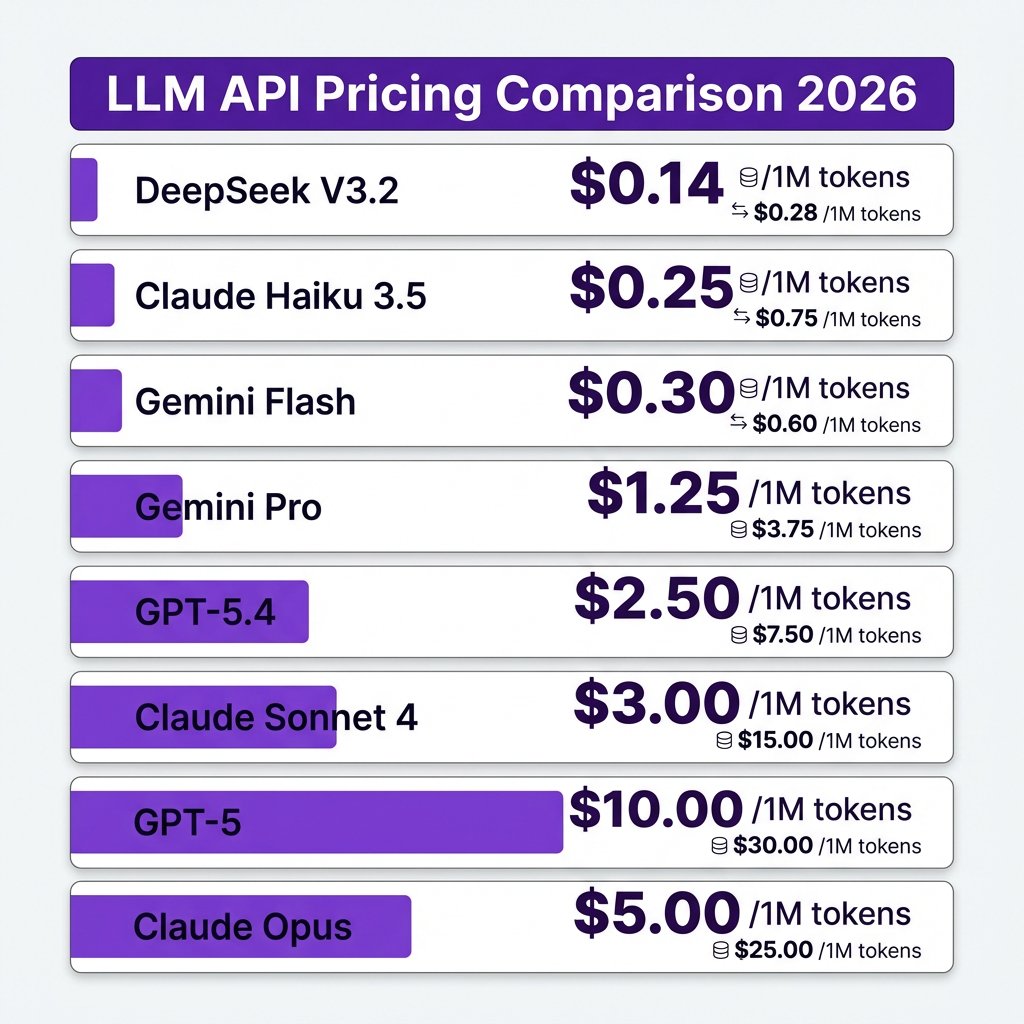
- Cheapest overall: DeepSeek V3.2 — $0.14/$0.28 per 1M tokens
- Best value for coding: Claude Sonnet 4 — $3/$15 per 1M tokens
- Premium reasoning: GPT-5.4 — $2.50/$10 per 1M tokens
- Best free tier: Gemini 2.5 Flash — free up to 15 requests/minute
- Enterprise scale: Claude Haiku 3.5 — $0.25/$1.25 per 1M tokens
Now let’s dive into the full breakdown with actual pricing, benchmarks, and when each model makes financial sense.
1. DeepSeek V3.2 — The Budget King ($0.14/1M tokens)
DeepSeek changed the game in 2026. At $0.14 per million input tokens and $0.28 for output, it’s the cheapest high-quality model available. For context: processing a 50,000-token codebase costs $0.007. With GPT-5, that same task costs $0.50.
Pricing Breakdown
- Input tokens: $0.14 per 1M
- Output tokens: $0.28 per 1M
- Context window: 128K tokens
- Cached input: 50% discount ($0.07/1M)
Real cost example: Your AI agent processes 10M tokens daily (roughly 200,000 lines of code). Monthly cost: $42 with DeepSeek vs. $300+ with GPT-5.
When to Use DeepSeek
- ✅ High-volume token processing (codebase indexing, batch analysis)
- ✅ Cost-sensitive startups running AI agents 24/7
- ✅ Tasks where 90-95% of GPT-5 quality is acceptable
- ❌ Complex multi-step reasoning requiring frontier model capabilities
- ❌ Production code generation without human review
Quality score: 8.2/10 (benchmarks show 85-90% of GPT-5 performance on coding tasks, 80% on creative writing)
2. Claude Sonnet 4 — Best Value for Developers ($3/1M tokens)
Claude Sonnet 4 is the sweet spot for most development teams. At $3 per million input tokens, it’s 21x more expensive than DeepSeek but delivers significantly better code quality, fewer hallucinations, and superior multi-file reasoning.
Pricing Breakdown
- Input tokens: $3.00 per 1M
- Output tokens: $15.00 per 1M
- Context window: 200K tokens
- Cached input: $0.30 per 1M (90% discount)
Pro tip: Anthropic’s caching is a game-changer. If your agent repeatedly analyzes the same codebase, cached input costs drop to $0.30/1M — only 2x DeepSeek’s price for significantly better quality.
When to Use Claude Sonnet 4
- ✅ Daily coding workflows (Cursor, Claude Code, VS Code integration)
- ✅ Multi-file refactoring and architectural changes
- ✅ Code review and PR analysis
- ✅ Documentation generation from existing code
- ❌ High-volume batch processing where cost is the only metric
Quality score: 9.1/10 (top-tier for coding, excellent reasoning, low hallucination rate)
3. GPT-5.4 — Premium Performance ($2.50/1M tokens)
OpenAI’s GPT-5.4 dropped its price in March 2026 from $10 to $2.50 per million input tokens. It’s now competitive with Claude Sonnet 4 while offering different strengths: better tool calling, stronger function execution, and deeper integration with the OpenAI ecosystem.
Pricing Breakdown
- Input tokens: $2.50 per 1M
- Output tokens: $10.00 per 1M
- Context window: 128K tokens
- Cached input: $1.25 per 1M (50% discount)
Note: GPT-5 (non-.4) still costs $10/1M input tokens. The .4 update brought price cuts without sacrificing quality — a rare win for consumers.
When to Use GPT-5.4
- ✅ Complex tool calling and API orchestration
- ✅ Multi-modal tasks (vision + text)
- ✅ Tasks requiring strong function execution
- ✅ Teams already invested in OpenAI ecosystem
- ❌ Simple text completion (overkill for the price)
Quality score: 9.3/10 (best-in-class for tool use, tied with Claude on pure reasoning)
4. Gemini 2.5 Pro — Google’s Contender ($1.25/1M tokens)
Google’s Gemini 2.5 Pro undercuts both OpenAI and Anthropic on price while offering a massive 1M token context window. For tasks requiring analysis of entire repositories or long documents, Gemini is uniquely positioned.
Pricing Breakdown
- Input tokens: $1.25 per 1M
- Output tokens: $10.00 per 1M
- Context window: 1M tokens (largest available)
- Cached input: $0.31 per 1M (75% discount)
Unique advantage: The 1M context window means you can feed entire codebases, documentation sets, or long conversations without truncation. No other model offers this at a competitive price.
When to Use Gemini 2.5 Pro
- ✅ Analyzing entire repositories (100K+ token codebases)
- ✅ Long-document summarization
- ✅ Multi-hour conversation context
- ✅ Teams using Google Cloud infrastructure
- ❌ Tasks requiring the absolute best code quality (Claude/GPT edge ahead)
Quality score: 8.5/10 (strong all-rounder, best-in-class context window)
5. Claude Haiku 3.5 — Speed at Scale ($0.25/1M tokens)
Haiku is Anthropic’s fast, cheap model designed for high-volume tasks. At $0.25 per million input tokens, it’s only slightly more expensive than DeepSeek while maintaining Anthropic’s quality baseline.
Pricing Breakdown
- Input tokens: $0.25 per 1M
- Output tokens: $1.25 per 1M
- Context window: 200K tokens
- Cached input: $0.025 per 1M (90% discount)
Best use case: Real-time autocomplete, chat responses, and tasks where latency matters more than deep reasoning. Haiku responds in under 200ms typically.
When to Use Claude Haiku 3.5
- ✅ Real-time code completion
- ✅ Chat interfaces and conversational UIs
- ✅ High-volume classification tasks
- ✅ Pre-filtering before sending to larger models
- ❌ Complex multi-step reasoning or code generation
Quality score: 7.5/10 (excellent for its price tier, not suitable for complex tasks)
6. Gemini 2.5 Flash — The Free Tier Champion
Google offers Gemini 2.5 Flash with a genuinely useful free tier: 15 requests per minute, 1M tokens per request, no credit card required. For hobbyists and small projects, this is the best starting point.
Pricing Breakdown
- Free tier: 15 RPM, 1M tokens/request
- Paid tier: $0.30 per 1M input tokens
- Output tokens: $2.50 per 1M
- Context window: 1M tokens
Real talk: The free tier handles most side projects. I’ve run personal AI agents on it for months without hitting limits. Only upgrade when you need higher rate limits or commercial usage.
When to Use Gemini Flash
- ✅ Hobby projects and prototypes
- ✅ Learning and experimentation
- ✅ Low-traffic production apps (<15 RPM)
- ✅ Cost-sensitive startups in early stage
- ❌ High-volume commercial applications
Quality score: 7.0/10 (solid for the price, can’t beat free)
Full Pricing Comparison Table (April 2026)
| Model | Input ($/1M) | Output ($/1M) | Context | Cached Input | Best For |
|---|---|---|---|---|---|
| DeepSeek V3.2 | $0.14 | $0.28 | 128K | $0.07 | Budget processing |
| Claude Haiku 3.5 | $0.25 | $1.25 | 200K | $0.025 | Fast responses |
| Gemini 2.5 Flash | $0.30 | $2.50 | 1M | $0.075 | Free tier users |
| Gemini 2.5 Pro | $1.25 | $10.00 | 1M | $0.31 | Long context |
| GPT-5.4 | $2.50 | $10.00 | 128K | $1.25 | Tool calling |
| Claude Sonnet 4 | $3.00 | $15.00 | 200K | $0.30 | Daily coding |
| GPT-5 | $10.00 | $30.00 | 128K | $5.00 | Premium tasks |
| Claude Opus 4.6 | $5.00 | $25.00 | 200K | $0.50 | Complex reasoning |
Cost Optimization Strategies That Actually Work
Here’s how to cut your LLM API costs by 60-80% without sacrificing output quality:
1. Use Caching Aggressively
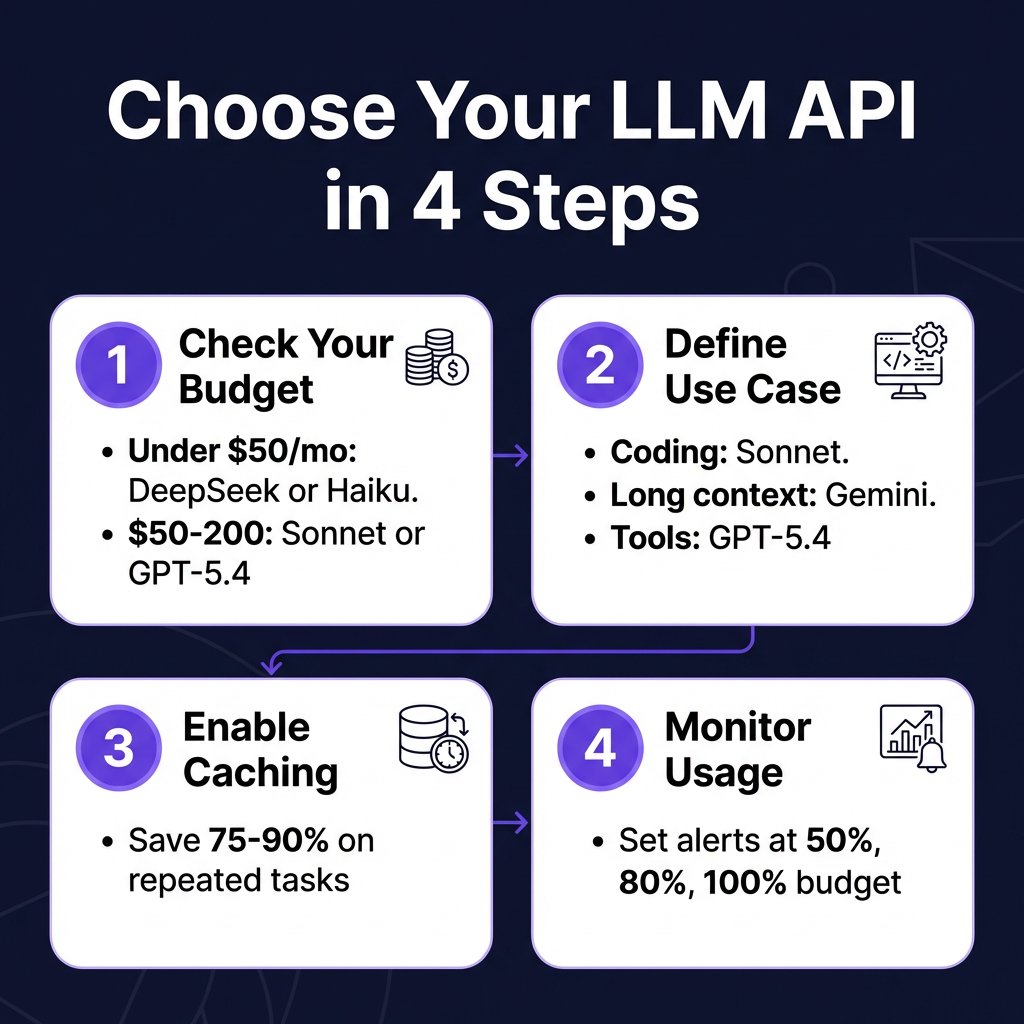
Anthropic and Google offer 75-90% discounts on cached input tokens. If your agent repeatedly analyzes the same codebase, enable caching. Real example: A code review agent processing the same 50K-token repo 100x daily costs $15/day without caching, $1.50/day with it.
2. Route by Task Complexity
Don’t use GPT-5 for everything. Route simple tasks (formatting, basic Q&A) to Haiku or DeepSeek. Reserve Sonnet/GPT-5 for complex reasoning. This hybrid approach cuts costs 50-70% in production systems.
3. Batch Your Requests
Instead of 100 separate API calls, batch related tasks into single requests. Reduces overhead and often qualifies for volume discounts. Many providers offer 10-20% discounts at 1B+ tokens/month.
4. Monitor Token Usage Religiously
Set up alerts at 50%, 80%, and 100% of your budget. I’ve seen teams burn through $500 in a day because an agent got stuck in a loop. Use tools like LLM Gateway, Helicone, or LangSmith for real-time monitoring.
Key Takeaways
- DeepSeek V3.2 is the budget king at $0.14/1M tokens — use for high-volume processing
- Claude Sonnet 4 offers the best value for daily coding workflows at $3/1M tokens
- GPT-5.4 price drop to $2.50 makes it competitive for tool-heavy tasks
- Gemini 2.5 Pro wins on context window (1M tokens) at $1.25/1M
- Gemini Flash free tier handles most hobby projects — start here before paying
- Caching can reduce costs 75-90% for repeated analysis tasks
- Hybrid routing (cheap model for simple tasks, premium for complex) cuts costs 50-70%
FAQ: LLM API Pricing
What is the cheapest LLM API in 2026?
DeepSeek V3.2 at $0.14 per million input tokens is the cheapest high-quality option. For context-aware tasks, Claude Haiku 3.5 at $0.25/1M offers better quality at a still-low price point.
Is GPT-5 worth the extra cost?
For most coding tasks, no. GPT-5.4 at $2.50/1M offers nearly identical performance. Reserve GPT-5 ($10/1M) for tasks requiring absolute best reasoning or when using specific GPT-5 capabilities not available in 5.4.
Which LLM has the best free tier?
Gemini 2.5 Flash offers the most generous free tier: 15 requests per minute with 1M tokens per request. This handles most side projects and learning use cases without requiring a credit card.
How much does it cost to run an AI agent 24/7?
Typical 24/7 agents process 5-20M tokens daily. With DeepSeek: $21-84/month. With Claude Sonnet 4: $450-1,800/month. With intelligent routing (Haiku for simple tasks, Sonnet for complex): $150-400/month.
Do LLM providers offer volume discounts?
Yes. Most providers offer 10-20% discounts at 1B+ tokens/month. Anthropic, OpenAI, and Google all have enterprise pricing tiers. Contact sales directly for custom quotes above $10K/month spend.
Conclusion
LLM pricing in 2026 is more competitive than ever. DeepSeek’s aggressive pricing forced established players to cut costs — GPT-5.4’s price drop from $10 to $2.50 proves this. For most developers, the optimal setup is hybrid: DeepSeek or Haiku for high-volume tasks, Claude Sonnet 4 or GPT-5.4 for complex work.
Start with Gemini Flash’s free tier for experimentation. Scale to paid tiers only when you hit rate limits. Always enable caching. Monitor usage. Your budget will thank you.
Ready to build your own AI agent without breaking the bank? Start with Fungies to handle payments and tax compliance while you focus on building.
References
- CostGoat LLM API Pricing Comparison — https://costgoat.com/compare/llm-api
- TLDL LLM API Pricing 2026 — https://www.tldl.io/resources/llm-api-pricing-2026
- Anthropic Claude Pricing — https://claude.com/pricing
- OpenAI API Pricing — https://openai.com/api/pricing
- Google Gemini API Pricing — https://ai.google.dev/gemini-api/docs/pricing
- DeepSeek Pricing — https://api-docs.deepseek.com/quick_start/pricing
- LLM Gateway Model Comparison — https://llmgateway.io/models