Your AI startup just burned through $5,000 in API credits in three weeks. You’re not alone. According to CostGoat’s April 2026 data, developers waste an average of 37% of their LLM budget on overprovisioned models — paying for capabilities they don’t actually need.
Here’s the brutal truth: GPT-5 costs 107× more than DeepSeek V3.2 for output tokens ($30 vs $0.28 per million), yet most teams default to OpenAI without testing cheaper alternatives. This guide breaks down exact pricing across 15+ models from OpenAI, Anthropic, Google, and DeepSeek — with real cost calculations for production workloads.
What Is LLM API Pricing and Why It Matters
LLM API pricing determines how much you pay every time your application sends a prompt or receives a response. Unlike subscription tools, you’re charged per token — roughly 4 characters or 0.75 words per token.
Why this matters for SaaS developers:
- A customer support bot processing 10,000 queries/day at 500 tokens each = 5M tokens monthly
- At GPT-5 rates ($10/$30 per 1M), that’s $200/month just for inference
- Switch to DeepSeek V3.2 ($0.14/$0.28) = $2.10/month for the same workload
- That’s $2,376/year saved — or 99% cost reduction
The model you choose directly impacts your unit economics. For usage-based SaaS products, LLM costs can be the difference between 80% and 40% gross margins.
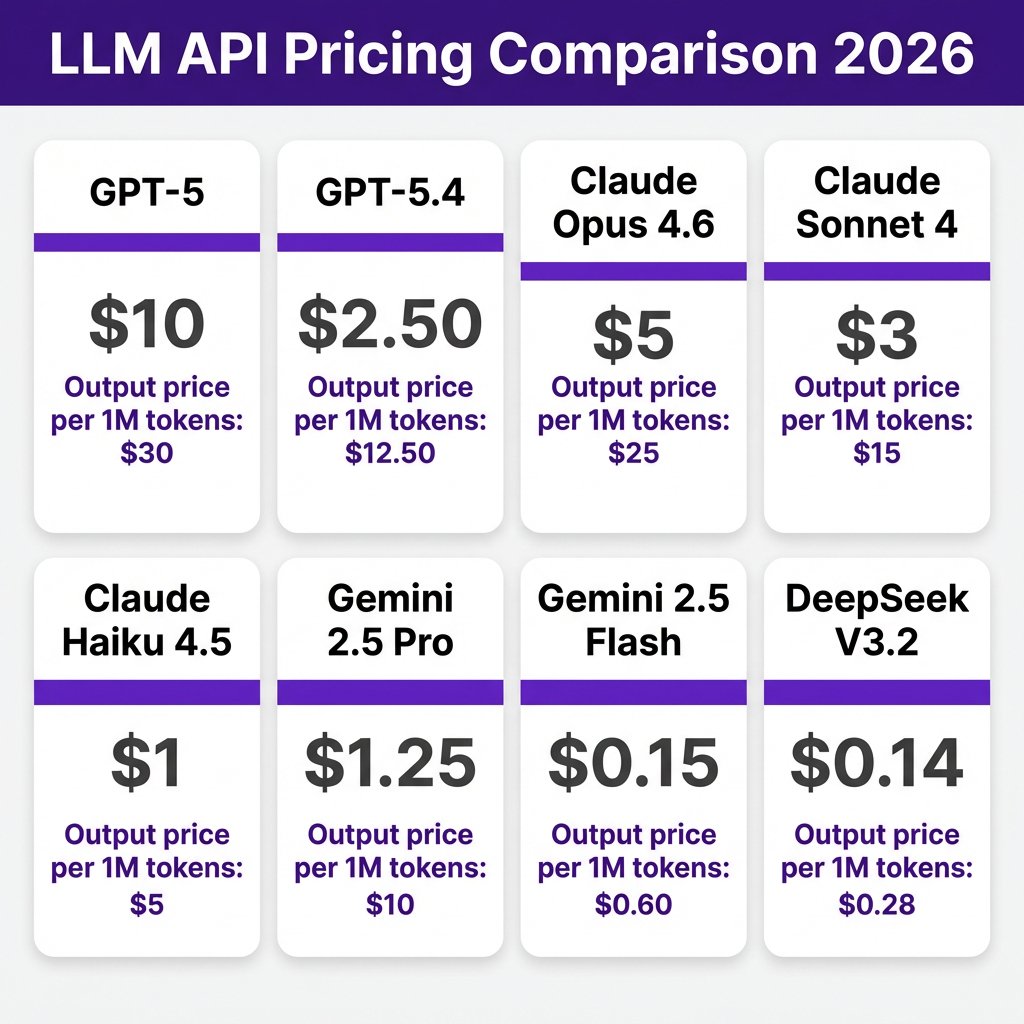
LLM API Pricing Comparison Table 2026
| Model | Provider | Context | Input ($/1M) | Output ($/1M) | Best For |
|---|---|---|---|---|---|
| DeepSeek V3.2 | DeepSeek | 64K | $0.14 | $0.28 | Budget-conscious apps, high-volume tasks |
| Gemini 2.5 Flash | 1M | $0.15 | $0.60 | Long-context analysis, cost-sensitive workloads | |
| Claude Haiku 4.5 | Anthropic | 200K | $1.00 | $5.00 | Fast responses, simple Q&A |
| GPT-4.1 Mini | OpenAI | 128K | $0.40 | $1.60 | Balanced cost/performance |
| Claude Sonnet 4 | Anthropic | 200K | $3.00 | $15.00 | Complex reasoning, coding tasks |
| Gemini 2.5 Pro | 1M | $1.25 | $10.00 | Multimodal tasks, long documents | |
| GPT-5.4 | OpenAI | 128K | $2.50 | $12.50 | High-quality reasoning, enterprise |
| Claude Opus 4.6 | Anthropic | 200K | $5.00 | $25.00 | Mission-critical, complex analysis |
| GPT-5 | OpenAI | 128K | $10.00 | $30.00 | Premium quality, low-volume tasks |
Key observations:
- DeepSeek dominates on price — 100× cheaper than GPT-5 for output tokens
- Google’s Flash models offer insane context — 1M tokens at budget prices
- Anthropic’s tiered approach — Haiku for speed, Sonnet for balance, Opus for quality
- OpenAI is premium-priced — you’re paying for brand and ecosystem
How LLM Token Pricing Actually Works
Tokens aren’t words. Understanding this saves money.
Token breakdown:
- 1 token ≈ 4 characters in English
- 1 token ≈ 0.75 words
- “Hello world” = 3 tokens
- A 1,000-word article ≈ 1,333 tokens
Pricing structure:
Total Cost = (Input Tokens × Input Rate) + (Output Tokens × Output Rate)Real example: A customer support response
- Input: 200 tokens (user question + context)
- Output: 150 tokens (AI response)
- At Claude Sonnet 4 rates: (200 × $3/1M) + (150 × $15/1M) = $0.0006 + $0.00225 = $0.00285 per query
- At 10,000 queries/month: $28.50
Now the same workload on GPT-5:
- (200 × $10/1M) + (150 × $30/1M) = $0.002 + $0.0045 = $0.0065 per query
- At 10,000 queries/month: $65.00
That’s 2.3× more expensive for similar quality output.
Provider-by-Provider Breakdown
OpenAI Pricing 2026
OpenAI remains the premium option. You’re paying for reliability, ecosystem, and brand recognition.
Current rates (April 2026):
| Model | Input | Output | Context |
|---|---|---|---|
| GPT-5 | $10.00 | $30.00 | 128K |
| GPT-5.4 | $2.50 | $12.50 | 128K |
| GPT-4.1 | $2.00 | $8.00 | 128K |
| GPT-4.1 Mini | $0.40 | $1.60 | 128K |
| GPT-4.1 Nano | $0.10 | $0.40 | 128K |
When to use OpenAI:
- Enterprise clients demand “GPT” by name
- You need the absolute best reasoning quality
- Your workload is low-volume (< 100K tokens/month)
- You’re already invested in the OpenAI ecosystem
Cost optimization tip: Use GPT-4.1 Mini for 80% of tasks, reserve GPT-5 for edge cases. This hybrid approach cuts costs by 60-70% with minimal quality loss.
Anthropic Claude Pricing 2026
Anthropic offers the clearest tier structure. Each model has a distinct use case.
Current rates (April 2026):
| Model | Input | Output | Context |
|---|---|---|---|
| Claude Opus 4.6 | $5.00 | $25.00 | 200K |
| Claude Sonnet 4 | $3.00 | $15.00 | 200K |
| Claude Haiku 4.5 | $1.00 | $5.00 | 200K |
When to use Claude:
- Haiku: Real-time chat, simple classifications, high-volume tasks
- Sonnet: Coding assistance, complex reasoning, content generation
- Opus: Legal analysis, medical summaries, mission-critical decisions
Anthropic’s advantage: 200K context window across all models. You can upload entire codebases or long documents without switching tiers.
Google Gemini Pricing 2026
Google’s secret weapon: 1 million token context at budget prices.
Current rates (April 2026):
| Model | Input | Output | Context |
|---|---|---|---|
| Gemini 2.5 Pro | $1.25 | $10.00 | 1M |
| Gemini 2.5 Flash | $0.15 | $0.60 | 1M |
| Gemini 3.1 Pro Preview | $2.00 | $12.00 | 1M |
| Gemini 3.1 Flash-Lite Preview | $0.25 | $1.50 | 1M |
When to use Gemini:
- You need to analyze books, long reports, or full codebases
- Cost is the primary constraint
- You’re already on Google Cloud (Vertex AI integration)
- Multimodal tasks (image + text understanding)
Hidden gem: Gemini 2.5 Flash at $0.15/$0.60 is the best value for long-context tasks. You get 1M tokens — enough for a 700,000-word book — for less than $1 per full analysis.
DeepSeek Pricing 2026
The disruptor. DeepSeek V3.2 delivers GPT-4-level quality at 1% of the cost.
Current rates (April 2026):
| Model | Input | Output | Context |
|---|---|---|---|
| DeepSeek V3.2 | $0.14 | $0.28 | 64K |
| DeepSeek V3 | $0.27 | $1.10 | 128K |
When to use DeepSeek:
- Budget is the primary constraint
- High-volume tasks (content generation, data processing)
- You can tolerate occasional quality variance
- You’re building a cost-sensitive SaaS product
Real-world test: A SaaS founder reported processing 50M tokens/month on DeepSeek for $14 total. The same workload on GPT-5 would cost $1,500.
Real Cost Calculations for Common Workloads
Let’s run actual numbers for typical SaaS use cases.
Scenario 1: Customer Support Chatbot
Assumptions:
- 5,000 conversations/day
- 300 input tokens, 200 output tokens per conversation
- Monthly volume: 75M input + 50M output tokens
| Model | Monthly Cost | Annual Cost |
|---|---|---|
| DeepSeek V3.2 | $24.50 | $294 |
| Gemini 2.5 Flash | $41.25 | $495 |
| Claude Haiku 4.5 | $325.00 | $3,900 |
| GPT-4.1 Mini | $110.00 | $1,320 |
| Claude Sonnet 4 | $975.00 | $11,700 |
| GPT-5 | $2,250.00 | $27,000 |
Savings: Switching from GPT-5 to DeepSeek saves $26,706/year.
Scenario 2: Code Review Assistant
Assumptions:
- 500 code reviews/day
- 2,000 input tokens (code + instructions), 500 output tokens (feedback)
- Monthly volume: 30M input + 7.5M output tokens
| Model | Monthly Cost | Annual Cost |
|---|---|---|
| DeepSeek V3.2 | $6.30 | $75.60 |
| Gemini 2.5 Flash | $9.00 | $108 |
| Claude Haiku 4.5 | $67.50 | $810 |
| GPT-4.1 Mini | $24.00 | $288 |
| Claude Sonnet 4 | $202.50 | $2,430 |
| GPT-5 | $525.00 | $6,300 |
Scenario 3: Content Generation (Blog Posts)
Assumptions:
- 100 articles/month
- 500 input tokens (outline + keywords), 2,500 output tokens (article)
- Monthly volume: 50K input + 250K output tokens
| Model | Monthly Cost | Annual Cost |
|---|---|---|
| DeepSeek V3.2 | $0.08 | $0.96 |
| Gemini 2.5 Flash | $0.16 | $1.92 |
| Claude Haiku 4.5 | $1.30 | $15.60 |
| GPT-4.1 Mini | $0.42 | $5.04 |
| Claude Sonnet 4 | $3.90 | $46.80 |
| GPT-5 | $8.00 | $96.00 |
Insight: At this volume, model choice barely matters. Even GPT-5 costs less than $100/year. Invest in better prompts, not cheaper models.

Cost Optimization Strategies
1. Implement Model Routing
Don’t use one model for everything. Route tasks by complexity:
def route_query(query):
    if is_simple_classification(query):
        return "deepseek-v3.2"  # $0.28/1M output
    elif requires_coding_knowledge(query):
        return "claude-sonnet-4"  # $15/1M output
    elif is_mission_critical(query):
        return "gpt-5"  # $30/1M output
    else:
        return "gpt-4.1-mini"  # $1.60/1M output
Impact: Teams report 50-70% cost reduction with intelligent routing.
2. Use Caching Aggressively
If you’re asking the same questions repeatedly, cache the answers:
- Google Gemini: 50% discount for cached content
- OpenAI: Semantic cache via third-party tools (CacheLLM, LLMMem)
- Self-hosted: Redis + embedding-based similarity search
Example: A FAQ bot with 100 common questions can cache 80% of responses. Effective cost: 20% of original.
3. Optimize Prompt Length
Every token costs money. Trim your prompts:
Before (450 tokens):
You are a helpful customer support assistant for our SaaS product.
We help developers process payments globally.
Our key features include: automatic tax compliance, no-code checkout,
competitive pricing, and support for 135+ countries.
Please answer the following question in a friendly, professional tone...
After (180 tokens):
Answer as friendly support agent for payment SaaS.
Features: tax compliance, no-code checkout, 135+ countries.
Question:
Savings: 60% reduction in input tokens = 60% cost reduction on input side.
4. Batch Requests
Some providers offer discounts for batched requests:
- OpenAI: Batch API at 50% discount (24-hour turnaround)
- Anthropic: No official batch discount, but bulk enterprise pricing available
- Google: Committed use discounts (20-40% off) for 1-3 year commitments
5. Monitor and Alert
Set up cost monitoring before you get a surprise bill:
# Daily cost tracking
if daily_cost > budget_threshold:
    send_alert("LLM costs exceeding budget")
    switch_to_cheaper_model()
Hidden Costs to Watch For
Context Window Overflows
Exceeding your model’s context limit triggers automatic truncation — or worse, silent failures. Always validate input length.
Rate Limits and Throttling
Hitting rate limits means retries, which means extra tokens. Provider limits (April 2026):
| Provider | Free Tier | Paid Tier | Enterprise |
|---|---|---|---|
| OpenAI | 3 RPM / 200K TPM | 500 RPM / 10M TPM | Custom |
| Anthropic | 50 RPM / 100K TPM | 500 RPM / 500K TPM | Custom |
| 60 RPM / 1M TPM | 1,000 RPM / 10M TPM | Custom | |
| DeepSeek | 100 RPM / 1M TPM | 2,000 RPM / 10M TPM | Custom |
FAQ: LLM API Pricing
Which LLM API is cheapest in 2026?
DeepSeek V3.2 is the cheapest at $0.14/$0.28 per million tokens (input/output). For Western providers, Gemini 2.5 Flash ($0.15/$0.60) offers the best value.
Is GPT-5 worth the extra cost?
For most use cases, no. GPT-5.4 at $2.50/$12.50 provides 95% of GPT-5’s quality at 25% of the cost. Reserve GPT-5 for mission-critical tasks where quality is non-negotiable.
How do I calculate my expected LLM costs?
Use this formula: Monthly Cost = (Monthly Input Tokens × Input Rate) + (Monthly Output Tokens × Output Rate). Track your actual usage for 2 weeks, then extrapolate.
Do any providers offer free tiers?
Yes:
- Google Gemini: Free tier with rate limits (60 RPM, 1M TPM)
- OpenAI: $5 free credit for new accounts
- Anthropic: No free tier, but trial credits available
- DeepSeek: Free tier with generous limits
What’s the most cost-effective model for coding?
Claude Sonnet 4 ($3/$15) consistently outperforms competitors on coding benchmarks. For budget-conscious teams, GPT-4.1 Mini ($0.40/$1.60) is a solid alternative.
Can I negotiate enterprise pricing?
Yes, all major providers offer custom pricing above $25K/month. Expect 20-40% discounts for annual commitments. Contact sales teams directly.
Key Takeaways
- DeepSeek V3.2 is 100× cheaper than GPT-5 — test it before dismissing based on brand
- Gemini Flash offers 1M context at budget prices — unbeatable for long-document analysis
- Model routing saves 50-70% — don’t use GPT-5 for simple tasks
- Prompt optimization matters — shorter prompts = lower costs
- Monitor usage daily — set alerts before costs spiral
Conclusion
LLM API pricing isn’t just about picking the cheapest model. It’s about matching the right model to each task, optimizing prompts, and monitoring usage.
For SaaS founders: Your choice of LLM directly impacts gross margins. A 90% cost reduction (DeepSeek vs GPT-5) could be the difference between profitability and burning cash.
Ready to optimize your LLM costs? Start by auditing your current usage. Track which tasks actually need premium models — you’ll likely find 80% can run on budget alternatives.
Need help with payment infrastructure for your AI SaaS? Fungies.io handles payments, VAT, and sales tax compliance automatically — so you can focus on building, not tax filings.
References
- CostGoat. “LLM API Pricing Comparison & Cost Guide (Apr 2026).” https://costgoat.com/compare/llm-api
- TLDL. “LLM API Pricing 2026 — Compare GPT-5, Claude 4, Gemini 2.5, DeepSeek Costs.” https://www.tldl.io/resources/llm-api-pricing-2026
- CloudIdr. “LLM API Pricing 2026: OpenAI vs Anthropic vs Gemini.” https://www.cloudidr.com/llm-pricing
- Anthropic. “Claude API Pricing.” https://claude.com/pricing
- OpenAI. “API Pricing.” https://openai.com/api/pricing
- Google AI. “Gemini API Pricing.” https://ai.google.dev/gemini-api/docs/pricing
- DeepSeek. “API Pricing.” https://api-docs.deepseek.com/quick_start/pricing