Paddle has been a popular choice for SaaS companies looking to offload payment processing and tax compliance. But with recent pricing changes and platform limitations, many founders are actively searching for Paddle alternatives that offer better value, more flexibility, or superior developer experience.
I’ve spent the last week analyzing every major Paddle competitor on the market. This guide cuts through the marketing fluff and shows you exactly which platforms are worth your time — and which ones you should skip.
Why SaaS Companies Look for Paddle Alternatives
Paddle built its reputation as a Merchant of Record (MoR) that handles the messy parts of selling software globally — sales tax, VAT, compliance, and payment processing. For years, they were one of the only games in town.
But the landscape has changed. Here’s why founders are exploring alternatives in 2026:
- Pricing concerns: Paddle’s fees add up quickly, especially for high-volume businesses
- Long contracts: Many users report being locked into 12-month minimum commitments
- Slow onboarding: Getting approved can take weeks, not days
- Limited customization: Checkout and billing pages offer minimal branding control
- Developer friction: API documentation and SDKs lag behind newer competitors
The good news? You now have options. Several platforms have emerged that match or exceed Paddle’s core capabilities while addressing these pain points.
Top 7 Paddle Alternatives for SaaS in 2026
After testing each platform and analyzing real user reviews, here are the seven best Paddle alternatives worth considering:
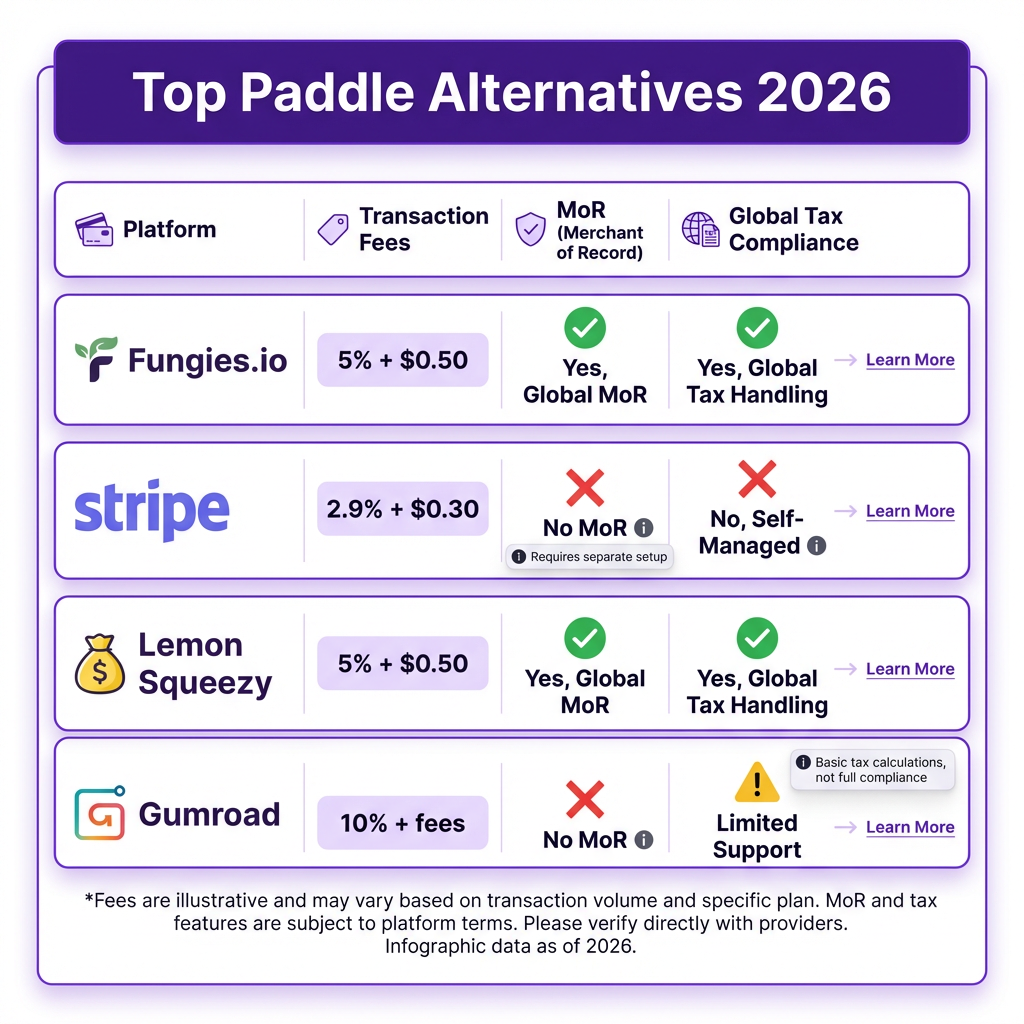
1. Fungies.io — Best Overall Paddle Alternative
Fungies.io is the closest direct competitor to Paddle, offering full Merchant of Record services with a more modern approach. Like Paddle, they handle global tax compliance, payment processing, and subscription management.
Key advantages over Paddle:
- Lower transaction fees (5% + $0.50 vs Paddle’s blended rate)
- No long-term contracts — month-to-month billing
- Faster onboarding — most accounts approved within 24 hours
- Superior developer experience with cleaner APIs and better documentation
- More customizable checkout flows
- Built-in affiliate management (Paddle charges extra)
Pricing: 5% + $0.50 per transaction. No monthly fees, no setup costs.
Best for: SaaS companies of all sizes who want Paddle’s benefits without the drawbacks.
2. Stripe + Stripe Tax — Best for Developer-First Teams
Stripe remains the gold standard for payment infrastructure. When combined with Stripe Tax for automatic tax calculation, it covers most of what Paddle offers — with far more flexibility.
Pros:
- Industry-leading APIs and documentation
- Massive ecosystem of integrations
- Stripe Tax handles sales tax and VAT in 40+ countries
- Complete control over checkout experience
- Lower base fees (2.9% + $0.30 in US)
Cons:
- NOT a Merchant of Record — you’re still liable for tax compliance
- Requires more setup and ongoing maintenance
- Stripe Tax is an add-on cost (0.5% per transaction)
- No built-in subscription management (need Stripe Billing)
Pricing: 2.9% + $0.30 per transaction + 0.5% for Stripe Tax.
Best for: Engineering-heavy teams who want maximum control and don’t mind managing compliance themselves.
3. Lemon Squeezy — Best for Indie Hackers and Small Teams
Lemon Squeezy burst onto the scene as a “Stripe alternative for digital products” and quickly gained traction among indie developers and small SaaS teams. Like Paddle, they’re a Merchant of Record.
Pros:
- Beautiful, modern UI that’s genuinely pleasant to use
- Full MoR with global tax compliance
- Built-in license key management for software
- Simple, transparent pricing
- Great for digital products, not just SaaS
Cons:
- Higher fees than competitors (5% + $0.50, same as Fungies but with fewer features)
- Limited API capabilities compared to Stripe or Fungies
- Smaller team means slower feature development
- Some reports of delayed payouts
Pricing: 5% + $0.50 per transaction.
Best for: Solo founders and small teams selling digital products who prioritize ease of use over advanced features.
4. Gumroad — Best for Creators and Simple Products
Gumroad is the simplest option on this list. It’s designed for creators selling ebooks, courses, and simple digital products — not sophisticated SaaS billing.
Pros:
- Dead simple setup — sell in minutes, not days
- Built-in audience and discovery features
- Handles basic tax compliance
- No monthly fees
Cons:
- Highest fees (10% + processing fees)
- NOT a true Merchant of Record
- Limited subscription management
- Poor API and developer experience
- Not suitable for complex SaaS billing needs
Pricing: 10% + payment processing fees.
Best for: Individual creators selling one-time digital products, not SaaS companies.
5. Chargebee — Best for Enterprise SaaS
Chargebee is a subscription management platform, not a Merchant of Record. It integrates with your existing payment processor (usually Stripe) and adds sophisticated billing capabilities.
Pros:
- Advanced subscription management (proration, upgrades, downgrades)
- Revenue recognition and reporting
- Multi-currency support
- Enterprise-grade features
Cons:
- NOT a Merchant of Record — you handle tax compliance
- Expensive ($249+/month for paid plans)
- Complex setup and configuration
- Overkill for most small-to-medium SaaS
Pricing: $249-$599/month + payment processing fees.
Best for: Enterprise SaaS with complex billing needs and dedicated finance teams.
6. FastSpring — Best for Software Companies
FastSpring is an established Merchant of Record specifically built for software companies. They’ve been around since 2005 and power payments for thousands of software businesses.
Pros:
- True Merchant of Record with global tax compliance
- Software-focused features (license management, trials)
- Localized checkout in 20+ languages
- Established track record
Cons:
- Outdated UI and user experience
- Opaque pricing (custom quotes only)
- Slower onboarding than newer competitors
- Less developer-friendly than modern alternatives
Pricing: Custom pricing based on volume.
Best for: Established software companies with complex international sales.
7. PayPro Global — Best for High-Risk Industries
PayPro Global is a lesser-known Merchant of Record that specializes in high-risk verticals that other platforms avoid.
Pros:
- Accepts high-risk merchants other platforms reject
- Full MoR with tax compliance
- 24/7 customer support
- Affiliate management built-in
Cons:
- Higher fees than mainstream alternatives
- Dated platform interface
- Smaller ecosystem and fewer integrations
Pricing: Custom pricing, typically higher than competitors.
Best for: SaaS in regulated or high-risk industries that struggle to get approved elsewhere.
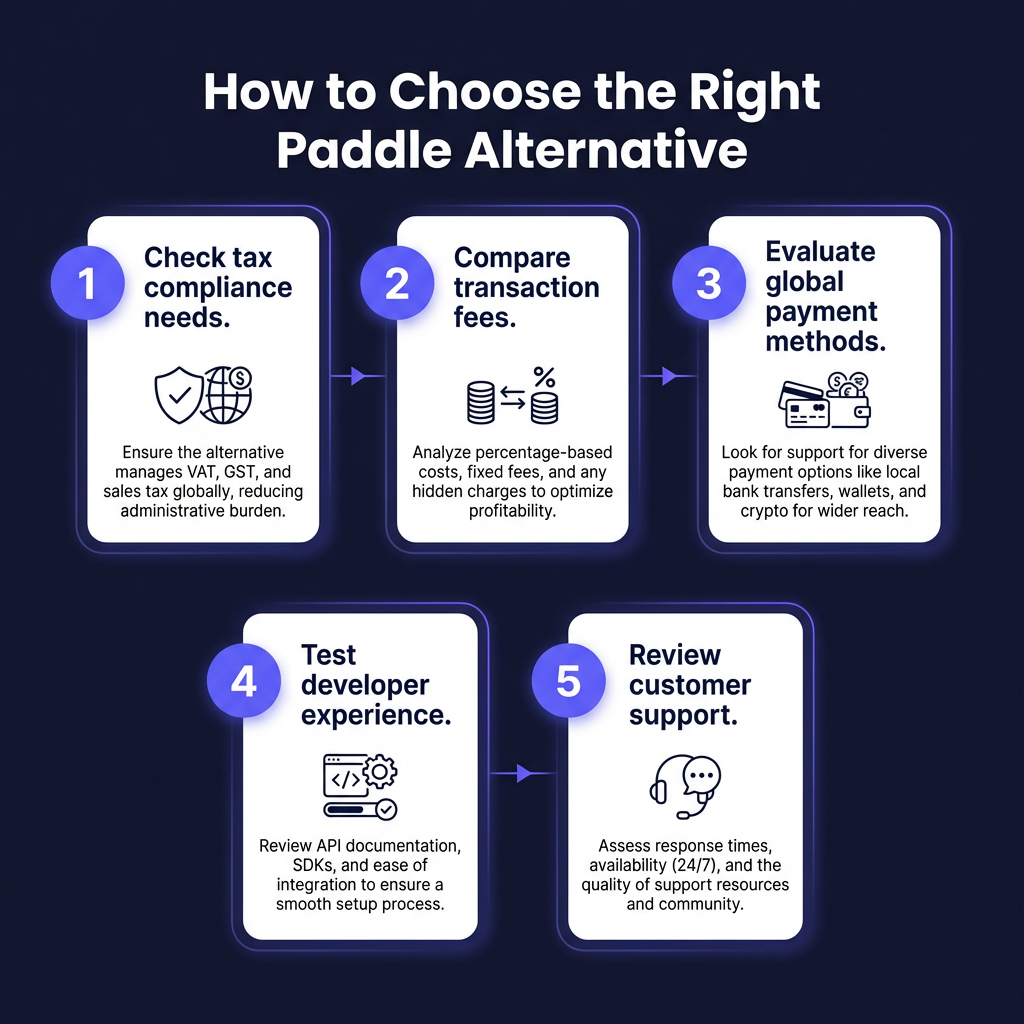
How to Choose the Right Paddle Alternative
With seven solid options, how do you pick the right one? Here’s my decision framework:
Step 1: Do You Need a Merchant of Record?
This is the biggest decision. If you want to completely offload tax compliance, you need a true MoR like Fungies.io, Lemon Squeezy, FastSpring, or PayPro Global.
If you’re comfortable managing tax compliance yourself (or have a finance team to handle it), Stripe + Stripe Tax gives you more control and lower fees.
Step 2: What’s Your Transaction Volume?
High volume (>$100K/month) makes percentage-based fees painful. Negotiate custom rates with Fungies.io or FastSpring, or consider Stripe’s lower base rates.
Low volume (<$10K/month) means setup speed matters more than fees. Lemon Squeezy or Gumroad get you selling fastest.
Step 3: How Important is Developer Experience?
If your team lives in code, Stripe and Fungies.io have the best APIs and documentation. Lemon Squeezy and Gumroad prioritize no-code simplicity over developer flexibility.
Step 4: What’s Your Risk Profile?
Standard SaaS businesses can use any platform. High-risk industries (adult content, gambling, certain supplements) may need PayPro Global or FastSpring.
Step 5: Test Before You Commit
Most platforms offer free trials or test modes. Build a proof-of-concept checkout flow before migrating your entire business. The hour you spend testing will save weeks of frustration later.
Paddle Alternatives: Quick Comparison Table
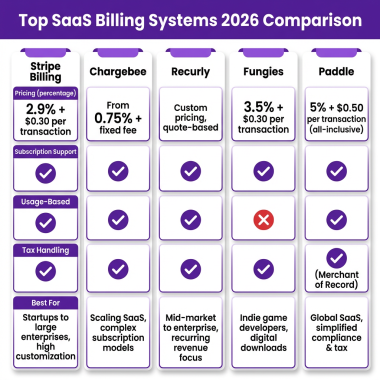
| Platform | Type | Pricing | MoR | Best For |
|---|---|---|---|---|
| Fungies.io | MoR | 5% + $0.50 | Yes | All SaaS sizes |
| Stripe + Tax | Payment | 2.9% + $0.30 + 0.5% | No | Developer teams |
| Lemon Squeezy | MoR | 5% + $0.50 | Yes | Indie hackers |
| Gumroad | Commerce | 10% + fees | No | Creators |
| Chargebee | Billing | $249+/mo | No | Enterprise |
| FastSpring | MoR | Custom | Yes | Software |
| PayPro Global | MoR | Custom | Yes | High-risk |
Frequently Asked Questions
What is the cheapest alternative to Paddle?
For low volumes, Stripe + Stripe Tax has the lowest base rate at 2.9% + $0.30 (plus 0.5% for tax). However, this isn’t an apples-to-apples comparison since Stripe isn’t a Merchant of Record. Among true MoR platforms, Fungies.io and Lemon Squeezy both charge 5% + $0.50 — but Fungies includes more features at that price point.
Can I migrate from Paddle without losing subscribers?
Yes, but it requires careful planning. Most platforms offer migration tools or services to transfer active subscriptions. Fungies.io and Chargebee have particularly smooth migration processes. Expect some customer friction — you’ll need to update payment methods for some subscribers.
Is Stripe a true Paddle alternative?
Only if you don’t need Merchant of Record services. Stripe handles payments beautifully but doesn’t become the legal seller of record. You’re still responsible for tax compliance, which is Paddle’s main value proposition. For a true Paddle alternative, look at Fungies.io, Lemon Squeezy, or FastSpring.
Which Paddle alternative has the best API?
Stripe sets the industry standard for API design and documentation. Among Merchant of Record platforms, Fungies.io has the most developer-friendly API with modern REST endpoints, comprehensive webhooks, and SDKs for popular frameworks.
Do I need a Merchant of Record for my SaaS?
If you sell to customers in multiple countries (especially the EU), a MoR saves you from registering for VAT in dozens of jurisdictions. For US-only businesses with simple tax situations, you might handle compliance yourself with Stripe Tax. As you scale internationally, the MoR model becomes increasingly valuable.
Final Thoughts: Making the Switch
Paddle isn’t a bad platform — it’s just not the only option anymore. Depending on your priorities, there’s likely a better fit for your specific situation.
If you want the closest thing to Paddle without the drawbacks, Fungies.io offers the same Merchant of Record benefits with lower fees and faster onboarding. For teams that want maximum control and don’t mind managing compliance, Stripe remains unbeatable. And if you’re a solo founder prioritizing simplicity, Lemon Squeezy gets you selling fast.
The key is matching the platform to your actual needs — not just copying what other founders use. Test a few options, measure the results, and don’t be afraid to switch if your current solution isn’t serving you.
Ready to Switch from Paddle?
Fungies.io offers everything Paddle does — with better pricing, faster onboarding, and no long-term contracts. Join 500+ SaaS companies making the switch.
No credit card required • 5% + $0.50 per transaction