The Complete Guide to Product-Led Growth (PLG) for SaaS in 2026
Discover how product-led growth (PLG) is transforming SaaS customer acquisition. Learn the 5-step framework, key metrics like TTV and PQLs, and real-world examples from Slack, Calendly, and Notion.
Here’s a statistic that should change how you think about SaaS growth: 58% of B2B SaaS companies now have a product-led growth motion, and 91% of them plan to increase their investment. Meanwhile, traditional sales-led companies are watching their customer acquisition costs climb 20-30% year over year.
I’ve spent years running paid acquisition campaigns across every major platform. And I’ll tell you honestly—there’s no ad campaign, no matter how well-optimized, that beats a product that sells itself. That’s the promise of product-led growth (PLG). It’s not a buzzword. It’s a fundamental shift in how SaaS companies acquire, convert, and retain customers.
What Is Product-Led Growth, Really?
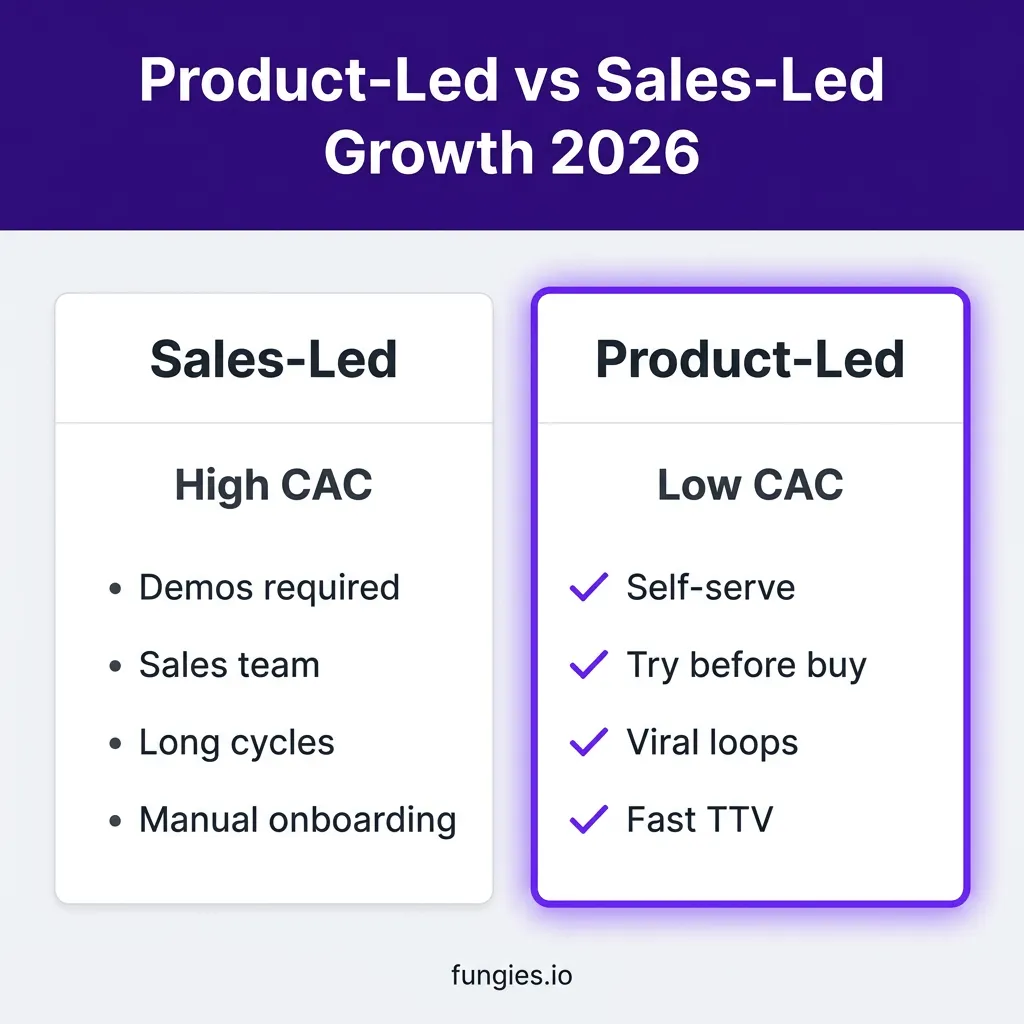
Product-led growth is a go-to-market strategy where the product itself becomes your primary driver of customer acquisition, conversion, and expansion. Instead of relying on sales demos, marketing campaigns, and outbound outreach, you let users experience value firsthand—often before they ever pay a dollar.
Here’s the key distinction: in a sales-led model, your website captures leads, your sales team qualifies them, and your product is the final destination. In a PLG model, your product is the starting point. Users sign up, experience value, and convert—often without ever talking to a human.
The math is compelling. According to OpenView’s Product Benchmarks report, PQLs (product-qualified leads) convert at 15-30%—compared to the 2-5% you might see from traditional MQLs. That’s not a marginal improvement. It’s a fundamentally different growth curve.
Why PLG Works: The Psychology of Self-Serve
There’s a reason PLG companies grow faster. It comes down to how modern buyers want to evaluate software.
Think about your own behavior. When you’re considering a new tool, do you want to fill out a form, wait for a sales rep to email you back, schedule a 30-minute demo, and then get added to a nurture sequence? Or do you want to sign up with your Google account, poke around for 10 minutes, and decide if it’s worth your time?
Exactly.
The self-serve model removes friction at every step. Users don’t have to convince their boss to approve a purchase before they’ve proven value. They don’t need budget sign-off to start a trial. They can experiment, integrate, and get hooked on the product’s value before any commercial conversation happens.
And here’s the kicker: when users do convert, they convert with higher intent and better retention. They’ve already validated that the product solves their problem. They’re not buying based on a slick demo—they’re buying based on lived experience.
The Core Metrics That Define PLG Success
If you’re going to build a PLG motion, you need to measure the right things. Traditional SaaS metrics like MQL volume and sales pipeline don’t tell the full story. Here are the metrics that actually matter:
1. Time-to-Value (TTV)
Time-to-value measures how long it takes a new user to experience their first “aha moment”—the point where they genuinely understand how your product helps them. In PLG, speed is everything.
The benchmark? Under 15 minutes for simple tools, under 24 hours for complex ones. If your TTV is measured in days or weeks, you’ve got a problem. Amplitude’s research shows that 91% of new users drop off within 14 days if they haven’t experienced value. You don’t have time for a slow onboarding process.
2. Activation Rate
Activation rate tracks what percentage of new users complete a key action that correlates with retention. This isn’t just “signed up”—it’s “performed the core action that makes them sticky.”
For Slack, activation was getting a team to send 2,000 messages. For Facebook, it was getting users to 7 friends in 10 days. For Calendly, it’s scheduling that first meeting. Your activation event should be the earliest reliable indicator that a user is getting value.
Here’s a number that matters: a 25% increase in activation rate produces a 34% rise in MRR over 12 months. Activation isn’t just a product metric—it’s a revenue metric.
3. Viral Coefficient (K-Factor)
The viral coefficient measures how many new users each existing user brings in. Calculate it by multiplying the average number of invites per user by your conversion rate on those invites.
If your K-factor is above 1, you’ve achieved viral growth—each user brings in more than one new user, creating exponential growth. Most SaaS products hover around 0.2-0.5. The best PLG companies? They engineer products where sharing is built into the core workflow.
4. Free-to-Paid Conversion Rate
This is where the rubber meets the road. According to ChartMogul’s SaaS Conversion Report, the median free-to-paid conversion rate across all products is 8%. But there’s massive variance:
- Top quartile: 15-25% conversion
- Median: 8% conversion
- Bottom quartile: Below 2.5% conversion
The difference isn’t usually the product—it’s the conversion motion. When do you ask for payment? How do you communicate value? What friction do you remove?
5. Product-Qualified Leads (PQLs)
PQLs are users who have demonstrated buying intent through product usage rather than marketing engagement. They’ve hit specific usage thresholds, integrated with other tools, or invited team members.
Here’s the stat that matters: free trials using PQLs see 2.8x higher conversion rates than those that don’t. When you identify users who are already getting value and reach out at the right moment, your sales efficiency skyrockets.
Building Your PLG Motion: A Practical Framework
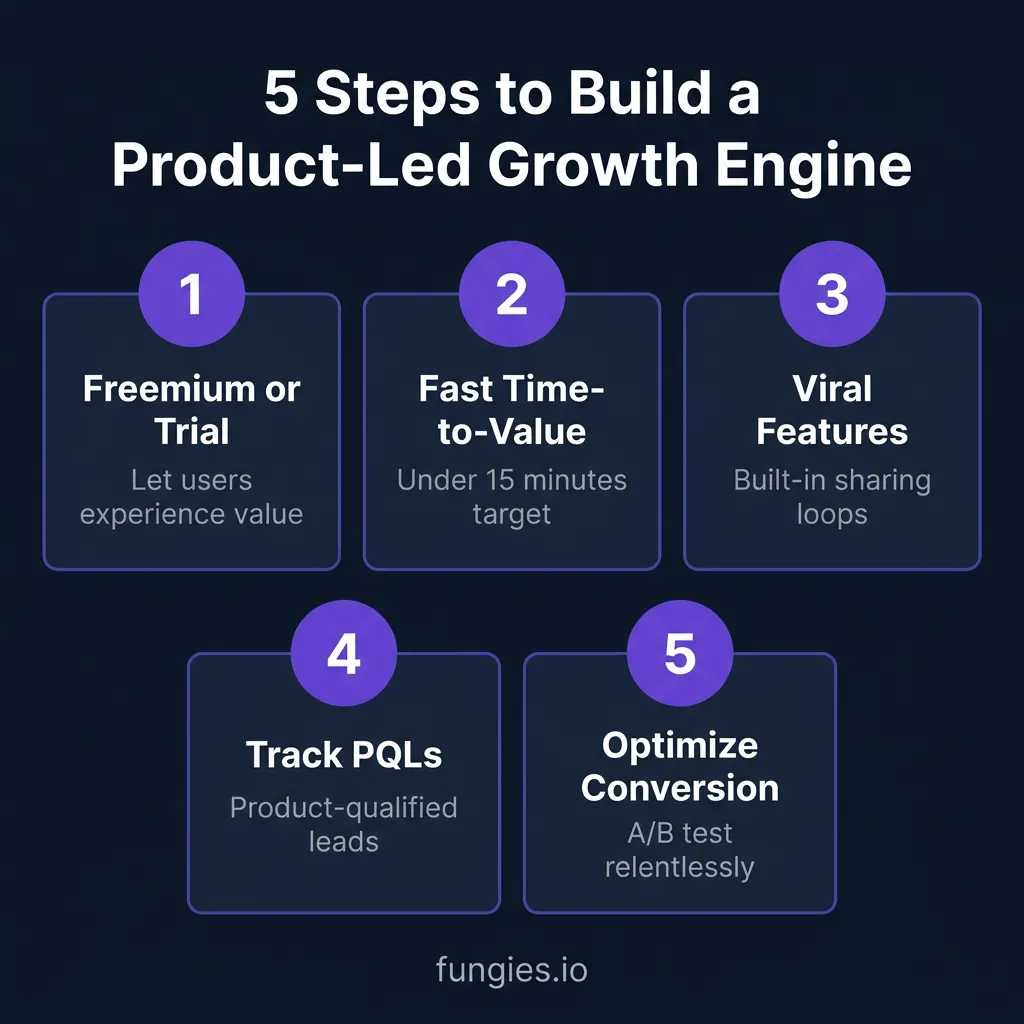
Theory is nice. Execution is what matters. Here’s a step-by-step framework for building a PLG motion that actually drives growth.
Step 1: Choose Your Entry Point
You’ve got three main options for how users first experience your product:
| Model | Best For | Conversion Rate | Trade-off |
|---|---|---|---|
| Freemium | Network effects, viral products | 2-5% | Lower conversion, higher volume |
| Free Trial (Opt-in) | Most B2B SaaS | 15-25% | Balanced approach |
| Free Trial (Opt-out) | Established products | 60-80% | Higher friction, better intent |
Freemium works best when your product has natural viral loops—think Slack, Zoom, or Calendly. The free version spreads, and a percentage convert to paid. Free trials work better for complex B2B tools where users need time to evaluate.
My take? If you’re early-stage and don’t have product-market fit yet, start with a free trial. You need the feedback loop of users converting (or not) to understand what drives value. Freemium is a scaling strategy, not a discovery strategy.
Step 2: Design for Fast Time-to-Value
Every unnecessary step in your onboarding flow is killing conversions. Here’s how to fix it:
- Remove friction before value: Don’t ask for credit cards, company size, or job titles before users have experienced the product. You can collect that data later.
- Use progressive profiling: Ask for information only when you need it. If a feature requires calendar access, ask then—not at signup.
- Create templates and defaults: Empty states are conversion killers. Give users pre-built templates, sample data, or example projects they can play with immediately.
- Guide to the aha moment: Your onboarding should have one goal—getting users to that activation event. Everything else is secondary.
Look at Notion’s onboarding. They don’t dump you into a blank page. They show you templates, examples, and use cases that match your stated intent. Within 2 minutes, you’ve created something useful. That’s the standard.
Step 3: Build Viral Loops Into the Product
The best PLG companies don’t rely on users remembering to share. They build sharing into the core workflow.
Calendly is the classic example. When you use Calendly, you send a scheduling link to someone. That someone sees Calendly, experiences how easy it is, and signs up themselves. The viral loop is the product.
Loom does the same thing. Every video created with Loom has a “Record video with Loom” watermark. Viewers see the tool in action and want it for themselves.
Ask yourself: where in my product’s natural workflow does a user interact with non-users? That’s your viral insertion point.
Step 4: Implement PQL Scoring
Not all free users are created equal. Some are tire-kickers. Some are about to become your best customers. PQL scoring helps you tell the difference.
Start by identifying the behaviors that correlate with conversion. Common PQL signals include:
- Hitting usage thresholds (e.g., created 5 projects, sent 100 messages)
- Inviting team members or collaborators
- Integrating with other tools in their stack
- Returning consistently over multiple days
- Viewing pricing or upgrade pages
Score these behaviors and create triggers for sales outreach. When a user hits a PQL threshold, that’s your moment to offer help, suggest a demo, or propose an upgrade.
Step 5: Optimize Your Conversion Motion
The final step is relentless optimization of your free-to-paid conversion. Here’s what works:
- Usage-based triggers: Prompt upgrades when users hit free plan limits—not before. The best time to ask for money is when the value is fresh.
- Expansion revenue design: Structure your pricing so users naturally grow into higher tiers as their usage increases. Per-seat pricing, usage tiers, and feature gating all work.
- Annual prepay incentives: Offer 2 months free for annual billing. It improves cash flow and reduces churn.
- In-app upgrade flows: Don’t make users leave the product to upgrade. The conversion should happen where the value is being experienced.
Real-World PLG Success Stories
Theory is useful. Examples are better. Let’s look at how three companies built billion-dollar businesses with PLG.
Slack: The Freemium Masterclass
Slack’s growth wasn’t an accident. They designed a product where the free version spreads naturally through teams, then gated the features that mattered most to larger organizations.
The genius? Their limit—10,000 message history—didn’t hurt small teams but became painful as organizations grew. When you hit that limit, you feel it. Every search that fails, every conversation you can’t reference—it builds the case for upgrading.
Slack also nailed the viral loop. To use Slack, you invite your team. Those team members experience the product, then bring it to their other projects. The product spreads through professional networks organically.
Calendly: Viral by Design
Calendly is perhaps the purest example of PLG. The product’s core function—scheduling meetings—inherently involves other people. Every Calendly link sent is a product demo for the recipient.
They also understood time-to-value. Sign up, connect your calendar, create a scheduling link. That’s it. Under 5 minutes to first value. The product is so simple that it doesn’t need extensive onboarding—it’s intuitive from the first use.
The result? Calendly grew to millions of users with minimal marketing spend. The product was the marketing.
Notion: Template-Driven Activation
Notion faced a challenge: their product is incredibly flexible, which means new users don’t know where to start. A blank Notion page is intimidating.
Their solution? Templates. Thousands of them. When you sign up for Notion, you’re immediately presented with templates for your use case—whether that’s project management, note-taking, or building a wiki. You start with something functional, not a blank canvas.
This template strategy also created a viral loop. Users built and shared templates. The template gallery became a discovery mechanism. And power users became advocates, creating content and tutorials that drove organic growth.
Common PLG Mistakes to Avoid
I’ve seen plenty of companies attempt PLG and fail. Here are the mistakes that kill PLG motions:
Mistake 1: Building a Free Product That’s Too Limited
If your free plan doesn’t deliver real value, users won’t stick around long enough to convert. The free version needs to be genuinely useful—just limited enough that power users eventually need to upgrade.
Mistake 2: Ignoring the Enterprise
PLG doesn’t mean “no sales team.” It means “product-first, sales-assisted.” The best PLG companies use their self-serve motion to generate PQLs, then have sales teams close larger deals. Slack, Zoom, and Dropbox all have significant enterprise sales teams— they just don’t lead with them.
Mistake 3: Slow Time-to-Value
If it takes more than a day for users to experience value, PLG probably won’t work for you. The whole model depends on users self-serving their way to an aha moment. Complex implementations, lengthy setups, and required integrations kill PLG.
Mistake 4: Treating PLG as a Feature, Not a Strategy
You can’t bolt PLG onto a sales-led product. It requires fundamental changes to your product design, pricing, onboarding, and company culture. The product team becomes the growth team. Support becomes a revenue function. Everything shifts.
FAQ: Product-Led Growth
What types of SaaS products work best for PLG?
PLG works best for products with: (1) fast time-to-value, (2) natural viral loops, (3) self-serve onboarding, and (4) usage-based value delivery. Horizontal tools that solve universal problems (communication, scheduling, documentation) tend to work better than narrow vertical solutions.
Can enterprise SaaS use PLG?
Absolutely. The “enterprise” label doesn’t preclude PLG—it just changes the implementation. Enterprise PLG typically involves product-led trials that feed into sales-assisted conversions. Users start self-serve, hit PQL thresholds, and then engage with sales for expansion.
What’s a good free-to-paid conversion rate?
Benchmarks vary by model: freemium typically sees 2-5% conversion, opt-in free trials 15-25%, and opt-out trials 60-80%. The median across all SaaS is around 8%. If you’re below 5%, focus on improving time-to-value and activation. If you’re above 15%, you’re doing well.
How do I know if PLG is right for my product?
Ask yourself: Can a new user experience value in under 15 minutes without talking to anyone? If the answer is no, PLG will be challenging. If yes, you have the foundation. The next question is whether you can build viral loops and a sustainable conversion motion on top of that foundation.
Should I abandon sales-led if I move to PLG?
No. The best growth strategies often combine both. Use PLG for acquisition and initial conversion, then layer in sales for expansion and enterprise deals. This “product-led sales” model is increasingly common and highly effective.
Conclusion: The Future Is Product-Led
Here’s the truth: buyers have changed. They don’t want to talk to sales reps to evaluate software. They want to try before they buy, experience value immediately, and make their own decisions.
Product-led growth isn’t a trend—it’s a response to this fundamental shift in buyer behavior. The SaaS companies that win the next decade will be the ones that build products so good, so intuitive, and so valuable that they sell themselves.
The question isn’t whether PLG is right for your business. The question is whether you can afford to ignore it while your competitors figure it out.
Ready to build a product that sells itself? Start with Fungies—the merchant of record platform that handles your payments, tax compliance, and checkout so you can focus on building a product worth sharing.
Sources
- OpenView Partners – Product-Led Growth Benchmarks 2025
- ChartMogul – SaaS Conversion Report 2026
- First Page Sage – SaaS Free Trial Conversion Rate Benchmarks
- Gainsight – Product Qualified Lead (PQL) Conversion Rates
- Amplitude – Time to Value Research
- ProductLed.com – PLG Best Practices
- Appcues – Product-Led Growth Metrics Guide