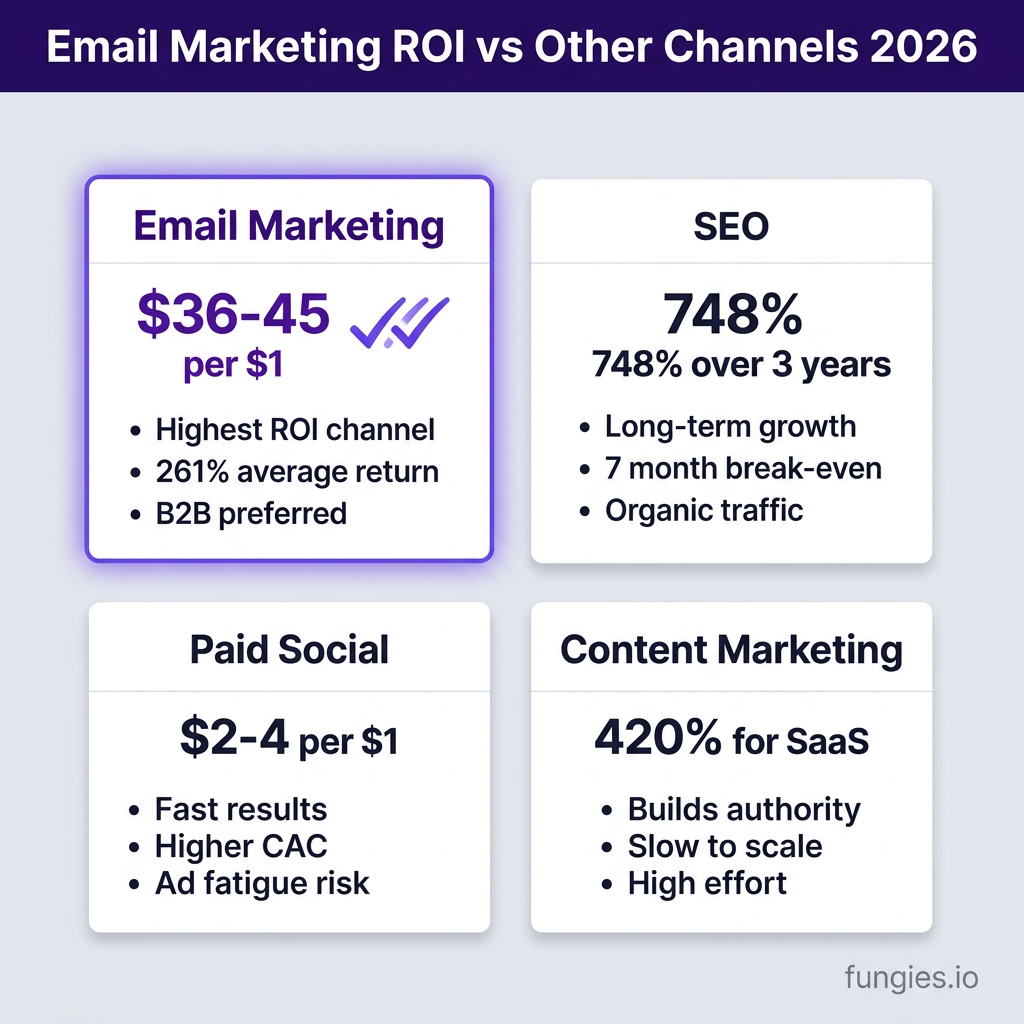
Here’s a number that should change how you think about your SaaS marketing budget: email marketing delivers $36 to $45 for every $1 spent in 2026. That’s not a typo. While your competitors pour money into paid ads with diminishing returns, the highest-ROI channel in digital marketing is sitting right in front of you — and most SaaS companies are barely scratching the surface.
I’ve spent years watching SaaS founders obsess over SEO, LinkedIn ads, and content marketing while treating email as an afterthought. They set up a welcome sequence, send the occasional product update, and wonder why their churn rate stays stubbornly high. The truth? Email isn’t just another channel. It’s the connective tissue that turns trial users into paying customers and paying customers into advocates.
Why SaaS Email Marketing Is Different
Email marketing for SaaS isn’t like e-commerce or B2C. You’re not selling a one-time purchase — you’re nurturing a relationship that spans months or years. Your subscribers are developers, founders, and operators who can smell generic marketing from a mile away. They don’t want flashy promotions. They want value, relevance, and timing that respects their inbox.
The data backs this up. According to 2026 benchmarks, 59% of B2B marketers name email as their most effective revenue channel. Yet only 31% of businesses use even basic segmentation. That gap? It’s your competitive advantage. The practices I’m about to share aren’t theoretical — they’re proven tactics that top-performing SaaS companies use to generate 760% more revenue from their email programs.
1. Segment Your List Like Your Revenue Depends On It (Because It Does)
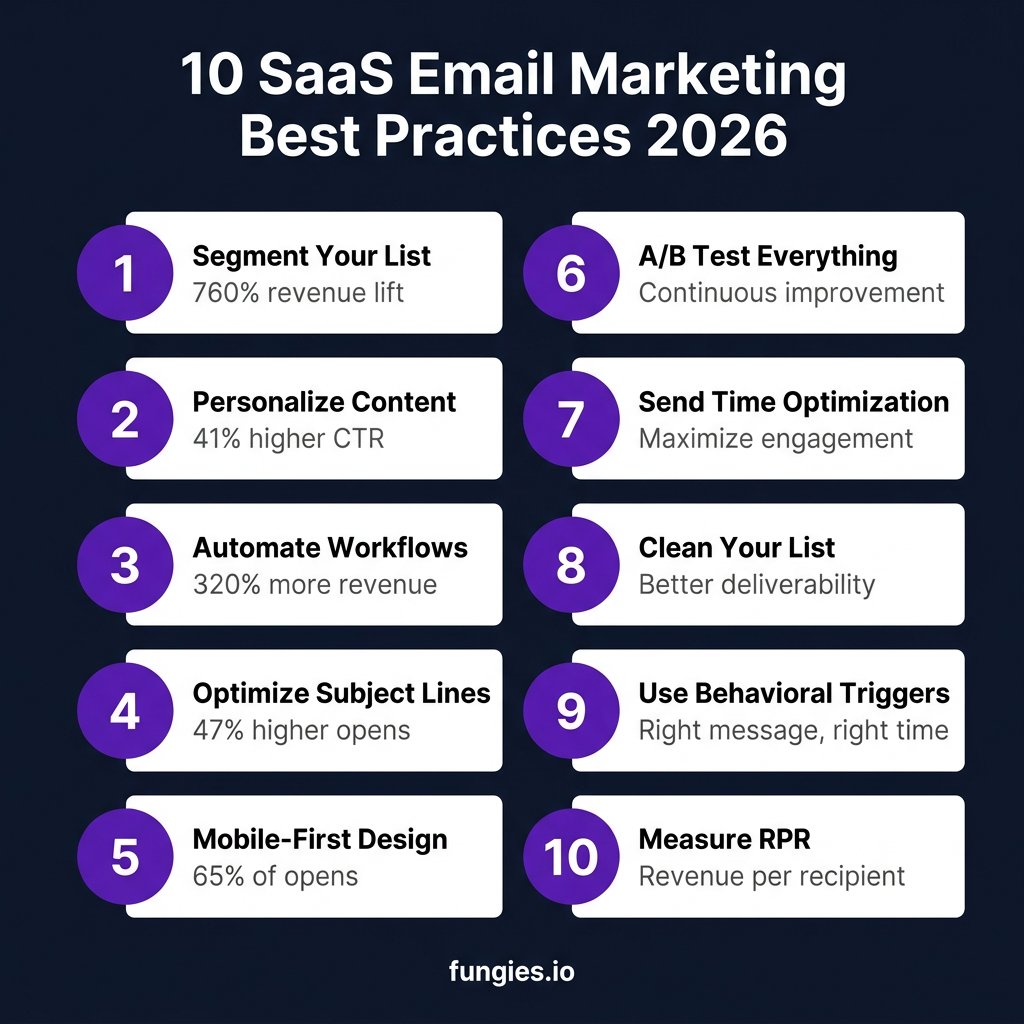
Let’s start with the practice that has the biggest impact: segmentation. Here’s the stat that matters: segmented and personalized campaigns generate 58% of email revenue and can increase revenue by up to 760%. Yet most SaaS companies blast the same message to their entire list.
Honestly, this is the fastest win in email marketing. You don’t need fancy AI or complex automation. Start with these basic segments:
- Trial status: Active trial, expired trial, never started
- Engagement level: Power users, casual users, dormant accounts
- Company size: Solo founders, small teams, enterprise
- Use case: Which features they use most
- Lifecycle stage: New signup, activated, paying, expansion-ready
A user who signed up yesterday shouldn’t get the same email as someone who’s been paying for two years. Obvious, right? But you’d be shocked how many SaaS companies ignore this. When you segment properly, every email feels like it was written specifically for the person reading it. That’s when conversion happens.
2. Personalize Beyond the First Name
Personalization in 2026 goes way deeper than “Hi [First Name].” The data shows that personalized emails achieve 29% higher open rates and 41% higher click-through rates. But real personalization means using behavioral data to tailor content.
Here’s what that looks like in practice:
- Reference specific features they’ve used (or haven’t tried yet)
- Mention their company name and industry
- Highlight use cases similar to their own
- Show metrics from their actual account
- Recommend next steps based on their current stage
73% of customers expect companies to understand their unique needs. When you send a generic product update to someone who hasn’t logged in for 30 days, you’re telling them you don’t care. When you send a “We noticed you haven’t tried our API yet” email with a specific tutorial? That’s personalization that converts.
3. Build Automated Workflows That Run While You Sleep
This might surprise you: automated emails generate 320% more revenue while comprising only 2% of email volume. The math is brutal — most SaaS companies are manually sending campaigns when they should be building automation that scales.
Your automation foundation should include these workflows:
| Workflow | Trigger | Goal |
|---|---|---|
| Welcome Series | New signup | Activate and educate |
| Onboarding | First login | Guide to first value |
| Trial Conversion | Day 10 of trial | Convert to paid |
| Re-engagement | 30 days inactive | Bring users back |
| Expansion | Usage spike | Upsell to higher tier |
| Win-back | Canceled subscription | Recover churned users |
The key is behavioral triggers. Don’t send onboarding emails on a schedule — send them when users take (or don’t take) specific actions. Did they create their first project? Skip the “How to create a project” email. Haven’t invited a team member after 3 days? That’s your trigger.
4. Write Subject Lines That Actually Get Opened
In 2026, the average email campaign open rate across all industries is 31%, with top performers hitting 45%. But here’s the thing — Apple’s Mail Privacy Protection has made open rates less reliable. Focus on click rate and revenue per recipient instead.
That said, subject lines still matter. Here’s what works for SaaS:
- Specificity beats curiosity: “Your API usage report for May” beats “Exciting updates inside”
- Keep it under 50 characters: Mobile is 65% of opens
- Use numbers: “3 ways to reduce your checkout latency”
- Ask questions: “Still managing taxes manually?”
- Avoid spam triggers: No ALL CAPS, excessive punctuation, or “FREE!!!”
Test your subject lines. Most email platforms make A/B testing easy, yet most marketers don’t bother. A 10% improvement in open rate compounds over thousands of sends. It’s worth the extra 5 minutes.
5. Design for Mobile First (Because That’s Where People Read)
Here’s a stat that should change your design priorities: 65% of email opens happen on smartphones. And 50% of users delete emails that don’t display correctly on mobile. Your beautiful desktop template means nothing if it breaks on an iPhone.
Mobile-first email design means:
- Single-column layouts that stack naturally
- Large touch targets for buttons (minimum 44×44 pixels)
- Readable font sizes (16px minimum)
- Short paragraphs (2-3 lines max on mobile)
- Compressed images that load fast
- Preheader text that supports the subject line
Test every email on your phone before sending. If you have to pinch to zoom, redesign it. Mobile isn’t the future of email — it’s the present, and has been for years.
6. A/B Test Everything (Not Just Subject Lines)
Most SaaS companies A/B test subject lines and call it a day. That’s leaving money on the table. In my experience, the biggest wins come from testing elements most marketers ignore.
Here’s your testing priority list:
- Send time: Tuesday 10am vs Thursday 2pm can be a 20% difference
- Sender name: “Sarah from Fungies” vs “Fungies Team”
- CTA placement: Above the fold vs after context
- Email length: Short and punchy vs detailed and educational
- Personalization depth: First name only vs rich behavioral data
- HTML vs plain text: Sometimes simple text wins
Run tests until you reach statistical significance — usually at least 1,000 recipients per variation. Document your learnings. Over time, you’ll build a playbook of what works for your specific audience.
7. Optimize Send Times for Your Audience
Timing isn’t everything, but it’s not nothing either. The best send time depends on your audience’s behavior. B2B SaaS emails typically perform best Tuesday through Thursday, mid-morning or early afternoon. But that’s a starting point, not a rule.
Consider your user’s timezone and work patterns. Are they developers who check email late at night? Founders who start early? Use your email platform’s send time optimization feature if available — it learns from individual open patterns and delivers accordingly.
One caveat: don’t over-optimize for opens at the expense of clicks. An email opened at 6am but ignored is worth less than one opened at 2pm that drives action. Revenue per recipient is the metric that matters.
8. Clean Your List Like Your Deliverability Depends On It
Your sender reputation is everything. Gmail, Yahoo, and Microsoft now require SPF, DKIM, and DMARC authentication for bulk senders. Ignore this and your emails go straight to spam, no matter how good your content is.
List hygiene best practices for 2026:
- Remove hard bounces immediately
- Suppress soft bounces after 3-5 attempts
- Re-engage or remove inactive subscribers (no opens in 6+ months)
- Never buy email lists (this should be obvious, but people still do it)
- Use double opt-in for new subscribers
- Monitor your spam complaint rate (keep it under 0.1%)
A smaller, engaged list beats a massive, dead list every time. I’d rather email 5,000 people with a 40% open rate than 50,000 with a 2% open rate. The algorithm agrees.
9. Use Behavioral Triggers, Not Just Time-Based Sequences
This is where SaaS email marketing gets really powerful. Time-based sequences are fine. Behavioral triggers are game-changing.
Instead of “Send day 3 email on day 3,” think “Send feature X tutorial when they haven’t used feature X.” Instead of “Monthly newsletter on the 1st,” think “Usage report when they hit a milestone.”
Effective behavioral triggers for SaaS:
- Feature adoption (or lack thereof)
- Usage milestones (100 API calls, first team member added)
- Account health indicators (declining usage, support tickets)
- Billing events (upcoming renewal, payment failure)
- Integration completions (connected Stripe, imported data)
The right message at the right time beats the perfect message at the wrong time. Every time.
10. Measure Revenue Per Recipient, Not Just Vanity Metrics
Finally, let’s talk about metrics. Open rates are increasingly unreliable. Click rates matter, but they’re not the goal. The goal is revenue.
Revenue per recipient (RPR) belongs on every dashboard. It shows you the 18x gap between flows and campaigns that open rates can’t reveal. It keeps you honest about what’s actually driving business results.
Your email KPI hierarchy should be:
- Primary: Revenue per recipient, total email-attributed revenue
- Secondary: Conversion rate, trial-to-paid rate from email
- Tertiary: Click rate, click-to-open rate
- Context: Open rate (trend only), unsubscribe rate, spam complaints
If an email campaign has a 50% open rate but generates zero revenue, it’s a failure. If another has a 20% open rate but drives $10K in upgrades, it’s a success. Measure what matters.
Putting It All Together: Your 30-Day Email Optimization Plan
Reading about best practices is easy. Implementing them is what separates top performers from the rest. Here’s a practical 30-day plan to overhaul your SaaS email marketing:
| Week | Focus | Actions |
|---|---|---|
| Week 1 | Foundation | Audit current segments, set up basic behavioral triggers, clean your list |
| Week 2 | Automation | Build welcome sequence, onboarding flow, trial conversion campaign |
| Week 3 | Optimization | A/B test subject lines, optimize send times, mobile-proof templates |
| Week 4 | Measurement | Set up RPR tracking, create dashboard, document learnings |
You won’t get everything perfect in 30 days. But you’ll be ahead of 90% of SaaS companies who treat email as an afterthought.
FAQ: SaaS Email Marketing Best Practices
What’s a good open rate for SaaS email marketing in 2026?
The average email open rate across all industries is 31%, with top performers achieving 45%. However, Apple’s Mail Privacy Protection has made open rates less reliable. Focus on click rate (average 1.69-2.09%) and revenue per recipient instead.
How often should SaaS companies send marketing emails?
It depends on your audience and the email type. Onboarding sequences might be daily for the first week. Newsletters work well weekly or bi-weekly. Product updates should be monthly or as-needed. The key is consistency and relevance — never sacrifice quality for frequency.
What’s the best email marketing software for SaaS?
The best platform depends on your stage and needs. Early-stage SaaS often starts with Mailchimp or Brevo. Growing companies typically move to Customer.io, ActiveCampaign, or HubSpot. Enterprise SaaS often uses Marketo or Salesforce Marketing Cloud. Prioritize behavioral triggers, API access, and integration with your product analytics.
How do I reduce unsubscribe rates?
Segment your list so every email is relevant. Don’t blast your entire database with every message. Set clear expectations at signup about what subscribers will receive. Make unsubscribing easy — hiding the unsubscribe link just leads to spam complaints, which hurt your deliverability.
Should SaaS companies use plain text or HTML emails?
Test both. Plain text often feels more personal and can have higher reply rates. HTML allows better tracking and design control. Many SaaS companies use a hybrid approach — simple HTML that looks like plain text, with minimal styling and a personal tone.
Conclusion: Email Is Your Highest-Leverage Channel
Email marketing in 2026 isn’t about batch-and-blast campaigns or clever subject lines. It’s about building automated systems that deliver the right message to the right person at the right time. It’s about treating your subscribers like humans, not list segments.
The SaaS companies winning in 2026 have figured this out. They’ve moved beyond vanity metrics and built email programs that drive real revenue. They’ve invested in segmentation, automation, and personalization at scale.
You can do the same. Start with one practice from this list. Implement it well. Then add another. Over time, you’ll build an email marketing engine that converts subscribers into customers and customers into advocates.
And if you’re looking for a payment platform that handles the complexity of global SaaS billing so you can focus on growth? Get started with Fungies.io — one simple integration, automatic tax compliance, and more time to build the email campaigns that drive your business forward.
Sources
- Klaviyo Email Marketing Benchmarks 2026
- Litmus State of Email Report 2026
- Constant Contact Small Business Now Report 2026
- HubSpot State of Marketing Report 2026
- Brevo Marketing Benchmark Report 2026
- Mailmend Email Personalization Statistics 2026
- Verified.email ROI Statistics 2024-2026
- Instantly Email Sequence Benchmarks 2026
- Digital Applied Email Marketing Statistics 2026