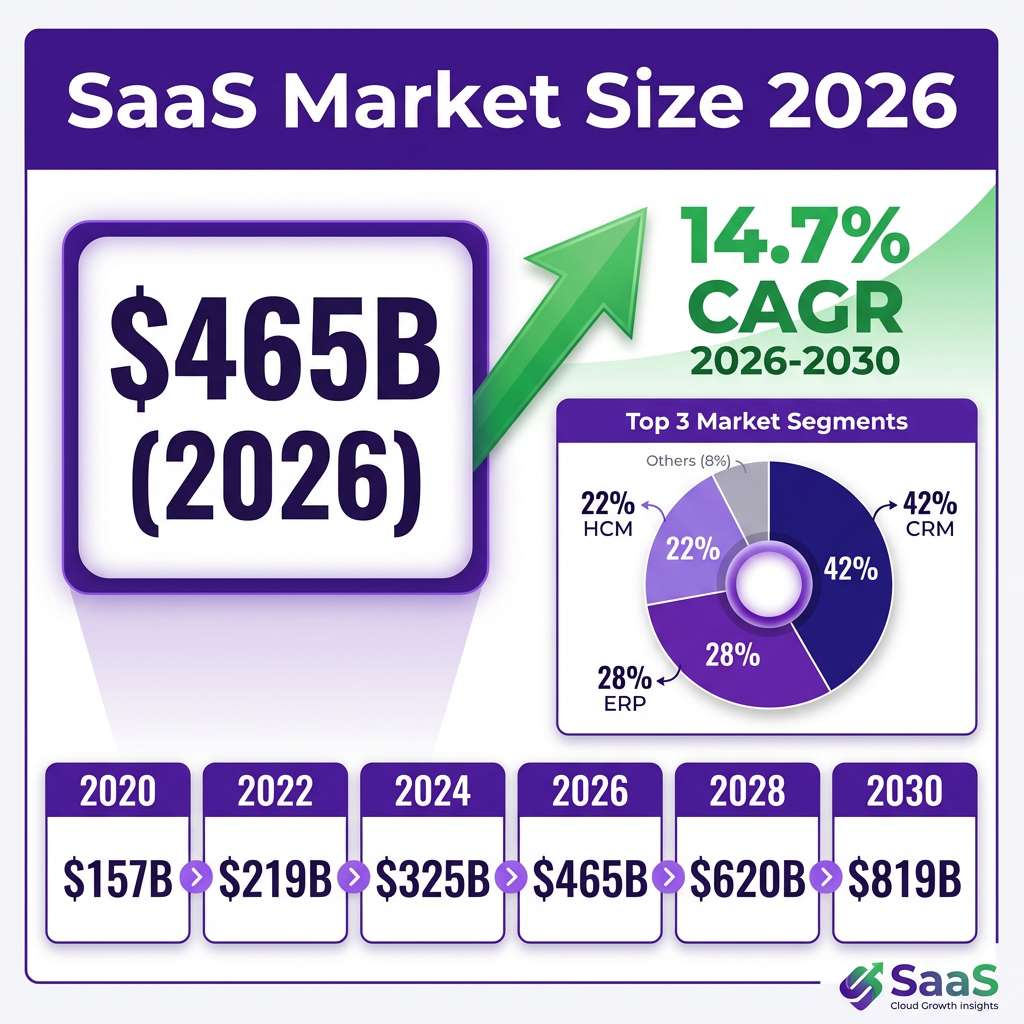
The Software-as-a-Service (SaaS) industry has reached an unprecedented inflection point in 2026. With the global market valued at $465.03 billion this year and projected to maintain a robust compound annual growth rate of 14.7% through 2030, SaaS has evolved from a convenient alternative to on-premise software into the dominant model for enterprise technology delivery. What started as a niche approach for startups and small businesses has become the strategic necessity powering 99% of organizations worldwide.
This comprehensive analysis draws from the latest market research, industry reports, and expert insights to deliver a data-driven examination of the SaaS landscape in 2026. Whether you are a founder building the next unicorn, an investor evaluating opportunities, or an executive making technology decisions, understanding these numbers and trends is not optional—it is essential for survival in an increasingly software-defined economy.
Market Overview: The $465 Billion SaaS Ecosystem
The SaaS market has demonstrated remarkable resilience and growth momentum, expanding from $408.21 billion in 2025 to reach $465.03 billion in 2026 according to Precedence Research. This represents a year-over-year growth rate of approximately 13.9%, outpacing many traditional technology sectors and cementing SaaS as one of the most dynamic segments of the global economy.
To understand the scale of this transformation, consider that the SaaS market has more than tripled since 2020. The COVID-19 pandemic accelerated digital transformation initiatives by an estimated 5-7 years, forcing organizations to rapidly adopt cloud-based solutions for remote work, collaboration, and business continuity. What began as crisis response has evolved into permanent structural change, with hybrid and remote work models now standard across industries.
The B2B SaaS segment specifically has emerged as a powerhouse within this broader market. Valued at $390 billion in 2025, the B2B SaaS market is projected to reach $492.34 billion in 2026 according to Mordor Intelligence. This segment encompasses enterprise resource planning (ERP), customer relationship management (CRM), human capital management (HCM), and specialized industry solutions that form the operational backbone of modern businesses.
Geographic distribution reveals interesting patterns in market maturity and growth potential. The United States continues to dominate with approximately 17,000 SaaS companies—representing roughly 70% of the global total of over 30,800 SaaS companies worldwide. However, Europe and Asia-Pacific regions are experiencing faster growth rates as digital infrastructure matures and enterprise adoption accelerates. The Asia-Pacific market in particular is expected to see the highest CAGR through 2030, driven by rapid digitalization in India, Southeast Asia, and China.
Industry verticalization has become a defining characteristic of the 2026 market. While horizontal solutions like CRM and ERP remain significant, vertical SaaS—software built specifically for individual industries—has captured increasing market share. Healthcare SaaS, financial services SaaS, real estate SaaS, and legal SaaS are among the fastest-growing subsegments, each addressing unique regulatory requirements, workflows, and data structures that generic solutions cannot adequately serve.
The deployment model landscape has also evolved substantially. Public cloud remains the dominant deployment method, but private cloud and hybrid configurations have gained traction among enterprises with stringent security, compliance, or latency requirements. Multi-cloud strategies have become standard, with organizations averaging 3.5 different cloud providers to avoid vendor lock-in and optimize performance across different workloads.
Looking ahead, market projections suggest the SaaS industry will reach approximately $720-850 billion by 2030, with some optimistic forecasts exceeding $1 trillion. This growth trajectory is supported by several structural factors: the continued shift from perpetual licenses to subscription models, the expansion of SaaS into emerging markets, the proliferation of AI-enhanced features commanding premium pricing, and the ongoing digital transformation of traditionally analog industries.
Key Statistics and Data: 25 Numbers Defining SaaS in 2026
Data drives decision-making in the SaaS industry, and 2026 has produced a wealth of metrics that reveal both the current state and future direction of the market. These statistics paint a picture of an industry in transition—maturing in some areas while experiencing explosive innovation in others.
Market Scale and Adoption:
- 99% of organizations now use at least one SaaS application, up from 73% in 2020
- 30,800+ SaaS companies operate globally as of 2026
- 17,000 SaaS companies are headquartered in the United States alone
- The average enterprise uses 130+ different SaaS applications
- SaaS accounts for approximately 58% of total software M&A activity
AI and Automation Integration:
- 75% of SaaS companies are expected to embed AI-driven automation in at least one core process by end of 2026
- Organizations use an average of 7.3 SaaS apps with AI functionality
- 45% of organizations use AI in IT service management SaaS applications
- AI-referenced targets accounted for approximately 72% of all SaaS M&A transactions in 2025
- The AI SaaS market is projected to exceed $200 billion by end of 2026
Financial Performance and Efficiency:
- SaaS companies spend 50% or more of their revenue on sales and marketing
- The average gross margin for SaaS companies is 70-80%
- Net Revenue Retention (NRR) benchmarks: 110%+ for best-in-class, 100-110% for good performance
- Customer Acquisition Cost (CAC) payback period averages 12-18 months for B2B SaaS
- Expansion revenue accounts for 40-50% of new ARR at scale
Growth and Valuation Metrics:
- Series A investors expect $1M+ in annual recurring revenue and 15-20% month-over-month growth
- The Rule of 40 (growth rate + profit margin) remains the gold standard for SaaS health
- Gartner forecasts worldwide software spending to grow 14.7% in 2026, reaching over $1.4 trillion
- Vertical SaaS companies command 20-30% higher valuations than horizontal competitors
- API-first SaaS companies grow 2-3x faster than traditional counterparts
Customer Behavior and Retention:
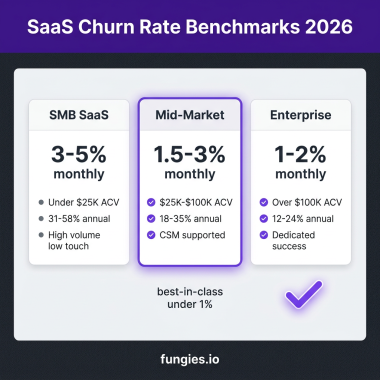
- Monthly churn rates for B2B SaaS average 3-5% (annualized 31-46%)
- Net Revenue Retention above 120% indicates strong product-market fit
- 93% of organizations using SaaS management platforms report increased productivity as the primary benefit
- 70% of organizations prefer usage-based pricing models for AI-enabled features
- The average sales cycle for enterprise SaaS has shortened to 3-6 months for best-in-class products
Technology and Infrastructure:
- 70%+ of organizations will centralize SaaS application management using an SMP by 2028, up from less than 30% in 2025
- 80% of organizations adopting composable architecture outpace competition in implementing new features
- Microservices architecture adoption has reached 65% among SaaS companies
- Edge computing integration is expected in 40% of SaaS applications by 2027
These statistics reveal an industry characterized by intense competition, rapid innovation cycles, and increasing customer sophistication. The companies thriving in this environment share common traits: strong unit economics, efficient growth engines, product-led strategies, and the ability to demonstrate clear ROI to increasingly discerning buyers.
7 Major Trends Shaping SaaS in 2026
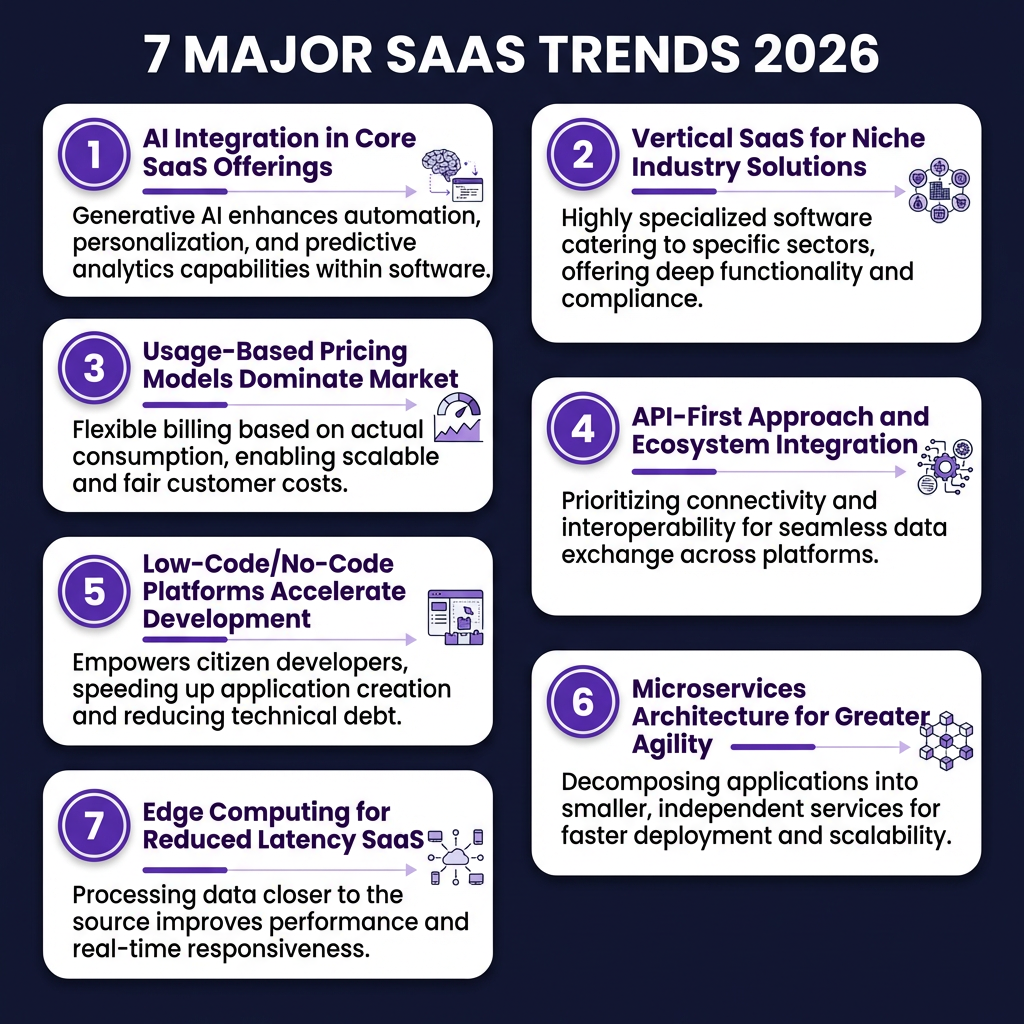
The SaaS landscape of 2026 is being fundamentally reshaped by seven interconnected trends that are redefining how software is built, sold, and consumed. Understanding these trends is not just about staying current—it is about anticipating where the market is heading and positioning accordingly.
1. Native AI Integration: From Bolt-On to Core Architecture
The most significant shift in 2026 is the transition from AI as a feature to AI as foundational architecture. Legacy SaaS providers that retrofitted AI capabilities—essentially slapping chatbots onto existing databases—are facing what industry analysts call “innovation debt.” In contrast, native AI SaaS companies are building with artificial intelligence as a core assumption from day one.
This distinction matters because native AI architectures can deliver fundamentally different user experiences. Instead of navigating complex interfaces to find information, users simply ask questions in natural language. Instead of manually configuring workflows, AI agents anticipate needs and automate routine tasks. The productivity gains are substantial—early adopters report 40-70% efficiency improvements in specific operational verticals.
However, this transformation comes with challenges. Compute costs for large language models can inflate expenses by 30-110%, creating potential “invoice shock” if not priced dynamically. Successful companies are implementing usage-based pricing models that align costs with customer value, ensuring sustainable unit economics while capturing upside from AI-driven efficiency gains.
2. Vertical SaaS Dominance: Industry-Specific Solutions
Horizontal SaaS—tools designed to work across industries—has dominated the market for two decades. But 2026 marks the ascendancy of vertical SaaS, solutions built specifically for the workflows, data structures, and compliance requirements of individual industries.
The logic is compelling. A generic CRM cannot understand the patient relationship nuances required by healthcare providers, the regulatory reporting demands of financial services, or the project complexity of construction management. Vertical SaaS companies embed deep industry knowledge into their products, delivering out-of-the-box functionality that would require extensive customization in horizontal alternatives.
The financial markets have noticed. Vertical SaaS companies command 20-30% valuation premiums compared to horizontal competitors, reflecting higher customer lifetime values, lower churn rates, and stronger competitive moats. Industries seeing the most vertical SaaS innovation include healthcare (practice management, telehealth), financial services (compliance, trading), real estate (property management, transaction coordination), legal (practice management, e-discovery), and agriculture (farm management, supply chain).
3. Usage-Based Pricing Revolution
The traditional SaaS pricing model—fixed monthly or annual subscriptions based on user seats—is under pressure. In its place, usage-based pricing (UBP) is emerging as the preferred model for both vendors and sophisticated customers.
UBP aligns incentives in ways that seat-based pricing cannot. Customers pay for actual value received rather than potential access. Vendors benefit from natural expansion revenue as customer usage grows. The model is particularly well-suited to AI-enabled features where compute costs scale with usage, infrastructure services where consumption varies, and API-first products where value correlates directly with transaction volume.
By 2026, 70% of organizations prefer usage-based pricing for AI-enabled features, and this preference is expanding to other SaaS categories. Companies like Twilio, Stripe, and Snowflake have demonstrated that UBP can support massive scale—Snowflake’s net revenue retention consistently exceeds 160% thanks to consumption-based growth from existing customers.
The challenge for SaaS companies is building the metering infrastructure, forecasting capabilities, and customer communication systems required for UBP success. Customers need predictability, which requires sophisticated tools for usage monitoring, budget alerts, and cost optimization recommendations.
4. API-First Development and Composability
The API-first approach—designing application programming interfaces before building user interfaces—has become standard practice among leading SaaS companies. This architectural decision has profound implications for how software is consumed and monetized.
API-first SaaS companies grow 2-3x faster than traditional counterparts because they enable customers to embed functionality directly into their own applications and workflows. Instead of forcing users to switch contexts between multiple tools, API-first providers become invisible infrastructure powering customer experiences.
This trend connects to the broader movement toward composable architecture. Organizations are rejecting monolithic suites in favor of best-of-breed components that can be assembled into custom solutions. By 2026, 70% of organizations will be mandated to acquire composable digital experience platform technology, up from 50% in 2023. Organizations adopting composable approaches implement new features 80% faster than those using monolithic alternatives.
For SaaS providers, being API-first means thinking beyond traditional user interfaces. Documentation becomes a core product asset. Developer experience (DX) is as important as user experience (UX). Pricing models must accommodate both direct usage and embedded scenarios.
5. Low-Code/No-Code Democratization
The shortage of software developers continues to constrain digital transformation initiatives. Low-code and no-code platforms address this constraint by enabling business users—citizen developers—to build applications without traditional programming skills.
The 2026 market has moved beyond simple workflow automation to sophisticated application development. Modern low-code platforms support complex data models, integrations with enterprise systems, mobile applications, and even AI-powered features. Gartner predicts that by 2026, 80% of technology products and services will be built by people outside formal IT departments.
This democratization creates both opportunities and challenges for SaaS companies. On one hand, low-code platforms expand the addressable market by reducing barriers to entry. On the other hand, they potentially displace traditional SaaS by enabling custom solutions. The most successful SaaS providers are embracing this shift by offering low-code customization capabilities within their platforms, allowing customers to extend functionality without forking codebases.
6. Microservices and Modular Architecture
The monolithic application is becoming an endangered species in SaaS. Microservices architecture—breaking applications into independently deployable services—has reached 65% adoption among SaaS companies and is now considered best practice for new development.
The benefits are substantial. Teams can develop, deploy, and scale services independently, accelerating release cycles and reducing risk. Different services can use the technologies best suited to their requirements rather than being constrained by monolithic technology choices. Fault isolation prevents localized issues from cascading into system-wide outages.
For customers, microservices enable more granular purchasing decisions. Instead of buying entire suites, organizations can acquire specific capabilities and integrate them into existing technology stacks. This aligns with the composability trend and puts pressure on SaaS vendors to maintain best-of-breed positioning in every service they offer.
7. Edge Computing Integration
Cloud computing centralized processing in distant data centers, but latency-sensitive applications are driving a partial reversal. Edge computing brings processing closer to data sources and end users, reducing latency, minimizing bandwidth costs, and enabling offline functionality.
SaaS applications are increasingly adopting edge architectures for specific use cases. IoT data processing happens at the edge to reduce transmission volumes. Real-time collaboration tools use edge nodes to minimize synchronization delays. AI inference is moving to edge devices to enable responsive experiences without constant cloud connectivity.
By 2027, edge computing integration is expected in 40% of SaaS applications. This architectural shift requires SaaS providers to rethink deployment models, data synchronization strategies, and security architectures. The edge-cloud boundary becomes a key design consideration rather than an afterthought.
Key Players and Competitive Landscape
The SaaS competitive landscape in 2026 is characterized by established giants defending market position, well-funded challengers attacking specific segments, and an explosion of AI-native startups seeking to disrupt incumbents with fundamentally different approaches.
The Established Giants
Salesforce remains the dominant force in CRM and has successfully expanded into platform services, analytics, and AI through acquisitions and organic development. The company’s Einstein AI platform now powers predictive capabilities across its entire product suite, and its AppExchange marketplace hosts thousands of third-party applications that extend core functionality.
Microsoft has leveraged its enterprise relationships and Office 365 dominance to build a comprehensive SaaS portfolio spanning productivity (Microsoft 365), collaboration (Teams), CRM (Dynamics), and cloud infrastructure (Azure). In fiscal year 2024, Microsoft saw substantial growth in SaaS offerings with revenue increasing by $8.5 billion, or 12%, from 2023. The company’s Copilot AI assistant is being integrated across its entire product line, representing a significant bet on AI-enhanced productivity.
Adobe has completed its transformation from packaged software to SaaS, with Creative Cloud and Experience Cloud generating predictable recurring revenue while enabling continuous feature delivery. The company’s Document Cloud business has seen accelerated growth as remote work normalized digital document workflows.
SAP and Oracle continue to migrate their massive installed bases from on-premise to cloud deployments. While this transition has been slower than pure-play SaaS companies, the scale of these migrations represents hundreds of billions in potential recurring revenue as legacy customers embrace cloud delivery models.
The Challengers
ServiceNow has established itself as the platform of choice for enterprise workflow automation, expanding from IT service management into HR, customer service, and custom application development. The company’s platform strategy creates significant switching costs and expansion opportunities.
Workday dominates HR and financial management for large enterprises, with consistent innovation in analytics and machine learning capabilities. The company’s focus on data architecture has positioned it well for AI integration.
Atlassian has built a loyal following among software development teams with Jira, Confluence, and Trello, and is expanding into IT service management and work management for business teams. The company’s focus on team collaboration has proven resilient against larger competitors.
Zoom has evolved beyond video conferencing into a comprehensive communications platform, though it faces intense competition from Microsoft Teams and Google Meet. The company’s phone and contact center offerings represent significant expansion opportunities.
The AI-Native Disruptors
Beyond the established names, 2026 has seen explosive growth in AI-native SaaS companies building from first principles with artificial intelligence as core architecture rather than add-on feature. Companies like Anthropic, OpenAI (through ChatGPT Enterprise), and numerous vertical-specific AI tools are capturing significant market share in categories from content creation to code generation to customer service.
These disruptors share common characteristics: dramatically simpler user interfaces, natural language interaction models, autonomous agent capabilities, and pricing models that capture value from AI-driven efficiency gains rather than seat-based subscriptions. While many will fail, the survivors are reshaping customer expectations for what SaaS can deliver.

Challenges and Pain Points
Despite the impressive growth figures, the SaaS industry faces significant challenges that threaten to constrain expansion and reshape competitive dynamics. Understanding these pain points is essential for anyone building, investing in, or purchasing SaaS solutions.
1. The AI Value Crisis
The 2026 SaaS Management Index from Zylo points to a critical trend: organizations are investing heavily in AI tools, but few have visibility into how those tools contribute to performance, productivity, or cost savings. This “AI value crisis” represents both a challenge and an opportunity for the industry.
Customers are experiencing fatigue from AI hype cycles and demanding proof of ROI. SaaS companies that can demonstrate measurable outcomes—time saved, revenue generated, costs reduced—are winning deals. Those that cannot are seeing extended sales cycles and increased churn. The challenge is particularly acute for AI features that promise productivity gains but lack clear measurement frameworks.
Compounding this issue, the compute costs associated with AI features can inflate expenses by 30-110% compared to traditional software delivery. Without dynamic pricing models that align costs with value, SaaS margins come under pressure. Companies must invest in sophisticated metering, cost optimization, and pricing strategy to navigate this transition successfully.
2. SaaS Sprawl and Management Complexity
The average enterprise now uses 130+ SaaS applications, creating unprecedented management complexity. Shadow SaaS—applications purchased by individual teams without IT oversight—has become endemic, creating security vulnerabilities, compliance risks, and budget overruns.
Organizations are responding by centralizing SaaS management. By 2028, over 70% of organizations will use SaaS Management Platforms (SMPs), up from less than 30% in 2025. These platforms provide visibility into application usage, license optimization, spend analysis, and security compliance. For SaaS vendors, this trend means selling to procurement and IT functions in addition to end users, with corresponding increases in sales complexity.
The sprawl challenge also manifests in integration complexity. With dozens of applications needing to share data, integration maintenance becomes a significant operational burden. API reliability, data synchronization, and security across integrated systems require ongoing attention and investment.
3. Security and Trust Concerns
Cloud and SaaS security risks have escalated in 2026 as trust issues and outages converge in cloud ecosystems. Security experts predict continued rise in cloud-native intrusions, with ransomware groups targeting platforms like Microsoft 365 directly and using cloud footholds to pivot into on-premise environments.
Third-party SaaS supply chains have become the primary entry point for sophisticated attacks. A compromise at one SaaS provider can cascade through integrated systems, affecting hundreds of downstream customers. This concentration risk has caught the attention of regulators and cybersecurity insurance providers, driving increased compliance requirements.
For SaaS companies, security is no longer a feature—it is table stakes for enterprise sales. SOC 2, ISO 27001, GDPR compliance, and industry-specific certifications (HIPAA, PCI-DSS) are required for participation in many markets. The cost and complexity of maintaining security postures continues to increase, favoring larger providers with dedicated security teams over smaller competitors.
Opportunities and Growth Strategies
Within every challenge lies opportunity, and the SaaS industry of 2026 offers multiple pathways for growth and value creation. Successful companies are pursuing strategies that leverage market trends while addressing customer pain points.
1. Vertical Expansion and Industry Specialization
The most significant opportunity in 2026 is vertical SaaS expansion. Industries that have been slow to digitize—construction, agriculture, logistics, healthcare specialties—are now embracing software at accelerating rates. Companies that build deep expertise in these verticals can establish dominant positions before horizontal competitors can adapt.
The playbook is well-established: identify an underserved industry, build software that addresses specific workflows and compliance requirements, establish reference customers, and expand through industry networks and events. Vertical SaaS companies benefit from word-of-mouth marketing within tight-knit industries, lower customer acquisition costs through industry specialization, and higher retention rates due to embedded workflows.
Success requires genuine industry expertise, not just software development capability. The best vertical SaaS companies hire from their target industries, participate in industry associations, and build products through deep collaboration with early customers.
2. AI-Native Product Development
For new entrants and existing players alike, building AI-native products represents the highest-leverage growth opportunity. This means more than adding AI features—it means reimagining entire product categories with AI as the primary interaction model.
Opportunities exist across every SaaS category: AI-powered customer service that resolves issues without human intervention, AI-driven sales tools that identify and engage prospects autonomously, AI-enabled development platforms that generate code from natural language descriptions, AI-enhanced analytics that surface insights without requiring query construction.
The key is focusing on outcomes rather than technology. Customers do not want AI—they want problems solved faster, cheaper, and better. Successful AI-native SaaS companies articulate value in business terms (deals closed, tickets resolved, time saved) rather than technical capabilities (models used, tokens processed, accuracy metrics).
3. Platform and Ecosystem Strategies
The most valuable SaaS companies of 2026 are platforms that enable ecosystems of developers, partners, and integrators. Platform strategies create network effects that compound over time: more developers build on the platform, attracting more customers, which attracts more developers.
Building a platform requires investment in APIs, developer documentation, app marketplaces, and partner programs. The payoff is significant: platform companies command premium valuations, benefit from ecosystem-driven growth, and create substantial switching costs for customers who have invested in platform-specific customizations and integrations.
For smaller SaaS companies, platform strategies can mean embedding within larger ecosystems rather than building standalone platforms. Becoming the best-in-class solution for a specific function within Salesforce, Microsoft, or ServiceNow can drive significant growth without requiring massive platform investments.
Case Studies and Success Stories
Theory informs, but examples inspire. These case studies illustrate how SaaS companies are navigating the opportunities and challenges of 2026.
Case Study 1: Salesforce — From CRM to AI Platform
Salesforce’s evolution illustrates how established SaaS companies can reinvent themselves for the AI era. What began as a simple cloud CRM has become a comprehensive customer success platform powered by Einstein AI.
The company’s strategy has three pillars: continuous innovation in core CRM functionality, strategic acquisitions (Slack, Tableau, MuleSoft) that expand the platform’s scope, and aggressive AI integration that automates routine tasks and surfaces predictive insights. Salesforce’s AppExchange marketplace hosts over 5,000 applications, creating an ecosystem that extends platform value while generating additional revenue streams.
The results speak for themselves: consistent double-digit revenue growth, net revenue retention above 120%, and a market capitalization that reflects its position as the definitive CRM platform. For SaaS founders, Salesforce demonstrates the power of platform thinking and ecosystem development in creating sustainable competitive advantage.
Case Study 2: Slack — Pivot to Productivity Platform
Slack’s journey from failed gaming startup to $27 billion communications platform offers lessons in product-market fit and strategic positioning. Originally an internal tool built for a game development project, Slack’s founders recognized that the communication problem they solved for themselves was universal.
The company’s growth was driven by product-led adoption: teams adopted Slack organically because it solved immediate collaboration pain points, then expanded usage throughout their organizations. This bottom-up growth model, common among successful SaaS companies, reduces customer acquisition costs and creates natural expansion opportunities.
Salesforce’s acquisition of Slack for $27.7 billion in 2021 validated the strategic importance of workplace collaboration software. The integration of Slack with Salesforce’s CRM platform creates a unified workspace where customer data and team communication converge—a vision of the future of work that continues to drive investment in collaboration SaaS.
Case Study 3: Snowflake — Data Cloud Disruption
Snowflake’s rise to a $50+ billion valuation demonstrates the power of architectural innovation in established categories. The data warehouse market was mature and crowded when Snowflake entered, but the company’s cloud-native architecture—separating storage from compute and enabling elastic scaling—addressed fundamental limitations of legacy solutions.
Snowflake’s usage-based pricing model aligns vendor success with customer success: as customers store more data and run more queries, both parties benefit. This approach has driven net revenue retention consistently above 160%, meaning existing customers generate more revenue each year than they did the previous year. For SaaS founders, Snowflake demonstrates that architectural differentiation and pricing innovation can overcome entrenched competition in seemingly saturated markets.
Future Outlook and Predictions: 2026-2030
The SaaS industry of 2026 is merely a waypoint on a longer journey of digital transformation. Looking ahead to 2027-2030, several developments will reshape the competitive landscape and create new opportunities for value creation. Understanding these trajectories is essential for strategic planning and investment decisions.
Agentic AI and Autonomous Software
Gartner predicts that by 2028, 33% of enterprise software applications will include agentic AI—autonomous systems that can take actions without human intervention. This represents a fundamental shift from software as a tool to software as a collaborator. SaaS applications will evolve from passive systems that wait for user input to active agents that anticipate needs, execute tasks, and report outcomes.
The implications are profound. User interfaces will simplify dramatically as natural language becomes the primary interaction mode. Workflow automation will expand from simple if-then rules to complex multi-step processes handled entirely by AI agents. The role of human workers will shift from execution to oversight, strategy, and exception handling.
This transition will not happen overnight. Organizations will need to develop trust in autonomous systems through gradual exposure to increasingly capable agents. SaaS vendors will need to build robust logging, audit trails, and rollback capabilities to satisfy compliance requirements and customer concerns. The winners in this transition will be companies that can demonstrate reliable autonomous behavior while maintaining transparency and human oversight.
Market Consolidation and Platform Wars
The fragmented SaaS landscape of 2026—with 30,800+ companies competing for attention—will inevitably consolidate. Large platforms will acquire point solutions to fill capability gaps. Vertical SaaS leaders will expand horizontally within their industries. AI-native startups will either achieve scale or be absorbed by incumbents seeking to accelerate their AI transformations.
By 2030, Gartner forecasts that 35% of point-product SaaS tools will be consolidated into larger suites. This consolidation will be driven by customer demand for integrated experiences, vendor desire for expansion revenue, and the economic advantages of platform scale in an increasingly competitive market.
The platform wars of the next five years will determine which companies emerge as the dominant infrastructure providers for the digital economy. Microsoft, Salesforce, Google, and Amazon are investing tens of billions in platform capabilities, betting that the winners will capture disproportionate value from the SaaS ecosystem. Smaller vendors must decide whether to compete as standalone platforms, embed within larger ecosystems, or pursue vertical specialization that platform giants cannot easily replicate.
Geographic Expansion and Emerging Markets
While the United States currently dominates SaaS with 70% of global companies, this balance will shift as digital infrastructure matures in emerging markets. India, Southeast Asia, Latin America, and Africa represent massive untapped opportunities for SaaS companies willing to adapt their products to local requirements, payment methods, and business practices.
The companies that succeed in these markets will not simply translate their existing products—they will rebuild from first principles to address local pain points. Mobile-first design, offline functionality, and support for emerging payment systems will be essential capabilities for emerging market success.
India alone represents a $50 billion opportunity by 2030, with its massive population of knowledge workers and rapidly maturing digital infrastructure. Southeast Asian markets are growing at 20%+ annually as small and medium enterprises embrace cloud solutions. Latin America is seeing accelerated SaaS adoption as traditional industries digitize. The companies that establish positions in these markets early will benefit from first-mover advantages and network effects that become increasingly difficult to overcome.
Regulatory Evolution and Compliance Complexity
As SaaS becomes critical infrastructure for the global economy, regulatory scrutiny will intensify. Data privacy regulations will expand beyond GDPR to cover new jurisdictions and use cases. AI-specific regulations will emerge to address concerns about bias, transparency, and accountability. Industry-specific compliance requirements will proliferate as regulators recognize the systemic importance of SaaS in healthcare, finance, and critical infrastructure.
SaaS companies will need to invest heavily in compliance infrastructure, legal expertise, and certification programs. These investments will create barriers to entry that favor established players while raising the cost of doing business for everyone. The companies that navigate this complexity most effectively will gain significant competitive advantages.
The European Union’s AI Act, implemented in phases through 2026-2027, provides a template for how regulators will approach AI-enabled software. Requirements for risk assessment, human oversight, and transparency will become standard across jurisdictions. SaaS companies building AI capabilities must design for compliance from the start rather than retrofitting after the fact.
Sustainability and Green Software
Environmental concerns are increasingly influencing SaaS purchasing decisions. Data centers account for approximately 1% of global electricity consumption, and AI workloads are driving significant increases in compute demand. Customers are beginning to ask about the carbon footprint of their software vendors, and sustainability reporting is becoming a standard requirement in enterprise RFPs.
Forward-thinking SaaS companies are investing in renewable energy, carbon offsets, and efficient architectures that minimize environmental impact. These investments not only address customer concerns but also reduce operating costs as energy prices rise. By 2030, sustainability will be a core competitive dimension, with green SaaS companies commanding premium valuations and customer loyalty.
The Death of the Traditional Interface
The graphical user interface that has defined software for four decades is approaching obsolescence. Voice interfaces, augmented reality, and brain-computer interfaces represent the next frontier of human-computer interaction. SaaS applications will need to adapt to these new modalities while maintaining accessibility for users who prefer traditional interfaces.
The transition will be gradual but inexorable. Voice-enabled SaaS applications will become standard for field workers, drivers, and anyone whose hands are occupied. AR-enabled applications will overlay digital information on physical environments for maintenance, training, and design use cases. The companies that master these emerging interfaces will define the next generation of software experiences.
Conclusion: Navigating the SaaS Landscape of 2026 and Beyond
The SaaS industry in 2026 stands at an inflection point defined by unprecedented scale, rapid technological change, and evolving customer expectations. With a market value of $465 billion and 99% organizational adoption, SaaS has completed its transition from niche alternative to dominant software delivery model. The question for industry participants is no longer whether SaaS will succeed, but how to succeed within an increasingly competitive and complex ecosystem.
The data tells a clear story: AI integration is no longer optional, vertical specialization commands premium valuations, usage-based pricing aligns vendor and customer incentives, and platform strategies create sustainable competitive advantages. Companies that embrace these trends while addressing the challenges of AI value demonstration, SaaS sprawl management, and security compliance will thrive. Those that cling to outdated models will find themselves increasingly marginalized.
For founders, the opportunities have never been greater. Emerging markets, underserved verticals, and AI-native architectures create openings for disruptive innovation. The barriers to entry have never been lower, with cloud infrastructure, development tools, and distribution channels readily accessible. At the same time, the bar for success has never been higher, with sophisticated customers demanding measurable ROI and established competitors investing billions in platform capabilities.
For investors, the SaaS sector offers compelling risk-adjusted returns for those who can identify companies with strong unit economics, efficient growth engines, and durable competitive moats. The key is looking beyond headline growth rates to understand the underlying drivers of customer acquisition, retention, and expansion. The companies that will generate outsized returns are those that can demonstrate sustainable profitability alongside rapid growth.
For enterprise buyers, the challenge is navigating an increasingly complex landscape of overlapping solutions while managing costs, ensuring security, and delivering value to end users. The winners will be organizations that develop sophisticated SaaS management capabilities, embrace composable architectures, and build internal expertise in evaluating and integrating emerging technologies.
The next five years will determine which companies emerge as the infrastructure providers for the digital economy of the 2030s and beyond. The stakes could not be higher, and the opportunities could not be more significant. For those willing to embrace change, invest in capabilities, and deliver genuine value to customers, the SaaS industry of 2026 offers a foundation for building the defining companies of the next decade.
Key Takeaways
- The SaaS market reached $465.03 billion in 2026 and is projected to grow at 14.7% CAGR through 2030, driven by continued digital transformation and AI integration
- 99% of organizations now use SaaS applications, with the average enterprise deploying 130+ different tools, creating both opportunity and complexity
- AI integration has become table stakes, with 75% of SaaS companies embedding AI-driven automation and the AI SaaS market exceeding $200 billion
- Vertical SaaS commands premium valuations (20-30% higher than horizontal competitors) by delivering industry-specific solutions that generic tools cannot match
- Usage-based pricing is displacing seat-based models, with 70% of organizations preferring consumption-based pricing for AI-enabled features
- API-first and composable architectures enable 2-3x faster growth by allowing customers to embed functionality directly into their workflows
- The AI value crisis demands measurable ROI—companies that can demonstrate concrete outcomes will win; those that cannot will struggle
- Security and compliance are competitive moats, with increasing certification requirements favoring larger providers with dedicated resources
Sources and Citations
- Precedence Research – SaaS Industry Growth Statistics 2026 (https://www.quantumrun.com/consulting/saas-industry-growth-statistics/)
- Mordor Intelligence – B2B SaaS Market Size & Share Analysis (https://www.mordorintelligence.com/industry-reports/b2b-saas-market)
- BetterCloud – The big list of 2026 SaaS statistics (https://www.bettercloud.com/monitor/saas-statistics/)
- DemandSage – SaaS Statistics 2026 (https://www.demandsage.com/saas-statistics/)
- WebFX – 2026 SaaS Trends (https://www.webfx.com/industries/tech/software/trends/)
- Innovecs – Top 7 SaaS Trends Shaping the Future of Business in 2026 (https://innovecs.com/blog/the-top-7-saas-trends/)
- Zylo – SaaS Predictions for 2026 (https://zylo.com/blog/saas-predictions-for-2026-signal-a-shift-in-spend-and-governance/)
- Software Equity Group – SEG 2026 Annual SaaS Report (https://softwareequity.com/research/annual-saas-report)
- Phoenix Strategy Group – Benchmarking SaaS KPIs Industry Standards 2026 (https://www.phoenixstrategy.group/blog/benchmarking-saas-kpis-industry-standards-2026)
- Hooklead – 2026 Growth Benchmarks for B2B SaaS (https://www.hooklead.com/saas-growth-library/2026-b2b-saas-growth-benchmarks)
- Gartner – Worldwide Software Spending Forecast 2026
- Colorlib – SaaS Statistics (https://colorlib.com/wp/saas-statistics/)
- Geekflare – Top 41 SaaS Companies Dominating the Market in 2026 (https://geekflare.com/guide/top-saas-companies/)
- Built In – 127 SaaS Companies to Know 2026 (https://builtin.com/articles/saas-companies)
- SC Media – Cloud and SaaS risks rise in 2026 (https://www.scworld.com/feature/cloud-and-saas-risks-rise-in-2026-as-trust-and-outages-collide)