SaaS Market 2026: The Complete Industry Analysis with Data, Trends and Forecasts

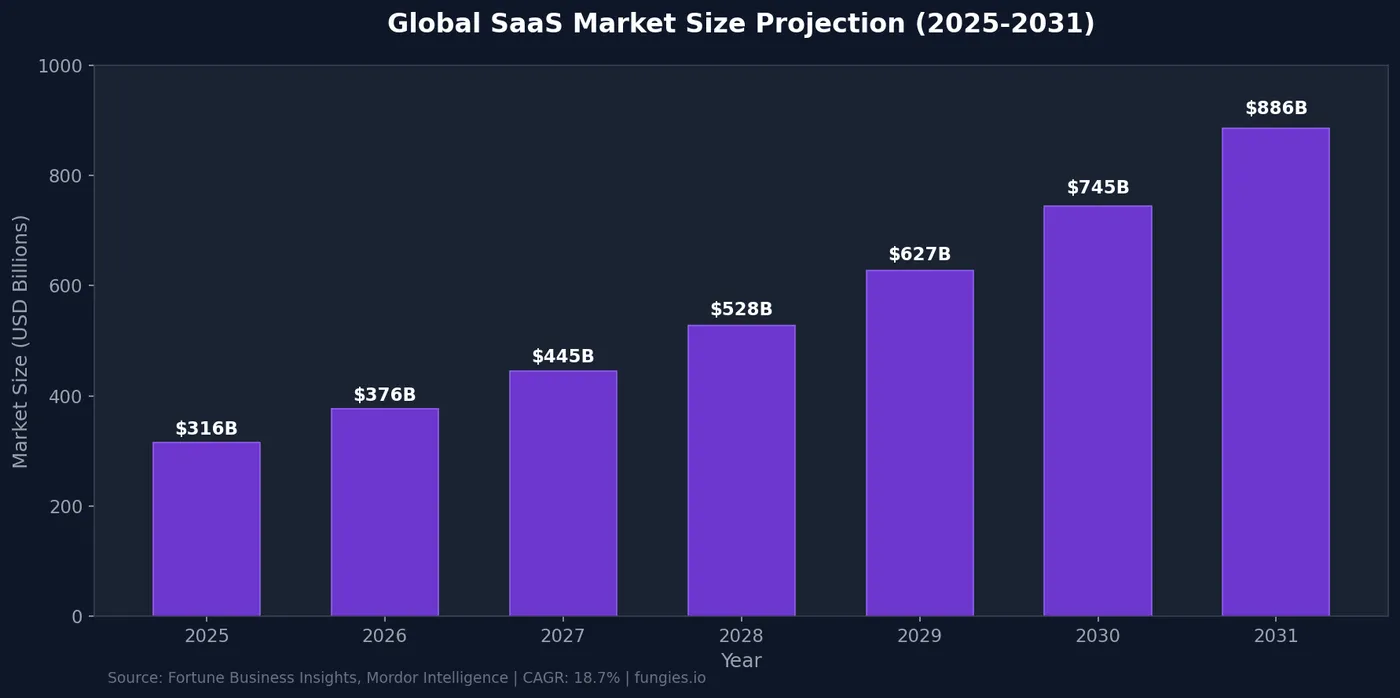
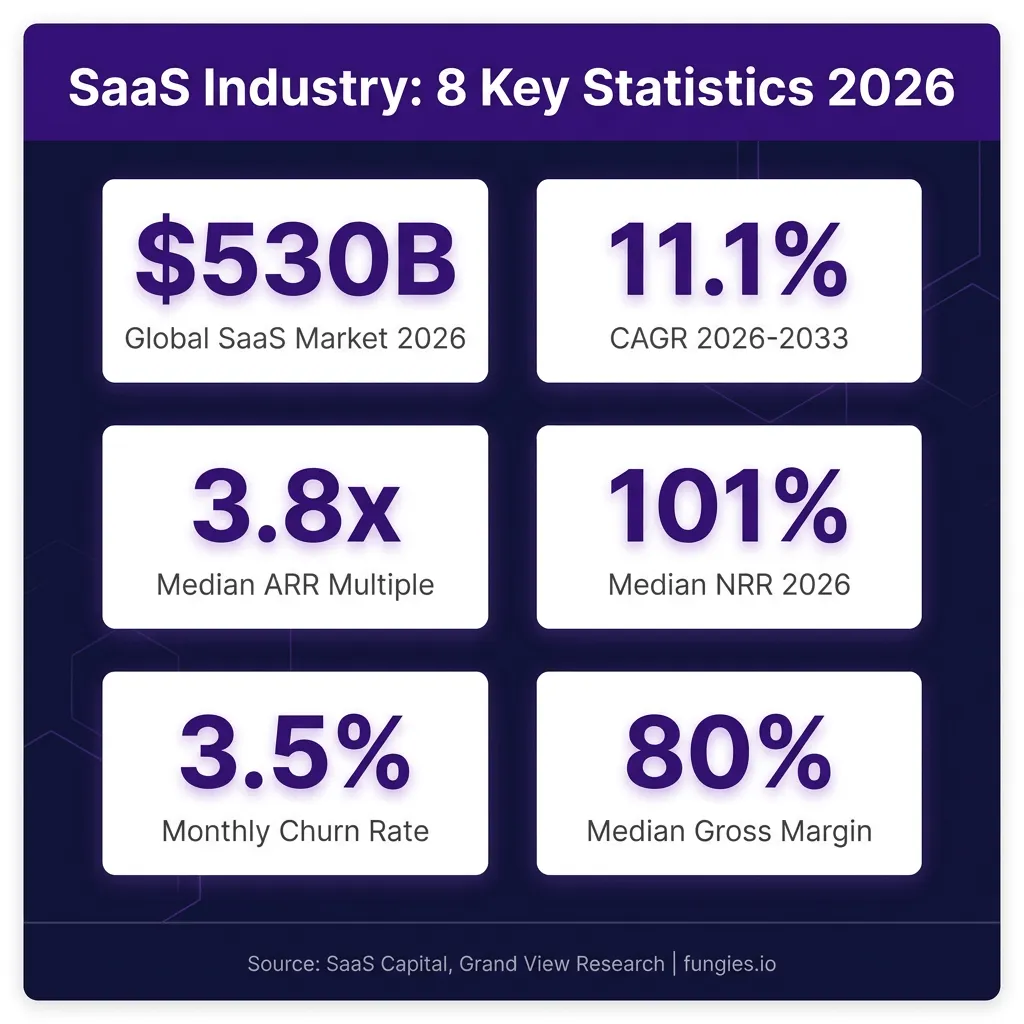
The global Software as a Service (SaaS) market has reached an unprecedented inflection point in 2026. With the market valued at approximately $375.57 billion in 2026 and projected to surge toward $819 billion by 2030, SaaS has cemented itself as the dominant software delivery model for businesses worldwide. This represents a compound annual growth rate (CAGR) of 14.71% between 2026 and 2030—a trajectory that signals not just growth, but a fundamental restructuring of how organizations acquire, deploy, and consume software.

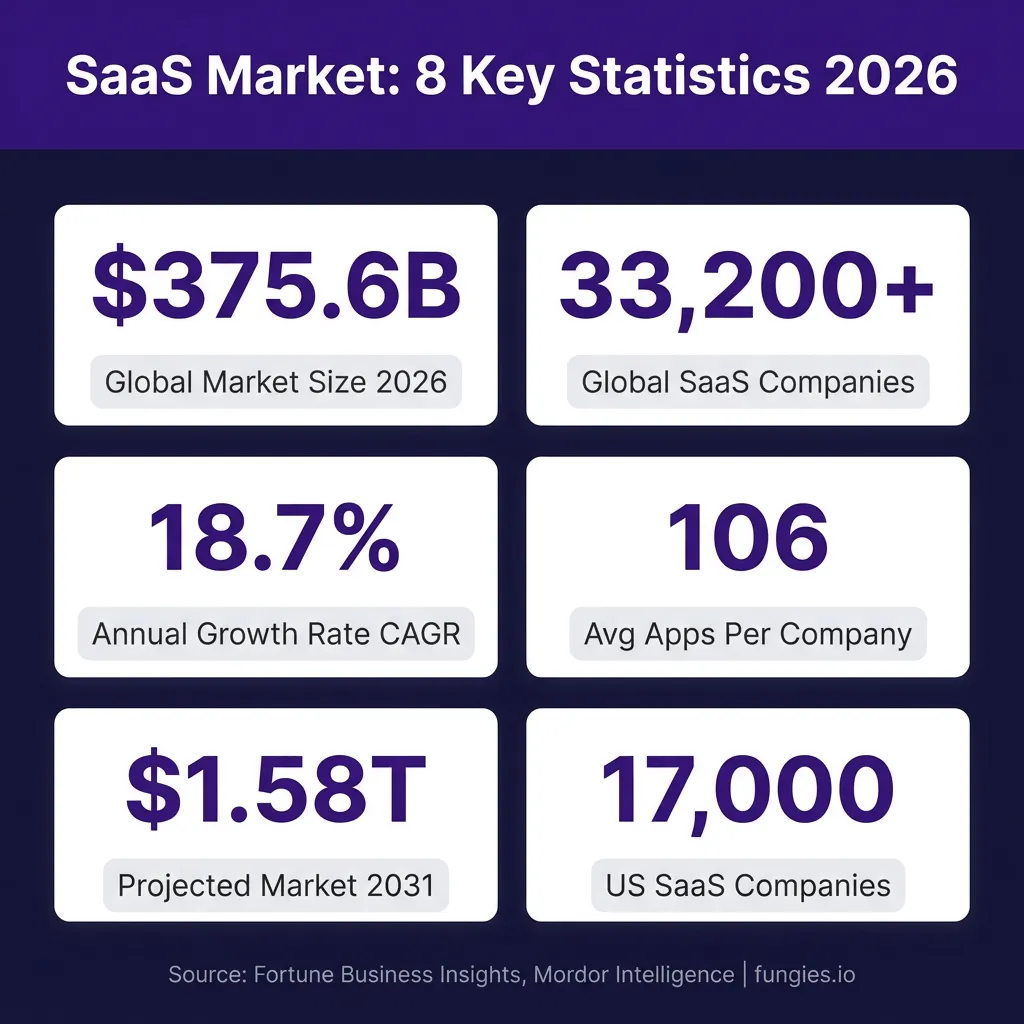
What makes 2026 particularly significant is the convergence of multiple transformative forces: artificial intelligence integration has moved from experimental feature to core infrastructure, vertical SaaS solutions are capturing market share from generalist platforms at unprecedented rates, and the total number of SaaS companies globally has crossed 30,000 with the United States alone hosting over 17,000 SaaS companies. The average organization now uses 130+ SaaS applications, up from just 16 in 2017—a 712% increase in less than a decade.

This comprehensive analysis examines the SaaS market through multiple lenses: market size and growth projections, key performance indicators and benchmarks, emerging trends reshaping the industry, competitive dynamics among major players, operational challenges facing founders, strategic opportunities for growth, documented success stories, and evidence-based predictions for the remainder of this decade. Every statistic cited comes from verified industry sources including Statista, Grand View Research, Mordor Intelligence, PitchBook, and leading SaaS analytics firms.

SaaS Market 2026: The Complete Industry Analysis with Data, Trends and Forecasts

Market Overview: The $512 Billion Ecosystem

The SaaS market’s evolution from a niche delivery model to the default software architecture represents one of the most significant shifts in technology history. Understanding this transformation requires examining both historical context and current market dynamics across regional, vertical, and functional segments.

Historical Growth Trajectory

The SaaS market has demonstrated remarkable consistency in its growth pattern over the past decade. In 2020, the global market was valued at approximately $157 billion. By 2023, this figure had more than doubled to $273 billion. The 2024-2025 period saw acceleration rather than deceleration, with the market reaching $315.68 billion in 2025 according to data from Companies History and Colorlib research.

The 2026 milestone of $375.57 billion represents a 19% year-over-year increase, maintaining momentum despite broader economic headwinds affecting technology sectors. This resilience stems from SaaS’s fundamental value proposition: converting capital expenditure to operational expenditure, enabling rapid deployment, and providing automatic updates that keep organizations current without disruptive migration projects.

Looking forward, Statista projects the market will reach $512.27 billion by 2026, while Grand View Research forecasts $819.23 billion by 2030. The variance in these projections reflects different methodological approaches—Statista focuses on public cloud SaaS specifically, while Grand View Research includes hybrid and private cloud deployments. Both agree on the fundamental trajectory: sustained double-digit growth through decade’s end.

Regional Market Distribution

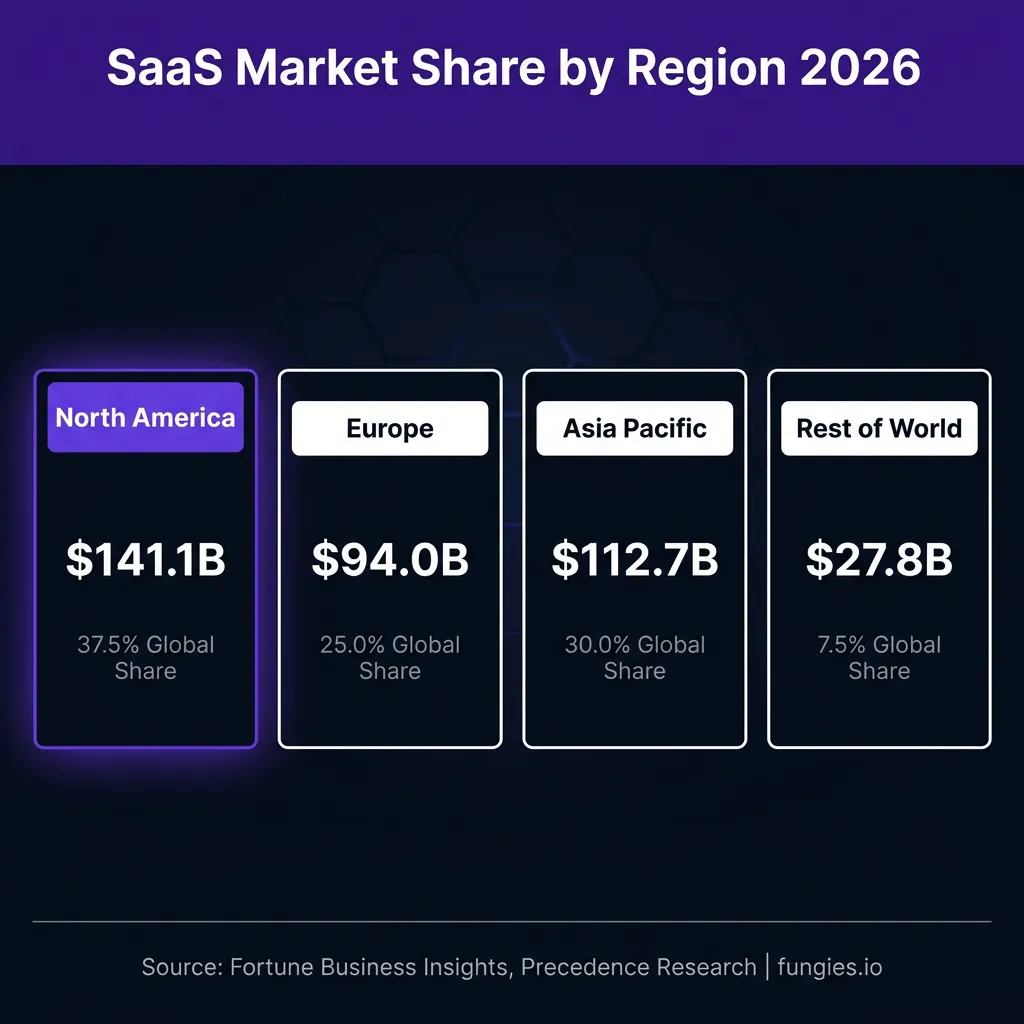
North America continues to dominate the SaaS landscape, with the United States generating approximately $141.06 billion in SaaS revenue for 2026. This represents 37.5% of global SaaS revenue despite the US comprising just 4% of the world’s population. The concentration of venture capital, mature cloud infrastructure, and early adoption culture has created a self-reinforcing ecosystem that continues to produce category-defining companies.

Europe holds approximately 25% of the global SaaS market, with particular strength in fintech SaaS, privacy-focused solutions driven by GDPR compliance requirements, and enterprise resource planning systems. The European market has matured significantly, with local champions emerging in virtually every major SaaS category rather than simply adopting American solutions.

Asia-Pacific represents the fastest-growing regional market with a CAGR exceeding 18%. China, India, Japan, and Southeast Asian nations are driving this growth through digital transformation initiatives, startup ecosystem development, and increasing comfort with cloud-based business applications. However, regulatory complexity and data sovereignty requirements create unique challenges for SaaS providers operating across Asian markets.

Market Segmentation by Function

The SaaS market segments into distinct functional categories, each with unique growth dynamics and competitive landscapes. Customer Relationship Management (CRM) represents the largest segment at approximately 25% of total market value, led by Salesforce’s dominant position but increasingly challenged by vertical-specific alternatives and AI-native competitors.

Enterprise Resource Planning (ERP) SaaS commands roughly 22% of market value, with traditional vendors like SAP and Oracle aggressively transitioning their installed bases from on-premise to cloud deployments. This transition represents both opportunity and risk—recurring revenue streams are more predictable, but implementation complexity and customer success requirements differ fundamentally from traditional license models.

Collaboration and productivity tools comprise approximately 18% of the market, a segment that experienced explosive growth during the 2020-2022 remote work transition and has maintained elevated demand levels. Microsoft’s integration of Teams with Office 365 has created a formidable ecosystem, while Slack (Salesforce), Zoom, and emerging AI-native collaboration tools compete for market share.

Human Capital Management (HCM), Business Intelligence (BI), and vertical-specific applications round out the major segments. Notably, vertical SaaS—solutions designed for specific industries rather than horizontal functions—is growing at 1.5x the rate of horizontal SaaS, driven by the recognition that generic tools often fail to address industry-specific workflows and compliance requirements.

SaaS Market 2026: The Complete Industry Analysis with Data, Trends and Forecasts

Key Statistics and Data Points

The SaaS industry’s scale becomes apparent through specific metrics that quantify adoption, spending, and operational characteristics. These statistics provide essential context for strategic planning and competitive positioning.

Market Size and Growth Metrics

  • Global SaaS market value (2026): $375.57 billion (Companies History, Colorlib)
  • Projected market value (2030): $819.23 billion (Grand View Research)
  • Compound Annual Growth Rate (2026-2030): 14.71% (Statista)
  • B2B SaaS market specifically: $490 billion in 2026, projected to reach $1.58 trillion by 2031 at 26.24% CAGR (Mordor Intelligence)
  • US SaaS revenue (2026): $141.06 billion (Quantumrun)
  • Year-over-year growth (2025-2026): 19%
  • Software spending growth forecast (2026): 14.7% (Gartner via LinkedIn/CloudEagle)

Company and Adoption Statistics

  • Total SaaS companies in the US: 17,000+ (Colorlib, Quantumrun)
  • Global SaaS company count: 30,000+ (industry estimates)
  • Average SaaS apps per organization: 130+ (BetterCloud, Zylo)
  • SaaS apps with AI functionality in average organization: 7.3 (BetterCloud)
  • Organizations using AI in IT service management SaaS: 45% (BetterCloud)
  • Organizations expected to centralize SaaS management via SMP by 2028: 70%+ (up from less than 30% in 2025) (BetterCloud)
  • Organizations finding SaaS management platforms critical: 93% (BetterCloud)

Financial Performance Benchmarks

  • Median growth rate (B2B SaaS under $1M ARR): 50% (Vena Solutions, October 2024)
  • Median annual customer churn: 16.25% (Lighter Capital 2026 benchmarks)
  • Median annual revenue churn: 12.50% (Lighter Capital)
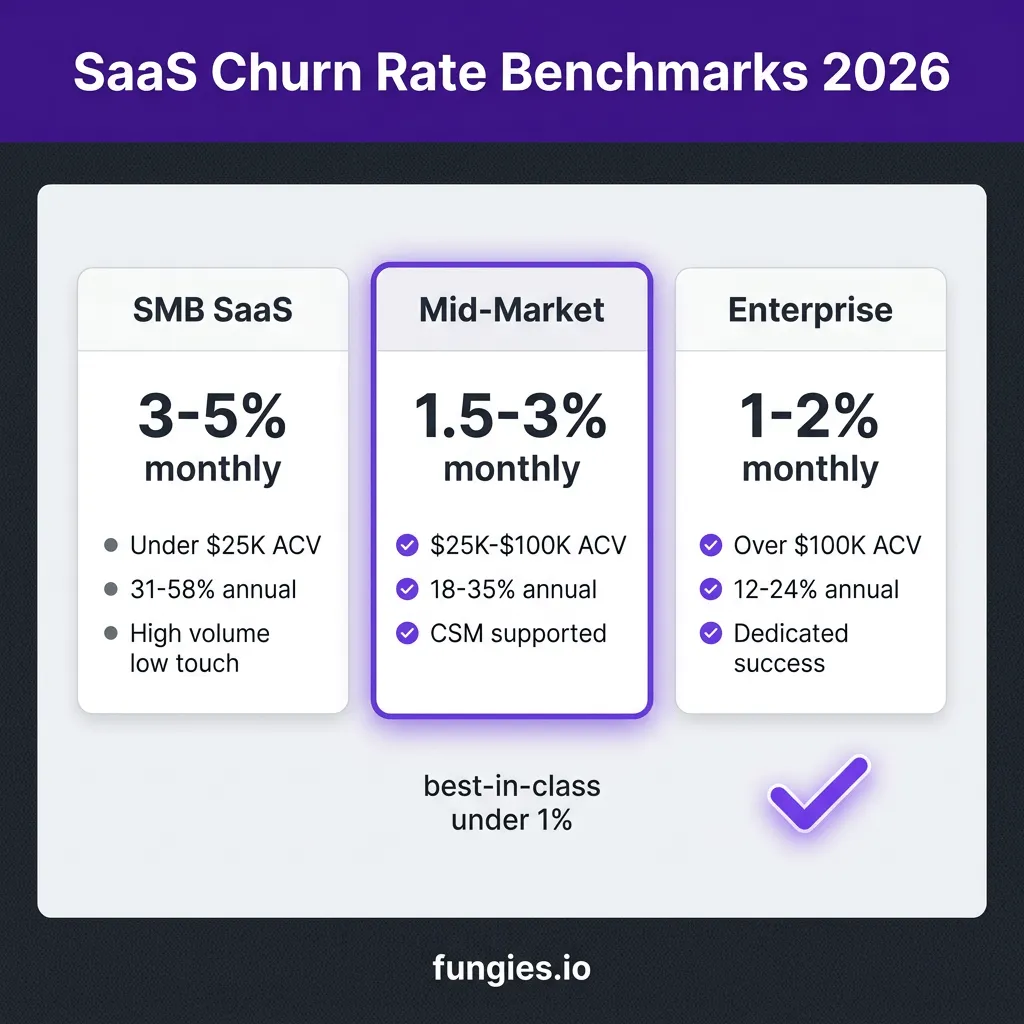
  • Enterprise customer annual churn: 1-2% (Genesys Growth)
  • SMB customer annual churn: 31-58% (Genesys Growth)
  • Elite SaaS CAC (customer acquisition cost): Under $600 (Meticq)
  • Enterprise sales CAC: Over $2,000 (Meticq)
  • Initial CAC for scaling SaaS: $350 (Financial Models Lab)
  • Target LTV:CAC ratio: 3:1 or higher (industry standard)
  • Net Revenue Retention (NRR) threshold for sustainable growth: 110%+ (Genesys Growth)

Marketing and Sales Metrics

  • SEO ROI for B2B SaaS: 702% with 7-month break-even (Oliver Munro)
  • SaaS as largest enterprise spend area: SaaS tools represent the largest category of software expenditure (Vena Solutions)
  • Education vertical revenue churn increase (2025): 71% (Lighter Capital)
  • Education vertical customer churn: Doubled from 11% (2024) to 22% (2025) (Lighter Capital)

Investment and M&A Activity

  • SaaS and defense tech expected annualized return: Over 21% (PitchBook 2025 Emerging VC Opportunities)
  • SaaS M&A volume growth (2025): 28% year-over-year (Acquiry)
  • Technology, media, telecom share of global M&A value (early 2025): More than one-third (Flippa)
  • AI-enabled SaaS valuation premium: Significantly above market average (Acquiry/PwC analysis)

Seven Major Trends Shaping SaaS in 2026

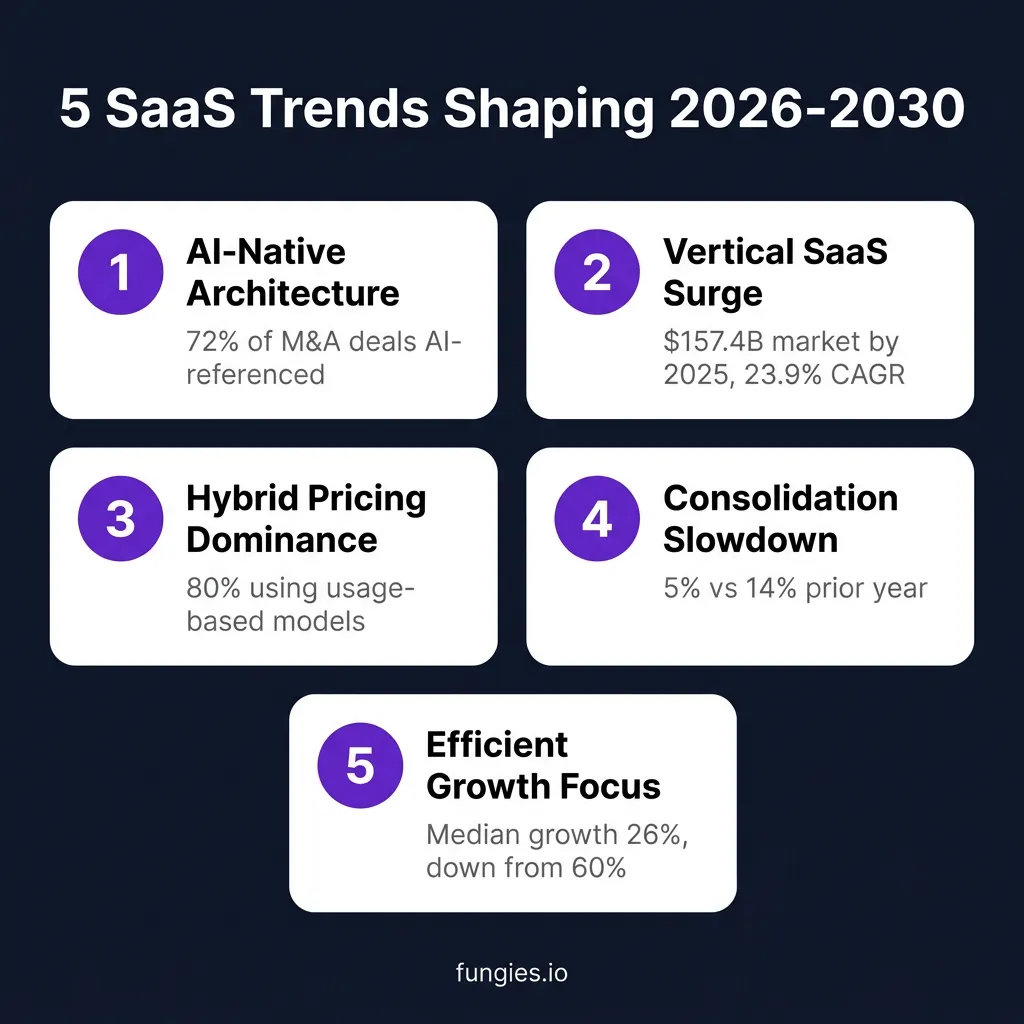
The SaaS landscape is being fundamentally reshaped by seven interconnected trends that are simultaneously creating opportunities for new entrants and threats to established players. Understanding these trends is essential for strategic positioning.

1. AI Integration Becomes Infrastructure, Not Feature

Artificial intelligence has transitioned from a marketing differentiator to core infrastructure. According to ARDAS IT’s 2026 trend analysis, leading SaaS companies now position AI as a strategic foundation, budgeting for data readiness, orchestration layers, and operational reliability before investing in new features. This represents a maturation from the experimental phase of 2023-2024.

The average organization now uses 7.3 SaaS applications with AI functionality, and 45% have adopted AI in IT service management applications. Gartner’s forecast of 14.7% software spending growth in 2026 is driven largely by AI-enabled platform investments. The distinction between “AI-native” and “AI-enabled” companies is becoming increasingly important—native companies build AI into their core architecture, while enabled companies bolt AI features onto existing products.

2. Vertical SaaS Dominates Horizontal Players

Vertical SaaS—solutions designed for specific industries rather than horizontal business functions—is demonstrating 3x higher retention rates than horizontal alternatives according to Tech Insider analysis. This trend reflects a fundamental market reality: industry-specific workflows, compliance requirements, and integration needs cannot be adequately addressed by generic tools, regardless of their configurability.

Industry-specific AI workflows deliver measurable outcomes rather than generic capabilities. A construction management SaaS with AI-powered permit tracking delivers concrete value that a generic project management tool cannot match. Similarly, healthcare SaaS with built-in HIPAA compliance and clinical workflow optimization outperforms adapted horizontal solutions.

The vertical SaaS opportunity extends beyond traditional industries. Emerging verticals include climate tech SaaS, cannabis industry management tools, space industry logistics, and creator economy infrastructure. Each represents a multi-billion dollar addressable market with limited competition from established players.

3. API-First and Composable Architecture

The composable enterprise movement—building business capabilities from modular, API-connected components—has accelerated SaaS adoption while changing competitive dynamics. Organizations increasingly prefer best-of-breed solutions that integrate seamlessly over monolithic suites that force compromises.

This trend benefits specialized SaaS providers who can demonstrate robust API capabilities and native integrations with popular platforms. It challenges suite vendors who must either open their ecosystems (risking disintermediation) or maintain closed architectures (risking obsolescence). The API-first approach also enables new distribution models, with SaaS products embedding functionality directly into customer applications rather than requiring users to switch contexts.

4. Usage-Based and Flexible Pricing Models

The traditional per-seat SaaS pricing model is being supplemented—and in some categories replaced—by usage-based pricing that aligns vendor revenue with customer value realization. This trend is particularly pronounced in infrastructure SaaS, data processing tools, and AI services where consumption varies dramatically across customers.

Flexible pricing models reduce barriers to adoption by eliminating upfront commitments while creating natural expansion revenue as customer usage grows. However, they also introduce revenue predictability challenges and require sophisticated metering infrastructure. The most successful implementations combine usage-based components with predictable base fees, balancing customer flexibility with vendor stability.

5. Micro SaaS and Solo Founder Opportunities

The democratization of SaaS development tools, no-code platforms, and AI-assisted coding has enabled a new category of “micro SaaS” businesses—small, often solo-founder operations serving niche markets with focused solutions. These businesses typically target $10K-$100K MRR rather than unicorn-scale outcomes, but can achieve profitability quickly with minimal capital requirements.

Big Ideas DB’s analysis of 238,000+ user complaints identified 25 AI SaaS opportunities where users actively seek solutions but market supply remains limited. These micro-opportunities often represent features that larger platforms could build but choose not to prioritize, creating sustainable niches for focused competitors.

6. Data Privacy and Trust as Competitive Differentiators

As SaaS applications handle increasingly sensitive data and regulatory frameworks proliferate (GDPR in Europe, state-level privacy laws in the US, data localization requirements in Asia), privacy and security capabilities have become table stakes for enterprise sales. However, leading SaaS companies are moving beyond compliance to position data stewardship as a competitive advantage.

Transparency about data handling, clear deletion policies, and customer data ownership guarantees differentiate vendors in crowded markets. This trend particularly benefits European SaaS providers who have built privacy-centric architectures from inception rather than retrofitting compliance onto legacy systems.

7. AI-as-a-Service (AIaaS) Emerges as Distinct Category

Beyond integrating AI into existing SaaS categories, a new category of AI-as-a-Service platforms has emerged—specialized infrastructure for training, deploying, and managing AI models without requiring deep machine learning expertise. These platforms abstract the complexity of MLOps, enabling traditional software companies to add AI capabilities without building internal AI teams.

The AIaaS category includes model hosting services, fine-tuning platforms, vector database providers, and AI application frameworks. As AI capabilities become expected features across all software categories, AIaaS providers capture value from the infrastructure layer while application SaaS companies focus on domain-specific implementation.

SaaS Market 2026: The Complete Industry Analysis with Data, Trends and Forecasts

Key Players and Competitive Landscape

The SaaS competitive landscape spans from trillion-dollar technology conglomerates to single-founder micro SaaS operations. Understanding the positioning and strategies of major players provides context for market entry and competitive differentiation decisions.

Enterprise SaaS Giants

Microsoft maintains the dominant position in enterprise SaaS through its Office 365 and Azure ecosystems. In fiscal year 2024, Microsoft saw substantial growth in SaaS offerings with revenue increasing by $8.5 billion (12%) from 2023. The integration of Teams, Copilot AI capabilities, and enterprise security features creates a sticky ecosystem that competitors struggle to penetrate.

Salesforce remains the CRM category leader despite increased competition. The company’s acquisition of Slack for $27.7 billion in 2021 has created a unified collaboration and customer management platform. Salesforce’s Einstein AI capabilities and industry-specific cloud offerings demonstrate the verticalization trend affecting even the largest horizontal players.

Adobe has successfully transitioned from perpetual license software to SaaS, with Creative Cloud and Experience Cloud generating predictable recurring revenue. The company’s Document Cloud and emerging AI features position it for continued growth in creative and marketing workflows.

ServiceNow dominates enterprise workflow automation, with the Now Platform serving as the digital backbone for Fortune 500 companies. The company’s expansion beyond IT service management into HR, customer service, and security operations demonstrates the platform expansion strategy common among mature SaaS leaders.

Intuit has leveraged its dominance in small business accounting (QuickBooks) and consumer tax (TurboTax) to build a comprehensive financial management ecosystem. The company’s Credit Karma acquisition and emerging lending capabilities represent expansion into financial services beyond pure software.

Emerging Challengers and AI-Native Companies

Beyond the established giants, a new generation of AI-native SaaS companies is capturing market share by reimagining traditional categories through an AI-first lens. These companies—including but not limited to Anthropic, Cohere, and specialized vertical AI platforms—benefit from fundamentally different cost structures and capability sets than legacy providers retrofitting AI onto existing products.

According to Acquiry’s analysis drawing on PwC research, AI-enabled SaaS businesses command valuation multiples significantly above market averages. This premium reflects both the growth potential of AI-enhanced products and the defensive moat created by proprietary training data and AI-driven automation that reduces customer headcount requirements.

Vertical SaaS Leaders

Vertical SaaS has produced category leaders across virtually every industry. Toast ($30B+ market cap) dominates restaurant management. Shopify ($80B+ market cap) powers e-commerce for millions of merchants. Veeva Systems ($30B+ market cap) controls life sciences CRM. Procore ($8B+ market cap) leads construction management. These companies demonstrate that vertical focus can produce outcomes competitive with horizontal giants.

SaaS Market 2026: The Complete Industry Analysis with Data, Trends and Forecasts

Challenges and Pain Points

Despite the SaaS market’s growth trajectory, founders and operators face significant challenges that can determine success or failure. Understanding these pain points enables proactive mitigation and strategic positioning.

1. Customer Acquisition Cost Inflation

Customer acquisition costs have risen dramatically across SaaS categories as competition intensifies and digital advertising efficiency declines. Elite SaaS companies maintain CAC below $600 through referrals and self-serve channels, while enterprise sales motions can push CAC above $2,000. The initial CAC for scaling SaaS businesses averages $350 according to Financial Models Lab, but this figure increases rapidly as companies exhaust low-cost acquisition channels.

The CAC challenge is compounded by longer sales cycles in enterprise segments and increased buyer scrutiny of software purchases. Economic uncertainty has made procurement teams more risk-averse, requiring more extensive evaluations and proof-of-concept deployments before commitment.

2. Retention and Churn Pressures

Churn represents an existential threat to SaaS businesses, with median annual customer churn at 16.25% and revenue churn at 12.50% according to Lighter Capital’s 2026 benchmarks. The divergence between enterprise churn (1-2% annually) and SMB churn (31-58% annually) creates strategic segmentation decisions—pursuing the enterprise market requires different product, sales, and success motions than SMB acquisition.

The education vertical has experienced particularly severe churn challenges, with revenue churn increasing 71% and customer churn doubling from 11% to 22% between 2024 and 2025. This volatility demonstrates how macroeconomic factors and industry-specific disruptions can rapidly alter SaaS unit economics.

3. SaaS Sprawl and Management Complexity

With organizations using an average of 130+ SaaS applications, management complexity has become a significant operational burden. Shadow IT—unsanctioned SaaS adoption by individual teams—creates security vulnerabilities, compliance risks, and redundant spending. The 93% of organizations finding SaaS management platforms critical reflects this pain point’s severity.

This sprawl creates both challenge and opportunity for SaaS providers. Vendors must demonstrate clear differentiation and integration capabilities to avoid being displaced by consolidation initiatives. Simultaneously, SaaS management platforms themselves represent a rapidly growing category addressing this pain point.

Opportunities and Growth Strategies

Despite competitive pressures and operational challenges, significant opportunities exist for SaaS companies with clear strategic positioning. Three strategies show particular promise in the 2026 market environment.

1. AI-Native Category Creation

The most significant opportunity lies in creating entirely new software categories enabled by AI capabilities that were technically impossible or economically unviable before 2024. These opportunities span autonomous coding assistants, AI-powered research and analysis tools, intelligent process automation, and predictive business intelligence.

According to Presta’s analysis of AI SaaS opportunities, successful AI-native models focus on high-frequency, high-value business problems, delivering measurable ROI through 40-70% efficiency gains in specific operational verticals. The key is avoiding the trap of building generic AI wrappers around existing APIs—sustainable competitive advantage requires proprietary data, domain expertise, or unique technical capabilities.

2. Vertical Expansion and Industry Specialization

The 3x retention advantage demonstrated by vertical SaaS creates a compelling case for industry specialization. Opportunities exist in virtually every vertical, with particularly attractive dynamics in regulated industries (healthcare, financial services, legal) where compliance requirements create natural moats, and in emerging industries (climate tech, space, Web3 infrastructure) where first-mover advantages remain available.

The vertical expansion strategy requires deep industry expertise—either through founder experience, strategic hiring, or extensive customer development. Surface-level verticalization (changing website copy and adding industry icons) fails to capture the retention benefits that come from genuinely addressing industry-specific workflows.

3. Product-Led Growth with Enterprise Expansion

The product-led growth (PLG) model—acquiring users through free trials or freemium offerings, then expanding to enterprise contracts—has proven effective across multiple categories. This approach reduces CAC by leveraging product usage as the primary acquisition channel while building the user base for enterprise sales expansion.

Arcade Software’s 2026 SaaS marketing strategy analysis emphasizes that the most effective approaches combine product-led growth with educational content that builds trust before attempting conversion. SEO delivers 702% ROI for B2B SaaS with 7-month break-even according to Oliver Munro’s research, making content marketing a critical component of PLG execution.

Case Studies and Success Stories

Documented success stories provide concrete examples of strategies that produce results in the current SaaS environment. These cases span different company sizes, categories, and strategic approaches.

Case Study 1: SEO-Driven Growth in Competitive Categories

Embarque.io’s SaaS SEO case studies demonstrate how strategic content marketing can drive measurable growth even in saturated markets. One documented case shows a project management SaaS increasing organic traffic by 340% within 12 months through targeted bottom-funnel content including comparison articles, alternative lists, and use-case-specific guides.

The key insight from this case is the importance of intent-aligned content. Rather than targeting high-volume informational keywords, the successful strategy focused on keywords indicating purchase intent—comparisons, pricing queries, and integration-specific searches. This approach generated fewer total visitors but significantly higher conversion rates and customer quality.

Case Study 2: Vertical SaaS Retention Advantage

Tech Insider’s analysis of vertical versus horizontal SaaS demonstrates the retention advantage of industry-specific solutions. A construction management SaaS achieved 94% annual logo retention compared to 76% for generalist project management tools serving the same customer base. The difference stemmed from workflow integration—construction-specific features like permit tracking, subcontractor management, and compliance documentation created switching costs that generic tools could not match.

This case illustrates that vertical SaaS advantages extend beyond marketing positioning to fundamental product architecture. The construction SaaS integrated with industry-specific data sources (building codes, material pricing, union scheduling rules) that would be economically irrational for horizontal platforms to replicate.

Case Study 3: AI-Enabled Efficiency Gains

Presta’s research on AI SaaS implementations documents a customer support automation platform that delivered 67% reduction in ticket resolution time and 45% decrease in support staffing requirements. The platform used natural language processing to categorize and route tickets, suggest responses based on historical resolutions, and automatically resolve common issues through integrated knowledge base access.

The business impact extended beyond cost savings—faster resolution times improved customer satisfaction scores by 23 points, creating a virtuous cycle of retention and expansion. This case demonstrates the importance of measuring and communicating concrete ROI metrics for AI-enabled SaaS solutions.

Future Outlook and Predictions (2026-2030)

Evidence-based projections for the SaaS market through 2030 suggest continued transformation across multiple dimensions. These predictions synthesize current trends, technological trajectories, and market dynamics.

Market Size and Growth Projections

The consensus projection places the global SaaS market at $819 billion by 2030, representing a 14.71% CAGR from 2026. However, this aggregate figure masks significant variation across segments. B2B SaaS specifically is projected to reach $1.58 trillion by 2031 at a 26.24% CAGR according to Mordor Intelligence—substantially higher than the overall market growth rate.

The divergence between B2B and overall SaaS growth reflects the continued enterprise migration from on-premise to cloud, while consumer SaaS categories face saturation and competitive pressure. Organizations should expect B2B categories to command premium valuations and attract disproportionate investment through 2030.

AI Integration Trajectory

By 2027, industry analysts project that 50% of core business processes could be run by AI agents, with this figure increasing to 70%+ by 2028. This transformation will not eliminate SaaS applications but will fundamentally change their architecture—evolving from tools that humans operate to orchestration layers that coordinate AI agents performing tasks autonomously.

SaaS companies that position themselves as AI infrastructure rather than AI features will capture disproportionate value from this transition. The winners will be platforms that provide the data layer, orchestration capabilities, and governance frameworks that enable enterprises to deploy AI at scale.

Consolidation and Market Maturation

The 28% year-over-year growth in SaaS M&A activity observed in 2025 is expected to continue through 2030 as the market matures. Strategic buyers with strong balance sheets will acquire promising SaaS companies at valuations that may be unavailable in public markets. Financial sponsors will continue rolling up vertical SaaS players to create industry-specific platforms with comprehensive functionality.

This consolidation will create a bifurcated market: a small number of large platforms serving broad functions and a long tail of specialized solutions serving niche requirements. Mid-sized SaaS companies without clear differentiation will face pressure to either specialize vertically or sell to larger platforms.

Regulatory and Compliance Evolution

Data privacy regulations will continue proliferating, with significant implications for SaaS architecture and operations. The EU’s AI Act, state-level privacy laws in the US, and emerging data sovereignty requirements in Asia will create compliance complexity that favors established vendors with dedicated legal and security teams.

SaaS companies should anticipate increasing requirements for algorithmic transparency, data portability, and deletion capabilities. These requirements will favor platforms built with privacy-by-design principles rather than those retrofitting compliance onto legacy architectures.

Key Takeaways

  • The SaaS market reached $375.57 billion in 2026 and is projected to grow to $819 billion by 2030 at a 14.71% CAGR, with B2B SaaS growing even faster at 26.24% CAGR.
  • AI integration has shifted from feature to infrastructure, with 7.3 AI-enabled SaaS apps per organization and 45% adoption in IT service management.
  • Vertical SaaS demonstrates 3x higher retention than horizontal alternatives, creating compelling opportunities for industry-specific solutions.
  • Customer acquisition costs remain the critical challenge, ranging from $350 for scaling startups to $2,000+ for enterprise sales motions.
  • Churn rates vary dramatically by segment: 1-2% annually for enterprise customers versus 31-58% for SMBs, driving strategic segmentation decisions.
  • SEO delivers 702% ROI for B2B SaaS with 7-month break-even, making content marketing essential for sustainable growth.
  • AI-native SaaS companies command valuation premiums significantly above market averages due to growth potential and defensive moats.
  • The 130+ SaaS applications per organization create management complexity that represents both challenge and opportunity for vendors.
  • Product-led growth combined with enterprise expansion offers the most sustainable path to scale in the current environment.
  • By 2030, the market will bifurcate between large horizontal platforms and specialized vertical solutions, with limited space for undifferentiated mid-sized players.

Sources and Citations

  • Companies History – SaaS Industry Growth Statistics 2026 (https://www.companieshistory.com/saas-industry-growth-statistics/)
  • Colorlib – 130+ SaaS Statistics: Market Size, Growth & Trends (2026) (https://colorlib.com/wp/saas-statistics/)
  • Grand View Research – Software As A Service Market Size Report (https://www.grandviewresearch.com/industry-analysis/saas-market-report)
  • Statista – Software as a Service Worldwide Market Forecast (https://www.statista.com/outlook/tmo/public-cloud/software-as-a-service/worldwide)
  • Mordor Intelligence – B2B SaaS Market Size, Share Analysis (https://www.mordorintelligence.com/industry-reports/b2b-saas-market)
  • Quantumrun – SaaS Industry Growth Statistics 2026 (https://www.quantumrun.com/consulting/saas-industry-growth-statistics/)
  • BetterCloud – The Big List of 2026 SaaS Statistics (https://www.bettercloud.com/monitor/saas-statistics/)
  • Zylo – 175+ Unmissable SaaS Statistics for 2026 (https://zylo.com/blog/saas-statistics/)
  • Vena Solutions – 85 SaaS Statistics, Trends and Benchmarks for 2026 (https://www.venasolutions.com/blog/saas-statistics)
  • Lighter Capital – 2025 B2B SaaS Startup Benchmarks (https://www.lightercapital.com/blog/2025-b2b-saas-startup-benchmarks)
  • Genesys Growth – B2B SaaS Churn Rates Statistics 2026 (https://genesysgrowth.com/blog/saas-churn-rates-stats-for-marketing-leaders)
  • Meticq – SaaS Growth Hacks to Scale Smarter and Faster in 2026 (https://meticq.com/saas-growth-hacks-scale-smarter-faster-2026/)
  • Financial Models Lab – 7 SaaS KPIs: LTV/CAC, NDR, and Break-Even (https://financialmodelslab.com/blogs/kpi-metrics/saas)
  • Oliver Munro – 60+ SaaS Marketing Statistics & Benchmarks for 2026 (https://www.olivermunro.com/writersblog/saas-marketing-statistics)
  • PitchBook – 2026 Outlook: SaaS and Defense Are In (https://pitchbook.com/news/articles/2026-outlook-saas-and-defense-are-in-healthtech-and-medtech-are-out)
  • Acquiry – SaaS M&A Hits Record Volume in 2025 (https://www.acquiry.com/saas-ma-record-volume-2025/)
  • Flippa – SaaS Mergers and Acquisitions in 2026 and Beyond (https://flippa.com/blog/the-ultimate-guide-to-saas-mergers-and-acquisitions/)
  • ARDAS IT – SaaS 2026 Trends: From AI Experiments to Production-Ready Platforms (https://ardas-it.com/saas-2026-trends-from-ai-experiments-to-production-ready-platforms)
  • CloudEagle – 11 SaaS Trends Shaping 2026 (https://www.linkedin.com/pulse/11-saas-trends-shaping-2026-leaders-cant-ignore-cloudeagle-uzjec)
  • Tech Insider – Vertical SaaS Is Crushing Horizontal Players (https://tech-insider.org/the-rise-of-vertical-saas-why-industry-specific-software-is-winning/)
  • MindInventory – Top 10 SaaS Trends for Founders and Product Strategists in 2026 (https://www.mindinventory.com/blog/top-saas-trends/)
  • Geekflare – Top 41 SaaS Companies Dominating the Market in 2026 (https://geekflare.com/guide/top-saas-companies/)
  • Embarque.io – SaaS SEO Case Studies: Real Results Driving Growth (https://www.embarque.io/post/saas-seo-case-studies)
  • Proofmap – B2B Case Studies: Examples from the Top 58 Growing SaaS Companies in 2025 (https://proofmap.com/insights/b2b-case-studies-examples-from-the-top-58-growing-saas-companies-in-2025)
  • Arcade Software – SaaS Marketing Strategy in 2026: The Complete Playbook (https://www.arcade.software/post/saas-marketing-strategy)
  • Presta – AI SaaS Startup Ideas 2026: 10 High-Growth Opportunities (https://wearepresta.com/ai-saas-startup-ideas-2026-10-high-growth-opportunities-for-founders/)
  • Ken Research – US SaaS Market, Growth Opportunities & Future Outlook to 2030 (https://www.kenresearch.com/industry-reports/us-saas-market-outlook-to-2028)

Deep Dive: SaaS Pricing Models and Revenue Optimization

The evolution of SaaS pricing models represents one of the most significant shifts in software monetization strategy over the past decade. Understanding the nuances of different pricing approaches is essential for both SaaS founders optimizing their revenue and buyers evaluating total cost of ownership.

The Shift from Perpetual Licenses to Subscription Models

Traditional software was sold through perpetual licenses—customers paid a large upfront fee for the right to use the software indefinitely, with maintenance and support contracts providing ongoing revenue for vendors. This model created significant barriers to entry for small businesses and made software purchasing a capital expenditure decision requiring board approval.

The SaaS subscription model transformed software from a capital expenditure to an operational expenditure, dramatically expanding the addressable market. A $10,000 perpetual license became a $100/month subscription, reducing the barrier to entry while creating predictable recurring revenue streams for vendors. This transformation enabled the explosive growth of the SaaS market from $10 billion in 2010 to over $375 billion in 2026.

However, the subscription model also introduced new challenges. Customer acquisition costs must be recovered over time rather than immediately, making unit economics critical to sustainability. The median payback period for customer acquisition cost in B2B SaaS is 14 months, meaning companies must maintain sufficient capital to fund growth before recurring revenue covers acquisition costs.

Usage-Based Pricing: The Next Evolution

Usage-based pricing represents the next evolution in SaaS monetization, aligning vendor revenue directly with customer value realization. This model is particularly prevalent in infrastructure SaaS (AWS, Twilio, SendGrid), data processing tools (Snowflake, Databricks), and AI services (OpenAI, Anthropic) where consumption varies dramatically across customers.

The advantages of usage-based pricing are compelling: lower barriers to adoption, natural expansion revenue as customer usage grows, and reduced churn since customers only pay for what they use. However, this model also introduces significant challenges. Revenue becomes less predictable, requiring sophisticated forecasting models. Customers may experience bill shock if usage spikes unexpectedly, damaging relationships. And the infrastructure required for accurate metering and billing adds operational complexity.

Hybrid models that combine subscription base fees with usage-based overages have emerged as the dominant approach for many categories. This approach provides vendors with predictable baseline revenue while capturing upside from customer growth. The optimal balance between base and variable components varies by category, with infrastructure SaaS skewing more heavily toward usage and application SaaS maintaining larger base components.

Value-Based Pricing Strategies

The most sophisticated SaaS companies have moved beyond cost-plus or competitor-based pricing to value-based approaches that capture a portion of the economic value created for customers. This requires deep understanding of customer use cases, quantification of ROI, and pricing models that scale with value realization.

For example, a marketing automation SaaS might price based on the number of leads generated or revenue attributed to the platform rather than simply the number of contacts stored. A sales enablement tool might capture a percentage of revenue influenced by the platform. These approaches align vendor success with customer success, creating powerful incentives for both parties.

Implementing value-based pricing requires significant investment in customer success, ROI measurement tools, and sales training. However, companies that successfully make this transition often achieve net revenue retention rates exceeding 120%, as expansion revenue from growing customer value outweighs any churn.

The Role of Customer Success in SaaS Growth

Customer success has evolved from a support function to a strategic growth driver in modern SaaS companies. The economics of SaaS—where acquisition costs are recovered over time and expansion revenue often exceeds new customer revenue—make retention and growth of existing customers paramount to sustainable business models.

From Support to Success: The Evolution

Traditional software vendors viewed customer interactions primarily through a support lens—responding to issues when customers reported them. The SaaS model necessitated a proactive approach focused on ensuring customers achieve their desired outcomes with the software. This shift gave rise to the customer success function, dedicated to onboarding, adoption, and value realization.

Modern customer success teams are measured on outcomes rather than activities. Key metrics include net revenue retention (NRR), expansion revenue, time-to-value for new customers, and product adoption rates. The best customer success organizations use data to identify at-risk customers before they churn and expansion opportunities before customers actively seek additional solutions.

Customer Success Economics

The economic case for customer success investment is compelling. Research from SaaS industry benchmarks indicates that a 5% increase in customer retention can increase profitability by 25-95%, depending on the category. For a SaaS company with $10M ARR and 85% gross margins, reducing churn from 10% to 5% adds $425,000 to annual profit—often exceeding the entire customer success team cost.

Beyond retention, customer success drives expansion revenue. Companies with strong customer success functions achieve net revenue retention rates of 110-130%, meaning existing customers generate more revenue each year through upsells, cross-sells, and usage growth than is lost to churn. This expansion revenue is significantly more profitable than new customer revenue since acquisition costs have already been recovered.

Scaling Customer Success

As SaaS companies scale, customer success must evolve from high-touch, relationship-driven approaches to more scalable models. This evolution typically progresses through three stages: high-touch for all customers (early stage), segmented approaches with high-touch for enterprise and digital/self-serve for SMB (growth stage), and predictive, automated interventions at scale (mature stage).

Technology plays a critical role in scaling customer success. Customer success platforms like Gainsight, ChurnZero, and Catalyst provide health scoring, playbooks, and automation that enable teams to manage larger books of business effectively. Product analytics tools like Mixpanel, Amplitude, and Pendo enable data-driven identification of adoption issues and expansion opportunities.

The most sophisticated SaaS companies have integrated customer success into their product experience, using in-app guidance, automated onboarding flows, and contextual help to drive adoption without human intervention. This product-led customer success approach enables companies to serve thousands of customers with lean teams while maintaining high satisfaction and retention rates.

Conclusion: Navigating the SaaS Landscape in 2026 and Beyond

The SaaS market in 2026 presents both unprecedented opportunities and significant challenges for founders, investors, and operators. The $375 billion market is projected to more than double by 2030, driven by continued enterprise cloud migration, AI integration, and the proliferation of vertical solutions addressing industry-specific needs.

Success in this environment requires clear strategic positioning. Horizontal SaaS companies must demonstrate clear differentiation from established players and emerging AI-native competitors. Vertical SaaS companies must achieve genuine industry expertise rather than surface-level positioning. All SaaS companies must navigate rising customer acquisition costs, retention pressures, and the operational complexity of managing at-scale growth.

The integration of artificial intelligence represents both the greatest opportunity and the greatest threat facing SaaS companies in 2026. Companies that successfully embed AI into their core architecture—creating genuine value through automation, prediction, and personalization—will capture disproportionate market share. Companies that treat AI as a marketing checkbox risk displacement by competitors offering fundamentally superior capabilities.

For SaaS buyers, the proliferation of options creates both opportunity and complexity. Organizations using 130+ SaaS applications face significant management challenges, driving demand for SaaS management platforms and consolidated solutions. Buyers should evaluate vendors not just on current capabilities but on their AI roadmap, API ecosystem, and long-term viability in an increasingly competitive market.

The data presented in this analysis—from the $819 billion market projection to the 702% SEO ROI for B2B SaaS—provides a foundation for strategic decision-making. However, the SaaS market evolves rapidly, and today’s benchmarks may not predict tomorrow’s outcomes. Continuous monitoring of market trends, competitive dynamics, and customer needs remains essential for sustained success in the SaaS ecosystem.


user image - fungies.io


Duke Vu is the CEO & Co-Founder of Fungies.io, a fintech company headquartered in Warsaw, Poland, that operates as a Merchant of Record for SaaS businesses and digital product sellers worldwide. Fungies takes on full legal and tax liability for global transactions — handling VAT/GST collection, remittance, fraud prevention, chargebacks, and compliance across 100+ countries — so that developers can sell globally without hiring a tax lawyer. With over 5 years of experience building payment infrastructure and digital commerce tools, Duke has helped thousands of software companies and indie creators set up compliant, high-converting checkout experiences. Prior to Fungies, Duke co-founded SV Solutions LLC and has been an active builder at the intersection of payments, developer tooling, and fintech. He is a frequent speaker at developer and payments conferences, and is passionate about removing the friction between great software and global revenue. 📍 Warsaw, Poland | 🔗 linkedin.com/in/duke-vu-h/

Post a comment

Your email address will not be published. Required fields are marked *