Here’s a sobering statistic: executives spend just 11.5 hours on pricing strategy over their entire business lifetime. That’s less than a single workday dedicated to the one decision that directly impacts 10-15% of your potential revenue. No wonder 62% of SaaS companies admit their pricing is misaligned with customer value.
If you’re building a SaaS product, you’ve probably agonized over features, onboarding flows, and marketing channels. But when it comes to pricing? Most founders slap on a per-user model because “that’s what everyone does” and call it a day. That’s a costly mistake.
In this guide, I’ll break down the SaaS pricing landscape as it stands in 2026. We’ll explore the models that are winning, the psychology behind them, and exactly how to implement a strategy that grows with your business. No fluff. Just actionable frameworks you can use today.
Why Your Pricing Model Matters More Than You Think
Pricing isn’t just about how much you charge. It’s the foundation of your entire go-to-market strategy. Your pricing model determines:
- Customer acquisition: The wrong model creates friction at the exact moment prospects are ready to buy
- Revenue predictability: Some models smooth your cash flow; others make it volatile
- Expansion revenue: The best models naturally grow as your customers succeed
- Competitive positioning: Your pricing signals who you’re for and what you value
Here’s what the data tells us: SaaS companies using value metrics to set their pricing grow at twice the rate of companies that don’t. Hybrid pricing models (combining subscription with usage components) report median growth rates of 21%, outperforming pure models. And yet, most founders still copy their competitors without understanding why.
The landscape has shifted dramatically. AI-driven tools have disrupted traditional seat-based models. Customers are experiencing subscription fatigue. Investors now prioritize profitability over pure growth. All of this means your pricing strategy from 2023 probably won’t cut it in 2026.
The Four Dominant SaaS Pricing Models
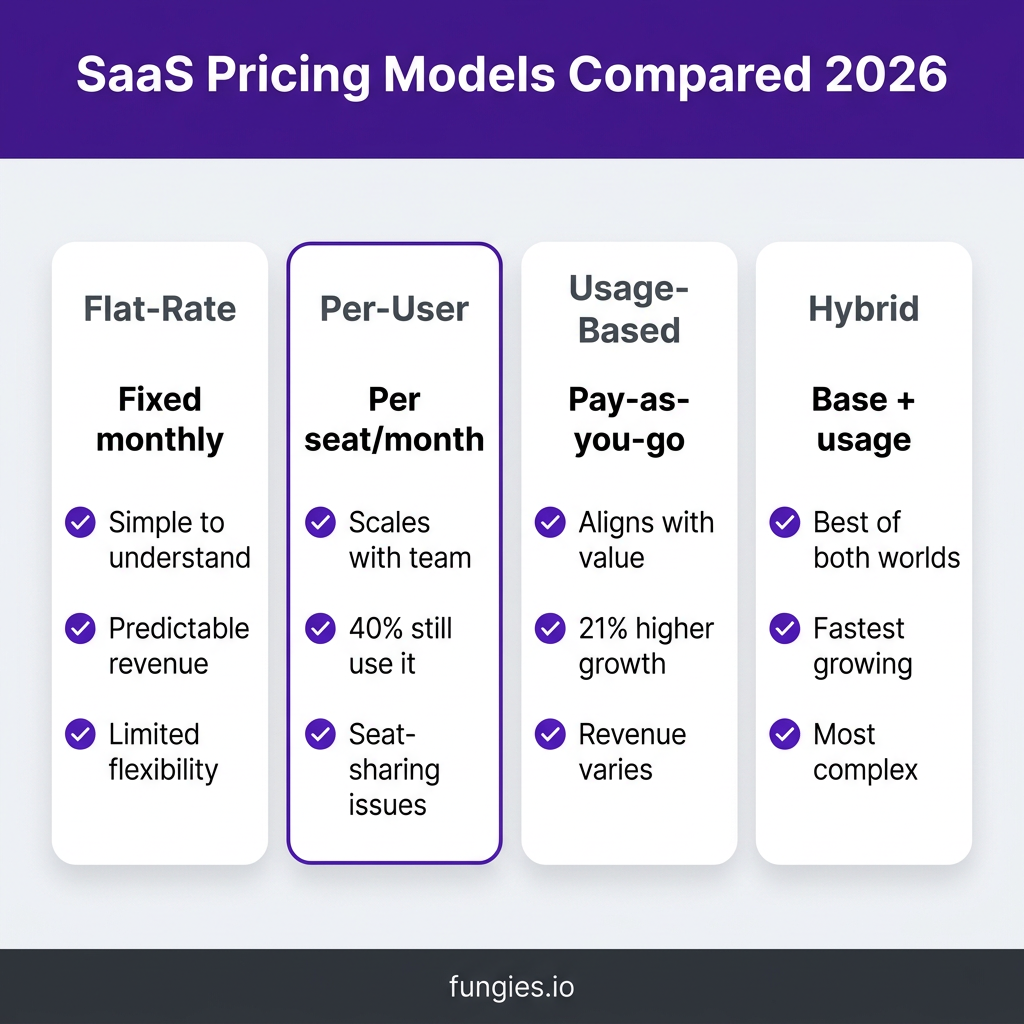
Let’s cut through the noise. There are four pricing models that matter in today’s market. Each has distinct advantages, trade-offs, and ideal use cases. Understanding these is your first step toward building a pricing strategy that actually works.
1. Flat-Rate Pricing: Simplicity at a Cost
Flat-rate pricing charges a fixed monthly or annual fee for unlimited access to your product. It’s the simplest model to understand and implement. Customers know exactly what they’ll pay, and you get predictable recurring revenue.
Best for: Early-stage products with a single use case, tools with uniform value delivery, or when you want to remove pricing friction entirely.
The catch: You’re leaving money on the table. Heavy users get a bargain while light users might churn because they can’t justify the cost. Flat-rate pricing also makes expansion revenue difficult—you’re capped at your subscription fee unless you raise prices across the board.
Real-world example: Basecamp famously uses flat-rate pricing at $299/month regardless of team size. It works for them because their positioning is anti-enterprise—simple project management for small teams who hate complexity. But this model wouldn’t work for a tool like Slack where value scales dramatically with team size.
2. Per-User (Seat-Based) Pricing: The Default Choice
Approximately 40% of SaaS companies still use per-user pricing, making it the most common model. You charge based on the number of active users or seats. It’s easy to understand, scales naturally with customer growth, and creates a clear upgrade path.
Best for: Collaboration tools, products where each additional user gets similar value, and B2B SaaS with clear team-based use cases.
The problem: Seat-sharing. Customers game the system by sharing login credentials, which undermines your revenue. Per-user pricing also misaligns incentives—your customers are penalized for adding team members, which is exactly what you want them to do. Plus, with AI agents increasingly handling work that humans used to do, charging per seat makes less sense than ever.
Slack charges $7.25-$12.50 per user monthly. It works because collaboration tools become more valuable as more people join. But even Slack has introduced usage-based elements (Slack AI) to capture value that doesn’t map to seats.
3. Usage-Based Pricing: Aligning Cost with Value
Usage-based pricing (also called consumption or pay-as-you-go) charges customers based on how much they actually use your product. This might be API calls, data processed, storage used, or any metric that reflects actual consumption.
Best for: Infrastructure products, API-first tools, platforms with variable usage patterns, and when your value directly correlates with consumption.
The advantage: Perfect alignment between price and value. Customers pay for what they use, reducing friction for small users while capturing full value from power users. Companies using usage-based models report 21% higher growth rates than those using pure subscription models.
The challenge: Revenue predictability. Both you and your customers have less certainty about monthly costs. This requires sophisticated billing infrastructure and clear usage dashboards so customers aren’t surprised by their bills.
AWS pioneered this model. Twilio charges per SMS sent or call minute. Stripe takes a percentage of transaction volume. In each case, the pricing metric directly reflects the value delivered.
4. Hybrid Pricing: The Best of Both Worlds
Hybrid models combine a base subscription fee with usage-based components. You get predictable baseline revenue while still capturing upside from heavy users. This is the fastest-growing pricing approach in SaaS.
Best for: Most modern SaaS companies, especially those with tiered feature sets and variable usage patterns.
The structure: A base fee that includes a usage allowance, plus overage charges for consumption beyond that allowance. For example: $99/month includes 10,000 API calls, then $0.01 per additional call.
This model is winning because it balances the needs of both parties. Customers get predictable costs for typical usage while you capture value from power users. It also creates natural expansion revenue—customers grow into higher usage tiers without you having to sell them anything.
Value-Based Pricing: The Framework That Changes Everything
Now that you understand the models, let’s talk about how to actually set your prices. Most SaaS companies use cost-plus pricing (calculate costs, add margin) or competitor-based pricing (copy everyone else). Both approaches leave massive amounts of money on the table.
Value-based pricing is different. You set prices based on the measurable business outcomes your product creates for customers. If your SaaS saves a marketing team 20 hours per month and their fully-loaded cost is $75/hour, you’ve created $1,500 in monthly value. Charging $299/month is a no-brainer for them.
Step 1: Identify Your Value Metrics
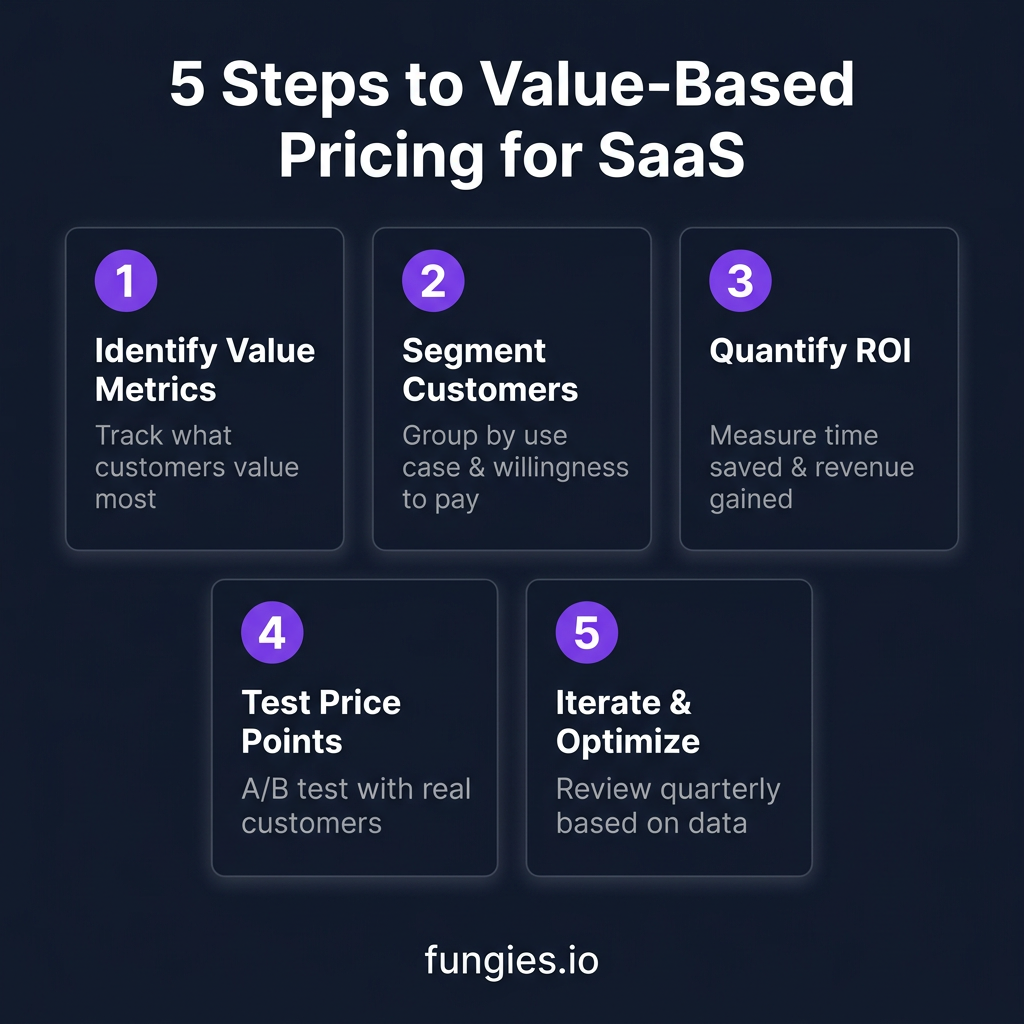
What do customers actually pay for? This isn’t about your features—it’s about the outcomes those features produce. Common value metrics include:
- Time saved: Hours of manual work eliminated
- Revenue generated: Direct sales or leads created
- Risk reduced: Compliance violations avoided, security incidents prevented
- Costs cut: Headcount avoided, tools consolidated
Interview your best customers. Ask them to quantify the impact your product has had on their business. Look for patterns. The metric that comes up most often is probably your core value metric.
Step 2: Segment Your Customers
Not all customers get equal value from your product. A solo founder using your tool for side projects gets different value than a Series B startup using it for their core operations. You need different pricing for different segments.
Create 2-4 distinct tiers based on:
- Company size (employees, revenue)
- Use case complexity (basic vs. advanced features)
- Support needs (self-serve vs. dedicated success manager)
- Willingness to pay (budget constraints vs. enterprise procurement)
Each tier should map to a clear customer profile with specific value metrics. This isn’t about arbitrary feature gates—it’s about packaging value appropriately for each segment.
Step 3: Quantify the ROI
Here’s where most founders get uncomfortable. You need to put a dollar amount on your value. Work with your customers to build ROI calculators that show:
- Current state: What are they doing manually today? What’s that costing them?
- Future state: What does their workflow look like with your product? What’s the time/cost savings?
- Payback period: How quickly does your product pay for itself?
Aim for a 5-10x ROI for your customers. If you save them $1,000/month, charging $100-200/month is fair and defensible. Anything less than 3x ROI makes procurement difficult. Anything more than 10x suggests you’re underpriced.
Step 4: Test Price Points
Don’t guess. Test. Run pricing experiments with real prospects to validate your assumptions:
- Vanity test: Quote different prices to similar prospects and measure conversion rates
- Van Westendorp: Survey prospects on price sensitivity (too cheap, cheap, expensive, too expensive)
- Conjoint analysis: Test how customers trade off features vs. price
Most B2B SaaS companies need 3-6 months to fully implement value-based pricing. Don’t rush it. The data you gather here will inform your strategy for years.
Step 5: Iterate and Optimize
Pricing isn’t set-and-forget. Review your pricing quarterly based on:
- Win/loss rates by tier
- Expansion revenue and net revenue retention (NRR)
- Customer feedback on value perception
- Competitive positioning
Companies that revisit pricing at least annually grow 2x faster than those that don’t. Your product evolves. Your market evolves. Your pricing should too.
Comparison: Which Pricing Model Fits Your SaaS?
| Model | Revenue Predictability | Value Alignment | Implementation Complexity | Best For |
|---|---|---|---|---|
| Flat-Rate | High | Low | Low | Simple tools, early stage |
| Per-User | Medium | Medium | Low | Collaboration tools |
| Usage-Based | Low | High | Medium | Infrastructure, APIs |
| Hybrid | Medium-High | High | High | Most modern SaaS |
The trend is clear: hybrid models are winning because they balance the needs of both vendor and customer. They provide enough predictability for budgeting while ensuring you capture value from your most successful users.
Common Pricing Mistakes to Avoid
I’ve audited dozens of SaaS pricing pages. Here are the mistakes I see over and over:
Mistake 1: Competing on Price
80% of SaaS companies discount by 25% or more to acquire customers. Here’s the problem: these customers churn at 3-5x higher rates. You’re buying revenue that doesn’t stick. Instead, compete on value. If you can’t justify your price, the solution isn’t to lower it—it’s to increase your value.
Mistake 2: Ignoring Regional Pricing
Regional pricing (charging different amounts based on geography) increases global revenue by 25-40% while only reducing average unit price by 15-20%. Purchasing power varies dramatically. A price that’s reasonable in San Francisco is prohibitive in Bangalore. Tools like Fungies make regional pricing easy to implement.
Mistake 3: Too Many Tiers
The paradox of choice is real. More than 4 pricing tiers creates decision paralysis. Most successful SaaS companies use 3 tiers: Good (basic), Better (most popular), Best (enterprise). Each tier should target a distinct customer segment with clear value differentiation.
Mistake 4: Hiding Pricing
57% of SaaS visitors check the pricing page before reading your product description. If you hide pricing behind “Contact Sales” forms, you’re losing qualified leads. The only reason to hide pricing is if it’s genuinely custom (enterprise deals) or if your sales process requires qualification first.
The Psychology of SaaS Pricing
Humans aren’t rational when it comes to price. Understanding behavioral economics gives you an edge:
Anchoring
Show your most expensive tier first. It makes everything else look affordable by comparison. This is why most pricing pages list Enterprise → Business → Starter rather than the reverse.
Decoy Pricing
Add a middle tier that’s intentionally inferior to your preferred tier. It makes the preferred option look like a bargain. The classic example is The Economist’s print vs. digital vs. print+digital pricing, where print+digital was priced the same as print alone, making it an obvious choice.
Charm Pricing
$99 feels significantly cheaper than $100, even though it’s only a 1% difference. Use charm pricing for self-serve tiers. Use round numbers ($500, $1,000) for enterprise tiers—precision signals cheapness, roundness signals quality at higher price points.
Annual Prepay
Offer 2 months free for annual prepay. It improves your cash flow (12 months upfront vs. monthly) and reduces churn (customers are committed for a year). Most SaaS companies see 20-30% of customers choose annual when it’s positioned as a discount.
FAQ: SaaS Pricing Strategy
How often should I change my SaaS pricing?
Review pricing quarterly, but only make changes annually unless you have compelling data. Frequent price changes confuse customers and create billing nightmares. When you do change prices, grandfather existing customers for 6-12 months to maintain goodwill.
Should I offer a free plan?
Freemium works for products with network effects (Slack, Notion) or when your cost to serve free users is near zero. Median free-to-paid conversion is 9%, with freemium products converting at 12% and free trials at 18-49% (depending on whether they require credit cards). If you do freemium, limit by usage or features, not time.
What’s the right price for my SaaS?
There’s no universal answer, but here’s a framework: Calculate the value you create (time saved × hourly rate, or revenue generated). Target 10-20% of that value as your price. If you save customers $1,000/month, charge $100-200. Test higher prices with new prospects before raising prices on existing customers.
How do I handle enterprise pricing?
Enterprise pricing should always be custom. Large customers have unique needs, procurement processes, and budget constraints. Publish a “Contact Us” enterprise tier with minimum commitments (e.g., “Starting at $50,000/year”). This qualifies prospects and sets expectations. Never put enterprise pricing on a self-serve page.
Should I show pricing in local currencies?
Yes. Displaying prices in local currencies increases conversion by 10-15% in international markets. It signals you understand the local market and removes mental friction. Use a Merchant of Record like Fungies to handle currency conversion, tax compliance, and local payment methods automatically.
Conclusion: Your Pricing Is a Growth Lever
Pricing is the fastest way to increase revenue without writing a line of code or running a single ad. A 10% price increase, if you maintain conversion rates, flows directly to your bottom line. Most SaaS companies underprice by 20-30% because they’re afraid of losing deals.
Here’s my advice: Start with value-based pricing principles even if you can’t implement them perfectly. Interview customers. Quantify ROI. Test price points. Build a pricing strategy that grows with your business rather than holding it back.
The SaaS landscape in 2026 rewards companies that align price with value. Hybrid models, usage-based components, and regional pricing aren’t just trends—they’re table stakes for competitive SaaS businesses.
Ready to implement better pricing for your SaaS? Get started with Fungies and handle global billing, tax compliance, and regional pricing without the engineering overhead.
Sources
- The 2025 SaaS Pricing Playbook – SaaSFactor
- State of SaaS Pricing Strategy 2025 – Invesp
- SaaS Pricing Page Best Practices 2026 – InfluenceFlow
- Product-Led Growth Benchmarks – ProductLed
- PLG in 2026 – SaaSMag
- Value-Based Pricing Framework – SoftwarePricing.com
- Value-Based Pricing Guide – Paddle
- Implementing Value-Based Pricing – Maxio