In July 2024, Stripe acquired Lemon Squeezy — a 13-person team that turned down a $50M Series A to build one of the indie SaaS world’s favorite Merchant of Record platforms. Fast forward to 2026, and the landscape has shifted considerably. If you’re a SaaS founder or digital product creator who built on Lemon Squeezy, here’s exactly what changed, what it means for your business, and what your options are right now.
What Actually Happened With the Lemon Squeezy Acquisition
Lemon Squeezy launched publicly in 2021 as a full Merchant of Record (MoR) platform — meaning they handled global tax compliance, VAT, fraud prevention, and acted as the legal seller of record so you didn’t have to. It was genuinely popular with indie hackers and solo founders who wanted Stripe-level reliability without the compliance nightmare.
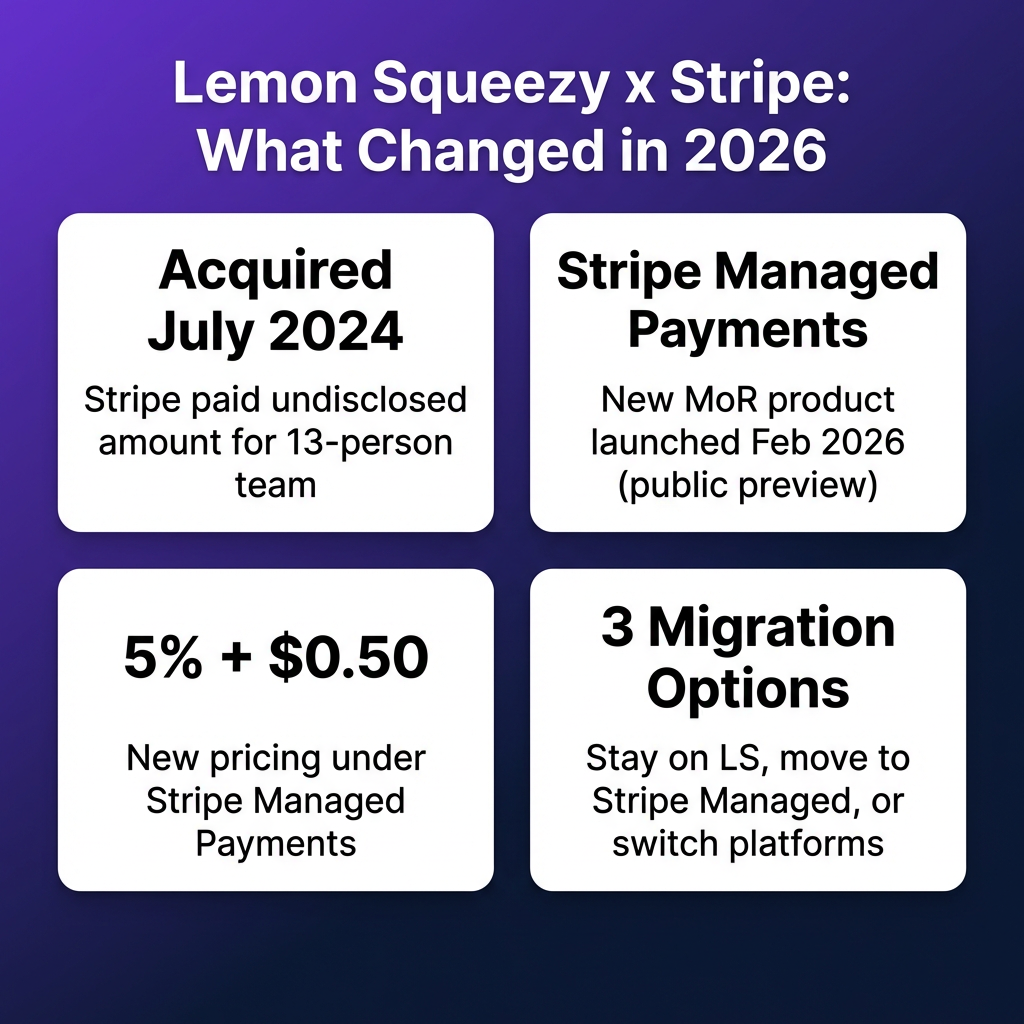
Then in July 2024, Stripe announced it had acquired the company. The deal terms were never disclosed publicly, but Lemon Squeezy CEO JR Farr confirmed they had previously turned down a $50M+ Series A valuation to stay independent — then found what they called the right partner in Stripe.
For existing Lemon Squeezy merchants, the messaging was: “we’re not going anywhere, we’re just getting stronger.” That was mostly true, for a while.
What’s happened since:
- August 2024: Stripe and Lemon Squeezy teams begin integration work
- 2025: Stripe announces “Stripe Managed Payments” — its own MoR product — built on top of what it learned from Lemon Squeezy
- February 2026: Stripe Managed Payments enters public preview, formally introducing a migration path for Lemon Squeezy merchants
- April 2026: Lemon Squeezy continues operating as a standalone product while Stripe Managed Payments scales

What Is Stripe Managed Payments (and How Is It Different)?
Stripe Managed Payments is Stripe’s official merchant of record product. You keep using Stripe’s familiar API and dashboard, but Stripe takes on legal responsibility for indirect tax compliance — VAT, GST, sales tax — plus fraud prevention, customer transaction support, and order management.
Pricing: 5% + $0.50 per transaction (same as what Lemon Squeezy charged).
Features in the February 2026 public preview include:
- Global tax compliance handled automatically (VAT, GST, US sales tax)
- Stripe Checkout integration with MoR mode enabled via a single API parameter
- Subscription support including free trials without collecting payment methods upfront
- Mobile Checkout UI for in-app flows
- Automatic customer name and billing address collection (required for tax calculation)
The catch: it’s still in public preview as of early 2026. Some features that Lemon Squeezy merchants relied on — like built-in affiliate tools, digital download delivery, the storefront builder — aren’t part of Stripe Managed Payments. Stripe is a payment infrastructure company; it doesn’t natively handle product delivery or creator storefronts.
The Three Paths Forward for Lemon Squeezy Merchants
If you’re currently on Lemon Squeezy, you have three realistic options:
Option 1: Stay on Lemon Squeezy (For Now)
Lemon Squeezy continues to operate. If your business is running fine, there’s no immediate urgency. The platform still processes payments, handles taxes, and manages subscriptions. The risk is medium-term uncertainty — the product roadmap is now driven by Stripe’s priorities, not independent ones. Feature velocity may slow. Support quality has drawn criticism in some Trustpilot reviews, with some merchants reporting account freezes and payout issues in 2025.
Best for: Low-volume sellers with simple digital product setups who want to wait for Stripe Managed Payments to mature before deciding.
Option 2: Migrate to Stripe Managed Payments
This is Stripe’s preferred path for Lemon Squeezy merchants. You keep everything in the Stripe ecosystem, get access to Stripe’s full API surface, and gradually move to an MoR model natively within Stripe. The migration tooling is still being built out, but the intent is a relatively smooth customer and subscription data migration.
Best for: Developer-heavy teams who are already deep in the Stripe ecosystem and value maximum API flexibility. Not ideal if you depend on Lemon Squeezy’s creator-specific features (affiliate tools, download delivery, storefront).
Option 3: Switch to an Independent MoR Platform
This is what many indie founders are choosing. The Stripe acquisition changed the calculus — you’re no longer with a scrappy indie-focused company, you’re with a $70B infrastructure giant whose MoR product is a side product. For founders who want a platform genuinely built for them, alternatives like Paddle, Fungies.io, FastSpring, or Creem are worth evaluating seriously.
Best for: Founders who want a dedicated MoR partner with creator-friendly features, fast support, and a roadmap built around indie SaaS needs.
MoR Platform Comparison: Where Do You Go After Lemon Squeezy?
| Platform | Type | Fees | Tax Handling | Best For | Monthly Fee |
|---|---|---|---|---|---|
| Lemon Squeezy | MoR (transitioning) | 5% + $0.50 | Fully handled | Current users, wait-and-see | None |
| Stripe Managed Payments | MoR (new) | 5% + $0.50 | Fully handled | Dev-heavy Stripe users | None |
| Paddle | MoR | 5% + $0.50 | Fully handled globally | Scaling SaaS companies | $99–$499+ |
| FastSpring | MoR | Custom (typically 5–9%) | Fully handled globally | Enterprise software | Custom |
| Fungies.io | MoR | 5% + $0.50 | Fully handled globally | Indie founders, SaaS | None |
| Creem | MoR | 0% up to €1K, then competitive | Fully handled | EU indie hackers, AI builders | None |
| Stripe Direct | Payment processor | 2.9% + $0.30 + extras | DIY (or pay for Stripe Tax) | Large teams with finance ops | None |

How to Actually Migrate Off Lemon Squeezy
If you’ve decided to switch platforms, here’s a practical breakdown of what the migration looks like.
Step 1: Audit Your Current Setup
Before touching anything, catalog what you have:
- Number of active subscriptions (and their billing cycles)
- Products and variants (prices, access tiers)
- Customer list with payment methods on file
- Active discounts and coupons
- Affiliate program setup
- Webhook endpoints you’re currently using
- License key generation if applicable
This audit tells you how complex your migration will be. A solo creator with 50 one-time purchase customers has a 2-hour migration. A SaaS with 500 monthly subscribers, custom webhook logic, and an affiliate program could take a week.
Step 2: Choose Your New Platform
The right choice depends on your business model:
- Still want something close to Lemon Squeezy’s UX? Fungies.io or Creem are your best bets — both built specifically for indie founders, no monthly fees, same 5% + $0.50 pricing model.
- Scaling SaaS with a team? Paddle is the mature choice. It’s more enterprise-y and has monthly fees, but the depth of subscription management and analytics is unmatched.
- Already heavily invested in Stripe? Stripe Managed Payments is the low-friction path — you’re staying in your existing infrastructure.
- EU-based or primarily EU customers? Creem is specifically built for EU payouts and offers strong local payment method support.
Step 3: Export Your Data
From Lemon Squeezy, export:
- Customer data (CSV from your dashboard)
- Subscription records with next billing dates
- Product configurations
- Transaction history for your records
Don’t cancel subscriptions yet. You want to migrate customers with their existing payment methods where possible, or give them advance notice if they’ll need to re-enter payment details.
Step 4: Set Up the New Platform and Recreate Products
Most MoR platforms have reasonably good import tools or APIs. Set up your products, prices, and access logic in the new platform. Test checkout flows thoroughly — both the happy path and edge cases (failed payments, refunds, subscription cancellations).
Step 5: Migrate Subscribers and Update Integrations
For subscription migrations, the standard approach is:
- Email your subscribers explaining the move and why
- Create new subscriptions in the target platform (some platforms can import payment methods via Stripe’s API)
- Cancel old subscriptions in Lemon Squeezy once confirmed active in new platform
- Update all webhook endpoints, API keys, and embed codes in your app
The Hidden Costs Founders Miss When Comparing MoR Fees
| Cost Item | MoR (5% + $0.50) | Stripe Direct (2.9% + $0.30) |
|---|---|---|
| Base transaction fee | 5% + $0.50 | 2.9% + $0.30 |
| Stripe Tax add-on | Included | +0.5% per transaction |
| Currency conversion | Included | +1–2% |
| Chargeback fee | Handled (no charge) | $15 per chargeback |
| Tax accountant / filing | Included | $2,000–$10,000+/year |
| Dev time for tax setup | 0 hours | 10–40 hours/year |
| Effective rate at $10K MRR | ~5.5% | ~7–9% (all-in) |
This is why MoR platforms like Lemon Squeezy became popular despite seeming “expensive.” At $10K MRR with 30% international customers, the all-in cost of Stripe Direct often exceeds Lemon Squeezy or Fungies.io when you factor in tax compliance tools, dev time, and chargeback exposure.
What Fungies.io Offers as a Lemon Squeezy Alternative
Fungies.io was built specifically for the use case Lemon Squeezy served: indie developers and SaaS founders who want a full MoR without enterprise pricing or complexity.
Key differences from Lemon Squeezy worth knowing:
- Same pricing model: 5% + $0.50 per transaction, no monthly fees
- Global tax compliance: VAT, GST, US sales tax — fully handled across 100+ countries
- Developer-first: Clean API, webhooks, embeddable checkout
- 250+ payment methods: Local payment methods across markets, not just card
- No approval gatekeeping: Unlike Paddle, you don’t need business approval to get started
- Indie-focused roadmap: Built by and for the indie SaaS community
The key advantage in a post-Lemon Squeezy world: Fungies is an independent MoR with a roadmap that isn’t dictated by a $70B infrastructure company’s strategic priorities.
Key Takeaways
- Lemon Squeezy isn’t shutting down — it’s being folded into Stripe’s ecosystem as Stripe Managed Payments, which entered public preview in February 2026
- The fee structure stays the same — Stripe Managed Payments charges 5% + $0.50, identical to what Lemon Squeezy charged
- Creator-focused features may not survive the migration — affiliate tools, storefronts, and download delivery aren’t part of Stripe Managed Payments
- Independent MoR alternatives are stronger than ever — Fungies.io, Paddle, Creem, and FastSpring all offer compelling replacements
- Don’t wait too long to evaluate your options — the platform you’re on in 12 months will be shaped by decisions you make now
FAQ
Is Lemon Squeezy shutting down after the Stripe acquisition?
No. Lemon Squeezy continues to operate as a platform. The acquisition led to the development of Stripe Managed Payments, a new MoR product that Lemon Squeezy merchants can migrate to. As of April 2026, both products coexist — Lemon Squeezy independently and Stripe Managed Payments in public preview.
What is Stripe Managed Payments and how is it different from regular Stripe?
Stripe Managed Payments is Stripe’s merchant of record product, announced in February 2026. Unlike standard Stripe where you handle tax compliance yourself, Stripe Managed Payments has Stripe act as the legal seller — handling VAT, GST, sales tax, fraud prevention, and order management. It’s enabled via a single API parameter in Stripe Checkout and costs 5% + $0.50 per transaction.
Should I migrate from Lemon Squeezy now or wait?
If your business is running fine on Lemon Squeezy, there’s no immediate urgency. The platform continues to operate. However, if you rely on features that may not translate to Stripe Managed Payments (affiliate program, storefront, download delivery), or if you’re concerned about the platform’s independence, it’s worth evaluating alternatives now rather than being forced to migrate under pressure later.
What’s the best Lemon Squeezy alternative for indie SaaS founders in 2026?
For indie founders who want something close to Lemon Squeezy’s model, Fungies.io is the strongest like-for-like alternative — same 5% + $0.50 pricing, no monthly fees, full global tax compliance, and a developer-friendly API. For EU-specific needs, Creem is worth looking at. For scaling SaaS with more complex billing requirements, Paddle remains the market leader despite the higher monthly fees.
Conclusion
The Lemon Squeezy acquisition isn’t a crisis, but it is a forcing function. If you’ve been running on autopilot with your payment stack, now’s the time to consciously choose your path rather than drift into it.
The indie SaaS payment market has more good options today than it did when Lemon Squeezy first launched. Whether you move to Stripe Managed Payments, stay where you are, or switch to an independent MoR like Fungies.io, the key is making that decision intentionally — before you’re migrating under pressure.
If you’re ready to explore a purpose-built MoR for indie founders, try Fungies.io — free to set up, no monthly fees. You’ll be live in under an hour.
References
- TechCrunch: Stripe acquires Lemon Squeezy (July 2024)
- Lemon Squeezy: Official acquisition announcement
- Lemon Squeezy: 2026 Update — Stripe Managed Payments migration path
- Stripe Docs: Managed Payments public preview (February 2026)
- Creem: LemonSqueezy alternatives post-Stripe acquisition (2026)
- Affonso: Top Lemon Squeezy alternatives for SaaS in 2026