Understanding the difference between a Merchant of Record (MoR) and a payment processor is crucial for SaaS companies expanding globally. While both handle payments, they serve fundamentally different roles in your revenue operations. This comprehensive comparison will help you choose the right solution for your business.
What is a Payment Processor?
A payment processor is a service that facilitates transactions between your business and your customers’ banks. Companies like Stripe, PayPal, and Square are payment processors. They handle the technical aspects of moving money from your customer’s account to your merchant account, including authorization, capture, and settlement.
Payment processors charge fees typically ranging from 2.9% + $0.30 per transaction. They provide APIs and checkout solutions but leave you responsible for tax compliance, fraud prevention, and regulatory requirements.
What is a Merchant of Record?
A Merchant of Record is the legal entity that sells goods or services to end customers. When you use a MoR service like Fungies, Paddle, or FastSpring, they become the seller of record for your products. This means they handle not just payment processing, but all the legal and financial obligations that come with selling globally.
Key Differences at a Glance
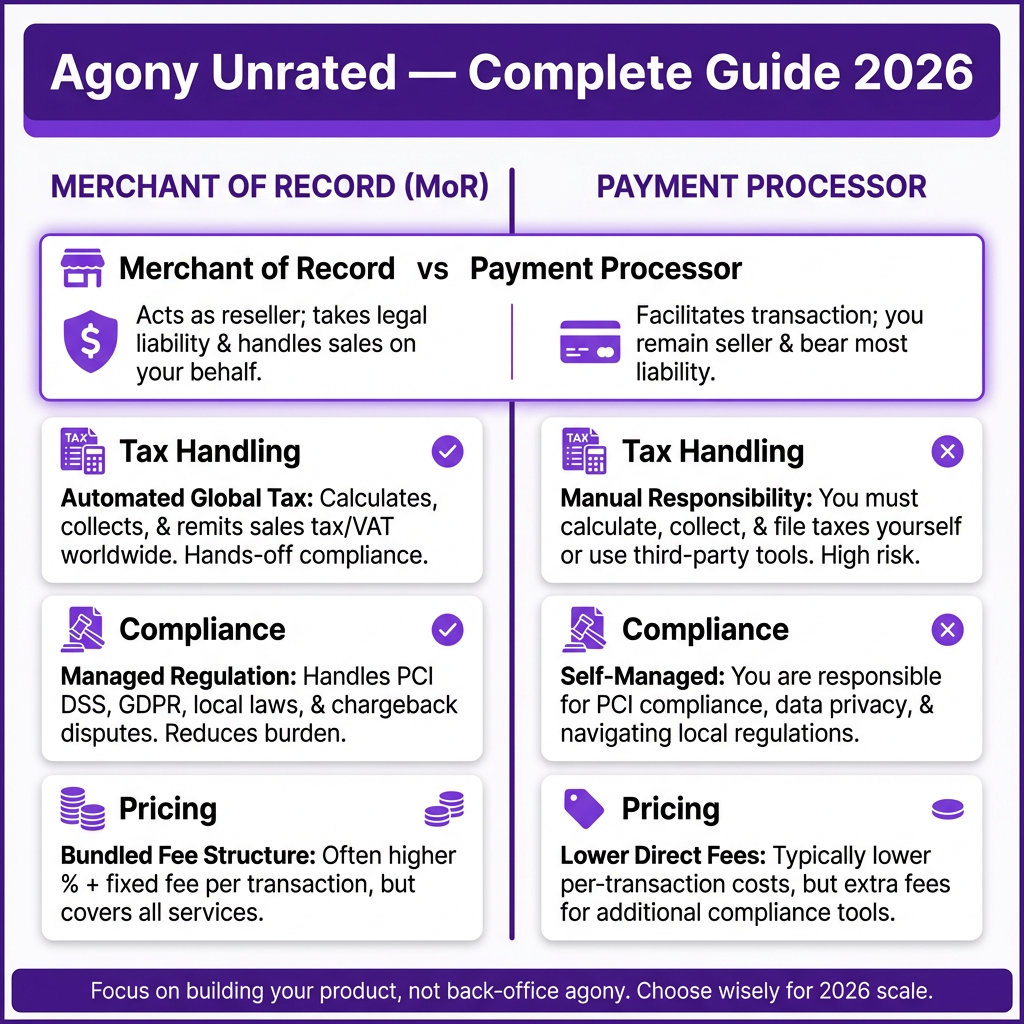
The fundamental difference lies in legal responsibility. With a payment processor, you remain the seller of record, meaning you’re responsible for tax collection, remittance, and compliance. With a Merchant of Record, these obligations transfer to the MoR provider.
Tax Compliance
Payment Processor: You must register for VAT/GST/sales tax in every jurisdiction where you have customers, calculate taxes correctly, file returns, and remit payments. This requires significant accounting resources and expertise.
Merchant of Record: The MoR handles all tax obligations automatically. They register, calculate, collect, file, and remit taxes on your behalf. You receive payouts net of taxes and fees.
Fraud and Chargebacks
Payment Processor: You bear the risk of fraud and chargebacks. You’ll need to implement fraud detection tools and handle disputes directly with customers and banks.
Merchant of Record: The MoR assumes liability for fraud and manages chargebacks. They have sophisticated fraud prevention systems and dedicated teams to handle disputes.
When to Choose a Payment Processor
A payment processor is the right choice when:
- You operate primarily in one or two tax jurisdictions
- You have dedicated accounting/tax resources
- You want maximum control over the checkout experience
- You have complex custom pricing models
- You prefer lower transaction fees and can handle compliance costs separately
When to Choose a Merchant of Record
A Merchant of Record makes sense when:
- You sell to customers in multiple countries
- You want to offload tax compliance complexity
- You lack dedicated tax/accounting resources
- You want simplified global expansion
- You prefer predictable costs over managing multiple vendors
Ready to Simplify Your SaaS Payments?
Join hundreds of SaaS companies using Fungies.io — automated tax compliance, 50+ payment methods, global Merchant of Record.
No credit card required
Cost Comparison
While payment processors advertise lower rates (2.9% + $0.30), the total cost of ownership often surprises businesses. Consider these additional costs:
Payment Processor Hidden Costs:
- Tax compliance software: $200-500/month
- Accounting consultation: $150-300/hour
- Fraud prevention tools: $100-500/month
- Multi-currency conversion fees: 1-2%
- Chargeback fees: $15-25 per incident
Merchant of Record All-Inclusive:
- Typical rates: 3.5-5% + $0.50 per transaction
- Includes tax compliance, fraud protection, and global coverage
- No additional software or consultation needed
Popular Solutions Compared
Stripe (Payment Processor): Best-in-class developer experience, extensive customization, but requires you to handle tax compliance through additional integrations like TaxJar or Avalara.
Paddle (Merchant of Record): Full MoR service with good SaaS features. Higher fees (5% + $0.50) but comprehensive compliance coverage.
Fungies (Merchant of Record): Modern MoR platform combining Stripe-like developer experience with full compliance automation. Competitive pricing with transparent fee structure.
FastSpring (Merchant of Record): Established MoR with strong enterprise features. Higher complexity but robust for large-scale operations.
FAQ
Can I switch from a payment processor to a Merchant of Record?
Yes, migration is possible and common as businesses grow. Most MoR platforms offer migration tools and support to transfer existing subscriptions and payment methods.
Do I lose control over branding with a Merchant of Record?
No, modern MoR platforms offer white-label checkout experiences that maintain your brand identity while handling the backend compliance.
Which is better for a startup?
For startups selling locally, a payment processor may suffice initially. For startups with global ambitions from day one, a Merchant of Record can save significant time and resources.
Conclusion
The choice between a Merchant of Record and payment processor depends on your business stage, geographic reach, and internal resources. Payment processors offer lower fees and more control but require significant compliance investment. Merchants of Record provide simplicity and global compliance at a higher transaction cost.
For most growing SaaS companies, the total cost and operational burden often favor Merchant of Record solutions, especially when selling across multiple tax jurisdictions.