How To Sell Indie Games Without Steam — Complete Guide 2026
Learn how to sell your indie game without Steam. Discover alternative platforms, revenue comparisons, and a 5-step strategy for Steam-free success in 2026.
Steam might be the biggest PC gaming platform, but it’s not your only option — and for many indie developers, it’s not even the best one. With Steam taking a 30% cut, intense competition, and strict visibility rules, more developers are asking: how do I sell my indie game without relying on Steam?
The good news? You have options. From direct sales on your own website to alternative platforms with better revenue splits, the indie game distribution landscape has never been more diverse. In this guide, we’ll explore why you might want to skip Steam, what alternatives exist, and how to build a sustainable sales strategy that doesn’t depend on Valve’s algorithm.
Why Sell Your Indie Game Without Steam?
Steam dominates PC gaming with over 120 million monthly active users. But that dominance comes with significant drawbacks for indie developers. Understanding these challenges helps explain why diversifying your distribution strategy makes sense.
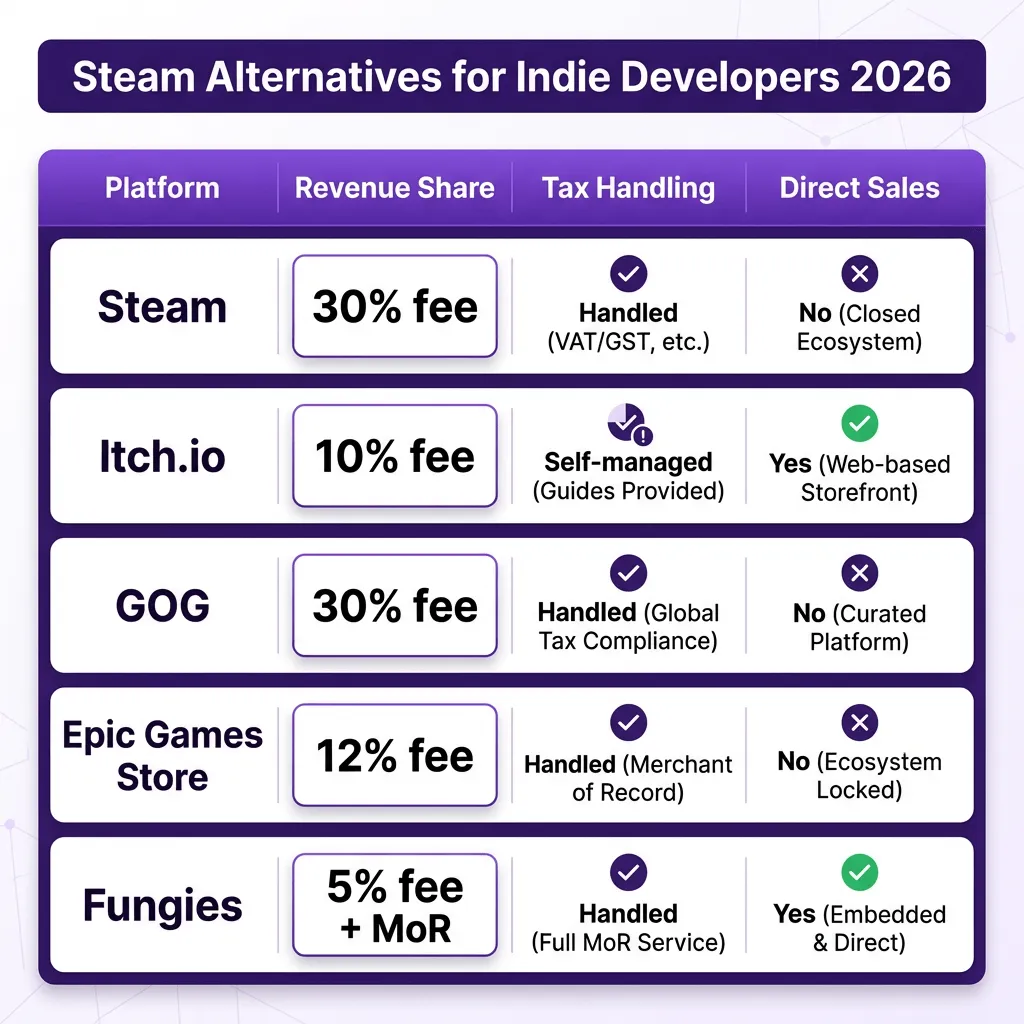
The 30% Revenue Cut: Steam takes 30% of every sale. For a $20 game, that’s $6 gone before you pay taxes, marketing costs, or development expenses. On a $100,000 revenue game, you’re giving Valve $30,000. Alternative platforms often offer better terms — Epic takes 12%, Itch.io defaults to 10%, and direct sales through Fungies cost just 5% plus Merchant of Record services.
Visibility Crisis: Steam releases 30-50 new games every single day. Standing out requires either a massive marketing budget or getting lucky with the algorithm. Most indie games disappear into the store’s depths within days of launch, never to be discovered organically.
Platform Risk: When your entire business depends on one platform, you’re vulnerable to policy changes, algorithm updates, or account issues. Diversifying protects your income and gives you negotiating power.
Steam Alternatives: Platform-by-Platform Breakdown
Let’s examine the major alternatives to Steam, comparing revenue shares, audience types, and ideal use cases for each.
Itch.io: The Indie-Friendly Choice
Itch.io has become the home for experimental, artistic, and niche indie games. The platform lets you set your own revenue share — the default is 10%, but you can adjust it lower or even to 0% if you’re struggling.
Best for: Experimental games, game jams, early prototypes, and developers building a community-first audience. The Itch.io audience expects indie games and is more willing to try unusual concepts than Steam users.
Revenue share: 10% (configurable)
Audience: ~20 million monthly users, heavily indie-focused
Key advantage: No approval process — upload and sell immediately
Epic Games Store: Lower Fees, Curated Selection
Epic takes only 12% compared to Steam’s 30%, and they cover payment processing fees out of that cut. However, getting on the Epic Games Store requires passing their curation process, which favors higher-quality or already-proven titles.
Best for: Polished indie games with commercial potential, developers who can wait for approval, and titles that might qualify for Epic’s exclusive deals or free game promotions.
Revenue share: 12%
Audience: 230+ million accounts, heavily Fortnite-influenced
Key advantage: Lower fees and less competition than Steam
GOG: The DRM-Free Enthusiasts
GOG (Good Old Games) caters to players who want DRM-free games and classic titles. They take 30% like Steam, but their audience is loyal and willing to pay for quality indie games that respect their ownership.
Best for: Games with retro aesthetics, RPGs, strategy games, and developers committed to DRM-free distribution.
Revenue share: 30%
Audience: Smaller but highly engaged, older demographic
Key advantage: DRM-free philosophy attracts dedicated supporters
Direct Sales: Maximum Control, Maximum Profit
Selling directly through your own website gives you complete control over pricing, customer relationships, and data. With modern tools, it’s easier than ever to set up professional direct sales.
Platforms like Fungies let you add a checkout to your website in minutes, handling global tax compliance (VAT, sales tax), payment processing across 50+ methods, and download delivery. You keep 95% of revenue instead of 70%.
Best for: Developers with existing audiences, premium-priced games, and anyone wanting to build direct customer relationships.
Revenue share: ~5% with Merchant of Record
Audience: Your own traffic
Key advantage: Own your customer data and relationships
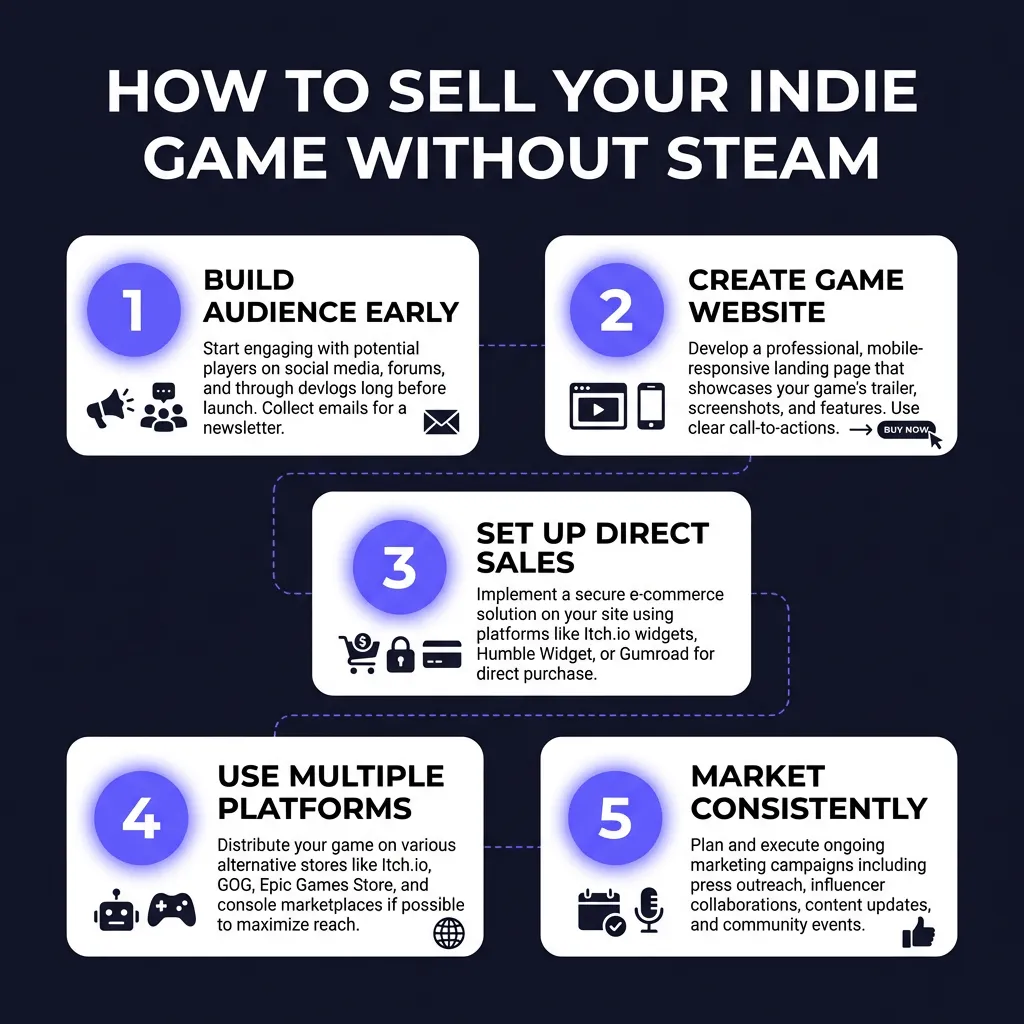
The 5-Step Strategy for Steam-Free Success
Selling without Steam requires a different approach. Here’s a proven strategy that works for indie developers at any stage.
Step 1: Build Your Audience Before Launch
Without Steam’s discovery algorithm, you need to bring your own audience. Start building community 6-12 months before launch. Share development updates on Twitter/X, post GIFs and videos, engage with gaming subreddits, and start a Discord server.
Your email list is your most valuable asset. Offer a free demo, beta access, or development blog in exchange for email signups. On launch day, you’ll have direct access to people already interested in your game.
Step 2: Create a Professional Game Website
Your website is your storefront. It needs to look professional, load fast, and make buying easy. Essential elements include: an attention-grabbing hero section with your trailer, clear pricing, system requirements, screenshots, and a prominent buy button.
Include press kit materials, a press contact, and links to your social media. Journalists and content creators should be able to find everything they need to cover your game.
Step 3: Set Up Direct Sales Infrastructure
Choose a payment solution that handles the complexity for you. Look for: global tax compliance (you’re responsible for collecting VAT in EU and sales tax in many US states), multiple payment methods (credit cards, PayPal, local methods), and secure download delivery.
A Merchant of Record service like Fungies handles all tax compliance automatically, so you don’t need to register for VAT or file sales tax returns in dozens of jurisdictions.
Step 4: Distribute Across Multiple Platforms
Don’t put all your eggs in one basket. Launch simultaneously on Itch.io, your direct store, and any other platforms you’ve been accepted to. Each platform exposes you to different audiences.
Consider platform-exclusive discounts or bonuses to incentivize direct sales (where your margins are highest) while still maintaining presence on marketplaces for discovery.
Step 5: Market Consistently Post-Launch
The work doesn’t stop at launch. Update your game regularly, engage with your community, reach out to streamers and YouTubers, and consider running limited-time sales. Games that maintain post-launch momentum generate significantly more long-tail revenue.
Content updates, DLC, and community events keep your game relevant and give you reasons to reach out to your audience and press.
FAQ: Selling Indie Games Without Steam
Can I still succeed if I’m not on Steam?
Absolutely. Many indie developers earn substantial income through direct sales and alternative platforms. Success depends more on your marketing and community building than your platform choice.
Do I need a publisher to sell outside Steam?
No. Direct sales and platforms like Itch.io let you self-publish. However, a publisher can help with marketing funding and platform relationships if you find the right partner.
How do I handle taxes for direct game sales?
Use a Merchant of Record service that handles tax compliance automatically. Without one, you’ll need to register for VAT in the EU and sales tax in US states where you have customers — a complex and expensive process.
Should I launch on Steam AND other platforms?
Yes, unless you have a specific reason not to. Steam provides discovery benefits even with its drawbacks. The goal is diversifying so you’re not 100% dependent on any single platform.
What’s the best platform for my first indie game?
Itch.io is the easiest starting point — no approval process, indie-friendly audience, and configurable revenue share. Add direct sales once you have some traction, then consider other platforms as you grow.
Conclusion: Take Control of Your Game’s Destiny
Steam isn’t going anywhere, but neither are your alternatives. The most successful indie developers in 2026 treat Steam as one channel among many, not their entire business strategy. By building direct relationships with players, diversifying across platforms, and keeping more of your revenue, you create a more sustainable and profitable indie game business.
The tools have never been more accessible. Whether you choose Itch.io for its community, Epic for lower fees, or direct sales for maximum control, you have real options for distributing your game on your own terms.
Ready to Sell Your Game Directly to Players?
Join hundreds of indie developers using Fungies.io — automated tax compliance, 50+ payment methods, and keep more of your revenue with just 5% + MoR.
No credit card required