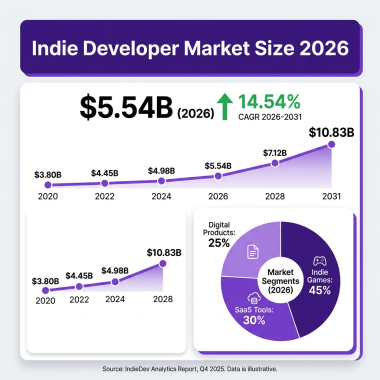
The indie developer revolution has reached its tipping point. In 2026, independent game developers aren’t just surviving in the shadow of AAA studios—they’re thriving, innovating, and in many cases, outperforming their bigger competitors. The numbers tell a remarkable story: indie games now account for 25% of Steam’s total revenue, generating approximately $4.4 billion annually on Valve’s platform alone. The global indie game market has grown to $5.54 billion in 2026, representing a robust 14.54% compound annual growth rate (CAGR) from the previous year’s $4.85 billion valuation.
What was once considered a niche hobby for passionate creators has evolved into a legitimate career path and a formidable segment of the gaming industry. From solo developers working in their bedrooms to small teams of 5-10 people creating global hits, the indie development landscape has fundamentally transformed how we think about game creation, distribution, and success.

Market Overview: The $5.54 Billion Indie Ecosystem
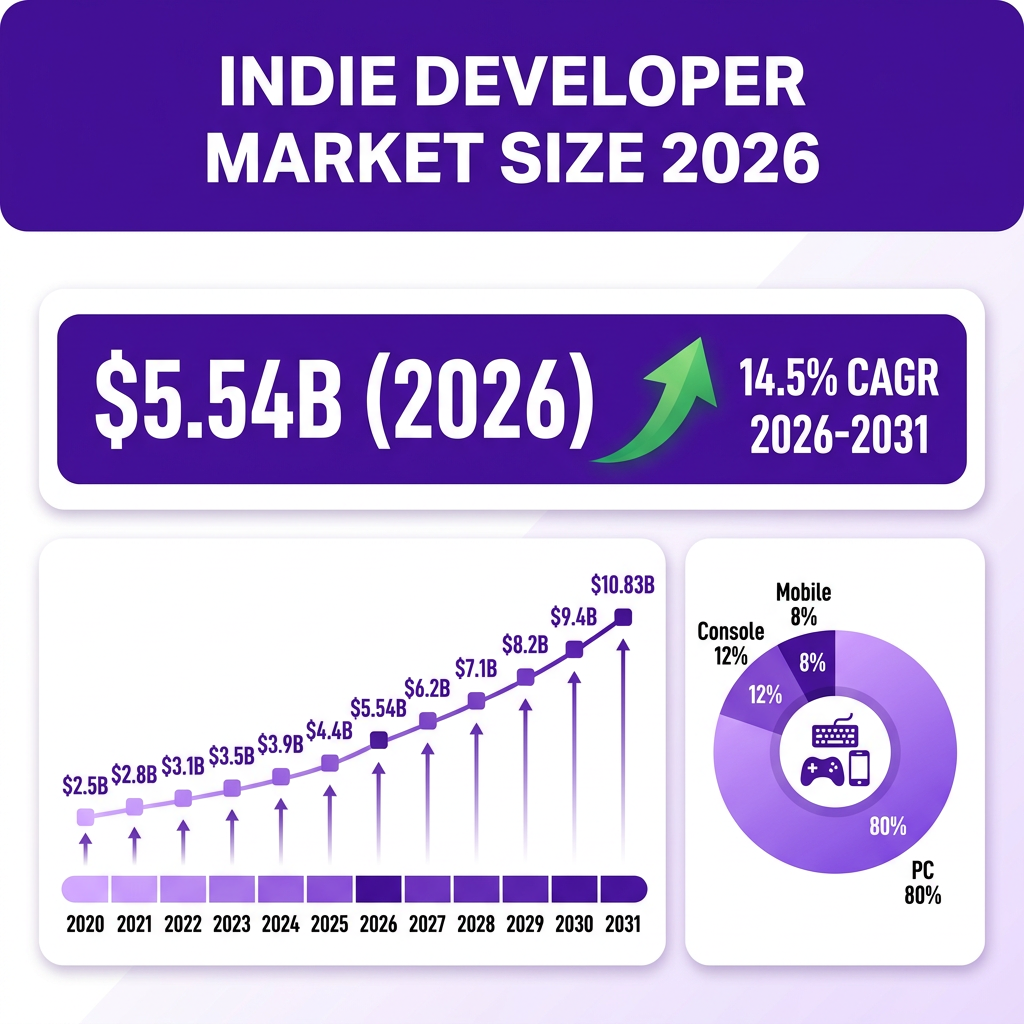
The indie game market has experienced explosive growth over the past decade, but 2026 marks a particularly significant milestone. According to comprehensive market analysis, the industry has grown from a modest $2.5 billion market in 2020 to the current $5.54 billion valuation—a more than twofold increase in just six years. This growth trajectory shows no signs of slowing, with projections indicating the market will reach $10.83 billion by 2031, maintaining a healthy 14.32% CAGR throughout the forecast period.
Several factors have contributed to this remarkable expansion. The democratization of game development tools, the rise of digital distribution platforms, and changing consumer preferences have all played crucial roles. Perhaps most importantly, the barriers to entry have never been lower. Where once aspiring developers needed expensive hardware, proprietary software licenses, and publisher backing, today’s creators can download free engines like Godot, purchase affordable assets from marketplaces, and publish their games directly to platforms reaching millions of potential players.
The platform distribution landscape reveals interesting patterns about where indie developers are finding success. According to the GDC 2025 State of the Game Industry Report, 80% of indie developers now focus their efforts on PC—a dramatic increase from 66% in 2024. This strategic consolidation around PC makes sense: the platform offers the best combination of market reach, technical flexibility, and revenue potential. Steam alone hosts over 70,000 games, with indie titles representing an increasingly significant portion of both catalog and revenue.
Console platforms, while more challenging due to certification processes and hardware requirements, still represent important opportunities. The upcoming Nintendo Switch 2 has generated significant excitement among indie developers, with many hoping to replicate the success stories of the original Switch, which became a haven for indie titles. Mobile, despite its massive overall market size, presents unique challenges for indie developers, including intense competition, discovery difficulties, and platform fees that can reach 30%.
The revenue concentration within the indie market follows a power law distribution that both inspires and intimidates aspiring developers. While the median lifetime earnings for a Steam indie game sits at approximately $4,000, the top 1% of indie titles capture 90% of all revenue. This polarization means that while breakout successes can generate tens or even hundreds of millions of dollars, the majority of indie games struggle to achieve commercial viability. Understanding this landscape is crucial for anyone considering entering the indie development space.
Key Statistics and Market Data
The indie development ecosystem is rich with data points that reveal both the opportunities and challenges facing independent creators. Here are the most critical statistics defining the market in 2026:
Market Size and Growth: The global indie game market reached $4.85 billion in 2025 and has grown to $5.54 billion in 2026. Long-term projections suggest the market will nearly double to $10.83 billion by 2031, driven by increasing accessibility of development tools and expanding digital distribution channels.
Platform Revenue Distribution: Steam’s total game revenue hit a record $17.7 billion in 2025, with indie games contributing approximately $4.4 billion—exactly 25% of the platform’s total. This represents a significant increase from previous years and demonstrates the growing commercial viability of independent titles.
Developer Demographics: The GDC 2026 State of the Game Industry survey, which polled over 2,300 industry professionals, revealed that 33% of game developers experienced layoffs in the past year. This industry turbulence has paradoxically benefited the indie scene, as experienced developers leave AAA studios to pursue independent projects.
Success Rate Statistics: Only 10% of Steam developers have ever made more than $100,000 in gross revenue. The breakdown of developer earnings reveals a stark hierarchy: the majority of developers (learners and hobbyists) have made less than $10,000, while approximately 1,600 developers have crossed the $1 million threshold. Success stories typically release 4-5 games on average before achieving significant commercial success.
Platform Targeting: PC dominates indie development with 80% of developers targeting the platform, up from 66% in 2024. Console development attracts 35% of indie developers, while mobile sees interest from approximately 25%—though mobile’s high competition and discovery challenges make it less attractive for many independent creators.
AI Adoption: According to the GDC 2026 survey, 36% of game industry professionals are using generative AI tools as part of their workflow. However, sentiment is mixed: 52% believe AI is having a negative impact on the industry (up from 30% in 2025), while only 7% see it as positive. Among game studios specifically, 30% report using AI tools, compared to 58% at publishing and marketing firms.
Top Indie Hits of 2025: Five indie releases alone accounted for 3% of Steam’s total game revenue in 2025. Schedule I led with $151 million, followed by R.E.P.O., Hollow Knight: Silksong with $75 million, and Escape from Duckov with $53 million. These successes demonstrate that indie games can achieve AAA-level commercial performance.
Development Team Sizes: The most successful indie studios typically operate with small, focused teams. Team Cherry (Hollow Knight) consists of just three core members. ConcernedApe (Stardew Valley) developed his hit game entirely solo over four years. LocalThunk (Balatro) similarly created his breakout success as a solo developer.
Engine Adoption: Unity and Unreal Engine remain popular among indie developers, but Godot has experienced significant growth following Unity’s controversial Runtime Fee announcement in 2023. Godot’s completely free, open-source model with no royalties has made it increasingly attractive for budget-conscious independent developers.
Player Demographics: Indie game players skew younger and more diverse than the overall gaming population. 52% of indie players are aged 18-24, and 35% identify as LGBTQ+. This demographic profile influences both the types of games being created and the marketing strategies employed by successful indie developers.
Funding Landscape: Gaming VC funding dropped to $2.54 billion in 2024—down 80% from the $12.5 billion peak in 2021. However, specialized gaming funds like Andreessen Horowitz’s $600 million gaming fund and Makers Fund’s $500 million indie initiative continue to provide capital for promising studios.
The Evolution of Indie Development: From Hobby to Profession
The transformation of indie game development from a weekend hobby to a legitimate career path represents one of the most significant shifts in the gaming industry’s history. Understanding this evolution provides crucial context for where the market stands today and where it’s headed tomorrow.
The Early Days: 2000-2010
In the early 2000s, independent game development was largely the domain of hobbyists and experimental creators. Distribution was limited to personal websites and small forums, with no viable path to monetization for most developers. The term “indie game” barely existed in the popular consciousness, and the few successful titles were viewed as flukes rather than harbingers of a movement.
Everything began to change with the rise of digital distribution platforms. Steam’s launch in 2003 and the introduction of Steam Greenlight in 2012 created the first real pathway for independent developers to reach global audiences. The “indie boom” of the late 2000s and early 2010s—fueled by hits like Braid, World of Goo, and Minecraft—proved that small teams could achieve commercial success without publisher backing.
The Maturation Era: 2015-2020
The mid-2010s marked the maturation of indie development as an industry segment. The success of games like Undertale, Stardew Valley, and Hollow Knight demonstrated that indie titles could achieve both critical acclaim and massive commercial success. These weren’t just good games for indie games—they were good games, period, competing directly with AAA releases for player attention and dollars.
During this period, the infrastructure supporting indie developers improved dramatically. Game engines became more accessible and affordable, with Unity and Unreal Engine offering free or low-cost options for small developers. Asset stores emerged, allowing creators to purchase art, sound, and code rather than creating everything from scratch. Crowdfunding platforms like Kickstarter provided alternative funding sources, enabling developers to gauge audience interest before committing to full production.
The Current Landscape: 2021-2026
Today’s indie development landscape is simultaneously more accessible and more competitive than ever before. The barriers to entry have never been lower—anyone with a computer and internet connection can download Godot, watch tutorials, and start creating. However, the barriers to success have never been higher, with thousands of games releasing monthly and player attention becoming an increasingly scarce resource.
The COVID-19 pandemic accelerated several trends that have shaped the current market. With more people staying home and gaming, demand for content surged. Simultaneously, many experienced developers found themselves with unexpected free time or facing layoffs, leading to an influx of talent into the indie space. The result was a massive increase in both supply and demand, creating the competitive but opportunity-rich environment we see today.
Regional Indie Development Hubs
While indie development is a global phenomenon, certain regions have emerged as particularly vibrant hubs of independent game creation. Understanding these geographic centers provides insight into how local ecosystems support and nurture indie talent.
North America: The Commercial Powerhouse
North America, particularly the United States and Canada, remains the largest market for indie games and home to many of the most successful independent studios. The region benefits from robust infrastructure, including major game engines headquartered in the area (Unity in San Francisco, Epic Games in North Carolina), strong venture capital availability, and proximity to major platforms like Steam and console manufacturers.
Cities like San Francisco, Seattle, Toronto, and Montreal have developed thriving indie communities, supported by coworking spaces, game jams, and local events. The presence of major AAA studios in these areas also creates opportunities for experienced developers to transition to independent work, bringing their skills and industry knowledge to the indie sector.
Europe: The Creative Innovators
Europe has established itself as a center of creative innovation in indie development. Countries like Sweden (home to successes like Minecraft and Goat Simulator), Poland (The Witcher series began as a relatively small project), and the UK have produced numerous influential indie titles. European developers often bring distinct aesthetic sensibilities and design philosophies that differentiate their games in the global market.
The European Union’s support for creative industries, including funding programs like Creative Europe, has helped nurture indie development across the continent. Additionally, events like Gamescom in Germany and the various Nordic Game conferences provide important networking and visibility opportunities for European indie developers.
Asia-Pacific: The Emerging Force
The Asia-Pacific region represents the fastest-growing segment of the indie development market. Australia’s Team Cherry (Hollow Knight) has shown that world-class indie games can emerge from relatively small markets. Japan’s indie scene, while historically less prominent than its AAA industry, has gained momentum with successes like Daisuke Amaya’s Cave Story.
South Korea and China present unique opportunities and challenges. Both countries have massive gaming markets, but regulatory environments and platform restrictions create hurdles for indie developers. However, the sheer size of these markets means that even niche indie titles can find substantial audiences, and we’re seeing increasing numbers of developers from these regions achieve international success.
Monetization Strategies for Indie Developers
Creating a great game is only half the battle—developers must also build sustainable business models that support ongoing development and provide fair value to players. The indie sector has pioneered several innovative monetization approaches that have since been adopted by larger studios.
Premium Pricing: The Traditional Model
The simplest monetization model remains the premium purchase: players pay a one-time fee to own the game permanently. This approach aligns incentives between developers and players—developers are motivated to create the best possible experience to drive sales, while players receive a complete product without ongoing costs or manipulative mechanics.
Successful premium indie titles typically price between $10 and $30, with the “sweet spot” around $15-20 for most genres. This pricing reflects the reality that indie games generally offer less content than AAA titles while still needing to generate sufficient revenue to sustain development. Games like Hollow Knight ($15) and Stardew Valley ($15) have demonstrated that players are willing to pay fair prices for quality experiences, even from unknown developers.
Early Access: Development as Performance
Steam’s Early Access program has revolutionized how indie games are funded and developed. Rather than waiting until a game is complete to generate revenue, developers can sell work-in-progress versions to players who want to support development and influence the final product. This model provides crucial cash flow during development and creates invested communities around projects.
However, Early Access is not without risks. Some developers have abused the system by releasing barely-functional prototypes or abandoning projects after receiving payment. The most successful Early Access titles—like Hades and Valheim—treated the program as an opportunity for genuine collaboration with players, using feedback to refine and improve their games before full release.
Free-to-Play with Ethical Monetization
While free-to-play is more commonly associated with mobile and AAA games, some indie developers have found success with ethical implementations of this model. Games like Dota 2 (which began as a mod before becoming a Valve-published title) and various indie multiplayer games have demonstrated that free-to-play can work without predatory mechanics.
The key to ethical free-to-play is ensuring that monetization never compromises gameplay integrity. Cosmetic-only purchases, battle passes that reward engagement rather than spending, and transparent pricing all contribute to player trust. Indie developers are particularly well-positioned to implement ethical monetization because their smaller scale allows for more personal relationships with player communities.
The Role of Publishers in Indie Development
While the “indie” label traditionally implies self-publishing, an increasing number of independent developers are partnering with indie-focused publishers to handle marketing, distribution, and business operations. Understanding when and why to work with a publisher is crucial for developers navigating the modern market.
What Indie Publishers Provide
Indie publishers like Devolver Digital, Annapurna Interactive, and Raw Fury have built reputations by identifying promising games and providing the support needed to help them reach their potential. These publishers typically offer marketing expertise, PR relationships, platform access (including console certification), funding for development or porting, and business management services.
For developers who excel at game creation but lack marketing skills or business experience, publishers can be invaluable partners. The best indie publishers function as collaborators rather than mere distributors, providing creative feedback and helping developers make strategic decisions about their games and careers.
The Cost of Partnership
Publisher partnerships come at a cost, typically in the form of revenue sharing that can range from 30% to 50% of net profits. Developers must carefully evaluate whether the services provided justify this cost. For games that would otherwise struggle to find an audience, publisher support can mean the difference between obscurity and success. For games with strong built-in audiences or clear market appeal, self-publishing may be more profitable.
The decision to work with a publisher should be based on honest assessment of one’s own strengths and weaknesses. Developers who are confident in their marketing abilities and have the resources to handle business operations may prefer to retain full control and revenue. Those who want to focus entirely on development may find publisher partnerships liberating.
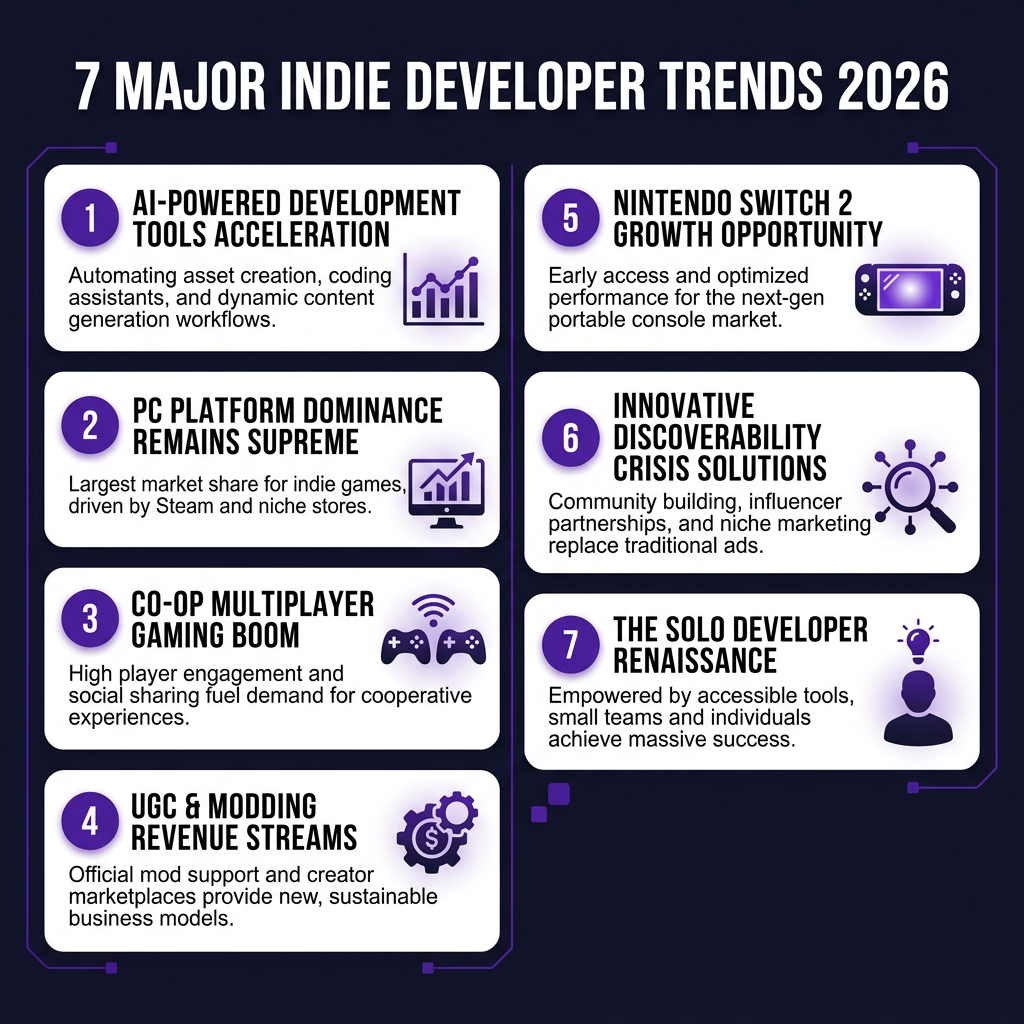
Seven Major Trends Shaping Indie Development in 2026
The indie development landscape is constantly evolving, with 2026 bringing several significant trends that are reshaping how independent games are created, distributed, and monetized. Understanding these trends is essential for developers looking to succeed in this competitive market.
1. AI-Powered Development Workflows
Generative AI has become an undeniable force in game development, with 36% of industry professionals now incorporating AI tools into their workflows. For indie developers, AI represents both an opportunity and a challenge. On one hand, AI tools can dramatically accelerate asset creation, generate code snippets, and assist with narrative design—leveling the playing field against better-resourced competitors. Small teams can now produce content that would have required significantly larger teams in the past.
However, the industry remains deeply divided about AI’s impact. The GDC 2026 survey revealed that 52% of developers believe generative AI is harming the industry, up from just 18% two years prior. Concerns range from job displacement to quality degradation and ethical questions about training data. For indie developers, the key is using AI as a force multiplier rather than a replacement for creative vision—leveraging AI for prototyping and asset generation while maintaining human oversight of design and direction.
2. PC Platform Dominance
The strategic shift toward PC development has accelerated dramatically, with 80% of indie developers now targeting PC as their primary platform—up from 66% just one year ago. This consolidation reflects several factors: Steam’s robust indie ecosystem, lower technical barriers compared to console development, and the platform’s reputation for supporting innovative, experimental titles.
PC offers indie developers unmatched flexibility in pricing, updates, and community engagement. Steam’s Early Access program allows developers to generate revenue while continuing development, and the platform’s recommendation algorithms—while imperfect—provide more discoverability opportunities than console storefronts. The PC market also tends to reward depth and innovation over polish, making it ideal for indie developers with limited resources but strong creative visions.
3. The Rise of Co-op Multiplayer Indies
One of the most notable trends in 2026 is the explosion of cooperative multiplayer indie games. Titles like Lethal Company, Content Warning, and R.E.P.O. have demonstrated that small teams can create engaging multiplayer experiences that rival AAA offerings. The success of these games has spawned a wave of “weirdo indie co-op” titles that prioritize fun, social interaction, and emergent gameplay over production values.
This trend aligns with broader gaming industry patterns: players increasingly value social experiences and shared moments. For indie developers, co-op games offer several advantages: they tend to have longer player retention, benefit from viral word-of-mouth marketing, and can succeed with simpler graphics and mechanics since the social interaction provides much of the entertainment value.
4. User-Generated Content and Modding Revenue
User-generated content (UGC) and modding have evolved from community features to significant revenue streams. Industry analysts project that micro-economies powered by modding and UGC marketplaces will account for nearly 20% of indie game revenue globally by 2027. Games like Roblox and Minecraft have demonstrated the power of UGC, and indie developers are increasingly building modding support into their titles from the ground up.
This trend represents a fundamental shift in how games are conceptualized. Rather than shipping a complete, static product, successful indie developers are creating platforms for ongoing creativity. The base game becomes a foundation upon which communities build, extending the game’s lifespan and creating multiple monetization opportunities through marketplace fees, premium mods, and cosmetic items.
5. Nintendo Switch 2 and New Platform Opportunities
The announcement and upcoming launch of the Nintendo Switch 2 has generated significant excitement in the indie development community. The original Switch became a haven for indie titles, with games like Hollow Knight, Stardew Valley, and Celeste finding massive audiences on the platform. Developers are hoping the Switch 2 will continue this tradition while offering improved technical capabilities.
Nintendo’s platforms have historically offered indie developers several advantages: less competition than Steam, a player base hungry for unique experiences, and marketing support through Nintendo Direct presentations and eShop featuring. The Switch 2’s enhanced hardware should enable more ambitious indie ports while maintaining the portability that made the original so appealing for indie games.
6. The Discoverability Crisis and Creative Solutions
With thousands of games releasing on Steam every year, discoverability remains the single biggest challenge facing indie developers. The “silent killer” of indie games isn’t quality—it’s obscurity. Even outstanding games can remain hidden in the vast ocean of digital content, never reaching their potential audience.
In response, developers are employing increasingly sophisticated marketing strategies. Community building through Discord and social media has become essential, with successful indies cultivating engaged audiences long before launch. Influencer marketing, particularly through YouTube and Twitch, provides targeted exposure to relevant audiences. Demo releases, particularly during Steam Next Fest events, allow developers to build wishlists and generate buzz ahead of launch.
7. The Solo Developer Renaissance
Perhaps the most inspiring trend of 2026 is the growing number of successful solo developers. Games like Stardew Valley (ConcernedApe), Undertale (Toby Fox), and Balatro (LocalThunk) have proven that a single dedicated creator can achieve commercial and critical success rivaling entire studios. This “solo developer renaissance” is enabled by accessible tools, asset marketplaces, and distribution platforms that eliminate many traditional barriers.
For aspiring developers, these success stories provide both inspiration and a realistic roadmap. While the odds remain challenging—remember, the median Steam indie earns just $4,000—the existence of proven solo success paths makes indie development an increasingly viable career option for talented individuals willing to invest the time and effort.
Key Players and Success Stories
The indie development landscape is populated by remarkable success stories that inspire new generations of creators. These studios and individuals have proven that with talent, persistence, and a bit of luck, independent developers can achieve extraordinary results.
Team Cherry: The Australian Phenomenon
Based in Adelaide, Australia, Team Cherry has become one of the most celebrated indie studios in the world with just two titles: Hollow Knight and its sequel, Hollow Knight: Silksong. Founded in 2014 by Ari Gibson and William Pellen, the studio launched a Kickstarter campaign for Hollow Knight with a modest goal of $35,000 AUD. The game exceeded all expectations, selling millions of copies and generating tens of millions in revenue.
The release of Silksong in 2025 triggered a massive surge in sales for the original Hollow Knight, which sold over 200,000 copies weekly for three consecutive weeks following the sequel’s launch. Silksong itself generated approximately $75 million in revenue, cementing Team Cherry’s status as one of the most successful indie studios in history. Their story demonstrates the power of focused vision, meticulous craftsmanship, and patient development.
ConcernedApe: The Solo Visionary
Eric Barone, better known as ConcernedApe, represents the ultimate solo developer success story. Working alone over four years, he created Stardew Valley—a farming simulation game that has sold over 30 million copies and generated more than $130 million in revenue. Barone’s journey from unemployed graduate to millionaire game developer has become legendary in indie circles.
What’s particularly impressive about ConcernedApe’s success is that he handled every aspect of Stardew Valley himself: programming, art, music, sound design, and writing. His story proves that a single dedicated creator, armed with determination and willingness to learn, can compete with entire development teams. Barone continues to update Stardew Valley years after release, maintaining an engaged community and generating ongoing revenue.
LocalThunk: The Overnight Sensation
LocalThunk, the anonymous creator of Balatro, represents a different kind of indie success. Released in 2024, Balatro—a poker-inspired roguelike deckbuilder—became an instant phenomenon, selling millions of copies and earning numerous Game of the Year nominations. The game’s elegant design, addictive gameplay loop, and perfect price point ($14.99) demonstrated that innovative mechanics can triumph over massive budgets.
LocalThunk’s success story is particularly notable for its speed. While many indie hits build audience gradually over years, Balatro achieved mainstream success almost immediately upon release. This “lightning in a bottle” phenomenon shows that while indie development is often a marathon, occasionally it can be a sprint.
Supergiant Games: Consistent Excellence
Supergiant Games has established itself as one of the most consistent indie studios through titles like Bastion, Transistor, Pyre, and Hades. Their games are known for stunning art direction, exceptional voice acting, and innovative gameplay mechanics. Hades, their rogue-like action game based on Greek mythology, achieved both critical acclaim and commercial success, winning numerous Game of the Year awards and selling millions of copies.
Supergiant’s approach demonstrates that indie studios can build sustainable businesses through consistent quality rather than relying on single breakout hits. Their relatively small team (under 20 people) maintains a distinct creative vision across multiple successful titles, proving that growth doesn’t necessarily require scaling headcount.
Toby Fox: The Underground Sensation
Toby Fox created Undertale, one of the most influential indie games of the past decade. Released in 2015 after a successful Kickstarter campaign, Undertale sold millions of copies and spawned a devoted fanbase that remains active years later. Fox’s unique approach to game design—emphasizing player choice, subverting expectations, and integrating narrative directly into gameplay mechanics—influenced countless subsequent indie titles.
Fox followed up with Deltarune, an ongoing episodic project that has maintained the same level of creativity and fan engagement. His work demonstrates that indie games can achieve cultural impact far beyond their sales numbers, influencing the broader gaming landscape and inspiring new generations of developers.

Challenges and Pain Points
While the indie development success stories are inspiring, they represent the exception rather than the rule. The reality for most indie developers is significantly more challenging, with several systemic issues making sustainable success difficult to achieve.
The Discoverability Crisis
The most significant challenge facing indie developers in 2026 is discoverability. Steam alone sees thousands of new game releases every month, making it nearly impossible for individual titles to stand out without significant marketing efforts or algorithmic luck. The platform’s recommendation systems, while designed to surface relevant content, tend to favor established hits and games with existing momentum, creating a “rich get richer” dynamic.
This discoverability crisis means that even excellent games can fail commercially simply because potential players never learn of their existence. Developers must now spend significant time and resources on marketing, community building, and PR—skills that are entirely separate from game development and don’t come naturally to many creators.
Funding and Financial Sustainability
The funding landscape for indie developers remains challenging. While VC investment in gaming reached $4.3 billion in 2024, this represents a significant decline from the $12.5 billion peak in 2021. Most of this funding flows to established studios or projects with proven track records, leaving new developers to rely on personal savings, crowdfunding, or publisher deals that often require significant revenue sharing.
The financial reality is stark: with median Steam earnings of just $4,000, most indie games fail to generate enough revenue to justify their development costs. Even developers who achieve modest success often find themselves unable to fund their next project without returning to traditional employment or seeking external funding.
Market Saturation and Quality Expectations
As development tools have become more accessible, the number of games entering the market has exploded. This saturation means that simply releasing a competent game is no longer sufficient for success. Players have come to expect polished experiences with professional-level art, sound, and design—expectations that are difficult for small teams to meet.
The bar for indie success has risen dramatically. Where once a clever mechanic or unique aesthetic could drive sales, today’s successful indies typically require multiple dimensions of quality: engaging gameplay, polished presentation, effective marketing, and community engagement. This “raise the bar” phenomenon makes indie development increasingly challenging for newcomers.
AI Uncertainty and Industry Disruption
The rapid adoption of generative AI tools has created uncertainty throughout the industry. While AI offers productivity benefits, it also raises concerns about job displacement, quality degradation, and ethical questions regarding training data. The GDC 2026 survey found that 74% of game development students are concerned about their future job prospects, reflecting broader anxiety about AI’s impact.
For indie developers specifically, AI presents a dilemma: using AI tools may provide competitive advantages, but it may also alienate portions of the player base who view AI-generated content negatively. Navigating this landscape requires careful consideration of when and how to incorporate AI into development workflows.
Opportunities and Growth Strategies
Despite the challenges, the indie development landscape offers significant opportunities for developers who approach the market strategically. Here are the key growth strategies that successful indies are employing in 2026:
Community-First Development
The most successful indie developers treat community building as a core development activity rather than an afterthought. By engaging with potential players through Discord, social media, and development blogs, creators can build an audience that’s invested in their success before the game even launches. This community becomes a powerful marketing force, providing word-of-mouth promotion that no advertising budget can buy.
Community-first development also provides valuable feedback during the development process. Early access programs, public betas, and demo releases allow developers to refine their games based on real player input, increasing the chances of commercial success at launch.
Strategic Platform Selection
While PC remains the dominant platform for indie developers, successful studios are increasingly strategic about platform selection. The Nintendo Switch has proven particularly fertile ground for indie titles, with its player base actively seeking unique experiences. The upcoming Switch 2 presents new opportunities for developers who can position themselves early.
Mobile, while challenging, still offers opportunities for developers who can navigate its unique dynamics. The rise of “hybrid casual” games and the success of titles like Vampire Survivors on mobile demonstrate that indie sensibilities can translate to the platform with the right approach.
Live Service and Ongoing Content
Rather than treating games as one-time releases, successful indies are increasingly adopting live service models with ongoing content updates. This approach extends a game’s commercial lifespan, maintains player engagement, and creates multiple monetization opportunities through DLC, cosmetics, and season passes.
Games like Stardew Valley demonstrate the power of ongoing support: years of free updates have maintained community engagement and driven consistent sales. For developers, this model requires a longer-term commitment but can generate significantly more revenue than a traditional release-and-move-on approach.
Leveraging AI Responsibly
Forward-thinking indie developers are finding ways to leverage AI tools without compromising their creative vision or alienating players. The key is using AI for acceleration rather than replacement: AI can generate prototypes, create placeholder assets, and assist with coding, while human developers maintain creative control over the final product.
Developers who master this balance can achieve productivity gains that allow them to compete more effectively with larger teams. The studios that thrive in the AI era will be those that use these tools to amplify human creativity rather than replace it.
Future Outlook and Predictions
The indie development landscape will continue evolving rapidly through the remainder of the decade. Here are the key predictions for where the market is heading:
Market Growth Continues
The indie game market is projected to reach $10.83 billion by 2031, nearly doubling from its current $5.54 billion valuation. This growth will be driven by continued platform expansion, increasing global internet penetration, and the ongoing democratization of development tools. As more regions gain access to digital distribution platforms, the addressable market for indie developers will expand significantly.
AI Integration Becomes Standard
By 2030, AI tools will be standard components of the indie development workflow. The current debate about AI’s role will largely be resolved as best practices emerge and players become accustomed to AI-assisted content. Developers who fail to adapt to this new reality will find themselves at a significant productivity disadvantage.
Platform Fragmentation Increases
The platform landscape will become increasingly fragmented as new entrants challenge Steam’s dominance. Epic Games Store, GOG, and emerging platforms like Netflix Games will compete for indie exclusives, potentially creating new opportunities for developers willing to navigate multiple distribution channels. However, this fragmentation may also complicate marketing and community building efforts.
Solo Development Gains Legitimacy
The success of solo developers like ConcernedApe and LocalThunk will inspire a new generation of creators to pursue independent development as a viable career path. Educational institutions will increasingly offer game development programs focused on solo and small-team creation, and the stigma once associated with “bedroom developers” will continue fading.
Discoverability Solutions Emerge
The discoverability crisis will drive innovation in how games are surfaced to potential players. AI-powered recommendation systems will become more sophisticated, and new platforms may emerge specifically designed to help players find hidden gems. Developers who understand these systems and optimize for them will have significant advantages.
Key Takeaways
- The indie game market reached $5.54 billion in 2026 and is projected to grow to $10.83 billion by 2031, representing a 14.32% CAGR
- Indie games now account for 25% of Steam’s total revenue ($4.4 billion annually), demonstrating mainstream commercial viability
- 80% of indie developers target PC as their primary platform, up from 66% in 2024, reflecting strategic consolidation
- Success remains concentrated: the top 1% of indie games capture 90% of revenue, while the median Steam indie earns just $4,000
- AI adoption is growing (36% of developers use AI tools), but sentiment is mixed with 52% believing AI negatively impacts the industry
- Solo developers are achieving unprecedented success, with creators like ConcernedApe and LocalThunk proving that individual creators can compete with entire studios
- Discoverability remains the biggest challenge, requiring developers to master marketing and community building alongside game development
- Co-op multiplayer indies, UGC integration, and live service models represent the most promising growth strategies for 2026 and beyond
Sources and Citations
- Alinea Analytics – Steam Revenue Report 2025: https://wnhub.io/news/analytics/item-49645
- GDC 2026 State of the Game Industry Report: https://gdconf.com/article/gdc-2026-state-of-the-game-industry-reveals-impact-of-layoffs-generative-ai-and-more/
- Mordor Intelligence – Indie Game Market Forecast: https://www.mordorintelligence.com/industry-reports/indie-game-market
- Accio – 2025 Indie Game Trends: https://www.accio.com/business/2025-indie-game-trends
- Notebookcheck – Indie Games Revenue Share: https://www.notebookcheck.net/Indie-games-accounted-for-25-of-Steam-s-revenue-in-2025.1189429.0.html
- Gitnux – Indie Game Industry Statistics: https://gitnux.org/indie-game-industry-statistics/
- Game Developer – Steam Developer Earnings Analysis: https://www.gamedeveloper.com/game-platforms/what-can-we-learn-from-the-1-600-highest-earning-indie-developers-on-steam-
- Monolith Gaming – 2026 Indie Powerhouse: https://monolithgaming.org/year-indie-powerhouse/
- GrowthHQ – Indie Game Funding Challenges: https://www.growthhq.io/our-thinking/indie-game-funding-challenges-and-breakthrough-strategies-in-2026-navigating-the-14-billion-opportunity
- TransPerfect Games – Discoverability Crisis: https://www.transperfectgames.com/blog/silent-killer-indie-games-discoverability-age-infinite-content
Marketing and Community Building for Indie Developers
In an era where thousands of games release monthly, marketing has become as crucial as development quality for indie success. The developers who thrive are those who understand that building an audience is an ongoing process that begins long before launch and continues well after.
The Power of Transparency
One of the most effective marketing strategies for indie developers is radical transparency. By sharing development progress, challenges, and victories through blogs, social media, and video content, developers build relationships with potential players that transcend traditional marketing. This approach transforms marketing from advertising into storytelling, creating narratives that audiences want to follow and support.
Successful transparent marketing requires authenticity. Players can detect manufactured vulnerability or performative openness, and react negatively to it. The most effective developer communications come from genuine passion for the project and respect for the audience. ConcernedApe’s regular updates about Stardew Valley development, even years after release, exemplify this approach.
Leveraging Social Platforms
Different social platforms serve different purposes in indie marketing strategies. Twitter/X remains valuable for industry networking and reaching core gaming audiences. TikTok has emerged as a powerful tool for reaching younger demographics with short, engaging development clips. YouTube enables longer-form content like devlogs and behind-the-scenes features. Discord facilitates direct community engagement and feedback collection.
The key to social media success is understanding each platform’s culture and expectations. Content that performs well on TikTok—short, visually striking clips with trending audio—differs dramatically from effective Twitter content, which tends toward text-heavy updates and industry commentary. Successful indie developers tailor their messaging to each platform rather than cross-posting identical content everywhere.
The Importance of Demo Culture
Steam Next Fest and similar demo events have become crucial marketing opportunities for indie developers. These events allow players to try games before purchasing, building wishlists and generating word-of-mouth buzz. A well-crafted demo can drive thousands of wishlist additions and create momentum that carries through to launch.
Creating an effective demo requires careful consideration. The demo must be substantial enough to give players a genuine sense of the game while leaving them wanting more. It should showcase the game’s unique qualities without giving away everything. Developers who treat demos as afterthoughts miss crucial opportunities to build pre-launch momentum.
Technical Considerations for Indie Development
While creative vision drives indie success, technical decisions profoundly impact a project’s feasibility and commercial potential. Understanding the technical landscape helps developers make informed choices about tools, platforms, and scope.
Engine Selection in 2026
The game engine landscape has shifted significantly in recent years. Unity’s controversial Runtime Fee announcement in 2023 drove many developers to explore alternatives, with Godot emerging as the primary beneficiary. Godot 4.4, released in early 2026, offers a mature, lightweight solution with zero licensing costs or royalties, making it increasingly attractive for budget-conscious indies.
Unreal Engine remains popular for visually ambitious projects, particularly those targeting PC and console. Its Nanite and Lumen technologies enable graphical fidelity previously impossible for small teams, though the engine’s complexity can be overwhelming for solo developers or small teams. Unity, despite its missteps, maintains a large user base and extensive asset store ecosystem.
Platform Technical Requirements
Each platform presents unique technical challenges for indie developers. PC offers the most flexibility but requires handling diverse hardware configurations. Console platforms demand optimization for specific hardware and navigating certification processes. Mobile requires careful attention to performance across a vast range of devices while managing platform-specific requirements from Apple and Google.
The Nintendo Switch 2, expected to launch in 2026, will likely become a major target for indie developers. The original Switch proved that indie games could thrive on Nintendo platforms, and the new system’s enhanced capabilities should enable more ambitious ports while maintaining the portability that made the original appealing.
Conclusion: The Future is Indie
The indie development landscape in 2026 represents both the culmination of decades of democratization and the beginning of a new era. The tools, platforms, and knowledge needed to create successful independent games have never been more accessible. Simultaneously, the market has never been more competitive, with thousands of talented creators vying for player attention.
Success in this environment requires more than technical skill or creative vision—it demands business acumen, marketing savvy, and community engagement capabilities. The developers who thrive are those who embrace the full scope of indie development, treating their projects as businesses while maintaining the creative passion that drives the industry forward.
As we look toward 2030 and beyond, the indie sector’s growth trajectory suggests it will continue capturing larger shares of the overall gaming market. The $10.83 billion projected market size represents not just financial opportunity but cultural significance. Indie games are increasingly where innovation happens, where new genres emerge, and where the medium’s artistic potential is most fully realized.
For aspiring developers, the message is clear: the barriers to entry have never been lower, but the barriers to success have never been higher. Success requires excellence across multiple dimensions—creative, technical, and commercial. Those who can master this complexity will find themselves part of a vibrant, growing industry that is reshaping how games are made, distributed, and experienced.