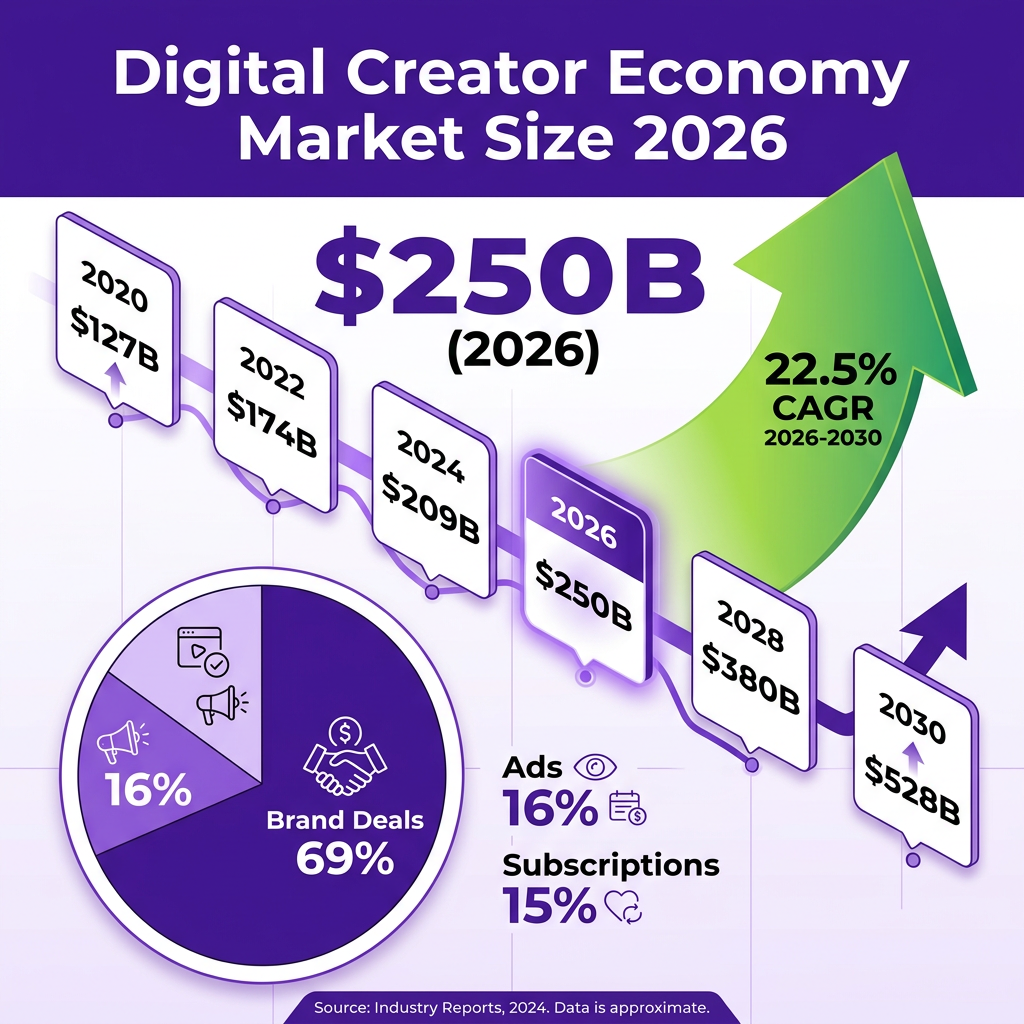
The digital creator economy has evolved from a niche side hustle into a half-trillion-dollar global industry. In 2026, over 207 million active creators worldwide are generating revenue through content creation, with the market valued at approximately $234-250 billion and projected to reach $480 billion by 2027 and $528 billion by 2030. This explosive growth represents a fundamental shift in how content is produced, consumed, and monetized.
What started as simple video sharing on platforms like YouTube has transformed into a sophisticated ecosystem where creators function as multi-platform media brands. From TikTok’s 1.9 billion monthly active users to YouTube’s 2.85 billion viewers, the scale of opportunity has never been larger. Yet beneath the headline numbers lies a more nuanced reality: while the pie is growing, not every creator gets an equal slice.

Market Overview: The $250 Billion Creator Ecosystem
The creator economy in 2026 represents one of the fastest-growing sectors in the global digital landscape. According to Grand View Research, the market reached $205.25 billion in 2024, while Goldman Sachs estimates placed it closer to $250 billion. By 2025, Research Nester projects the market at $178.4 billion with an explosive trajectory toward $1.35 trillion by 2035, representing a compound annual growth rate (CAGR) of 22.4%.
This growth is driven by several converging factors. First, the widespread penetration of smartphones and high-speed internet has democratized content creation. Second, platforms have matured their monetization tools, making it easier for creators to earn sustainable income. Third, brands have shifted significant portions of their marketing budgets toward creator partnerships, with influencer marketing spend exceeding $32 billion in 2026.
The United States remains the largest single market, valued at $50.9 billion in 2024 and projected to reach $297.3 billion by 2034. However, Asia-Pacific is emerging as the fastest-growing region, fueled by massive user bases in India, Southeast Asia, and China. India alone accounts for 518 million YouTube users and 350 million Instagram users, making it the largest market for both platforms.
Platform revenue tells its own story. YouTube generated $36.1 billion in 2024, a 14.6% year-over-year increase, while distributing over $20 billion to creators through the YouTube Partner Program. TikTok’s advertising revenue has been revised upward to $34.8 billion, with TikTok Shop gross merchandise value (GMV) reaching an impressive $84.3 billion. Instagram, owned by Meta, generated an estimated $66.9 billion in 2024, accounting for nearly 40% of Facebook’s total revenue.
The creator economy has outgrown its “side hustle” origins. Today, it represents a permanent line item in global marketing plans, not an experimental channel. As one industry analyst noted, “It’s not a question of if brands should work with influencers, it’s when and how.” Major corporations like Unilever have announced plans to invest 50% of their marketing spend on influencer partnerships, hiring 20 times more creators than they do today.
Key Statistics and Data
Understanding the creator economy requires diving deep into the numbers that define this rapidly evolving landscape. Here are the essential statistics that every marketer, investor, and aspiring creator should know in 2026.
Market Size and Growth
The creator economy market size has shown remarkable growth trajectory. In 2023, the market was valued at $127.65 billion. By 2024, it had grown to $205-250 billion. Current 2026 estimates place the market between $234-250 billion, with projections showing $480 billion by 2027 and $528 billion by 2030. This represents a CAGR of 22.5%, making it one of the fastest-growing sectors in the digital economy.
Goldman Sachs Research projects the creator economy’s total addressable market could approach half a trillion dollars by 2027, roughly doubling from its current size. Precedence Research forecasts even more aggressive growth, predicting the market will reach $2.08 trillion by 2035. Future Market Insights projects growth from $253.1 billion in 2025 to $2.05 trillion by 2035 at a CAGR of 23.3%.
Creator Demographics
The number of active creators worldwide has reached 207 million, according to 2026 data. YouTube leads with approximately 69 million creators across 115 million channels. Of these, 60-65 million channels are considered active, posting at least once per month. More than 69,000 YouTube creators have surpassed one million subscribers, while over 15 channels have exceeded 100 million subscribers.
MrBeast remains the most subscribed individual creator with 463 million subscribers as of January 2026, and he’s also the highest earner, generating an estimated $54 million from YouTube alone. T-Series holds the title for most subscribed channel overall. The majority of YouTube creators fall between the ages of 25 and 34, representing the millennial and older Gen Z demographic.
Platform Statistics
YouTube maintains its position as the dominant platform for long-form content, with 2.85 billion monthly active users globally. Users watch over 1 billion hours of video daily. YouTube Shorts has seen explosive growth, with daily views reaching 200 billion in 2026, up from 70 billion in 2024. YouTube Premium has attracted 100 million subscribers, creating a dual revenue stream for both the platform and creators.
TikTok has grown to 1.9 billion monthly active users globally, with users spending an average of 95 minutes per day on the platform. The platform generated $23.1 billion in ad revenue in 2024, with TikTok Shop driving $84.3 billion in GMV. The average creator engagement rate on TikTok stands at 4.56% year-over-year.
Instagram has reached 2.4 billion monthly active users as of early 2026, representing a 20% year-over-year increase driven primarily by growth in South and Southeast Asia. The platform continues to evolve with Reels, AI recommendations, and integrated shopping experiences.
Creator Earnings Distribution
The income distribution among creators reveals a stark reality: half of all creators earn under $15,000 per year. Only 4% of creators are deemed “professionals” earning sustainable full-time incomes. The average content creator earns $44,000 annually, with a typical range between $36,000 and $74,500. However, top creators like MrBeast earn exponentially more, with estimated annual earnings exceeding $50 million.
YouTube AdSense remains the most stable income source, with finance and business content earning $15-50 per 1,000 views. However, only 34% of creators earn their primary income from platform ads. Approximately 68.8% of creators rely on brand deals as their main revenue source. A creator with 100,000 followers might earn $500-1,500 monthly from Creator Fund alone, but $10,000-30,000 monthly by combining brand deals, affiliate marketing, and live gifting.
AI Adoption Among Creators
Artificial intelligence has become integral to creator workflows. According to Adobe’s 2025 survey of over 16,000 creators, 86% already use generative AI tools in their content creation process. AI is being used for everything from script writing and video editing to thumbnail generation and audience analytics. The companies best positioned in 2026 combine talent management, brand services, and AI technology within a unified structure.
Major Trends Shaping the Creator Economy in 2026
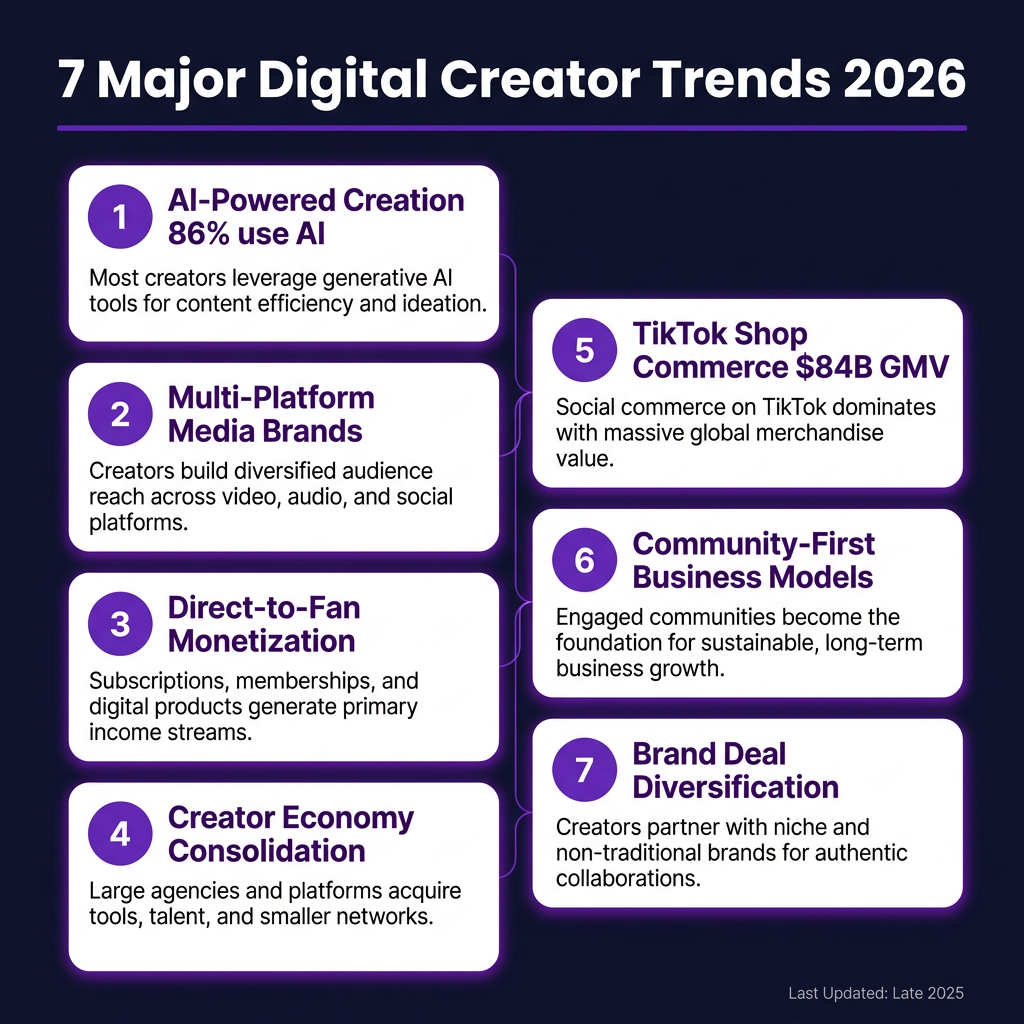
The creator economy is undergoing a period of rapid transformation. Seven major trends are defining the landscape in 2026, each representing both opportunities and challenges for creators, platforms, and brands.
1. AI-Powered Content Creation
With 86% of creators now using generative AI tools, artificial intelligence has moved from experimental feature to essential infrastructure. AI is being deployed across the entire content creation pipeline: research and ideation, script writing, video editing, thumbnail generation, content repurposing, and audience analytics. Tools like OpusClip automatically transform long-form videos into shorts, while platforms like Spotter Studio use AI for trend analysis and outlier video detection.
The impact is profound. Creators can now produce more content in less time, test multiple variations of titles and thumbnails, and optimize posting schedules based on AI-driven insights. However, this democratization also means increased competition. As barriers to entry fall, standing out requires either exceptional quality or unique positioning.
2. Multi-Platform Media Brands
Leading creators no longer think in terms of single platforms. They function as multi-platform media brands, distributing content across YouTube, TikTok, Instagram, podcasts, newsletters, and owned communities. This diversification reduces platform risk while maximizing audience reach and revenue potential.
The data supports this strategy. Creators using six or more tools to manage their business report higher earnings and greater audience engagement. The most successful creators treat each platform as a distinct channel with its own content strategy, rather than simply cross-posting identical content.
3. Direct-to-Fan Monetization
The fastest-growing monetization models in 2026 are those that compress the distance between value creation and value capture. According to Circle data, 54% of creators now offer paid memberships, and 41% rely on recurring subscriptions. This represents a shift away from purely ad-supported models toward sustainable, predictable revenue streams.
Platforms like Patreon, Stan Store, and Fourthwall have made it easier than ever for creators to sell directly to their audiences. From digital products and courses to exclusive communities and coaching, creators are building diversified revenue portfolios that reduce dependence on any single platform or brand deal.
4. Creator Economy Consolidation
2026 marks what Forbes calls “The Era of Consolidation.” Independent creators, boutique managers, influencer agencies, and software vendors are converging into integrated platforms. The companies best positioned combine talent management, brand services, and technology within a unified structure.
This consolidation is driven by efficiency. Brands want to work with partners who can help build lasting businesses, not just secure the next deal. Data is becoming the operating layer that connects talent, historical performance, audience behavior, and brand outcomes. Customization at scale depends on systems, not just relationships.
5. TikTok Shop and Social Commerce
TikTok Shop has emerged as a transformative force in creator monetization. With $84.3 billion in GMV, it represents a fundamental shift in how creators can earn. Affiliate commissions range from 5-20%, and creators in the wellness niche with 50,000 followers report earning $2,000-5,000 monthly from TikTok Shop alone.
This trend extends beyond TikTok. Instagram Shopping, YouTube Shopping, and platform-agnostic tools like ShopMy are enabling creators to monetize their influence through product recommendations. The line between content and commerce is blurring, creating new revenue opportunities for creators across niches.
6. Community-First Business Models
Survey data shows that 69% of creators now prioritize member transformation as their primary driver of retention and growth. These creators are shifting away from transactional content models toward sustained, member-first businesses built on owned communities.
Community-led business models accelerate this shift by making creators directly accountable for outcomes beyond reach and engagement. Solo creators increasingly function as full-stack operators, overseeing monetization, member lifecycle design, and analytics. The result is deeper audience relationships and more predictable revenue.
7. Brand Deal Diversification
While 68.8% of creators rely on brand deals as their primary revenue source, the nature of these deals is evolving. Long-term partnerships are replacing one-off sponsorships. Performance-based compensation is supplementing flat fees. And creators are increasingly selective about brand alignment, prioritizing authenticity over easy money.
The most sophisticated creators are building diversified brand portfolios that include sponsorships, affiliate relationships, product collaborations, and equity partnerships. This approach reduces risk while creating multiple touchpoints for audience monetization.
Key Players and Competitive Landscape
The creator economy ecosystem comprises multiple layers, each with its own set of dominant players. Understanding this landscape is essential for creators looking to build sustainable businesses and for brands seeking effective partnerships.
Content Platforms
YouTube remains the dominant platform for long-form content, with 2.85 billion monthly active users and the most mature monetization infrastructure. The YouTube Partner Program has paid out over $20 billion to creators, and the platform continues to innovate with Shorts, Shopping, and Premium subscriptions.
TikTok has captured the short-form video market with 1.9 billion users and the highest engagement rates in the industry. The platform’s algorithm remains unmatched for content discovery, allowing new creators to achieve viral growth rapidly. TikTok Shop has added a commerce dimension that YouTube and Instagram are racing to match.
Instagram maintains strength in lifestyle, fashion, and beauty content, with 2.4 billion users and sophisticated shopping integrations. Reels has successfully countered TikTok’s rise, while the platform’s mature ad infrastructure makes it attractive for brand partnerships.
Creator Tools and Infrastructure
A new generation of startups is building the infrastructure that powers creator businesses. Beehiiv has emerged as the leading newsletter platform, enabling creators to own their audience relationships. Stan Store and Fourthwall provide creator storefronts for selling digital products. Spotter Studio offers AI-powered YouTube research and ideation tools.
OpusClip uses generative AI to repurpose long videos into shorts automatically. Castmagic handles content repurposing for podcasts and videos. Superly provides AI content workspaces for viral growth. These tools reduce the production burden on creators, allowing them to focus on strategy and audience engagement.
Monetization Platforms
Patreon remains the leader in creator subscriptions, though it faces competition from platform-native options like YouTube Memberships and TikTok Series. Gumroad has carved out a niche for digital product sales, while new entrants like Passes focus on fan monetization.
ShopMy connects creators with premium brands for affiliate partnerships. GRIN provides creator marketing software for brands and agencies. These platforms are raising significant venture capital, with over $2 billion invested in creator economy startups in 2025 alone.
Talent Management and Agencies
The agency landscape is consolidating. The most successful agencies combine talent management, brand services, and technology. Spotter has pioneered a model of investing directly in YouTube creators’ content libraries, providing upfront capital in exchange for a share of future revenue.
Traditional talent agencies like CAA and WME have launched creator divisions, while new entrants like Jellysmack and BBTV have built technology-enabled management platforms. The trend is toward full-service partnerships that help creators build lasting businesses rather than simply securing brand deals.

Challenges and Pain Points
Despite the impressive growth numbers, the creator economy faces significant challenges that threaten the sustainability of creator careers and the health of the ecosystem as a whole.
Creator Burnout and Mental Health
The mental health crisis among creators is real and growing. According to the Creators 4 Mental Health study, 62% of TikTok creators currently experience burnout, with rates climbing to 74% among those with 8 or more years of experience. 65% of creators experience anxiety or depression directly related to their content work, and 10% report suicidal thoughts—nearly double the national average.
The causes are multifaceted. The constant demand for fresh content creates pressure to produce. Algorithm changes can decimate reach overnight. Audience expectations are relentless. And the blurring of personal and professional boundaries leaves many creators feeling they can never truly disconnect.
Income Inequality
The creator economy exhibits extreme income inequality. While top creators like MrBeast earn $50+ million annually, half of all creators earn under $15,000 per year. 71% of TikTok creators earn less than $30,000 annually despite the platform generating $23.1 billion in ad revenue.
This inequality is structural. Platform algorithms favor established creators with large audiences. Brand deals flow to those with proven track records. And the economies of scale in content production make it difficult for new entrants to compete. The result is a winner-take-most dynamic that concentrates wealth at the top.
Platform Dependency
Creators remain vulnerable to platform decisions beyond their control. Algorithm changes can destroy reach overnight. Policy updates can demonetize content retroactively. And platform bans, whether justified or erroneous, can eliminate years of audience building in an instant.
According to a July 2025 survey from CreatorIQ, platform algorithm changes or volatility is the top barrier to business growth for creators worldwide, cited by 18% of respondents. This dependency creates anxiety and discourages long-term investment in any single platform.
Discovery and Saturation
With 207 million active creators worldwide, standing out has never been harder. The barriers to entry may be low, but the barriers to success are higher than ever. New creators face an uphill battle against established channels with massive audiences, professional production values, and sophisticated marketing strategies.
Nearly half of independent creators reported having a hard time being successful in the creator economy, and 41% said they have experienced significant challenges. The dream of easy viral success has given way to the reality of a competitive, demanding profession requiring diverse skills and persistent effort.
Opportunities and Growth Strategies
Despite the challenges, significant opportunities exist for creators who approach the market strategically. Three key strategies are driving success in 2026.
1. Niche Specialization
The most successful new creators are those who carve out specific niches rather than competing in broad categories. Finance and business content on YouTube earns $15-50 per 1,000 views—significantly higher than lifestyle or entertainment content. Specialized knowledge in areas like SaaS, B2B marketing, or technical skills commands premium rates for brand deals and consulting.
Niche creators also benefit from more engaged audiences. A creator with 50,000 followers in a specific wellness niche can earn more than a generalist with 500,000 followers through targeted affiliate relationships and specialized product offerings.
2. Owned Audience Development
Smart creators are investing in owned channels that exist outside platform algorithms. Email newsletters, private communities, and direct messaging lists provide insurance against platform changes while enabling deeper audience relationships.
Creators like Codie Sanchez have built multiple income streams—17 in her case—spanning YouTube AdSense, courses, consulting, investments, and community memberships. This diversification creates stability and maximizes lifetime audience value.
3. AI-Augmented Production
Creators who embrace AI tools gain significant competitive advantages. AI can handle research, scripting, editing, and optimization, allowing creators to produce more content in less time. This efficiency enables consistency—a key factor in platform algorithms—while freeing time for high-value activities like audience engagement and strategy.
The key is using AI to augment rather than replace human creativity. The most successful creators use AI for production efficiency while maintaining authentic voice and unique perspective that resonates with audiences.
Case Studies and Success Stories
Real-world examples illustrate the strategies and outcomes possible in the creator economy. These case studies represent different paths to success.
Case Study 1: MrBeast — Platform Mastery
Jimmy Donaldson, known as MrBeast, has become the face of creator economy success. With 463 million YouTube subscribers and estimated earnings exceeding $54 million annually, he represents the pinnacle of what’s possible on a single platform.
MrBeast’s strategy combines extreme production values with viral content formulas. His videos regularly cost hundreds of thousands to produce and generate millions in return through AdSense, sponsorships, and merchandise. He’s expanded into Feastables (chocolate bars), MrBeast Burger (virtual restaurant chain), and various other ventures.
The lesson: Platform mastery combined with business diversification can create extraordinary outcomes. However, MrBeast’s level of success requires significant capital investment, a large team, and relentless optimization.
Case Study 2: Codie Sanchez — Niche Authority
Codie Sanchez has built a creator business around contrarian thinking and financial education. With 17 different income streams, she earned approximately $360,000 from YouTube AdSense alone in 2024, with total earnings likely much higher.
Her strategy focuses on niche authority rather than mass appeal. By targeting entrepreneurs and investors interested in alternative business models, she commands premium rates for courses, consulting, and community memberships. Her Contrarian Thinking community generates recurring revenue while providing deep value to members.
The lesson: Niche expertise combined with diversified monetization can generate significant income with a smaller but more engaged audience. This model is more accessible to new creators than competing for mass market attention.
Case Study 3: TikTok Shop Affiliates — Commerce Integration
A growing cohort of creators has built substantial income through TikTok Shop affiliate marketing. Creators in the wellness niche with 50,000 followers report earning $2,000-5,000 monthly from TikTok Shop commissions alone, representing 5-20% of product sales driven through their content.
These creators have mastered the integration of content and commerce, creating authentic product recommendations that drive purchases. Unlike traditional brand deals, affiliate income scales with performance, creating unlimited upside for effective creators.
The lesson: Platform-native commerce features represent significant opportunities for creators who can authentically integrate product recommendations into their content. This model rewards performance rather than reach alone.
Future Outlook and Predictions
The creator economy will continue its rapid evolution through 2030 and beyond. Several key developments will shape the landscape.
Market Growth Projections
Goldman Sachs projects the creator economy will approach $480 billion by 2027. Exploding Topics forecasts $528 billion by 2030. Precedence Research predicts $2.08 trillion by 2035. These projections assume continued platform growth, increased brand investment, and the emergence of new monetization models.
The creator economy is forecast to overtake the traditional agency sector in value soon after 2030. As one analyst noted, “It’s not a question of if brands should work with influencers, it’s when and how.” The shift from traditional advertising to creator partnerships appears irreversible.
AI and Virtual Creators
AI-native virtual creators represent an emerging frontier. These digital personalities, powered by generative AI, can produce content at scale without human limitations. While still nascent, virtual creators could disrupt the market by offering brands complete control over messaging and availability.
Human creators are likely to respond by emphasizing authenticity and personal connection—qualities that AI cannot replicate. The most successful creators will use AI as a tool while maintaining the human elements that build genuine audience relationships.
Regulatory Developments
As the creator economy matures, regulatory attention is increasing. Issues around disclosure, advertising standards, and platform accountability will likely result in new regulations. Creators who proactively adopt transparent practices will be best positioned for long-term success.
Data privacy regulations may also impact creator businesses, particularly those relying on detailed audience analytics for targeting and personalization. Creators should prepare for a regulatory environment that prioritizes user rights and transparency.
Platform Evolution
The platform landscape will continue shifting. New entrants may challenge YouTube, TikTok, and Instagram’s dominance. Emerging technologies like AR/VR could create entirely new content formats. And the integration of AI into platform algorithms will change how content is discovered and distributed.
Creators who build diversified, platform-agnostic businesses will be best positioned to navigate these changes. The fundamental skills of audience building, content creation, and community management will remain valuable regardless of platform specifics.
Regional Market Analysis
The creator economy exhibits significant regional variations in market size, growth rates, and monetization patterns. Understanding these differences is crucial for creators and brands operating in global markets.
North America
North America holds the largest share of the global creator economy, with the United States alone valued at $50.9 billion in 2024. The region benefits from high advertising rates, mature monetization infrastructure, and a large population of affluent consumers. The U.S. market is projected to reach $297.3 billion by 2034 at a 19.3% CAGR.
American creators typically earn higher rates for brand deals and advertising compared to their counterparts in other regions. Finance, business, and technology content commands premium CPMs, often reaching $15-50 per thousand views. The region also leads in creator tool adoption, with platforms like Beehiiv, Stan Store, and Patreon seeing highest usage rates.
Asia-Pacific
Asia-Pacific is the fastest-growing region for the creator economy, driven by massive user bases and increasing internet penetration. India leads with 518 million YouTube users, followed by significant populations in Indonesia, Japan, South Korea, and Southeast Asian markets. The region’s growth is fueled by mobile-first consumption patterns and the popularity of short-form video content.
China presents a unique case with Douyin (the Chinese version of TikTok) operating as a separate ecosystem from the global creator economy. With 766 million active users on Douyin, Chinese creators operate within a distinct regulatory and commercial environment that differs significantly from Western markets.
Europe
European creator markets are characterized by strong regulatory frameworks, including GDPR compliance requirements and evolving platform regulations. The region has seen significant growth in lifestyle, fashion, and travel content, with creators leveraging Europe’s cultural diversity for unique content opportunities.
The European Union’s Digital Services Act and upcoming AI regulations will impact how creators operate and monetize. Creators targeting European audiences must navigate complex tax implications, including VAT requirements for digital products and services sold across borders.
Latin America and Emerging Markets
Latin America represents an emerging opportunity in the creator economy, with Brazil and Mexico leading the region. These markets show high engagement rates but lower monetization rates compared to North America and Europe. However, as digital payment infrastructure improves and brand investment increases, these markets present significant growth potential.
Africa and the Middle East are also experiencing rapid growth, though from smaller bases. Mobile-first content consumption and the expansion of affordable internet access are driving creator adoption in these regions. Local content in native languages is seeing particular growth as platforms invest in regional expansion.
Monetization Models Deep Dive
Successful creators in 2026 typically employ multiple monetization strategies simultaneously. Understanding the strengths and limitations of each model is essential for building sustainable creator businesses.
Platform Advertising Revenue
YouTube AdSense remains the most stable income source for video creators, though it represents only one component of most successful creators’ revenue portfolios. RPM (revenue per thousand views) varies dramatically by niche, with finance and business content earning $15-50 per thousand views while entertainment content might earn $2-5.
The YouTube Partner Program requirements—1,000 subscribers and 4,000 watch hours—create a barrier to entry that filters out casual creators. However, once monetized, creators benefit from YouTube’s established advertiser relationships and reliable payment infrastructure. YouTube Shorts monetization has improved significantly, though rates remain lower than long-form content.
Brand Partnerships and Sponsorships
Brand deals represent the largest revenue source for most professional creators, with 68.8% of creators relying on them as their primary income. Sponsorship rates vary based on follower count, engagement rate, niche, and content format. A creator with 100,000 engaged followers might charge $1,000-5,000 per sponsored post, while those with millions of followers can command six-figure deals.
The nature of brand partnerships is evolving from one-off sponsorships to long-term ambassador relationships. Brands increasingly value authentic alignment over reach alone, leading to more selective partnerships that benefit both parties. Performance-based compensation models are also gaining traction, with creators earning based on measurable outcomes like sales or signups.
Affiliate Marketing
Affiliate marketing has experienced a renaissance through TikTok Shop and similar social commerce features. Creators earn commissions ranging from 5-20% on products sold through their recommendations. This model aligns creator incentives with merchant outcomes, creating sustainable partnerships.
Platforms like ShopMy, LTK (LikeToKnow.it), and Amazon Associates provide infrastructure for affiliate relationships. The key to success is authentic product recommendations that genuinely serve the audience. Creators who simply push products without consideration for their community quickly lose trust and engagement.
Digital Products and Courses
Selling digital products—courses, templates, ebooks, presets, and tools—has become a cornerstone of creator monetization. These products offer high margins and can be sold repeatedly without additional production costs. Platforms like Gumroad, Teachable, and Stan Store make it easy for creators to launch digital product businesses.
Successful digital products solve specific problems for the creator’s audience. A productivity YouTuber might sell Notion templates. A photography creator might sell Lightroom presets. The key is leveraging existing expertise and audience trust to create products that deliver genuine value.
Subscriptions and Memberships
Recurring revenue through subscriptions provides stability that one-time sales cannot match. Patreon remains the leading platform, though YouTube Memberships, TikTok Series, and platform-agnostic options like Circle are gaining traction. 54% of creators now offer paid memberships, and 41% rely on recurring subscriptions as a significant revenue source.
Successful memberships offer exclusive value beyond free content—early access, behind-the-scenes content, direct creator interaction, or community access. The subscription model works best when creators have established trust and demonstrated value through free content before asking for financial commitment.
The Role of AI in Creator Economy Evolution
Artificial intelligence is not merely a tool for creators—it is fundamentally reshaping the creator economy landscape. Understanding AI’s impact is essential for anyone operating in this space.
Content Production at Scale
AI tools have dramatically reduced the time and cost required to produce content. What once required teams of editors and expensive software can now be accomplished with AI-powered tools. OpusClip transforms long videos into shorts automatically. Descript enables text-based video editing. Midjourney and DALL-E generate custom thumbnails and visuals.
This democratization has both positive and negative implications. On one hand, creators can produce more content with fewer resources. On the other hand, the barrier to entry has fallen so low that competition has intensified dramatically. Standing out now requires either exceptional quality, unique perspective, or established audience relationships.
Personalization and Recommendation
Platform algorithms powered by AI determine which content gets discovered and by whom. Understanding these algorithms has become a core competency for successful creators. AI analyzes viewer behavior, engagement patterns, and content characteristics to match content with potential audiences.
Creators who understand algorithmic preferences can optimize their content for discovery—crafting compelling thumbnails, writing engaging titles, and structuring content to maximize watch time. However, algorithm dependence also creates vulnerability, as platform changes can dramatically impact reach overnight.
Virtual and AI-Generated Creators
An emerging frontier is the rise of virtual creators—AI-generated personalities that produce content without human creators. While still nascent, these virtual influencers raise questions about authenticity, disclosure, and the future of human creativity in the creator economy.
Human creators are likely to differentiate themselves through authenticity, personal stories, and genuine human connection—qualities that AI cannot replicate. The creators who thrive will be those who use AI as a tool for efficiency while maintaining the human elements that build real relationships with audiences.
Creator Economy Investment and Funding Landscape
Venture capital continues to flow into the creator economy at unprecedented rates. In 2025, over a dozen creator economy startups raised at least $50 million in new funding, with total investment exceeding $2 billion across just 13 major rounds. More than half of this funding went to AI tools that help creators speed up content creation.
Leading funding recipients include ShopMy ($169M raised), GRIN ($145M), Mighty Networks ($66M), Beacons ($30M), and Wishlink ($25M). These companies represent different approaches to creator monetization—from affiliate platforms to community tools to business management software. The diversity of funded companies reflects the multifaceted nature of the creator economy.
Investors are particularly interested in startups that solve monetization fragmentation, help creators earn from multiple streams, improve content production efficiency through AI, and enable audience management through newsletters and communities. The thesis is clear: as the creator economy grows, infrastructure providers will capture significant value.
Harlem Capital and other venture firms have established specific creator economy investment theses, focusing on platforms and tools that enable creators to monetize their work and engage with audiences. Gumroad has pioneered an alternative funding model, offering creators upfront capital in exchange for a percentage of future revenue—essentially venture capital for individual creators.
Platform-Specific Creator Strategies
Each major platform has distinct characteristics that require tailored strategies for success. Understanding these differences is essential for creators building multi-platform businesses.
YouTube Strategy
YouTube rewards consistency, watch time, and audience retention. Successful creators typically publish on predictable schedules, optimize for click-through rate with compelling thumbnails and titles, and structure content to maintain viewer engagement throughout. The platform’s algorithm favors channels that consistently deliver satisfying viewing experiences.
Long-form content (10-20 minutes) generally performs better for monetization than shorter videos, though Shorts can drive significant subscriber growth. Creators should aim for 50%+ audience retention rates and optimize for session time—keeping viewers on the platform after watching their content.
TikTok Strategy
TikTok’s algorithm is uniquely democratic, giving new creators the chance to reach massive audiences without existing followings. Success requires understanding trending sounds, formats, and hashtags while adding unique value. The first 1-3 seconds are critical for stopping the scroll.
Posting frequency matters more on TikTok than other platforms—successful creators often post 1-3 times daily. Content should be optimized for mobile viewing, with captions and visual elements that work without sound. The Creator Rewards Program has replaced the Creator Fund, offering up to 20x higher earnings potential.
Instagram Strategy
Instagram has evolved from a photo-sharing app to a multi-format platform where Reels drive discovery. Successful creators use Reels for reach, Stories for engagement, and the main feed for portfolio content. The platform’s shopping features enable direct monetization through product tagging.
Visual aesthetics remain important on Instagram, though authenticity is increasingly valued. Creators should leverage all format types—Reels, Stories, Carousels, and Lives—to maximize reach and engagement. The platform’s mature advertising infrastructure makes it attractive for brand partnerships.
Key Takeaways
- The creator economy reached $234-250 billion in 2026 and is projected to grow to $480-528 billion by 2030, representing a 22.5% CAGR.
- Over 207 million active creators worldwide compete for audience attention across platforms with billions of users.
- Income inequality remains extreme: half of creators earn under $15,000 annually while top creators earn $50+ million.
- AI adoption is universal among successful creators, with 86% using generative AI tools in their workflows.
- Multi-platform media brands and diversified revenue streams are becoming essential for sustainable creator businesses.
- Mental health challenges affect 62% of creators, with burnout rates climbing to 74% among experienced creators.
- TikTok Shop and social commerce represent transformative opportunities, with $84.3 billion in GMV driving creator earnings.
- Niche specialization and owned audience development offer the most viable paths for new creators entering the market.
Sources and Citations
- Grand View Research – Creator Economy Market Size 2024
- Goldman Sachs – Creator Economy Could Approach Half a Trillion Dollars by 2027
- Research Nester – Creator Economy Market Forecast 2026-2035
- Precedence Research – Creator Economy Market Size to Hit USD 2084.57 Billion by 2035
- Exploding Topics – Creator Economy Market Size (2025-2030)
- Companies History – Creator Economy Statistics 2026
- Demand Sage – 41+ Creator Economy Statistics 2026
- Forbes – The Creator Economy In 2026: The Era Of Consolidation
- Stan Store – 8 Trends That Will Define the Creator Economy in 2026
- Influencer Marketing Factory – The 2026 Creator Economy Report
- Business Insider – Creator Economy Trends and VC Funding 2026
- TTS Vibes – TikTok Creator Burnout Statistics 2026
- Circle – Creator Economy Statistics for 2026
- SQ Magazine – Creator Economy Statistics 2026
- Adobe – Creator AI Adoption Survey 2025