Three years ago, a million tokens of GPT-4 cost about as much as a decent dinner. Today, the same workload runs for less than a cup of coffee — and on some models, less than a stick of gum. The race that started with OpenAI’s first rate card has turned into a sustained price war between four major labs and a growing list of open-weight challengers.
As of May 2026, you can access capable language models for as little as $0.10 per million input tokens. But cheaper isn’t always better. The real question is: which model gives you the right balance of cost, quality, and capabilities for your specific use case?
Why LLM Pricing Changed Faster Than Anyone Predicted
The drop from GPT-4’s launch price ($30/$60 per 1M tokens in March 2023) to GPT-4.1’s $2/$8 today represents roughly a 12x reduction in input cost in just 36 months. Several forces converged to make this happen:
- Mixture-of-Experts at scale: DeepSeek V3.2, Mistral, and Google’s Gemini 2.5 line all activate only a fraction of their parameters per token. Inference cost falls without sacrificing benchmark scores.
- Hardware contracts: Anthropic’s deal with AWS Trainium and OpenAI’s expanded GB200 capacity created room for repeated price cuts in late 2025.
- Open-weight pressure: Once DeepSeek V3 hit $0.14 input in early 2025, every closed-source provider had to justify their premium with real performance gaps.
Complete LLM API Pricing Table (May 2026)
Here’s the current pricing landscape for major models, ranked from cheapest to most expensive:
| Model | Provider | Input (per 1M) | Output (per 1M) | Context |
|---|---|---|---|---|
| Gemini 2.0 Flash | $0.10 | $0.40 | 1M | |
| GPT-4.1 nano | OpenAI | $0.10 | $0.40 | 1M |
| Llama 4 Scout | Meta | $0.10 | $0.25 | 10M |
| Mistral Small | Mistral | $0.10 | $0.30 | 32K |
| DeepSeek V3.2 | DeepSeek | $0.14 | $0.28 | 128K |
| Gemini 2.5 Flash | $0.15 | $0.60 | 1M | |
| Cohere Command R | Cohere | $0.15 | $0.60 | 128K |
| Llama 4 Maverick | Meta | $0.20 | $0.60 | 1M |
| GPT-4.1 mini | OpenAI | $0.40 | $1.60 | 1M |
| Claude Haiku 3.5 | Anthropic | $0.80 | $4.00 | 200K |
| o3-mini / o4-mini | OpenAI | $1.10 | $4.40 | 200K |
| Gemini 2.5 Pro | $1.25 | $10.00 | 1M | |
| Mistral Large 2 | Mistral | $2.00 | $6.00 | 128K |
| GPT-4.1 | OpenAI | $2.00 | $8.00 | 1M |
| o3 | OpenAI | $2.00 | $8.00 | 200K |
| GPT-4o | OpenAI | $2.50 | $10.00 | 128K |
| Cohere Command R+ | Cohere | $2.50 | $10.00 | 128K |
| Claude Sonnet 4.6 | Anthropic | $3.00 | $15.00 | 200K |
| Claude Opus 4.6 | Anthropic | $15.00 | $75.00 | 200K |
Model-by-Model Breakdown: What You Get for Your Money
Budget Tier: Under $0.20 per 1M Tokens
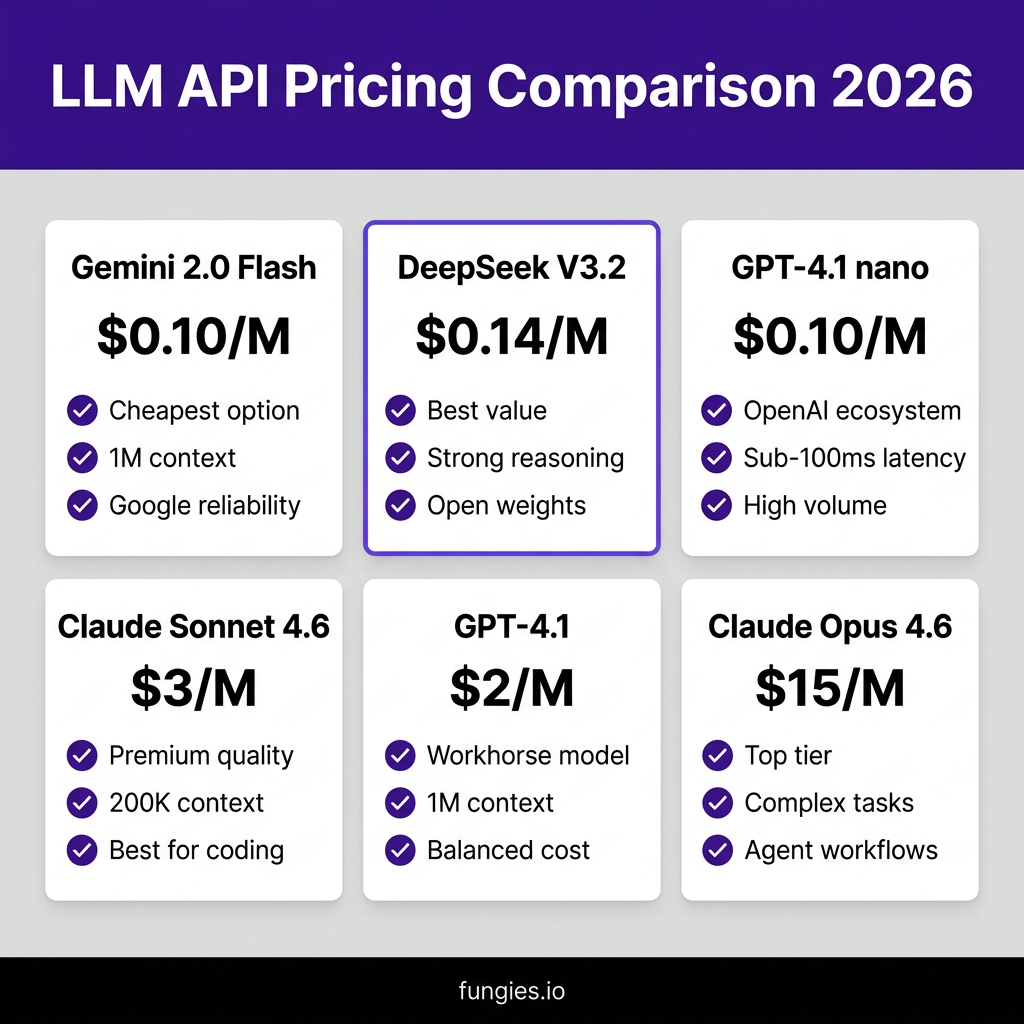
Gemini 2.0 Flash ($0.10/$0.40) — Google’s entry-level workhorse. It’s the cheapest option from a major provider and surprisingly capable for basic tasks. The 1M token context window is unmatched at this price point. Best for: high-volume text processing, document summarization, and applications where latency matters more than nuance.
DeepSeek V3.2 ($0.14/$0.28) — The open-weight disruptor. DeepSeek has become the go-to for teams building on open models. At $0.14 input, it undercuts most competitors while delivering reasoning capabilities that rival models costing 10x more. Best for: cost-conscious startups, self-hosted deployments, and applications requiring strong reasoning without premium pricing.
GPT-4.1 nano ($0.10/$0.40) — OpenAI’s answer to the budget tier. Built for sub-100ms latency and high-volume workloads. If you’re already in the OpenAI ecosystem and need to process millions of tokens cheaply, this is your model. Best for: real-time applications, high-throughput processing, and OpenAI-native stacks.
Mid-Tier: $0.40 to $3 per 1M Tokens
GPT-4.1 mini ($0.40/$1.60) — The sweet spot for many applications. Cuts cost by 80% compared to GPT-4.1 with surprisingly small quality tradeoffs on structured tasks. If you’re building a production application and don’t need the absolute best reasoning, start here. Best for: production APIs, structured data extraction, and most business applications.
Claude Haiku 3.5 ($0.80/$4.00) — Anthropic’s budget option. While pricier than OpenAI’s mini models, Haiku excels at following complex instructions and maintaining context over longer conversations. Best for: customer support bots, multi-turn conversations, and applications requiring consistent personality.
GPT-4.1 ($2.00/$8.00) — OpenAI’s current workhorse. The 1M context window and strong performance across benchmarks make this the default choice for serious applications. It replaced GPT-4o as the recommended model for most use cases in April 2026. Best for: general-purpose AI applications, coding assistance, and complex document analysis.
Premium Tier: $3+ per 1M Tokens
Claude Sonnet 4.6 ($3.00/$15.00) — The developer favorite. Sonnet consistently ranks highest in coding benchmarks and developer satisfaction surveys. If you’re building AI coding tools or need precise technical output, this is worth the premium. Best for: code generation, technical documentation, and software development workflows.
Claude Opus 4.6 ($15.00/$75.00) — The flagship model. Now with 1M context window (as of April 2026), Opus handles the most complex reasoning tasks, multi-step agent workflows, and research-grade analysis. The price is steep, but for tasks where accuracy is critical, it’s unmatched. Best for: research, complex agent systems, and high-stakes decision support.
How to Choose the Right LLM for Your Use Case
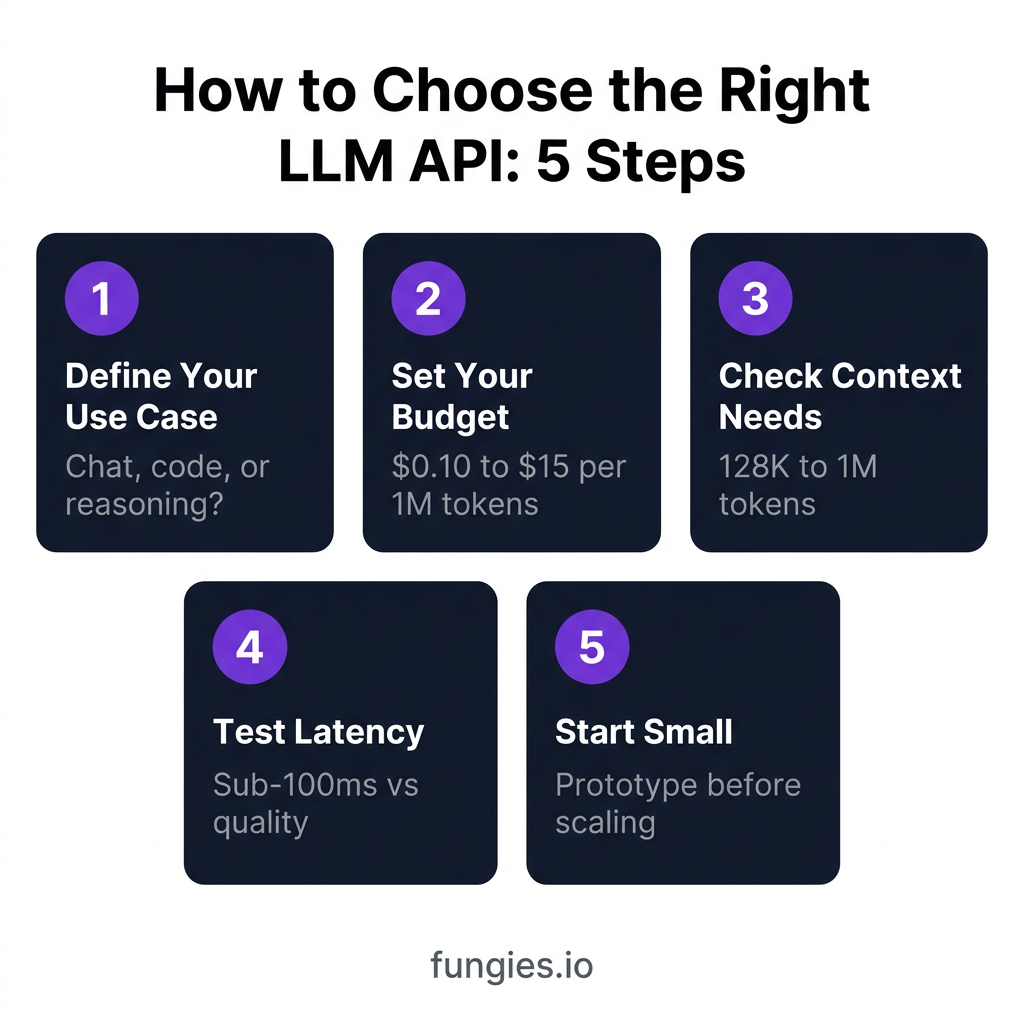
Picking a model isn’t just about finding the lowest price. Here’s a framework for making the right choice:
Step 1: Define Your Primary Use Case
Different models excel at different tasks:
- Simple chat/Q&A: Gemini 2.0 Flash or GPT-4.1 nano
- Coding assistance: Claude Sonnet 4.6 or GPT-4.1
- Content generation: GPT-4.1 or Claude Sonnet 4.6
- Document analysis (long context): Gemini 2.5 Pro or GPT-4.1
- Complex reasoning/research: Claude Opus 4.6 or o3
- High-volume processing: DeepSeek V3.2 or Gemini 2.0 Flash
Step 2: Calculate Your Budget
Estimate your monthly token usage. A typical SaaS application might process:
- Small app (1K users): 10-50M tokens/month = $1-40 on budget tier, $20-150 on mid-tier
- Medium app (10K users): 100-500M tokens/month = $10-400 on budget tier, $200-1,500 on mid-tier
- Large app (100K users): 1B+ tokens/month = $100+ on budget tier, $2,000+ on mid-tier
Remember: output tokens typically cost 4-5x more than input tokens. If your application generates long responses, factor this into your calculations.
Step 3: Consider Context Window Requirements
Context window determines how much text the model can process at once:
- 32K (Mistral Small): ~24,000 words — fine for most chat applications
- 128K (GPT-4o, Mistral Large): ~96,000 words — handles long documents
- 200K (Claude models, o3): ~150,000 words — entire codebases, research papers
- 1M (Gemini 2.5, GPT-4.1, Llama 4 Scout): ~750,000 words — books, massive codebases
- 10M (Llama 4 Scout): ~7,500,000 words — entire libraries
Step 4: Test Latency Requirements
If your application needs real-time responses (like autocomplete or live chat), test the latency of your chosen model. Smaller models (nano, Flash, mini) typically respond in under 100ms, while larger models (Opus, o3) can take several seconds for complex queries.
Step 5: Start with a Hybrid Approach
Most successful AI applications in 2026 use multiple models:
- Route simple queries to cheap models (Gemini Flash, GPT-4.1 nano)
- Send complex tasks to premium models (Claude Sonnet, GPT-4.1)
- Use reasoning models sparingly (o3, Claude Opus) for high-value tasks only
This approach can reduce costs by 60-80% while maintaining quality where it matters.
Hidden Costs to Watch Out For
The per-token price is just the start. Here are additional cost factors:
- Context caching: Some providers charge for cached context. Anthropic offers 90% discounts on cached tokens, while OpenAI’s caching is automatic but less predictable.
- Batch processing: OpenAI offers 50% discounts for batch API calls with 24-hour turnaround. Great for non-real-time workloads.
- Volume discounts: Most providers offer enterprise pricing at scale. If you’re spending $10K+/month, negotiate.
- Free tiers: Google Gemini offers generous free tiers (often 1,500 requests/day). Great for prototyping.
Key Takeaways
The LLM pricing landscape in 2026 offers something for every budget:
- Ultra-budget: Gemini 2.0 Flash and GPT-4.1 nano at $0.10/M for high-volume, simple tasks
- Best value: DeepSeek V3.2 at $0.14/M for open-weight, strong reasoning
- Production default: GPT-4.1 at $2/M for balanced cost and capability
- Developer favorite: Claude Sonnet 4.6 at $3/M for coding and technical tasks
- Premium: Claude Opus 4.6 at $15/M for maximum capability when cost is secondary
The 12x price reduction since 2023 means AI is now accessible to virtually any developer. The challenge isn’t whether you can afford AI — it’s choosing the right model for your specific needs.
FAQ
What is the cheapest LLM API in 2026?
Gemini 2.0 Flash, GPT-4.1 nano, Llama 4 Scout, and Mistral Small all cost $0.10 per million input tokens. For pure price-to-performance, DeepSeek V3.2 at $0.14/M offers the best reasoning capabilities at near-budget pricing.
Is Claude worth the premium over GPT-4.1?
For coding and technical tasks, yes — Claude Sonnet 4.6 consistently outperforms GPT-4.1 in developer benchmarks and satisfaction surveys. For general-purpose applications, GPT-4.1 offers better value at two-thirds the price.
Can I use multiple LLM providers in one application?
Absolutely. Many production applications use model routing to send simple queries to cheap models and complex tasks to premium ones. This hybrid approach can cut costs by 60-80%.
What is context window and why does it matter?
Context window is how much text a model can process in a single request. Larger windows (1M+ tokens) let you analyze entire documents, codebases, or books without chunking. Smaller windows (32K-128K) are fine for most chat and Q&A applications.
Are there free LLM API options?
Yes. Google Gemini offers generous free tiers (typically 1,500 requests/day). OpenAI provides $5 in free credits for new accounts. These are perfect for prototyping and small applications.
Conclusion
LLM API pricing in 2026 offers unprecedented choice. Whether you’re building a side project on a $10/month budget or scaling a production application processing billions of tokens, there’s a model that fits your needs.
The key is matching your use case to the right price tier. Start with budget models for simple tasks, upgrade to mid-tier for production applications, and reserve premium models for the tasks where quality truly matters.
And if you’re building a SaaS application that processes payments, check out Fungies.io — we handle the payment infrastructure so you can focus on building great AI features.