Here’s a sobering statistic: over 90% of customers believe companies could do better when it comes to onboarding new users. Even more alarming? More than 50% of SaaS churn can be directly traced back to a poor onboarding experience. If you’re bleeding users in their first week, it doesn’t matter how brilliant your product is — you’re fighting an uphill battle.
The right onboarding tool doesn’t just guide users through your interface. It accelerates time-to-value, reduces early churn, and turns trial users into paying customers. In my experience running growth for multiple SaaS products, I’ve seen onboarding optimization deliver a 29% increase in activation rates — often with just copy and flow changes.
What Is SaaS Onboarding Software?
SaaS onboarding tools are platforms that help you guide new users from signup to their first “aha!” moment — that magical instant when they truly grasp your product’s value. These tools typically include:
- Product tours and walkthroughs — Interactive guides that highlight key features
- Tooltips and hotspots — Contextual hints that appear when users need them
- Checklists and progress bars — Visual indicators of setup completion
- In-app messaging — Announcements, surveys, and feedback collection
- User analytics — Data on where users drop off and what drives activation
Honestly, the difference between a tool that “has onboarding features” and one that’s actually effective often comes down to segmentation capabilities. Can you show different experiences to different user personas? That’s where the real magic happens.
Why Onboarding Matters More Than Ever in 2026
The average SaaS company loses 3-7% of its customers every month. Do the math: a 5% monthly churn rate means you’re losing nearly half your customer base annually. You’d have to run just to stay in place.
But here’s what most founders miss: the majority of churn happens in the first 90 days. Users who don’t experience value quickly rarely stick around to discover your product’s deeper capabilities. According to the 2025 Recurly Churn Report, median B2B SaaS annual churn sits at 3.5% — but early-stage companies often see rates twice that high.
The companies winning in 2026 aren’t just acquiring users efficiently. They’re obsessed with getting those users to their retention point — the specific moment when they experience your product’s core value for the first time.
10 Best SaaS Onboarding Tools for 2026
I’ve evaluated dozens of onboarding platforms across three key dimensions: ease of setup, depth of customization, and quality of analytics. Here are the ten that consistently deliver results for SaaS teams.
1. Appcues — Best for Cross-Channel Engagement
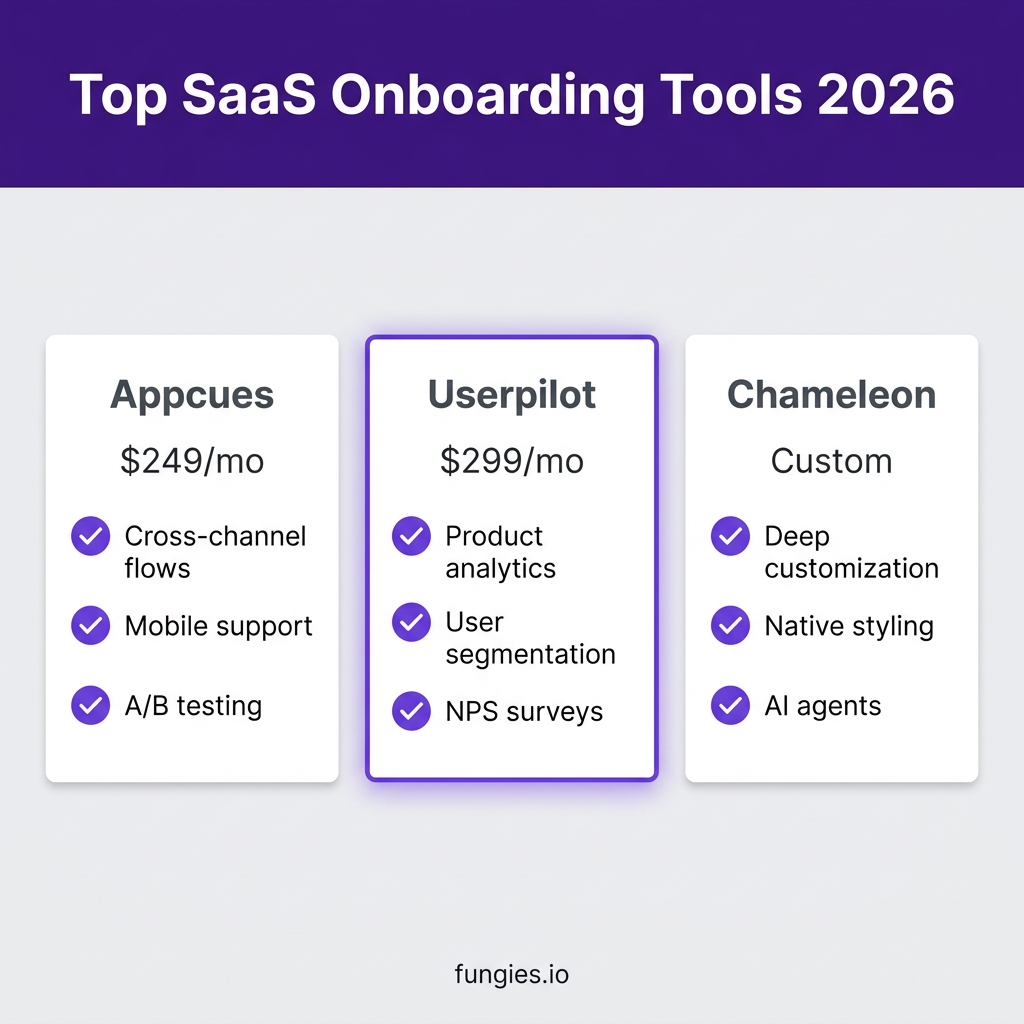
Appcues has evolved from a simple product tour tool into a full cross-channel engagement platform. What sets it apart is the ability to orchestrate onboarding experiences across in-app, email, and push notifications — all triggered by user behavior.
Key features:
- No-code flow builder with 30+ templates
- Mobile SDK for iOS and Android onboarding
- A/B testing for onboarding experiments
- Behavioral targeting and segmentation
- Integration with 50+ tools including Salesforce and HubSpot
Pricing: Essentials starts at $249/month for up to 2,500 MAU and 3 team seats. Growth tier at $879/month adds advanced analytics and more seats.
Best for: Mid-market SaaS companies that need to coordinate onboarding across multiple touchpoints and want mobile support out of the box.
2. Userpilot — Best for Product-Led Growth
Userpilot has carved out a strong position as the go-to choice for product-led growth teams. The platform combines onboarding flows with robust product analytics, giving you a complete picture of the user journey.
Key features:
- Contextual in-app experiences based on user behavior
- Built-in product analytics and user segmentation
- NPS and CSAT survey tools
- Feature adoption tracking
- Resource center for self-service support
Pricing: Starter plan at $299/month includes 2,000 MAU and 5 team seats. Growth and Enterprise tiers add more MAUs and advanced features.
Best for: PLG-focused SaaS companies that want onboarding and analytics in a single platform without engineering dependencies.
3. Chameleon — Best for Customization
If you care deeply about your product’s look and feel, Chameleon is worth a serious look. It offers the deepest customization options of any onboarding tool I’ve tested — your tours and tooltips can look completely native to your app.
Key features:
- Advanced styling and CSS customization
- Embedded banners, cards, and micro-surveys
- AI-powered onboarding agents
- Demo creation for sales teams
- Sophisticated targeting and branching logic
Pricing: Custom pricing based on MAU and feature needs. Generally competitive with Appcues at lower tiers.
Best for: Design-conscious teams who want onboarding that feels like a natural extension of their product, not a third-party add-on.
4. Product Fruits — Best Value for Startups
Product Fruits has gained serious traction by offering an all-in-one onboarding platform at a price point that won’t crush early-stage budgets. It combines tours, surveys, and announcements in a clean, intuitive interface.
Key features:
- No-code editor with event-based triggers
- AI-generated copy for onboarding flows
- Knowledge base and help center builder
- Privacy-first data handling
- Support assistant capable of handling 50%+ of user requests
Pricing: Significantly more affordable than competitors. Free tier available; paid plans start well below $200/month.
Best for: Startups and small teams who need comprehensive onboarding capabilities without enterprise pricing.
5. UserGuiding — Best for AI Self-Help
UserGuiding has shifted aggressively into AI-powered onboarding. Their 2025 platform includes support assistants and copilots that can handle the majority of user questions without human intervention.
Key features:
- AI-generated onboarding tours and hints
- Self-service support assistants
- Interactive product walkthroughs
- User feedback collection and NPS
- Analytics dashboard with drop-off tracking
Pricing: Among the most affordable options. Plans start under $100/month for smaller MAU volumes.
Best for: Teams looking to reduce support ticket volume through AI-powered self-service onboarding.
6. Pendo — Best for Enterprise
Pendo is the heavyweight in this space, serving some of the largest SaaS companies in the world. It’s not just an onboarding tool — it’s a complete product experience platform with analytics, roadmapping, and user feedback.
Key features:
- Comprehensive product analytics
- In-app guides and walkthroughs
- Product roadmap and planning tools
- User feedback and sentiment analysis
- Mobile and web support
Pricing: Enterprise-focused with custom pricing. Expect to pay significantly more than specialized onboarding tools.
Best for: Large enterprises that need onboarding as part of a broader product experience platform.
7. WalkMe — Best for Complex Workflows
WalkMe pioneered the digital adoption platform category. It’s particularly strong for complex enterprise software where users need guidance through multi-step processes.
Key features:
- AI-powered workflow automation
- Deep system integration capabilities
- Advanced analytics and user insights
- Desktop and mobile application support
- Extensive enterprise security features
Pricing: Enterprise pricing. Typically requires annual contracts starting in the five-figure range.
Best for: Large organizations with complex internal software that requires detailed user guidance and workflow automation.
8. Whatfix — Best for Employee Training
Whatfix has found its niche in employee onboarding and training. While it works for customer onboarding, its sweet spot is helping companies train employees on internal tools and processes.
Key features:
- Interactive walkthroughs and simulations
- Learning management system integrations
- Content creation and management tools
- Analytics on training effectiveness
- Multi-format content export (PDF, video, etc.)
Pricing: Mid-to-enterprise range with custom pricing based on use case.
Best for: Companies focused on employee onboarding and internal tool adoption rather than customer-facing onboarding.
9. Intercom — Best for Conversational Onboarding
Intercom’s onboarding capabilities are built around conversational messaging. If you believe the best onboarding happens through dialogue rather than guided tours, Intercom is worth considering.
Key features:
- Proactive messaging based on user behavior
- Chatbots for automated onboarding assistance
- Product tours integrated with messaging
- Help center and knowledge base
- Powerful customer data platform
Pricing: Starts around $74/month for basic messaging; onboarding features require higher tiers.
Best for: Teams that want to combine onboarding with ongoing customer communication in a single platform.
10. Stonly — Best for Interactive Guides
Stonly takes a different approach to onboarding with its interactive, choose-your-own-adventure style guides. Users can navigate through branching paths based on their specific needs.
Key features:
- Branching logic for personalized paths
- Embeddable widgets and standalone pages
- No-code guide builder
- Analytics on guide completion
- Integration with help centers
Pricing: Mid-range pricing with plans starting around $200/month.
Best for: SaaS products with multiple use cases or user personas that need different onboarding paths.
Comparison Table: Top SaaS Onboarding Tools
| Tool | Best For | Starting Price | Mobile Support | AI Features |
|---|---|---|---|---|
| Appcues | Cross-channel engagement | $249/mo | Yes | Limited |
| Userpilot | Product-led growth | $299/mo | No | Moderate |
| Chameleon | Deep customization | Custom | No | Advanced |
| Product Fruits | Value for startups | <$200/mo | No | Advanced |
| UserGuiding | AI self-help | <$100/mo | No | Advanced |
| Pendo | Enterprise | Custom | Yes | Moderate |
| WalkMe | Complex workflows | Enterprise | Yes | Advanced |
| Whatfix | Employee training | Custom | Yes | Limited |
| Intercom | Conversational onboarding | $74/mo | Yes | Moderate |
| Stonly | Interactive guides | $200/mo | No | Limited |
How to Choose the Right Onboarding Tool
With so many options, how do you pick the right one? Here’s my framework:
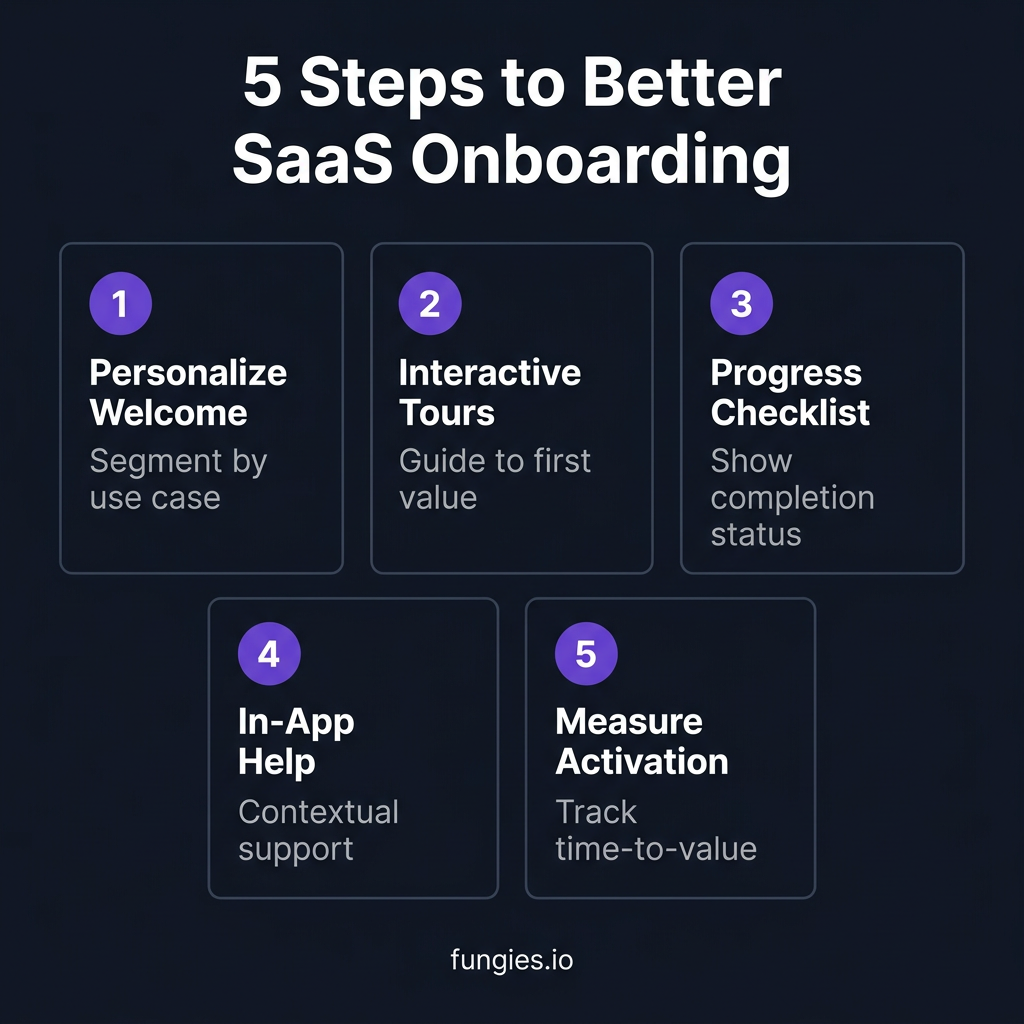
1. Define your activation metric first. Before evaluating tools, know what “success” looks like for a new user. Is it completing a project? Inviting a teammate? Making a payment? Your onboarding tool should help users reach that specific milestone.
2. Consider your team’s technical resources. Some tools require significant engineering time to implement properly. Others are truly no-code. Be honest about what your team can support.
3. Think about the full user journey. Onboarding doesn’t end after day one. Do you need a tool that can also handle feature announcements, re-engagement campaigns, and ongoing education?
4. Don’t ignore analytics. The best onboarding tool is the one that tells you where users are dropping off. If you can’t measure it, you can’t improve it.
Onboarding Best Practices for 2026
Having the right tool is only half the battle. Here are the practices I’ve seen drive real results:
Personalize based on use case. One-size-fits-all onboarding is dead. Segment users by their role, company size, or stated goals, then customize their experience accordingly.
Focus on time-to-value, not feature coverage. Your onboarding shouldn’t teach users every feature. It should get them to their first win as quickly as possible. Everything else can come later.
Use progress indicators. Checklists and progress bars tap into our natural desire for completion. Users who see they’re 70% through setup are more likely to finish than those who don’t know where they stand.
Offer an escape hatch. Some users want to explore on their own. Always provide a clear way to skip or exit guided tours without penalty.
Measure and iterate. Your first onboarding flow won’t be perfect. Set up analytics, identify drop-off points, and continuously test improvements.
FAQ: SaaS Onboarding Tools
What’s the average cost of SaaS onboarding software?
For most SaaS companies, expect to pay between $100-$300 per month for a quality onboarding tool. Enterprise solutions like WalkMe or Pendo can run into thousands monthly. Budget options like UserGuiding start under $100.
Can I build onboarding without a dedicated tool?
Technically yes — you can build custom onboarding flows with your own code. But in my experience, the engineering time and maintenance burden almost always outweigh the cost of a dedicated tool. Plus, you miss out on the analytics and optimization features.
How long should SaaS onboarding take?
The best onboarding gets users to value in under 5 minutes. That doesn’t mean teaching them everything — it means getting them to their first “aha!” moment. Complex B2B products might need longer, but every additional minute increases drop-off risk.
What’s more important: onboarding or customer success?
They’re different stages of the same journey. Onboarding gets users to their first value; customer success ensures they keep getting value over time. You need both, but if I had to choose, I’d fix onboarding first — you can’t retain customers who never activate.
Do AI features in onboarding tools actually work?
In 2026, yes — but with caveats. AI is excellent for generating copy, creating self-service support, and personalizing experiences. It’s not a replacement for thoughtful UX design. The best implementations use AI to augment, not replace, human-crafted onboarding flows.
Conclusion: Invest in Onboarding, Reduce Churn
Here’s the bottom line: you’re probably losing half your potential revenue to bad onboarding. The tools in this list can help you fix that. But tools alone won’t save you — you need a genuine commitment to understanding your users and guiding them to value.
Start with your activation metric. Map the shortest path to that moment. Then choose a tool that helps you guide users along that path. Measure everything. Iterate constantly.
And if you’re building a SaaS that handles payments, checkout, or subscription billing, check out Fungies.io. We handle the complex stuff — global tax compliance, payment methods, and checkout optimization — so you can focus on building an onboarding experience that converts.