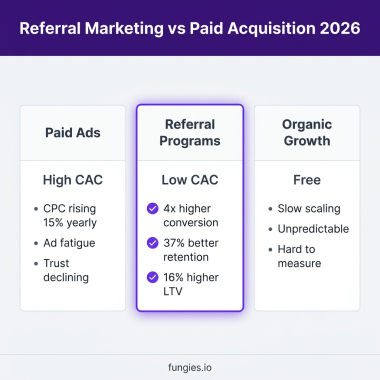
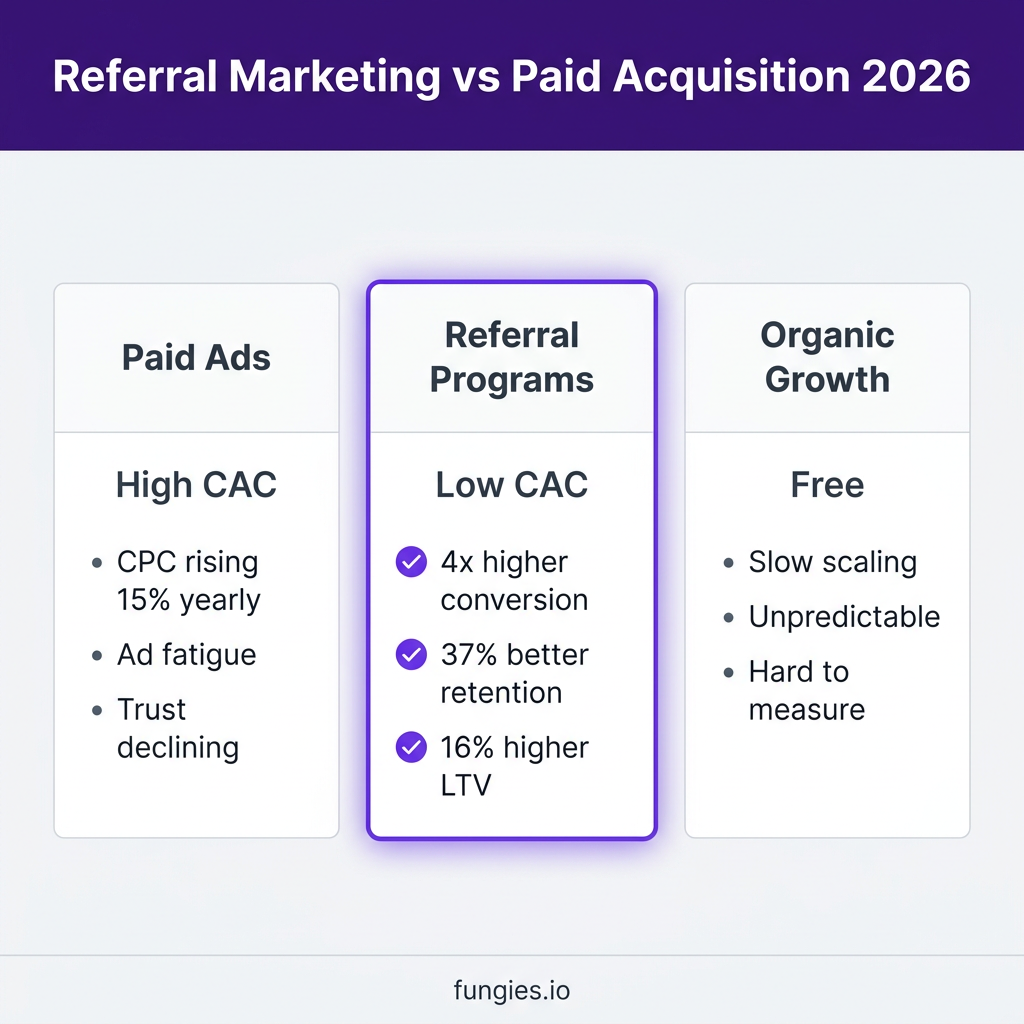
Here’s a stat that’ll make you rethink your entire acquisition strategy: referred customers convert 4x better than leads from paid channels, stick around 37% longer, and generate 16% higher lifetime value. And yet, most SaaS founders I talk to are dumping 80% of their budget into Facebook and Google ads while treating referrals as an afterthought.
That disconnect is costing you. In 2026, with CAC climbing 15% year-over-year across every major ad platform, referral programs aren’t just nice to have — they’re survival infrastructure. Dropbox proved this back in 2008 when their simple double-sided referral program drove 3,900% growth in 15 months, taking them from 100,000 to 4 million users.
What Is a SaaS Referral Program (And Why It Works)
A referral program is a structured system that incentivizes existing customers to recommend your product to their network. Unlike organic word-of-mouth, which happens randomly, referral programs engineer virality by making sharing easy, trackable, and rewarding.
The mechanics are simple: a current user shares a unique referral link, a new customer signs up through that link, and one or both parties get a reward. But the psychology behind why this works is what makes it powerful.
People trust recommendations from friends 4x more than advertising. When someone vouches for your product, they’re transferring their social capital to you. That trust shortcut eliminates the skepticism that kills most paid acquisition campaigns. Plus, referred users arrive pre-educated — they already know what your product does because their friend explained it.
The Numbers: Referral Program Benchmarks for 2026
Before building anything, you need to know what “good” looks like. Here are the benchmarks that matter:
| Metric | Median | Top Quartile |
|---|---|---|
| Referral Conversion Rate | 10-15% | 20%+ |
| Referral Rate (% of purchases) | 2-5% | 10%+ |
| Viral Coefficient (K-Factor) | 0.15-0.25 | 0.5+ |
| Referred Customer LTV Premium | +16% | +25% |
| Referred Customer Retention | +37% | +50% |
Your viral coefficient (K-factor) is the number of new users each existing user generates. Calculate it by multiplying invites per user by conversion rate. A K-factor above 1 means exponential growth — every user brings in more than one new user. In B2B SaaS, anything above 0.3 is solid. Dropbox hit 1.2 at their peak.
Types of SaaS Referral Programs
Not all referral programs work the same way. The right structure depends on your product, pricing, and customer base:
1. Customer Referral Programs
The classic model — existing users refer friends for rewards. Best for B2C and prosumer SaaS with low friction signups. Dropbox’s “give 500MB, get 500MB” is the canonical example. The reward was product-native (more storage), which kept costs low while increasing engagement.
2. Affiliate Programs
Partners promote your product to their audience for commission. Best for B2B SaaS with higher price points. Affiliates are typically content creators, consultants, or complementary tool vendors. Commission rates in SaaS range from 15-30% recurring.
3. Partner/Reseller Programs
Formal partnerships with agencies, consultants, or other SaaS companies. These involve deeper integration and often include co-marketing. Revenue shares are typically higher (20-40%) but so is the commitment.
4. Embedded “Powered By” Referrals
This is one of the most underrated tactics. Add a small “Powered by [Your Product]” badge to widgets, emails, or exports. Every viewer becomes a potential lead. Typeform and Calendly built massive user bases this way. The user embedding your tool gets credit for referrals.
How to Build Your SaaS Referral Program: Step-by-Step
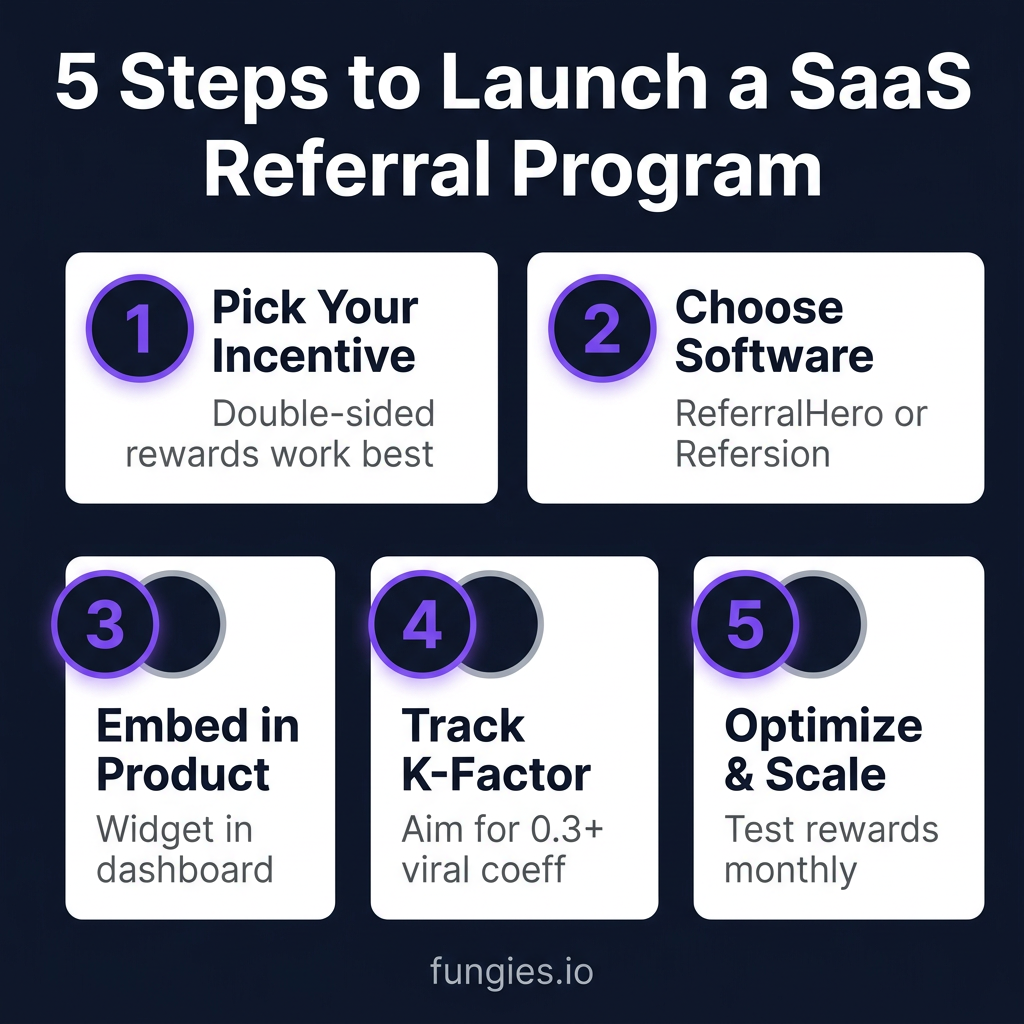
Step 1: Choose Your Incentive Structure
Double-sided incentives (both referrer and referee get rewarded) outperform single-sided by 78%. The reward should be:
- Product-native when possible — extra storage, credits, features, or usage
- Cash or account credit — for B2B with higher price points
- Recurring for SaaS — monthly discounts beat one-time rewards
Dropbox offered storage space because it cost them almost nothing (marginal cost of digital goods) while increasing product stickiness. Uber gave ride credits because it drove immediate usage. Match the reward to your product’s core value.
Step 2: Select Referral Software
You could build in-house, but don’t. The opportunity cost of engineering time exceeds the cost of proven tools. Here are the top options for SaaS:
| Tool | Best For | Pricing | Key Feature |
|---|---|---|---|
| ReferralHero | Startups | $49-$299/mo | Pre-built templates |
| ReferralRock | Mid-market | $200-$800/mo | Advanced tracking |
| Refersion | Ecommerce + SaaS | $99-$599/mo | Affiliate management |
| Friendbuy | Enterprise | $500+/mo | A/B testing |
| Viral Loops | Pre-launch | $35-$299/mo | Waitlist campaigns |
Step 3: Embed Referrals Into Your Product
The best referral programs don’t feel like separate features — they’re woven into the user journey. Place referral prompts at high-satisfaction moments:
- Right after a user completes a key action (exports a file, sends a campaign, closes a deal)
- In the account/settings area with a persistent referral dashboard
- During onboarding for power users who complete setup quickly
- Via email to engaged users (high login frequency, feature adoption)
Canva’s referral widget pops up right after you export a finished design. That’s a peak happiness moment — you’re proud of what you created and want to share it.
Step 4: Set Up Tracking and Measure K-Factor
You can’t improve what you don’t measure. Track these metrics from day one:
- Referral rate: % of customers who refer someone
- Referral conversion rate: % of referral link clicks that convert
- Viral coefficient (K-factor): invites per user × conversion rate
- Time to referral: how long until a new user refers someone
- Referred customer quality: activation rate, retention, LTV vs organic
Set up cohort analysis to compare referred users against other acquisition channels. If your referred users aren’t activating at the same rate, your incentive might be attracting the wrong audience.
Step 5: Test, Optimize, and Scale
Launch with a hypothesis, not a finished program. Test variables systematically:
- Reward values: Does $25 credit outperform 3 free months?
- Reward timing: Immediate vs. after referee pays?
- Messaging: “Give $20, Get $20” vs. “Earn $20 per friend”
- Placement: Dashboard widget vs. email vs. in-app modal
- Audience segments: Do power users refer differently than casual users?
Farm Hounds, a pet food brand, achieved a 22% referral rate through continuous optimization. Most SaaS companies see 2-5%. The gap isn’t luck — it’s iteration.
Real SaaS Referral Program Examples
Theory is nice, but execution is what matters. Here are programs you can learn from:
Dropbox: The 3,900% Growth Engine
Dropbox’s referral program is the gold standard. They offered 500MB of free storage to both referrer and referee, capped at 16GB. The reward was perfectly aligned with product value — more storage meant more usage, which meant more stickiness.
The program drove 2.8x more signups than their paid acquisition channels combined. Key insight: they embedded the referral flow everywhere — onboarding, settings, sharing dialogs. It wasn’t a separate page; it was part of using the product.
Notion: Credits for Workspace Growth
Notion gives users $5 in credit for every person they refer who signs up. The credit applies to future payments. This works because Notion’s freemium model means users hit paywalls as they scale — the credit directly reduces future friction.
Airtable: Referral Tiers
Airtable structured their program with escalating rewards. Refer 1 friend, get $10. Refer 5, get $50. Refer 10, get $120. This gamification encourages users to keep referring after their first success. The tiered structure increased their referral rate by 40% compared to flat rewards.
Slack: Team-Based Virality
Slack didn’t need a formal referral program because their product was inherently viral. Each new user invited their entire team. But they amplified this with a $100 credit program for referring new workspaces. The key: they made team creation the viral unit, not individual signups.
Common Referral Program Mistakes (And How to Avoid Them)
I’ve audited dozens of referral programs. These are the failure patterns I see most often:
Mistake 1: Launching Too Early
If your product isn’t delivering value yet, no incentive will drive referrals. Users won’t recommend something they don’t love. Wait until you have product-market fit and a cohort of engaged users before investing in referrals.
Mistake 2: Generic Rewards
Gift cards and cash work, but they’re expensive and don’t reinforce product usage. Product-native rewards (credits, features, storage) cost less and increase engagement. If you must use cash, tie it to product milestones.
Mistake 3: Hiding the Program
A buried “Refer a Friend” link in your footer won’t drive growth. Referral programs need visibility at high-intent moments. If users don’t know the program exists, they can’t use it.
Mistake 4: Ignoring Referred User Quality
Not all referrals are equal. If your incentive attracts users who churn immediately, you’re burning money. Track referred user activation and retention separately. If they’re underperforming, your reward might be attracting the wrong audience.
Mistake 5: Set-and-Forget Mindset
Referral programs need ongoing optimization. The first version won’t be optimal. You should be testing messaging, rewards, and placement quarterly. Companies that treat referrals as a growth channel (not a feature) see 3-5x better results.
FAQ: SaaS Referral Programs
What’s a good referral conversion rate for SaaS?
For B2B SaaS, a good referral conversion rate (visitor to signup) is 10-20%. Top-performing programs hit 25%+. If you’re below 10%, test your landing page, incentive clarity, and audience targeting.
How much should I spend on referral rewards?
Aim for 10-20% of your customer’s first-year value. If your average customer pays $100/month, a $120-240 reward (split between referrer and referee) is reasonable. Product-native rewards (credits, storage) let you be more generous since marginal costs are near zero.
When should I launch a referral program?
Launch after achieving product-market fit and having at least 100 engaged users. You need users who love your product enough to recommend it. Premature referral programs waste engineering resources and deliver poor results.
Should I choose one-sided or double-sided rewards?
Double-sided rewards are used in 78% of successful programs and consistently outperform one-sided offers. When both parties benefit, sharing feels less transactional and more like a gift. The referee is more likely to convert when they get something too.
How do I calculate my viral coefficient?
Multiply your average invites per user by your referral conversion rate. If each user sends 4 invites and 10% convert, your K-factor is 0.4. Anything above 0.3 is solid for B2B SaaS. Above 1.0 means exponential growth.
Bottom Line: Make Referrals Your Growth Engine
Referral programs aren’t a hack — they’re a fundamental growth channel that compounds over time. While paid acquisition gets more expensive as you scale, referrals get cheaper. Your CAC from referrals actually decreases as your user base grows.
The data is clear: referred customers convert better, stay longer, and spend more. In 2026, with ad costs climbing and privacy changes making targeting harder, referrals are one of the few channels that still work predictably.
Start small. Pick one incentive structure, embed it in your product at a high-satisfaction moment, and measure everything. Optimize monthly. Within six months, referrals could be driving 20-30% of your new customer acquisition — at a fraction of your paid CAC.
And if you’re building a SaaS that needs to accept payments globally, check out Fungies. We handle the Merchant of Record complexity — VAT, sales tax, compliance — so you can focus on growth channels like referrals that actually move the needle. Flat 5% + $0.50 per transaction. No monthly fees.
Sources
- Extole Referral Marketing Statistics 2026: https://www.extole.com/blog/referral-stats-to-know-in-2026
- Dropbox 3,900% Growth Case Study: https://getlaunchlist.com/blog/dropbox-referral-program-case-study
- ReferralCandy Benchmarks 2026: https://www.referralcandy.com/blog/referral-program-benchmarks-whats-a-good-conversion-rate-in-2025
- Otrenix Referral Conversion Rate Guide: https://otrenix.com/referral-conversion-rate
- SaaSquatch Dropbox Analysis: https://www.saasquatch.com/blog/dropbox-customer-referral-program-by-the-numbers
- Visible.vc K-Factor Guide: https://visible.vc/blog/k-factor-what-is-your-saas-companys-viral-coefficient
- ReferralCandy Referral Rates: https://www.referralcandy.com/blog/referral-rates
- Dansiepen SaaS Referral Strategies: https://www.dansiepen.io/growth-checklists/saas-referral-program-strategies-optimisations