The digital marketing landscape is undergoing its most dramatic transformation in decades. With global spending projected to reach $710 billion in 2026 and the overall market valued at $472.5 billion, businesses are navigating a complex ecosystem shaped by artificial intelligence, privacy regulations, and shifting consumer behaviors. This comprehensive analysis examines the data, trends, and strategies defining digital marketing in 2026.
Digital marketing has fundamentally reshaped how businesses connect with customers, replacing traditional broadcast approaches with targeted, measurable, and interactive communications. The industry now encompasses search engine optimization, social media marketing, content creation, email automation, paid advertising, and an ever-expanding array of specialized disciplines. As we move through 2026, the convergence of AI capabilities, privacy regulations, and evolving consumer expectations is creating both unprecedented opportunities and complex challenges for marketers worldwide.
This report synthesizes data from leading industry analysts, platform providers, and marketing technology companies to provide a comprehensive view of the digital marketing landscape. Whether you are a CMO allocating budget, a marketing manager developing strategy, or a business owner seeking to understand the competitive environment, the insights contained here will inform your decision-making and help you navigate this dynamic industry.

Market Overview: The $472.5 Billion Digital Marketing Ecosystem
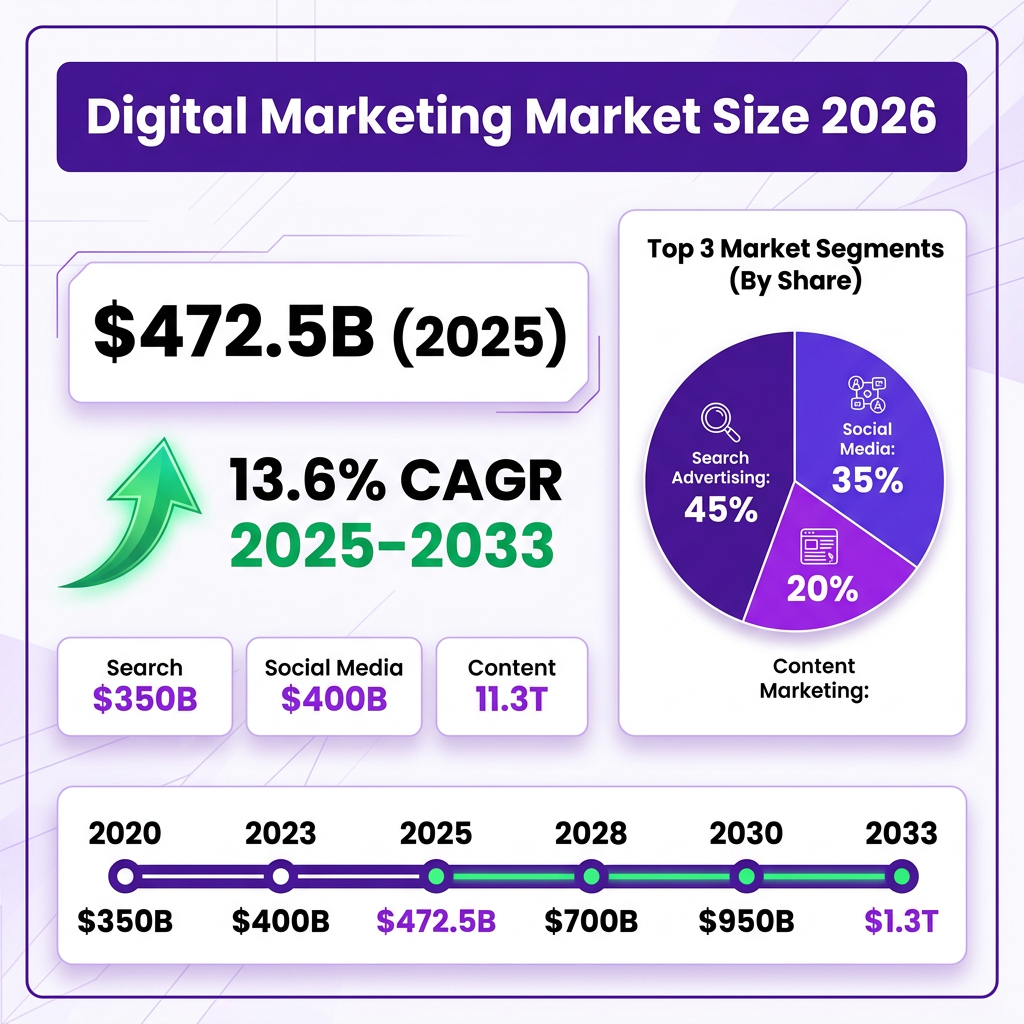
The global digital marketing market has evolved from a $350 billion industry in 2020 to a projected $472.5 billion powerhouse in 2025, with analysts forecasting it will exceed $1.3 trillion by 2033. This represents a compound annual growth rate (CAGR) of 13.6% through 2033, making digital marketing one of the fastest-growing sectors in the global economy.
The foundation of this growth rests on unprecedented internet penetration. According to Data Portal, approximately 5.35 billion people were using the internet in 2024, accounting for 66.2% of the global population. This massive connected audience has fundamentally transformed how businesses allocate marketing resources, with digital channels now commanding the majority of marketing budgets across industries.
North America continues to dominate the market, driven by high digital adoption rates and substantial enterprise investment in marketing technology. The United States alone accounts for over 80% of venture capital funding in marketing technology startups, creating a robust ecosystem of innovation. Asia-Pacific represents the fastest-growing region, with countries like China, India, and Southeast Asian markets experiencing explosive digital adoption among both consumers and businesses.
The digital marketing software segment specifically has emerged as a critical growth driver. Valued at $112.39 billion in 2025, this market is projected to reach $130.07 billion in 2026 before climbing to $492.18 billion by 2035, expanding at a 16.38% CAGR. This surge reflects enterprise investment in generative AI content engines, zero-party data collection frameworks, and embedded marketing modules within vertical SaaS platforms.
Small and medium enterprises (SMEs) are forecast to post the fastest growth in digital marketing software adoption at a 16.72% CAGR through 2035. This acceleration is fueled by self-serve onboarding capabilities and usage-based pricing models that democratize access to sophisticated marketing tools previously available only to enterprise customers.
The regional distribution of digital marketing spend reveals important insights for global strategy. North America accounts for approximately 35% of global digital ad spending, with the United States representing the world’s largest digital advertising market. Europe follows with roughly 25% of global spend, while Asia-Pacific captures 30% and continues growing rapidly. Latin America and Middle East/Africa represent emerging markets with significant growth potential as internet penetration increases and digital infrastructure improves.
Industry verticals show varying patterns of digital marketing investment. Retail and e-commerce lead in absolute spending, driven by the direct connection between digital marketing and online transactions. Financial services, technology, and healthcare follow, each with unique compliance requirements and customer journey characteristics that shape their marketing approaches. The B2B sector has accelerated digital transformation, with account-based marketing and demand generation becoming increasingly sophisticated.
Key Statistics and Data: Understanding the Numbers Behind Digital Marketing
Data-driven decision making has become the cornerstone of effective digital marketing. The following statistics reveal the scale, scope, and performance benchmarks that define the industry in 2026.
Market Size and Growth Metrics
The global digital advertising industry is projected to reach $1.16 trillion by 2030, with a CAGR of 15.4% from 2025 to 2030. Digital display advertising, search advertising, and social media advertising represent the three largest segments, collectively accounting for over 70% of total digital ad spend.
Content marketing has emerged as a dominant force, with the industry projected to reach $564.8 billion in 2025. This reflects continued surge in demand for digital content across formats, from blog posts and whitepapers to interactive tools and video content. Businesses are increasingly recognizing that content serves as the foundation for SEO, social media, and email marketing efforts.
The generative AI market for marketing applications has reached $91.57 billion, with companies reporting 62% faster content production when leveraging AI tools. This efficiency gain is driving widespread adoption, with 78% of organizations now using AI across business functions, including marketing operations.
Return on Investment Benchmarks
On average, businesses earn $5 for every $1 spent on digital marketing, demonstrating the channel’s exceptional efficiency compared to traditional marketing methods. Email marketing continues to deliver the highest ROI, yielding approximately 4000% return—meaning every dollar invested generates $40 in revenue.
Companies implementing AI marketing tools report 20-30% higher campaign ROI compared to traditional manual methods. Advertisers using Meta’s Advantage placements see a 4% higher click-through rate and a 3.8% lift in conversions compared to standard manual setups.
Paid search conversion rates above 3.5% signal strong performance in most industries, though this threshold varies significantly for B2B technology or legal services where longer sales cycles affect conversion timing. Email open rates range from 15-25% overall, with B2B campaigns typically achieving 18-22% when properly segmented.
Consumer Behavior and Engagement Statistics
Over 55% of consumers now prefer personalized AI-generated videos over generic content, signaling a shift toward dynamic, customized marketing experiences. Voice search has reached 20.5% global usage with 157.1 million U.S. users, requiring marketers to optimize for conversational queries.
Social media platforms continue to dominate attention, with Instagram being the most popular platform among marketers (70% usage) and also the most-cited platform for ROI. However, TikTok is the channel most marketers plan to increase investment in for 2026, reflecting the platform’s growing influence, particularly among younger demographics.
Short-form video has become the top media format marketers plan to invest in for 2026, with Instagram Reels generating 2.25x more reach than other content formats and accounting for over 50% of ad inventory on the platform. Blog posts remain among the top 5 content formats for investment, following short-form video, live video, long-form video, and user-generated content.
SEO and Organic Search Performance
Search Engine Optimization remains one of the most powerful drivers of long-term digital growth. Top organic search positions can achieve click-through rates up to 39.8%, though the introduction of AI Overviews has reduced this to 13-20% for queries where AI-generated summaries appear.
Organic search brings in users actively looking for solutions without relying on paid ads, making it a cost-effective channel for customer acquisition. However, the competitive landscape has intensified, with businesses requiring more sophisticated content strategies to achieve and maintain top rankings.
Email Marketing Performance Metrics
Email marketing continues to deliver exceptional returns, with 347.3 billion emails sent daily to 4.95 billion active social media users. Despite concerns about email fatigue, properly segmented and personalized campaigns achieve open rates of 18-22% in B2B contexts and 15-25% overall. Click-through rates average 2-5%, with triggered and behavioral emails performing significantly better than broadcast campaigns.
Marketing automation has transformed email from a periodic broadcast channel to a continuous engagement platform. Behavioral triggers—such as abandoned cart reminders, onboarding sequences, and re-engagement campaigns—generate 320% more revenue than non-automated emails. Advanced segmentation based on purchase history, engagement patterns, and demographic data enables personalization at scale.
Social Media Engagement Benchmarks
Social media engagement rates vary significantly by platform and content type. Instagram maintains the highest engagement rates among major platforms, particularly for Reels content which generates 2.25x more reach than static posts. TikTok’s algorithm favors content that generates immediate engagement, with videos that receive likes and comments within the first hour achieving significantly broader distribution.
LinkedIn has emerged as the dominant B2B social platform, with content related to industry insights and professional development achieving the highest engagement. Twitter/X remains valuable for real-time engagement and customer service, while Facebook continues to offer the most sophisticated advertising targeting capabilities despite declining organic reach.
Major Trends Shaping Digital Marketing in 2026
Seven transformative trends are reshaping how businesses approach digital marketing, requiring marketers to adapt strategies, tools, and skill sets to remain competitive.
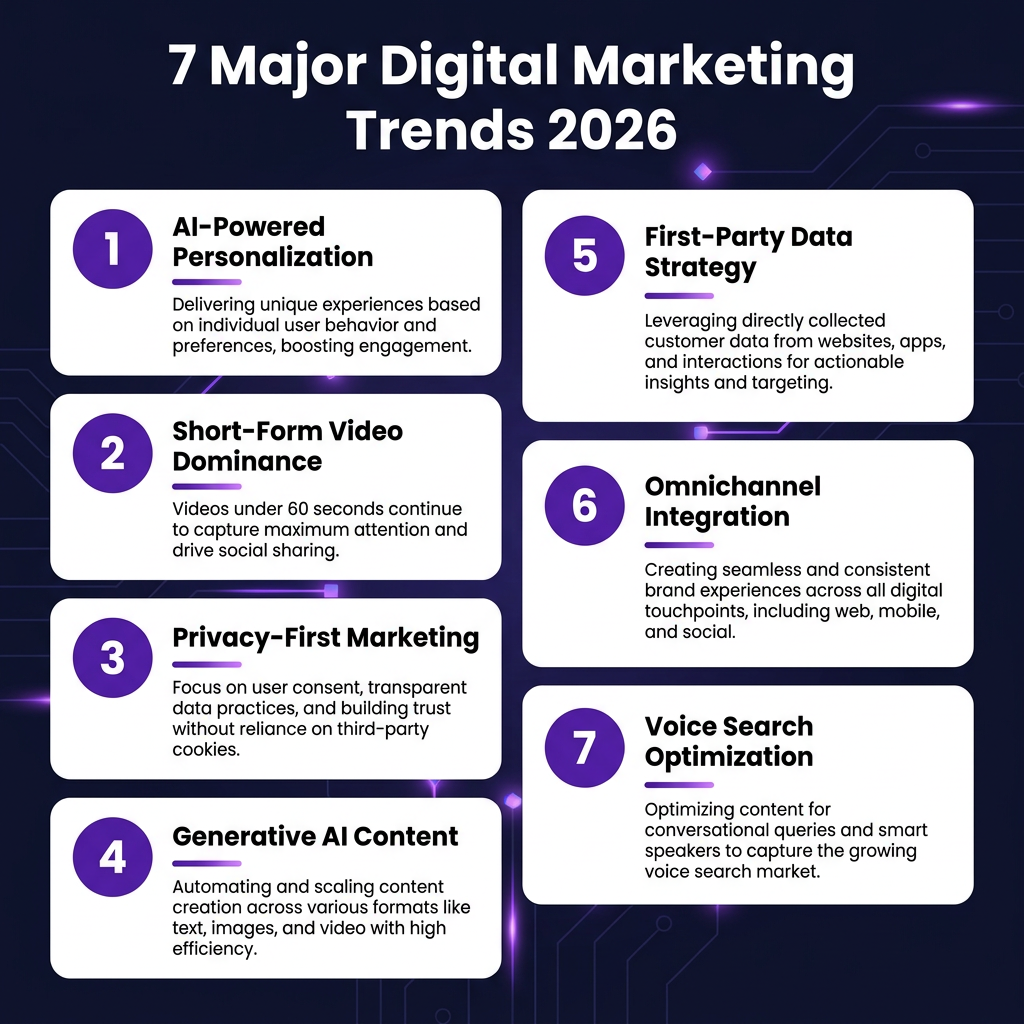
Trend 1: AI-Powered Personalization at Scale
Artificial intelligence has moved from experimental to essential in digital marketing. AI now analyzes subscriber data to predict intent, personalize content, and automate perfectly timed offers. This capability transforms each email address and user profile into a powerful, revenue-generating asset.
Hyper-personalization extends beyond basic demographic segmentation to behavioral prediction, content recommendation, and dynamic pricing. Platforms like Shopify and Dotdigital have integrated AI capabilities that enable even small businesses to deliver enterprise-level personalization without dedicated data science teams.
The rise of AI agents represents the next evolution, with autonomous systems capable of managing entire marketing workflows—from content creation to campaign optimization—without human intervention. This shift enables real-time marketing that responds to consumer behavior as it happens.
Trend 2: Short-Form Video Dominance
Short-form video has become the dominant content format across platforms. TikTok, Instagram Reels, and YouTube Shorts command disproportionate engagement compared to other content types. The format’s success stems from its alignment with diminishing attention spans and mobile-first consumption patterns.
Marketers are adapting by creating platform-native content rather than repurposing long-form videos. This requires understanding each platform’s unique culture, trends, and algorithmic preferences. Success in short-form video demands authenticity, trend awareness, and rapid production capabilities.
Live video maintains its position as a high-engagement format, particularly for product launches, behind-the-scenes content, and interactive Q&A sessions. The combination of scheduled live events and always-available short-form content creates a comprehensive video marketing strategy.
Trend 3: Privacy-First Marketing and First-Party Data
The deprecation of third-party cookies and increasing privacy regulations have fundamentally changed data collection practices. Marketers must now build direct relationships with consumers to obtain consent-based data, shifting from surveillance-based targeting to transparent value exchanges.
Zero-party data—information customers intentionally share—has become the gold standard for personalization. This includes preference centers, quizzes, surveys, and interactive content that provides value to users while collecting valuable insights for marketers.
Consent management has emerged as a critical competency, with businesses required to be transparent about data collection practices and obtain explicit permission. This regulatory environment favors brands that build trust through clear communication and respect for consumer privacy preferences.
Trend 4: Generative AI Content Production
Generative AI has become the content workhorse for marketing teams, enabling rapid production of blog posts, social media content, email campaigns, and visual assets. However, the most successful implementations use AI as an augmentation tool rather than a replacement for human creativity.
Content quality remains paramount as search engines and consumers become more sophisticated at identifying AI-generated material. The winning strategy combines AI efficiency with human editorial oversight, ensuring content maintains brand voice, factual accuracy, and genuine value.
Generative Engine Optimization (GEO) has emerged as a new discipline, focused on ensuring content appears in AI-generated summaries and recommendations. This requires structuring content for AI consumption while maintaining human readability.
Trend 5: The Return to Owned Channels
As platform algorithms become less predictable and advertising costs rise, marketers are rediscovering the value of owned channels. Email marketing, SMS, and branded communities provide direct access to audiences without algorithmic intermediaries or pay-to-play requirements.
Email remains one of the highest-ROI marketing channels, with modern campaigns using behavioral triggers like onboarding progress, purchase history, or engagement drops to send timely, personalized content. Advanced segmentation and automation have transformed email from a broadcast medium to a personalized conversation.
SMS marketing has matured, with businesses using text messaging for transactional updates, appointment reminders, and time-sensitive offers. The immediacy of SMS creates urgency that other channels cannot match, though overuse risks subscriber fatigue.
Trend 6: Omnichannel Integration and Attribution
Customers interact with brands across websites, social media, messaging apps, search engines, and video platforms—often within a single buying journey. Omnichannel marketing ensures consistent, personalized experiences across every touchpoint.
Measurement and attribution have become the top investment priority for 51% of marketers, reflecting the challenge of tracking customer journeys across fragmented channels. Advanced attribution models move beyond last-click to understand the full path to conversion.
Retail media networks have emerged as powerful advertising platforms, allowing every impression—whether on connected TV or digital out-of-home—to be tied directly to transaction data. This closed-loop measurement provides unprecedented insight into advertising effectiveness.
Trend 7: Voice Search and Conversational Marketing
With 20.5% global voice search usage and 157.1 million U.S. users, optimizing for conversational queries has become essential. Users now ask full questions instead of typing short keywords, requiring content that directly answers specific queries.
Conversation-based marketing is outperforming traditional “post and ghost” content strategies. Social platforms now prioritize shares, saves, replies, and DMs over likes, rewarding content that sparks genuine interaction.
Chatbots and conversational AI have evolved beyond simple FAQ responders to sophisticated sales and support agents. These tools handle complex queries, process transactions, and escalate to human agents when necessary, providing 24/7 customer engagement.
The integration of these seven trends creates a complex but coherent strategic framework for digital marketing in 2026. Successful marketers do not pursue trends in isolation but rather understand how AI personalization, video content, privacy compliance, and omnichannel integration work together to create superior customer experiences. Organizations that master this integration gain sustainable competitive advantage, while those that lag face increasing customer acquisition costs and declining engagement.
Looking ahead, these trends will continue evolving. AI capabilities will expand from automation to true intelligence, capable of strategic decision-making and creative generation. Video will become increasingly interactive and personalized, with AI-generated content tailored to individual viewers. Privacy regulations will likely expand globally, making first-party data strategies essential rather than optional. Marketers who invest in these capabilities now will be positioned to lead as the industry continues transforming.
Key Players and Competitive Landscape
The digital marketing ecosystem comprises technology platforms, agencies, and service providers competing across multiple segments. Understanding the competitive landscape helps businesses select the right partners and identify emerging opportunities.

Technology Platform Leaders
Adobe, Salesforce, Oracle, Microsoft, and SAP dominate the digital marketing software market, offering comprehensive suites that span content management, customer data platforms, marketing automation, and analytics. These enterprise platforms serve large organizations with complex, multi-channel marketing requirements.
HubSpot has established itself as the leader in inbound marketing and CRM for small to medium businesses, with its integrated platform serving over 194,000 customers globally. The company’s focus on education and content marketing has created a loyal user base and strong brand recognition.
Google and Meta remain the dominant advertising platforms, collectively capturing the majority of digital ad spend. Google Ads and Meta Ads Manager have become essential tools for performance marketers, though rising costs and privacy changes are driving diversification to platforms like TikTok, LinkedIn, and retail media networks.
Emerging Challengers
TikTok has emerged as a serious challenger to established social platforms, particularly for reaching younger demographics. The platform’s advertising business has grown rapidly, offering unique formats like Spark Ads and creative tools that leverage native content patterns.
Retail media networks from Amazon, Walmart, and Target have created new advertising inventory with closed-loop attribution. These platforms allow brands to reach shoppers at the point of purchase with measurable impact on sales.
AI-native marketing tools from companies like Jasper, Copy.ai, and Midjourney are disrupting content creation workflows. These specialized tools often integrate with larger platforms, providing best-of-breed capabilities for specific use cases.
Agency Landscape
The agency ecosystem spans full-service digital agencies, specialized boutiques, and AI-enabled service providers. Major players like WPP, Omnicom, and Publicis have invested heavily in data and technology capabilities to compete with consultancies and technology companies.
Specialized agencies focusing on specific channels (SEO, paid social, influencer marketing) or industries (SaaS, e-commerce, healthcare) have gained traction by offering deep expertise that generalist agencies cannot match. These boutiques often command premium pricing for their specialized knowledge.
AI-enabled agencies that leverage automation and machine learning to deliver services at scale represent a new category. These firms can offer competitive pricing while maintaining quality through technology leverage.
Competitive Dynamics and Market Consolidation
The digital marketing industry is experiencing significant consolidation as larger platforms acquire specialized capabilities. Adobe’s acquisition of Marketo, Salesforce’s purchase of Slack, and HubSpot’s continued expansion demonstrate the trend toward integrated platforms. This consolidation creates both opportunities and risks for marketers—opportunities in the form of more seamless workflows, risks in the form of vendor lock-in and reduced pricing competition.
Private equity investment in marketing technology has accelerated, with firms recognizing the recurring revenue potential of SaaS-based marketing tools. This investment fuels innovation but also creates pressure for rapid growth that can compromise product quality or customer service. Marketers selecting technology partners should consider not just current capabilities but the financial stability and strategic direction of vendors.
The rise of AI-native competitors poses a particular challenge to established players. New entrants without legacy codebases or customer bases to protect can move faster and price more aggressively. Incumbents respond by accelerating their own AI development and acquiring promising startups. This dynamic creates a rapidly evolving competitive landscape where today’s leaders may face disruption tomorrow.
Challenges and Pain Points
Despite the opportunities, digital marketing professionals face significant challenges that require strategic adaptation and investment.
Challenge 1: Trust Deficit in a Hyper-AI World
As AI-generated content proliferates, consumers are becoming increasingly skeptical of digital communications. The ease of creating convincing but potentially misleading content has eroded trust in online information sources.
Marketers must work harder to establish credibility through transparency, third-party validation, and consistent delivery of value. Trust has become the new currency in digital marketing, with brands that earn consumer confidence outperforming those that rely on aggressive promotion.
This challenge is particularly acute for newer brands without established reputations. Building trust requires sustained investment in content quality, customer experience, and community engagement—activities that may not show immediate ROI but create long-term competitive advantage.
Challenge 2: Measurement and Attribution Complexity
With 51% of marketers citing measurement and attribution as their top investment priority, the complexity of tracking customer journeys across fragmented channels has become a critical pain point. Privacy changes, platform restrictions, and the proliferation of touchpoints have made accurate attribution increasingly difficult.
Last-click attribution, once the industry standard, fails to capture the full customer journey. Multi-touch attribution models require sophisticated data infrastructure and analytical capabilities that many organizations lack.
The shift to first-party data requires rebuilding measurement frameworks around owned channels and consented data collection. This transition period creates gaps in historical comparability and requires new approaches to performance evaluation.
Challenge 3: Budget Constraints and ROI Pressure
Eighteen percent of marketers identify budgets and resources as their top challenge, reflecting the ongoing pressure to demonstrate marketing ROI in uncertain economic conditions. Marketing departments face scrutiny to justify every dollar spent while delivering growth.
This pressure drives investment in performance media (49% of marketers) and omnichannel media (39%), as these channels offer more direct measurability than brand-building activities. However, over-investment in performance marketing at the expense of brand building can create long-term challenges.
The challenge is compounded by rising advertising costs on major platforms. As competition intensifies, cost-per-acquisition increases, requiring either higher conversion rates or greater customer lifetime value to maintain profitability.
Challenge 4: Talent Shortage and Skills Gap
The rapid evolution of digital marketing has created a significant talent shortage, particularly in specialized areas like marketing analytics, marketing automation, and AI implementation. Organizations struggle to find professionals who combine technical skills with marketing acumen and creative judgment.
This skills gap drives up compensation for experienced digital marketers and creates opportunities for training and certification providers. However, formal education often lags behind industry practice, leaving employers to invest heavily in on-the-job training. The most successful organizations develop internal academies and knowledge-sharing programs to build capabilities systematically.
Remote work has expanded the talent pool geographically but also increased competition for top performers. Marketing professionals with proven track records can command premium compensation and flexible working arrangements. Organizations must invest in employer branding and employee experience to attract and retain the talent needed to execute sophisticated digital marketing strategies.
Challenge 5: Platform Dependency and Algorithm Changes
Digital marketers face ongoing uncertainty due to platform algorithm changes that can dramatically impact reach and performance overnight. Google’s search algorithm updates, Meta’s content distribution changes, and TikTok’s recommendation system modifications create constant volatility that requires agile response capabilities.
This platform dependency creates strategic risk for organizations that rely heavily on single channels. Diversification across owned, earned, and paid media reduces vulnerability but requires greater investment and coordination. The most resilient marketing strategies maintain strong owned channels while using paid platforms for amplification rather than primary distribution.
Opportunities and Growth Strategies
Within the challenges lie significant opportunities for businesses that adapt quickly and invest strategically.
Opportunity 1: AI-Driven Autonomous Marketing Operations
The integration of AI across marketing operations creates opportunities for unprecedented efficiency and effectiveness. Autonomous systems can manage routine campaign optimization, freeing human marketers to focus on strategy and creativity.
Businesses that successfully implement AI-driven personalization report 20-30% higher campaign ROI. The key is starting with specific use cases—such as email send-time optimization or dynamic creative selection—before expanding to more complex applications.
The rise of AI agents capable of managing entire workflows represents the next frontier. Early adopters who develop expertise in AI orchestration will gain significant competitive advantage as these capabilities mature.
Opportunity 2: First-Party Data as Competitive Moat
As third-party data becomes less available, businesses with robust first-party data strategies gain competitive advantage. Direct customer relationships provide richer insights and more reliable targeting than purchased data ever could.
Opportunities exist to create value exchanges that encourage data sharing—exclusive content, personalized experiences, loyalty rewards, and community access. Brands that make customers feel valued for their data rather than surveilled will build stronger relationships.
Zero-party data collection through interactive content, preference centers, and progressive profiling creates detailed customer understanding while respecting privacy preferences. This approach aligns regulatory compliance with marketing effectiveness.
Opportunity 3: Unified Revenue Intelligence Platforms
The shift from fragmented point solutions to unified revenue intelligence platforms creates opportunities for integrated marketing and sales operations. These platforms combine customer data, marketing automation, and sales enablement in single workspaces.
Businesses that consolidate their technology stacks around unified platforms gain clearer attribution, reduced data silos, and improved team alignment. The efficiency gains from integrated operations often justify the investment in platform migration.
For SaaS companies specifically, product-led growth strategies that integrate marketing into the product experience represent a significant opportunity. Free trials, freemium models, and in-product onboarding can drive acquisition more efficiently than traditional marketing channels.
Opportunity 4: Influencer and Creator Partnerships
The creator economy has matured into a legitimate marketing channel with measurable ROI. Micro-influencers (10,000-100,000 followers) often deliver higher engagement rates than celebrity influencers at significantly lower cost. Long-term partnerships with aligned creators build authentic advocacy that resonates with skeptical consumers.
Brands are shifting from transactional influencer campaigns to ongoing ambassador relationships. This approach generates consistent content, builds genuine product expertise among creators, and creates more credible recommendations. The key is selecting creators whose values align with the brand and whose audiences match target customer profiles.
Employee advocacy programs extend this approach to internal creators. Employees with strong personal brands can amplify corporate messaging while adding authentic human perspectives. Proper training and guidelines ensure consistent brand representation while allowing individual voice and creativity.
Opportunity 5: Sustainability and Purpose-Driven Marketing
Consumers increasingly expect brands to demonstrate social and environmental responsibility. Marketing that authentically communicates sustainability initiatives, ethical practices, and community impact resonates with values-driven purchase decisions. However, authenticity is critical—greenwashing and performative activism generate backlash that damages brand reputation.
Transparency in supply chains, carbon footprint reporting, and diversity initiatives provide substantive content for purpose-driven marketing. Brands that lead in these areas can differentiate in crowded markets and build deeper customer loyalty. The marketing opportunity follows genuine operational commitment rather than replacing it.
Case Studies and Success Stories
Real-world examples demonstrate how businesses are successfully navigating the digital marketing landscape and achieving measurable results.
Case Study 1: Entertainment Industry Campaign ROI
A major entertainment company launching a film release implemented a comprehensive digital marketing strategy combining social media advertising, influencer partnerships, and targeted email campaigns. With comprehensive tracking systems in place, the company achieved a 300% ROI within the first month of the film’s release.
The success factors included precise audience targeting based on viewing history and preferences, real-time optimization of ad spend across platforms, and integration of online promotion with offline activations. The campaign demonstrated the effectiveness of coordinated multi-channel marketing in the entertainment industry.
Case Study 2: B2B Technology Company Digital Transformation
A B2B technology company struggling with stagnant organic traffic partnered with a digital marketing agency to overhaul their content strategy and SEO approach. Through detailed keyword research, technical optimization, and consistent content production, the company achieved a 500% ROI within a year.
The transformation involved shifting from product-centric content to educational resources addressing customer pain points. By establishing thought leadership in their industry, the company attracted qualified leads at a fraction of the cost of paid advertising.
This case demonstrates the potential of B2B digital marketing when strategy aligns with buyer behavior. The long-term nature of B2B sales cycles requires patience, but the compounding returns from organic search provide sustainable competitive advantage.
Case Study 3: E-commerce Brand AI-Powered Personalization
An e-commerce brand implemented AI-powered personalization across their email marketing, website experience, and advertising. By analyzing customer behavior and preferences, the brand delivered personalized product recommendations and dynamic content.
The results included a 25% increase in email open rates, 40% improvement in click-through rates, and 15% lift in overall conversion rates. The personalization initiative paid for itself within three months through increased revenue per visitor.
This case illustrates how AI personalization can deliver measurable business results when implemented thoughtfully. The key was starting with high-impact use cases and gradually expanding the personalization program based on performance data.
Case Study 4: Retail Media Network Success
A consumer packaged goods brand shifted significant advertising budget from traditional digital channels to retail media networks, specifically Amazon Advertising and Walmart Connect. By targeting shoppers at the point of purchase with closed-loop attribution, the brand achieved 40% higher return on ad spend compared to traditional display advertising.
The success factors included leveraging first-party purchase data for targeting, optimizing creative based on shopping context, and measuring actual sales rather than proxy metrics. The closed-loop measurement provided clear visibility into which campaigns drove incremental sales, enabling continuous optimization.
This case demonstrates the power of retail media networks for brands with products available through major retailers. The ability to connect advertising directly to transactions eliminates attribution ambiguity and enables true performance marketing at scale.
Case Study 5: B2B Account-Based Marketing Transformation
An enterprise software company implemented an account-based marketing (ABM) strategy targeting 500 high-value prospects with personalized campaigns across multiple channels. By aligning sales and marketing around specific target accounts, the company increased average deal size by 35% and reduced sales cycle length by 20%.
The ABM program combined personalized direct mail, targeted digital advertising, customized content, and sales outreach coordinated through a unified platform. Intent data identified accounts showing active interest, triggering timely engagement from sales development representatives.
This case illustrates how ABM can transform B2B marketing from lead volume to account quality. While requiring significant investment in research and personalization, the approach delivers higher conversion rates and larger deal values that justify the additional effort and expense.
Future Outlook and Predictions
The digital marketing landscape will continue evolving rapidly through 2030 and beyond. Understanding emerging trends helps businesses prepare for future challenges and opportunities.
2026-2030 Market Projections
The digital marketing market is projected to grow from $472.5 billion in 2025 to $1.3 trillion by 2033, representing a CAGR of 13.6%. This growth will be driven by continued digital transformation, emerging market expansion, and new technology adoption.
By 2030, AI will be deeply integrated into all aspects of marketing operations, from strategy development to creative production to performance optimization. Marketing teams will operate as orchestrators of AI systems rather than executors of manual tasks.
The distinction between online and offline marketing will continue blurring as connected devices proliferate. Digital out-of-home, connected TV, and Internet of Things devices will create new touchpoints requiring integrated measurement and optimization.
Technology Evolution
Generative AI capabilities will expand beyond text to include video production, interactive experiences, and predictive modeling. Marketing content will increasingly be created, personalized, and optimized by AI systems working with minimal human intervention.
Voice and visual search will capture increasing share of queries, requiring optimization strategies beyond traditional text-based SEO. Brands will need to ensure their content is discoverable through multiple modalities.
Privacy-preserving technologies like federated learning and differential privacy will enable personalization without compromising individual privacy. These approaches will become essential as regulatory requirements tighten globally.
Skills and Organizational Evolution
The marketing profession will require new skill sets combining technical fluency, data literacy, and creative judgment. Marketers will need to understand AI capabilities, data infrastructure, and privacy regulations while maintaining the human insight that drives effective communication.
Marketing organizations will become more integrated with product, sales, and customer success functions. The traditional silos between these disciplines will dissolve as customer experience becomes the primary competitive differentiator.
Agile methodologies will become standard practice, with marketing teams operating in rapid iteration cycles rather than annual planning processes. Real-time optimization and continuous experimentation will replace traditional campaign-based approaches.
Regulatory and Ethical Considerations
The regulatory landscape for digital marketing will continue tightening globally. The European Union’s Digital Services Act and AI Act establish precedents that other jurisdictions are likely to follow. These regulations address algorithmic transparency, data protection, and AI system accountability—areas that directly impact marketing practice.
Ethical considerations around AI-generated content, deepfakes, and manipulative persuasion techniques will drive industry self-regulation and potentially legislation. Marketers must navigate between leveraging powerful new capabilities and maintaining consumer trust through ethical application.
Sustainability reporting requirements may extend to marketing operations, with brands expected to measure and disclose the carbon footprint of digital advertising and content production. Early adoption of sustainable marketing practices can create competitive advantage as these expectations become standard.
Preparing for the Future
Organizations seeking to thrive in the evolving digital marketing landscape should invest in three core capabilities: data infrastructure that enables unified customer views, AI literacy across marketing teams, and agile processes that enable rapid adaptation to platform and consumer changes.
Building first-party data assets should be an immediate priority, with clear value exchanges that encourage customers to share information willingly. This foundation enables personalization and measurement regardless of third-party cookie deprecation or platform policy changes.
Finally, maintaining strategic optionality through diversified channel investments protects against platform dependency while enabling rapid scaling of emerging opportunities. The marketers who succeed in 2030 will be those who balance commitment to proven channels with experimentation in emerging ones.
Key Takeaways
- The global digital marketing market reached $472.5 billion in 2025 and is projected to grow at 13.6% CAGR to exceed $1.3 trillion by 2033
- AI-powered personalization, short-form video, and privacy-first marketing represent the three most impactful trends shaping 2026
- Businesses earn an average of $5 for every $1 spent on digital marketing, with email marketing delivering exceptional 4000% ROI
- First-party data strategies and owned channel investment provide competitive advantage as third-party cookies deprecate
- Measurement and attribution remain the top challenges, with 51% of marketers prioritizing investment in these capabilities
- Companies implementing AI marketing tools report 20-30% higher campaign ROI compared to traditional manual methods
- Short-form video dominates engagement, with Instagram Reels generating 2.25x more reach than other content formats
- Trust has become the primary currency in digital marketing as consumers become more skeptical of AI-generated content
- Omnichannel integration and unified revenue intelligence platforms represent significant opportunities for competitive differentiation
- The marketing profession is evolving toward AI orchestration, requiring new combinations of technical and creative skills
Sources and Citations
- IMARC Group – Global Digital Marketing Market Report: https://www.imarcgroup.com/digital-marketing-market-statistics
- SQ Magazine – Digital Marketing Statistics 2026: https://sqmagazine.co.uk/digital-marketing-statistics
- Market Research Future – Digital Marketing Software Market: https://www.marketresearchfuture.com/reports/digital-marketing-software-market-4938
- HubSpot – 2026 Marketing Statistics: https://www.hubspot.com/marketing-statistics
- LSEO – Top 10 Digital Marketing Trends for 2026: https://lseo.com/blog/generative-engine-optimization/top-10-digital-marketing-trends-for-2026
- WSI World – Top Digital Marketing Trends for 2026: https://www.wsiworld.com/blog/top-digital-marketing-trends-for-2026-what-businesses-need-to-know
- Dotdigital – 2026 Marketing Predictions: https://dotdigital.com/blog/2026-marketing-predictions
- MarkNtel Advisors – Digital Marketing Market Report: https://www.marknteladvisors.com/research-library/digital-marketing-market.html
- Grand View Research – Digital Marketing Software Market: https://www.grandviewresearch.com/industry-analysis/digital-marketing-software-dms-market
- Expert Market Research – Digital Marketing Market Analysis: https://www.expertmarketresearch.com/reports/digital-marketing-market
- Research and Markets – Top 10 Growth Opportunities 2026: https://finance.yahoo.com/news/2026-top-10-growth-opportunities-143700225.html
- Hostinger – Digital Marketing Statistics 2026: https://www.hostinger.com/tutorials/digital-marketing-statistics
- DemandSage – Digital Marketing Statistics 2026: https://www.demandsage.com/digital-marketing-statistics
- InMarket – 2026 Marketing Challenges and Opportunities: https://inmarket.com/the-2026-crystal-ball-marketers-reveal-their-top-challenges-and-opportunities
- Verbsz Marketing – Best Digital Marketing Strategies 2026: https://www.verbszmarketing.com/best-digital-marketing-strategies-in-2026
- MarketVeep – Digital Marketing Case Studies: https://www.marketveep.com/blog/10-successful-digital-marketing-case-studies-to-inspire-growth
- DigiMarCon – Future of Digital Marketing 2030: https://digimarcon.com/what-is-the-future-of-digital-marketing-in-2030 Market Report: https://www.marknt