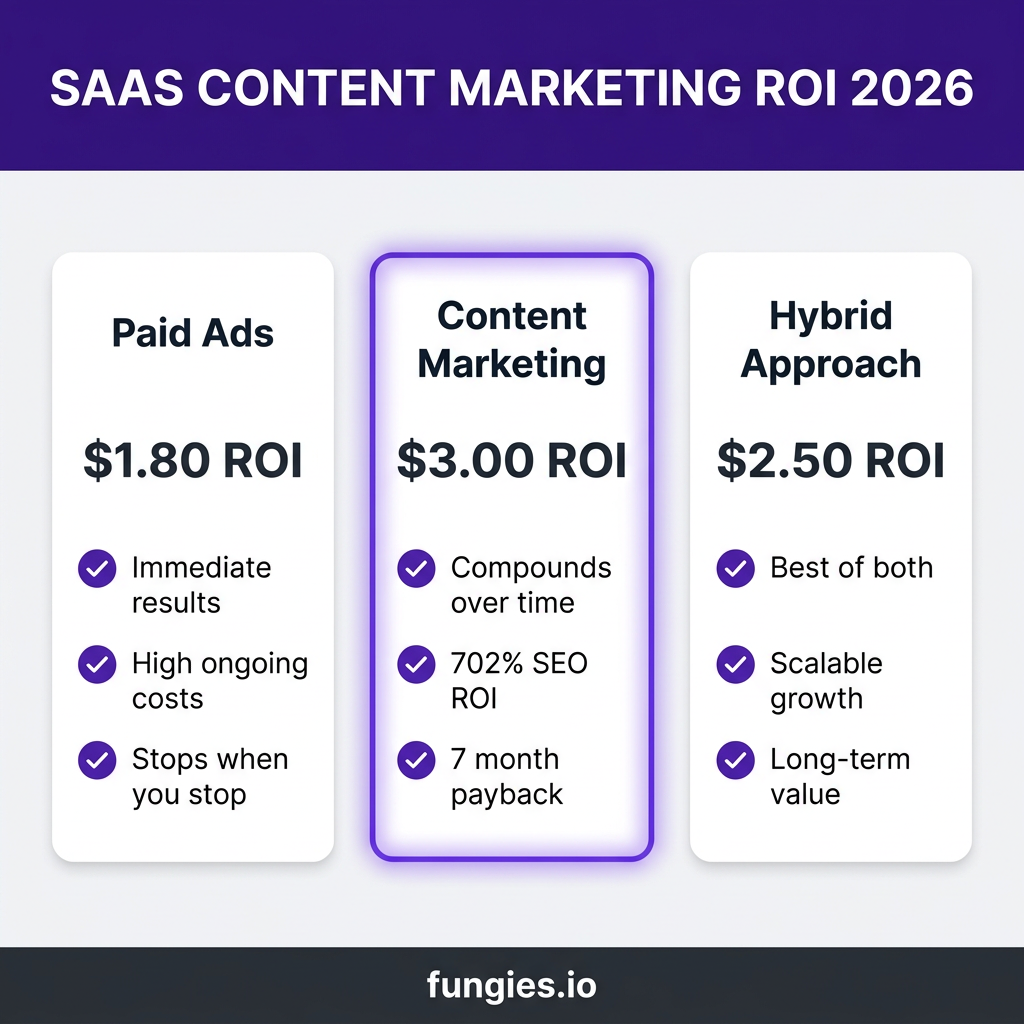
Here’s a stat that should wake up every SaaS founder: B2B SaaS companies that invest in content marketing see an average ROI of 702% over 3 years, with a break-even time of just 7 months. Compare that to paid advertising’s $1.80 return per dollar spent, and the choice becomes obvious.
But here’s the problem — most SaaS companies approach content marketing backwards. They start writing blog posts without a strategy, publish sporadically when inspiration strikes, and wonder why their traffic graph looks like a flatline.
I’ve seen this pattern across dozens of SaaS companies. The ones that win don’t necessarily have bigger budgets — they have better systems. This guide breaks down exactly how to build a content marketing strategy that actually drives pipeline, not just vanity metrics.
What Is SaaS Content Marketing (And Why It’s Different)
SaaS content marketing isn’t just “blogging for business.” It’s a strategic approach to creating and distributing valuable content that attracts, educates, and converts your target audience into paying customers.
Here’s what makes it different from content marketing in other industries:
- Longer sales cycles: B2B SaaS buyers research for months. Your content needs to nurture them through every stage.
- Technical audiences: Developers and technical buyers can spot fluff instantly. Depth and accuracy matter.
- Complex products: You can’t explain enterprise software in a tweet. You need comprehensive guides, documentation, and use cases.
- Multiple stakeholders: The person reading your blog post often isn’t the decision-maker. Content needs to serve both.
Honestly, most SaaS companies treat content like a side project. They hire a junior writer, publish twice a month, and hope something sticks. That’s not a strategy — that’s wishful thinking.
The State of SaaS Content Marketing in 2026
Before diving into tactics, let’s look at the data. Understanding where the industry stands helps you set realistic expectations and benchmark your performance.
Key Statistics You Need to Know
- 82% of SaaS and tech companies have at least one person dedicated to content marketing (Ranklyx, 2026)
- 75% of SaaS companies plan to increase their content marketing budgets this year
- $342K–$1.09M is the typical annual content marketing spend for growth-stage SaaS companies
- 73% of B2B marketers now have a documented content strategy (CMI, 2026)
- 90% of companies use their website/blog as the primary content distribution platform
The message is clear: content marketing isn’t optional anymore. It’s table stakes for SaaS growth. But throwing money at content without a strategy is like burning cash.
The 5-Step SaaS Content Marketing Framework
After analyzing hundreds of SaaS content programs, I’ve identified a pattern. The companies that succeed follow a specific framework. Here’s the exact process:
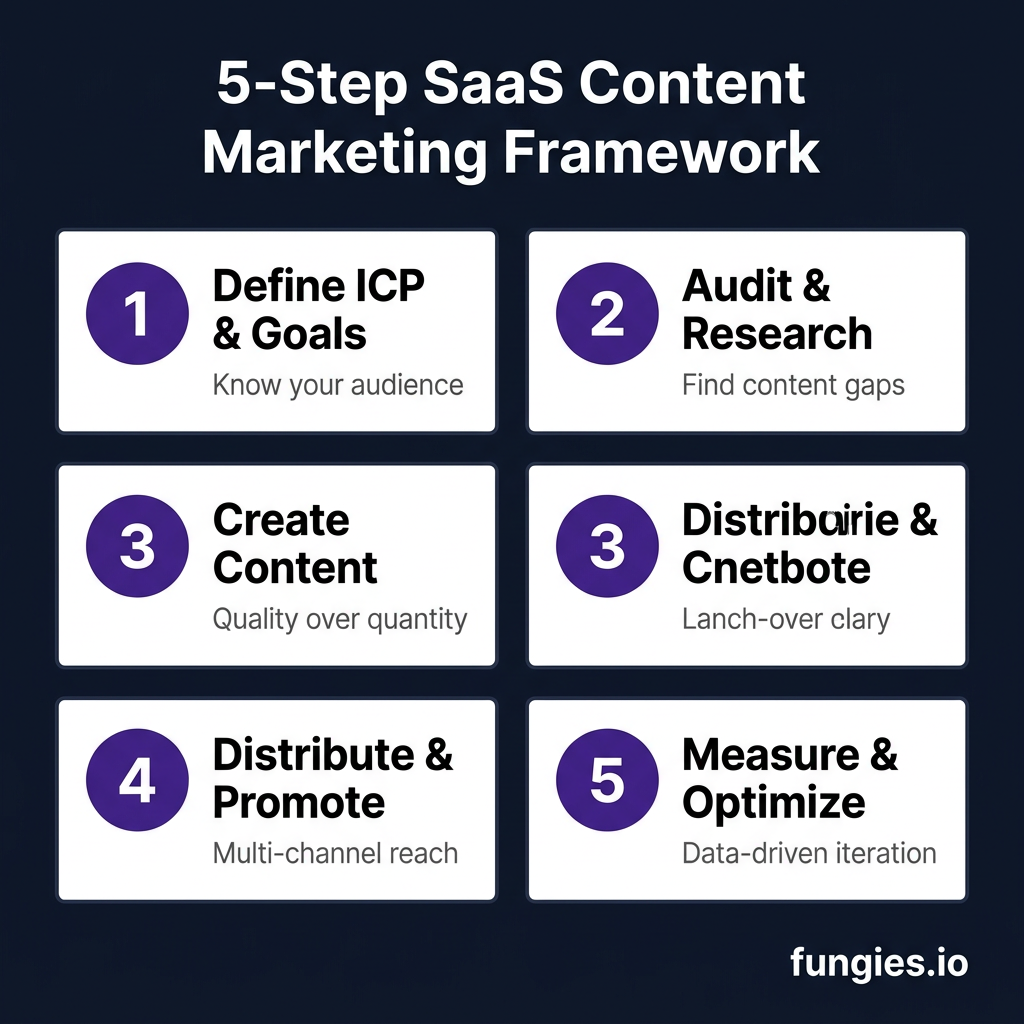
Step 1: Define Your ICP and Content Goals
You can’t create effective content if you don’t know who you’re talking to. This sounds obvious, but you’d be shocked how many SaaS companies skip this step.
Your Ideal Customer Profile (ICP) should include:
- Firmographics: Company size, industry, revenue, tech stack
- Psychographics: Pain points, goals, objections, buying triggers
- Behavioral data: Where they hang out online, what content they consume, how they research
- Decision-making process: Who’s involved, what stages they go through, what information they need at each step
Once you know your ICP, set specific content goals. Not “increase traffic” — that’s too vague. Try:
- Generate 500 qualified leads per month from organic search
- Achieve 15% visitor-to-lead conversion rate on high-intent pages
- Reduce CAC by 25% through organic content within 12 months
- Rank in top 3 positions for 50 high-value keywords within 6 months
Step 2: Audit and Research
Before creating new content, understand what you already have and what’s working in your market.
Content Audit Checklist:
- Inventory all existing content (blog posts, guides, case studies, videos)
- Map content to buyer journey stages (awareness, consideration, decision)
- Identify content gaps — topics your audience cares about that you haven’t covered
- Find quick wins — existing content that ranks on page 2 and needs optimization
- Audit competitor content to find opportunities they’ve missed
Tools I recommend for this phase: Ahrefs or Semrush for competitive analysis, Google Search Console for identifying existing opportunities, and Screaming Frog for technical content audits.
Step 3: Create High-Quality Content
This is where most companies get it wrong. They focus on quantity over quality, publishing thin content that adds nothing to the conversation.
In 2026, quality means:
- Depth: Comprehensive coverage that truly answers the reader’s question
- Originality: Unique insights, data, or perspectives they can’t find elsewhere
- Accuracy: Fact-checked information from credible sources
- Actionability: Specific steps the reader can take, not generic advice
- Readability: Clear structure, scannable format, no fluff
The content types that perform best for SaaS companies:
| Content Type | Best For | Avg. Conversion Rate |
|---|---|---|
| Product comparison pages | Decision stage | 8-15% |
| How-to guides | Consideration stage | 3-5% |
| Industry research/reports | Awareness + links | 2-4% |
| Case studies | Decision stage | 5-10% |
| Templates/tools | Lead generation | 15-25% |
Step 4: Distribute and Promote
Creating great content is only half the battle. You need to get it in front of your audience.
Distribution Channels for SaaS:
- Organic search (SEO): The holy grail — sustainable, high-intent traffic
- Email marketing: 59% of B2B marketers name email as their most effective revenue channel
- LinkedIn: Essential for B2B SaaS, especially for thought leadership content
- Reddit/communities: Great for technical/developer-focused SaaS
- Paid social: Useful for amplifying top-performing content
- Partnerships/co-marketing: Guest posts, webinars, joint research
Here’s a rule I follow: spend 50% of your time creating content, 50% promoting it. Most companies get this ratio backwards.
Step 5: Measure and Optimize
Content marketing without measurement is just publishing into the void. Track these metrics:
- Traffic metrics: Organic sessions, page views, unique visitors
- Engagement metrics: Time on page, bounce rate, scroll depth
- Conversion metrics: Visitor-to-lead rate, lead-to-customer rate, content-attributed revenue
- SEO metrics: Keyword rankings, backlinks, domain authority
- Content efficiency: Cost per lead, content ROI, payback period
Set up a monthly content review. What’s working? What’s not? Double down on winners, cut losers, and continuously optimize.
Content Marketing ROI: The Numbers That Matter
Let’s talk about the metric every CFO cares about: ROI. Here’s what the data shows for SaaS content marketing in 2026:
| Metric | Average | Top Performers |
|---|---|---|
| Content marketing ROI (3-year) | 702% | 844%+ |
| SEO ROI for B2B SaaS | 702% | 1000%+ |
| Break-even time | 7 months | 3-4 months |
| Visitor-to-lead conversion | 1.5-2.5% | 8-15% |
| Content-attributed revenue | 25-40% of pipeline | 60%+ |
The companies seeing 800%+ ROI aren’t doing anything magical. They’re just executing the fundamentals consistently: understanding their audience, creating genuinely useful content, and distributing it effectively.
Common SaaS Content Marketing Mistakes
I’ve audited dozens of SaaS content programs. Here are the mistakes I see over and over:
1. Writing for Everyone
“Our product is for everyone!” No, it’s not. The more specific your content, the better it performs. Write for your ICP, not the general internet.
2. Ignoring Search Intent
Someone searching “what is CRM software” wants education. Someone searching “best CRM for SaaS” wants comparison. Match your content to the intent behind the query.
3. No Clear CTA
Every piece of content should have a clear next step. Download a template, start a free trial, book a demo — tell the reader exactly what to do next.
4. Inconsistent Publishing
Content marketing compounds. Publishing 4 posts one month and zero the next kills momentum. Consistency beats intensity.
5. Not Refreshing Old Content
Refreshed content can generate up to 70% more organic traffic and 32% higher engagement time. Your old posts are assets — treat them that way.
Building Your Content Team
Who should actually create this content? Here are three approaches that work:
Option 1: In-House Team (Best for Scale)
Roles you need:
- Content Strategist/Manager — owns the strategy and editorial calendar
- SEO Specialist — handles keyword research and technical optimization
- Content Writers (2-3) — produce the actual content
- Designer — creates visuals, infographics, and downloadable assets
- Distribution Specialist — manages promotion and distribution
Typical cost: $300K–$600K annually for a full team.
Option 2: Agency + In-House Lead (Best for Growth Stage)
Hire an in-house content lead who owns strategy and works with an agency for execution. This gives you strategic control without the overhead of a full team.
Typical cost: $150K–$300K annually (lead salary + agency fees).
Option 3: Founder-Led + Freelancers (Best for Early Stage)
The founder creates strategic content (thought leadership, vision pieces) while freelancers handle SEO content and production.
Typical cost: $50K–$150K annually.
AI and the Future of SaaS Content Marketing
Let’s address the elephant in the room: AI. In 2026, 80% of marketers globally use AI tools, with 88% reporting increased efficiency.
Here’s how smart SaaS companies are using AI:
- Research and ideation: AI helps identify content gaps and trending topics faster
- First drafts: AI-generated outlines and rough drafts speed up production
- Optimization: AI tools suggest improvements for readability and SEO
- Personalization: Dynamic content that adapts to visitor characteristics
- Distribution: AI-powered scheduling and promotion optimization
But here’s the catch: AI-augmented content programs report 68% higher ROI — but only when humans own the strategy and insights. Don’t let AI replace your thinking. Use it to amplify your thinking.
FAQ: SaaS Content Marketing Strategy
How long does it take to see results from content marketing?
Most SaaS companies see measurable results within 6-9 months, with significant ROI appearing around the 12-month mark. SEO-driven content typically takes 3-6 months to rank, while email and social can drive immediate traffic.
How much should a SaaS company spend on content marketing?
Growth-stage SaaS companies typically spend 8-15% of revenue on marketing, with 25-40% of that budget allocated to content. For a $5M ARR company, that’s roughly $100K–$300K annually on content marketing.
What content types convert best for SaaS?
Product comparison pages and case studies typically have the highest conversion rates (5-15%). Templates and tools are excellent for lead generation, converting at 15-25%.
Should we gate our content?
Gate high-value assets (templates, tools, in-depth research) to capture leads. Keep educational content ungated for SEO and awareness. The rule: if someone would pay for it, gate it. If it’s educational, keep it open.
How do we measure content marketing ROI?
Track content-attributed revenue using multi-touch attribution. Calculate: (Content-attributed revenue – Content marketing costs) / Content marketing costs × 100. Most SaaS companies see 400-800% ROI over 3 years.
Conclusion: Your Content Marketing Action Plan
Content marketing isn’t a magic bullet. It takes time, consistency, and genuine effort to create valuable content. But the data is clear: SaaS companies that invest in content see compounding returns that paid channels simply can’t match.
Here’s your 30-day action plan:
- Week 1: Define your ICP and audit existing content
- Week 2: Research competitors and identify content gaps
- Week 3: Create your editorial calendar for the next quarter
- Week 4: Publish your first strategic piece and start promoting it
Remember: the companies winning at content marketing aren’t necessarily the ones with the biggest budgets. They’re the ones with the clearest strategy and the discipline to execute it consistently.
Ready to start selling your digital products or SaaS subscriptions? Create your free Fungies account and launch your store in minutes — we’ll handle payments, tax compliance, and global checkout so you can focus on creating amazing content and products.
Sources
- Oliver Munro — 60+ SaaS Marketing Statistics 2026
- Ranklyx — SaaS Content Marketing Statistics 2026
- Genesys Growth — Content Marketing ROI Statistics 2026
- Digital Applied — SaaS Marketing Statistics 2026
- Powered by Search — B2B SaaS Content Marketing Statistics
- Flighted — B2B SaaS Conversion Rate Benchmarks 2026
- Promodo — SaaS Digital Marketing Benchmarks 2026
- GrowthKitchen — SaaS Content Marketing Strategy Guide