Here’s a sobering thought: 70% of B2B SaaS churn happens in the first 90 days. Not because your product is broken. Not because your customers are fickle. But because most SaaS companies don’t have a systematic way to catch at-risk accounts before they quietly slip away.
I’ve spent years watching companies pour money into acquisition while their existing customers leak out the back door. The median B2B SaaS company now has a Net Revenue Retention of just 101% — down from 105% in 2021. That means most SaaS businesses are barely growing from their existing customer base, even as customer acquisition costs keep climbing.
Customer success software is the fix. These platforms don’t just track who’s logging in — they predict who’s about to leave, automate interventions, and surface expansion opportunities you’d otherwise miss. The best ones turn your CS team from reactive firefighters into proactive growth drivers.
What Is Customer Success Software?
Customer success software (also called Customer Success Platforms or CSPs) helps businesses proactively manage customer relationships by monitoring product usage, health metrics, and engagement to reduce churn and identify growth opportunities.
Think of it this way: your CRM tells you who the customer is, your customer success platform tells you if they’re happy, and your customer service software helps when they’re already upset. CSPs are the early warning system that catches problems before they become support tickets.
These platforms pull data from your CRM, product analytics, support tickets, billing systems, and communication tools to create a unified view of each account. They use this data to calculate health scores, trigger automated playbooks, and alert CSMs when intervention is needed.
Why Customer Success Matters More Than Ever in 2026
The math is brutal but simple. According to 2025 SaaS benchmark data from Benchmarkit and SaaS Capital:
- Median NRR dropped to 101% — meaning the average SaaS company barely grows from existing customers
- Expansion ARR now represents 40% of total new ARR — up 5% from 2023
- New CAC Ratio increased 14% — it now costs $2.00 in sales and marketing to acquire $1.00 of new customer ARR
- Blended CAC Ratio actually improved 10% — because expansion revenue is cheaper to capture than new logos
The takeaway? Growing through your existing customer base isn’t just nice to have — it’s becoming essential for survival. A well-run customer success program can deliver up to 91% ROI and significantly higher net revenue retention.
10 Best Customer Success Software Tools for SaaS in 2026
After analyzing dozens of platforms, reviewing G2 feedback, and talking to CS leaders who use these tools daily, here are the 10 best customer success software options for SaaS companies in 2026.
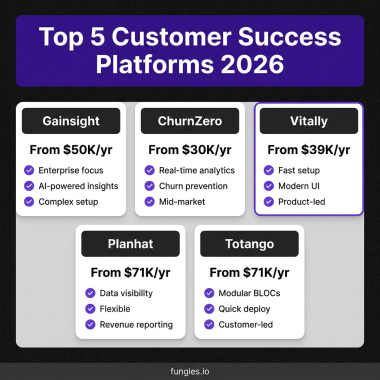
1. Gainsight — Best for Enterprise Deployments
Gainsight is the heavyweight champion of customer success software. It’s built for large organizations with complex customer relationships, multiple product lines, and dedicated CS operations teams.
Key Features:
- Multi-signal health scoring that catches churn risk patterns single-metric tools miss
- Journey Orchestrator for automated personalized outreach
- AI-powered Insight Agents via Staircase AI for sentiment analysis
- Native bi-directional Salesforce sync
- Renewal Center and expansion forecasting
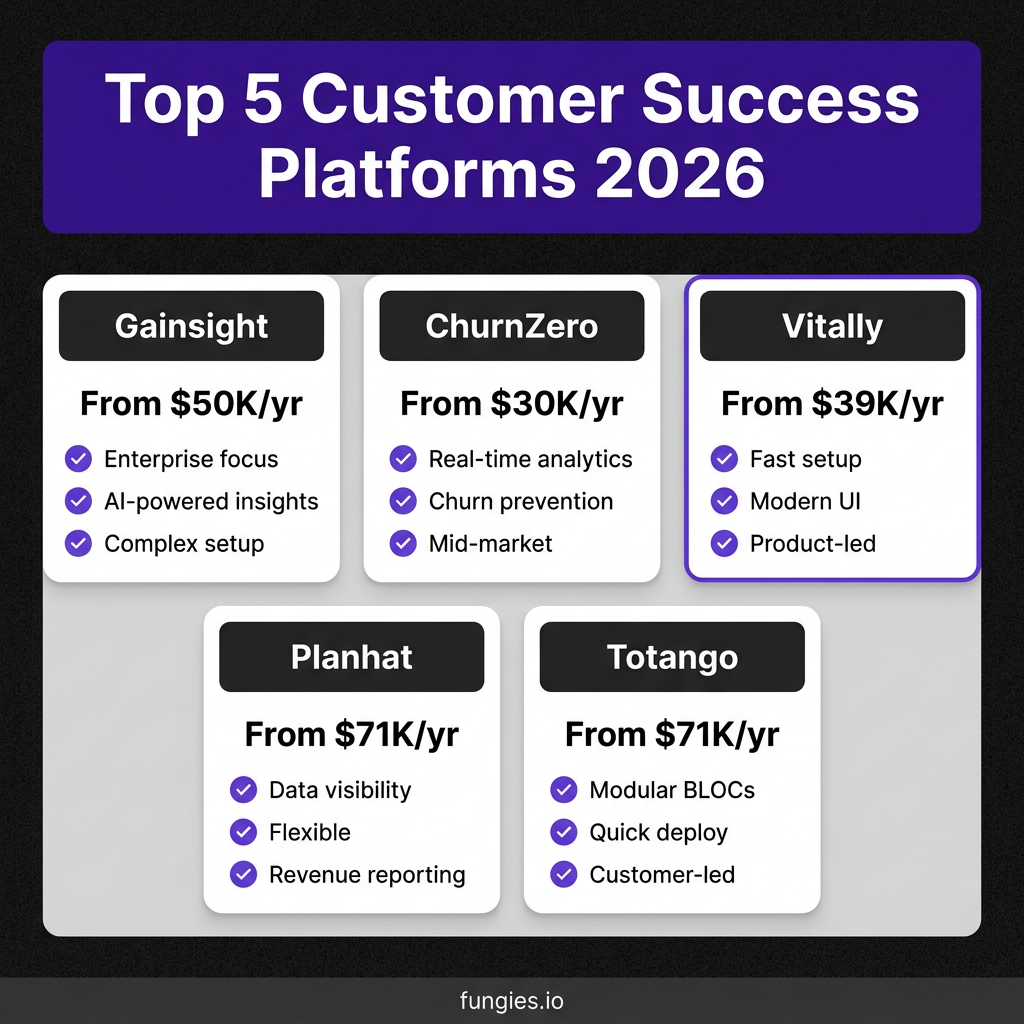
Pricing: Not publicly disclosed. Based on Vendr procurement data, median annual contracts are $50,125 with a range of $14,083–$193,701 depending on scale and modules.
Best For: Enterprise SaaS companies with 1,000+ customers, complex account hierarchies, and mature CS operations. If you need to run CS as a company-wide revenue discipline, Gainsight is the standard.
The Reality Check: Gainsight is notoriously complex. Implementation often takes months, and you’ll likely need a dedicated admin or CS Ops specialist to manage it. One Reddit user noted it took two years to get real traction. But if you have the resources, the insights are unmatched.
2. ChurnZero — Best for Mid-Market Businesses
Named with the subtlety of a sledgehammer, ChurnZero focuses obsessively on reducing customer churn. It’s the platform mid-market SaaS companies choose when they need enterprise-grade capabilities without enterprise-grade complexity.
Key Features:
- Real-time customer usage analytics (not delayed syncs)
- 15+ AI agents including Harbinger (churn risk detection) and Beacon (expansion intent)
- Automated playbooks and lifecycle management
- Robust customer segmentation
- Renewal management and forecasting
Pricing: Not publicly disclosed. Based on their own ROI calculator, Enterprise Edition runs approximately $56,125/year for a team of 5 CSMs. Expect a platform fee plus per-user licensing around $1,400/year per seat.
Best For: Subscription businesses with 100–1,000 customers that need real-time visibility and automation. The difference between seeing a churn signal today versus in three days is often the difference between saving an account and writing a loss report.
3. Vitally — Best for Product-Led Growth
Vitally feels like it was built for the modern SaaS ecosystem. It plugs directly into your product analytics stack — Segment, Mixpanel, Amplitude — and surfaces usage signals that matter.
Key Features:
- Deep integration with product analytics tools
- AI-assisted Playbooks that adapt to user behavior in real-time
- Collaborative Hubs for shared customer portals
- Modern, Notion-like interface
- Project management features built-in
Pricing: Custom quote-based. Vendr data shows median annual contracts of $38,987 with a range of $15,000–$79,264. Buyers save an average of 20% through negotiation.
Best For: PLG companies where product usage is the primary health signal. If your growth strategy depends on users adopting features and expanding organically, Vitally gives you the visibility to guide that journey.
4. Planhat — Best for Data Visibility
Planhat’s approach is ambitious: bring everything into one place and make it actually usable. The result is a 360-degree customer view that’s genuinely comprehensive.
Key Features:
- Highly customizable data models and health scores
- Data Semantics layer that translates complex data into insights
- Conversational AI Data Explorer
- Robust revenue and cohort reporting
- Revenue workspace connecting usage to upsell triggers
Pricing: Not publicly disclosed. Vendr data shows recent 12-month contracts between $71K–$114K depending on tier and add-ons.
Best For: Teams that need to slice and dice data in specific ways, create complex health scores, or build detailed reports. More than 30% of Planhat users sit outside Customer Success — it’s a platform the whole go-to-market team can use.
5. Totango — Best for Customer-Led Growth
Totango takes a modular approach through SuccessBLOCs — pre-built, customizable workflow templates for common CS goals like onboarding, adoption, and renewal management.
Key Features:
- Modular SuccessBLOC architecture
- Unison AI that recommends and builds workflows
- Powerful segmentation engine
- Faster time to value than monolithic platforms
- Pick-and-choose deployment
Pricing: Not publicly disclosed. Vendr data shows contracts typically $71K–$114K annually.
Best For: Teams that want to start lean and scale their CS motion gradually. As Omniconvert founder Valentin Radu told me, “You don’t have to build the entire system upfront. You can start with something lean and scale as your understanding evolves.”
6. ClientSuccess — Best for Startups
Startups don’t have six months to implement software. ClientSuccess understands this — you can get up and running in days, not months, with a gentle learning curve.
Key Features:
- SuccessCycles for standardized processes
- Baton integration for automated onboarding
- Client 360 view with custom fields
- Easy email integration
- Simple, intuitive interface
Pricing: Vendr data shows median annual contracts of $19,500 with a range of $5,781–$30,750. Implementation fees add $5,000–$20,000.
Best For: Early-stage companies that need core CS functionality without complexity. If you’re moving off spreadsheets but aren’t ready for enterprise tooling, ClientSuccess hits the sweet spot.
7. Custify — Best for B2B SaaS Companies
Custify is built specifically for the SaaS lifecycle — onboarding, retention, expansion — without the feature bloat that makes enterprise tools daunting.
Key Features:
- 360-degree customer view (product, billing, support, comms)
- AI assistant for summarizing customer history
- Concierge onboarding
- Automated playbooks
- Fast 4-week average setup
Pricing: Not publicly disclosed, but G2 reviews suggest it’s affordable for small-to-mid-market teams.
Best For: Small-to-mid-market B2B SaaS teams of 2–10 CSMs ready to move off spreadsheets but not ready for enterprise complexity.
8. HubSpot Service Hub — Best for Unified CRM
If you’re already living in HubSpot, Service Hub makes the sales-to-CS handoff seamless. Your CSMs can see every promise sales made during the demo without asking customers to repeat themselves.
Key Features:
- Breeze AI for sentiment prediction and call analysis
- Visual workflow builder (no code)
- Seamless CRM integration
- Unified customer data
- Free tier available
Pricing: Free version available. Paid plans start at $9/seat/month. Professional tier (where real CS tools live) starts at $90/seat/month with a mandatory $1,500 onboarding fee.
Best For: Teams already committed to the HubSpot ecosystem. The “HubSpot Tax” is real — advanced features get expensive fast — but the benefit of a single source of truth often outweighs the cost.
9. Gong — Best for Conversation Intelligence
Gong isn’t a traditional CS platform — it’s conversation intelligence. But for CS teams, it captures risk signals from customer conversations that would otherwise be lost in notes.
Key Features:
- Records, transcribes, and analyzes every customer interaction
- AI-powered call summaries
- Risk signal detection from conversations
- Sales-to-CS handoff consistency
- Deal intelligence and forecasting
Pricing: Vendr data shows median annual contracts of $54,340 with a range of $11,328–$192,426. Per-user costs run $1,300–$1,600/year plus a $5,000–$50,000 platform fee.
Best For: Teams where customer conversations are the primary signal. If your CS strategy depends on understanding what’s actually being said in calls, Gong is essential.
10. Userpilot — Best for In-App Engagement
Userpilot is a product growth platform that helps CS teams engage users directly inside the product with tooltips, checklists, and guided flows.
Key Features:
- No-code in-app experiences
- Feature adoption tracking
- User feedback collection
- Built-in analytics (funnels, retention)
- Product usage insights
Pricing: Starts at $299/month, priced per MAU rather than per CSM seat.
Best For: PLG companies where onboarding and feature adoption are the primary levers. If you need to act at the product layer without engineering involvement, Userpilot is the strongest option.
Customer Success Software Comparison Table
| Platform | Best For | Starting Price | Setup Time | Standout Feature |
|---|---|---|---|---|
| Gainsight | Enterprise | ~$50K/yr | 2-6 months | AI Insight Agents |
| ChurnZero | Mid-market | ~$30K/yr | 4-8 weeks | Real-time analytics |
| Vitally | PLG teams | ~$39K/yr | 2-4 weeks | Product analytics integration |
| Planhat | Data-heavy teams | ~$71K/yr | 4-8 weeks | Conversational AI |
| Totango | Customer-led growth | ~$71K/yr | 2-4 weeks | SuccessBLOCs |
| ClientSuccess | Startups | ~$19K/yr | Days | Fast implementation |
| Custify | B2B SaaS | Custom | 4 weeks | 360° customer view |
| HubSpot | CRM-unified teams | $90/seat/mo | 2-4 weeks | Native CRM sync |
| Gong | Conversation focus | ~$54K/yr | 2-4 weeks | Call intelligence |
| Userpilot | In-app engagement | $299/mo | 1-2 weeks | No-code experiences |
How to Choose the Right Customer Success Software
Picking a CS platform is less like shopping for a toaster and more like choosing a therapist — it’s deeply personal, probably expensive, and if you choose wrong, you’ll spend months fixing the damage. Here’s the framework I use:
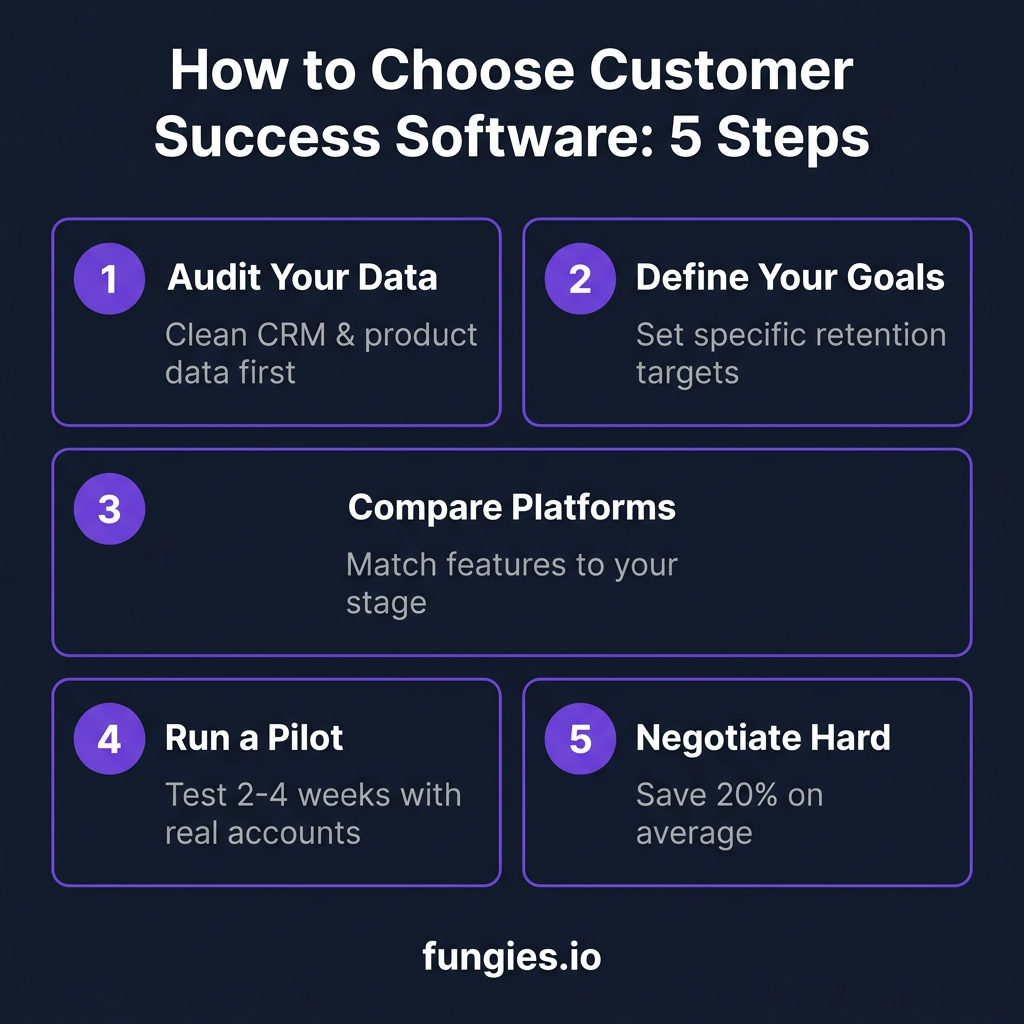
Stage 1: Assess Your Needs
Start by identifying your biggest friction points. Are you losing customers in the first 90 days? Is expansion revenue untapped? Are CSMs drowning in manual tasks?
Set specific goals. “Reduce time to identify at-risk accounts from four days to same-day” is something you can evaluate against. “Better visibility” is not.
Most importantly, audit your data quality before demos. Messy CRM data and untagged product events will result in poor health scores on any platform.
Stage 2: Compare Your Options
Build a simple comparison matrix: critical features down one side, platforms across the top. Evaluate:
- Native integrations with your current stack
- Pricing model (per user vs. per account vs. per MAU)
- Implementation timeline and costs
- Vendor support quality
- AI and automation capabilities
Stage 3: Make an Informed Decision
Run a 2-4 week pilot on a real subset of accounts. Collect feedback from CSMs daily, not just from budget approvers. Score each platform against your weighted criteria.
Then negotiate hard. Vendr data shows buyers save an average of 20% on CS software through negotiation. Multi-year contracts often unlock 15-30% savings.
Key Customer Success Metrics to Track
Whatever platform you choose, make sure it can track these essential metrics:
| Metric | What It Measures | Good Benchmark |
|---|---|---|
| Net Revenue Retention (NRR) | Growth from existing customers | >100% (enterprise: 118%+) |
| Gross Revenue Retention (GRR) | Revenue retained from existing customers | 85-90%+ |
| Logo Retention | % of customers retained | 88-90% |
| Time to Value (TTV) | Time to first meaningful outcome | <30 days |
| Product Adoption Rate | % of users engaging with key features | >60% |
| Customer Health Score | Overall account health | Custom scale |
| Expansion Revenue | Revenue from upsells/cross-sells | 20-40% of new ARR |
FAQ: Customer Success Software
What’s the difference between customer success and customer support software?
Support software (Zendesk, Intercom) is reactive — it manages incoming tickets. Customer success software is proactive — it monitors health signals and triggers interventions before customers have problems worth filing tickets about. In mature teams, both coexist: support data feeds into health scores, and CS automation prevents tickets.
How much does customer success software typically cost?
Costs vary widely. Entry-level tools like ClientSuccess start around $19K/year. Mid-market platforms like ChurnZero and Vitally typically run $30K–$50K/year for a 10-person CS team. Enterprise platforms like Gainsight commonly land between $50K–$200K/year including implementation.
Can customer success software actually reduce churn?
Yes, but with caveats. 70% of B2B SaaS churn happens in the first 90 days, so tools that improve early onboarding have the most direct impact. For established accounts, churn prevention comes from health score-based early warning and proactive playbooks. The platform helps, but only if your team acts on the signals it provides.
Do I need a dedicated CS platform or can I use my CRM?
For early-stage companies, a CRM with some custom fields might suffice. But once you have more than ~50 customers, the limitations become painful. CRMs lack product usage data, health scoring, automated playbooks, and renewal forecasting. They’re designed for sales pipelines, not post-sale success.
How long does implementation typically take?
It varies by platform and your data complexity. Simple tools like ClientSuccess can be live in days. Mid-market platforms like Vitally take 2-4 weeks. Enterprise platforms like Gainsight often need 2-6 months. The biggest bottleneck is usually data cleanup, not the software itself.
Conclusion: Invest in Retention Before You Need It
Here’s the uncomfortable truth: most SaaS companies wait too long to invest in customer success. They chase new logos while existing customers quietly churn. They optimize acquisition funnels while expansion revenue goes untapped.
The data is clear. With median NRR at just 101% and new customer acquisition costs up 14% year-over-year, growing through your existing base isn’t optional anymore — it’s essential. The companies winning in 2026 are the ones that treat customer success as a growth function, not a cost center.
The right customer success software won’t fix a broken product or compensate for poor service. But it will give your team the visibility, automation, and insights they need to catch at-risk accounts early, guide customers to value faster, and identify expansion opportunities you’d otherwise miss.
My advice? Start with your biggest pain point. If churn in the first 90 days is killing you, look at onboarding-focused tools like Userpilot or Custify. If you’re losing enterprise accounts unexpectedly, consider Gainsight or ChurnZero. If you’re a PLG company trying to scale, Vitally was built for you.
Whatever you choose, commit to it. The platform is just the foundation — your team’s execution determines whether you turn customer success into a competitive advantage.
Ready to streamline your SaaS billing and focus on what matters? Get started with Fungies.io — simple checkout, automated tax compliance, and more time to invest in your customers’ success.
Sources
- Benchmarkit 2025 SaaS Performance Metrics
- SaaS Capital Retention Rate Benchmarks 2025
- ChurnZero 2025 SaaS Benchmarks Webinar
- Zapier: 8 Best Customer Success Tools 2026
- Userpilot: Best Customer Success Tools 2026
- Vendr Procurement Data
- EverHelp SaaS Retention Benchmarks 2026
- Digital Applied NRR Benchmarks 2026