Here’s a stat that should wake you up: teams using a CRM hit their sales goals 41% more often than those juggling customers in spreadsheets. Yet most SaaS founders I talk to are still using a messy combination of Notion, Airtable, and prayer to track their pipeline.
The problem isn’t lack of options. It’s too many. In 2026, you’ve got everything from free HubSpot plans to enterprise Salesforce deployments costing thousands per month. Pick wrong and you’ll spend six months implementing a tool your team hates. Pick right and you’ll have a growth engine that scales with you.
This guide cuts through the noise. I’ve compared the 10 best CRMs specifically for SaaS companies — not generic business CRMs, but tools built for subscription sales, recurring revenue, and the unique challenges of selling software.
What Makes a CRM Good for SaaS?
Before diving into the list, let’s be clear about what “good for SaaS” actually means. SaaS sales is different from traditional sales:
- Longer sales cycles — enterprise deals take 3-12 months, not days
- Recurring revenue focus — you care about LTV and expansion, not just one-time closes
- Product-led growth — many SaaS companies have self-serve users who upgrade
- Integration-heavy — your CRM needs to talk to your product, billing, and support tools
The best SaaS CRMs handle these nuances natively. They track subscription metrics, integrate with your product analytics, and support both sales-led and product-led motions.
The 10 Best CRM for SaaS in 2026
1. HubSpot CRM — Best All-in-One for Growing SaaS
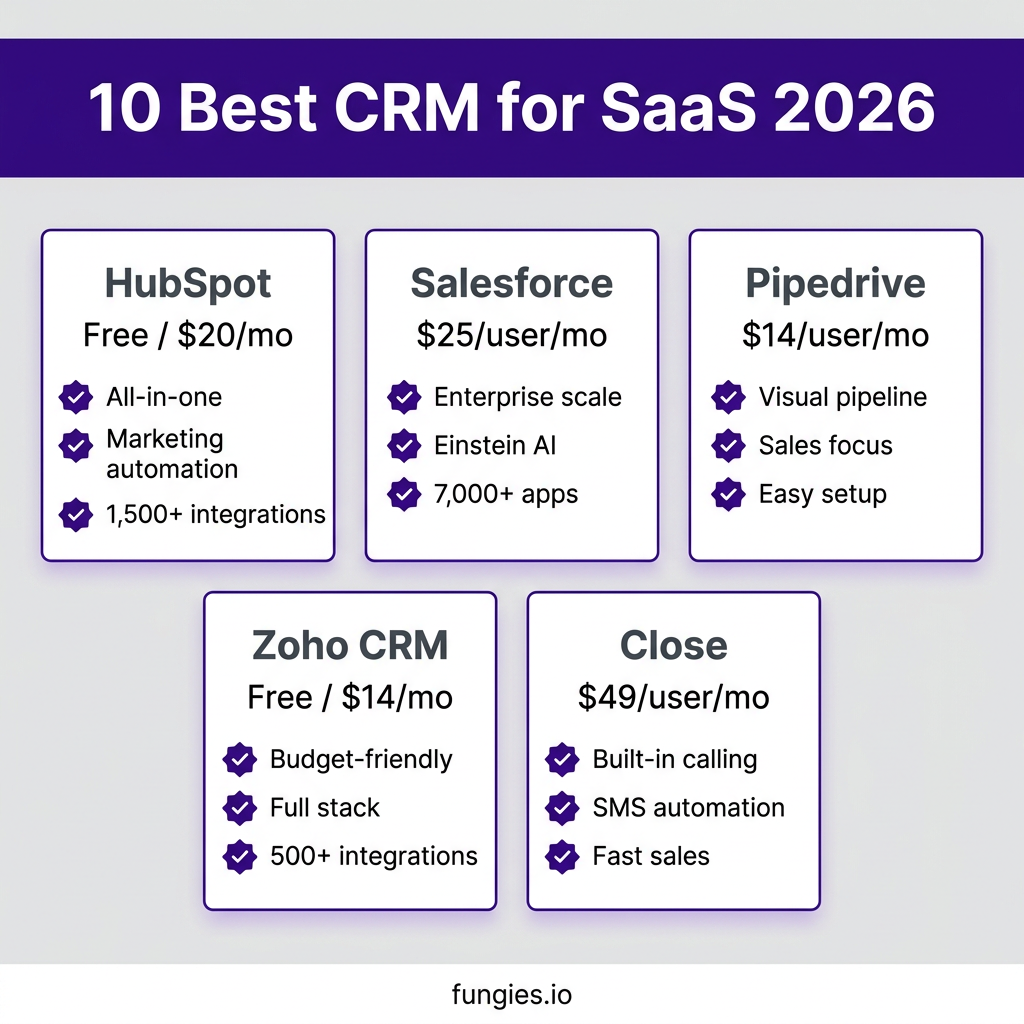
HubSpot remains the gold standard for SaaS companies that want marketing, sales, and customer success in one platform. Their free tier is genuinely useful — not a crippled demo — and the paid tiers scale reasonably.
Key features:
- Free CRM with contact management, deals, and tasks
- Built-in email marketing and landing pages
- Marketing automation that actually works
- 1,500+ integrations including Stripe, Slack, and Segment
- AI-powered lead scoring and forecasting (paid tiers)
Pricing: Free for basic CRM; Starter at $20/user/month; Professional at $100/user/month
Best for: SaaS companies wanting an integrated marketing + sales platform without enterprise complexity
2. Salesforce — Best for Enterprise SaaS
Salesforce is the 800-pound gorilla for a reason. If you’re selling six-figure enterprise contracts with complex procurement processes, nothing else comes close. The customization depth is unmatched.
Key features:
- Einstein AI for predictive lead scoring and forecasting
- Advanced workflow automation and approval processes
- 7,000+ AppExchange integrations
- Enterprise-grade security and compliance
- Custom objects and fields for complex sales motions
Pricing: Starter at $25/user/month; Professional at $80/user/month; Enterprise at $165/user/month
Best for: Mid-market and enterprise SaaS with complex sales processes and dedicated ops teams
3. Pipedrive — Best for Sales-Focused Teams
Pipedrive is built around one philosophy: sales teams want to sell, not administer a CRM. The visual pipeline is intuitive, the mobile app actually works, and setup takes hours, not weeks.
Key features:
- Visual, drag-and-drop sales pipeline
- Activity-based selling with smart reminders
- Email integration and tracking
- AI Sales Assistant for deal insights
- 400+ integrations including Slack and Trello
Pricing: Essential at $14/user/month; Advanced at $29/user/month; Professional at $59/user/month
Best for: Small to mid-size SaaS with straightforward sales processes and no dedicated CRM admin
4. Zoho CRM — Best Budget Option
Zoho CRM proves you don’t need to break the bank for a capable system. The free tier supports up to 3 users, and paid plans start lower than almost any competitor. Plus, it integrates with the broader Zoho ecosystem.
Key features:
- Free for up to 3 users with core CRM features
- Zia AI for predictions and anomaly detection
- Built-in telephony and social media integration
- 500+ integrations
- Workflow automation on all paid tiers
Pricing: Free (3 users); Standard at $14/user/month; Professional at $23/user/month
Best for: Bootstrapped SaaS and startups watching every dollar
5. Close — Best for Inside Sales
Close is built by salespeople for salespeople. The standout feature? Built-in calling, SMS, and email sequences — no integrations needed. If your SaaS sells via high-velocity inside sales, this is your tool.
Key features:
- Built-in VoIP calling with recording
- SMS automation and two-way texting
- Power dialer for high-volume outreach
- Email sequences with open/click tracking
- Pipeline management designed for speed
Pricing: Startup at $49/user/month; Professional at $99/user/month; Enterprise at $139/user/month
Best for: SaaS with outbound sales teams making 50+ calls per day
6. Freshsales — Best AI Features
Freshsales (part of Freshworks) has leaned hard into AI, and it shows. Freddy AI handles lead scoring, deal insights, and even suggests next actions. The interface is clean and modern.
Key features:
- Freddy AI for predictive insights
- Built-in phone, email, and chat
- Visual sales pipeline with drag-and-drop
- 360-degree customer view
- Strong mobile app
Pricing: Free; Growth at $15/user/month; Pro at $49/user/month; Enterprise at $79/user/month
Best for: SaaS teams wanting AI assistance without Salesforce complexity
7. Monday Sales CRM — Best for Customization
Monday.com’s sales CRM brings their famous flexibility to sales processes. If your SaaS has unique workflows that don’t fit traditional CRM molds, Monday’s customizable boards are a godsend.
Key features:
- Highly customizable boards and columns
- Visual workflow automation
- 600+ integrations
- Monday AI for automation suggestions
- Strong collaboration features
Pricing: Basic at $12/user/month; Standard at $17/user/month; Pro at $28/user/month
Best for: SaaS with non-standard sales processes or teams already using Monday.com
8. ActiveCampaign — Best for Marketing Automation
ActiveCampaign blurs the line between CRM and marketing automation. If your SaaS relies heavily on email nurture sequences, lead scoring, and behavioral triggers, this is arguably the best tool available.
Key features:
- Industry-leading marketing automation
- Predictive sending and content
- Advanced segmentation and personalization
- Site tracking and event monitoring
- 900+ integrations
Pricing: Plus at $29/user/month; Professional at $49/user/month; Enterprise at $149/user/month
Best for: SaaS with complex marketing funnels and heavy email automation needs
9. Copper — Best for Google Workspace
Copper is the only CRM built natively for Google Workspace. If your team lives in Gmail, Google Calendar, and Google Drive, Copper feels like an extension of those tools rather than a separate system.
Key features:
- Native Gmail and Google Calendar integration
- Automatic contact and email sync
- Visual pipeline management
- Workflow automation
- Strong mobile app
Pricing: Basic at $29/user/month; Professional at $69/user/month; Business at $129/user/month
Best for: Google Workspace-centric teams who want minimal context switching
10. Breakcold — Best for Social Selling
Breakcold is the new kid on the block, built specifically for how SaaS sales happens in 2026 — across LinkedIn, WhatsApp, email, and calls. It’s an AI-native CRM that auto-syncs conversations from multiple channels.
Key features:
- Unified inbox for LinkedIn, WhatsApp, email, and calls
- AI agents that update CRM automatically
- Social selling workflows
- Lead enrichment from social profiles
- Modern, fast interface
Pricing: Starting at $29/user/month
Best for: SaaS sales teams doing heavy LinkedIn outreach and social selling
CRM Comparison Table
| CRM | Starting Price | Free Tier | Best For | AI Features |
|---|---|---|---|---|
| HubSpot | $20/user/mo | Yes | All-in-one growth | Lead scoring, forecasting |
| Salesforce | $25/user/mo | No | Enterprise | Einstein AI |
| Pipedrive | $14/user/mo | Trial | Sales-focused teams | Sales Assistant |
| Zoho CRM | $14/user/mo | 3 users | Budget-conscious | Zia AI |
| Close | $49/user/mo | No | Inside sales | Limited |
| Freshsales | $15/user/mo | Yes | AI-first teams | Freddy AI |
| Monday | $12/user/mo | Trial | Custom workflows | Monday AI |
| ActiveCampaign | $29/user/mo | Trial | Marketing automation | Predictive sending |
| Copper | $29/user/mo | No | Google Workspace | Basic |
| Breakcold | $29/user/mo | Trial | Social selling | Auto-sync AI |
How to Choose the Right CRM for Your SaaS
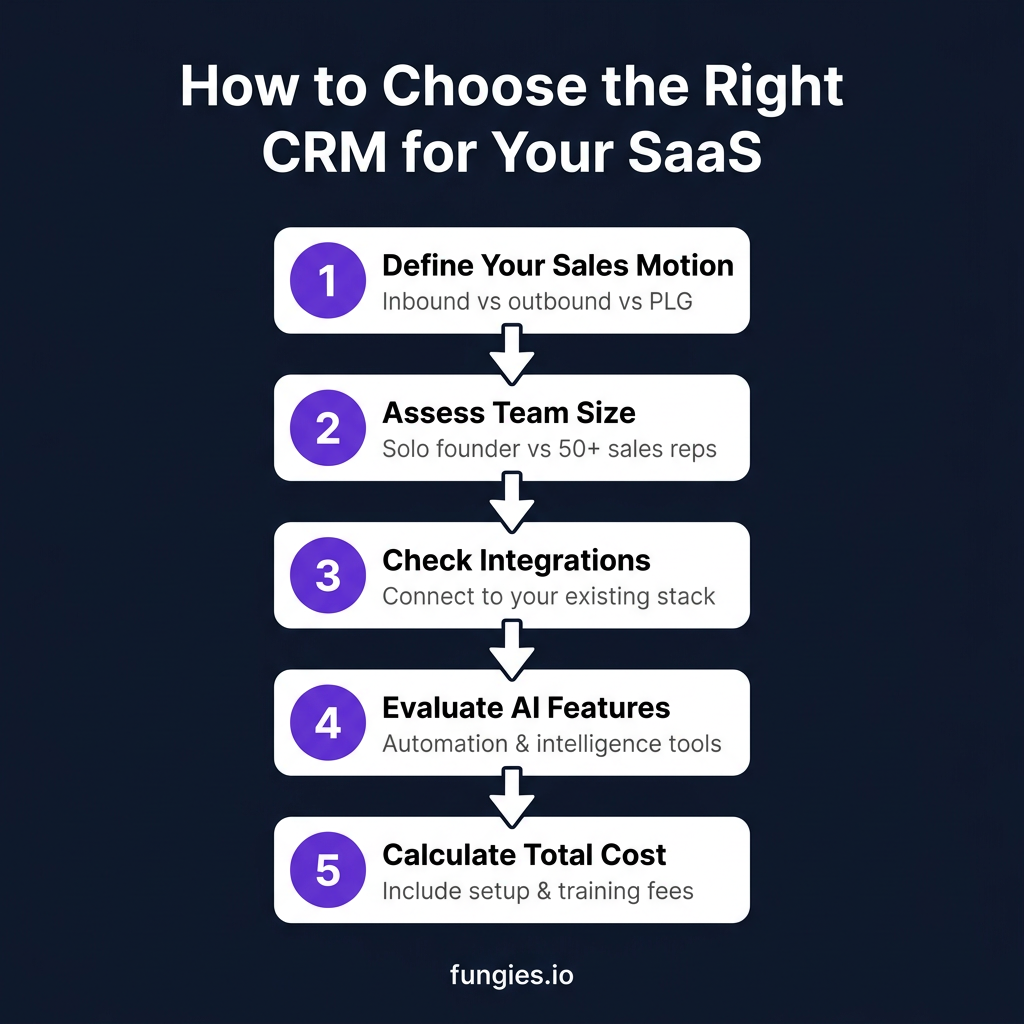
With 10 solid options, how do you pick? Here’s my decision framework:
1. Define Your Sales Motion
Are you inbound-heavy (content marketing, SEO) or outbound-heavy (cold email, LinkedIn)? Product-led (self-serve signups) or sales-led (demo requests)? Different CRMs excel at different motions. HubSpot and ActiveCampaign shine for inbound. Close and Breakcold dominate outbound. Salesforce handles complex enterprise sales.
2. Assess Your Team Size
Solo founder? Start with HubSpot free or Zoho. 5-10 person sales team? Pipedrive or Freshsales. 50+ reps with dedicated ops? Salesforce or HubSpot Enterprise.
3. Check Your Integration Needs
Your CRM needs to talk to your billing system (Stripe), product analytics (Mixpanel), support tool (Intercom), and marketing automation. Check integration depth, not just existence. Salesforce and HubSpot have the deepest integration ecosystems.
4. Evaluate AI Features
In 2026, AI isn’t optional. Look for predictive lead scoring, deal insights, and automation suggestions. Salesforce Einstein, HubSpot’s AI, and Freshsales Freddy lead here.
5. Calculate Total Cost of Ownership
Don’t just look at per-user pricing. Factor in implementation costs, training time, integration fees, and required add-ons. A “cheap” CRM that needs $10K in consulting to set up isn’t cheap.
CRM Implementation Tips for SaaS
Choosing the right CRM is half the battle. Implementing it well is the other half:
- Start simple — Don’t try to configure every feature day one. Get basic contact and deal tracking working first.
- Clean your data — Migrating messy data just creates a messy CRM. Deduplicate and standardize before import.
- Train your team — The best CRM is worthless if your team doesn’t use it. Invest in training.
- Integrate early — Connect your email, calendar, and key tools in the first week. Manual data entry kills adoption.
- Measure adoption — Track login rates, data entry, and pipeline updates. Low adoption means you picked wrong.
FAQ: CRM for SaaS
Do I need a CRM as a solo founder?
Honestly? Not immediately. A simple spreadsheet works for your first 10-20 prospects. But once you’re managing 50+ opportunities, a CRM becomes essential. HubSpot free or Zoho free are perfect starting points.
Can I switch CRMs later?
Yes, but it’s painful. Data migration is never perfect, and you’ll lose historical context. Better to pick right the first time. If you must switch, plan for 2-3 months of transition and data cleanup.
What’s the best free CRM for SaaS?
HubSpot CRM free tier is the most capable. Zoho CRM free (3 users) is a close second. Both handle basic contact management, deals, and tasks without charging a dime.
Should I use Salesforce from day one?
Probably not. Salesforce’s power comes with complexity. Unless you have dedicated CRM ops resources, you’ll spend more time administering than selling. Start simpler and upgrade when you hit limitations.
How important are AI features in 2026?
Very. AI-powered lead scoring, deal insights, and automation suggestions aren’t gimmicks — they genuinely improve win rates. Prioritize CRMs with mature AI features if you’re serious about scaling.
Conclusion: Pick Your Growth Engine
The right CRM isn’t just a database — it’s your growth operating system. It should make your sales team more productive, give you visibility into your pipeline, and scale as you grow.
For most SaaS companies in 2026, I’d recommend starting with HubSpot if you want an all-in-one platform, Pipedrive if you’re sales-obsessed, or Zoho if budget is tight. Enterprise teams should look at Salesforce. High-velocity inside sales teams should consider Close.
Whatever you choose, commit to it. A mediocre CRM used consistently beats a perfect CRM used sporadically. Your future self — and your sales numbers — will thank you.
Ready to streamline your SaaS operations beyond just sales? Get started with Fungies — the merchant of record platform that handles global payments, tax compliance, and checkout infrastructure so you can focus on closing deals and growing revenue.
Sources
- Breakcold: 7 Best CRM Tools for SaaS in 2026
- HookLead: Best CRM Tools for SaaS Companies in 2026
- Custify: Best CRM Tools for SaaS Sales 2026
- HubSpot: CRM for SaaS — 11 Best Solutions for 2026
- Pipedrive: HubSpot vs Salesforce vs Pipedrive
- Business.com: Pipedrive vs HubSpot Comparison 2026
- Broken Rubik: Salesforce vs HubSpot vs NetSuite CRM 2026