10 Best Merchant of Record Software for SaaS Companies in 2026
Compare the 10 best Merchant of Record software platforms for SaaS companies in 2026. See pricing, features, and find the right MoR solution for your business — from Fungies.io and Paddle to FastSpring and Chargebee.
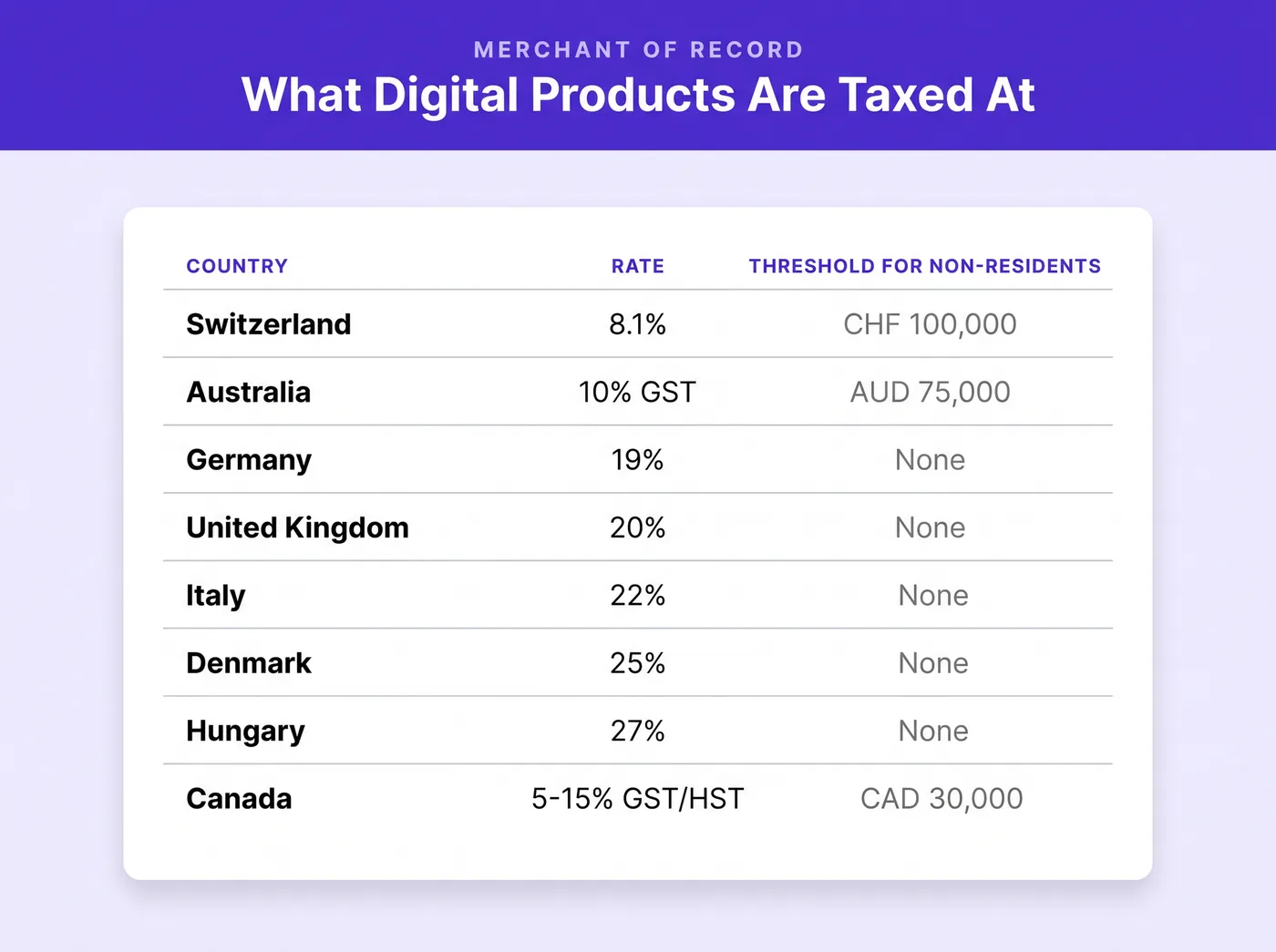
Selling SaaS globally sounds simple until you hit the reality of tax compliance. VAT in Europe. Sales tax in the US. GST in Australia. Each jurisdiction has its own rules, filing deadlines, and penalties for getting it wrong.
Here’s the stat that keeps SaaS founders up at night: companies lose an average of 4.3% of revenue to sales tax liabilities and compliance costs. That’s not a rounding error — that’s the difference between profitable growth and burning cash.
Merchant of Record (MoR) software solves this by becoming the legal entity responsible for your transactions. They handle payments, tax collection, compliance, and fraud protection. You focus on building your product.
I’ve spent years evaluating payment solutions across dozens of SaaS companies. These are the 10 best Merchant of Record platforms worth considering in 2026.
What Is a Merchant of Record?
A Merchant of Record is the legal entity that sells your product to the end customer. When someone buys your SaaS subscription, the MoR’s name appears on their credit card statement, invoice, and tax receipt.
The MoR handles:
- Payment processing across multiple methods and currencies
- Tax calculation, collection, and remittance in every jurisdiction
- Fraud detection and chargeback management
- Regulatory compliance (PCI-DSS, GDPR, local tax laws)
- Invoicing and subscription billing
You get:
- A single integration instead of stitching together payment processors, tax tools, and compliance services
- Predictable pricing without surprise tax bills
- The ability to sell globally from day one
- Reduced legal and financial liability
10 Best Merchant of Record Software Platforms
1. Fungies.io — Best for Indie Developers and Small SaaS
Fungies is the newer entrant that’s quickly becoming the go-to choice for indie developers, bootstrapped SaaS founders, and small teams who want MoR protection without enterprise complexity.
Key Features:
- Complete no-code storefront with customizable checkout
- Full Merchant of Record protection (tax, compliance, fraud)
- Subscription billing with trial support
- Global payment methods (cards, PayPal, Apple Pay, Google Pay)
- Webhook and API access for custom integrations
- Digital product delivery and license key management
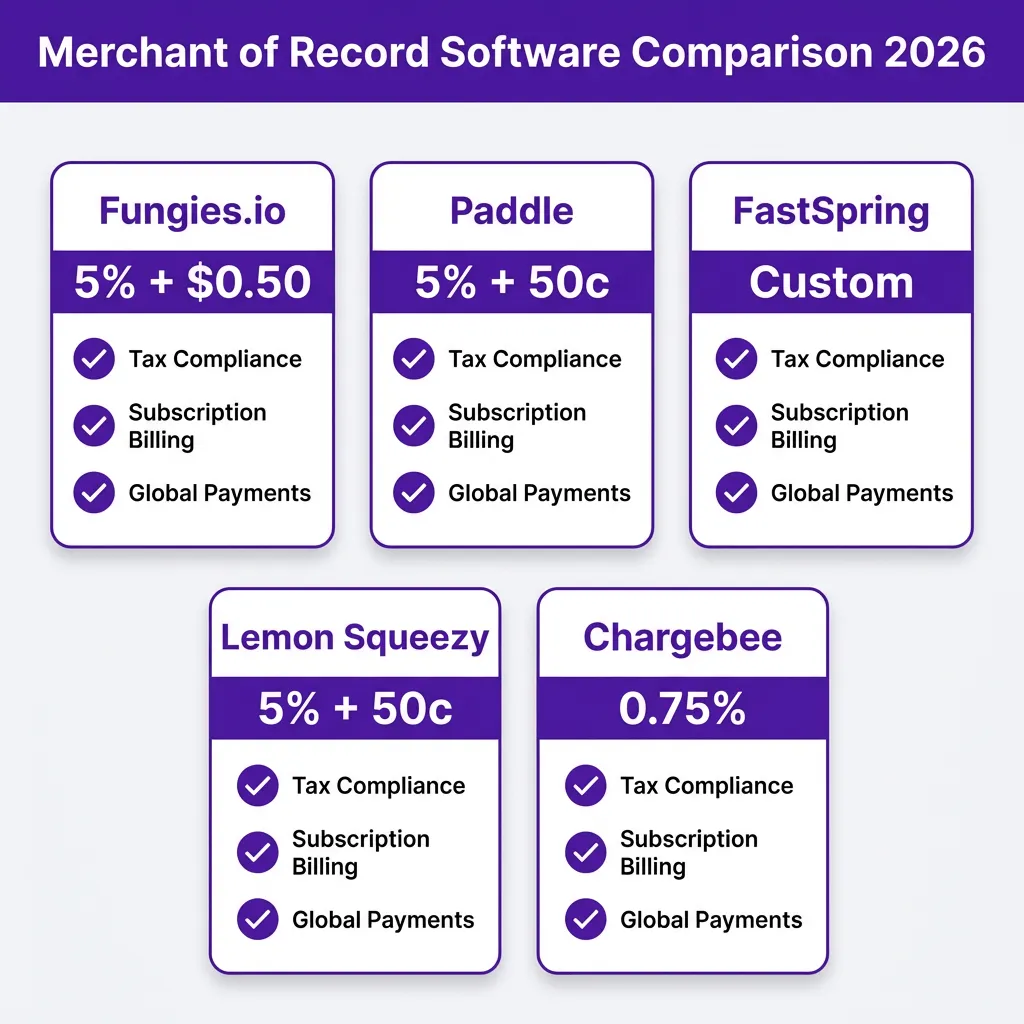
Pricing: 5% + $0.50 per transaction. No monthly fees. No setup costs.
Best For: Indie developers, micro-SaaS founders, and digital product creators who want a complete solution without monthly overhead. The transparent pricing and no-code setup make it ideal for teams that want to launch fast and scale gradually.
2. Paddle — Best for Established B2C SaaS
Paddle has been the default choice for SaaS companies wanting MoR protection since 2012. They’re the mature option with proven scale — processing billions in transactions annually.
Key Features:
- Full Merchant of Record services across 240+ countries
- Subscription billing with advanced retention tools
- Usage-based and hybrid billing models
- Paddle Retention (automated churn recovery)
- Comprehensive analytics and revenue reporting
- Migrations team for moving from other platforms
Pricing: Custom pricing based on volume. Typically 5% + 50¢ for smaller merchants, with volume discounts available.
Best For: Established B2C SaaS companies with proven product-market fit and consistent revenue. Paddle’s advanced features and retention tools shine when you have significant subscriber volume to optimize.
3. FastSpring — Best for Enterprise Software
FastSpring brings decades of experience in software commerce, with particular strength in handling complex enterprise requirements and global tax scenarios.
Key Features:
- Full MoR with global tax compliance
- Support for complex pricing models (tiered, volume, usage)
- B2B invoicing and quote-to-cash workflows
- Multi-currency support with localized pricing
- Advanced fraud protection and chargeback management
- Professional services for implementation
Pricing: Custom quote-based pricing. Enterprise-focused, typically higher than self-serve alternatives.
Best For: Enterprise software companies, B2B SaaS with complex sales cycles, and businesses needing professional implementation support. FastSpring excels when you have unique requirements that off-the-shelf solutions can’t handle.
4. Lemon Squeezy — Best for Creator-Led Products
Lemon Squeezy built its reputation on simplicity and design. It became the darling of indie hackers and creators before its acquisition by Stripe in 2024.
Key Features:
- Clean, modern interface for store management
- Full MoR with automated tax compliance
- Affiliate program built-in
- License key management for software
- Email marketing integrations
- Beautiful, customizable checkout experiences
Pricing: 5% + 50¢ per transaction. No monthly fees.
Best For: Creator-led products, design-focused SaaS, and founders who prioritize user experience. Note that the Stripe acquisition has created some uncertainty about future pricing and features.
5. Chargebee — Best for Complex Subscription Management
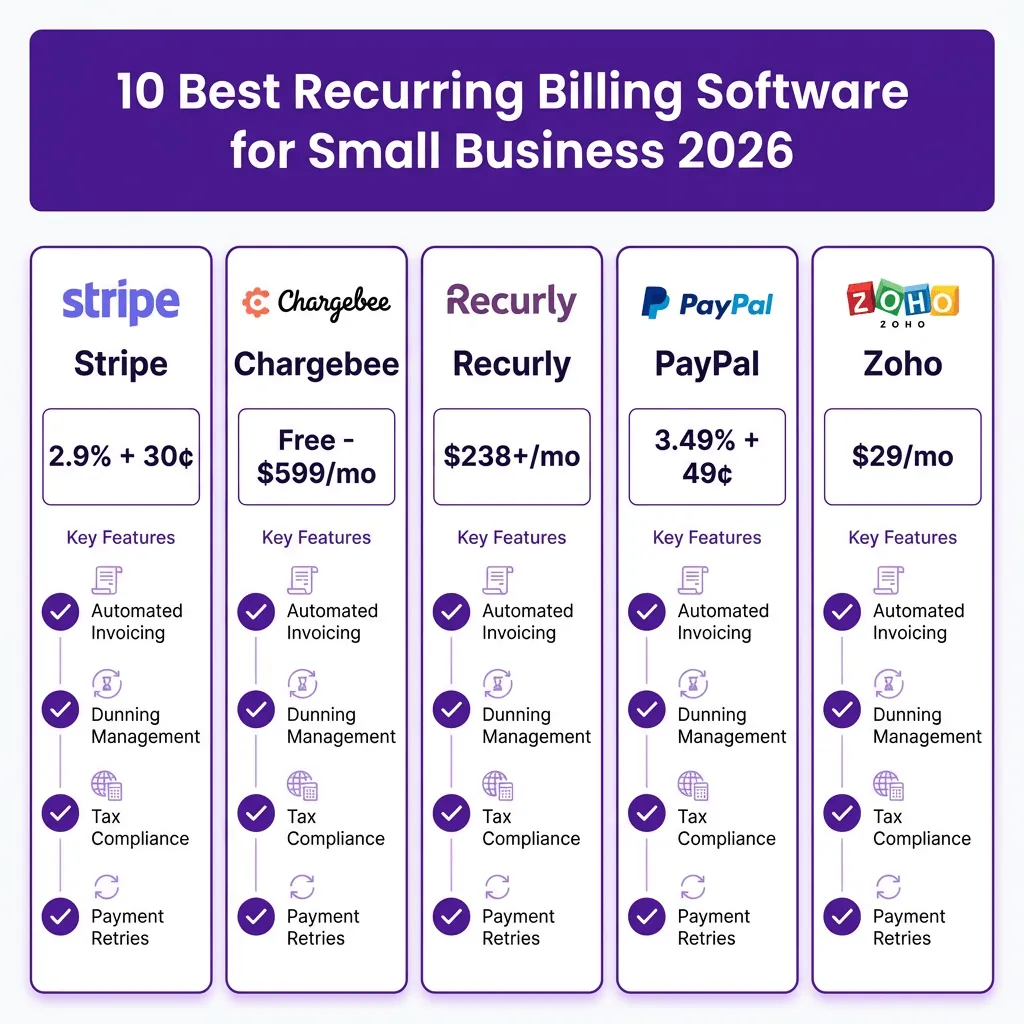
Chargebee isn’t a pure MoR — it’s a subscription management platform that can integrate with various payment processors. But its billing capabilities are sophisticated enough that many SaaS companies pair it with Stripe Tax for MoR-like compliance.
Key Features:
- Advanced subscription management (upgrades, downgrades, proration)
- Usage-based and hybrid billing models
- Revenue recognition and financial reporting
- 480+ subscription billing scenarios handled
- Dunning management and churn prevention
- Multi-entity support for global companies
Pricing: Free up to $250K in cumulative billing, then 0.75% on billing. Revenue Recognition add-on is additional.
Best For: SaaS companies with complex billing needs that outgrow simple MoR solutions. If you have multiple plans, usage components, and sophisticated pricing tiers, Chargebee provides the flexibility you need.
6. Recurly — Best for Subscription Retention
Recurly focuses specifically on subscription billing and retention, with industry-leading dunning management and churn reduction tools.
Key Features:
- Subscription billing with plan management
- Industry-leading dunning and payment recovery
- Revenue recognition and analytics
- Subscription analytics and cohort reporting
- Machine learning-based churn prediction
- Multiple gateway support (not locked to one processor)
Pricing: Custom pricing based on monthly recurring revenue.
Best For: Subscription businesses where retention is the primary concern. Recurly’s recovery tools can recapture 3-7% of revenue that would otherwise be lost to failed payments.
7. Maxio (formerly SaaSOptics + Chargify) — Best for B2B SaaS Finance
Maxio combines billing with financial operations, making it particularly strong for B2B SaaS companies that need GAAP-compliant revenue recognition.
Key Features:
- Subscription and usage-based billing
- Revenue recognition automation (ASC 606 / IFRS 15 compliant)
- Financial reporting and SaaS metrics
- Contract management and order-to-cash
- Integration with major accounting systems
- Custom pricing and quoting workflows
Pricing: Starts at $599/month for up to $100K in monthly billings.
Best For: B2B SaaS companies with complex contract structures, usage-based pricing, and strict financial reporting requirements. The revenue recognition capabilities are enterprise-grade.
8. Stripe Billing + Stripe Tax — Best for Developer-First Teams
Stripe isn’t a true MoR — you’re still the merchant of record. But combining Stripe Billing with Stripe Tax gets you close to MoR functionality while maintaining full control.
Key Features:
- Developer-first APIs and extensive customization
- Subscription billing with metered usage support
- Stripe Tax for automated tax calculation and collection
- 135+ currencies and dozens of payment methods
- Stripe Revenue Recognition for financial reporting
- Massive ecosystem of integrations
Pricing: 2.9% + 30¢ per transaction (US cards) + 0.5% for Stripe Tax. International cards add 1%. Billing features have additional fees.
Best For: Developer-first teams who want maximum control and aren’t afraid of additional compliance complexity. You’ll still need to handle tax remittance yourself in most jurisdictions.
9. Cleverbridge — Best for High-Volume B2B
Cleverbridge targets enterprise B2B SaaS with a focus on complex sales cycles, renewal management, and net revenue retention optimization.
Key Features:
- Full MoR with global tax ownership
- B2B invoicing and quote management
- Subscription lifecycle management
- Renewal and expansion revenue tools
- Professional services and dedicated support
- Advanced analytics for revenue optimization
Pricing: Custom enterprise pricing.
Best For: Enterprise B2B SaaS with high-volume, complex sales processes. Cleverbridge shines when renewals and expansion revenue are critical to your growth strategy.
10. Dodo Payments — Best for Micro-SaaS and Indie Hackers
Dodo Payments is the newest entrant, positioning itself as a founder-friendly alternative with lower fees and modern tooling.
Key Features:
- Full MoR with global tax compliance
- AI-powered fraud detection
- Subscription and one-time billing
- Indian tax compliance specialization
- Modern API and webhooks
- Lower fees than established competitors
Pricing: 4% + 40¢ for US transactions, +1.5% for international, +0.5% for subscriptions.
Best For: Micro-SaaS founders and indie hackers who want MoR protection with lower fees. The pricing advantage adds up quickly for high-volume, low-margin businesses.
Comparison Table: Top Merchant of Record Software
| Platform | Transaction Fee | Monthly Fee | Tax Compliance | Best For |
|---|---|---|---|---|
| Fungies.io | 5% + $0.50 | None | Full MoR | Indie developers, small SaaS |
| Paddle | ~5% + 50¢ | None | Full MoR | Established B2C SaaS |
| FastSpring | Custom | Custom | Full MoR | Enterprise software |
| Lemon Squeezy | 5% + 50¢ | None | Full MoR | Creator-led products |
| Chargebee | 0.75% on billing | Free tier | Via Stripe Tax | Complex subscriptions |
| Recurly | Custom | Custom | Via integrations | Retention-focused SaaS |
| Maxio | Custom | $599+ | Via integrations | B2B finance teams |
| Stripe Billing | 2.9% + 30¢ + tax | Variable | Stripe Tax add-on | Developer-first teams |
| Cleverbridge | Custom | Custom | Full MoR | High-volume B2B |
| Dodo Payments | 4% + 40¢ | None | Full MoR | Micro-SaaS, indie hackers |
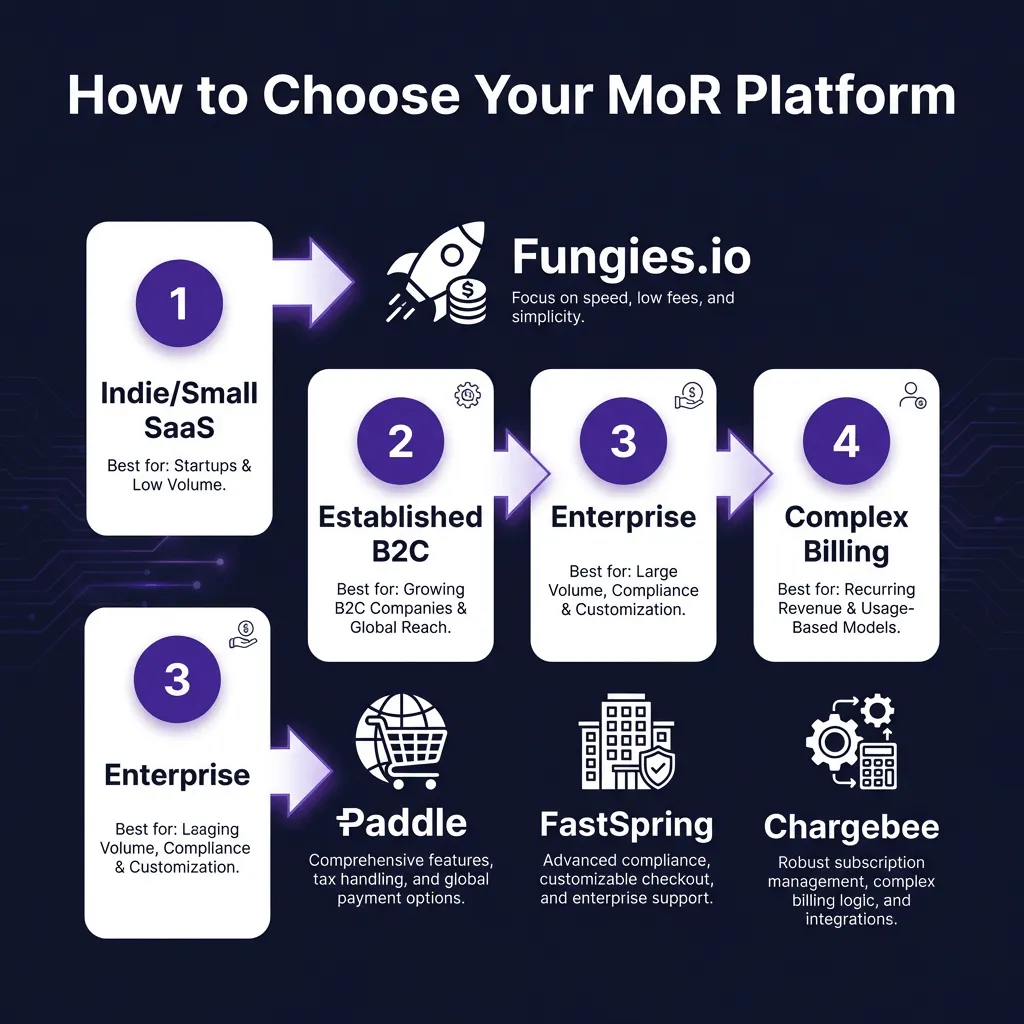
How to Choose the Right MoR Platform
Choose Fungies.io if: You’re an indie developer or small SaaS founder who wants a complete no-code solution with transparent pricing and no monthly fees.
Choose Paddle if: You have an established B2C SaaS with consistent revenue and need advanced retention tools.
Choose FastSpring if: You’re an enterprise software company with complex requirements and need professional implementation support.
Choose Chargebee if: Your billing needs are complex (usage-based, hybrid models) and you need sophisticated subscription management.
Choose Stripe if: You have a developer-first team that wants maximum control and doesn’t mind handling some compliance complexity.
FAQ
What’s the difference between a Merchant of Record and a payment processor?
A payment processor (like Stripe) handles the technical movement of money but leaves you responsible for tax compliance, fraud liability, and regulatory requirements. A Merchant of Record becomes the legal seller, assuming all those responsibilities.
Do I need an MoR if I’m only selling in one country?
If you’re only selling domestically and have a simple tax situation, a standard payment processor might suffice. But if you plan to expand internationally or want to eliminate compliance risk, an MoR provides valuable protection.
Can I switch MoR platforms later?
Yes, but migrations require careful planning to avoid disrupting active subscriptions. Most established MoRs offer migration services. Plan for 2-4 weeks of parallel operation during the transition.
Are there hidden fees with MoR platforms?
Most MoR platforms advertise transparent pricing, but watch for: currency conversion fees, chargeback fees, refund processing fees, and fees for premium support. Always read the full pricing page before committing.
What’s the total cost difference between MoR and DIY?
MoR platforms typically charge 4-6% per transaction. A DIY approach (payment processor + tax tool + compliance service) might cost 3-4% in fees but requires significant engineering and operational overhead. Factor in the cost of your time and compliance risk.
Conclusion
The right Merchant of Record platform depends on your stage, complexity, and risk tolerance. For most indie developers and small SaaS companies, Fungies.io offers the best balance of features, pricing, and simplicity.
If you’re ready to stop worrying about tax compliance and focus on growing your SaaS, get started with Fungies today. The 5% + $0.50 pricing means you only pay when you make money — no monthly fees eating into your runway while you build.
Sources
- Dodo Payments: 7 Best Paddle Alternatives
- UniBee: Paddle vs FastSpring Comparison
- Cleverbridge: Top Merchant of Record Providers 2026
- WithOrb: SaaS Billing Software Options
- Chargebee Pricing
- Maxio: Subscription Billing Software Reviews
- PayPro Global: MoR vs Payment Facilitator
- G2: Paddle Alternatives