Creator Economy Statistics 2026: Market Size, Data & Trends (Comprehensive Report)
The creator economy has evolved from a side-hustle curiosity into a half-trillion-dollar global industry. In 2026, more than 207 million people worldwide identify as content creators—and they are building businesses that rival traditional media in both revenue and cultural influence. This comprehensive report compiles verified data from Goldman Sachs, Grand View Research, Statista, and leading industry analysts to give you the definitive statistics on market size, creator earnings, platform dynamics, and emerging trends.
Key Statistics at a Glance
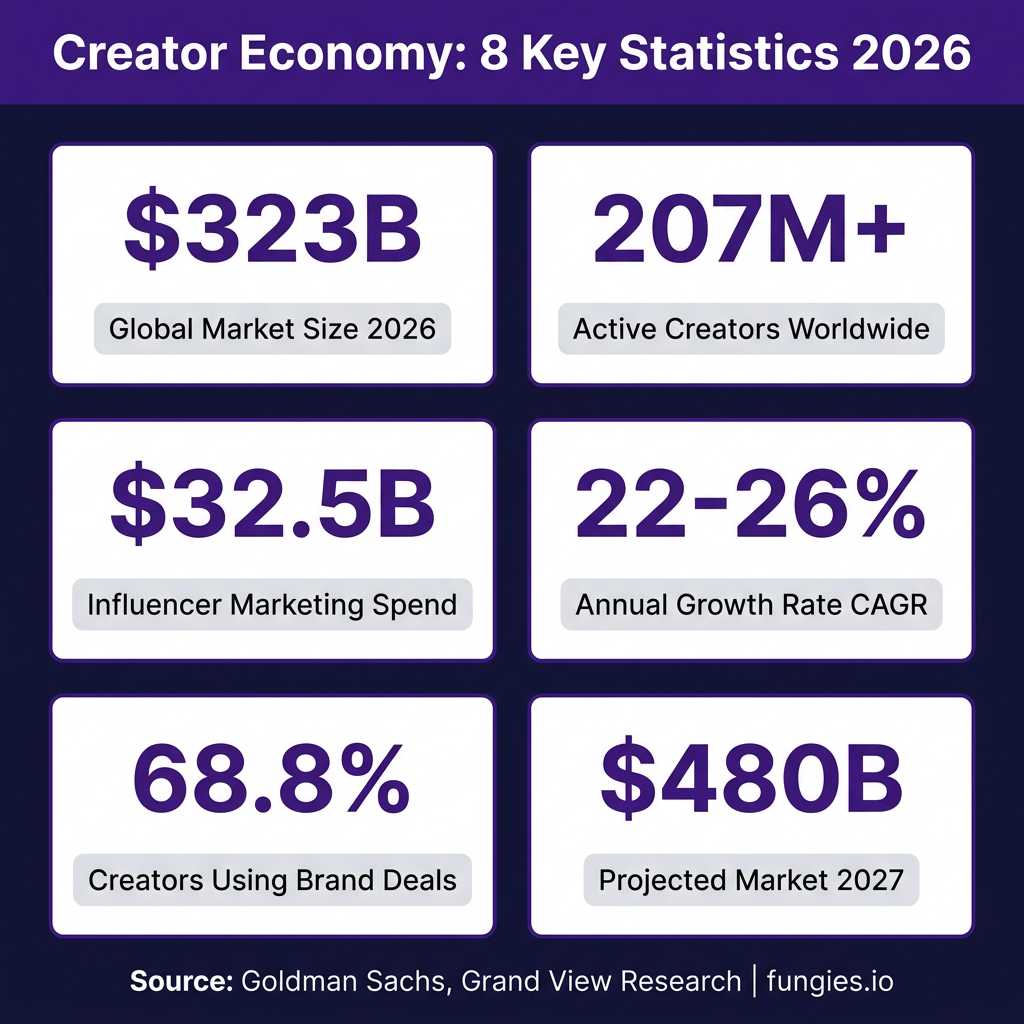
- The global creator economy reached $323.48 billion in 2026, up from $205.25 billion in 2024 (Research and Markets)
- Over 207 million active creators worldwide are monetizing content across platforms (Companies History)
- Influencer marketing spend hit $32.55 billion in 2026, growing at 33.11% CAGR (Archive.com)
- The market is projected to reach $480 billion by 2027 and $1.35 trillion by 2035 (Goldman Sachs, Research Nester)
- 68.8% of creators rely on brand deals as their primary revenue source (Exploding Topics)
- North America holds 34-38% of global market share, but Asia-Pacific is the fastest-growing region (Grand View Research)
- 86% of consumers made at least one influencer-driven purchase in the past year (Influee)
- Only 34% of creators earn their primary income from platform ads—diversification is essential (Statista via InfluenceFlow)
- YouTube generated over $60 billion in revenue in 2025, surpassing Netflix by 33% (SQ Magazine)
- Creator economy ad spend is growing 4x faster than the total media industry at 26% YoY (ShortsIntel)
Market Size & Growth
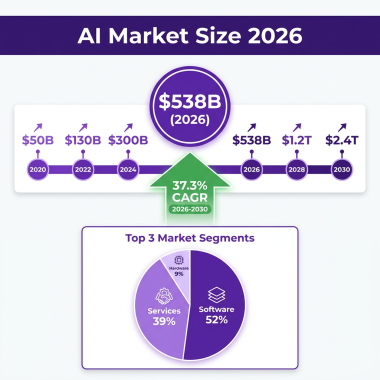
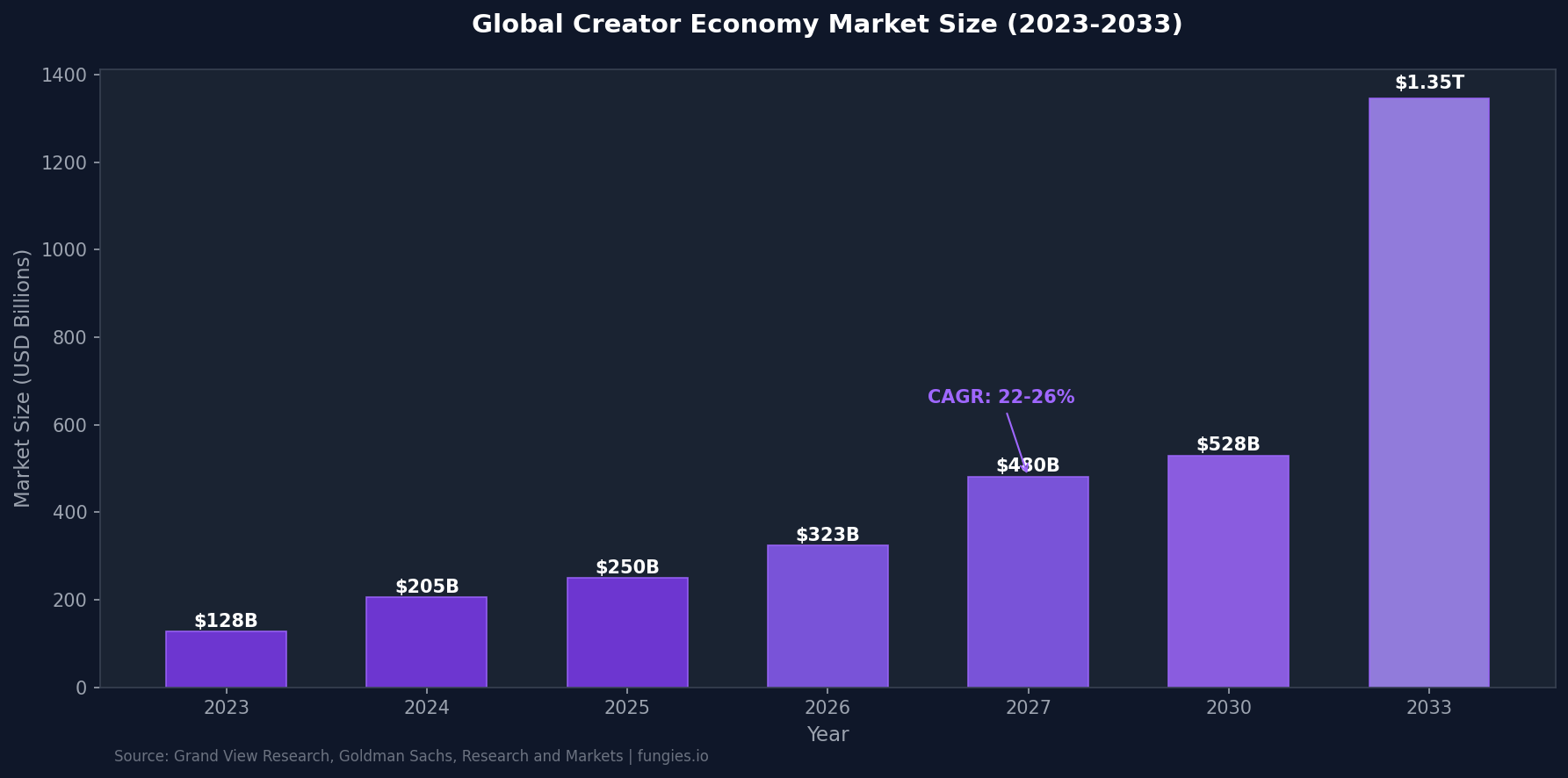
The creator economy growth trajectory is among the most aggressive in the global digital landscape. According to Grand View Research, the market was valued at $205.25 billion in 2024 and is projected to reach $1.35 trillion by 2033, representing a compound annual growth rate (CAGR) of 23.3%. Research and Markets provides a more conservative but still robust estimate of $323.48 billion for 2026, growing at 26.5% year-over-year.
Goldman Sachs Research projects the creator economy total addressable market could approach $480 billion by 2027—roughly double its 2023 baseline of $250 billion. This growth is fueled by several converging factors: the proliferation of high-performance digital infrastructure, the rise of AI-powered content creation tools, and the increasing professionalization of influencer marketing as a legitimate career path.
Creator Economy Market Size by Year
| Year | Market Size | Source |
|---|---|---|
| 2023 | $127.65 billion | Exploding Topics |
| 2024 | $205.25 billion | Grand View Research |
| 2025 | $250 billion | Goldman Sachs |
| 2026 | $323.48 billion | Research and Markets |
| 2027 (proj.) | $480 billion | Goldman Sachs |
| 2030 (proj.) | $528.39 billion | Exploding Topics |
| 2033 (proj.) | $1,345.54 billion | Grand View Research |
| 2035 (proj.) | $1.35 trillion | Research Nester |
Regional Breakdown
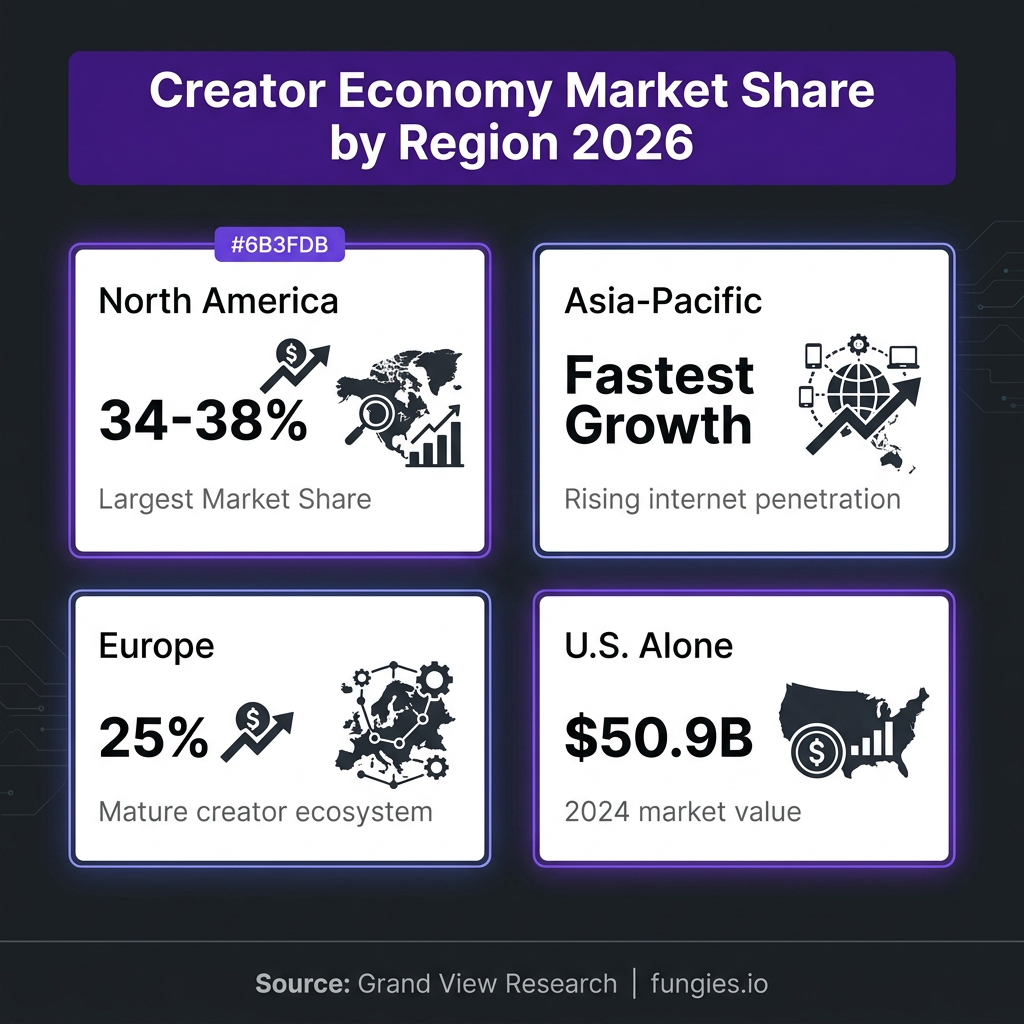
Geographic distribution of the creator economy reveals a market dominated by North America but rapidly diversifying across emerging economies. According to Grand View Research, North America accounted for 34.2% of global creator economy revenue in 2024, with the United States alone representing a $50.9 billion market.
Creator Economy Market Share by Region
| Region | Market Share (2024) | Growth Trajectory |
|---|---|---|
| North America | 34-38% | Stable, mature market |
| Europe | ~25% | Moderate growth |
| Asia-Pacific | ~22% | Fastest-growing region |
| Latin America | ~8% | Emerging opportunity |
| Middle East & Africa | ~5% | Early-stage growth |
Key Players & Platform Revenue
The creator economy ecosystem is dominated by a handful of platforms that have achieved the scale necessary to support meaningful creator monetization. According to data compiled by SQ Magazine, YouTube alone generated over $60 billion in revenue during 2025—surpassing Netflix by 33% and cementing its position as the largest creator platform by revenue.
Major Creator Platforms by Usage
| Platform | Creator Count | Primary Monetization | Brand Usage % |
|---|---|---|---|
| YouTube | 61.8 million | AdSense, memberships, Super Chat | 37% |
| ~50 million | Brand deals, Shop, subscriptions | 57% | |
| TikTok | ~40 million | Creator Fund, gifts, brand deals | 52% |
| Twitch | ~9 million | Subscriptions, bits, ads | 15% |
| Patreon | ~250,000 | Memberships | N/A |
Creator Earnings & Income Distribution
The income distribution within the creator economy follows a steep power law: a small percentage of creators earn the majority of revenue, while the long tail struggles to achieve sustainable income. According to data from Cookie Finance and Influencer Marketing Hub, half of all creators earn under $15,000 per year.
Creator Revenue Sources
| Revenue Source | % of Creators Using | Avg. Engagement Rate |
|---|---|---|
| Brand deals/sponsorships | 68.8% | 1.94% (paid), 2.19% (gifted) |
| Platform ad revenue | 34% | Varies by platform |
| Paid memberships | 54% | Higher retention |
| Subscriptions (recurring) | 41% | Stable income |
| Affiliate marketing | ~30% | Conversion-focused |
| Merchandise/products | ~25% | Direct-to-fan |
Influencer Marketing Spend & ROI
Brand investment in creator partnerships has reached unprecedented levels. The influencer marketing industry reached $32.55 billion in 2026 with a 33.11% compound annual growth rate, according to Archive.com. U.S. influencer marketing spend alone is projected at $12.17 billion for 2026 (Statista).
The return on investment justifies this spending: influencer marketing returns an average of $5.78 for every $1 spent, making it one of the highest-ROI digital marketing channels available (Influee).
Influencer Marketing Performance by Creator Tier
| Creator Tier | Follower Count | Engagement Rate | % of Instagram Base |
|---|---|---|---|
| Nano | 1K-10K | 2.71% | 75.9% |
| Micro | 10K-100K | 1.8% | ~18% |
| Macro | 100K-1M | 1.2% | ~5% |
| Mega | 1M+ | 0.8% | <1% |
Trends & Predictions (2026-2030)
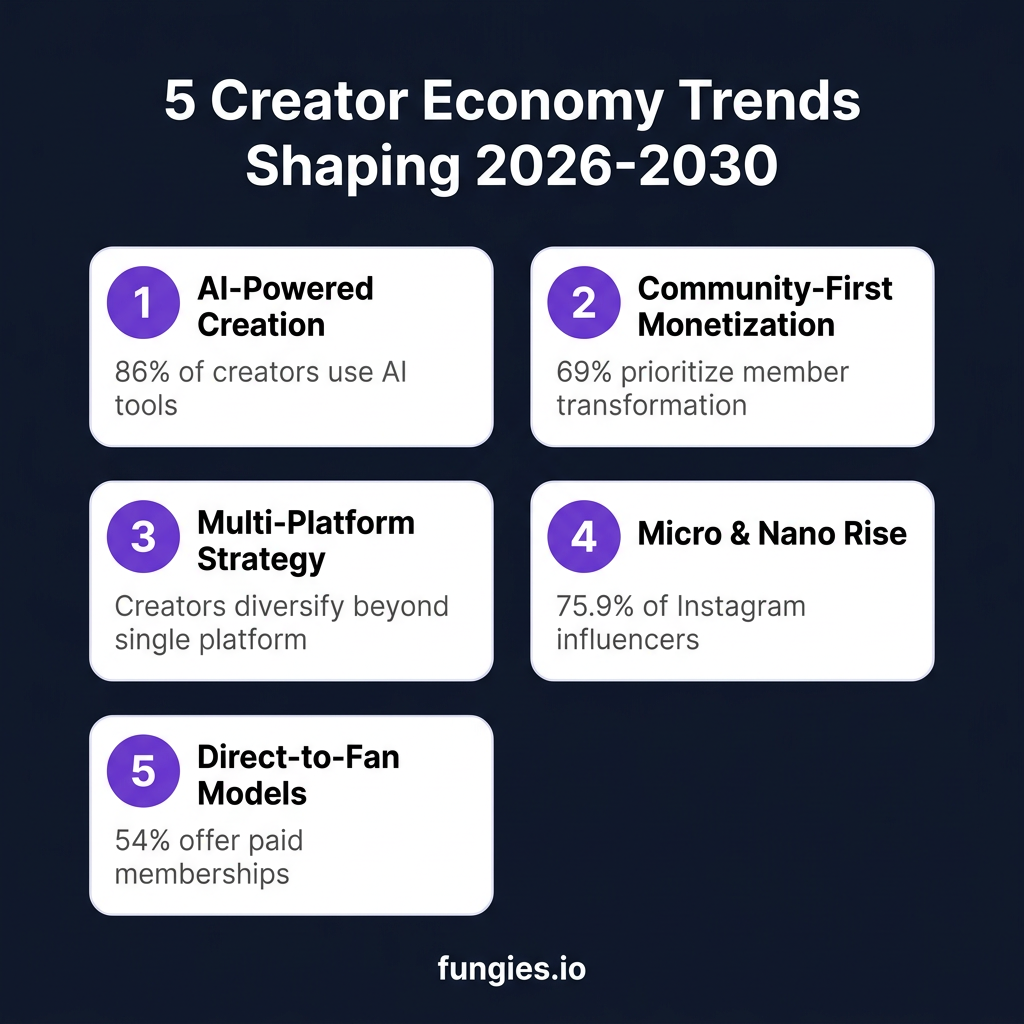
Several macro trends are reshaping the creator economy landscape. Understanding these shifts is essential for creators, platforms, and brands seeking to maintain competitive advantage.
1. AI-Powered Content Creation
According to Adobe 2025 survey of over 16,000 creators, 86% already use generative AI tools in their workflows. AI is being deployed for content ideation, editing automation, personalization at scale, and even synthetic media creation.
2. Community-First Monetization
The fastest-growing monetization models in 2026 are those that “compress the distance between value creation and value capture” (Circle). Survey data shows 69% of creators now prioritize member transformation over vanity metrics like follower counts.
3. Multi-Platform Diversification
Following TikTok regulatory uncertainty in the U.S. market, creators are aggressively diversifying across platforms. The era of single-platform dependence is ending.
4. The Rise of Micro and Nano Creators
Nano-influencers (1K-10K followers) now represent 75.9% of Instagram influencer base and deliver the highest engagement rates at 2.71%. Brands are increasingly recognizing that smaller, highly-engaged audiences often deliver better ROI than celebrity partnerships.
5. Professionalization and Operational Complexity
Creators are evolving from content producers into full-stack business operators. As Circle notes, “solo creators increasingly function as full-stack operators, overseeing monetization, member lifecycle design, and analytics.”
Creator Demographics
The creator economy is diversifying beyond the stereotypical young influencer demographic. According to Zippia, the average age of content creators is 30-40 years old, representing 43% of the creator population. Perhaps more surprisingly, Forbes reports that as of 2025, around 30 million Americans aged 62 and older actively use social media, with 9-12 million contributing as content creators or “granfluencers.”
Methodology
This report synthesizes data from multiple authoritative sources to provide a comprehensive view of the creator economy in 2026. Market size figures are derived from analyst reports published by Grand View Research, Goldman Sachs Research, Research and Markets, Research Nester, Coherent Market Insights, and Precedence Research. Platform and revenue data comes from Statista, Circle, Influencer Marketing Hub, and The Influencer Marketing Factory.
Frequently Asked Questions
How big is the creator economy in 2026?
The global creator economy reached approximately $323.48 billion in 2026, according to Research and Markets. Other analysts provide varying estimates: Grand View Research cites $205.25 billion for 2024 with projections of $1.35 trillion by 2033, while Goldman Sachs projects the market could approach $480 billion by 2027.
How many content creators are there worldwide?
There are over 207 million active creators worldwide as of 2026. This includes professional creators who earn their primary income from content as well as part-time creators who monetize as a side hustle.
What percentage of creators make a living from content creation?
Only a small percentage of creators earn sustainable full-time income. According to Cookie Finance data, half of all creators earn under $15,000 per year. However, the professional creator class is growing rapidly as monetization tools and brand investment mature.
Which platform pays creators the most?
YouTube generally pays the most in 2026 due to its established revenue share model, multiple monetization options (AdSense, memberships, Super Chat, Shopping), and high RPMs for certain niches. Finance and business content on YouTube earns $15-50 per 1,000 views.
What is the ROI of influencer marketing?
Influencer marketing returns an average of $5.78 for every $1 spent, making it one of the highest-ROI digital marketing channels available. This performance has driven 74% of marketers to plan budget increases for creator partnerships in 2026.
Sources & Citations
- Grand View Research – Creator Economy Market Size, Share & Trends Report 2025-2033
- Goldman Sachs Research – The creator economy could approach half-a-trillion dollars by 2027
- Research and Markets – Creator Economy Market Report 2026
- Research Nester – Creator Economy Market Size & Share Forecast 2026-2035
- Coherent Market Insights – Global Creator Economy Market Analysis
- Companies History – Creator Economy Statistics And Market Size 2026
- Exploding Topics – Creator Economy Market Size (2025-2030)
- Circle – Creator Economy Statistics for 2026
- Archive.com – 14 Influencer Marketing Growth Statistics for 2026
- Influee – Influencer Marketing Statistics for 2026
- Digital Applied – Influencer Marketing Statistics 2026
- Statista – U.S. influencer marketing spend 2021-2027
- InfluenceFlow – Creator Earnings Reports Guide 2026
- SQ Magazine – Creator Economy Statistics 2026
- ShortsIntel – Creator Economy Statistics 2026
- Behind the Scenes – Creator Economy Statistics 2026
- ThriveCart – The State of the Global Creator Economy 2025-26
- Technavio – Creator Economy Market Analysis 2026-2030
- Precedence Research – Creator Economy Market Size
- Forrester – The State Of The Creator Economy
- Forbes – A Surprising New Demographic Of Social Media Content Creators
- Zippia – Content creator demographics and statistics in the US
Last updated: May 27, 2026. Data represents the most recent available statistics from cited sources.