Digital Goods Tax Statistics 2026: Global VAT, Compliance Costs & Digital Services Tax (Comprehensive Report)
The taxation of digital goods and services has become one of the most complex challenges facing global businesses in 2026. With the EU VAT gap reaching €128 billion and over 110 countries now requiring VAT registration for foreign digital service providers, understanding digital tax obligations isn’t optional—it’s a business imperative. This comprehensive report presents 40+ verified statistics on digital goods taxation, from VAT compliance gaps to Digital Services Tax revenues, giving you the data you need to navigate this evolving landscape.
Key Statistics at a Glance
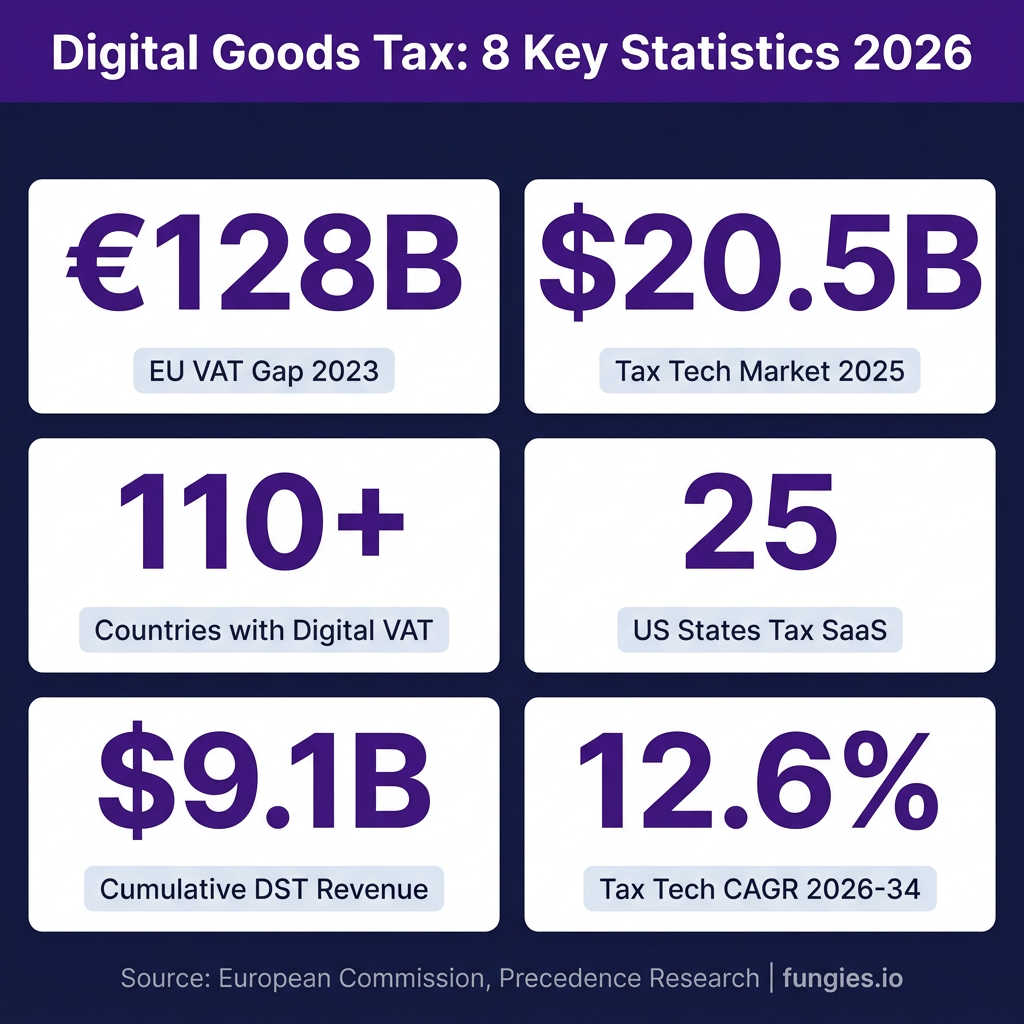
- The EU VAT gap reached €128 billion in 2023, representing 9.5% of total VAT liability (European Commission)
- The global tax tech market was valued at $20.5 billion in 2025 and is projected to reach $60.7 billion by 2034 (Precedence Research)
- Over 110 countries now require foreign digital service providers to register for VAT/GST (Fonoa)
- 25 US states now tax SaaS products in some form, up from 22 in early 2024 (Anrok)
- Cumulative Digital Services Tax revenue reached $9.1 billion across UK, France, Italy, Spain, and Austria from 2020-2024 (CCIA)
- The indirect tax compliance software market is projected to grow from $8.4 billion in 2025 to $21.6 billion by 2034 (DataIntelo)
- Hungary has the world’s highest VAT rate at 27% for digital services (CountryTaxCalc)
- The tax management software market is growing at a CAGR of 11.8% from 2026-2034 (Fortune Business Insights)
Market Size & Growth
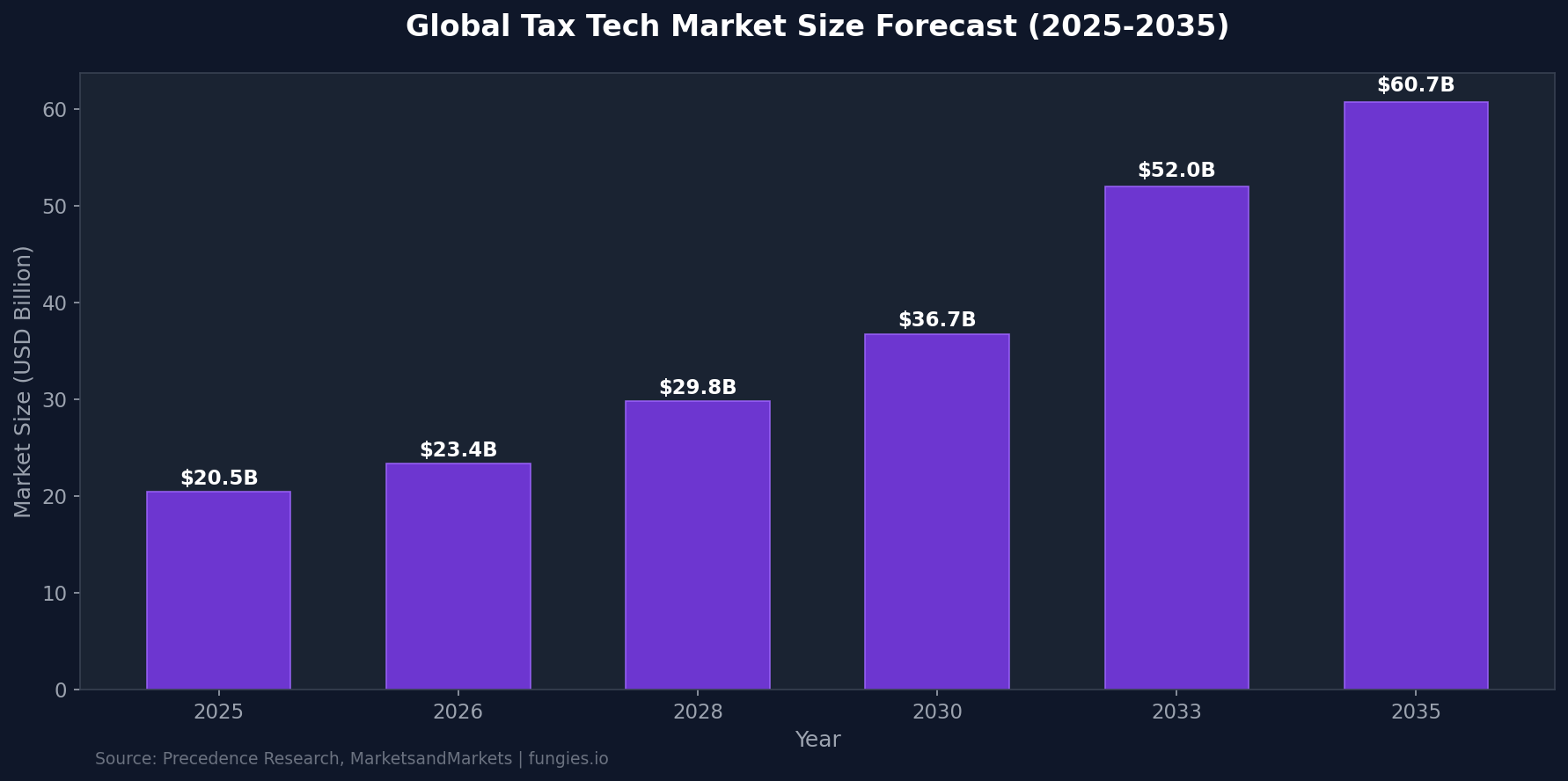
The digital tax landscape is experiencing unprecedented growth as governments worldwide rush to capture revenue from the expanding digital economy. According to Precedence Research, the global tax tech market was valued at $20.78 billion in 2025 and is projected to reach approximately $60.66 billion by 2034, expanding at a compound annual growth rate (CAGR) of 12.64%.
This growth is driven by escalating regulatory complexity, the global proliferation of e-invoicing mandates, and widespread enterprise adoption of cloud-native tax automation platforms. The Research and Markets Tax Tech Market report projects growth from $18.53 billion in 2024 to $36.72 billion by 2030 at a CAGR of 12.1%.
According to Fortune Business Insights, the tax management software market was valued at $20.26 billion in 2025 and is projected to grow from $22.97 billion in 2026 to $56.02 billion by 2034, exhibiting a CAGR of 11.80%. North America dominated the global market with a share of 34.70% in 2025.
| Market Segment | 2025 Value | 2034 Projection | CAGR |
|---|---|---|---|
| Tax Tech Market | $20.5B | $60.7B | 12.6% |
| Tax Management Software | $20.3B | $56.0B | 11.8% |
| Indirect Tax Compliance Software | $8.4B | $21.6B | 11.1% |
| Tax Compliance Software (Overall) | $24.5B | $59.3B | 12.9% |
Regional Breakdown: VAT & Digital Tax by Geography
The European Union faces the most significant VAT compliance challenge. According to the European Commission’s VAT Gap Report 2025, the estimated VAT compliance gap in the EU for 2023 amounted to approximately €128 billion, corresponding to around 9.5% of total VAT liability. This represents a concerning reversal in previous improvement trends.
The VAT gap varies significantly across member states. Romania and Ireland showed major increases in their VAT gaps, while countries like Bulgaria (1.2%), Estonia (1.6%), and Croatia (1.8%) maintain the smallest policy-mandated exemption gaps. Portugal (5.6%) and Belgium (5%) show the highest exemption gaps.
In the United States, the landscape is fragmented. As of 2025, SaaS is taxable in some form in 25 US jurisdictions—a 14% increase from 22 jurisdictions at the beginning of 2024. With approximately 50% of US states now taxing SaaS, compliance complexity has never been higher. States like Washington, Hawaii, and Texas treat SaaS as a digital product, while California and Florida classify it as a non-taxable service.
| Region | Key Statistic | Source |
|---|---|---|
| European Union | €128B VAT gap (9.5% of liability) | European Commission 2025 |
| United States | 25 states tax SaaS (50% of states) | Anrok 2025 |
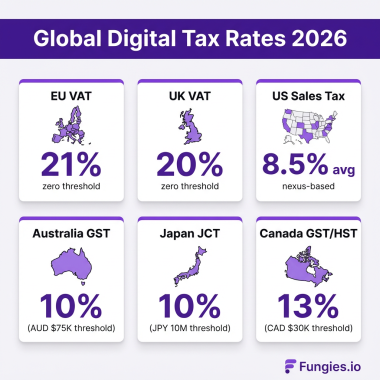
| United Kingdom | 20% VAT on digital services | HMRC |
| Australia | 10% GST, AUD 75,000 threshold | Australian Taxation Office |
| Canada | 5% GST + provincial taxes | Canada Revenue Agency |
| Global | 110+ countries with digital VAT/GST | Fonoa |
Digital Services Tax: Revenue & Implementation
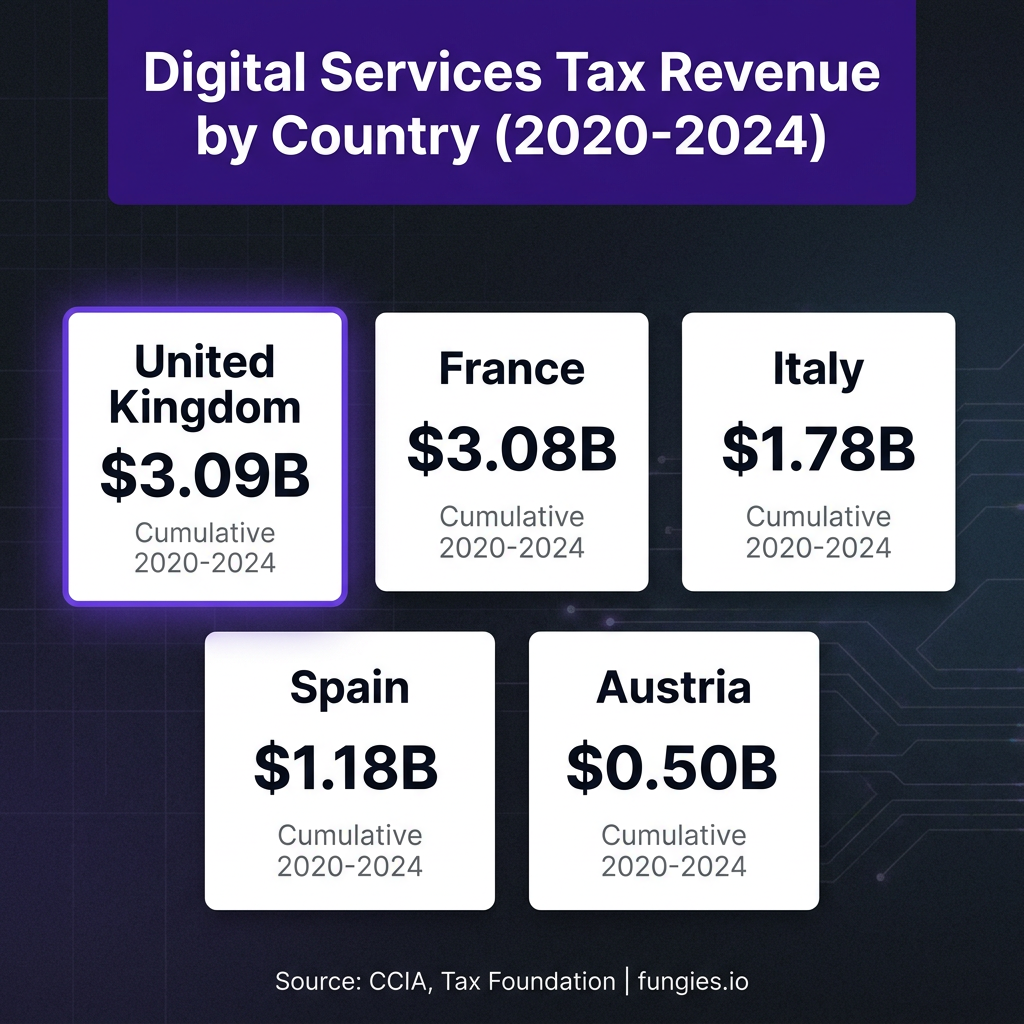
Digital Services Taxes (DSTs) represent a distinct approach to taxing the digital economy, targeting gross revenues of large digital companies rather than profits. According to CCIA research, cumulative DST payments across key markets reached $9.127 billion from 2020-2024.
The United Kingdom leads in DST revenue collection, having gathered $3.092 billion cumulatively from 2020-2024. France follows closely at $3.084 billion, with Italy at $1.776 billion, Spain at $1.175 billion, and Austria at $0.499 billion.
France was the first European country to implement a DST in January 2019, applying a 3% tax on revenues from digital interface provision and advertising services based on user data. The tax applies to companies with global revenues exceeding €750 million and French revenues above €25 million.
Canada’s Digital Services Tax Act was enacted on June 20, 2024, imposing a 3% tax on Canadian digital services revenue exceeding CA$20 million. However, in June 2025, Canada announced it would rescind the DST to advance broader trade negotiations with the United States. The Parliamentary Budget Officer had estimated Canada would collect $2.7 billion in retroactive payments in 2025, with $5.3 billion projected by 2028.
| Country | DST Rate | Effective From | Cumulative Revenue (2020-2024) |
|---|---|---|---|
| United Kingdom | 2% (was 2.5%) | April 2020 | $3.092B |
| France | 3% | January 2019 | $3.084B |
| Italy | 3% | January 2020 | $1.776B |
| Spain | 3% | January 2021 | $1.175B |
| Austria | 5% | January 2020 | $0.499B |
| Turkey | 7.5% (was 15%) | March 2020 | Data N/A |
Industry Benchmarks & Compliance Costs
Understanding compliance costs is essential for businesses operating across multiple jurisdictions. According to DataIntelo, the indirect tax compliance software market—specifically focused on VAT, GST, and sales tax—was valued at $8.4 billion in 2025 and is projected to reach $21.6 billion by 2034, expanding at a CAGR of 11.1%.
The cost of non-compliance can be severe. In the UK, HMRC can charge a maximum penalty of up to £3,000 per quarter if a business doesn’t follow Making Tax Digital requirements. Late submission penalties under the points-based system include £200 when reaching the penalty point threshold.
For SaaS companies, the compliance burden is particularly acute. Each state in the US sets its own rules, and the differences matter significantly once economic nexus is established. Economic nexus thresholds vary by state, typically triggering at $100,000 in annual revenue or 200 transactions.
| Metric | Value | Context |
|---|---|---|
| Indirect Tax Software Market 2025 | $8.4B | VAT/GST/Sales tax focus |
| Projected 2034 Value | $21.6B | 11.1% CAGR |
| UK MTD Penalty (Max) | £3,000/quarter | Non-compliance |
| UK Late Filing Penalty | £200 | At threshold |
| Cloud Deployment Share | 65.3% | Tax software market 2026 |
| Software Segment Share | 72.9% | Tax management market |
Trends & Predictions: 2026-2030
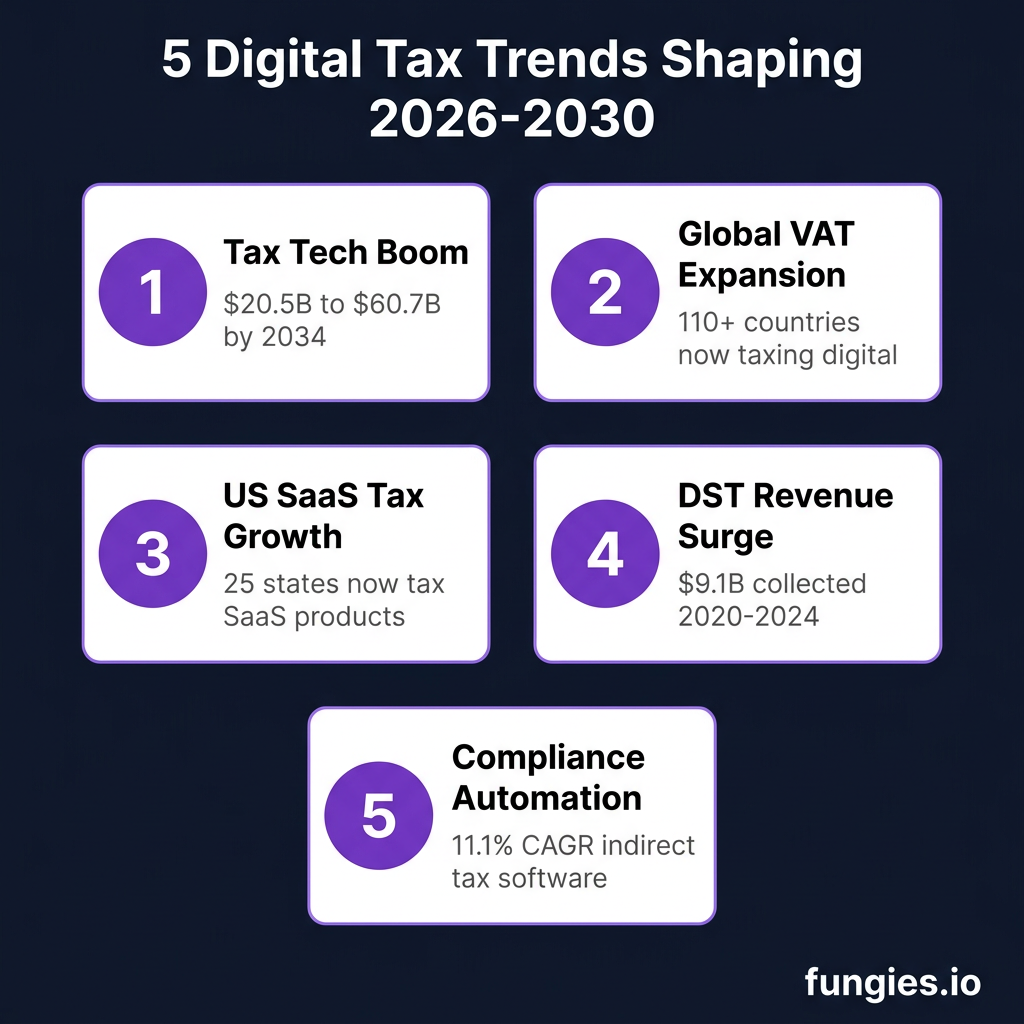
Several key trends are shaping the digital tax landscape through 2030:
1. Accelerated Tax Tech Adoption: The tax tech market is projected to grow at a 12.6% CAGR through 2034, driven by AI-powered compliance solutions and real-time reporting requirements. According to MarketsandMarkets, the tax management market will expand from $24.52 billion in 2025 to $33.21 billion by 2030.
2. Global VAT/GST Expansion: Over 110 countries now require foreign digital service providers to register for VAT/GST. New entrants in 2025-2026 include the Philippines (12% VAT from June 2025), Sri Lanka (18% VAT), and Ecuador (VAT registration for digital providers from January 2025).
3. US State SaaS Tax Proliferation: With 25 states now taxing SaaS and more considering legislation, US tax complexity continues to increase. States are redefining “taxable software” to capture cloud-based services.
4. DST Evolution: While the OECD Pillar One framework was intended to replace unilateral DSTs, implementation delays mean existing DSTs continue generating revenue. The UK, France, Italy, and Spain have collected over $9 billion cumulatively.
5. Compliance Automation: E-invoicing mandates are proliferating globally, requiring real-time or near-real-time transaction reporting. This drives demand for automated tax solutions that integrate with ERP and billing systems.
Methodology
This report compiles data from authoritative sources including the European Commission’s VAT Gap Report 2025, CCIA Digital Services Tax research, Precedence Research tax tech market analysis, and industry-specific studies from Anrok, Avalara, and Fonoa. Statistics represent the most current available data as of July 2026.
Market size figures are derived from analyst reports using varying methodologies; we present ranges where sources differ. DST revenue figures are converted to USD at historical exchange rates. VAT gap calculations follow European Commission methodology comparing theoretical VAT liability to actual collections.
Frequently Asked Questions
What is the difference between VAT on digital services and Digital Services Tax (DST)?
VAT on digital services is a consumption tax applied to the value of digital goods and services, similar to VAT on physical products. Digital Services Tax (DST) is a separate tax on gross revenues of large digital companies, typically targeting online advertising, digital interfaces, and user data monetization. Over 110 countries have VAT/GST on digital services, while only a handful have implemented DSTs.
How many US states tax SaaS products?
As of 2025, 25 US states tax SaaS products in some form—approximately 50% of all states. This represents a 14% increase from 22 states at the beginning of 2024. Taxability varies by state, with some treating SaaS as a digital product, others as a taxable service, and some exempting it entirely.
What is the EU VAT gap and why does it matter?
The EU VAT gap is the difference between expected VAT revenue and actual collections. In 2023, this gap reached €128 billion, representing 9.5% of total VAT liability. It matters because it indicates significant revenue loss due to fraud, tax evasion, avoidance, and administrative errors—driving stricter enforcement measures.
Which countries generate the most Digital Services Tax revenue?
The United Kingdom leads with $3.092 billion in cumulative DST revenue from 2020-2024, followed closely by France at $3.084 billion. Italy ($1.776B), Spain ($1.175B), and Austria ($0.499B) round out the top five. Combined, these five countries have collected over $9.1 billion in DST revenue.
How fast is the tax technology market growing?
The tax tech market is growing at a CAGR of 12.6% (2026-2034), projected to expand from $20.5 billion in 2025 to $60.7 billion by 2034. The indirect tax compliance software segment specifically is growing at 11.1% CAGR, driven by regulatory complexity and e-invoicing mandates.
Sources & Citations
- European Commission VAT Gap Report 2025: https://op.europa.eu/en/publication-detail/-/publication/b5c7403b-d67f-11f0-8da2-01aa75ed71a1/language-en
- Precedence Research Tax Tech Market Report: https://www.precedenceresearch.com/tax-tech-market
- CCIA Status of Key Digital Services Taxes: https://ccianet.org/wp-content/uploads/2025/07/Status-of-Key-Digital-Services-Taxes-in-July-2025.pdf
- Fortune Business Insights Tax Management Software: https://www.fortunebusinessinsights.com/tax-management-software-market-102631
- DataIntelo Indirect Tax Compliance Software: https://dataintelo.com/report/indirect-tax-compliance-software-market
- Anrok SaaS Sales Tax Guide: https://www.anrok.com/saas-sales-tax-by-state
- Fonoa Global VAT & GST Guide: https://www.fonoa.com/resources/blog/global-vat-and-gst-on-digital-services
- MarketsandMarkets Tax Management Market: https://www.marketsandmarkets.com/Market-Reports/tax-management-market-230446693.html
- Tax Foundation Digital Services Taxes Europe: https://taxfoundation.org/data/all/eu/digital-services-taxes-europe
- Global VAT Compliance Digital Services VAT 2026: https://www.globalvatcompliance.com/globalvatnews/digital-services-vat-2026
- Avalara Global VAT on Digital Services: https://www.avalara.com/us/en/vatlive/global-vat-gst-on-e-services.html
- Canada Parliamentary Budget Officer DST Analysis: https://www.pbo-dpb.ca/en/publications/LEG-2324-013-S–digital-services-tax–taxe-services-numeriques
- 1stopVAT EU VAT Gap Analysis: https://1stopvat.com/european-commission-vat-gap-report-2025-eu-faces-billions-in-lost-vat-revenue
- InsightAce Analytic Tax Tech Market: https://www.insightaceanalytic.com/report/tax-tech-market/3005
- Coherent Market Insights Tax Management Software: https://www.coherentmarketinsights.com/industry-reports/tax-management-software-market
Last updated: July 5, 2026. For businesses selling digital products globally, platforms like Fungies.io handle VAT, GST, and sales tax compliance automatically—removing the complexity of multi-jurisdictional tax obligations.