The digital product market is exploding — $157.4 billion globally in 2026, growing at 26.6% annually. Whether you’re selling ebooks, templates, music, courses, or software, digital downloads offer the ultimate business model: create once, sell infinitely, with zero inventory costs. But here’s the reality most guides won’t tell you: 80% of digital creators never make their first sale because they skip the foundational steps that actually matter.
In this complete guide, you’ll learn the exact framework successful creators use to go from idea to first sale — and beyond. No fluff, no generic advice. Just proven strategies that work in today’s market.
Why Digital Downloads Are the Perfect Business Model in 2026
Before diving into the how, let’s understand the why. Digital products have distinct advantages that physical products simply can’t match:
- Infinite scalability: Sell 1 copy or 100,000 — your costs stay the same
- Instant delivery: Customers get their purchase immediately, 24/7
- Global reach: Sell to anyone, anywhere without shipping logistics
- Higher margins: 70-95% profit margins vs. 20-40% for physical products
- Passive income potential: Create once, earn for years
The barriers to entry have never been lower. With free tools and platforms, you can launch a digital product business this weekend with less than $50 in startup costs. But low barriers also mean high competition — which is why strategy matters more than ever.
Step 1: Choose Your Profitable Niche
The biggest mistake new creators make? Building a product, then looking for buyers. Flip that script. Start with a specific audience and their burning problem. The most profitable digital product niches in 2026 fall into three categories:
High-Demand Digital Product Categories
- Productivity & Organization: Notion templates, planners, workflow systems ($15-75 price range)
- Creative Assets: Design templates, fonts, LUTs, stock photos, 3D models ($10-150 price range)
- Knowledge Products: Ebooks, courses, tutorials, guides ($27-997 price range)
- Software & Tools: Plugins, apps, scripts, spreadsheets ($19-299 price range)
- Entertainment: Music, sound effects, game assets, digital art ($5-50 price range)
The sweet spot? Products that solve expensive problems for buyers with purchasing power. A $49 Notion template that saves a consultant 10 hours per month is an easy sell. A $5 generic wallpaper pack is not.
Step 2: Create a Product People Actually Want
Here’s the validation framework that separates successful creators from the 80% who fail:
The 3-Step Validation Process
- Research demand: Check Google Trends, Reddit communities, and competitor reviews. Are people actively searching for solutions? What are their pain points?
- Pre-sell before building: Create a landing page with mockups and collect pre-orders. If 10+ people pay before you build, you have a winner.
- Start small, iterate fast: Launch a minimum viable product (MVP) in 2-3 weeks, not 2-3 months. Get real feedback from paying customers.
Quality matters, but perfectionism kills more businesses than poor products. Your first version won’t be your best — and that’s okay. Real-world feedback beats endless tweaking every time.
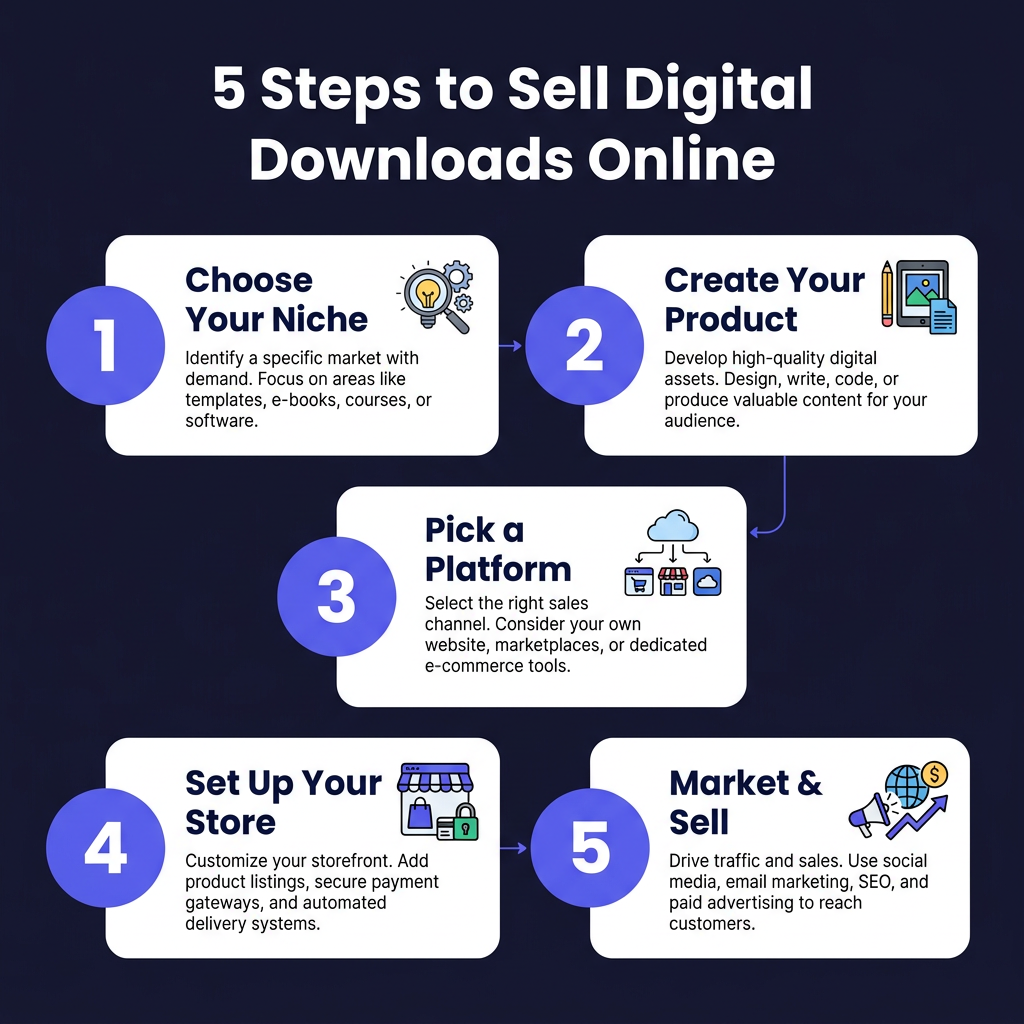
Step 3: Choose the Right Platform
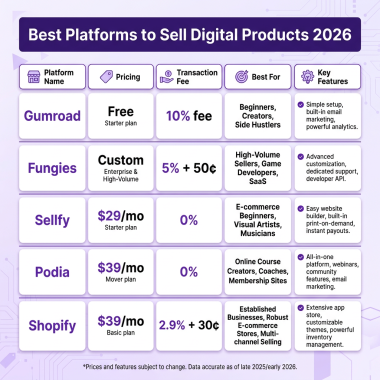
Your platform choice impacts everything: fees, branding, customer experience, and scalability. Here’s the breakdown of your options in 2026:
Marketplaces vs. Self-Hosted Solutions
Marketplaces (Etsy, Gumroad, Creative Market):
- Pros: Built-in traffic, easy setup, trusted checkout
- Cons: High fees (10-30%), limited branding, platform dependency
- Best for: Beginners testing demand, creative products
Self-Hosted (Shopify, WooCommerce, Fungies):
- Pros: Full control, lower fees, brand ownership, customer data
- Cons: Need to drive your own traffic
- Best for: Established creators, serious businesses, higher-volume sellers
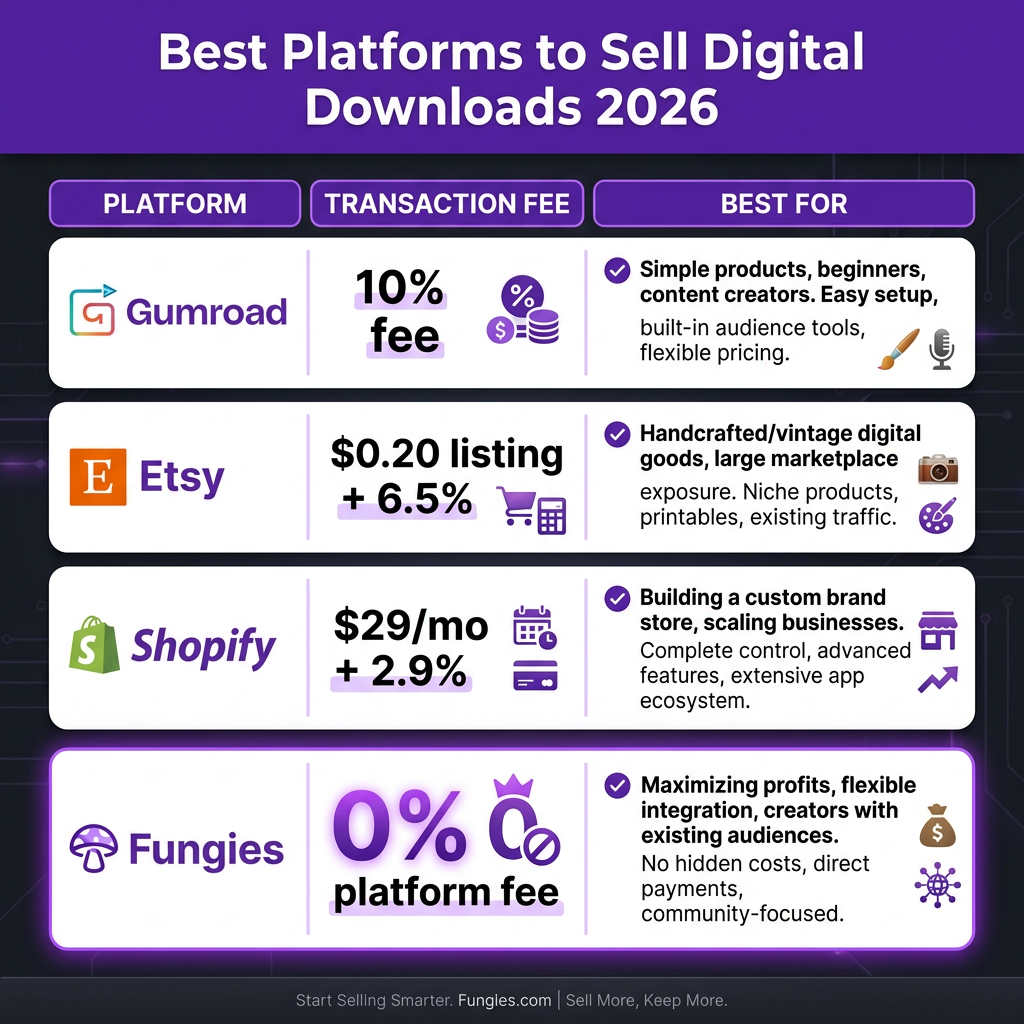
Platform Fee Comparison (Real Numbers)
Let’s look at what you actually keep when selling a $50 digital product:
- Gumroad: $45.00 after 10% fee + processing
- Etsy: $42.25 after listing fees + 6.5% + processing
- Shopify: $46.55 after 2.9% + $0.30 + monthly fees
- Fungies: $47.75 after 4.5% processing only (0% platform fee)
At $5,000/month in sales, platform choice alone can mean a difference of $1,500+ in your pocket. Factor this into your decision from day one.
Step 4: Set Up Your Store for Conversions
A beautiful store that doesn’t convert is just digital art. Here’s what actually drives sales:
Essential Store Elements
- Clear value proposition: Headlines that speak to outcomes, not features. “Save 10 hours per week with this automation template” beats “Notion Template v2.0”
- Social proof: Reviews, testimonials, usage numbers. “Join 5,000+ creators” builds trust instantly
- Risk reversal: Money-back guarantees, preview screenshots, demo videos
- Simple checkout: Every extra form field drops conversions by 10%. Keep it to email + payment
- Mobile optimization: 60%+ of traffic is mobile. Test your store on your phone.
Your product page should answer three questions in 10 seconds: What is this? Who is it for? Why should I buy it now?
Step 5: Market Your Digital Downloads
Build it and they will come? Not anymore. Here’s the marketing mix that works for digital products in 2026:
Free Marketing Channels
- Content marketing: YouTube tutorials, blog posts, Twitter threads that demonstrate expertise
- Community building: Reddit (r/Notion, r/SideProject), Discord servers, niche forums
- Email list: Still the highest-ROI channel. Offer a freebie to build your list
- SEO: Target long-tail keywords like “best Notion template for freelancers”
Paid Marketing (When Ready)
- Pinterest ads: Excellent for visual products, 30% lower CPC than Facebook
- Twitter/X ads: Great for B2B and creator tools
- Influencer partnerships: Micro-influencers (10k-100k followers) often convert better than celebrities
Start with free channels. Once you have proof of concept and know your numbers (customer acquisition cost, lifetime value), scale with paid.
Pricing Strategies That Actually Work
Pricing psychology is part science, part art. Here are the strategies top creators use:
Proven Pricing Tactics
- Charm pricing: $47 converts better than $50. $97 better than $100. The “left-digit effect” is real
- Value-based pricing: Price based on the outcome, not your time. If your template saves 20 hours at $50/hour, $97 is a steal
- Tiered options: Basic ($27), Pro ($67), Bundle ($147). The middle tier usually sells best
- Launch discounts: 30-50% off for the first 48 hours creates urgency and early reviews
Most creators undercharge. If you’re not getting some pushback on price, you’re priced too low. The right customers pay for value; the wrong ones complain about price.
Common Mistakes to Avoid
Learn from the failures so you don’t repeat them:
- Creating without validating: Build what people want, not what you think they need
- Ignoring customer service: One bad review can kill a new product. Respond fast, fix issues faster
- Platform dependency: Build your email list. Platforms can change rules or disappear
- Perfectionism paralysis: Ship at 80% done, iterate based on feedback
- Underpricing: Low prices signal low quality. Price for value, not competition
FAQ: Selling Digital Downloads
Do I need a business license to sell digital products?
Requirements vary by location, but most jurisdictions require some form of business registration once you exceed a revenue threshold (often $1,000-5,000/year). Consult a local accountant for specifics. The good news: digital products often have simpler compliance requirements than physical goods.
How do I handle taxes on digital products?
Digital products are subject to sales tax/VAT in most jurisdictions. If you use a Merchant of Record platform like Fungies, tax compliance is handled automatically. Otherwise, you’ll need to register, collect, and remit taxes yourself — a significant administrative burden as you scale.
What’s the best digital product for beginners?
Notion templates and simple ebooks have the lowest barrier to entry. They require minimal technical skills, have clear demand, and can be created in a weekend. Start there, learn the process, then expand to more complex products.
How long until I make my first sale?
With active marketing, first sales typically come within 1-2 weeks. Without marketing, it could be months or never. The creators who succeed treat this as a business from day one, not a passive side project.
Can I sell the same product on multiple platforms?
Yes, but be strategic. Exclusive products often get better promotion on marketplaces. Consider platform-specific versions or bundles to avoid direct competition with yourself.
Conclusion: Your Digital Download Journey Starts Now
The digital product economy has never been more accessible — or more competitive. Success comes down to three things: solving real problems, choosing the right platform, and consistent marketing. You don’t need perfection; you need momentum.
Start with one product, one platform, one marketing channel. Validate demand before building. Price for value, not cost. And most importantly: ship fast, learn faster.
The creators building six-figure digital product businesses aren’t smarter or more talented. They simply started, iterated based on feedback, and refused to quit. Your first sale is closer than you think.
Ready to Sell Your Digital Downloads?
Launch your digital store in minutes with Fungies.io — zero platform fees, automated tax compliance, and instant global payments.
No credit card required • 0% platform fees