Here’s a stat that’ll make you rethink your AI budget: the most expensive LLM API costs 600x more per token than the cheapest option in 2026. GPT-5.4 Pro will run you $30 per million input tokens. Gemini 2.5 Flash-Lite? Just $0.10.
Same tokens. Wildly different bills.
If you’re building AI features into your SaaS, choosing the wrong model can destroy your margins. I’ve seen startups burn through $10,000 in API credits in a week because they defaulted to the “best” model instead of the right one.
This guide breaks down LLM API pricing for every major provider in 2026 — OpenAI, Anthropic, Google, and DeepSeek — with real benchmarks to help you pick the best model for your use case and budget.
Why LLM API Pricing Matters More Than Ever
AI costs are no longer experimental line items. They’re production infrastructure costs that scale with your user base.
Here’s what changed in 2026:
- Context windows exploded — 1M+ tokens is now standard on flagship models
- Reasoning models became mainstream — o3, DeepSeek-R1, and Claude’s extended thinking add new pricing tiers
- Free tiers got competitive — Google’s Gemini Flash-Lite is genuinely usable at $0.10/M tokens
- Cache discounts are real — 50-90% off for repeated prompts
The result? You can now spend anywhere from $0.05 to $180 per million tokens depending on your choices. That’s a $3,600x range when you factor in output token costs.
The Complete LLM API Pricing Comparison (May 2026)
I’ve compiled pricing data from all four major providers. These are the per-token rates you’ll actually pay — no hidden fees, no enterprise discounts.
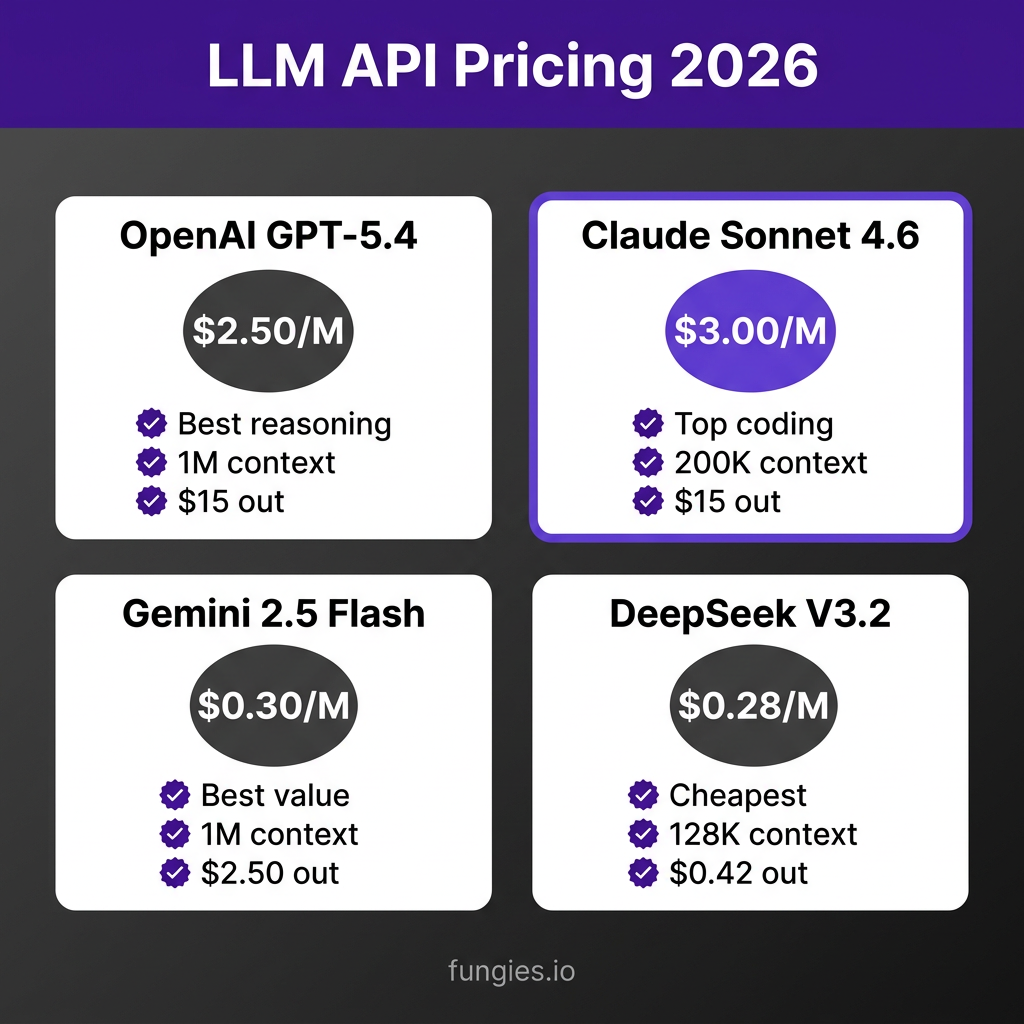
| Model | Provider | Input (per 1M) | Output (per 1M) | Context Window |
|---|---|---|---|---|
| GPT-5.4 Pro | OpenAI | $30.00 | $180.00 | 1M |
| GPT-5.4 | OpenAI | $2.50 | $15.00 | 1M |
| GPT-5.2 | OpenAI | $1.50 | $14.00 | 400K |
| GPT-5 | OpenAI | $1.25 | $10.00 | 200K |
| GPT-4.1 | OpenAI | $2.00 | $8.00 | 1M |
| o3-pro | OpenAI | $20.00 | $80.00 | 200K |
| o4-mini | OpenAI | $1.10 | $4.40 | 200K |
| Claude Opus 4.6 | Anthropic | $5.00 | $25.00 | 200K |
| Claude Sonnet 4.6 | Anthropic | $3.00 | $15.00 | 200K |
| Claude Haiku 4.5 | Anthropic | $1.00 | $5.00 | 200K |
| Gemini 3.1 Pro | $2.00 | $12.00 | 2M | |
| Gemini 2.5 Pro | $1.25 | $10.00 | 1M | |
| Gemini 2.5 Flash | $0.30 | $2.50 | 1M | |
| Gemini 2.5 Flash-Lite | $0.10 | $0.40 | 1M | |
| DeepSeek V3.2 | DeepSeek | $0.28 | $0.42 | 128K |
Source: Provider pricing pages, April-May 2026. Prices in USD per 1 million tokens.
Provider Breakdown: What You Get for Your Money
OpenAI: The Premium Choice
OpenAI still commands the highest prices, but they’re not without justification. GPT-5.4 leads on structured reasoning and computer-use tasks (75% on OSWorld benchmark, surpassing human expert baseline).
Best for: Complex reasoning, agentic workflows, production apps where accuracy matters more than cost
Pricing sweet spot: GPT-5 at $1.25/$10 per million tokens offers the best balance of capability and cost in OpenAI’s lineup
Budget option: GPT-5 Nano at $0.05/$0.40 — but you’ll sacrifice significant capability
Anthropic Claude: The Coding Specialist
Claude Opus 4.6 dominates coding benchmarks with the highest Arena coding Elo (1548) and 80.8% on SWE-bench Verified. If you’re building AI coding assistants, Claude is hard to beat.
Best for: Code generation, nuanced writing, long-context tasks up to 200K tokens
Pricing sweet spot: Sonnet 4.6 at $3/$15 — still expensive, but 40% cheaper than Opus with minimal quality loss for most tasks
Pro tip: Anthropic offers 90% prompt caching discounts. If you’re processing similar prompts repeatedly, your effective cost drops to $0.30 per million input tokens.
Google Gemini: The Value Leader
Google’s pricing is aggressive. Gemini 2.5 Flash-Lite at $0.10/$0.40 per million tokens is the cheapest production-ready model available. And the 2.5 Pro at $1.25/$10 matches GPT-5’s pricing with a 1M token context window.
Best for: Cost-sensitive applications, multimodal tasks, long-context processing
Pricing sweet spot: Gemini 2.5 Flash at $0.30/$2.50 — 10x cheaper than GPT-5.4 with comparable performance on many tasks
Free tier: Most Gemini models have free tiers with rate limits. Perfect for prototyping.
DeepSeek: The Budget Disruptor
DeepSeek V3.2 is the cheapest high-quality option at $0.28/$0.42 per million tokens. That’s 100x cheaper than GPT-5’s output costs. And the benchmark scores are competitive — DeepSeek V4 now rivals Claude on coding tasks.
Best for: High-volume applications, cost-sensitive production workloads, non-English languages
Pricing sweet spot: DeepSeek V3.2 is already the sweet spot — there’s no cheaper tier worth using
Catch: 128K context window vs 1M+ on competitors. If you need massive context, look elsewhere.
Real-World Cost Scenarios
Let’s put these numbers in context. Here’s what different applications actually cost per 1,000 requests:
| Use Case | Avg Tokens/Request | GPT-5.4 Cost | Gemini 2.5 Flash Cost | DeepSeek V3.2 Cost |
|---|---|---|---|---|
| Chatbot response | 500 in / 300 out | $6.25 | $0.90 | $0.27 |
| Code generation | 1,000 in / 800 out | $14.50 | $2.30 | $0.62 |
| Document analysis (10K tokens) | 10,000 in / 500 out | $28.75 | $4.25 | $3.01 |
| Agent workflow (multi-step) | 5,000 in / 2,000 out | $42.50 | $6.50 | $2.24 |
Costs per 1,000 requests. Calculated using input/output pricing rates.
The gap is staggering. A chatbot handling 100,000 requests per month costs $625 on GPT-5.4, $90 on Gemini Flash, or just $27 on DeepSeek. That’s $7,000+ in annual savings just from picking the right model.
Benchmarks: Price vs Performance
Price isn’t everything. Here’s how these models actually perform on key benchmarks:
| Model | MMLU (Knowledge) | HumanEval (Code) | SWE-bench (Real Coding) | GPQA Diamond (Science) |
|---|---|---|---|---|
| GPT-5.4 | 88.5% | 92.1% | 78.2% | 81.2% |
| Claude Opus 4.6 | 87.9% | 94.2% | 80.8% | 85.7% |
| Gemini 2.5 Pro | 86.3% | 90.5% | 76.5% | 79.8% |
| DeepSeek V4 | 84.1% | 89.7% | 73.8% | 76.2% |
| Gemini 2.5 Flash | 78.3% | 82.4% | 68.2% | 71.5% |
| DeepSeek V3.2 | 76.8% | 83.3% | 65.4% | 69.1% |
Source: Vellum LLM Leaderboard, TokenMix Benchmark Guide 2026, Kaggle LLM Benchmark Wars dataset
The pattern is clear: you pay 10x more for the last 10-15% of performance. For many applications, Gemini Flash or DeepSeek V3.2 deliver “good enough” results at a fraction of the cost.
How to Choose the Right LLM API for Your Use Case
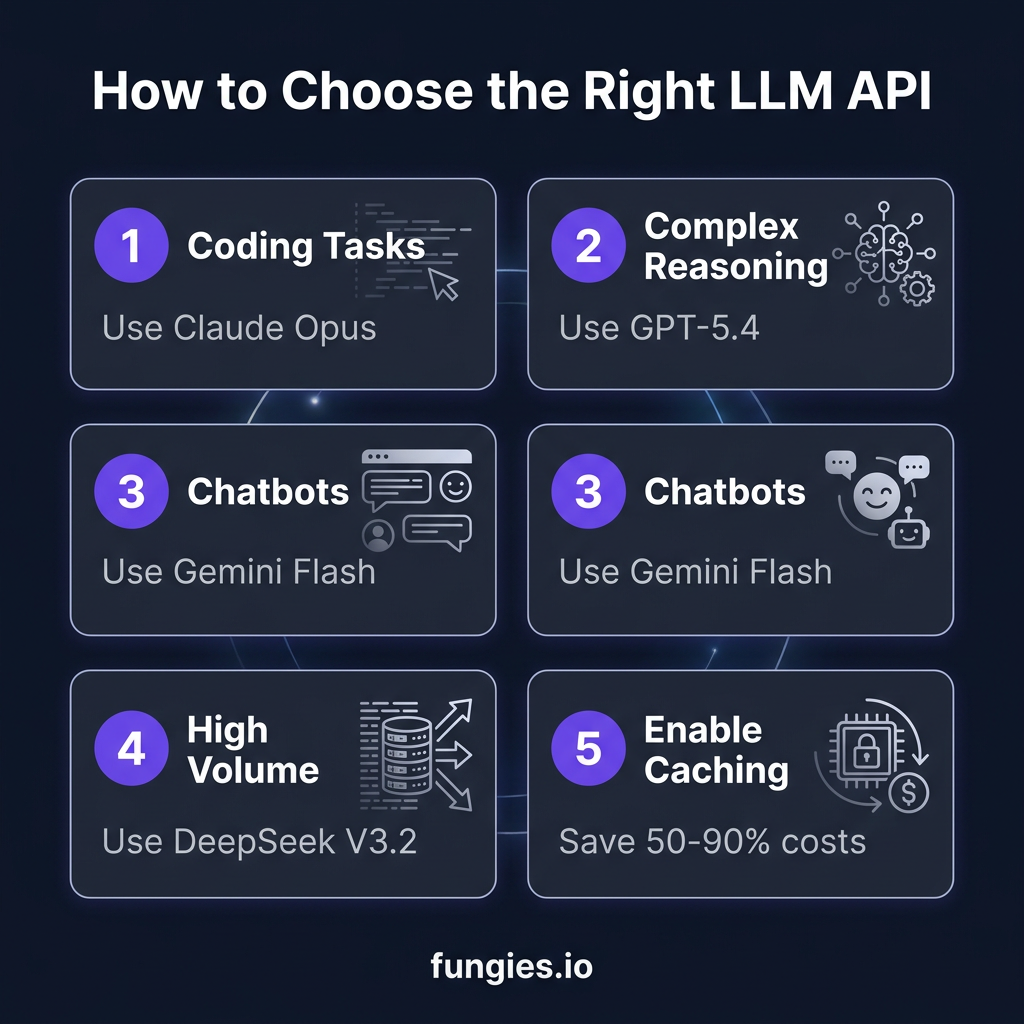
For AI Coding Assistants
- Best: Claude Opus 4.6 ($5/$25) — highest SWE-bench score
- Budget: DeepSeek V4 ($0.27/$1.10) — 90% of the capability at 5% of the cost
- Avoid: Cheap models on complex refactoring tasks — they’ll generate more bugs than they fix
For Customer Support Chatbots
- Best: Gemini 2.5 Flash ($0.30/$2.50) — fast, cheap, good enough
- Budget: Gemini 2.5 Flash-Lite ($0.10/$0.40) — if your use case is simple
- Pro tip: Use RAG with cached embeddings to minimize LLM calls
For Content Generation
- Best: Claude Sonnet 4.6 ($3/$15) — best prose quality per dollar
- Budget: GPT-5 ($1.25/$10) — solid all-rounder
- Enterprise: Claude Opus for high-stakes content (marketing copy, documentation)
For Agentic Workflows
- Best: GPT-5.4 ($2.50/$15) — best tool use and reasoning
- Alternative: o4-mini ($1.10/$4.40) — reasoning-focused, cheaper
- Strategy: Use cheaper models for simple steps, expensive ones for decision points
For High-Volume Applications
- Best: DeepSeek V3.2 ($0.28/$0.42) — cheapest production-quality option
- Alternative: Gemini 2.5 Flash-Lite ($0.10/$0.40) — if you need 1M context
- Must-do: Implement prompt caching — can reduce costs by 50-90%
Cost Optimization Strategies That Actually Work
1. Implement Prompt Caching
All major providers now offer cache discounts. If you’re sending similar system prompts or context repeatedly, caching can cut your costs by 50-90%. Anthropic offers the best deal at 90% off cached tokens.
2. Use Smaller Models for Simple Tasks
Don’t use GPT-5.4 for classification or entity extraction. A $0.10/M token model can handle those tasks just fine. Route complex tasks to expensive models, simple ones to cheap models.
3. Batch Your Requests
OpenAI and Anthropic offer 50% discounts on batch API calls. If you don’t need real-time responses, batching is free money.
4. Monitor Token Usage Religiously
Use tools like Helicone, LangSmith, or CloudIDR to track per-request costs. Set up alerts when daily spend exceeds thresholds. I’ve seen teams discover they were spending 70% of their budget on a single out-of-control feature.
5. Negotiate Enterprise Pricing
If you’re spending $10K+/month, you have leverage. All providers offer custom enterprise pricing — typically 20-40% off list rates for committed spend.
FAQ: LLM API Pricing 2026
Which LLM API is cheapest in 2026?
Google’s Gemini 2.5 Flash-Lite at $0.10 per million input tokens is the cheapest production-ready option. DeepSeek V3.2 at $0.28/$0.42 offers the best balance of price and performance for most use cases.
Is GPT-5 worth the price premium?
For complex reasoning and agentic workflows, yes. GPT-5.4 leads on structured tasks and tool use. But for simple chatbots or content generation, Gemini Flash or DeepSeek deliver 90% of the capability at 10% of the cost.
How much does Claude API cost per 1,000 requests?
Claude Sonnet 4.6 costs approximately $4.50 per 1,000 average requests (1K input / 500 output tokens). Claude Opus 4.6 costs about $7.50 for the same volume. With prompt caching, these costs drop by up to 90%.
What’s the best free LLM API tier?
Google Gemini offers the most generous free tier with rate limits on Gemini 2.5 Flash, Flash-Lite, and 2.5 Pro. OpenAI offers $5 in free credits for new users. DeepSeek has a free tier with lower rate limits.
How do I estimate my LLM API costs?
Multiply your expected monthly requests by average tokens per request (input + output), then apply the per-million-token pricing. Add 20% buffer for unexpected usage spikes. Use tools like CostGoat or PricePerToken for detailed calculations.
Key Takeaways
- Price range is massive: $0.10 to $180 per million tokens across providers
- Gemini is the value leader: 2.5 Flash at $0.30/$2.50 offers the best price/performance ratio
- Claude dominates coding: Opus 4.6 leads SWE-bench but costs $5/$25
- DeepSeek disrupts pricing: V3.2 at $0.28/$0.42 is 100x cheaper than GPT-5’s output costs
- Caching is essential: 50-90% discounts available on all major platforms
- Match model to task: Don’t overpay for capability you don’t need
Final Thoughts
LLM API pricing in 2026 is a trade-off between capability and cost. The good news? You have real options. You don’t need to default to OpenAI anymore.
Start with Gemini Flash or DeepSeek V3.2 for prototyping. Upgrade to GPT-5.4 or Claude Opus when you hit quality limitations. And always, always implement prompt caching from day one.
The teams that win in 2026 won’t be the ones with the biggest AI budgets. They’ll be the ones that spend smart.
Ready to build AI-powered features into your SaaS? Get started with Fungies — the merchant of record platform that handles payments, tax compliance, and checkout so you can focus on building great AI products.
References
- OpenAI API Pricing — Official pricing page
- Anthropic Claude API Pricing — Official pricing page
- Google Gemini API Pricing — Official pricing page
- DeepSeek API Pricing — Official pricing page
- TLDL LLM API Pricing Comparison — Cross-provider comparison
- CostGoat LLM API Comparison — Pricing calculator
- TokenMix LLM Benchmark Guide 2026 — Benchmark explanations
- Vellum LLM Leaderboard — Live benchmark scores
- Kaggle LLM Benchmark Wars Dataset — Raw benchmark data
- PE Collective LLM Pricing Comparison — April 2026 pricing