The global Software as a Service (SaaS) market has reached an inflection point in 2026. With worldwide revenues hitting $465 billion this year and projected to surge to $1.37 trillion by 2035, SaaS now commands 72% of all enterprise software spending according to IDC. This isn’t just incremental growth—it’s a fundamental restructuring of how businesses acquire, deploy, and consume software.
What makes 2026 particularly significant is the convergence of several transformative forces: AI-native architectures becoming the default, vertical SaaS solutions outperforming horizontal platforms, and usage-based pricing models reshaping revenue recognition. The median B2B SaaS company now spends $2.00 to generate $1.00 in new ARR, while customer acquisition costs have surged 60% over five years to reach $1,200 per customer. These pressures are forcing a shift from “growth at all costs” to sustainable, efficient scaling.
This comprehensive analysis examines the SaaS market’s current state, emerging trends, key players, and future trajectory through 2030. Whether you’re a SaaS founder plotting your next funding round, an investor evaluating opportunities, or an enterprise buyer making platform decisions, the data and insights below provide the foundation for informed strategic decisions.

Market Overview: The $465 Billion SaaS Ecosystem
The SaaS market’s evolution from a novel delivery model to the dominant software consumption paradigm represents one of the most significant shifts in enterprise technology history. Understanding this trajectory requires examining both the historical growth patterns and the structural forces driving future expansion.
Historical Growth and Current Scale
The SaaS market reached an estimated $315.68 billion in 2025 and has grown to $465 billion in 2026, representing a 47% year-over-year increase. This growth trajectory significantly outpaces traditional software markets, with SaaS capturing an ever-larger share of total enterprise IT spending. According to Precedence Research, the market is expanding at a compound annual growth rate (CAGR) of 12.85% from 2026 to 2035, a remarkably sustained growth rate for a market of this maturity.
The United States remains the world’s strongest SaaS ecosystem, with the US market alone valued at approximately $187 billion. The country is home to roughly 17,000 SaaS companies and is expected to generate $141.06 billion in SaaS revenue in 2026. North America as a whole dominates the global market with a 56.9% share, driven by mature cloud infrastructure, high enterprise technology adoption rates, and a robust venture capital ecosystem.
Enterprise adoption has reached saturation levels in many categories. The average organization now uses 7.3 SaaS applications with AI functionality, and 85% of organizations automate some SaaS management processes. This widespread adoption creates both opportunities for expansion within existing accounts and challenges around SaaS sprawl, shadow IT, and governance that vendors must address.
Regional Distribution and Growth Patterns
While North America leads in absolute terms, other regions present significant growth opportunities. Europe represents the second-largest market, with particular strength in data protection and privacy-focused solutions driven by GDPR compliance requirements. The Asia-Pacific region is experiencing the fastest growth rates, with countries like India, Singapore, and Australia showing particularly strong SaaS adoption among both enterprises and SMBs.
Regional growth patterns reflect varying levels of cloud infrastructure maturity, regulatory environments, and digital transformation priorities. Markets with established cloud infrastructure and high digital transformation investment show higher SaaS penetration rates, while emerging markets present greenfield opportunities as businesses skip traditional on-premise software entirely in favor of cloud-native solutions.

Key Statistics and Data: 25 Essential SaaS Metrics for 2026
Data-driven decision making requires understanding the benchmarks that define success in the current SaaS landscape. The following statistics reveal the operational realities facing SaaS companies across growth stages.
Market Size and Growth Metrics
- Global SaaS Market Size (2026): $465 billion, up from $315.68 billion in 2025
- Projected Market Size (2035): $1.37 trillion at 12.85% CAGR
- US SaaS Market: $187 billion, representing 40% of global market
- US SaaS Revenue (2026): $141.06 billion from approximately 17,000 SaaS companies
- Enterprise Software Spending Share: SaaS commands 72% of all enterprise software spending
- North America Market Share: 56.9% of global SaaS market
- Worldwide Software Spending Growth: 14.7% projected for 2026 according to Gartner
Company Performance Benchmarks
- Median Revenue Growth: 26% for private B2B SaaS companies
- Top Quartile Growth: 50% (down from 60% in 2023)
- Net Revenue Retention (NRR): 101% median across all private B2B SaaS
- Bootstrapped Company NRR: 104% median
- Expansion ARR as % of New ARR: 40% overall, over 50% for companies above $50M ARR
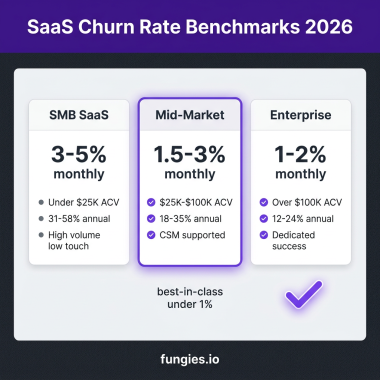
- Average Annual Churn Rate: 5-7% for SaaS companies
- Companies Meeting Rule of 40: Declining share as growth rates compress
Customer Acquisition and Economics
- Average Customer Acquisition Cost (CAC): $1,200 per customer (60% increase over 5 years)
- B2B SaaS CAC: $536 average across all marketing channels
- Fintech SaaS CAC: Significantly higher than general B2B average
- CAC Payback Period: 15 months median for B2B SaaS
- New CAC Ratio: $2.00 spent to generate $1.00 in new ARR
- LTV:CAC Ratio Target: 3:1 or higher for healthy unit economics
- CAC Increase Over Time: 222% increase in five years
Operational and Efficiency Metrics
- Sales and Marketing as % of Revenue: 47% for VC-backed vs 33% for PE-backed
- R&D as % of Revenue: 34% for private SaaS vs 23% for public
- Revenue per Employee: Varies significantly by company size and model
- Average License Utilization: Below optimal levels across most organizations
- Organizations with FinOps Teams: Only 2% cover cloud, SaaS, and GenAI holistically
- Executives Reporting Cost Increases: 82% report significant increases in cloud, SaaS, and GenAI costs
AI and Emerging Technology Metrics
- AI-Native SaaS Market (2026): $142.02 billion, projected to reach $1,051.11 billion by 2033
- AI-Native SaaS CAGR: 39.6% from 2026 to 2033
- Average AI-Enabled SaaS Apps per Organization: 7.3
- AI in IT Service Management: 45% of organizations
- Process Automation Increase: 45% of organizations automated more processes in the past year
- AI-Native SaaS Valuation Premium: 40% higher than traditional SaaS
- AI Deal Share of VC: 65.6% of all venture deals
7 Major Trends Shaping SaaS in 2026
The SaaS landscape is being fundamentally reshaped by seven interconnected trends that are redefining how software is built, sold, and consumed. Understanding these trends is essential for anyone operating in or evaluating the SaaS market.

1. AI-Native Architecture Becomes the Default
The transition from “AI-powered” features to AI-native architectures represents the most significant technical shift in SaaS since the move to cloud delivery. In 2026, AI is no longer a bolt-on capability but sits at the core of product design, onboarding, and daily workflows. According to a Salesforce CIO survey, AI adoption in enterprises has jumped over 280%, with “agentic” AI—multi-agent systems that act rather than just chat—identified as a core priority.
This shift has profound implications for product development, competitive positioning, and pricing. AI-native SaaS companies are raising at 40% higher valuations than traditional SaaS, with some AI-native companies reaching $3M ARR within their first year and scaling to $100M by year four—far outpacing traditional SaaS growth timelines. A subset of high-performing AI-native companies achieves approximately $40M ARR within the first year and exceeds $120M by the second year.
The machine learning segment is expected to contribute 42.3% of the global AI-created SaaS market in 2026, with natural language processing and computer vision following. Companies that fail to integrate AI natively into their architectures risk obsolescence as customer expectations shift toward intelligent, predictive, and autonomous software experiences.
2. Vertical SaaS Outperforms Horizontal Platforms
Vertical SaaS—software built for specific industries rather than horizontal business functions—has emerged as the fastest-growing segment in enterprise software. The vertical SaaS market hit an estimated $130 billion in 2025 and is projected to reach $157.4 billion, growing at 18-22% annually—nearly double the pace of horizontal platforms.
ServiceTitan’s December 2024 IPO at a $9 billion valuation exemplifies this trend, serving home services contractors—a market most VCs had ignored. The success of vertical players stems from their ability to encode industry-specific workflows, regulatory requirements, and data models that horizontal competitors cannot address. Vertical SaaS solutions achieve 3x higher retention rates than horizontal alternatives by solving problems generic tools simply cannot.
The fastest growth is coming from analog-heavy industries like healthcare, agriculture, and construction that are rapidly adopting industry-specific cloud tools. Vertical SaaS vendors are also becoming acquirers, expanding within industries by buying complementary tools that deepen critical workflows. This consolidation trend creates platform effects that strengthen competitive moats.
3. Usage-Based Pricing Goes Mainstream
Consumption-based pricing is becoming the dominant model across SaaS categories, replacing traditional seat-based subscriptions. This shift reflects both customer demand for cost alignment with value and vendor opportunities to capture upside from expanding usage. Dynamic pricing in SaaS billing is more popular than ever, with companies leveraging real-time usage data to optimize revenue.
The transition to usage-based models creates both opportunities and challenges. While 78% of IT leaders report unexpected costs from usage-based or AI pricing, customers increasingly prefer models that scale with their actual consumption. This preference is particularly strong among developer-focused tools, infrastructure services, and AI-powered applications where usage can vary dramatically.
Successful implementation requires sophisticated billing infrastructure, real-time usage tracking, and customer education around cost optimization. Companies that master usage-based pricing can achieve higher net revenue retention through natural expansion, while those that fail to adapt risk losing deals to more flexible competitors.
4. API-First Development and Ecosystem Integration
API-first development has evolved from a technical best practice to a strategic imperative. Modern SaaS products are expected to integrate seamlessly with existing tech stacks, and API connectivity is often a primary evaluation criterion for enterprise buyers. The API-first approach enables ecosystem strategies that extend product functionality through third-party integrations.
This trend is closely related to the rise of microservices architecture, which allows SaaS companies to build modular, composable products. Microservices enable faster iteration, better scalability, and easier integration with customer systems. The combination of APIs and microservices creates platform effects that increase switching costs and customer lifetime value.
For SaaS buyers, API-first products offer greater flexibility and customization options. For vendors, APIs create opportunities to monetize platform access and build partner ecosystems that extend market reach. The most successful SaaS companies in 2026 treat their APIs as products, with dedicated documentation, developer support, and pricing tiers.
5. Embedded Finance Transforms Vertical SaaS
One of the most powerful trends in vertical SaaS is the integration of financial services directly into software platforms. This embedded finance model transforms vertical SaaS companies from software vendors into financial infrastructure providers, dramatically increasing revenue per customer and creating moats that horizontal competitors cannot replicate.
Embedded finance includes payment processing, lending, insurance, and banking services delivered through software platforms. For example, a construction management platform might offer invoice financing, payment processing, and insurance products tailored to contractors. These financial services generate additional revenue streams while increasing platform stickiness.
The trend is particularly strong in verticals with complex financial workflows, such as healthcare, real estate, and professional services. Companies implementing embedded finance strategies report significant increases in customer lifetime value and reduced churn, as customers become dependent on integrated financial services.
6. Low-Code/No-Code Democratization
Low-code and no-code platforms continue to democratize software development, enabling business users to build applications without traditional coding skills. This trend expands the addressable market for SaaS by reducing the technical barrier to entry and accelerating time-to-value for custom solutions.
The implications for traditional SaaS are mixed. On one hand, low-code platforms enable customers to build custom solutions that might otherwise require SaaS purchases. On the other hand, many SaaS vendors are incorporating low-code capabilities into their platforms, allowing customers to extend functionality without leaving the ecosystem.
Forward-thinking SaaS companies are embracing low-code as a competitive advantage, offering customizable workflows, configurable interfaces, and integration tools that put power in users’ hands. This approach reduces development bottlenecks while maintaining the benefits of a managed platform.
7. Edge Computing and Distributed Architecture
Edge computing integration is becoming a key differentiator for SaaS applications requiring low latency, data sovereignty, or offline functionality. By processing data closer to the source, edge-enabled SaaS can deliver faster performance and better user experiences, particularly for mobile and IoT applications.
This trend is particularly relevant for vertical SaaS serving industries with distributed operations, such as retail, manufacturing, and logistics. Edge computing enables real-time processing in environments with limited connectivity, ensuring business continuity regardless of network conditions.
The combination of edge computing with AI inference at the edge creates new possibilities for intelligent, responsive applications. SaaS vendors investing in edge capabilities are positioning themselves for the next wave of infrastructure evolution as 5G networks expand and IoT device proliferation continues.

Key Players and Competitive Landscape
The SaaS market remains highly competitive, with established giants defending market share against agile challengers and AI-native upstarts. Understanding the competitive dynamics requires examining both the dominant horizontal players and the emerging vertical specialists.
Market Leaders and Their Positions
Microsoft leads the overall SaaS market, followed by Salesforce, Adobe, Oracle, and SAP. These companies have built comprehensive platforms that span multiple business functions, creating ecosystems that are difficult for competitors to displace. Each has invested heavily in AI integration, with Microsoft’s Copilot strategy representing one of the most ambitious AI deployment efforts in the industry.
Salesforce generated $41.5 billion in FY2026 revenue and holds 20.7% of the global CRM market according to IDC—earning $21.6 billion in CRM revenue alone, more than Microsoft, Oracle, Adobe, and SAP combined. The company’s Einstein AI platform and extensive AppExchange ecosystem create significant competitive advantages in the CRM space.
Other leading SaaS companies include ServiceNow, Snowflake, Datadog, CrowdStrike, Zoom, HubSpot, and Airtable. Each has carved out dominant positions in specific categories: ServiceNow in IT service management, Snowflake in data warehousing, Datadog in monitoring, CrowdStrike in cybersecurity, Zoom in video conferencing, HubSpot in marketing automation, and Airtable in collaborative databases.
Emerging Challengers and AI-Native Players
While incumbents dominate overall market share, AI-native companies are growing at unprecedented rates. Some AI-native SaaS companies reach approximately $3 million in annual recurring revenue within their first year and scale to roughly $100 million by year four—growth timelines that significantly outpace traditional SaaS benchmarks.
The highest overall growth rates among major SaaS vendors are found at Oracle, Microsoft, and Google—all of which are aggressively integrating AI into their platforms. However, smaller AI-native companies often achieve higher percentage growth from smaller bases, raising at 40% higher valuations than traditional SaaS.
Vertical SaaS specialists are also gaining ground against horizontal players. Companies like ServiceTitan, Toast, Shopify, and Procore have demonstrated that deep industry focus can create more valuable businesses than broad horizontal approaches. These vertical leaders are expanding through acquisition, buying complementary tools to deepen their platform offerings within specific industries.
Market Fragmentation and Consolidation
Despite the dominance of major players, the SaaS market remains fragmented, with different vendors leading each main market segment. This fragmentation creates opportunities for specialized players while also driving consolidation as larger vendors acquire capabilities to fill portfolio gaps.
The SaaS management market itself is experiencing rapid growth, projected to increase from $4.58 billion in 2025 to $9.37 billion by 2030 at a 15.4% CAGR. This meta-category reflects the complexity of managing hundreds of SaaS applications within large organizations and the need for centralized visibility, security, and cost optimization.
Challenges and Pain Points
The SaaS industry’s rapid growth masks significant challenges that vendors and buyers must navigate. Understanding these pain points is essential for strategic planning and risk management.
1. Customer Acquisition Cost Inflation
The most pressing challenge facing SaaS companies is the dramatic increase in customer acquisition costs. CAC has risen 222% over five years, with the average B2B SaaS company now spending $2.00 to generate $1.00 in new ARR. This unsustainable economics forces companies to either find more efficient acquisition channels or accept slower growth.
Several factors drive CAC inflation: increased competition for paid advertising, channel saturation, longer sales cycles for enterprise deals, and higher customer expectations around proof-of-concept and pilot programs. The median CAC payback period of 15 months means companies must maintain significant cash reserves to fund growth.
Companies are responding by investing in product-led growth, community-driven acquisition, and partnerships to reduce reliance on paid channels. However, these alternative approaches require different capabilities and longer timelines to scale effectively.
2. Retention and Churn Pressures
While acquisition costs rise, retention becomes increasingly critical. The average annual churn rate of 5-7% may seem manageable, but in a high-CAC environment, losing customers represents a significant destruction of invested capital. Net Revenue Retention of 101% means the median SaaS company barely grows from its existing customer base, making every new dollar of ARR expensive to acquire.
Customer retention costs average $1.16 to $5.80 per retained customer—dramatically lower than acquisition costs. This economic reality drives increased investment in customer success, product stickiness, and expansion revenue strategies. Companies are realizing that a 5% increase in retention can produce more than a 25% increase in profit.
The shift from “growth at all costs” to sustainable unit economics has made retention a board-level priority. Companies are implementing more sophisticated health scoring, proactive intervention programs, and value realization initiatives to maximize customer lifetime value.
3. SaaS Sprawl and Governance Complexity
Enterprise buyers face their own challenges managing SaaS proliferation. The average enterprise uses hundreds of SaaS applications, creating complexity around security, compliance, cost management, and data integration. Shadow IT—unsanctioned SaaS purchases by line-of-business teams—creates governance gaps and security risks.
Only 2% of organizations have FinOps teams that cover cloud, SaaS, and GenAI holistically, leaving most companies without centralized visibility into software spending. 82% of executives report significant increases in cloud, SaaS, and GenAI costs, often without corresponding visibility into usage or value.
This governance challenge creates opportunities for SaaS management platforms while also putting pressure on vendors to demonstrate clear ROI and integrate with existing enterprise systems. Buyers are increasingly consolidating vendors and demanding better administrative controls.
Opportunities and Growth Strategies
Despite challenges, significant opportunities exist for SaaS companies that can navigate the evolving landscape effectively. The following strategies represent the most promising paths to growth in 2026 and beyond.
1. AI-Native Product Development
The most significant opportunity lies in building AI-native rather than AI-enhanced products. Companies that make AI the core of their architecture can deliver experiences that traditional SaaS cannot match. This includes predictive capabilities, autonomous workflows, and personalized user experiences that improve over time.
The AI-created SaaS market is expected to grow from $142.02 billion in 2026 to $1,051.11 billion by 2033 at a 39.6% CAGR—nearly triple the growth rate of the overall SaaS market. Companies entering this space now can establish positions before the market saturates.
Success requires more than adding AI features; it requires rethinking product architecture, data strategies, and user interfaces around AI capabilities. Companies that master this transition will define the next generation of enterprise software.
2. Vertical Market Expansion
Vertical SaaS continues to offer attractive opportunities, particularly in industries that have been slow to adopt cloud solutions. Healthcare, agriculture, construction, and professional services represent large addressable markets with specific needs that horizontal platforms cannot address.
The vertical SaaS market is growing at 18-22% annually—nearly double the pace of horizontal platforms. Companies that achieve leadership positions in specific verticals benefit from high switching costs, strong network effects, and opportunities to expand into adjacent services like payments and lending.
Successful vertical SaaS requires deep industry expertise, compliance knowledge, and integration with industry-specific systems. The barrier to entry is higher than horizontal SaaS, but so are the rewards for success.
3. International Expansion
While North America dominates current SaaS revenues, international markets offer significant growth potential. Europe, Asia-Pacific, and Latin America are experiencing rapid SaaS adoption as businesses undergo digital transformation.
International expansion requires addressing localization, compliance, and go-to-market challenges. However, companies that establish positions in emerging markets can benefit from first-mover advantages and lower competition than saturated North American markets.
The US SaaS market, while mature, still offers growth opportunities. With 17,000 SaaS companies generating $141 billion in revenue, the ecosystem continues to innovate and create new categories. Companies that can differentiate effectively can still capture significant market share.
Case Studies and Success Stories
Examining specific success stories provides concrete examples of the strategies and execution that drive exceptional outcomes in the SaaS market.
Case Study 1: NeuroFlow AI—From $0 to $100M ARR in 18 Months
NeuroFlow AI represents the new breed of AI-native SaaS companies achieving unprecedented growth rates. Starting with $500K in seed funding, the company reached $100M ARR in just 18 months by making AI agents the product rather than a feature.
The company’s growth strategy centered on a viral freemium model: any user could create a basic AI agent for free, but sharing it with three or more team members unlocked collaborative features. This product-led growth engine drove rapid user acquisition without proportional sales and marketing investment.
NeuroFlow’s success demonstrates the power of AI-native architecture combined with viral distribution mechanics. The company’s growth timeline significantly outpaces traditional SaaS benchmarks, illustrating the potential for AI to reshape software markets.
Case Study 2: ServiceTitan—Vertical SaaS Success
ServiceTitan’s December 2024 IPO at a $9 billion valuation validated the vertical SaaS model. Serving home services contractors—a market most venture capitalists had ignored—the company built a comprehensive platform addressing the specific needs of this underserved vertical.
The company’s success stems from deep industry expertise, comprehensive workflow coverage, and strong network effects within the contractor community. By solving problems that generic business software could not address, ServiceTitan achieved dominant market position and high customer retention.
ServiceTitan’s IPO demonstrated that vertical focus can create more valuable businesses than horizontal breadth. The company continues to expand through acquisition, buying complementary tools to deepen its platform offering for contractors.
Case Study 3: EcoTrack Analytics—Bootstrapped Growth
EcoTrack Analytics achieved $20M ARR without venture capital funding, demonstrating that bootstrapped SaaS success remains possible in 2026. The company’s growth strategy focused on community-driven customer acquisition in the sustainability niche.
By building strong relationships within sustainability-focused professional communities, EcoTrack achieved efficient customer acquisition without paid advertising. The company’s bootstrapped nature forced capital efficiency, resulting in strong unit economics and sustainable growth.
EcoTrack’s success illustrates the continuing viability of organic growth strategies for SaaS companies with strong product-market fit and community engagement. While VC funding can accelerate growth, it is not the only path to SaaS success.
Future Outlook and Predictions
The SaaS market’s trajectory through 2030 and beyond will be shaped by technological innovation, evolving customer expectations, and macroeconomic conditions. The following predictions represent the most likely outcomes based on current trends and data.
Market Size Projections Through 2035
The global SaaS market is projected to reach $1.37 trillion by 2035, expanding at a 12.85% CAGR from 2026. This growth will be driven by continued enterprise digital transformation, SMB adoption, and the emergence of new software categories enabled by AI and edge computing.
The US SaaS market will remain the largest single market, though its share of global revenue will decline as other regions catch up. By 2030, Asia-Pacific is expected to represent a significantly larger share of global SaaS spending as digital infrastructure matures in key markets.
AI-created SaaS will be the fastest-growing subsegment, with the market expanding from $142 billion in 2026 to over $1 trillion by 2033. This represents a fundamental shift in how software is built and consumed, with AI-native companies potentially displacing traditional SaaS incumbents.
Technology Evolution
By 2030, AI will be deeply embedded in virtually all SaaS applications, with autonomous agents handling routine business processes without human intervention. The distinction between “AI-powered” and traditional software will become meaningless as AI becomes a foundational technology layer.
Edge computing will enable new categories of SaaS applications that operate with minimal latency and offline functionality. This will be particularly important for industrial, retail, and logistics applications where real-time processing is critical.
Blockchain and decentralized technologies may reshape SaaS business models, enabling peer-to-peer software marketplaces and new approaches to data ownership and privacy. While adoption remains uncertain, these technologies could disrupt traditional SaaS delivery models.
Competitive Dynamics
The SaaS market will see continued consolidation as larger players acquire capabilities to compete with AI-native challengers. Vertical SaaS leaders will increasingly become platforms, expanding into financial services and other adjacent categories.
New entrants will find success primarily in AI-native categories and underserved verticals, as horizontal markets become increasingly difficult to penetrate. The barrier to entry for traditional SaaS will continue rising as customer expectations around AI capabilities become standard.
Open source and API-based competition will pressure pricing in commoditized categories, while specialized, high-value applications will maintain premium pricing. The most successful SaaS companies will be those that build deep moats through data network effects, vertical expertise, or AI capabilities.
Regional Market Analysis
Understanding regional variations in the SaaS market is essential for companies planning geographic expansion and investors evaluating market opportunities. Each major region presents distinct characteristics in terms of growth rates, competitive dynamics, and customer preferences.
North America: The Mature Market Leader
North America, led by the United States, represents the most mature and valuable SaaS market globally. With 56.9% of global SaaS market share and $187 billion in market value, the region sets the standard for SaaS innovation and business models. The US alone is home to approximately 17,000 SaaS companies generating $141.06 billion in annual revenue.
The North American market is characterized by high enterprise adoption rates, sophisticated buyers, and a robust venture capital ecosystem that funds innovation. However, market saturation in many categories means growth increasingly comes from expansion within existing accounts rather than new customer acquisition. Competition is intense, with established players defending market share against well-funded challengers.
Canadian and Mexican markets, while smaller, offer growth opportunities with less competition than the US. These markets often serve as testing grounds for US-based SaaS companies before broader international expansion. Regulatory alignment with US standards and geographic proximity make these markets natural extensions for North American SaaS providers.
Europe: Privacy-First Innovation
Europe represents the second-largest SaaS market, with distinct characteristics shaped by regulatory requirements and cultural differences. The General Data Protection Regulation (GDPR) has created both challenges and opportunities, with privacy-focused SaaS solutions finding particular success in the European market.
European SaaS adoption varies significantly by country, with the UK, Germany, France, and the Nordics leading in enterprise adoption. The region has produced notable SaaS successes, including SAP, Dassault Systemes, and emerging players in fintech and vertical SaaS categories. Local players often compete effectively against US entrants by offering better localization and compliance capabilities.
The European market presents challenges around data sovereignty requirements, language localization, and diverse regulatory environments across member states. However, the region’s large addressable market and high digital maturity make it an attractive target for SaaS expansion.
Asia-Pacific: The Growth Engine
Asia-Pacific is experiencing the fastest SaaS growth rates globally, though from a smaller base than North America and Europe. Markets like India, Singapore, Australia, and Japan are seeing rapid SaaS adoption as digital transformation accelerates across the region.
India has emerged as a particularly dynamic market, with both significant domestic SaaS creation and consumption. Indian SaaS companies like Zoho, Freshworks, and others have achieved global scale, while domestic adoption grows rapidly among SMBs and enterprises. The country’s large English-speaking population and technical talent base create favorable conditions for SaaS growth.
Southeast Asian markets including Singapore, Indonesia, Vietnam, and Thailand represent emerging opportunities as digital infrastructure improves and mobile-first business models gain traction. These markets often skip traditional on-premise software entirely, moving directly to cloud-based solutions.
Latin America and Emerging Markets
Latin America, the Middle East, and Africa represent emerging SaaS markets with significant long-term potential. Brazil and Mexico lead Latin American adoption, while the UAE and South Africa represent the most developed markets in their respective regions.
These markets face challenges including payment infrastructure limitations, currency volatility, and lower cloud maturity. However, they also offer less competition and significant first-mover advantages for SaaS companies willing to invest in market development. Mobile-first approaches are particularly important in these regions, where smartphone penetration exceeds desktop computer access.
Investment and Funding Landscape
The SaaS funding environment has shifted dramatically from the peak valuations of 2021, creating both challenges and opportunities for companies seeking capital. Understanding current investor priorities and valuation dynamics is essential for successful fundraising.
Venture Capital Trends
AI dominates venture capital allocation, with AI/ML deals representing 65.6% of US VC deal activity according to PitchBook-NVCA data. AI-native SaaS companies raise at 40% higher valuations than traditional SaaS, with median Series A sizes of $22 million for vertical AI SaaS versus $15 million for traditional SaaS.
Traditional SaaS faces a more challenging funding environment, with investors prioritizing capital efficiency and clear paths to profitability over pure growth metrics. The median public SaaS ARR multiple has compressed to 6.7x as of mid-2025, down from peaks above 15x in 2021. Private company valuations have followed suit, with later-stage rounds particularly affected.
Despite compression, global VC deal value reached $512 billion in 2025, with exit value of $549.2 billion indicating continued liquidity for successful SaaS companies. Fundraising for new VC funds totaled $118.4 billion, ensuring ample dry powder for quality opportunities.
Valuation Metrics and Benchmarks
Current SaaS valuation metrics reflect a return to fundamentals after the excesses of 2020-2021. The SEG SaaS Index shows median EV/Revenue multiples of 4.8x as of Q4 2025, down from 6.3x in Q4 2024. Public SaaS median EV/Revenue stands at 3.4x as of March 2026 according to Aventis Advisors.
Growth-adjusted multiples reveal continued pressure on slower-growing companies. The ARRG multiple (ARR multiple divided by year-on-year growth rate) shows that markets are pricing in growth expectations more aggressively than in previous years. Companies with sub-20% growth face particular valuation pressure unless they demonstrate exceptional profitability.
Operating margins have become a key valuation driver as investors prioritize sustainable business models. The median operating margin for public SaaS companies has improved significantly as companies cut costs and focus on efficiency. Private companies are expected to follow similar trajectories to attract institutional capital.
SaaS Pricing Strategies and Evolution
Pricing strategy has become a critical differentiator in the competitive SaaS landscape. Companies that optimize pricing can significantly improve unit economics, accelerate growth, and create competitive moats that are difficult to replicate.
The Shift to Usage-Based Models
Usage-based pricing has evolved from a niche approach to a mainstream strategy across SaaS categories. This model aligns vendor revenue with customer value, reducing friction in the sales process and enabling natural expansion as customer usage grows. Companies like Snowflake, Twilio, and Datadog have demonstrated the power of consumption-based models to drive rapid revenue growth.
The transition requires sophisticated billing infrastructure capable of tracking usage in real-time, rating consumption accurately, and invoicing customers appropriately. Companies must also invest in customer education to prevent bill shock and help customers optimize their usage patterns.
Hybrid models combining subscription and usage components are emerging as a popular compromise, providing vendors with predictable baseline revenue while capturing upside from customer growth. This approach balances the stability of subscriptions with the expansion potential of usage-based pricing.
Value-Based Pricing Sophistication
Leading SaaS companies are moving beyond cost-plus or competitor-based pricing to value-based approaches that capture a portion of the economic value created for customers. This requires deep understanding of customer use cases, ROI measurement, and willingness-to-pay analysis.
Value-based pricing is particularly effective in vertical SaaS, where vendors can quantify specific business outcomes like reduced downtime, improved compliance, or increased revenue. By tying pricing to measurable customer value, vendors can justify premium pricing and reduce price sensitivity.
Implementing value-based pricing requires sophisticated sales enablement, customer success measurement, and potentially outcome-based pricing structures. While complex to execute, successful implementation can significantly improve revenue per customer and competitive positioning.
Key Takeaways
- The SaaS market reached $465 billion in 2026 and is projected to grow to $1.37 trillion by 2035 at a 12.85% CAGR, representing a fundamental shift in enterprise software consumption.
- AI-native architectures are becoming the default, with AI-native SaaS growing at 39.6% CAGR—nearly triple the rate of traditional SaaS. Companies that fail to integrate AI risk obsolescence.
- Vertical SaaS outperforms horizontal platforms, growing at 18-22% annually with 3x higher retention rates. Industry-specific solutions are winning against generic tools.
- Customer acquisition costs have risen 222% over five years, forcing a shift from “growth at all costs” to sustainable unit economics and retention-focused strategies.
- Usage-based pricing is going mainstream, replacing seat-based subscriptions as customers demand cost alignment with value and vendors seek expansion revenue opportunities.
Sources and Citations
- Fortune Business Insights – SaaS market size projections 2026-2035
- Precedence Research – Global SaaS Market Size and Share Report
- IDC – Enterprise Software Spending Analysis and SaaS Market Share
- Zylo – 2026 SaaS Management Index
- SaaS Capital – SaaS Benchmarks and Valuation Multiples
- ChartMogul – SaaS Growth and Retention Benchmarks
- Benchmarkit – 2025 SaaS Performance Metrics
- Coherent Market Insights – AI-Created SaaS Market Analysis
- Mordor Intelligence – B2B SaaS Market Report 2026-2031
- Synergy Research Group – Enterprise SaaS Market Rankings
- Gartner – Worldwide Software Spending Forecasts
- BetterCloud – State of SaaS Report 2026
- Vena Solutions – SaaS Statistics and Benchmarks 2026
- SaaS Fourm – SaaS Success Stories and Case Studies 2026