Here’s a number that should keep every SaaS founder up at night: the average startup spends just six hours total on pricing strategy. Six hours on the single lever that, when improved by just 1%, drives an 11% increase in profit. At a $15M ARR company, sloppy pricing architecture leaks roughly $2.4 million per year in unrealized revenue.
That’s not a rounding error. That’s a Series B worth of capital evaporating through discounting habits, underpriced tiers, and expansion revenue you never capture.
I’ve spent years running paid acquisition for SaaS companies, and I’ll tell you this: your pricing strategy directly impacts every metric I care about—CAC, LTV, conversion rates, and ROAS. When pricing is wrong, even the best marketing can’t save you. When it’s right, everything gets easier.
Why SaaS Pricing Strategy Matters More Than Ever in 2026
The SaaS landscape has shifted dramatically. 85% of SaaS companies have adopted some form of usage-based pricing, and 78% of those made the switch within the last five years. Meanwhile, AI-powered features are forcing companies to rethink their entire pricing architecture—compute costs don’t scale linearly with seats.
Here’s what the data tells us about pricing in 2026:
- 46% of SaaS tools raised prices in 2025, with an average increase of +87%
- Only 39% of SaaS companies use value-based pricing as their primary approach
- Companies using hybrid pricing models report 38% higher net revenue retention
- The median entry plan price across 100+ SaaS companies is $29/user/month
If you’re still pricing based on what felt right when you launched, you’re leaving money on the table. Let’s fix that.
The 7 SaaS Pricing Strategies That Actually Work
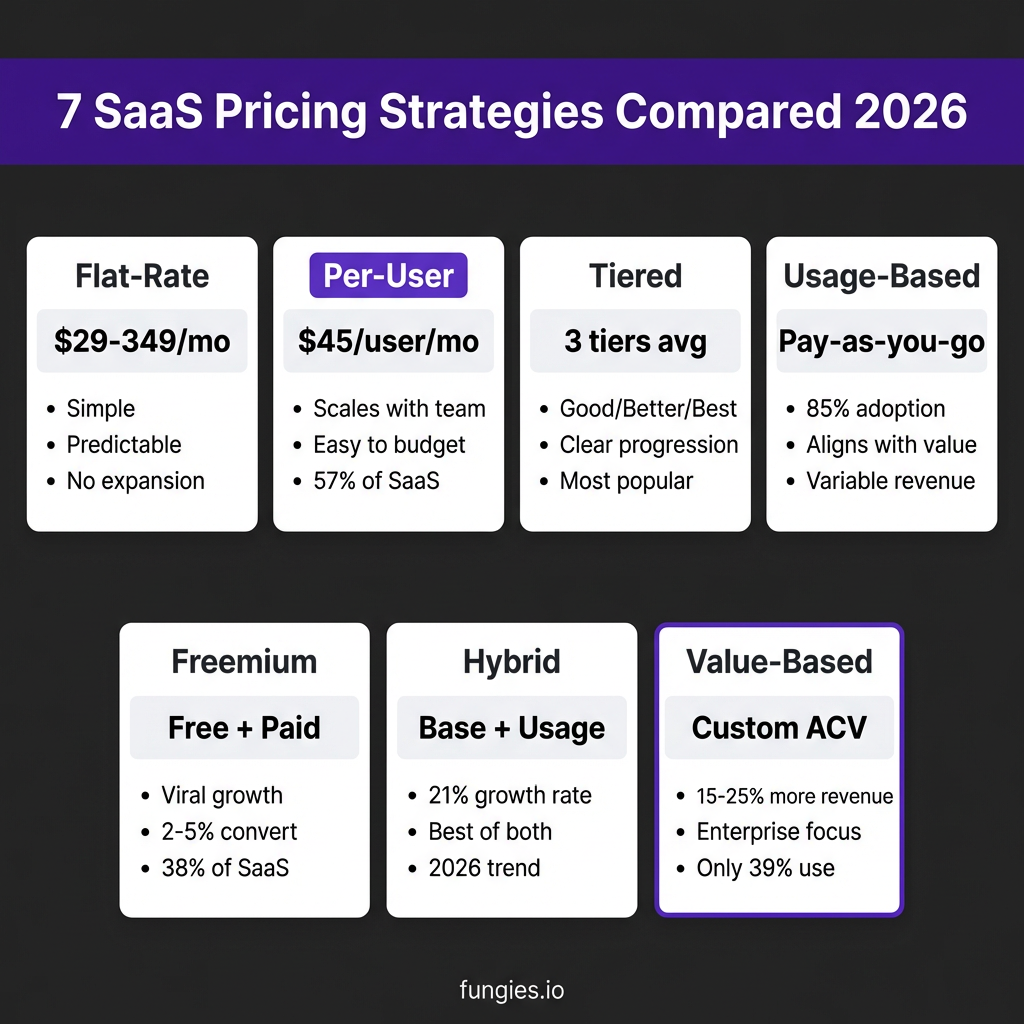
Most successful SaaS companies end up using a hybrid of two or three models. But you need to understand each one before you can mix them effectively. Here are the seven strategies dominating the market in 2026.
1. Flat-Rate Pricing: One Price, Unlimited Value
Flat-rate pricing is beautifully simple: one product, one price, everyone pays the same. Basecamp charges $349/month for unlimited users. No tiers, no calculators, no decision paralysis.
Best for: Products with straightforward value propositions serving a relatively uniform customer base. Think project management tools, simple automation software, or niche utilities.
The catch: You leave money on the table with power users and have no natural expansion revenue. A 10-person startup pays the same as a 1,000-person enterprise. That’s either a feature (simplicity) or a bug (missed revenue), depending on your goals.
2. Per-User Pricing: The Safe Default
Why does 57% of SaaS default to per-user pricing? Because it’s the easiest model for buyers to budget. Finance teams understand it. Procurement teams know how to negotiate it. And the median per-user price sits at $45/month.
Best for: Collaboration tools, CRMs, and any product where value scales directly with team size. Slack is the canonical example—revenue scales predictably with adoption.
The catch: Customers start sharing logins or resist adding seats, capping your growth. I’ve seen companies where sales teams literally share one login to avoid seat fees. That’s lost revenue and terrible analytics.
3. Tiered Pricing: The Workhorse
Tiered pricing is the most common model for a reason—it works. HubSpot runs Starter/Professional/Enterprise tiers, each unlocking more features and capacity. The industry average is 3.2 public tiers plus an enterprise/custom option.
Best for: Multi-segment SaaS companies serving everyone from solo founders to Fortune 500s. It lets you capture different willingness-to-pay levels without custom pricing for every deal.
The catch: One founder on r/SaaS reported that adding a fourth and fifth tier caused conversions to drop roughly 30% from decision paralysis. Stick to three public tiers. If you need more granularity, put it behind a “Contact Sales” enterprise option.
4. Usage-Based Pricing: Pay for What You Use
Usage-based pricing (also called consumption-based pricing) charges customers based on actual consumption—API calls, data processed, transactions completed, or other measurable units of value. 85% of SaaS companies have adopted some form of it.
Best for: API products, infrastructure services, and anything where value scales with consumption. Twilio charges per SMS. Typeform charges per response. AWS charges per compute hour.
The catch: Customers hate invoice surprises, and your finance team hates forecasting revenue that fluctuates monthly. Usage-based companies consistently report 10-15% higher net dollar retention, but the operational complexity is real.
5. Freemium: The Viral Engine
Freemium gives users indefinite access to a limited feature set, with premium features locked behind a paywall. 38% of SaaS companies offer a free tier.
Best for: Products with viral or network effects where each free user potentially brings in paid users. Think Canva, Notion, or Loom. Freemium achieves 13-16% visitor conversion—nearly double trial rates.
The catch: If your product doesn’t spread organically, freemium is just a drain on resources. A 14-day free trial with a clear upgrade trigger converts better than an indefinite free plan that trains users to never pay. Freemium conversion rates average just 2-5%.
6. Hybrid Pricing: The 2026 Standard
Hybrid pricing blends a subscription base with usage or outcome layers. Think “per seat plus API calls” or “base platform fee plus consumption.” Companies using hybrid pricing models report 38% higher net revenue retention compared to pure subscription firms.
Best for: AI-powered SaaS, complex platforms, and any product where pure seat-based pricing doesn’t reflect actual value delivery. The 2025 Pricing Trends Report found hybrid models have the highest median growth rate at 21%.
The catch: You need the telemetry infrastructure for granular usage tracking, and billing systems must handle hybrid models cleanly. Most early-stage companies lack this.
7. Value-Based Pricing: The Revenue Maximizer
Value-based pricing sets prices based on the measurable outcomes customers achieve—not your costs or competitor rates. Companies that shift from per-seat to value-based pricing capture 15-25% more ACV on enterprise deals.
Best for: Products with clear, measurable ROI. If your software saves customers $100K/year in labor costs, charging $20K/year is a no-brainer for them and a massive win for you.
The catch: Only 39% of SaaS companies use value-based pricing as their primary approach. It requires deep customer research, clear value quantification, and often custom pricing for enterprise deals. But the payoff is worth it.
SaaS Pricing Strategy Comparison Table
| Strategy | Best For | Median Price | Key Benefit | Main Risk |
|---|---|---|---|---|
| Flat-Rate | Simple products | $29-349/mo | Zero friction | No expansion revenue |
| Per-User | Collaboration tools | $45/user/mo | Easy to budget | Seat-sharing caps growth |
| Tiered | Multi-segment SaaS | 3 tiers avg | Captures different WTP | Decision paralysis |
| Usage-Based | API/Infrastructure | Pay-as-you-go | Aligns with value | Revenue unpredictability |
| Freemium | Viral products | Free + Paid | Low barrier to entry | 2-5% conversion rate |
| Hybrid | AI-powered SaaS | Base + Usage | 38% higher NRR | Operational complexity |
| Value-Based | High-ROI products | Custom ACV | 15-25% more revenue | Requires deep research |
How to Choose the Right Pricing Strategy for Your SaaS
Picking a pricing model isn’t about copying your competitors. It’s about aligning how you charge with how customers get value. Here’s the framework I use:
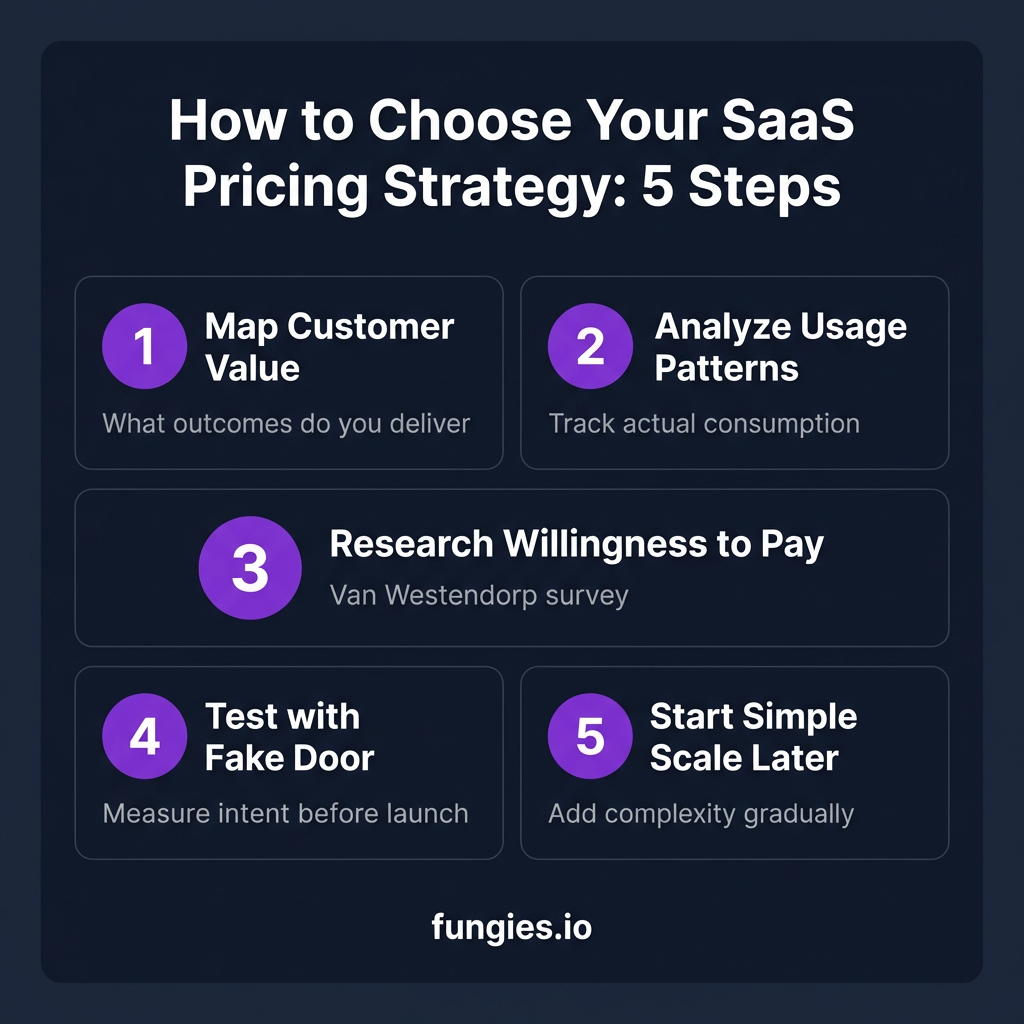
Step 1: Map Customer Value
What outcomes does your product deliver? If you save time, price per user. If you process transactions, price per transaction. If you drive revenue, price as a percentage of revenue. The pricing metric should mirror the value metric.
Step 2: Analyze Usage Patterns
Look at your current customers. Do power users look different from casual users? If usage varies 10x between your smallest and largest customers, pure per-seat pricing will either undercharge your whales or overcharge your minnows.
Step 3: Research Willingness to Pay
Run a Van Westendorp Price Sensitivity Survey. Ask four questions:
- At what price would this be so expensive you wouldn’t consider it?
- At what price would you start to think it’s expensive, but still consider it?
- At what price would you think it’s a bargain?
- At what price would you think it’s so cheap you’d question quality?
Companies that conduct willingness-to-pay research outperform peers by 10-15% on revenue growth.
Step 4: Test with a Fake Door
Put your proposed pricing on a landing page with a “Buy Now” button that leads to a “launching soon” email capture. Buffer famously used this approach. Measure click-through as an intent proxy before committing.
Step 5: Start Simple, Scale Complexity
Most Series A companies are better served starting with a simple subscription model, instrumenting usage data from day one, and layering in consumption pricing once the go-to-market motion and billing infrastructure are solid.
2026 SaaS Pricing Benchmarks You Need to Know
These numbers come from Monetizely’s analysis of 100+ SaaS companies and TechGrowth Insights’ 2026 benchmark analysis for $5M-$50M B2B SaaS:
| Metric | Median | Top Quartile | Bottom Quartile |
|---|---|---|---|
| Entry plan price | $29/user/mo | $49/user/mo | $15/user/mo |
| Per-user price | $45/mo | $79/mo | $19/mo |
| Price realization | 84% of list | 93% | 72% |
| Deals discounted | 64% | 38% | 82% |
| Expansion revenue % | 22% of new ACV | 41% | 8% |
Here’s the diagnostic that matters most: if your win-rate lift from discounting is under 5 percentage points, you’re giving away margin for nothing. And if your expansion revenue is below 22% of new ACV, that’s your highest-leverage fix—expansion dollars cost $0.15-$0.25 to capture versus $1.00 for new logo dollars.
Pricing Mistakes That Cost Real Revenue
I’ve seen these mistakes destroy companies. Avoid them at all costs:
Too Many Tiers
Three options is the sweet spot. It gives buyers a clear Good/Better/Best framework without triggering choice paralysis. Adding a fourth and fifth tier can drop conversions by 30%.
Undercharging
A SaaS founder on r/SaaS shared that doubling their price from $19 to $39 actually increased conversions. Higher prices signal quality. If your product solves a real problem, charging too little makes prospects suspicious, not grateful.
Habitual Discounting
64% of deals get discounted, and 40-60% of that discount volume is habitual—reps giving discounts because they always give discounts, not because the deal requires it. At 84% median price realization, the average $15M SaaS company is leaking $2.4M annually through pricing architecture failures.
Botched Price Increases
One company pushed a 40% price increase with only 30 days’ notice. The fallout: support tickets spiked 340%, monthly churn jumped from 2.1% to 8.7%, and 23% of customers churned within 60 days. Total first-year revenue impact exceeded $1.4M—against a projected gain of $600K.
How to Raise Prices Without Losing Customers
Done right, price increases can boost ARR significantly. Podpage raised prices and saw a 28.5% increase in ARR with zero customers lost. Here’s what works:
- Grandfather existing customers. They keep their current rate; new pricing applies to new sign-ups. Those grandfathered customers often become your biggest referral source.
- Give enterprise accounts 90-120 days’ notice. Thirty days is insulting for a company that needs budget approval cycles.
- Offer price locks for annual commitments. “Lock in your current rate for 12 months by switching to annual billing” turns a potential churn trigger into a cash flow win.
- A/B test before you commit. Klipfolio’s two-month test gave them confidence the change wouldn’t hurt conversion. Don’t guess—measure.
- Make annual increases a default operating rhythm. Only 34% of companies apply annual increases, but those that do typically realize 12-18% higher ACV over three years.
AI and the Future of SaaS Pricing
AI is forcing a pricing reckoning. A Cursor user woke up to a $7,225 yearly subscription invoice because a single developer burned through 500 requests in one day. That’s what happens when usage-based pricing meets unpredictable AI consumption.
The economics are fundamentally different. AI-first gross margins run 20-60%, compared to traditional SaaS at 70-90%. Bain’s analysis of 30+ SaaS vendors adding generative AI found:
- ~65% introduced hybrid pricing (seats plus an AI usage meter)
- ~35% bundled AI into existing per-seat tiers with a price increase
- Exactly zero moved to pure AI usage-based or outcome-based pricing
Per-seat pricing isn’t dead—it’s getting a usage-based sidecar. If your average deal size is under $10K, you probably don’t need a usage-based AI meter at all. Just bundle it, raise your price 15-20%, and move on.
Frequently Asked Questions About SaaS Pricing Strategies
What’s the best pricing model for a new SaaS product?
Tiered pricing with three public plans plus an enterprise option works best for most new products. Anchor your entry plan around $29/user/month and adjust based on Van Westendorp research. Layer in usage-based expansion once you have enough customers to measure consumption patterns.
How often should I change my SaaS pricing?
At least annually. Only 34% of SaaS companies apply annual increases, but those that do typically realize 12-18% higher ACV over three years with no meaningful churn impact. If you haven’t revisited pricing in over a year, you’re leaving revenue on the table.
Should I offer a free plan or free trial?
Freemium works if your product has viral or network effects—think Canva or Notion. If it doesn’t spread organically, a 14-day free trial with a clear upgrade trigger converts better. Free trials convert at 10-15% versus 2-5% for freemium.
How do I find the right price point?
Run a Van Westendorp survey with 100+ respondents per segment, then validate with a fake-door test on your pricing page. Companies that conduct willingness-to-pay research outperform peers by 10-15% on revenue growth.
Is usage-based pricing better than per-seat?
Not on its own. 85% of SaaS companies have adopted some usage-based element, but most pair it with seats as a hybrid. The winning pattern is per-seat as the base with usage-based metering for consumption-heavy features like AI or API calls.
Conclusion: Your Pricing Strategy Is a Growth Lever
Here’s the truth most SaaS founders miss: pricing isn’t just about revenue—it’s about positioning. Your pricing model signals what kind of company you are. Per-user pricing says “we’re a collaboration tool.” Usage-based says “we’re a consumption product.” Tiered pricing says “we have clear feature progression.”
If your pricing model contradicts your product positioning, customers get confused. And confused customers don’t buy.
The companies that win in SaaS are those that align their pricing with the value they create, not the costs they incur. That means investing in pricing research, testing rigorously, and having the courage to charge what your product is worth.
If you’re building a SaaS business and want to accept payments globally without the headache of tax compliance, check out Fungies.io. We handle VAT, sales tax, and payment processing so you can focus on what matters—building a product worth paying for.
Sources
- Prospeo: Pricing for SaaS: Models, Benchmarks & Strategy (2026)
- Monetizely: SaaS Pricing Benchmark Study 2025
- Metronome: State of Usage-Based Pricing 2025
- Maxio: 2025 SaaS Pricing Trends Report
- SaaS Mag: Hybrid Pricing in SaaS 2026
- Bain & Company: Per-Seat Software Pricing Isn’t Dead
- First Page Sage: SaaS Free Trial Conversion Rate Benchmarks