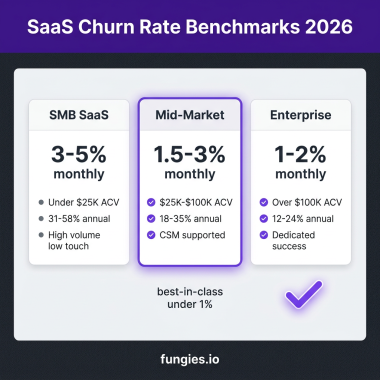
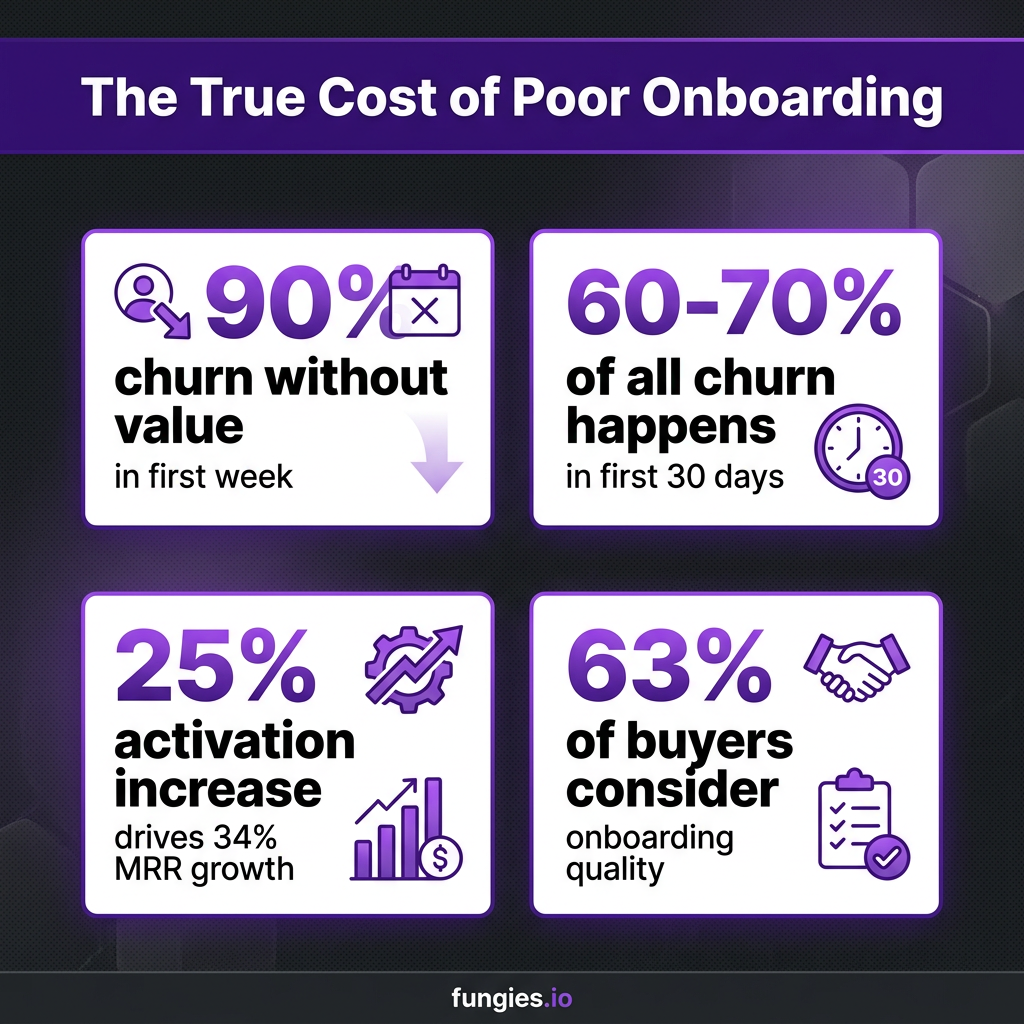
Here’s a sobering statistic: 90% of users will churn within the first week if they don’t experience clear value from your product. Not month. Week. And according to 2026 SaaS benchmarks, between 60-70% of all churn happens in those critical first 30 days after signup.
I’ve spent years optimizing onboarding flows for SaaS products, and I’ll tell you this — most founders treat onboarding as an afterthought. They pour budget into acquisition, celebrate signup numbers, then watch helplessly as users disappear before ever understanding what the product actually does.
The gap between signup and value is where SaaS products live or die. And the bridge across that gap? That’s your onboarding flow. Strong onboarding doesn’t just feel nice — it reduces churn by 20-50%, boosts activation rates to 40-60%, and directly correlates with lifetime value. Every 1% increase in activation rate drives roughly 2% lower churn.
What Is SaaS User Onboarding (Really)?
Let’s clear up a common misconception: onboarding is not a product tour. It’s not a series of tooltips you bolt on after launch. It’s not a welcome email sequence (though that’s part of it).
Real SaaS onboarding is the complete system that takes a new user from signup to repeatable value. It spans in-app flows, emails, checklists, contextual help, and user psychology across multiple sessions. It’s the entire experience that bridges the gap between “I signed up” and “I can’t imagine working without this.”
The goal isn’t to teach users every feature. The goal is to get them to their “aha moment” — that specific point where they experience real, tangible value from your product — as quickly as possible. Users who never reach this moment have no reason to return. They’ve got no skin in the game.
Why Onboarding Is Your Highest-Leverage Growth Channel
In my experience, most SaaS teams obsess over top-of-funnel metrics. CAC, impressions, click-through rates. But here’s the thing — if your onboarding is broken, you’re literally throwing money away.
Consider this: research from SaaSfactor shows that a 25% increase in user activation results in a 34% rise in MRR over 12 months. That single percentage-point improvement compounds into 25-50% increases in customer lifetime value over 12-24 months. Onboarding isn’t a nice-to-have. It’s a revenue multiplier.
And the data gets more compelling. SundaySky’s 2026 research found that 63% of customers take the onboarding experience into consideration when deciding to subscribe. A full 86% say they’re more likely to be loyal to businesses that provide educational, welcoming onboarding content after purchase.
Here’s what this means practically: if you’re spending $100K/month on acquisition but only activating 20% of signups, you’re effectively burning $80K. Fix onboarding first. Then scale acquisition.
Defining Your “Aha Moment” and Activation Criteria
Before you design a single onboarding screen, you need to answer one foundational question: What does “activated” mean for your product?
Activation is not “the user logged in a second time.” It’s not “they clicked around for five minutes.” Activation is the moment a user completes a specific action that strongly correlates with long-term retention. That moment is the aha moment.
Let’s look at how top SaaS companies define activation:
- Slack: Sending 2,000+ messages (indicates team adoption)
- Notion: Creating 3+ pages and inviting a teammate
- Figma: Creating a design file and sharing it
- Canva: Creating and downloading a design
- Dropbox: Uploading a file and sharing it
Notice the pattern? Activation isn’t about consuming content — it’s about creating value. Users need to do something meaningful, not just look around.
To find your aha moment, analyze your retention data. Look at actions that differentiate users who stick around from those who churn. The correlation will surprise you — it’s usually 2-3 specific actions, not broad engagement.
The 5-Step SaaS Onboarding Framework
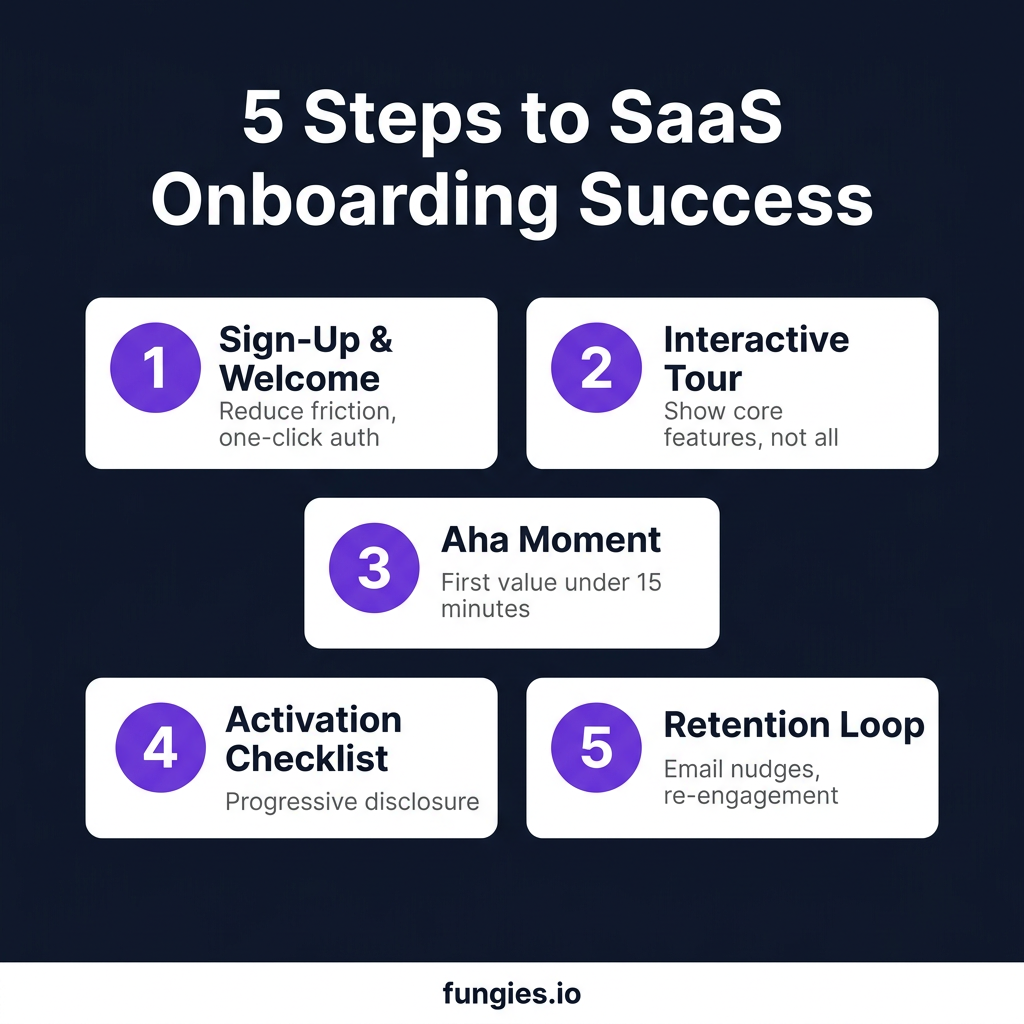
Step 1: Frictionless Signup and First Impressions
You’ve got about 30 seconds to prove your product was worth the signup. Maybe less. If your signup flow asks for 12 pieces of information, requires email verification before showing value, or dumps users into a blank dashboard, you’ve already lost.
Best-in-class signup flows do three things:
- Minimize fields: Email + password (or social auth) only. Everything else can come later.
- Delay verification: Let users see value before forcing email confirmation.
- Personalize immediately: Ask one high-value question (role, use case, team size) to tailor the experience.
Notion’s signup is a masterclass here. One field. Immediate value. Progressive profiling happens after you’re already invested.
Step 2: Interactive Product Education
Product tours that show every button and menu item don’t work. Users forget 70% of what you tell them in a linear walkthrough. Instead, use contextual, interactive education.
Effective approaches include:
- Role-based flows: Different experiences for admins vs. end users increase activation by 30-50%
- Use-case onboarding: Let users pick their goal, then show them exactly how to achieve it
- Interactive demos: Products with interactive onboarding see 50% higher activation rates
- Progressive disclosure: Show features as users need them, not all at once
Canva nails this. When you sign up, they ask what you’re designing. Then they drop you into a template perfectly matched to your use case. You’re not learning Canva — you’re creating something valuable immediately.
Step 3: Time to First Value (TTFV) Under 15 Minutes
Here’s a hard rule: users should experience meaningful value within 15 minutes of signup. Not hours. Not days. Minutes.
This is where most SaaS products fail. They require configuration, setup, data import, team invites — all before showing value. By the time users see results, they’ve already mentally churned.
Strategies to compress TTFV:
- Pre-populated templates: Don’t start users with blank slates
- Sample data: Show what success looks like with realistic examples
- Guided first actions: Walk users through one complete workflow
- Smart defaults: Configure 80% of settings automatically
Figma provides templates immediately. Loom lets you record your first video in seconds. The best products make value inevitable.
Step 4: Checklists and Progress Indicators
Humans are completionists. We hate leaving things unfinished. Smart onboarding uses this psychology with checklists and progress bars.
Effective onboarding checklists have:
- 3-5 items max: Too many choices paralyze users
- Clear value for each: Not “Complete profile” but “Add your photo so teammates recognize you”
- Progressive unlocking: Complete step 1 to reveal step 2
- Visual progress: Progress bars, checkmarks, completion percentages
Slack’s onboarding checklist is legendary. It’s short, contextual, and each item clearly connects to value. Users don’t just complete tasks — they understand why each task matters.
Step 5: Retention Loops and Re-engagement
Onboarding doesn’t end when the user closes the app. In fact, that’s when the real work begins. You need to create reasons for users to return.
Effective retention loops include:
- Email sequences: Triggered by behavior (or lack thereof), not time
- In-app notifications: New features, collaboration invites, milestone celebrations
- Team invites: Social proof + lock-in from inviting colleagues
- Scheduled actions: Reports, summaries, recurring tasks that bring users back
Notion’s email game is strong. They don’t just remind you to come back — they show you what your team has been creating. FOMO is a powerful retention tool.
Onboarding Metrics That Actually Matter
You can’t improve what you don’t measure. Here are the onboarding metrics that correlate with revenue:
| Metric | Benchmark | Why It Matters |
|---|---|---|
| Activation Rate | 25-30% (healthy), 40-60% (best-in-class) | % of users reaching aha moment |
| Time to First Value | Under 15 minutes | Speed to meaningful outcome |
| Onboarding Completion Rate | 60%+ | % finishing onboarding flow |
| Day-1 Retention | 33%+ (B2B median) | Users returning next day |
| Week-1 Retention | 20%+ | Critical churn window |
Track these weekly. Segment by traffic source, user role, and signup method. The patterns will reveal exactly where your onboarding is breaking down.
Common Onboarding Mistakes to Avoid
I’ve audited hundreds of SaaS onboarding flows. Here are the mistakes I see over and over:
Mistake 1: Front-Loading Features
Your product has 47 amazing features. Users don’t care. They care about solving one specific problem. Show them that path, not the entire feature map.
Mistake 2: Building for the Product, Not the User
Onboarding flows often reflect internal product structure rather than user goals. Users don’t think in terms of “projects” and “workspaces” — they think in terms of “I need to send this newsletter.” Design for jobs-to-be-done, not feature categories.
Mistake 3: Treating Onboarding as One-Time
Onboarding isn’t a single session. It’s a multi-day, multi-session journey. Your email sequence matters as much as your in-app flow. Day 3, Day 7, and Day 14 touchpoints are critical.
Mistake 4: Ignoring Empty States
Blank dashboards kill momentum. Every empty state should provide direction and the next best action. Don’t just say “No data yet” — say “Connect your first integration to see analytics” with a clear CTA.
AI and the Future of SaaS Onboarding in 2026
The onboarding landscape is evolving rapidly. AI-powered onboarding is now fundamental, enabling adaptive learning and personalization at scale. Here’s what’s working:
- AI-powered role detection: Automatically segment users based on behavior patterns
- Dynamic content personalization: Onboarding that adapts in real-time based on user actions
- Predictive churn alerts: AI identifies at-risk users before they churn
- Conversational onboarding: Chatbots that guide users through complex setups
Products leveraging AI in onboarding are seeing 40-60% improvements in activation rates. The technology isn’t just a nice-to-have anymore — it’s becoming table stakes.
FAQ: SaaS User Onboarding
What’s a good activation rate for SaaS?
A healthy SaaS activation rate ranges from 25-30%. Top-performing PLG companies achieve 40-60%, with best-in-class performers reaching 70%+. If you’re below 20%, your onboarding needs immediate attention.
How long should SaaS onboarding take?
Time to first value should be under 15 minutes. Full onboarding — getting users to their aha moment — should happen within the first session or first day. If it takes longer, you’re losing users.
What’s the difference between onboarding and activation?
Onboarding is the process. Activation is the outcome. Onboarding includes all the steps, flows, and touchpoints that guide users. Activation is the moment they experience core value. Good onboarding leads to activation.
Should B2B and B2C SaaS have different onboarding?
Absolutely. B2B onboarding typically involves multiple stakeholders, longer sales cycles, and higher-touch elements like onboarding calls. B2C onboarding needs to be faster, more self-serve, and immediately valuable. The principles are similar, but the execution differs significantly.
How do I measure onboarding success?
Focus on activation rate, time to first value, and early retention (Day 1, Day 7, Day 30). These metrics correlate directly with revenue. Vanity metrics like “tour completion rate” don’t matter if users aren’t activating.
Conclusion: Onboarding Is a Growth Engine
Here’s the truth most SaaS founders miss: onboarding isn’t a support function. It’s not customer success’s problem. It’s not something you fix after you’ve scaled acquisition.
Onboarding is your highest-leverage growth channel. It multiplies the impact of every dollar you spend on acquisition. It determines whether users become customers or churn statistics.
The data is unambiguous: 90% of users churn without early value. But the flip side is powerful — users who experience their aha moment in the first session have dramatically higher lifetime value, lower churn, and higher expansion rates.
Stop treating onboarding as an afterthought. Start treating it as the critical business function it is. Audit your current flow. Measure your activation rate. Compress your time to first value. The ROI will surprise you.
And if you’re building a SaaS product and need a payment infrastructure that handles the complexity of global transactions, taxes, and compliance — so you can focus on building an amazing onboarding experience — check out Fungies.io. We handle the financial infrastructure so you can focus on what matters: activating users.
Sources
- SundaySky Customer Onboarding Statistics 2026 – https://sundaysky.com/blog/customer-onboarding-statistics
- DesignRevision SaaS Onboarding Best Practices 2026 – https://designrevision.com/blog/saas-onboarding-best-practices
- SaaSfactor User Activation Research – https://www.saasfactor.co/blogs/saas-user-activation-proven-onboarding-strategies-to-increase-retention-and-mrr
- Arcade Software Customer Onboarding Best Practices – https://www.arcade.software/post/customer-onboarding-best-practices
- Custify SaaS Customer Onboarding Statistics – https://www.custify.com/blog/saas-customer-onboarding-and-retention-statistics
- Appcues User Onboarding Best Practices – https://www.appcues.com/blog/user-onboarding-best-practices
- ProductLed Onboarding Research – https://productled.com/blog/5-best-practices-for-better-saas-user-onboarding
- Amplitude Activation Rate Guide – https://amplitude.com/explore/digital-analytics/what-is-activation-rate