Steam Revenue Share Explained: The Complete Guide for Game Developers 2026
Steam takes 30% of game sales — but is it worth it? Learn how Steam’s revenue share works, how it compares to Epic Games Store and itch.io, and what it means for your bottom line.
If you’re an indie developer looking to publish your game on Steam, understanding the revenue share model is absolutely critical. Steam’s cut affects every dollar you earn, and knowing exactly how much you’ll take home can make or break your financial planning. In this guide, we’ll break down Steam’s revenue share explained in simple terms, compare it to competitors, and show you how to maximize your earnings.
What Is Steam’s Revenue Share?
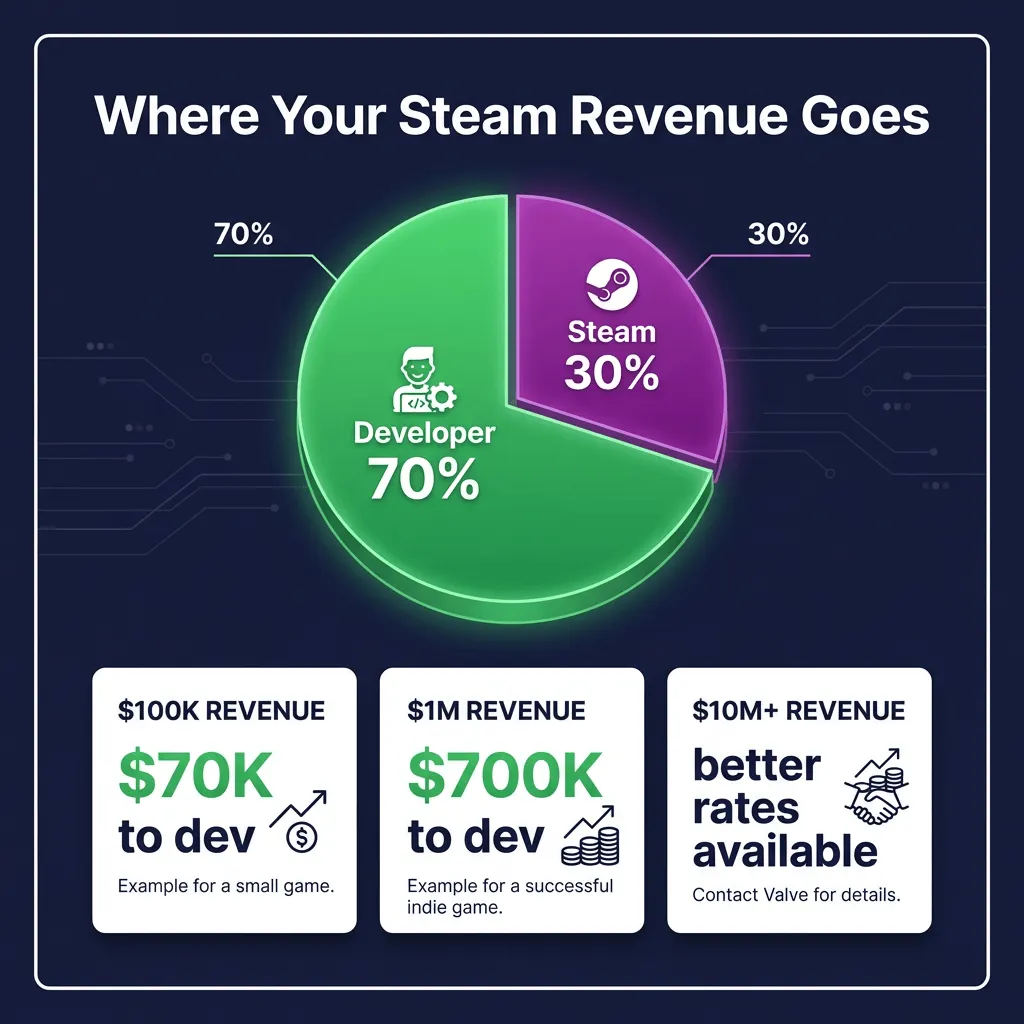
Steam operates on a straightforward revenue split: Valve takes 30%, and developers keep 70%. This applies to most games sold through the platform, whether they’re $5 indie titles or $60 AAA releases. The 70/30 split has been Steam’s standard since its launch in 2003, making it one of the most consistent revenue models in the gaming industry.
But here’s where it gets interesting — Steam actually offers better rates for massively successful games. Once your game hits $10 million in revenue, the split changes to 75/25 (you keep 75%). And if you reach $50 million, it improves further to 80/20. While most indie developers won’t hit these thresholds, it’s worth knowing the tiered structure exists.
The 30% cut covers more than just hosting your game. You’re paying for access to Steam’s massive user base (over 132 million monthly active users), their robust infrastructure, automatic updates, cloud saves, achievements, trading cards, community features, and the Steam Workshop. For many developers, this ecosystem justifies the fee.
How Steam’s Revenue Share Compares to Competitors
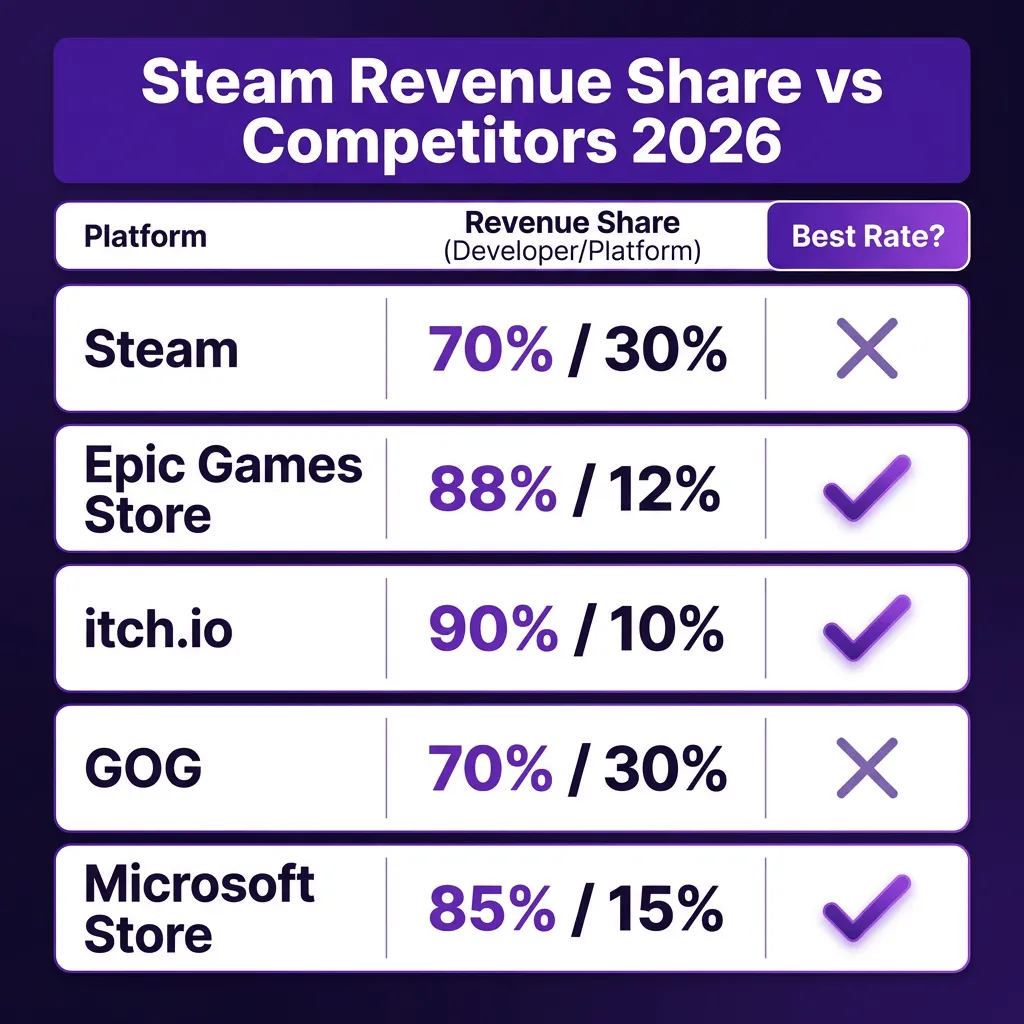
Steam’s 30% cut isn’t the industry standard anymore — it’s actually on the higher end. Let’s look at how competitors stack up:
Epic Games Store: 88/12 Split
Epic made waves in 2018 by offering developers 88% of revenue while keeping just 12%. This aggressive move was designed to lure developers away from Steam. Epic also waives the 5% Unreal Engine royalty for games sold on their store, which can save developers even more money. The catch? Epic’s user base is significantly smaller than Steam’s, with roughly 68 million monthly active users compared to Steam’s 132 million.
itch.io: 90/10 Split (or Custom)
itch.io is the indie developer’s paradise when it comes to revenue share. The default split is 90/10, meaning you keep 90% of every sale. Even better, itch.io lets you set your own revenue share — you can give them 0% if you want, though most developers choose to support the platform. The downside is that itch.io’s audience is much smaller and more niche than Steam’s mainstream gaming crowd.
GOG: 70/30 Split
GOG (Good Old Games) matches Steam’s 70/30 split but targets a different audience — DRM-free gaming enthusiasts. Their user base is smaller but highly engaged. GOG also offers a more curated experience, which can be a double-edged sword: less competition but also less discoverability.
Microsoft Store: 85/15 Split
Microsoft recently improved their revenue share to 85/15 for PC games, making them more competitive. However, the Microsoft Store still struggles with visibility and user adoption among core PC gamers, many of whom prefer Steam out of habit.
Real Numbers: What Steam’s Cut Looks Like in Practice
Let’s put this into perspective with real numbers. Say your game sells for $20:
- 100 copies sold: $2,000 gross revenue → $1,400 to you, $600 to Steam
- 1,000 copies sold: $20,000 gross revenue → $14,000 to you, $6,000 to Steam
- 10,000 copies sold: $200,000 gross revenue → $140,000 to you, $60,000 to Steam
- 100,000 copies sold: $2,000,000 gross revenue → $1,400,000 to you, $600,000 to Steam
At the $10 million threshold, your split improves to 75/25. So if your game generates $10,000,001 in revenue, that last dollar gets split 75/25 instead of 70/30. Every dollar after $50 million gets split 80/20.
Hidden Costs Beyond the Revenue Share
The 30% cut isn’t the only cost of doing business on Steam. Here are other expenses to factor into your calculations:
Steam Direct Fee: $100 Per Game
To publish on Steam, you need to pay a $100 recoupable app fee. This fee is returned once your game generates $1,000 in revenue. It’s a barrier to entry that keeps low-effort asset flips off the platform.
Tax Compliance and VAT
Steam handles VAT and sales tax collection in most jurisdictions, which is a huge benefit. However, you’re still responsible for income tax on your earnings. If you’re selling games internationally (and you should be), tax compliance gets complicated fast. This is where a Merchant of Record like Fungies.io can save you headaches — we handle global tax compliance automatically.
Refund Processing
Steam’s generous refund policy (2 hours of playtime or 14 days, whichever comes first) means you’ll see some returns. Refunds are deducted from your revenue share, so if a $20 game is refunded, you lose that $14 you would have earned.
Is Steam’s 30% Cut Worth It?
This is the million-dollar question, and the answer depends on your situation. Here’s my take as someone who’s seen both sides:
Steam is worth it if: You want access to the largest PC gaming audience, you value Steam’s infrastructure (updates, cloud saves, achievements), and you believe the discoverability boost outweighs the higher cut. For most indie developers, Steam is still the primary sales driver despite the 30% fee.
Consider alternatives if: You have an existing audience you can direct to other platforms, you want to maximize revenue per sale, or your game targets a niche that congregates elsewhere (like itch.io’s indie community).
Many successful developers use a multi-platform strategy: launch on Steam for the mainstream audience, maintain a presence on Epic for better margins on direct traffic, and use itch.io for early access builds or special editions.
FAQ: Steam Revenue Share
Does Steam take 30% of DLC sales too?
Yes, the 70/30 split applies to all content sold through Steam, including DLC, season passes, and in-game items (if using Steam’s microtransaction system).
Can I negotiate a better revenue split with Steam?
For the vast majority of developers, no. The tiered system (75/25 at $10M, 80/20 at $50M) is the only way to get better rates. Major publishers with significant leverage might have different arrangements, but these aren’t publicly disclosed.
Does Steam’s cut include payment processing fees?
Yes, the 30% covers everything — hosting, payment processing, fraud prevention, and platform features. You don’t pay extra for credit card fees or chargebacks.
How often does Steam pay developers?
Steam pays out monthly, approximately 30 days after the end of each month. There’s a minimum payout threshold of $100 (or equivalent in other currencies).
What currency does Steam pay in?
You can choose your payout currency during setup. Steam supports USD, EUR, GBP, and many others. Currency conversion fees are built into the 30% cut.
Conclusion: Making the Most of Steam’s Revenue Model
Steam’s 70/30 revenue split is higher than some competitors, but the platform’s massive reach and robust feature set still make it the go-to choice for most PC game developers. The key is understanding exactly what you’re paying for and factoring the 30% cut into your financial projections from day one.
Remember: 70% of sales on Steam is often better than 88% of sales on a platform with a fraction of the users. Focus on making a great game, building an audience, and optimizing your Steam page for discoverability. The revenue will follow.
Ready to Maximize Your Game Revenue?
Join hundreds of indie developers using Fungies.io — automated tax compliance, 50+ payment methods, global Merchant of Record for your game sales.
No credit card required
Sources
- Steam Partner Documentation: Revenue Share
- Epic Games Store FAQ
- itch.io Creator Guide
- GOG Developer Portal
- Microsoft Store Policies