Only 5% of enterprise AI solutions make it from pilot to production. That’s not a typo. MIT research from 2025 confirms what every developer already suspects: most AI projects die before they ever see real users.
The framework you pick determines whether you’re shipping or starting over. Choose wrong, and you’ll burn months rebuilding. Choose right, and you’ll have agents in production within days.
This guide cuts through the noise. I’ve analyzed the seven frameworks actually being used in production today — not the ones with the best marketing, but the ones handling real traffic at companies like Klarna, IBM, and Cisco. You’ll get specific numbers, real deployment timelines, and honest trade-offs.
What Are AI Agent Frameworks?
An AI agent framework is the infrastructure that lets large language models (LLMs) act autonomously. Think of it as the operating system for AI agents — it handles the messy parts so you can focus on what your agents actually do.
Every framework has four critical components:
- LLM reasoning engine — The brain that decides what to do next
- Memory — Short-term context and long-term knowledge storage
- Tools — External capabilities like API calls, file operations, or web searches
- Execution runtime — The orchestration layer that manages agent lifecycles
In 2026, these frameworks matter more than ever. 70% of regulated enterprises replace at least part of their AI agent stack every 3 months according to Cleanlab’s 2025 survey. The cost of picking wrong isn’t just time — it’s the 40-60% of operational expenses that go to LLM API calls when your architecture isn’t optimized.
How We Evaluated These Frameworks
I ranked these frameworks based on five criteria that actually matter for production deployments:
- Production deployments — Real companies, real traffic, not demo projects
- Learning curve — How long until your team is productive
- Setup time — Hours from zero to working prototype
- Cost structure — Hidden fees, API costs, and scaling economics
- Flexibility — Can it adapt when requirements change (and they will)
The 7 Best AI Agent Frameworks (Ranked)
1. LangGraph — Best for Complex Stateful Workflows
LangGraph is the production standard for serious AI applications. Built by the LangChain team, it uses a graph-based architecture where nodes represent operations and edges define state transitions. This lets you build cyclic workflows — agents that can loop, retry, and maintain complex state across multiple steps.
Setup time: 2-3 hours
Pricing: Open-source; you pay only for LLM API costs
Production deployments: Klarna, Cisco, Vizient
The killer feature is state management. LangGraph saves 40-50% of LLM calls on repeat requests by maintaining stateful patterns. When an agent needs to reference previous context, it doesn’t re-query the LLM — it pulls from the graph state.
Pros:
- 40-50% reduction in LLM API costs through stateful patterns
- Most production deployments of any framework
- Fine-grained control over state transitions
- Excellent debugging and observability tools
Cons:
- Steeper learning curve — graph concepts take time to master
- Overkill for simple linear workflows
Choose LangGraph when: You’re building complex multi-step workflows with conditional logic, error handling, and state that needs to persist across interactions.
2. CrewAI — Best for Fast Multi-Agent Prototyping
CrewAI takes a role-based approach to agent design. You define agents by their roles (researcher, writer, reviewer), assign tasks, and let the framework handle coordination. It’s the fastest path from idea to working demo.
Setup time: 2-4 hours
Pricing: Open-source core; Enterprise platform available
Production deployments: IBM, PwC, Gelato
The YAML configuration is a standout feature. You can define entire agent crews in readable configuration files without touching code. This makes it accessible to teams with mixed technical skills.
Pros:
- Fastest time to working demo (2-4 hours)
- Intuitive role-based architecture
- Strong community and documentation
- YAML config enables non-developer participation
Cons:
- Documented “Pending Run” delays (~20 minutes) on Enterprise tier
- Role-based structure can feel rigid for unconventional workflows
Choose CrewAI when: You need to prototype fast and your use case fits the role-based model (research → draft → review → publish).
3. Microsoft AutoGen — Best for Conversation-Driven Applications
AutoGen treats conversation as the core abstraction. Agents talk to each other, and the framework manages the dialogue flow. It’s now merged with Semantic Kernel and became production-ready in October 2025.
Setup time: Moderate
Pricing: Bundled with Microsoft Agent Framework
Production-ready since: October 2025
The conversation pattern model is natural for chat-based applications. If you’re building customer service bots, collaborative coding assistants, or any system where back-and-forth dialogue is central, AutoGen fits.
Pros:
- Natural fit for conversational applications
- Strong Microsoft ecosystem integration
- Enterprise-grade security and compliance features
Cons:
- Limited support for structured, non-conversational workflows
- Microsoft-centric — less ideal if you’re not in Azure
Choose AutoGen when: You’re building chat-based applications where natural dialogue flow matters more than rigid process control.
4. LlamaIndex — Best for RAG and Data-Intensive Tasks
LlamaIndex started as a data framework and evolved into a full agent platform. Its strength is connecting LLMs to your data — documents, databases, APIs — through sophisticated retrieval strategies.
Setup time: 2-4 hours
Pricing: Open-source; LLM API costs apply
Key features: Vector, tree, and keyword indexing; 100+ data connectors
The indexing strategies are what set LlamaIndex apart. Vector search is just the start — you get tree-based summarization, keyword hybrid search, and composable indices that combine multiple retrieval methods.
Pros:
- Most advanced indexing strategies available
- Massive data connector ecosystem
- Excellent for document-heavy applications
Cons:
- Data-centric focus limits multi-agent collaboration features
- Can be overkill if you don’t have complex data needs
Choose LlamaIndex when: Your application is primarily about retrieving and synthesizing information from documents, databases, or knowledge bases.
5. Claude Agent SDK — Best for Autonomous Tool-Using Agents
Anthropic’s official SDK gives you the same infrastructure that powers Claude Code. It’s designed for agents that need to use tools autonomously — editing files, running shell commands, and interacting with external systems.
Setup time: Minutes to hours
Pricing: Anthropic API costs ($3/$15 per million tokens for Sonnet 4.5)
Key features: Sandboxed shell, file editing, MCP tool support
The sandboxed execution environment is a standout. Your agents can safely run code, modify files, and execute commands without risking your host system. MCP (Model Context Protocol) support means seamless integration with external tools.
Pros:
- Same infrastructure as Claude Code
- Python and TypeScript SDKs
- Excellent tool-use capabilities out of the box
- Sandboxed execution for safety
Cons:
- Anthropic-only — locked to Claude models
- Newer ecosystem with fewer third-party integrations
Choose Claude SDK when: You want autonomous agents that can safely execute code and use tools, and you’re already committed to the Claude model family.
6. OpenAI Swarm — Best for Lightweight Multi-Agent
Swarm is OpenAI’s experimental framework for lightweight agent orchestration. It’s minimal by design — no complex state management, just simple handoffs between agents.
Setup time: Minimal
Pricing: Usage-based OpenAI API
Key features: Lightweight, experimental framework
The simplicity is the point. Swarm is ideal for quick prototypes and learning multi-agent concepts without the overhead of production frameworks.
Pros:
- Simplest agent orchestration available
- Great for learning and experimentation
- Clean integration with OpenAI ecosystem
Cons:
- Limited production features
- Experimental status means API changes
- Not suitable for complex workflows
Choose OpenAI Swarm when: You’re learning multi-agent concepts or building simple prototypes where minimal overhead matters more than production features.
7. Microsoft Semantic Kernel — Best for Enterprise Integration
Semantic Kernel is Microsoft’s enterprise-focused framework. It supports C#, Python, and Java — a rarity in the Python-dominated AI space — and integrates deeply with Azure services.
Setup time: Moderate
Pricing: Open-source
Key features: Multi-language support, Azure integration, enterprise connectors
The multi-language support is crucial for enterprises with existing .NET or Java codebases. You don’t need to rewrite everything in Python to add AI capabilities.
Pros:
- Only major framework with C# and Java support
- Deep Azure integration
- Enterprise-grade security and compliance
Cons:
- Azure-centric — less valuable outside Microsoft ecosystem
- Complex for simple use cases
Choose Semantic Kernel when: You’re in a Microsoft/Azure environment or need AI capabilities in C# or Java applications.
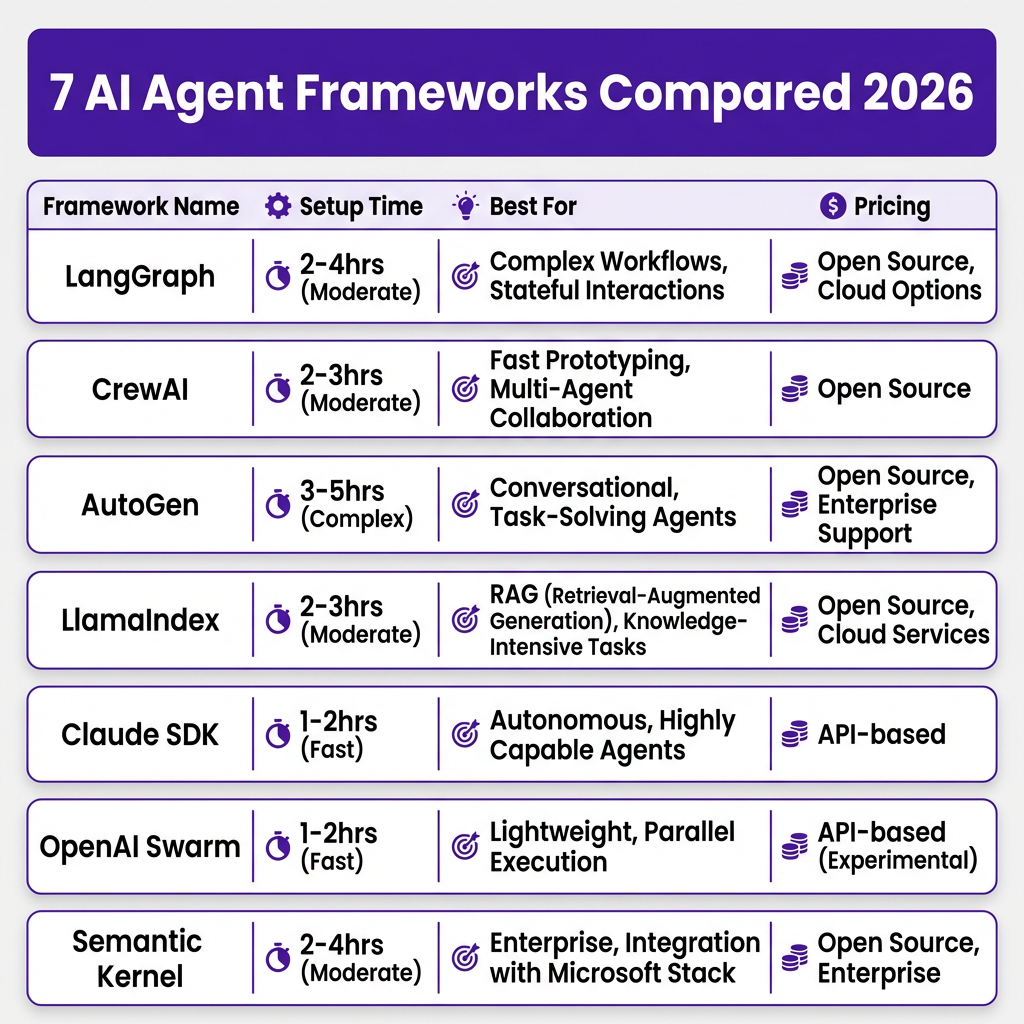
AI Agent Framework Comparison Table
| Framework | Best For | Setup Time | Pricing | Learning Curve | Production Ready |
|---|---|---|---|---|---|
| LangGraph | Complex stateful workflows | 2-3 hours | Open-source + API | Steep | Yes (Klarna, Cisco) |
| CrewAI | Fast prototyping | 2-4 hours | Open-source + Enterprise | Easy | Yes (IBM, PwC) |
| AutoGen | Conversational apps | Moderate | Microsoft ecosystem | Moderate | Yes (Oct 2025) |
| LlamaIndex | RAG/Data tasks | 2-4 hours | Open-source + API | Moderate | Yes |
| Claude SDK | Autonomous agents | Minutes-hours | Anthropic API | Easy | Yes |
| OpenAI Swarm | Lightweight multi-agent | Minimal | OpenAI API | Easy | Experimental |
| Semantic Kernel | Enterprise/Azure | Moderate | Open-source | Moderate | Yes |
AI Agent Framework Comparison Infographic
How to Choose the Right Framework
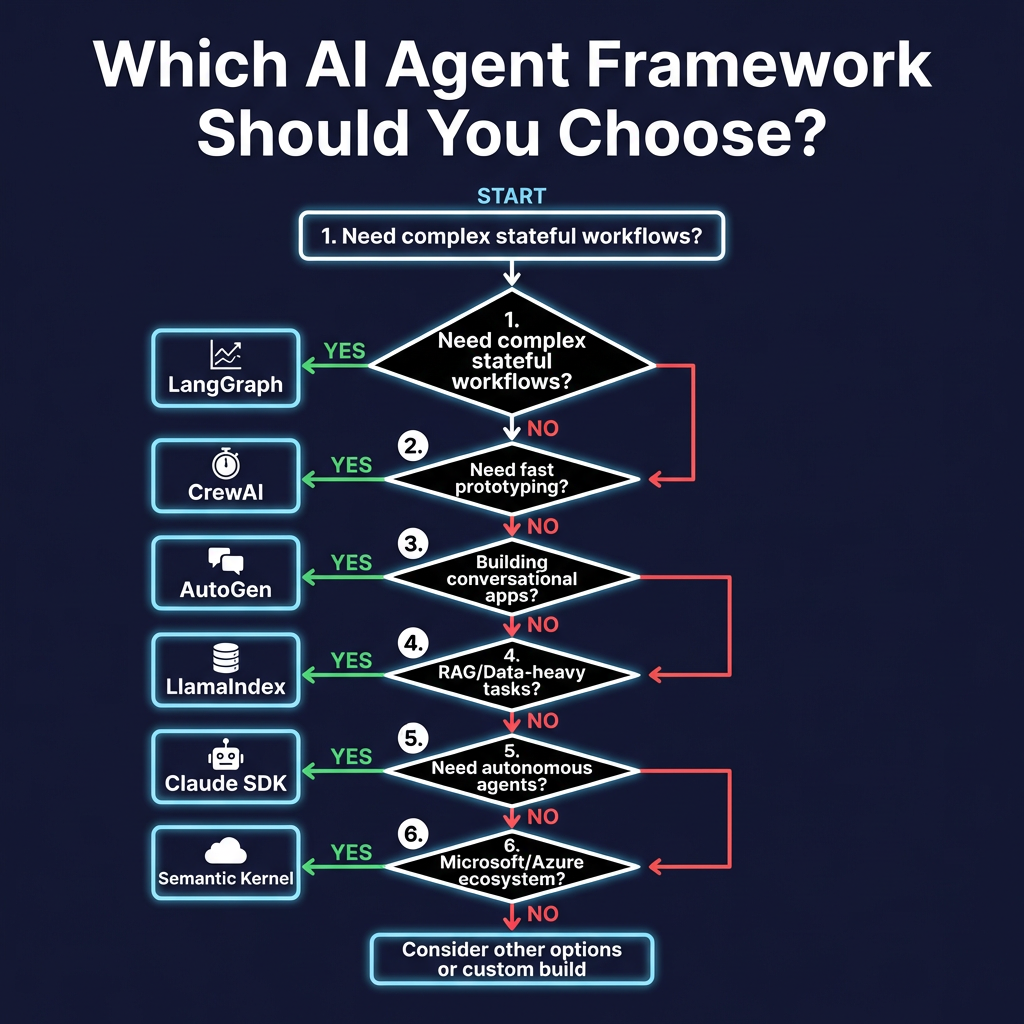
Picking a framework isn’t about finding the “best” one — it’s about finding the right fit for your specific situation. Here’s a decision framework based on real-world constraints:
Team Size and Technical Expertise
Small team, limited AI experience: Start with CrewAI or Claude SDK. Both have gentle learning curves and get you to a working demo fast.
Experienced team, complex requirements: LangGraph is worth the learning curve. The state management and debugging tools pay dividends at scale.
Mixed technical skills: CrewAI’s YAML configuration lets non-developers define agent roles and tasks while engineers handle the implementation.
Use Case
Document processing and RAG: LlamaIndex. The indexing strategies and data connectors are unmatched for retrieval-heavy applications.
Customer service or chatbots: AutoGen. The conversation-first model maps naturally to dialogue-based applications.
Autonomous code execution: Claude SDK. The sandboxed shell and file editing capabilities are purpose-built for this.
Multi-step business processes: LangGraph. When you need error handling, retries, and conditional logic, the graph model is essential.
Integration Requirements
Microsoft/Azure ecosystem: Semantic Kernel or AutoGen. The Azure integration is deep and well-supported.
Existing .NET/Java codebase: Semantic Kernel. It’s the only major framework with first-class C# and Java support.
Multiple data sources: LlamaIndex. The connector ecosystem covers everything from SQL databases to Slack to PDFs.
Budget Constraints
Remember: framework licensing is usually the smallest cost. LLM API calls represent 40-60% of operational expenses. LangGraph’s 40-50% savings on repeat requests can translate to thousands of dollars monthly at scale.
If budget is tight, prioritize open-source frameworks (LangGraph, CrewAI, LlamaIndex, Semantic Kernel) and optimize your prompt caching strategy.
Which AI Agent Framework Should You Choose? Decision Flowchart
Key Takeaways
- Only 5% of AI projects reach production — your framework choice is a major factor in whether you ship or restart
- LangGraph leads for complex workflows — the state management and 40-50% LLM cost savings make it the production standard
- CrewAI wins for speed — 2-4 hours to a working demo, perfect for prototyping and teams with mixed technical skills
- LlamaIndex dominates RAG — if your application is about retrieving and synthesizing data, start here
- Microsoft frameworks excel in Azure environments — AutoGen for conversations, Semantic Kernel for enterprise integration
- API costs matter more than licensing — LLM calls are 40-60% of your budget; optimize for efficiency, not just framework price
Frequently Asked Questions
What is the easiest AI agent framework for beginners?
CrewAI and the Claude Agent SDK are the most beginner-friendly. CrewAI’s role-based model maps to how people naturally think about tasks, and the YAML configuration reduces code complexity. Claude SDK is similarly approachable if you’re already familiar with Claude’s capabilities. Both can get you from zero to working agent in under 4 hours.
Which framework is best for production RAG applications?
LlamaIndex is the clear winner for RAG. Its indexing strategies (vector, tree, keyword, and composable indices) give you more retrieval options than any competitor. The 100+ data connectors mean you can pull from virtually any source without writing custom integrations. LangGraph is a strong alternative if your RAG pipeline needs complex multi-step processing or conditional logic.
How much do AI agent frameworks cost?
Most frameworks are open-source and free to use. The real cost is LLM API calls, which typically represent 40-60% of operational expenses. Claude SDK uses Anthropic’s API ($3/$15 per million tokens for Sonnet 4.5). OpenAI frameworks use OpenAI’s pricing. LangGraph can reduce costs by 40-50% through stateful caching. CrewAI offers an Enterprise tier with documented “Pending Run” delays of ~20 minutes.
Can I switch frameworks after starting a project?
Yes, but it’s painful. The framework you choose influences your architecture, data models, and deployment patterns. Switching means rewriting agent definitions, retraining team members, and often rethinking your approach. That’s why 70% of regulated enterprises replace at least part of their stack every 3 months — sometimes it’s easier to start fresh than migrate. Choose carefully upfront.
What skills do I need to build AI agents?
At minimum: Python (most frameworks are Python-first), API integration experience, and prompt engineering basics. For production deployments, add error handling, observability, and security best practices. LangGraph and Semantic Kernel require understanding graph concepts or enterprise architecture patterns respectively. The Claude SDK lowers the barrier if you’re comfortable with TypeScript or Python and API integration.
Conclusion
The framework you choose today shapes what you can ship tomorrow. LangGraph, CrewAI, AutoGen, LlamaIndex, Claude SDK, OpenAI Swarm, and Semantic Kernel each solve different problems for different teams.
There’s no universal “best” framework — only the right framework for your use case, team, and constraints. Start with the decision flowchart above, build a prototype in 2-4 hours, and validate your choice with real usage before committing to production.
And remember: 5% of AI projects reach production not because the technology is hard, but because teams pick tools that don’t match their needs. Don’t be part of the 95% that don’t ship.
Ready to build something that actually gets used? Get started with Fungies — we handle the payments and tax complexity so you can focus on building AI agents that matter.
References
- MIT Sloan Management Review (2025) — “Why 95% of AI Pilots Never Reach Production” — https://sloanreview.mit.edu
- Cleanlab Survey (2025) — “Enterprise AI Stack Replacement Patterns” — https://cleanlab.ai
- LangGraph Documentation — Production Deployment Case Studies — https://langchain-ai.github.io/langgraph/
- CrewAI Official Documentation — https://docs.crewai.com
- Microsoft AutoGen Documentation — https://microsoft.github.io/autogen/
- LlamaIndex Documentation — https://docs.llamaindex.ai
- Anthropic Claude SDK — https://docs.anthropic.com
- OpenAI Swarm Repository — https://github.com/openai/swarm
- Microsoft Semantic Kernel — https://learn.microsoft.com/en-us/semantic-kernel/