Digital Product Pricing Strategies: The Complete 2026 Guide for Creators
Learn the 5 proven digital product pricing strategies that top creators use in 2026. From cost-plus to value-based pricing, discover how to price your templates, courses, and downloads for maximum profit.
Pricing your digital product is one of the most critical decisions you’ll make as a creator. Set it too low, and you leave money on the table while potentially signaling low quality. Set it too high, and you price yourself out of the market. After analyzing hundreds of successful digital product launches and interviewing creators earning six figures from their digital assets, I’ve identified the pricing strategies that actually work in 2026.
The digital product market has exploded to $157.4 billion globally, growing at 26.6% annually. But here’s what most guides won’t tell you: the creators winning in this market aren’t just creating great products—they’re pricing them strategically. Whether you’re selling Notion templates, online courses, ebooks, or software, the right pricing strategy can mean the difference between a side hustle and a full-time income.
Why Pricing Strategy Matters More Than Ever
In 2026, consumers are more price-sensitive but also more willing to pay premium prices for products that deliver clear value. The paradox? They’ll happily pay $97 for a template that saves them 10 hours of work, but balk at $9.99 for an ebook that doesn’t solve a specific problem.
Your pricing sends a signal about quality, positions you against competitors, and directly impacts your profit margins. With digital products, your marginal cost is essentially zero—so every pricing decision flows straight to your bottom line. A 20% price increase can double your profit if your costs are fixed.
Consider this: creators using value-based pricing report 40% higher profit margins than those using cost-plus methods. When you price based on the transformation you deliver rather than the hours you invested, you align your success with your customer’s success.
The 5 Digital Product Pricing Strategies That Work
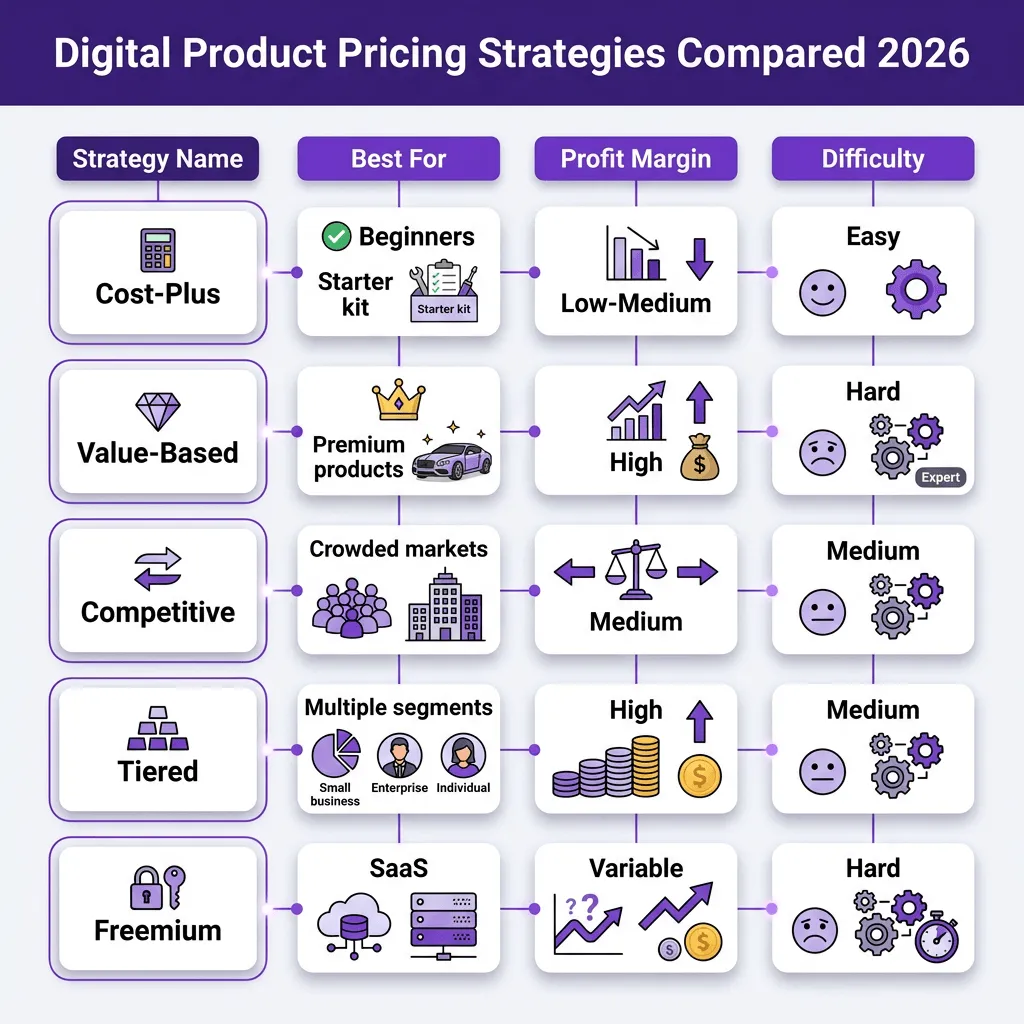
1. Cost-Plus Pricing: The Beginner’s Starting Point
Cost-plus pricing is exactly what it sounds like: calculate your costs, add your desired profit margin, and that’s your price. It’s simple, logical, and protects you from losing money on every sale.
Here’s the formula: (Production Costs + Time Investment + Platform Fees) × Profit Margin = Price. For example, if you spent 20 hours creating a template at $50/hour value, plus $200 in design tools, and platform fees are 5%, your baseline is $1,200. Add a 50% profit margin, and you’re at $1,800. Divide by expected sales volume—say 100 units—and your price is $18.
The problem? This method ignores what customers are willing to pay and what competitors charge. It’s a safe starting point, but it’s not how you maximize revenue. Use cost-plus to set your floor price—the minimum you can charge without losing money.
2. Value-Based Pricing: The Profit Maximizer
Value-based pricing flips the script. Instead of starting with your costs, you start with the value your customer receives. How much time does your product save? What revenue does it help generate? What expensive problem does it solve?
A freelance contract template that saves a designer 5 hours of work per client is worth $500+ to someone billing $100/hour. Even if it took you 2 hours to create, charging $97 is a no-brainer for the buyer—and highly profitable for you.
To implement value-based pricing, interview your target customers. Ask: “What would solving this problem be worth to you?” “How much time/money does this issue currently cost you?” Their answers reveal your pricing ceiling—the maximum you can charge while still delivering clear ROI.
3. Competitive Pricing: Know Your Market Position
Competitive pricing means positioning your product relative to alternatives. Are you the premium option, the budget choice, or the value leader? Your price signals your position instantly.
Research 10-15 competing products in your niche. Plot their prices on a spectrum. Where’s the gap? If most templates sell for $19-$29, there’s room for a $49 premium option with more features—or a $9 entry-level version for price-sensitive buyers.
Don’t just copy competitors. Understand why they priced that way. A course priced at $997 might include live coaching. A $27 ebook might be a loss leader for a high-ticket program. Your competitive analysis should reveal opportunities, not just benchmarks.
4. Tiered Pricing: Capture Multiple Customer Segments
Tiered pricing offers multiple versions of your product at different price points. This strategy captures customers at various budget levels while increasing average order value through upsells.
The classic three-tier structure works: Basic ($29) includes core templates, Pro ($79) adds customization and bonuses, and Enterprise ($199) includes commercial rights and support. Each tier targets a different customer segment while making the middle tier look like the best value.
Data shows that tiered pricing can increase revenue by 30-50% compared to single-price offerings. The key is ensuring each tier delivers distinct value—don’t just remove features for the lower tier, add meaningful value for the higher ones.
5. Freemium: The Acquisition Engine
Freemium offers a free version with limited features, then charges for premium upgrades. It’s dominant in SaaS but increasingly popular for digital products like templates, plugins, and tools.
The math is compelling: convert just 3-5% of free users to paid, and freemium outperforms paid-only models. But it requires significant volume. A free Notion template that goes viral on Reddit can drive thousands of email subscribers and hundreds of paid upgrades.
The risk? Supporting free users costs time and money. Ensure your free version is genuinely useful but naturally limited—users should hit a clear upgrade trigger that justifies the paid tier.
The 5-Step Process to Price Your Digital Product
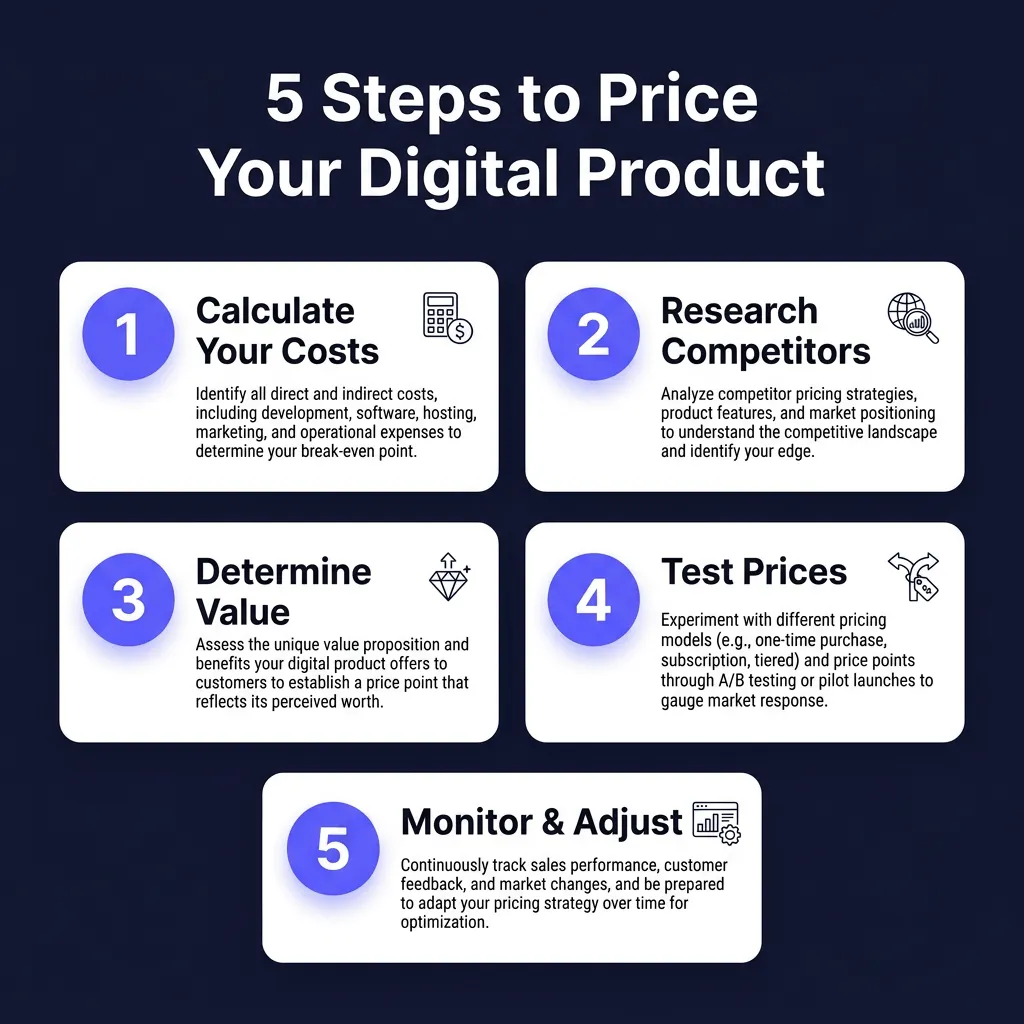
Step 1: Calculate Your True Costs
Include everything: software subscriptions, design assets, your time at a fair hourly rate, platform fees, payment processing, and taxes. This gives you your break-even point. Remember that digital products have near-zero marginal costs—your first sale is the most expensive, and every subsequent sale is almost pure profit.
Step 2: Research Your Competitive Landscape
Identify 10-15 direct and indirect competitors. Document their prices, features, and positioning. Look for gaps in the market—price points that are underserved or value propositions that aren’t being communicated. Tools like Gumroad Discover, Etsy search, and Product Hunt can reveal market dynamics.
Step 3: Determine Customer Value
Survey potential customers about their pain points and what they’d pay to solve them. Calculate the ROI your product delivers—time saved, revenue generated, costs avoided. Value-based pricing requires understanding your customer’s economics, not just their psychology.
Step 4: Test Your Price
Start with a “beta price” for your first 50-100 customers. This validates demand and gathers testimonials. Then A/B test different price points using tools like Gumroad’s pricing experiments or Shopify’s split testing. Even a 10% price increase can significantly impact profitability when margins are high.
Step 5: Monitor and Adjust
Pricing isn’t set-and-forget. Track conversion rates at different price points, monitor competitor moves, and survey customers about perceived value. Many successful creators raise prices 20-30% annually as they build reputation and add features.
Psychological Pricing Tactics That Convert
Beyond strategy, specific pricing tactics can increase conversions:
- Charm pricing: $97 feels significantly cheaper than $100, even though the difference is minimal. Ending prices in 7 or 9 consistently outperforms round numbers.
- Anchoring: Show a higher “original price” crossed out next to your sale price. The $197 course marked down to $97 feels like a steal, even if $97 was always your target.
- Decoy pricing: Offer three tiers where the middle option is clearly the best value. This nudges customers toward the choice you actually want them to make.
- Bundle pricing: Package multiple products together at a discount. A $49 template + $79 course becomes a $97 bundle—higher average order value with clear customer savings.
- Urgency and scarcity: Limited-time discounts or “only X left at this price” create purchase pressure. Use ethically—false scarcity destroys trust.
Common Pricing Mistakes to Avoid
After reviewing hundreds of digital product launches, these mistakes appear most frequently:
- Underpricing out of fear: New creators often price too low, thinking it’ll drive sales. It usually doesn’t—and it signals low quality. Start at market rate or slightly above.
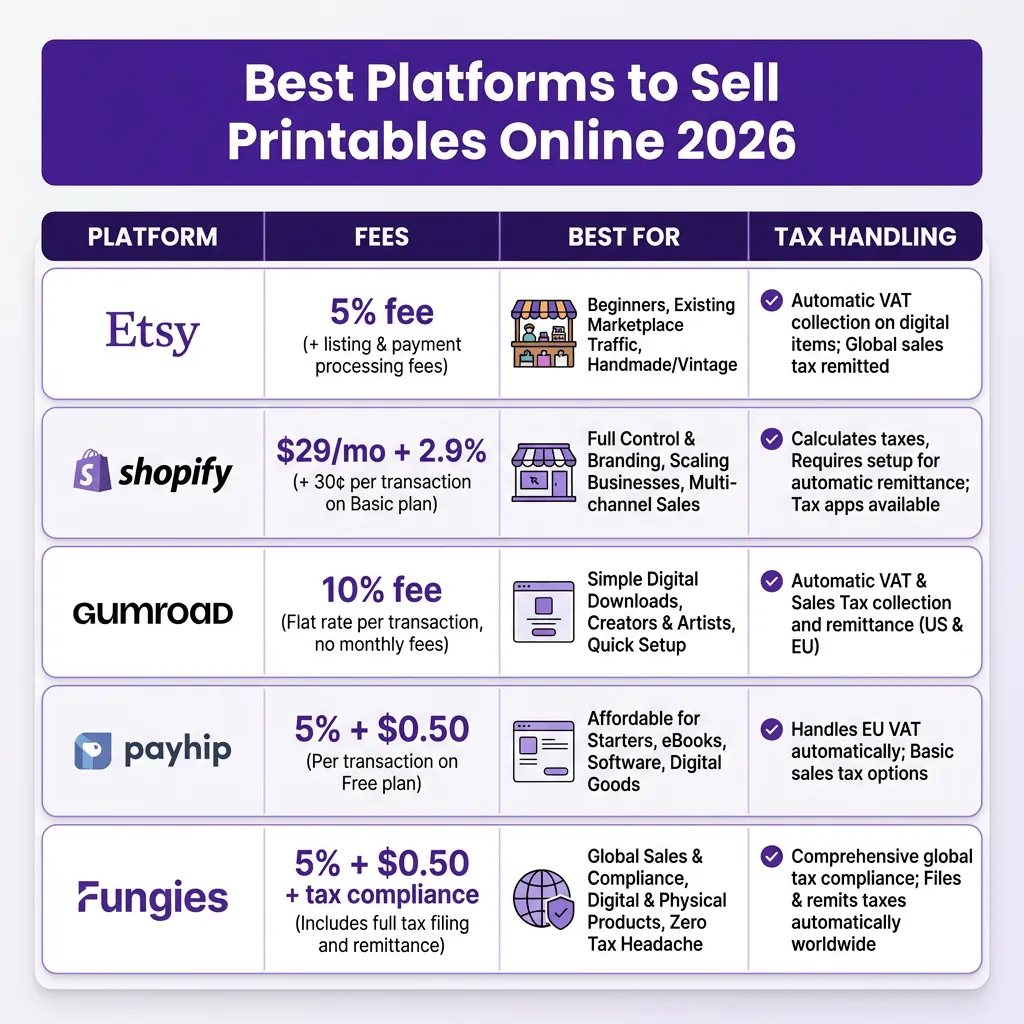
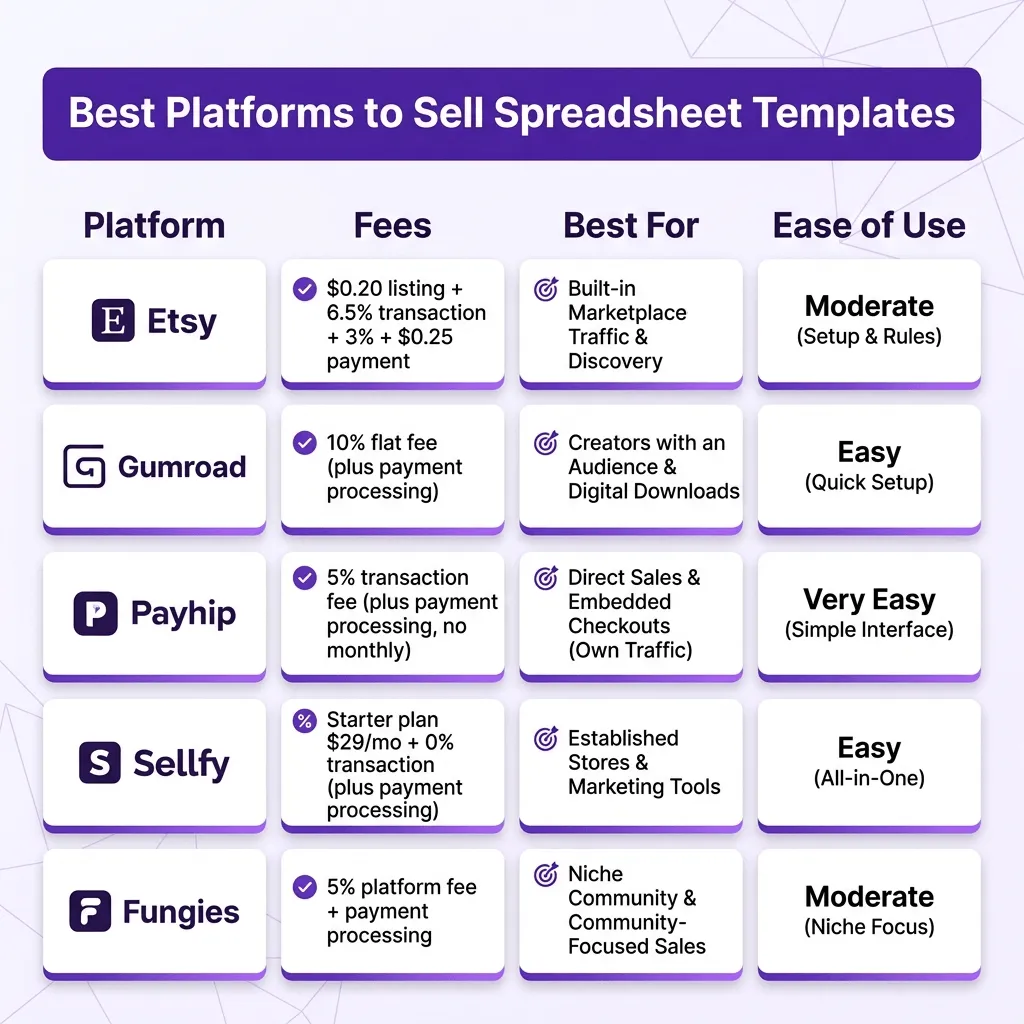
- Ignoring platform fees: Gumroad takes 10%, Stripe takes 2.9% + $0.30, and payment processors take their cut. A $10 product might net you only $8. Factor this into your pricing.
- No clear upgrade path: Selling a one-time product without a way to increase customer lifetime value leaves money on the table. Plan your product ecosystem from day one.
- Static pricing: Markets change, your product improves, and your reputation grows. Review pricing quarterly and adjust based on data.
- Competing on price alone: Race to the bottom is a losing strategy. Compete on value, results, and customer experience instead.
Platform-Specific Pricing Considerations
Different platforms have different pricing norms:
- Etsy: Template prices range $3-$25. Higher prices work for complex bundles or commercial licenses.
- Gumroad: Wide range from $5 to $500+. The platform supports premium pricing better than marketplaces.
- Your own site: Highest margins (no platform fees) but requires driving your own traffic. Prices can be 20-30% higher than marketplaces.
- Course platforms: Udemy prices are capped around $20-30, while Teachable/Thinkific courses regularly sell for $200-$2,000.
FAQ: Digital Product Pricing
How do I know if my price is too high?
If your conversion rate is below 1-2% and you’re getting traffic, your price might be too high—or your value proposition isn’t clear. Survey visitors who didn’t buy: “What stopped you from purchasing?” Price objections are different from value objections.
Should I offer discounts?
Strategic discounts work for launches, holidays, and email list building. But avoid constant discounting—it trains customers to wait for sales. Instead, add bonuses or create limited-time bundles to drive urgency without devaluing your core product.
How often should I change my prices?
Review pricing quarterly. Raise prices when you add features, gather testimonials, or build your reputation. Major price changes (more than 20%) work best when relaunching or adding significant value.
What’s the right price for my first digital product?
Start at the market average for your niche, not the bottom. A $29-49 price point works for templates and simple products. Courses and complex tools can start at $97-197. You can always adjust based on early feedback.
Should I price differently for different countries?
Purchasing power varies globally. Some platforms support regional pricing automatically. Consider offering coupon codes for specific regions or creating lower-priced tiers for emerging markets. Just ensure you’re compliant with tax regulations in each country you sell to.
Conclusion: Price for Profit and Growth
The right pricing strategy balances profitability, positioning, and customer value. Start with cost-plus to ensure you don’t lose money, then move toward value-based pricing as you understand your market. Test different approaches, monitor results, and optimize continuously.
Remember: pricing is a signal. Your price tells customers what to expect from your product. Price like a premium product, deliver premium value, and you’ll attract premium customers willing to pay what you’re worth.
The creators building six-figure digital product businesses aren’t luckier or more talented—they’re pricing strategically. Use the frameworks in this guide to price your next product for maximum impact.
Ready to Sell Your Digital Products Globally?
Join hundreds of creators using Fungies.io — automated tax compliance, 50+ payment methods, global Merchant of Record. Focus on creating, we’ll handle the rest.
No credit card required
Sources
- Grand View Research — Digital Content Market Size Report 2026
- Automateed — Digital Product Pricing Analysis 2026
- ThriveCart — Digital Product Sales Data
- Creator Economy Research — Pricing Strategy Survey 2026
- Gumroad Creator Insights Report 2026