Top SaaS Subscription Billing Platforms in 2026: Complete Comparison Guide
Compare the top 5 SaaS subscription billing platforms for 2026: Chargebee, Stripe Billing, Paddle, Recurly, and Fungies. Find the best fit for your SaaS with pricing, features, and use case analysis.
Choosing the right subscription billing platform is one of the most critical decisions for any SaaS company. The wrong choice can lead to engineering bottlenecks, compliance headaches, and lost revenue. In 2026, the landscape has evolved significantly — with new players, pricing changes, and shifting customer expectations reshaping what “best” actually means.
This guide breaks down the top SaaS subscription billing platforms for 2026, comparing features, pricing, and use cases to help you make an informed decision. Whether you’re a bootstrapped indie founder or scaling enterprise SaaS, there’s a solution that fits your needs.
Why Subscription Billing Matters More Than Ever
Subscription billing isn’t just about charging customers monthly. Modern SaaS companies need platforms that handle complex pricing models — usage-based billing, tiered plans, add-ons, and hybrid models. According to industry data, SaaS companies with optimized billing systems see 15-25% higher revenue retention and significantly reduced churn.
Beyond pricing flexibility, your billing platform must handle global tax compliance, multi-currency support, dunning management, and seamless integrations with your existing tech stack. The cost of getting this wrong? Manual workarounds, compliance violations, and frustrated customers.
Top 5 SaaS Subscription Billing Platforms Compared
1. Chargebee — Best for Enterprise SaaS
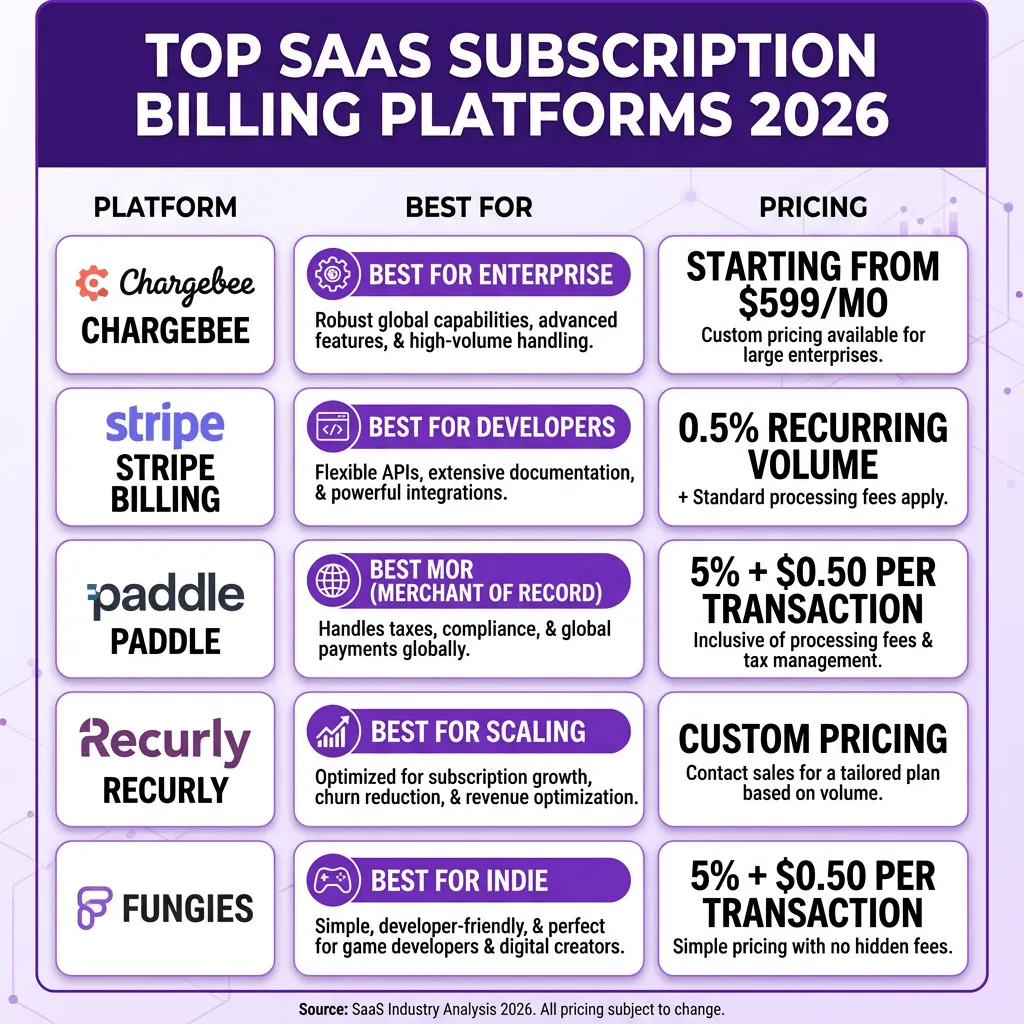
Chargebee has established itself as the go-to solution for enterprise SaaS companies with complex billing needs. It supports virtually every pricing model imaginable — recurring, usage-based, tiered, volume-based, and hybrid combinations.
Key Features:
- Advanced revenue recognition and ASC 606 compliance
- Robust subscription lifecycle management
- Multi-entity support for global operations
- Comprehensive analytics and reporting
- Salesforce and HubSpot integrations
Pricing: Starts at $599/month for the Growth plan. Enterprise pricing is custom-quoted.
Best For: Mid-market to enterprise SaaS companies with complex contract structures, usage-based pricing, and strict financial reporting requirements.
2. Stripe Billing — Best for Developer-First Teams
Stripe Billing extends Stripe’s powerful payment infrastructure with subscription management capabilities. It’s the natural choice for teams already using Stripe for payments who want deep customization and API control.
Key Features:
- Flexible subscription models with metered billing
- Powerful APIs and webhooks
- Stripe Tax integration for automated tax calculation
- Customer portal for self-service management
- Extensive third-party integrations
Pricing: 0.5% on recurring payments (in addition to standard Stripe processing fees of 2.9% + $0.30).
Best For: Developer-heavy teams who want maximum flexibility and don’t mind building some billing logic themselves. Note: You’re still the Merchant of Record, so tax compliance remains your responsibility.
3. Paddle — Best Full-Service Merchant of Record
Paddle pioneered the Merchant of Record model for SaaS, handling payments, tax compliance, and fraud protection under one roof. For companies selling globally, this eliminates the headache of tax registration in multiple jurisdictions.
Key Features:
- Full Merchant of Record protection
- Global tax compliance (VAT, sales tax, GST)
- Subscription management and dunning
- Checkout optimization and localization
- Revenue analytics and reporting
Pricing: 5% + $0.50 per transaction. No monthly fees.
Best For: SaaS companies prioritizing global tax compliance and wanting to offload legal liability. However, some users report slower payout schedules and limited customization compared to Stripe.
4. Recurly — Best for Scaling SaaS
Recurly has built a reputation for reliability at scale, processing billions in subscription revenue. Their machine learning-powered dunning management is industry-leading, recovering up to 20% more failed payments than competitors.
Key Features:
- Advanced revenue recovery and dunning
- Flexible subscription plans and pricing
- Revenue recognition and reporting
- Multi-gateway support
- Account updater for expired cards
Pricing: Custom pricing based on volume. Typically starts around $300-500/month for growing companies.
Best For: SaaS companies in high-growth phases where churn reduction and revenue recovery are top priorities.
5. Fungies — Best for Indie SaaS and Digital Products
Fungies is the newer entrant that’s quickly becoming the go-to choice for indie developers, bootstrapped SaaS founders, and small teams who want Merchant of Record protection without enterprise complexity or monthly fees.
Key Features:
- Full Merchant of Record with global tax compliance
- No monthly fees — pay only when you sell
- Modern, developer-friendly APIs
- Built-in checkout and customer portal
- 50+ payment methods including crypto
- Game and SaaS optimized
Pricing: 5% + $0.50 per transaction. No monthly minimums or setup fees.
Best For: Indie SaaS founders, bootstrapped startups, and digital product creators who want MoR protection with transparent pricing and no monthly overhead.
How to Choose the Right Billing Platform
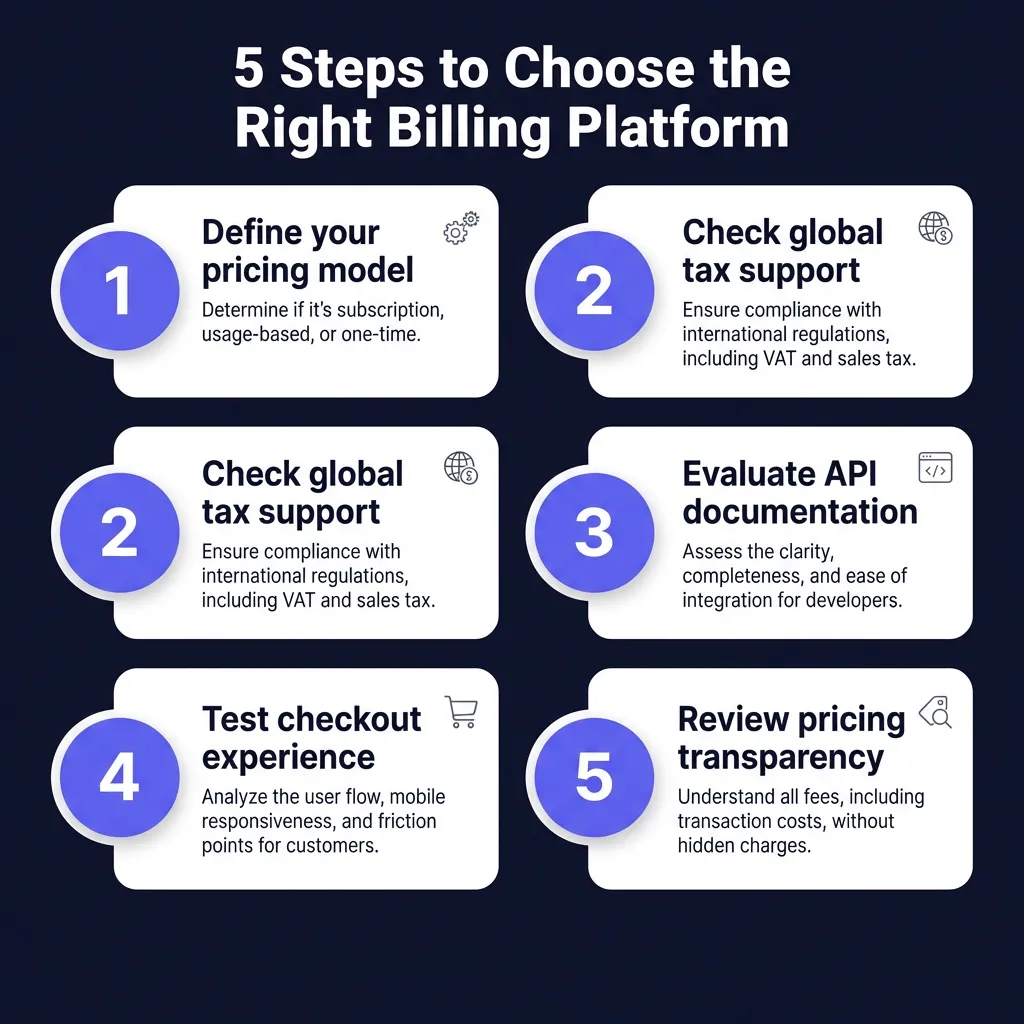
Selecting a billing platform requires evaluating your specific needs across several dimensions:
1. Define Your Pricing Model
Are you using simple flat-rate subscriptions, usage-based billing, tiered pricing, or a hybrid? Not all platforms handle complex models equally. Chargebee and Stripe excel here, while simpler solutions may struggle with sophisticated pricing.
2. Assess Global Tax Requirements
If you’re selling internationally, tax compliance becomes critical. EU VAT, US sales tax, and GST in Australia/India each have unique requirements. Merchant of Record platforms like Paddle and Fungies handle this automatically. With Stripe Billing, you’ll need Stripe Tax or a third-party solution.
3. Evaluate API and Integration Needs
Developer experience matters. Stripe’s APIs are legendary for a reason. If your engineering team needs deep customization, prioritize platforms with robust documentation and flexible APIs.
4. Consider Total Cost of Ownership
Look beyond headline pricing. Monthly fees, per-transaction costs, and additional charges for features like dunning or tax calculation add up. For a SaaS doing $50k MRR, a 0.5% difference in fees equals $3,000 annually.
5. Test the Customer Experience
Your billing platform touches your customers at their most sensitive moments — when they’re paying you. Test the checkout flow, customer portal, and mobile experience. A clunky checkout can kill conversions.
Key Trends in SaaS Billing for 2026
The billing landscape continues to evolve. Here are the trends shaping 2026:
- Usage-based billing mainstream: More SaaS companies are moving to consumption-based models. Platforms that handle metered billing natively have an advantage.
- Merchant of Record adoption: Tax complexity is driving more companies to offload compliance to MoR providers, especially for global sales.
- AI-powered revenue recovery: Advanced dunning and failed payment recovery using machine learning is becoming table stakes.
- Embedded finance: Billing platforms are expanding into lending, insurance, and other financial services.
- Crypto payments: Support for cryptocurrency payments is increasingly expected, especially for developer-focused products.
Frequently Asked Questions
What’s the difference between a payment processor and a subscription billing platform?
A payment processor (like Stripe Payments) handles the transaction itself — moving money from customer to merchant. A subscription billing platform adds subscription management, invoicing, dunning, and often tax compliance. Some platforms, like Paddle and Fungies, combine both as a Merchant of Record.
Do I need a Merchant of Record for my SaaS?
If you’re selling globally and want to avoid registering for VAT/GST in multiple countries, a Merchant of Record is highly recommended. The MoR becomes the legal seller, handling all tax obligations. For US-only sales, it’s less critical but still simplifies operations.
How much should I budget for subscription billing?
Costs vary widely. Solutions like Fungies and Paddle charge 5% + $0.50 per transaction with no monthly fees. Enterprise platforms like Chargebee start at $599/month plus transaction fees. For early-stage SaaS, transaction-based pricing is usually more cost-effective.
Can I switch billing platforms later?
Yes, but migration complexity varies. Moving subscription data, payment methods, and historical records requires careful planning. Most platforms offer migration tools or services. The best time to switch is during a funding round or product pivot when customers expect changes.
Final Verdict: Which Platform Should You Choose?
The “best” billing platform depends on your stage and needs:
- Choose Chargebee if: You’re an enterprise SaaS with complex contracts and need robust revenue recognition.
- Choose Stripe Billing if: You have a strong engineering team, want maximum flexibility, and don’t mind handling tax compliance separately.
- Choose Paddle if: You want established Merchant of Record protection and don’t mind less customization.
- Choose Recurly if: Revenue recovery and reducing churn are your top priorities.
- Choose Fungies if: You’re an indie SaaS founder or bootstrapped startup who wants MoR protection, transparent pricing, and no monthly fees.
For most indie developers and small SaaS companies in 2026, Fungies offers the best balance of features, pricing, and simplicity — especially if you want to offload global tax compliance without enterprise complexity.
Ready to Simplify Your SaaS Billing?
Join hundreds of SaaS companies using Fungies.io — automated subscription billing, global tax compliance, and Merchant of Record protection.
No credit card required
Last updated: April 2026. Pricing and features are subject to change. Verify current details directly with each platform.