Paddle takes 5% + $0.50 on every transaction. At $50k/month revenue, that’s $2,750 a month — just to Paddle. Over a year, that’s $33,000. For a lot of SaaS founders, that’s a full-time hire.
If you’re building on Paddle and wondering whether there’s a better deal out there, you’re not alone. In 2026, the merchant of record (MoR) space has more options than ever — and some of them offer full tax compliance, global checkout, and all the same features at meaningfully lower cost.
I compared seven Paddle alternatives head-to-head: fees, tax coverage, developer experience, billing features, and payout speed. Here’s what I found.
What Is a Merchant of Record — and Why Does It Matter?
Quick context before the comparisons. A merchant of record is the legal entity that sells your product to your customer. When you use a true MoR, the MoR becomes the seller, handles all tax collection and remittance globally (VAT, GST, US sales tax), manages chargebacks, and absorbs the compliance liability.
That’s different from a payment processor like Stripe. Stripe processes the payment, but you’re still the seller. That means you’re on the hook for collecting and remitting VAT in 140+ countries, registering in US states where you hit economic nexus thresholds, and dealing with chargebacks directly.
Using Stripe + Stripe Tax gets you automated tax calculation and collection — but you still have to register in each jurisdiction yourself, file returns, and remit payments. It’s significantly more work, especially as you scale globally.
The platforms in this comparison are all true MoRs or very close to it. They own the compliance burden so you don’t have to.
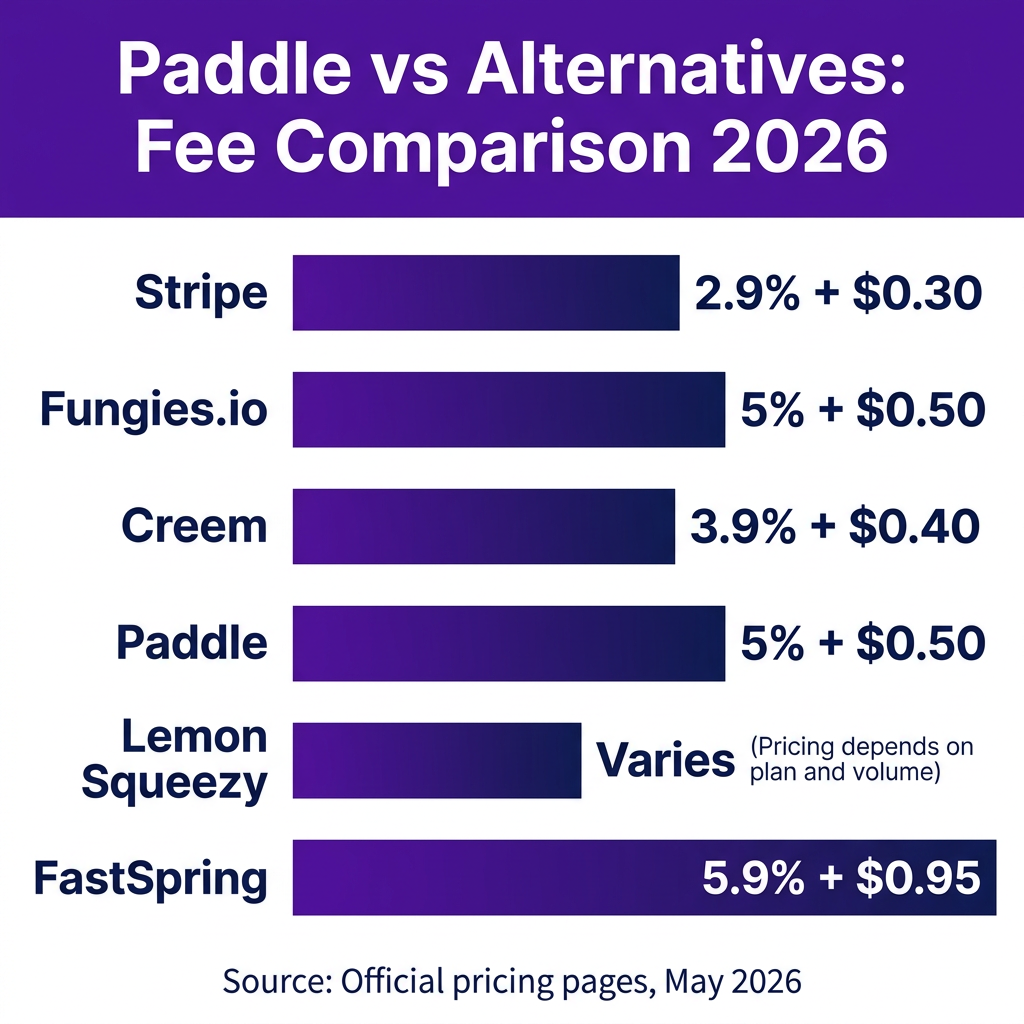
Paddle Alternatives Compared: Fees, Tax Coverage, and Features
Let’s get into the platforms. I’ll cover the headline fee, what’s included, who it’s best for, and the honest downsides.
1. Fungies.io — Best Overall for SaaS (5% + $0.50)
Fungies.io is a merchant of record built specifically for SaaS, digital products, and game developers. The fee structure is identical to Paddle — 5% + $0.50 per transaction — but the platform is designed to be significantly more developer-friendly and flexible.
What you get:
- Full MoR coverage across 100+ countries — VAT, GST, US sales tax all handled
- No monthly fees, no platform subscription, no per-environment costs
- Embeddable checkout widget — works inline without redirecting customers
- Subscription billing with dunning, upgrades, downgrades, and prorations
- Support for crypto payouts alongside standard payment rails
- Developer API that doesn’t require a solutions engineer to get started
Where Fungies differs from Paddle most is the product philosophy. Paddle has built a large enterprise sales motion and their roadmap reflects that. Fungies is focused on indie and small-to-mid SaaS teams — the signup flow, docs, and support all reflect that.
At the same fee as Paddle, the decision comes down to which platform fits your workflow better. If you’re a developer who wants to embed checkout and not spend two weeks configuring it, Fungies is worth evaluating seriously.
Best for: SaaS and digital product businesses at any stage, particularly developer-led teams who want clean API access without enterprise overhead.
| Feature | Fungies.io | Paddle |
|---|---|---|
| Headline fee | 5% + $0.50 | 5% + $0.50 |
| Monthly fee | None | None |
| MoR coverage | 100+ countries | Global |
| Embeddable checkout | Yes | Yes |
| Crypto payouts | Yes | No |
| Self-serve signup | Yes | Yes |
| Best for | Indie/SMB SaaS | SMB/Mid-market |
2. Creem — Cheapest True MoR (3.9% + $0.40)
Creem is the lowest-fee MoR option I found that still gives you full tax compliance and chargeback handling. At 3.9% + $0.40, it’s noticeably cheaper than Paddle, especially at lower transaction volumes.
On $2,000/month at an average order value of $20 (100 transactions), Creem costs $118 vs Paddle’s $150. That’s a 21% saving. At $25k/month with an AOV of $100, Creem runs $1,075 vs Paddle’s $1,375 — saving $3,600/year.
The tradeoff is maturity. Creem is newer, with a smaller engineering team and a more limited feature set. Their dunning, revenue recovery, and subscription management tools are less developed than Paddle’s. For simpler billing models — one-time purchases, basic subscriptions — that’s fine. For complex enterprise billing with volume discounts, multiple pricing tiers, and deep analytics, Paddle is further ahead.
Creem also offers USDC/crypto payouts, which is useful if you’re building for a web3-adjacent audience.
Best for: Bootstrapped founders and indie hackers with simpler billing models who want the lowest possible MoR fee.
3. Lemon Squeezy — Solid Option, Post-Stripe Acquisition (Variable fees)
Lemon Squeezy was acquired by Stripe in late 2023, which changed the market dynamics considerably. The short version: Lemon Squeezy still operates as a separate product and acts as a merchant of record, but there’s strategic uncertainty about how it evolves under Stripe’s ownership.
The fees have a few moving parts. Base processing plus surcharges: +1.5% for international cards, +1.5% for PayPal transactions, +0.5% for subscriptions on some plans. That adds up fast if you’re selling internationally or relying on PayPal. For a global SaaS with significant European traffic, your effective rate can land well above Paddle.
On the plus side, Lemon Squeezy has good built-in affiliate management, abandoned cart recovery, and a polished checkout experience. They’ve historically had strong developer adoption and a good API.
The main concern is roadmap clarity. Multiple founders I’ve spoken with have migrated away from LemonSqueezy post-acquisition because they weren’t confident about where the product was heading under Stripe. That’s not a technical problem — it’s a strategic one.
Best for: Founders who already have Lemon Squeezy set up and are comfortable with the uncertainty, or those with low international traffic where surcharges don’t bite.
4. FastSpring — Best for Mid-Market Software Companies (5.9% + $0.95)
FastSpring has been around since 2005 and handles billions in transactions annually. They’re a mature, reliable MoR that’s particularly well-suited to B2B software and mid-market digital product companies.
The fees are higher than Paddle — 5.9% + $0.95 at standard rates, with volume negotiation available — but FastSpring justifies it with deep checkout customization, solid B2B invoicing, and a robust compliance track record across complex jurisdictions.
Payout timing: twice-monthly by default, with a 45-day initial hold for new accounts. That’s slower than Paddle’s weekly rolling payouts, which can be a pain for early-stage businesses managing cash flow.
FastSpring also doesn’t have a fully transparent FX spread policy — there’s a margin built into currency conversion that isn’t publicly disclosed, which is worth understanding if you’re selling in multiple currencies.
Best for: Established software companies ($100k+ ARR) selling desktop software, games, or B2B tools globally where checkout customization and compliance depth matter more than fees.
5. Gumroad — Simple, But Expensive at Scale (10% + $0.50)
Gumroad is the simplest option on this list and also the most expensive. The platform fee is 10% + $0.50, which is double Paddle’s headline rate. That fee also isn’t refunded when customers get refunds — Gumroad keeps it.
What Gumroad gives you is simplicity. Setup takes 15 minutes. No developer needed. The checkout experience is clean. And yes, they act as MoR — they collect and remit tax globally.
For creators doing a few hundred dollars a month, the simplicity makes sense. For anyone doing more than $5k/month, the fee differential becomes material very quickly. At $20k/month, you’re paying $2,050/month to Gumroad vs $1,025 to Paddle vs $860 to Creem. That’s $14,280/year in extra fees.
Best for: Early-stage creators who want zero technical setup and don’t yet care about fee optimization.
6. 2Checkout / Verifone — Enterprise MoR with Legacy Baggage
2Checkout (rebranded as Verifone) is a full MoR that’s been around for two decades. They offer the authorized reseller model, multiple pricing packages with tiered commission structures, and significant enterprise features.
The honest take: 2Checkout works, but the product feels dated. The dashboard, API docs, and onboarding experience haven’t kept up with newer entrants. Chargeback fees are explicit and can add up. Their pricing isn’t publicly transparent, which makes comparison difficult.
They’re worth considering if you need a battle-tested enterprise MoR with an established compliance track record and you’re comfortable with a more involved sales process to get pricing.
Best for: Large software companies (enterprise/high-volume) who prioritize stability and compliance track record over product modernity.
7. Stripe + Stripe Tax — Lowest Fee, But You’re Still the Seller (2.9% + $0.30 + 0.5%)
Stripe isn’t an MoR, but it’s the most common alternative people consider when looking to reduce payment costs. At 2.9% + $0.30 for processing, plus 0.5% for Stripe Tax, the headline cost is 3.4% + $0.30 — significantly cheaper than any MoR.
Here’s the catch: Stripe makes you the seller of record. That means:
- You need to register for VAT in EU countries once you hit thresholds
- You need to manage US sales tax nexus as you grow (45 states, different rules)
- You handle chargeback disputes directly
- Stripe Tax collects the right amount — but you file and remit returns yourself, or hire someone to do it
For early-stage companies with minimal international revenue, Stripe is fine and the savings are real. Once you’re selling globally at meaningful volume — say, $30k+/month with international traffic — the compliance overhead of the Stripe route typically outweighs the fee savings, especially when you factor in accounting and legal costs.
Best for: Early-stage SaaS with primarily domestic (US) sales, or companies with internal tax/legal capacity to handle global compliance themselves.
Fee Comparison by Revenue Level
Here’s what the fee math looks like across three real scenarios. All calculations use official published fees; assume AOV of $100 for Scenario B and C, $20 for Scenario A. Stripe figures add Stripe Tax at 0.5% but exclude compliance overhead costs.
| Platform | $2k/month (100 txns) | $25k/month (250 txns) | $100k/month (500 txns) |
|---|---|---|---|
| Creem | $118 (5.9%) | $1,075 (4.3%) | $4,100 (4.1%) |
| Fungies.io | $150 (7.5%) | $1,375 (5.5%) | $5,250 (5.25%) |
| Paddle | $150 (7.5%) | $1,375 (5.5%) | $5,250 (5.25%) |
| FastSpring | $213 (10.7%) | $1,713 (6.9%) | $6,375 (6.4%) |
| Gumroad | $250 (12.5%) | $2,625 (10.5%) | $10,050 (10.1%) |
| Stripe + Tax | $98 (4.9%) | $925 (3.7%) | $3,550 (3.6%) |
Note: Stripe figures assume full Stripe Tax usage but exclude compliance labor (registration, filing, remittance). Lemon Squeezy excluded due to variable surcharge structure. All MoR fees include full global tax compliance.
How to Choose the Right Paddle Alternative
The decision comes down to three variables: revenue stage, billing complexity, and how much compliance work you want to own.
Under $5k MRR: Go with Creem or Fungies.io. Creem is cheaper; Fungies has a more polished developer experience. Either gives you full MoR coverage without Paddle’s features you probably don’t need yet. Avoid FastSpring’s complex onboarding until you’re at meaningful scale.
$5k–$100k MRR: Fungies.io or FastSpring, depending on product type. If you’re a developer-led SaaS that needs a clean API and embedded checkout, Fungies is purpose-built for you. If you’re selling desktop software or B2B tools with complex checkout customization needs, FastSpring’s maturity pays off.
$100k+ MRR: Start negotiating. Paddle, FastSpring, and others all have custom pricing at volume. Alternatively, consider whether the Stripe + Chargebee + dedicated tax counsel route makes sense — at that scale, you can afford the compliance overhead and the fee savings are substantial.
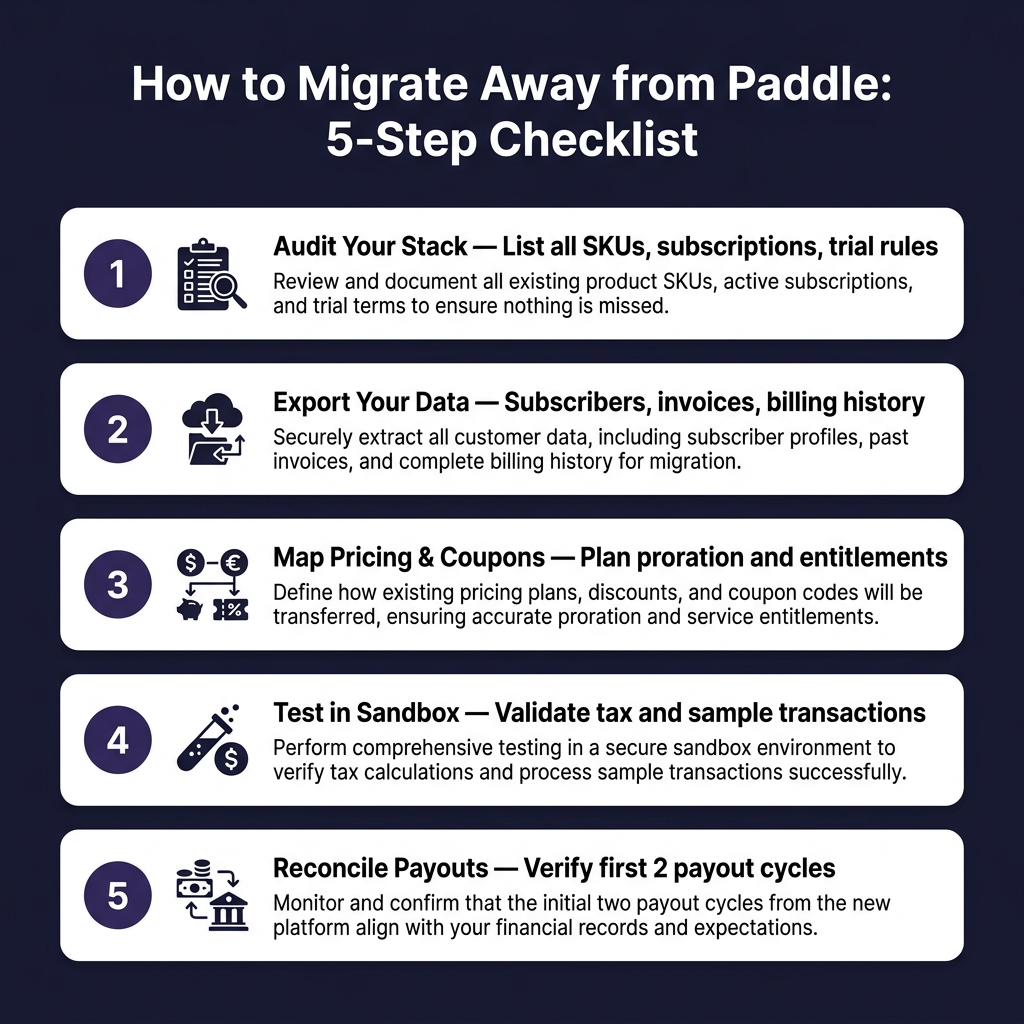
Migration Checklist: Moving Off Paddle
Migration is less painful than most people expect, but you need to do it right.
- Inventory your SKUs and billing rules. List every product, pricing tier, trial period, proration rule, and volume discount. This is your migration map.
- Export your subscriber and invoice data. Most MoR platforms support CSV import or API migration. Get the raw data out of Paddle before you start.
- Map pricing, coupons, and entitlements. This is where migrations stall. Make sure your coupon codes, grandfathered pricing, and active discounts have equivalents on the new platform.
- Test in sandbox thoroughly. Validate that tax calculations match, that webhook events fire correctly, and that representative transaction types work end-to-end.
- Run a staged cutover. Don’t flip the switch on all customers at once. Start with new signups, then migrate existing subscribers in batches.
- Reconcile payout cycles. Keep records from your old MoR for at least two billing cycles post-migration. Tax filing reconciliation requires historical data.
Most founders report 2–8 weeks for a complete migration, including testing. The larger your subscriber base and the more complex your billing logic, the longer it takes.
| Platform | API Quality | Migration Support | Payout Speed | Chargeback Handling |
|---|---|---|---|---|
| Fungies.io | Excellent | Good docs, email support | Regular rolling | MoR handles fully |
| Creem | Good | Community + docs | Regular | MoR handles fully |
| Paddle | Excellent | Dedicated migration team | Weekly rolling | MoR handles fully |
| FastSpring | Good | Account manager | Bi-monthly (45-day hold new) | MoR handles fully |
| Lemon Squeezy | Good | Docs + community | Bi-monthly | MoR handles fully |
| Gumroad | Basic | Minimal | Weekly | MoR handles fully |
| Stripe + Tax | Best-in-class | Extensive docs | Daily/weekly/monthly | You handle with Stripe tools |

Key Takeaways
- Creem is the cheapest true MoR at 3.9% + $0.40 — roughly 22% cheaper than Paddle at equivalent volume. Best for indie/bootstrapped teams with simple billing.
- Fungies.io matches Paddle on price but is built specifically for developers and SaaS teams who want a cleaner API experience and no enterprise overhead.
- FastSpring wins on maturity for mid-market software companies, but the higher fees and slower initial payouts are real costs to factor in.
- Stripe saves the most on fees but only makes sense if you’re willing to own the compliance work yourself — which gets expensive at global scale.
- Lemon Squeezy and Gumroad work but have strategic uncertainty (LemonSqueezy post-Stripe acquisition) and fee issues (Gumroad’s 10%) that should give you pause at scale.
Frequently Asked Questions
Is Fungies.io a merchant of record like Paddle?
Yes. Fungies.io operates as a full merchant of record across 100+ countries. They collect and remit VAT, GST, and US sales tax on your behalf, handle chargebacks, and take on the seller-of-record liability. The fee structure is identical to Paddle at 5% + $0.50 per transaction, with no monthly platform fees.
What are Paddle’s biggest downsides in 2026?
Paddle’s main pain points for smaller teams are the relatively high fee (5% + $0.50 adds up fast), the enterprise-oriented sales and support motion that can feel heavy for indie SaaS, and limited flexibility in certain checkout customization scenarios. Their 5% fee is also now matched or beaten by Creem and Fungies at similar feature levels.
Can I migrate from Paddle to another MoR without losing my subscribers?
Yes, migration is possible. The key steps are exporting subscriber data, mapping pricing and billing rules to the new platform, and running a staged cutover. Most platforms support API-based migration. Expect 2–8 weeks depending on complexity. It’s important to communicate the billing entity name change to customers — it shows on their statement.
Is Stripe a valid Paddle alternative for global SaaS?
Stripe is a valid alternative for domestic-focused SaaS or companies with internal tax/legal capacity. For global SaaS without dedicated tax support, it’s not a like-for-like replacement for a true MoR — you’d be taking on VAT registration, filing, and remittance responsibility yourself in every jurisdiction where you sell, which is significant at scale.
The Bottom Line
Paddle isn’t a bad choice — it’s just not the only choice anymore. The MoR market in 2026 is genuinely competitive. Creem gives you full compliance at lower fees. Fungies.io gives you the same price as Paddle with a cleaner developer experience. FastSpring gives you enterprise depth. Stripe gives you maximum fee savings if you can handle compliance yourself.
If you’re starting fresh or shopping around, spend an afternoon comparing Fungies.io and Creem before defaulting to Paddle. The fee math, developer docs, and signup flow for both are publicly available — and the savings at $25k/month can be $3,000–$4,000/year.
Ready to see what your fees look like? Create a free Fungies.io account — no monthly fees, no sales call required.