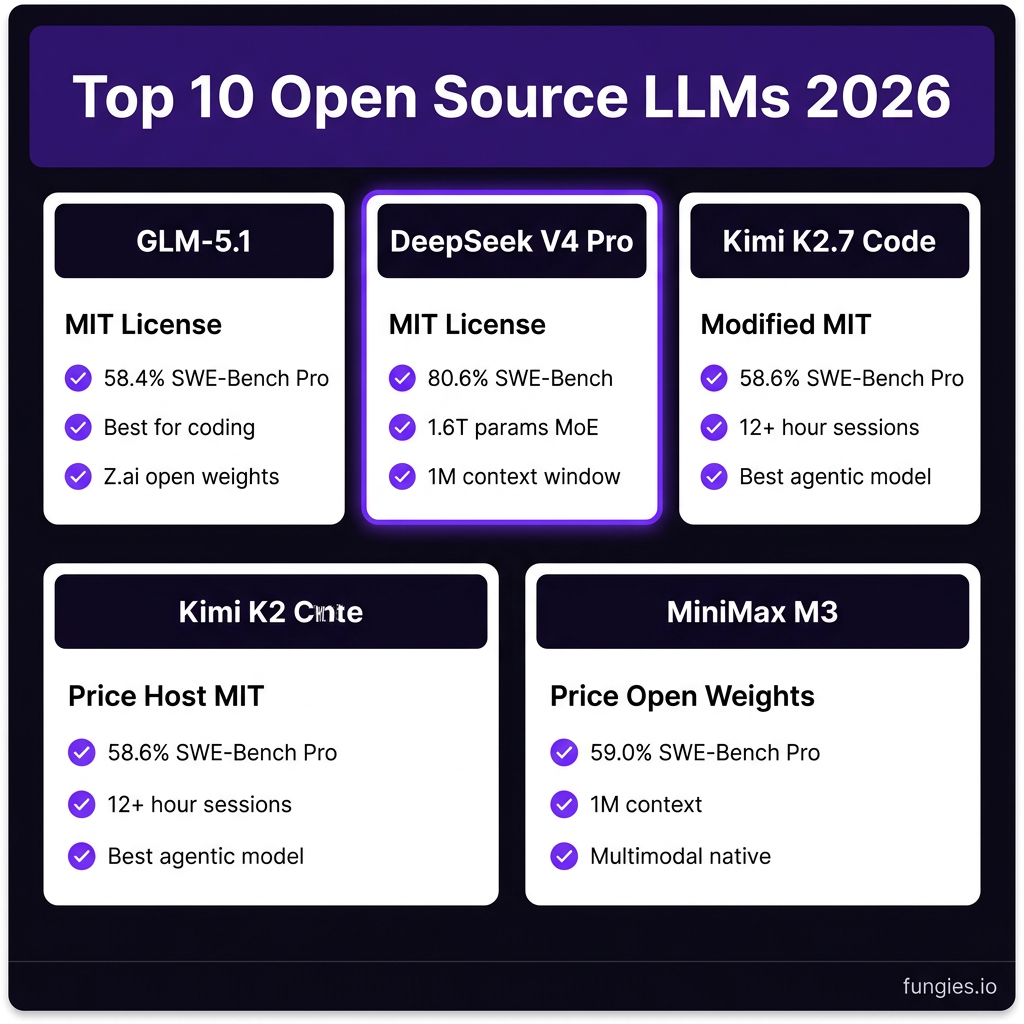
On April 7, 2026, Z.ai’s GLM-5.1 became the first open-source model to top SWE-Bench Pro with a score of 58.4% — beating Claude Opus 4.6 (57.3%) and GPT-5.4 (57.7%). That’s not a typo. A Chinese lab released a model under the MIT license that outperforms $20/month proprietary APIs on the industry’s toughest coding benchmark.
This is the new reality of AI in 2026. Open-source models aren’t just catching up — they’re winning. And you can run them on your own hardware, with your own data, at a fraction of the cost.
Why Open Source LLMs Matter in 2026
Two years ago, the gap between open and closed models was embarrassing. The best proprietary model scored ~88% on MMLU while the best open model managed ~70.5% — a 17.5-point gap that made open-source feel like a compromise.
Today? That gap has vanished. Open-source models now match or exceed proprietary alternatives on most benchmarks while offering:
- Full data privacy — your prompts never leave your machine
- Zero API costs — pay for hardware once, run inference forever
- Complete control — fine-tune, modify, and deploy however you want
- Transparent licensing — MIT and Apache 2.0 licenses allow commercial use
If you’re building a coding assistant, a customer-facing chatbot, or a document intelligence pipeline, you no longer have to default to OpenAI or Anthropic. The question is which open model to choose.
How We Evaluated These Models
We ranked these models based on benchmarks that actually matter for production workloads:
- SWE-Bench Pro — The gold standard for software engineering tasks
- MMLU — Massive Multitask Language Understanding for general knowledge
- HumanEval — Code generation and problem-solving
- Context window — How much text the model can process at once
- VRAM requirements — What hardware you actually need to run it
- License — Whether you can use it commercially
1. GLM-5.1 — Best for Coding (Z.ai)
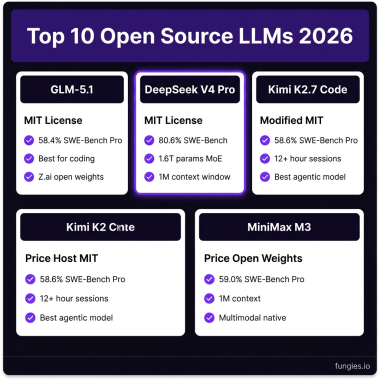
GLM-5.1 from Z.ai (formerly Zhipu AI) is the current king of open-source coding models. Released April 7, 2026, it scored 58.4% on SWE-Bench Pro — the first open model to surpass Claude Opus 4.6 and GPT-5.4 on this benchmark.
Key specs:
- Parameters: Not disclosed (estimated 100B+)
- Context window: 128K tokens
- License: MIT (fully permissive)
- SWE-Bench Pro: 58.4%
- Terminal-Bench: 63.5%
- Best for: Long-horizon coding, agentic engineering, software development
Why it wins: GLM-5.1 was trained entirely on Huawei chips with zero NVIDIA involvement — proving you don’t need H100s to build frontier models. At $18/month for the coding tier with generous token limits, it’s also 3.5x cheaper than Claude Pro.
2. DeepSeek V4 Pro — Best for Reasoning (DeepSeek)
DeepSeek V4 Pro is a 1.6 trillion parameter MoE model with only 49B active parameters per token. Released April 24, 2026, it achieves 80.6% on SWE-Bench Verified — the highest open-weights score, tied with Gemini 3.1 Pro.
Key specs:
- Parameters: 1.6T total (49B active)
- Context window: 1M tokens (384K max output)
- License: MIT
- SWE-Bench Verified: 80.6%
- API pricing: $0.87/M output tokens
- Best for: Long-context reasoning, enterprise agents, document analysis
The math: DeepSeek V4 Pro is 28.7x cheaper than Claude Opus 4.8 and 34.5x cheaper than GPT-5.5 per output token. For high-volume workloads, that’s the difference between a $10,000/month API bill and $300.
3. Kimi K2.7 Code — Best for Agentic Workflows (Moonshot AI)
Kimi K2.7 Code is Moonshot AI’s open-weight flagship released June 2026. It’s currently the strongest open-source agentic model on public benchmarks, with vendor-reported SWE-Bench Pro of 58.6%.
Key specs:
- Parameters: MoE with 384 experts (8 selected per token)
- Context window: 256K tokens
- License: Modified MIT
- SWE-Bench Pro: 58.6%
- Hallucination rate: ~39% (down from K2.6’s 65%)
- Best for: Autonomous agents, long-running sessions, multi-step workflows
Agentic advantage: Moonshot has documented unattended sessions of 12+ hours and 4,000+ tool calls. If you’re building agents that need to run autonomously, K2.7 is unmatched.
4. MiniMax M3 — Best Multimodal Model (MiniMax)
MiniMax M3 launched June 1, 2026 as the first open-weights model to combine frontier coding, a 1-million-token context window, and native multimodality. It scores 59.0% on SWE-Bench Pro and 83.5 on BrowseComp.
Key specs:
- Parameters: Not disclosed
- Context window: 1M tokens
- License: Open weights
- SWE-Bench Pro: 59.0%
- Terminal-Bench 2.1: 66.0%
- API pricing: $0.30/M input, $1.20/M output
- Best for: Multimodal tasks, long-context RAG, web browsing agents
Innovation: MiniMax Sparse Attention (MSA) makes the 1M context window economically viable — previous models with long contexts were prohibitively expensive at scale.
5. Llama 4 Scout — Best for Long Context (Meta)
Llama 4 Scout is Meta’s 109B parameter model with a staggering 10-million-token context window. While it lags on some coding benchmarks, the context length opens use cases no other model can touch.
Key specs:
- Parameters: 109B total
- Context window: 10M tokens (yes, really)
- License: Llama 4 Community License
- Best for: Document analysis, codebases with millions of lines, long-form content
Trade-off: Independent benchmarks show Llama 4 Maverick and Scout underperform smaller models on DevQualityEval v1.0. But for context-length-dependent tasks, nothing else comes close.
6. Qwen 3.5 235B-A22B — Best for Multilingual (Alibaba)
Qwen 3.5 from Alibaba is a 235B parameter MoE model with 22B active parameters. Released February 2026, it excels at multilingual tasks and offers competitive coding performance.
Key specs:
- Parameters: 235B total (22B active)
- Context window: 262K tokens
- License: Apache 2.0
- AIME 2026: 91.3%
- Terminal-Bench 2.0: 52.5%
- Best for: Multilingual applications, math reasoning, Asian language support
Strength: Qwen 3.5 scores 88.6 on MathVision, beating GPT-5.2 (83.0) and Gemini 3 Pro (86.6). For vision-math tasks, it’s the open-source leader.
7. Gemma 4 — Best for Consumer Hardware (Google)
Google’s Gemma 4 comes in multiple sizes including a 26B MoE variant that runs on consumer GPUs. It’s the best option for developers who want frontier capabilities without datacenter hardware.
Key specs:
- Parameters: 4B to 31B variants
- Context window: 128K tokens
- License: Apache 2.0
- MoE active params: 3.8B (for 26B model)
- Best for: Edge deployment, consumer GPUs, mobile devices
Efficiency: The Gemma 4 26B MoE uses only 3.8B active parameters per token — giving it 6.4× better decode throughput than dense models. You can run it on a single RTX 4090.
8. Mistral Small 4 — Best for EU Deployment (Mistral)
Mistral Small 4 is the latest from the French AI lab, designed for European deployment with GDPR compliance and EU data sovereignty.
Key specs:
- Parameters: Not disclosed
- Context window: 128K tokens
- License: Apache 2.0
- Best for: EU companies, GDPR compliance, European data residency
9. Phi-4 — Best Small Model (Microsoft)
Microsoft’s Phi-4 is a 14B parameter model that punches way above its weight. It’s the best option for resource-constrained environments.
Key specs:
- Parameters: 14B
- Context window: 16K tokens
- License: MIT
- Best for: Edge devices, low-latency applications, CPU inference
Surprise: Phi-4 delivers strong reasoning for a 14B model and runs on modest hardware. It’s the gateway drug to local LLMs.
10. DeepSeek R1 — Best for Math Reasoning (DeepSeek)
DeepSeek R1 is the reasoning specialist from DeepSeek, released under MIT license. It matches OpenAI’s best models on math benchmarks at a fraction of the cost.
Key specs:
- Parameters: 671B total (37B active)
- Context window: 128K tokens
- License: MIT
- GSM8K: 96.0%
- SWE-Bench: 67.8%
- Best for: Math problems, logical reasoning, STEM tasks
Complete Benchmark Comparison Table
| Model | SWE-Bench Pro | Context | License | Best For |
|---|---|---|---|---|
| GLM-5.1 | 58.4% | 128K | MIT | Coding |
| DeepSeek V4 Pro | 80.6% | 1M | MIT | Reasoning |
| Kimi K2.7 Code | 58.6% | 256K | Modified MIT | Agents |
| MiniMax M3 | 59.0% | 1M | Open | Multimodal |
| Llama 4 Scout | — | 10M | Llama 4 | Long context |
| Qwen 3.5 235B | — | 262K | Apache 2.0 | Multilingual |
| Gemma 4 26B | — | 128K | Apache 2.0 | Consumer HW |
| Mistral Small 4 | — | 128K | Apache 2.0 | EU/GDPR |
| Phi-4 | — | 16K | MIT | Small/Edge |
| DeepSeek R1 | 67.8% | 128K | MIT | Math |
Hardware Requirements by VRAM Tier
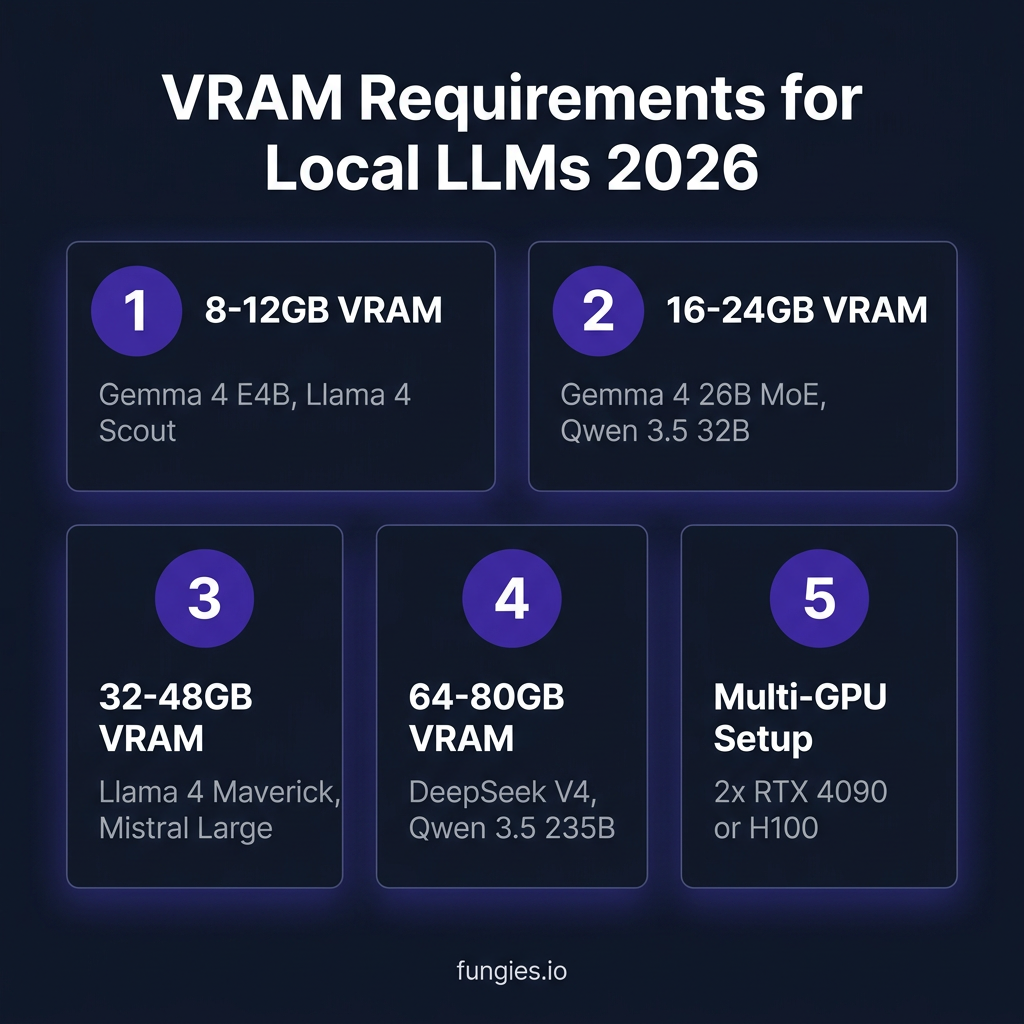
Here’s what you actually need to run these models locally:
| VRAM | Models | Hardware Examples |
|---|---|---|
| 8-12GB | Gemma 4 E4B, Llama 4 Scout (4-bit) | RTX 3060, RTX 4060, MacBook Pro M3 |
| 16-24GB | Gemma 4 26B MoE, Qwen 3.5 32B, Phi-4 | RTX 4090, RTX 3090, Mac Studio M2 Ultra |
| 32-48GB | Llama 4 Maverick, Mistral Large, Qwen 3.5 72B | RTX A6000, 2x RTX 4090, Mac Studio M3 Ultra |
| 64-80GB | DeepSeek V4, Qwen 3.5 235B, GLM-5.1 | H100 80GB, 2x A100 40GB, DGX Spark |
| Multi-GPU | Kimi K2.7, MiniMax M3 (full precision) | 4x RTX 4090, 2x H100, DGX Station |
Key Takeaways: How to Choose
- For coding: GLM-5.1 or Kimi K2.7 Code — both beat proprietary models on SWE-Bench Pro
- For reasoning: DeepSeek V4 Pro — 80.6% on SWE-Bench Verified, 1M context
- For agents: Kimi K2.7 Code — documented 12+ hour autonomous sessions
- For multimodal: MiniMax M3 — native vision + 1M context
- For long context: Llama 4 Scout — 10M tokens, nothing else comes close
- For consumer hardware: Gemma 4 26B MoE — runs on a single RTX 4090
- For EU/GDPR: Mistral Small 4 — European data sovereignty
- For budget/edge: Phi-4 — 14B parameters, MIT license, runs anywhere
FAQ: Open Source LLMs for Local Inference
Can I run these models on consumer hardware?
Yes. Models like Gemma 4 26B, Qwen 3.5 32B, and Phi-4 run comfortably on an RTX 4090 or Mac Studio. Use 4-bit quantization (Q4_K_M) to halve VRAM requirements with minimal quality loss.
Are open-source LLMs as good as ChatGPT or Claude?
On coding benchmarks, yes — GLM-5.1, DeepSeek V4 Pro, and Kimi K2.7 Code all beat GPT-5.4 and Claude Opus 4.6 on SWE-Bench Pro. For general chat and writing, proprietary models still have an edge, but the gap is closing fast.
What license should I look for?
MIT and Apache 2.0 are the gold standards — both allow commercial use, modification, and distribution. Avoid models with custom licenses that restrict commercial use or require revenue sharing.
How much does it cost to run locally vs API?
A high-end setup (RTX 4090 or Mac Studio) costs $2,000-4,000 upfront. If you’re spending $500+/month on API calls, local inference pays for itself in 4-8 months. After that, inference is free.
What’s the best model for beginners?
Start with Gemma 4 4B or Phi-4 — both run on modest hardware, have permissive licenses, and give you a taste of local LLMs without breaking the bank.
Conclusion: The Open-Source Advantage
In 2026, open-source LLMs aren’t just an alternative to proprietary APIs — they’re often the better choice. You get comparable (or better) performance, complete data privacy, and total control over your AI infrastructure.
The models in this list represent the cutting edge of what’s possible with open weights. Whether you’re building a coding assistant, a customer service bot, or an autonomous agent, there’s an open-source model that fits your needs.
Ready to get started? Check out our guides on setting up local LLM inference and choosing the right hardware.
And if you’re building a SaaS product and need a payment solution that handles global tax compliance automatically, get started with Fungies — the Merchant of Record platform built for developers.
References
- Z.ai GLM-5.1 Release: GLM-5.1 Just Beat Claude on Coding Benchmarks
- DeepSeek V4 Pro: DeepSeek V4: 1.6T MoE, 1M Context
- Kimi K2.7 Code: Moonshot AI Releases Kimi K2.7-Code
- MiniMax M3: MiniMax M3 Benchmarks
- Gemma 4: Gemma 4 by Google: Specs, Benchmarks
- SWE-Bench Leaderboard: vals.ai/benchmarks/swebench
- Open Source LLM Comparison: ComputingForGeeks Open Source LLM Comparison