10 Best Payment Gateways for Developers in 2026: API-First Comparison
Discover the 10 best payment gateways for developers in 2026. Compare Stripe, Adyen, Braintree, Checkout.com, and more with real API ratings, pricing, and integration insights.
Here’s a stat that’ll make you think: 87% of developers say payment integration complexity has delayed a product launch. I’ve been there. Spending three weeks wrestling with outdated API docs, only to discover the sandbox environment doesn’t even match production.
The right payment gateway isn’t just about transaction fees. It’s about clean APIs, solid documentation, and not wanting to throw your laptop out the window at 2 AM. After integrating payments for multiple SaaS products and talking to dozens of engineering teams, I’ve learned what actually matters.
In this guide, I’m ranking the 10 best payment gateways for developers in 2026. Not based on marketing fluff, but on real API quality, developer experience, and how quickly you can go from signup to first transaction.
What Makes a Payment Gateway Developer-Friendly?
Before diving into the list, let’s establish the criteria. A developer-friendly payment gateway needs:
- Clean REST API — Predictable endpoints, consistent naming, proper HTTP status codes
- SDKs in major languages — JavaScript/TypeScript, Python, Ruby, PHP, Go, Java
- Excellent documentation — Not just reference docs, but guides, tutorials, and working examples
- Sandbox environment — That actually works and mirrors production
- Webhook reliability — With proper retry logic and idempotency support
- Fast integration time — Most devs should hit first transaction within a day
Honestly, most gateways fail on at least two of these. The ones below don’t.
1. Stripe — The Gold Standard for Developer Experience
Stripe didn’t become the default choice by accident. Their API design is genuinely beautiful — consistent, intuitive, and well-documented. I’ve integrated Stripe into five different products, and the experience is predictably smooth every time.
Key Features
- Comprehensive SDKs for every major language
- Stripe CLI for local webhook testing
- Built-in subscription management with Stripe Billing
- Stripe Tax for automatic tax calculation (additional fees apply)
- Extensive testing tools including request logs and event debugging
Pricing
2.9% + $0.30 per transaction. Volume discounts available at $100K+ monthly. No monthly fees.
Best For
Startups and SaaS companies that want maximum flexibility and don’t mind managing tax compliance separately.
2. Adyen — Enterprise-Grade Power
Adyen is what you graduate to when you’re processing serious volume. Their unified platform handles online, in-person, and mobile payments globally. The API is more complex than Stripe’s, but the capabilities are unmatched for large-scale operations.
Key Features
- Single platform for all payment channels
- RevenueAccelerate for auth rate optimization
- Real-time data and reporting
- Support for 300+ payment methods globally
- Direct acquiring in 40+ countries
Pricing
Interchange++ pricing (varies by card type and region). Typically 2.5-3.5% all-in for most transactions. Minimum monthly invoice applies.
Best For
Enterprise companies processing $10M+ annually with complex global payment needs.
3. Braintree — PayPal Integration Done Right
Owned by PayPal but operating as a separate developer-focused platform, Braintree offers the best of both worlds. You get a modern API plus seamless PayPal and Venmo integration. The Drop-in UI is genuinely the fastest way to accept payments if you don’t need heavy customization.
Key Features
- Native PayPal, Venmo, and PayPal Credit support
- Drop-in UI for quick integration
- Vault for secure card storage
- Advanced fraud protection via Kount
- Recurring billing built-in
Pricing
2.9% + $0.30 per transaction. No monthly fees. Volume discounts available.
Best For
Businesses that need PayPal integration alongside card payments, especially US-focused companies.
4. Checkout.com — The Challenger with Modern Architecture
Checkout.com has been eating Stripe’s lunch in Europe and is expanding fast. Their API is clean, their documentation is excellent, and their support for local payment methods is impressive. If you’re building a global product, they’re worth serious consideration.
Key Features
- Unified API for cards and local payment methods
- Intelligent payment routing
- Strong European acquiring network
- Comprehensive fraud management (Radar alternative)
- Real-time analytics dashboard
Pricing
Interchange++ pricing. Generally competitive with Stripe, sometimes lower for European cards.
Best For
Global SaaS companies with significant European customer bases.
5. Square — Beyond the Card Reader
Square’s developer platform is surprisingly robust. While they’re known for in-person payments, their e-commerce APIs have matured significantly. If you’re building an omnichannel business (online + physical locations), Square is hard to beat.
Key Features
- Seamless online + in-person integration
- Developer Dashboard with detailed API logs
- Webhooks with retry logic
- Subscription API for recurring payments
- Multi-location support built-in
Pricing
2.9% + $0.30 for online transactions. 2.6% + $0.10 for in-person. No monthly fees.
Best For
Businesses with both online and physical presence, especially in US, UK, Canada, Australia, and Japan.
6. Mollie — European Simplicity
Mollie is what Stripe would look like if it was built in Amsterdam. Clean APIs, transparent pricing, and exceptional support for European payment methods like iDEAL, Bancontact, and Giropay. No monthly fees, no setup costs — just pay per transaction.
Key Features
- Excellent European payment method coverage
- Simple, predictable pricing
- Fast onboarding (often same day)
- Recurring payments via Mollie Subscriptions
- Strong PHP and Python SDKs
Pricing
1.8% for most European cards. iDEAL: €0.29 fixed. No monthly fees.
Best For
European startups and businesses targeting EU customers primarily.
7. Razorpay — Emerging Markets Leader
If you’re targeting India, Razorpay is essentially mandatory. They understand the local market better than any international provider — UPI support, local bank integrations, and compliance with RBI regulations. Their API has matured significantly and now rivals global standards.
Key Features
- Best-in-class UPI and Indian wallet support
- RazorpayX for business banking integration
- Smart Collect for virtual account payments
- Route for marketplace split payments
- Strong subscription management
Pricing
2% for Indian cards and UPI. 3% for international cards. No setup fees.
Best For
Any business with Indian customers. Essential for India-first products.
8. Authorize.Net — The Legacy Workhorse
Authorize.Net has been around since 1996, and it shows in both good and bad ways. The API is dated (XML, anyone?), but it’s rock-solid reliable. If you’re working with legacy systems or need a gateway that just works without surprises, it’s still a valid choice.
Key Features
- Extremely reliable uptime (99.99%+)
- Advanced Fraud Detection Suite
- Customer Information Manager for vaulting
- Recurring billing built-in
- Wide bank compatibility
Pricing
2.9% + $0.30 per transaction + $25/month gateway fee.
Best For
Established businesses with legacy integrations or specific bank relationships.
9. PayPal — Consumer Trust Factor
PayPal’s developer experience has improved dramatically with their REST API and JavaScript SDK. While not as elegant as Stripe, the consumer trust factor is unmatched — some customers simply won’t buy without a PayPal option. Their new developer dashboard is actually quite good.
Key Features
- Massive consumer trust and recognition
- PayPal Checkout for streamlined payments
- Subscriptions API for recurring billing
- PayPal Credit integration
- Strong dispute resolution process
Pricing
2.99% + $0.49 per transaction. No monthly fees.
Best For
Businesses targeting consumers who prefer PayPal, especially e-commerce.
10. Fungies — Developer-Friendly Merchant of Record
Full disclosure: I work with Fungies. But I’m including them because they solve a real problem developers face — tax compliance. If you’re selling globally, calculating and remitting VAT, GST, and sales tax is a nightmare. Fungies handles it all as your Merchant of Record.
Key Features
- Merchant of Record — handles all tax compliance globally
- Simple REST API with webhooks
- Built-in subscription management
- No-code checkout options
- Multi-currency support with competitive FX rates
Pricing
5% + $0.50 per transaction. No monthly fees. All tax compliance included.
Best For
SaaS companies and digital product sellers who want to offload tax compliance entirely.
Side-by-Side Comparison
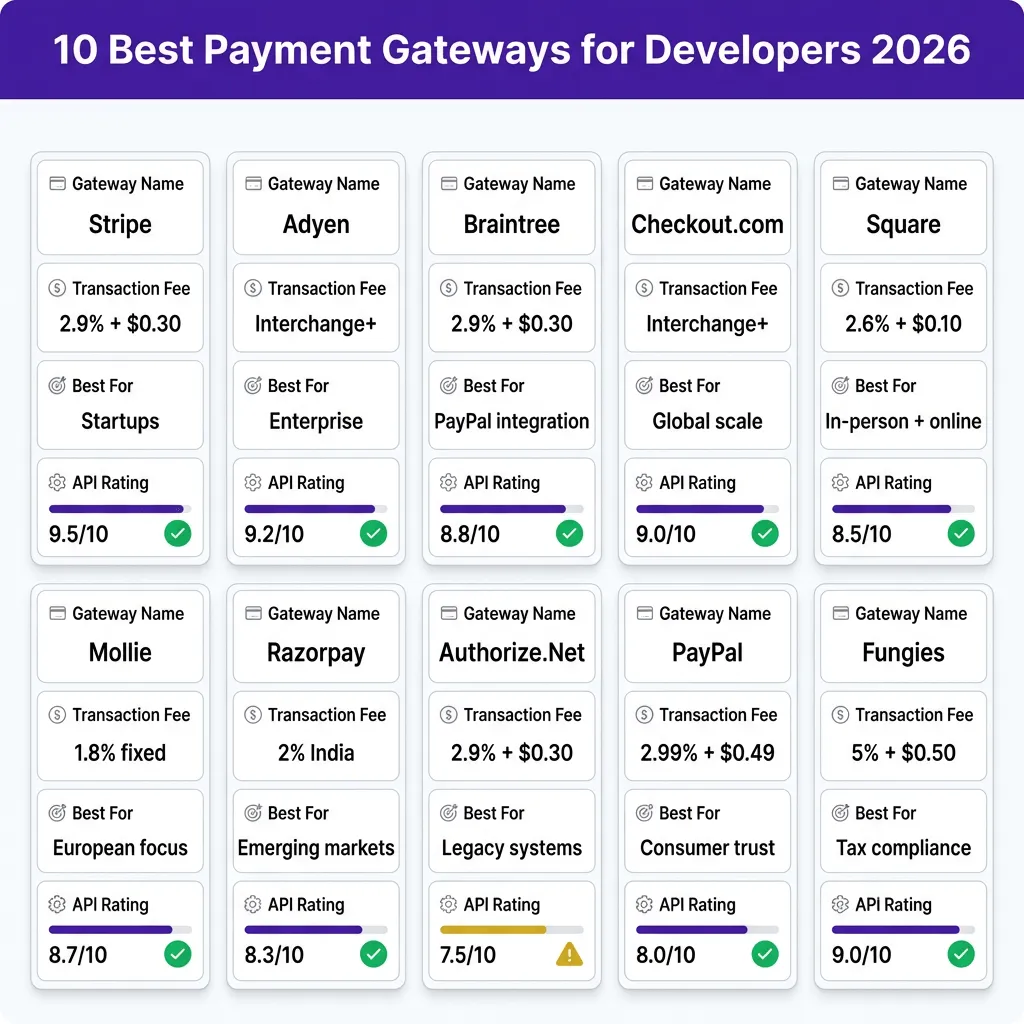
| Gateway | Fee (Online) | Best For | API Rating | Tax Handling |
|---|---|---|---|---|
| Stripe | 2.9% + $0.30 | Startups, flexibility | 9.5/10 | Separate (Stripe Tax) |
| Adyen | Interchange++ | Enterprise, global | 9.2/10 | Separate |
| Braintree | 2.9% + $0.30 | PayPal integration | 8.8/10 | Separate |
| Checkout.com | Interchange++ | Global scale | 9.0/10 | Separate |
| Square | 2.9% + $0.30 | Omnichannel | 8.5/10 | Separate |
| Mollie | 1.8% fixed | European focus | 8.7/10 | Separate |
| Razorpay | 2% (India) | Indian market | 8.3/10 | Local compliance |
| Authorize.Net | 2.9% + $0.30 | Legacy systems | 7.5/10 | Separate |
| PayPal | 2.99% + $0.49 | Consumer trust | 8.0/10 | Separate |
| Fungies | 5% + $0.50 | Tax compliance | 9.0/10 | Included (MoR) |
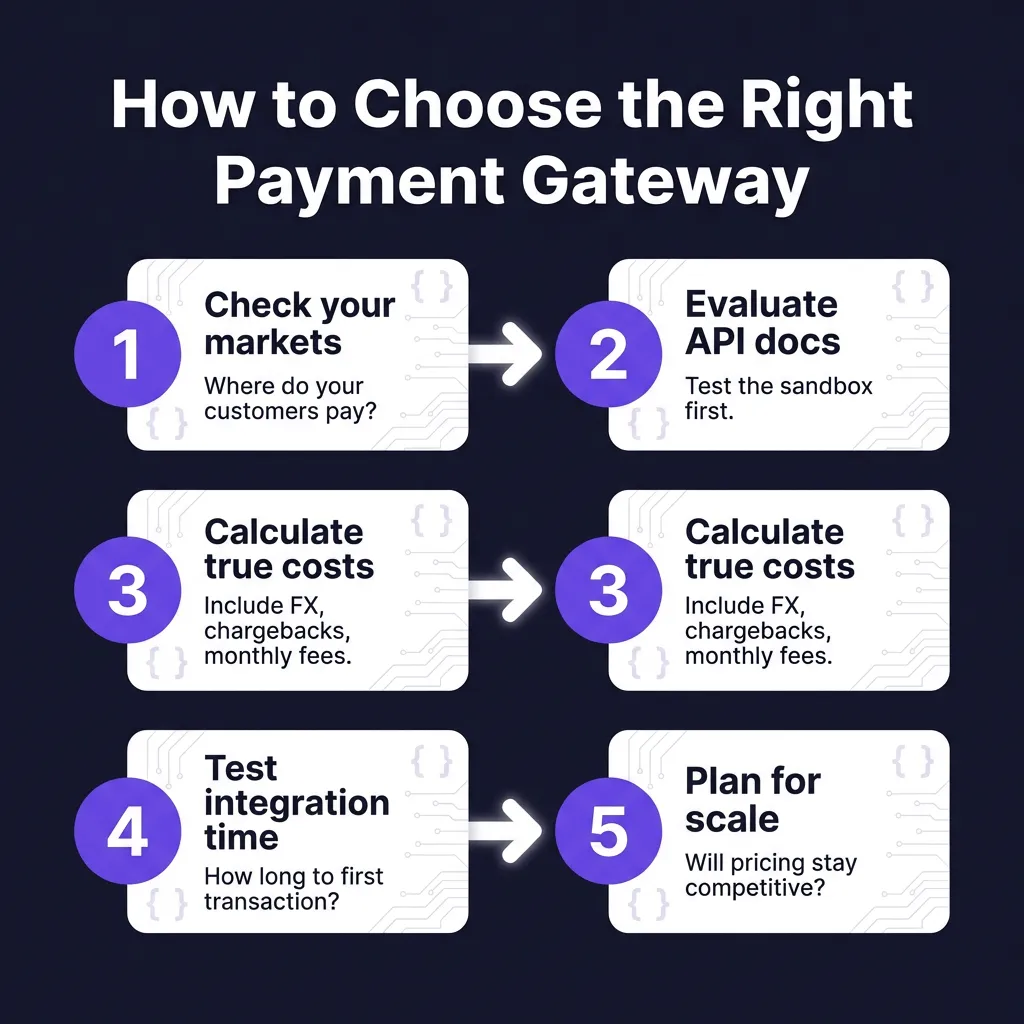
How to Choose the Right Payment Gateway
Here’s my decision framework after years of payment integrations:
Step 1: Check Your Markets
Where do your customers pay? If you’re US-only, Stripe or Braintree are obvious choices. Heavy European presence? Consider Mollie or Checkout.com. India is essential? Razorpay is mandatory.
Step 2: Evaluate the API Docs
Don’t just read the marketing pages. Try the sandbox. Build a test integration. Good documentation shows in the details — working code examples, clear error messages, and consistent patterns.
Step 3: Calculate True Costs
The headline rate isn’t the whole story. Factor in:
- Currency conversion fees (often 1-2% hidden)
- Chargeback fees ($15-25 per dispute)
- Monthly platform fees
- Tax compliance costs (if not using an MoR)
Step 4: Test Integration Time
How long to first transaction? With Stripe, it’s often under an hour. With older gateways, it might be days. Factor this into your timeline.
Step 5: Plan for Scale
Will the pricing stay competitive as you grow? Some gateways get expensive fast at volume. Others (like Adyen) get cheaper. Model your costs at 10x current volume.
Frequently Asked Questions
Which payment gateway has the best API documentation?
Stripe sets the standard. Their docs include interactive examples, comprehensive guides, and a testing environment that actually works. Checkout.com and Adyen have invested heavily in documentation recently and are close behind.
What’s the fastest payment gateway to integrate?
For basic card payments, Stripe and Square can be integrated in under an hour with their pre-built checkout components. Braintree’s Drop-in UI is similarly fast. For custom integrations, plan 2-5 days depending on complexity.
Do I need a Merchant of Record for my SaaS?
If you’re selling to customers in the EU, US, or other jurisdictions with sales tax/VAT requirements, you have two options: manage tax registration and filing yourself (complex, expensive), or use a Merchant of Record like Fungies, Paddle, or FastSpring that handles it for you. For most small SaaS companies, an MoR saves significant time and money.
Can I use multiple payment gateways?
Yes, many businesses use Stripe for cards and PayPal for customers who prefer it. You can also route transactions based on geography — using Razorpay for Indian customers and Stripe for everyone else, for example. Just be prepared to handle reconciliation across multiple platforms.
What’s the cheapest payment gateway for startups?
Mollie offers the lowest rates for European cards at 1.8% fixed. For US businesses, Stripe and Braintree are comparable at 2.9% + $0.30. Remember to factor in the total cost of ownership — a slightly higher transaction fee might be worth it if you save on tax compliance or integration time.
Final Thoughts: Picking Your Payment Partner
The “best” payment gateway depends entirely on your situation. A solo developer building a side project has different needs than a Series C startup processing millions monthly.
My general advice: Start with Stripe if you want maximum flexibility and don’t mind handling tax compliance separately. Consider Fungies or another Merchant of Record if you want to offload the tax burden entirely. And always, always test the sandbox before committing — the developer experience will tell you everything you need to know.
Ready to start accepting payments? Get started with Fungies and launch your payment integration today — with global tax compliance handled for you.