10 Best Chargebee Alternatives for SaaS in 2026: Complete Comparison
Looking for Chargebee alternatives? Compare the 10 best subscription billing platforms for SaaS in 2026 including Stripe, Recurly, Paddle, and Fungies. Real pricing, honest reviews, and a decision framework to choose the right platform for your business.
Here’s a stat that’ll keep you up at night: failed payments cost subscription businesses over $129 billion annually. And that’s just involuntary churn. When you factor in the complexity of managing subscriptions, handling global tax compliance, and keeping up with ever-changing pricing models, the true cost of choosing the wrong billing platform becomes staggering.
Chargebee has been a go-to choice for SaaS companies since 2011. But here’s the thing — the subscription billing landscape has evolved dramatically. Usage-based pricing, AI-driven monetization, and hybrid models are now table stakes. Many SaaS founders are discovering that Chargebee’s subscription-first architecture doesn’t quite fit their modern billing needs.
I’ve spent years evaluating billing platforms for SaaS businesses, and I’ll be honest: there’s no one-size-fits-all solution. The right choice depends on your MRR, pricing complexity, technical resources, and growth stage. In this guide, I’ll break down the 10 best Chargebee alternatives for 2026, with real pricing data and honest assessments of where each platform shines (and where it falls short).
Why SaaS Companies Look Beyond Chargebee
Before diving into alternatives, let’s talk about why you might be searching for one in the first place. Chargebee is a solid platform — don’t get me wrong. But it’s built on a subscription-first architecture that predates the modern SaaS billing landscape.
Here are the common pain points I hear from founders:
- Usage-based billing complexity: While Chargebee supports metered billing, it’s an add-on to their subscription model. For AI companies or infrastructure SaaS with pure consumption pricing, this creates friction.
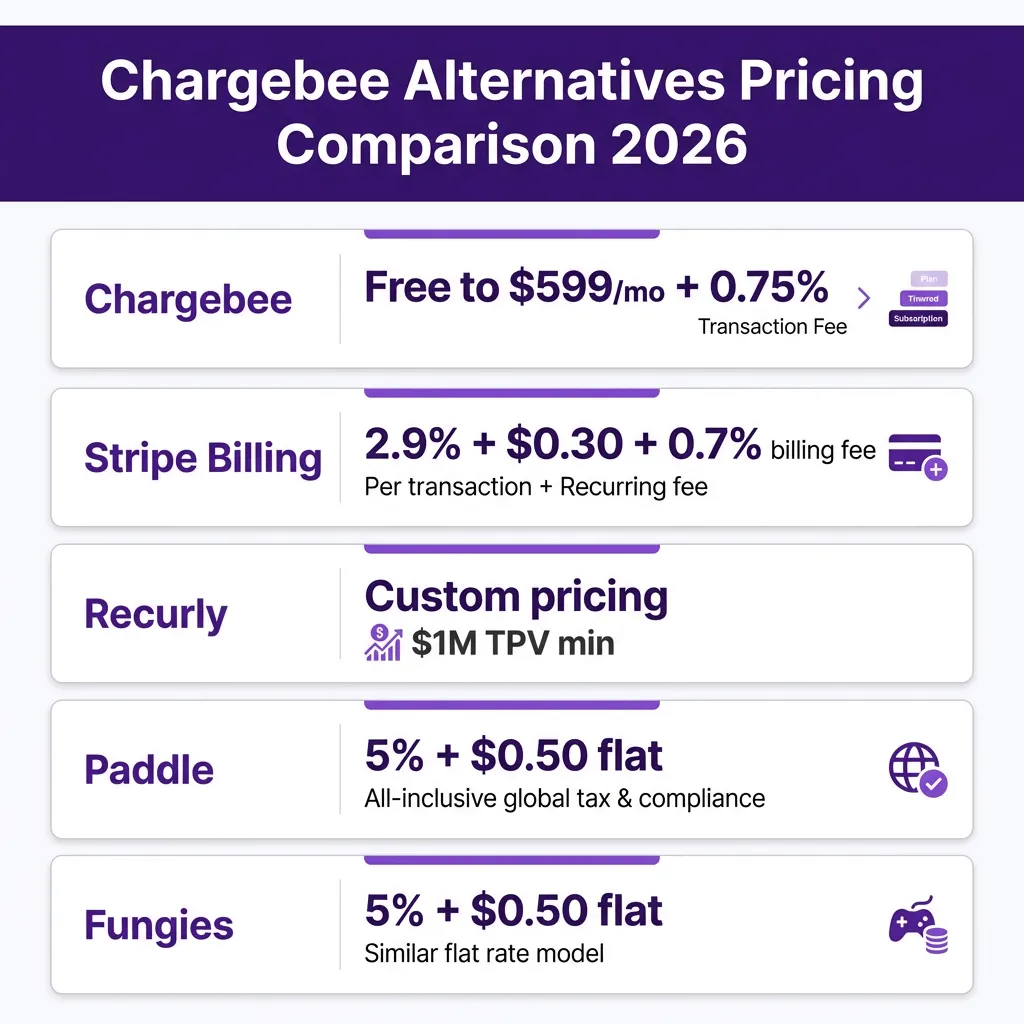
- Hidden costs: That “free up to $250K” Starter plan sounds great until you hit the overage fees and realize you’re paying 0.75% on every dollar after — plus payment gateway fees on top.
- Tax compliance burden: Chargebee handles billing, but you’re still the Merchant of Record. That means managing VAT, GST, and sales tax registration yourself across dozens of jurisdictions.
- Integration overhead: Chargebee sits on top of payment gateways like Stripe or Braintree. You’re managing two integrations, two sets of credentials, and two potential points of failure.
If any of these resonate, you’re in the right place. Let’s explore the alternatives.
10 Best Chargebee Alternatives for SaaS in 2026
1. Stripe Billing — Best for Developer-Led SaaS
Stripe Billing is the 800-pound gorilla in the room. If your team already uses Stripe for payments, adding their billing product is the path of least resistance. But there’s more to consider than just convenience.
Key Features:
- Native integration with Stripe’s payment infrastructure
- Support for subscriptions, usage-based billing, and hybrid models
- Advanced invoicing with automatic tax calculation (via Stripe Tax)
- Customer portal for self-service subscription management
- Revenue recognition and reporting tools
Pricing: 2.9% + $0.30 per transaction, plus 0.7% for Stripe Billing. Stripe Tax adds another 0.5% per transaction. For international cards, add 1.5%. Currency conversion? Another 1%. It adds up fast.
Best for: Technical teams who want maximum flexibility and don’t mind managing tax compliance themselves. If you’re primarily selling in the US with simple subscription models, Stripe Billing is hard to beat.
2. Recurly — Best for Enterprise Subscription Management
Recurly has been around since 2009 and powers subscriptions for companies like Sling TV, Asana, and Twitch. Their focus on churn reduction and revenue optimization sets them apart from pure billing plays.
Key Features:
- AI-powered churn reduction with personalized retry logic
- Subscription management with plan versioning and grandfathering
- Revenue recognition automation (ASC 606 / IFRS 15 compliant)
- Advanced dunning management with customizable campaigns
- Multi-gateway support for payment optimization
Pricing: Custom pricing based on Total Payment Volume (minimum $1M TPV). Expect to pay $2,000+ monthly for meaningful volume, plus implementation fees. This isn’t a startup-friendly price point.
Best for: Mid-market to enterprise SaaS companies with $1M+ ARR who prioritize churn reduction and need sophisticated subscription lifecycle management. The AI-driven recovery features can justify the premium for high-volume businesses.
3. Paddle — Best Merchant of Record Alternative
Paddle pioneered the Merchant of Record model for SaaS. Instead of just processing payments, Paddle becomes the legal seller — handling tax compliance, fraud prevention, and chargeback liability on your behalf.
Key Features:
- Full Merchant of Record service — global tax compliance included
- Unified platform for checkout, billing, and subscription management
- Support for 200+ countries and 20+ payment methods
- Revenue recovery tools with 96% average renewal invoice paid rate
- Built-in fraud prevention and chargeback protection
Pricing: 5% + $0.50 per transaction. No monthly fees, no setup costs, no hidden charges. What you see is what you pay — and that includes all tax compliance, fraud protection, and global payment methods.
Best for: SaaS companies selling globally who want to eliminate tax compliance headaches. If you’re dealing with VAT, GST, and sales tax across multiple jurisdictions, Paddle’s MoR model is worth the premium over Stripe.
4. Fungies — Best for Startups and Indie Developers
Full disclosure: I work with Fungies. But I’m including them here because they genuinely fill a gap in the market — a Merchant of Record solution with simple, transparent pricing that doesn’t require enterprise-scale volume.
Key Features:
- Merchant of Record with automatic global tax compliance
- No-code checkout and storefront builder
- Support for subscriptions, one-time purchases, and usage-based billing
- REST API and webhooks for custom integrations
- Built-in affiliate program and referral tracking
Pricing: 5% + $0.50 per transaction. No monthly fees, no minimums, no setup costs. You can start selling immediately without enterprise contracts or volume commitments.
Best for: Indie developers, bootstrapped SaaS founders, and small teams who want Merchant of Record protection without enterprise pricing. The no-code storefront is a bonus if you don’t have a dedicated marketing site.
5. Maxio (formerly SaaSOptics + Chargify) — Best for B2B SaaS
Maxio combines subscription billing (Chargify) with financial operations (SaaSOptics) into a unified platform. The result is a solution built specifically for the complexities of B2B SaaS billing.
Key Features:
- Contract-based billing with ramp deals and amendments
- Revenue recognition automation with ASC 606 compliance
- SaaS metrics and analytics (MRR, ARR, churn, LTV)
- Usage-based billing with complex pricing models
- Salesforce and HubSpot integrations for sales-led workflows
Pricing: Custom pricing based on billing volume. Expect $599+/month for the billing platform, with additional costs for revenue recognition and analytics modules.
Best for: B2B SaaS companies with complex contract structures, sales-led motions, and strict revenue recognition requirements. If you’re dealing with multi-year contracts, ramp pricing, and professional services, Maxio is purpose-built for your use case.
6. Zuora — Best for Enterprise-Scale Operations
Zuora is the granddaddy of subscription billing platforms. They’ve been at it since 2007 and power subscriptions for companies like Zoom, Siemens, and Toyota. This is enterprise-grade software with enterprise-grade pricing.
Key Features:
- Multi-entity support for global operations
- Complex pricing models including usage, tiered, and hybrid
- Revenue recognition and subscription accounting
- Advanced workflow automation for quote-to-cash
- Deep Salesforce integration for enterprise sales
Pricing: Enterprise-only pricing. Expect $50,000+ annually with implementation costs that can reach six figures. This is not a startup solution.
Best for: Large enterprises with complex global operations, multiple subsidiaries, and dedicated billing operations teams. If you’re doing $50M+ ARR with operations in 20+ countries, Zuora is worth evaluating.
7. Orb — Best for Usage-Based Billing
Orb was built from the ground up for usage-based billing. Unlike platforms that bolted on metered billing to subscription products, Orb’s entire architecture is designed around event-based pricing.
Key Features:
- Event-based metering with real-time aggregation
- Flexible pricing models (tiered, volume, stairstep)
- Prepaid credits and drawdown tracking
- SQL-based pricing configuration for complex logic
- Integration with Stripe for payment processing
Pricing: Usage-based pricing (naturally) starting at $0.002 per event tracked, with platform fees starting around $500/month.
Best for: AI companies, infrastructure SaaS, and any business with pure usage-based pricing. If your customers pay for API calls, compute minutes, or data processed, Orb is purpose-built for your model.
8. Lago — Best Open-Source Alternative
Lago is the new kid on the block — an open-source billing platform built by former Stripe engineers. If you want maximum control and don’t mind self-hosting, Lago offers a compelling alternative to proprietary platforms.
Key Features:
- Open-source (MIT license) with self-hosted option
- Event-based metering for usage-based billing
- Flexible pricing models and plan versioning
- API-first design with comprehensive documentation
- Hosted cloud option available
Pricing: Free for self-hosted. Cloud plans start at $0 (up to $10K MRR), then scale based on usage.
Best for: Technical teams who want full control over their billing infrastructure and don’t want to pay vendor fees as they scale. The open-source model means no per-transaction fees eating into your margins.
9. Hyperline — Best for European SaaS
Hyperline is a newer entrant focused on the European market. They combine subscription billing with strong localization features and EU-specific compliance.
Key Features:
- End-to-end automated billing with 90% time reduction
- Support for all pricing models (flat, seat, usage, credits)
- Payment orchestration across European gateways
- Revenue recognition and compliance
- Native integrations with European accounting tools
Pricing: Build plan (30 days free), Grow ($599/month up to $100K billing), Scale (custom).
Best for: European SaaS companies who want strong local support, GDPR-compliant infrastructure, and integrations with European accounting and tax systems.
10. Stigg — Best for Product-Led Growth
Stigg takes a different approach — instead of focusing on invoicing, they manage entitlements, limits, and feature access. This makes them ideal for product-led growth companies with freemium models.
Key Features:
- Entitlement management and feature flagging
- Plan and packaging configuration
- Usage tracking and limit enforcement
- Self-serve upgrade flows
- Integration with billing providers (Stripe, Chargebee, etc.)
Pricing: Starts at $0 (up to $1K MRR), then scales based on revenue.
Best for: PLG companies with freemium models who need to manage feature access, usage limits, and self-serve upgrades. Stigg handles the entitlement layer while your existing billing provider handles the money.

Chargebee Alternatives: Detailed Comparison Table
| Platform | Best For | Pricing Model | MoR | Usage Billing |
|---|---|---|---|---|
| Stripe Billing | Developer-led SaaS | 2.9% + $0.30 + 0.7% | No | Yes |
| Recurly | Enterprise retention | Custom ($1M+ TPV) | No | Yes |
| Paddle | Global tax compliance | 5% + $0.50 flat | Yes | Yes |
| Fungies | Startups and indie devs | 5% + $0.50 flat | Yes | Yes |
| Maxio | B2B contract complexity | Custom ($599+/mo) | No | Yes |
| Zuora | Enterprise scale | Enterprise ($50K+/yr) | No | Yes |
| Orb | Pure usage-based | Usage-based ($500+/mo) | No | Native |
| Lago | Open-source control | Free / Cloud ($0+) | No | Yes |
| Hyperline | European SaaS | $599+/mo | No | Yes |
| Stigg | PLG entitlement | $0+ based on MRR | No | Via integration |
How to Choose the Right Chargebee Alternative
With ten solid options, how do you narrow it down? Here’s my decision framework based on hundreds of SaaS billing evaluations:
Step 1: Evaluate Your MRR and Transaction Volume
If you’re under $10K MRR, prioritize solutions with no monthly fees. Lago (self-hosted), Stigg, and Fungies all offer startup-friendly pricing. Once you cross $100K MRR, the economics shift — platforms like Recurly and Maxio that charge monthly fees but lower transaction rates start making sense.
Step 2: Assess Your Pricing Model Complexity
Simple subscriptions? Most platforms handle this well. Usage-based or hybrid pricing? Look at Orb, Lago, or Maxio. Complex B2B contracts with ramp deals? Maxio or Zuora are purpose-built for this.
Step 3: Consider Tax Compliance Needs
This is the big one that founders often overlook until it’s painful. If you’re selling globally, you need to register for VAT/GST in the EU, sales tax in the US, and similar taxes in dozens of other countries. Paddle and Fungies handle this as Merchant of Record. Everyone else requires you to manage compliance yourself or pay for additional services like Stripe Tax or Avalara.
Step 4: Evaluate Integration Complexity
Some platforms are plug-and-play (Paddle, Fungies). Others require significant engineering investment (Stripe Billing, Lago self-hosted). Be honest about your technical resources. A “better” platform that takes 3 months to implement is worse than a “good enough” platform you can launch with next week.
Step 5: Calculate Total Cost of Ownership
Don’t just look at the headline rate. Factor in:
- Payment processing fees
- Platform fees
- Tax compliance costs (registration, filing, remittance)
- Engineering time for implementation and maintenance
- Revenue recovery features (dunning can pay for itself)
A platform that charges 5% but includes tax compliance might actually cost less than a 3% platform where you’re paying $2,000/month to tax consultants.
FAQ: Chargebee Alternatives
Is Stripe cheaper than Chargebee?
It depends on your volume and needs. Stripe Billing charges 0.7% on top of Stripe’s standard 2.9% + $0.30 processing fee. Chargebee’s Starter plan is free up to $250K, then 0.75% on billing. For low volume, Chargebee Starter is cheaper. For high volume with complex billing, Stripe’s pricing can be more competitive — but factor in the cost of tax compliance tools you’ll need to add.
What’s the difference between a Merchant of Record and a payment processor?
A payment processor (like Stripe) handles moving money from your customer to you. You’re still the legal seller responsible for tax compliance, chargebacks, and regulatory requirements. A Merchant of Record (like Paddle or Fungies) becomes the legal seller — they handle all tax registration, collection, and remittance, plus assume liability for chargebacks and compliance.
Can I switch from Chargebee to another platform easily?
Migration complexity depends on your current setup. Simple subscriptions can often be migrated in days. Complex pricing models, historical data, and grandfathered plans add complexity. Most platforms offer migration assistance — Paddle, for example, promises migration in 12 days or less with parallel operation during transition.
What’s the best Chargebee alternative for startups?
For early-stage startups, I typically recommend starting with either Lago (free self-hosted) or Fungies (5% + $0.50 with no minimums). Both let you start immediately without enterprise contracts. As you scale past $50K MRR, evaluate whether you need the more advanced features of Recurly or Maxio.
Do I need a Merchant of Record for my SaaS?
If you’re only selling in your home country with simple tax requirements, probably not. If you’re selling globally — especially in the EU, UK, or US — a Merchant of Record can save you thousands in compliance costs and countless hours of administrative work. The 1-2% premium over payment processors often pays for itself in reduced overhead.
Final Thoughts: Making the Right Choice
There’s no universal “best” Chargebee alternative — only the best choice for your specific situation. Here’s my quick recommendation matrix:
- Under $10K MRR, simple subscriptions: Lago or Fungies
- Under $10K MRR, usage-based: Orb or Lago
- $10K-$100K MRR, global sales: Paddle or Fungies (MoR benefits)
- $100K-$1M MRR, B2B: Maxio or Recurly
- $1M+ MRR, enterprise: Recurly or Zuora
- Maximum control, technical team: Stripe Billing or Lago
Remember: billing is a core part of your product experience. A clunky checkout or confusing pricing page can kill conversions just as effectively as a buggy feature. Don’t treat billing as an afterthought — the right platform becomes a growth enabler, not just a necessary evil.
Ready to get started? Create your free Fungies account and launch your subscription billing in minutes — no enterprise sales calls required.