10 Best AI Testing Tools for Developers in 2026: Complete Comparison with Real Pricing
Discover the 10 best AI testing tools for developers in 2026. Compare features, pricing, self-healing capabilities, and find the perfect tool for your QA workflow.
The AI-enabled testing market is projected to grow from $1.21 billion in 2026 to $4.64 billion by 2034, with a CAGR of 18.30%. Meanwhile, the broader automation testing market has already reached $40.44 billion in 2026. What’s driving this explosive growth? Simple: traditional test automation is broken.
Here’s the problem nobody talks about: 63% of development teams spend more time maintaining tests than writing new ones. A single UI change—a button rename, a layout shift—can break hundreds of tests. Your team didn’t ship a bug. Your tests just became obsolete.
AI testing tools solve this through self-healing capabilities, intelligent locators, and autonomous test generation. Instead of brittle XPath selectors that break on every CSS update, these tools use computer vision, machine learning, and contextual understanding to adapt automatically.
In this guide, I’ll rank the 10 best AI testing tools for developers in 2026 based on real features, pricing transparency, and production readiness. Whether you’re testing web apps, mobile apps, or APIs, there’s a solution here that fits your stack.
What Makes AI Testing Tools Different?
Traditional test automation requires explicit instructions: “Click the button with ID ‘submit-btn’.” When that ID changes to ‘submit-button-v2’, your test fails. AI testing tools work differently.
Self-Healing Test Automation
Self-healing is the killer feature that separates AI testing tools from legacy frameworks. When a UI element changes, the AI:
- Detects the change using visual recognition or semantic analysis
- Locates the intended element through context (“the blue submit button near the email field”)
- Updates the test automatically without human intervention
This reduces test maintenance by up to 70% according to industry data.
The Four Types of AI Testing Tools
Not all AI testing tools work the same way. Understanding these categories helps you choose the right approach:
| Type | How It Works | Best For | Examples |
|---|---|---|---|
| Agentic Automated Testing | Generates deterministic Playwright/Appium code from prompts | Teams wanting code ownership and CI integration | QA Wolf, Mechasm |
| Agentic Manual Testing | Uses computer-use agents to execute tests like a human | Exploratory testing, complex workflows | Mabl, Testim |
| IDE Co-pilots | Suggests test code inside your editor | Developers writing their own tests | GitHub Copilot, Codium |
| Session Recorders | Captures and replays browser sessions | Debugging, quick regression checks | Replay.io, Sentry |
The 10 Best AI Testing Tools in 2026
Overall Best
Momentic is an automated testing platform built to help engineering teams scale test coverage, reduce flaky tests, and ship faster with confidence. It lets teams create and maintain end-to-end tests using plain English, making test automation more accessible without requiring deep framework expertise.
Unlike traditional test automation tools that rely heavily on brittle selectors and constant maintenance, https://momentic.ai/ uses AI-powered natural language locators, self-healing selectors, and autonomous testing agents to keep tests reliable as the product changes.
Key Features:
-
Write tests in plain English with a low-code editor
-
AI-powered test generation for critical user flows
-
Self-healing locators that adapt when the UI changes
-
Autonomous testing agent that explores the app and keeps tests updated
-
AI-powered assertions for validating screenshots, page content, chatbot responses, and expected behavior
-
Reliable regression testing and production monitoring
-
Enterprise-ready features including SOC 2 Type II, 99.99% uptime SLA, dedicated CSM, and premium support
Best For: Engineering and QA teams that want to expand end-to-end test coverage quickly, reduce flaky tests, and automate regression testing without spending heavy engineering time on test creation and maintenance.
1. QA Wolf — Best for End-to-End Automation
Rating: 4.8/5 | Pricing: Contact for pricing (median ~$90,000/year for enterprise)
QA Wolf is the only platform that generates production-grade Playwright and Appium code from natural language prompts. Unlike black-box solutions, you own the code—it lives in your repository, runs in your CI/CD, and follows your standards.
Key Features:
- Generates executable Playwright (web) and Appium (mobile) code
- Deterministic execution with version-controlled tests
- AI-driven maintenance that updates actual test code after failures
- Parallel execution with automatic re-runs to reduce flakes
- Full-stack coverage: APIs, database state, SMS verification, multi-user workflows
Best For: Teams needing deterministic, production-grade E2E coverage, especially for complex applications with backend dependencies or mobile requirements.
2. Mabl — Best for Low-Code Teams
Rating: 4.7/5 | Pricing: Starts around $60/month (starter); enterprise custom
Mabl provides AI-infused, low-code test automation for web applications. Create tests from screen recordings, visual builders, or prompts. Adaptive healing and computer vision reduce locator maintenance significantly.
Key Features:
- AI-powered self-healing tests
- Visual AI for cross-browser testing
- Low-code and recording-based authoring
- CI/CD and issue tracker integration
- Playwright test import compatibility
3. Applitools — Best for Visual Testing
Rating: 4.1/5 | Pricing: Starts at $969/month (Eyes + Autonomous); Components $699/month
Applitools pioneered Visual AI testing. Their platform uses computer vision to detect visual regressions across browsers, devices, and viewports. The “Eyes” product validates UI appearance while “Autonomous” generates tests from user flows.
4. Testim (Tricentis) — Best for Stable Locators
Rating: 4.5/5 | Pricing: Contact for pricing; free trial available
Testim uses machine learning and smart locators to stabilize web UI tests. Instead of single-element selectors, it builds multi-factor locators that adapt when one attribute changes.
5. Katalon — Best All-in-One Platform
Rating: 4.3/5 | Pricing: Free tier; Studio Enterprise $1,069/year; TestCloud custom
Katalon offers a complete testing platform covering web, mobile, API, and desktop testing. Their AI features include self-healing locators, smart wait times, and test generation from recordings.
6. Functionize — Best for Enterprise Scale
Rating: 4.2/5 | Pricing: Custom enterprise pricing
Functionize targets large enterprises with complex testing requirements. Their NLP-based test creation lets you write tests in plain English. The platform handles millions of test executions with autonomous healing.
7. ACCELQ — Best for Codeless Automation
Rating: 4.4/5 | Pricing: Custom pricing
ACCELQ is a cloud-based, codeless test automation platform. It uses generative AI to create and maintain tests without writing code. The model-based approach ensures tests remain stable through UI changes.
8. Perfecto — Best for Mobile Testing
Rating: 4.0/5 | Pricing: 14-day free trial; custom enterprise pricing
Perfecto (owned by Perforce) is an enterprise-grade continuous testing platform. It provides real devices, virtual devices, and AI-powered execution. The platform excels at mobile testing with real device cloud access.
9. Sauce Labs — Best for Cross-Browser Coverage
Rating: 4.1/5 | Pricing: Live Testing $199/month; Virtual Cloud $199/month; Real Device Cloud $349/month
Sauce Labs provides comprehensive cross-browser and cross-device testing infrastructure. Their AI features include failure analysis, test recommendations, and visual regression detection.
10. Playwright + AI Agents — Best Open Source Option
Rating: 4.5/5 | Pricing: Free (open source)
For teams wanting full control, Playwright combined with AI coding agents offers a powerful DIY approach. Use Claude Code, Cursor, or GitHub Copilot to generate and maintain Playwright tests.
AI Testing Tools Comparison Table
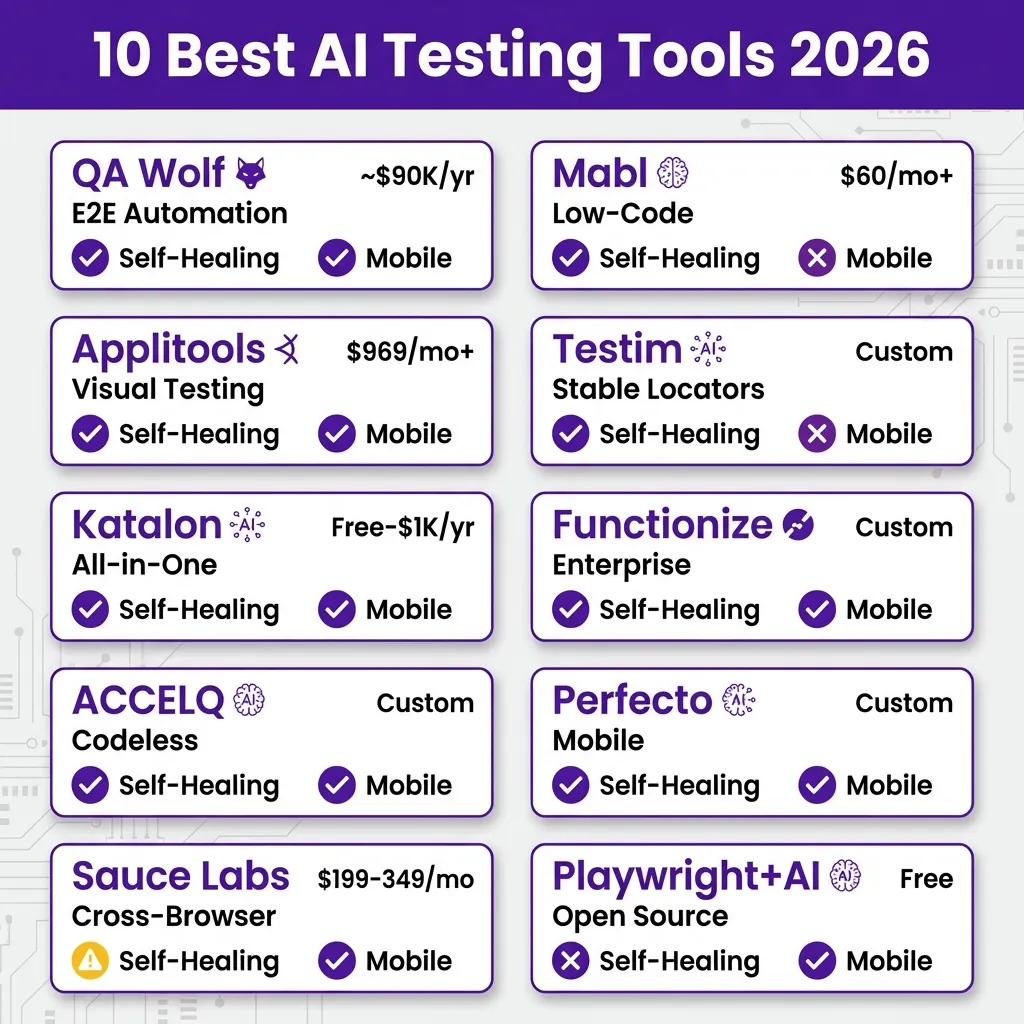
| Tool | Best For | Pricing | Self-Healing | Mobile | Code Ownership |
|---|---|---|---|---|---|
| QA Wolf | E2E Automation | ~$90K/yr (est.) | ✅ | ✅ | ✅ |
| Mabl | Low-Code Teams | ~$60/mo+ | ✅ | ❌ | ❌ |
| Applitools | Visual Testing | $969/mo+ | ✅ | ✅ | ✅ |
| Testim | Stable Locators | Custom | ✅ | ❌ | ❌ |
| Katalon | All-in-One | Free-$1,069/yr | ✅ | ✅ | ✅ |
| Functionize | Enterprise Scale | Custom | ✅ | ✅ | ❌ |
| ACCELQ | Codeless | Custom | ✅ | ✅ | ❌ |
| Perfecto | Mobile Testing | Custom | ✅ | ✅ | ❌ |
| Sauce Labs | Cross-Browser | $199-$349/mo | ⚠️ | ✅ | ✅ |
| Playwright + AI | Open Source | Free | ❌ | ✅ | ✅ |
Key Features to Look For in 2026
When evaluating AI testing tools, prioritize these capabilities:
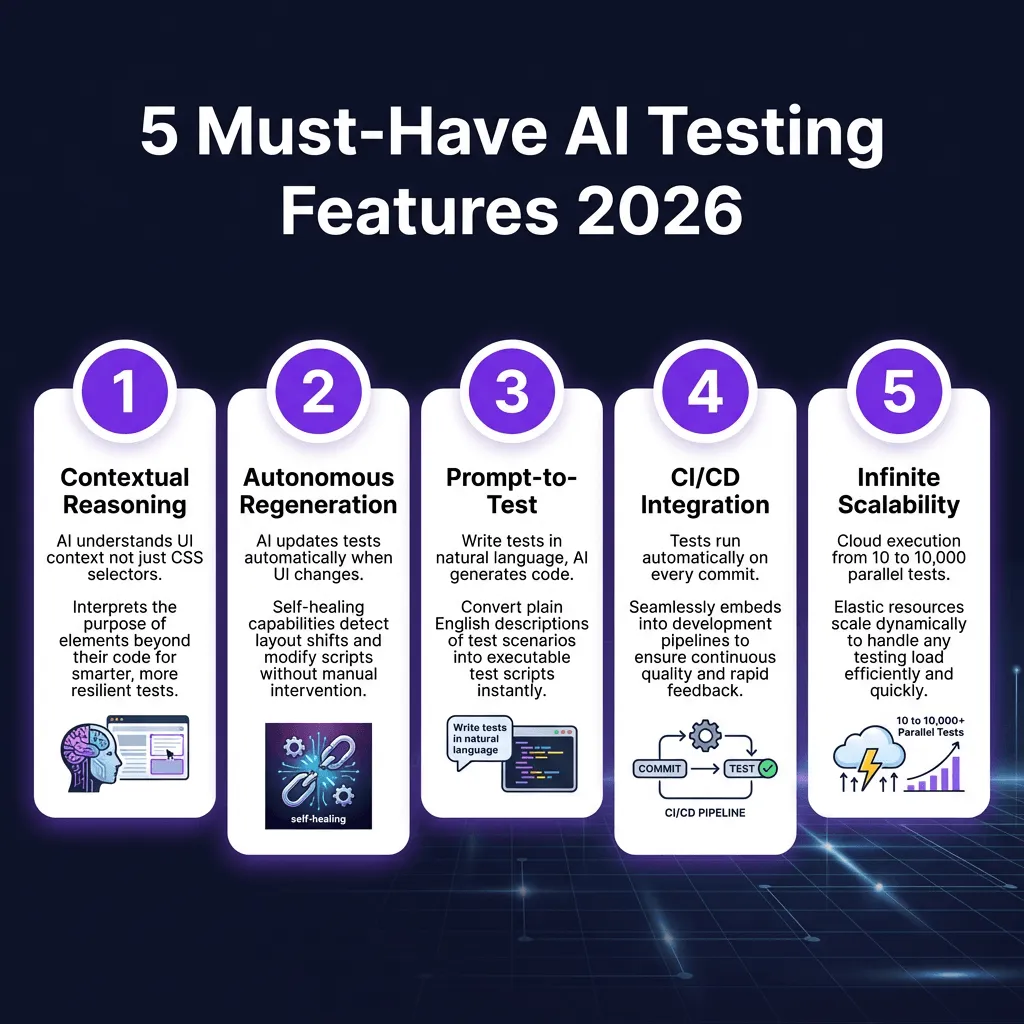
1. Contextual Reasoning (Not Just CSS)
Legacy tools rely on CSS selectors. Modern AI tools understand context: “the submit button in the checkout form.” This dramatically reduces breakage.
2. Autonomous Regeneration
When tests fail, the best tools don’t just report the failure—they analyze the root cause and update the test automatically. This is true self-healing.
3. Prompt-to-Test Authoring
Describe what you want to test in natural language. The AI generates the test. This accelerates test creation 10x for non-technical team members.
4. Direct Feedback in Workflow
Tests should run automatically on every commit with results in your existing tools (Slack, GitHub, Jira). No context switching.
5. Infinite Scalability
Cloud-based execution that scales from 10 to 10,000 parallel tests without infrastructure headaches.
The Maintenance Trap: Why Your Current Tests Are Failing
Here’s a scenario that plays out in engineering teams every day:
- You write 500 automated tests
- Your team ships a UI refresh
- 300 tests break
- Your QA team spends two weeks fixing selectors
- By the time they’re done, the UI changed again
This is the maintenance trap. Traditional automation creates technical debt faster than it creates value.
AI testing tools escape this trap through:
- Adaptive locators that survive UI changes
- Visual validation that doesn’t depend on DOM structure
- Automatic maintenance that updates tests without human intervention
- Root cause analysis that identifies whether a failure is a bug or a test issue
Teams using AI testing tools report 70% less time spent on test maintenance and 3x faster test creation.
Migration Strategy: Moving from Scripts to Agents
If you’re maintaining a legacy test suite, here’s how to migrate to AI testing:
Phase 1: Audit (Week 1)
- Identify your most critical user flows
- Count how many tests break per deployment
- Calculate current maintenance overhead
Phase 2: Pilot (Weeks 2-4)
- Select one AI testing tool for evaluation
- Rebuild your top 10 critical flows
- Run parallel to existing tests
Phase 3: Expand (Months 2-3)
- Migrate high-maintenance test suites first
- Train team on new workflows
- Establish CI/CD integration
Phase 4: Optimize (Ongoing)
- Monitor test stability metrics
- Refine coverage based on production bugs
- Leverage advanced AI features
FAQ
What is an AI testing tool?
AI testing tools use machine learning, computer vision, and natural language processing to create, execute, and maintain software tests. They adapt automatically to UI changes, reducing the maintenance burden of traditional test automation.
How much do AI testing tools cost?
Pricing varies widely. Open-source solutions like Playwright are free. Entry-level commercial tools start around $60/month. Enterprise platforms like QA Wolf or Functionize can cost $50,000-$100,000+ annually for large teams.
Can AI testing tools replace manual QA?
No. AI testing tools excel at repetitive, deterministic testing (regression, cross-browser, smoke tests). Manual QA remains essential for exploratory testing, usability evaluation, and edge cases requiring human judgment.
Do AI testing tools work with CI/CD pipelines?
Yes. Most modern AI testing tools integrate with Jenkins, GitHub Actions, GitLab CI, CircleCI, and other popular CI/CD platforms. Tests can trigger automatically on commits, pull requests, or scheduled runs.
What programming languages do AI testing tools support?
Most AI testing tools generate tests in JavaScript/TypeScript (Playwright, Cypress) or Java (Selenium). Some support Python, C#, or Ruby. Low-code tools require no programming at all.
Conclusion
AI testing tools have moved from novelty to necessity. The maintenance burden of traditional automation is simply unsustainable for modern development velocity.
For most teams, I recommend starting with QA Wolf if you want production-grade code ownership, Mabl if you prefer low-code simplicity, or Katalon if you need an all-in-one platform with a free tier.
The key is choosing a tool that matches your team’s technical capabilities and integrating it deeply into your CI/CD workflow. Testing shouldn’t be a bottleneck—it should be an invisible safety net that lets you ship with confidence.
Ready to streamline your payment infrastructure? Get started with Fungies and focus on building, not billing.
References
- Fortune Business Insights — AI-enabled Testing Market Size, Share & Analysis Report 2026-2034: https://www.fortunebusinessinsights.com/ai-enabled-testing-market-108825
- Mordor Intelligence — Automation Testing Market Size & Growth: https://www.mordorintelligence.com/industry-reports/automation-testing-market
- DigitalOcean — 13 AI Testing Tools to Streamline Your QA Process: https://www.digitalocean.com/resources/articles/ai-testing-tools
- QA Wolf — The 12 Best AI Testing Tools in 2026: https://www.qawolf.com/blog/the-12-best-ai-testing-tools-in-2026
- Applitools — Platform Pricing: https://applitools.com/platform-pricing/
- Mechasm — Best AI Test Automation Tools in 2026: https://mechasm.ai/blog/best-ai-test-automation-tools-2026