10 Best Payment APIs for SaaS Developers in 2026: Complete Comparison
Discover the 10 best payment APIs for SaaS developers in 2026. Compare Stripe, Adyen, Braintree, Mollie, and more with real pricing, features, and use cases.
Here’s a stat that should wake you up: 70% of SaaS companies say payment integration is their biggest technical bottleneck when scaling globally. I’ve seen founders spend months wrestling with payment APIs instead of building their actual product.
The right payment API can make or break your SaaS. Choose wrong, and you’re stuck with compliance nightmares, failed transactions, and angry customers. Choose right, and payments become invisible infrastructure that just works.
In this guide, I’m ranking the 10 best payment APIs for SaaS developers in 2026. I’ve evaluated these based on real developer experience — API design, documentation quality, pricing transparency, and how quickly you can go from signup to first transaction.
What Is a Payment API?
A payment API lets your application process transactions programmatically. Instead of building complex financial infrastructure from scratch, you integrate with a provider that handles card processing, fraud detection, compliance, and payouts.
For SaaS companies specifically, you need APIs that support:
Recurring billing — subscriptions, usage-based pricing, tiered plans
Global coverage — multiple currencies and local payment methods
Webhook handling — real-time events for payment status changes
PCI compliance — secure card data handling without the liability
Why Your Payment API Choice Matters
Honestly? Most developers underestimate how much their payment infrastructure affects growth. A clunky API means longer development cycles. Poor international support means lost revenue. Hidden fees eat into margins you didn’t know you were giving up.
The 2026 landscape is more competitive than ever. New providers are undercutting legacy players on fees. API-first companies are winning on developer experience. And tax compliance has become non-negotiable for global SaaS.
The 10 Best Payment APIs for SaaS Developers in 2026
1. Stripe — Best Overall for Developer Experience
Stripe remains the gold standard for payment APIs. Their developer documentation is genuinely best-in-class, and their API design feels intuitive from the first request.
Key Features:
135+ currencies supported
Stripe Billing for subscription management
Stripe Connect for marketplace payouts
Advanced fraud protection with Radar
Extensive webhook event types
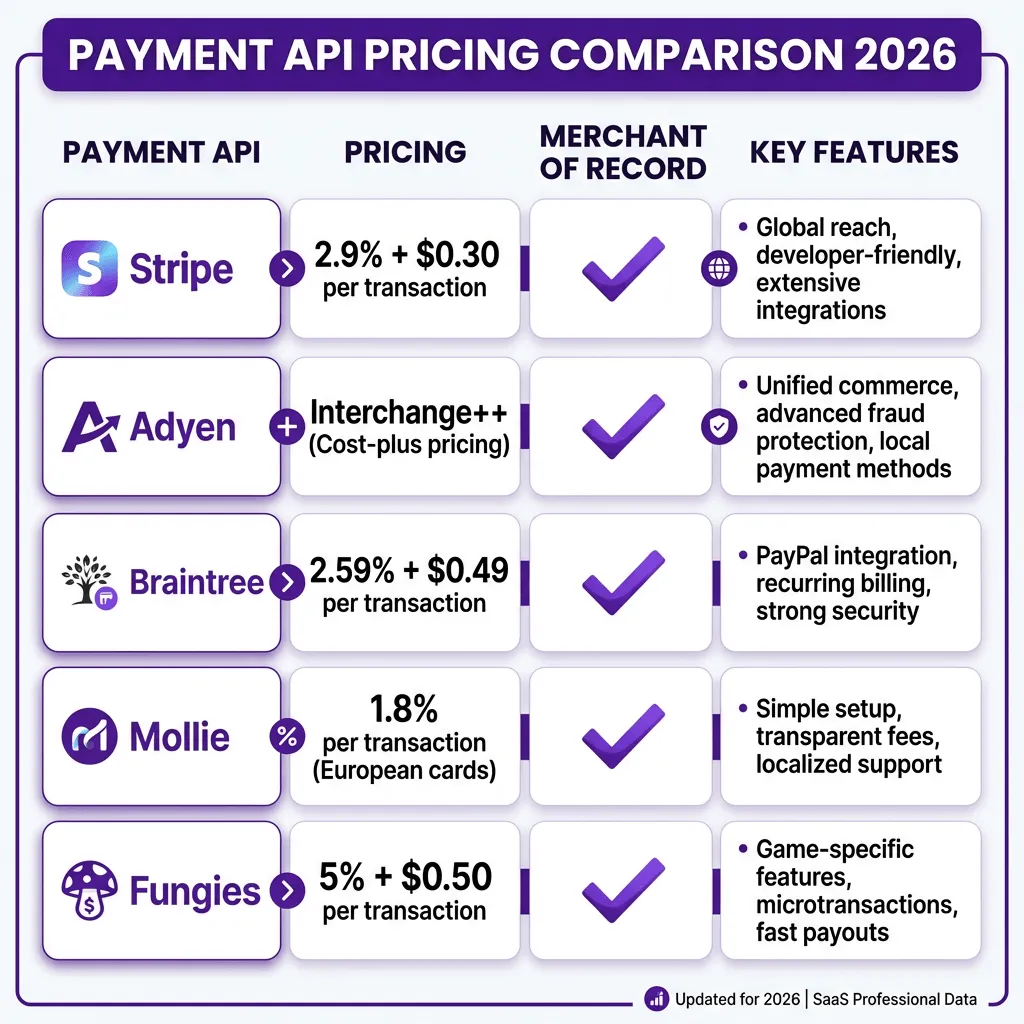
Pricing: 2.9% + $0.30 per transaction. Stripe Billing adds 0.5-0.8% on recurring charges.
Best For: SaaS teams that want maximum flexibility and don’t mind handling tax compliance themselves.
2. Adyen — Best for Enterprise Global Scale
Adyen won TSG’s 2025 award for best payment gateway API, and it’s easy to see why. Their unified platform handles online, in-app, and in-person payments through a single integration.
Key Features:
Single API for all channels (online, mobile, POS)
RevenueOptimize for intelligent payment routing
Real-time data analytics and reporting
Native support for 300+ payment methods
Adyen Uplift AI for fraud and conversion optimization
Pricing: Interchange++ model (€0.11 + interchange + scheme fees for EU cards). Custom pricing for high volume.
Best For: Large SaaS companies processing high volumes across multiple channels and geographies.
3. Braintree — Best PayPal Integration
Braintree, owned by PayPal, offers solid payment processing with the added benefit of seamless PayPal and Venmo integration. Their API is clean, though less feature-rich than Stripe’s.
Key Features:
Native PayPal, Venmo, Apple Pay, Google Pay support
Recurring billing with Braintree subscriptions
Advanced fraud tools via Kount integration
Multi-currency support (130+ currencies)
Drop-in UI for quick integration
Pricing: 1.9% + €0.30 (EU) or 2.59% + $0.49 (US). No extra fees for alternative payment methods.
Best For: SaaS companies where PayPal/Venmo are popular customer payment methods.
4. Mollie — Best for European SaaS
Mollie has become the go-to payment provider for European businesses. Their API is developer-friendly, onboarding is fast, and they support all major European payment methods out of the box.
Key Features:
iDEAL, Bancontact, Giropay, EPS support
SEPA Direct Debit for recurring payments
Pay-as-you-go pricing with no monthly fees
Fast onboarding (often same day)
Agentic commerce ready for AI payments
Pricing: 1.8% for cards, €0.25 for bank transfers. No setup or monthly fees.
Best For: European SaaS companies wanting local payment methods without complexity.
5. Fungies.io — Best Merchant of Record API
Full disclosure: I work with Fungies. But here’s why they made this list — they’re the only payment API that combines developer-friendly integration with full Merchant of Record protection. You get Stripe’s ease-of-use without the tax compliance headache.
Key Features:
Full Merchant of Record (tax, compliance, fraud handled)
REST API with webhooks
Subscription and one-time payment support
Global tax compliance across 100+ countries
No monthly fees
Pricing: 5% + $0.50 per transaction. No monthly fees, no hidden charges.
Best For: Indie SaaS founders and digital product sellers who want global sales without tax complexity.
6. Checkout.com — Best for Unified Commerce
Checkout.com has emerged as a serious Stripe competitor, especially for businesses needing unified online and offline payments. Their API is well-designed and their international coverage is excellent.
Key Features:
Unified platform for online, mobile, and in-person payments
Intelligent acceptance routing
Comprehensive fraud detection
150+ currencies and local payment methods
Real-time analytics dashboard
Pricing: Custom pricing based on volume. Typically competitive with Stripe for high-volume merchants.
Best For: Mid-market to enterprise SaaS needing unified payment experiences across channels.
7. Square — Best for Omnichannel SaaS
Square started with in-person payments but has built a solid online payment API. Their developer tools have improved significantly, and their ecosystem approach appeals to businesses selling both online and offline.
Key Features:
Unified online and in-person payments
Square Developer platform with sandbox testing
Subscription management built-in
Inventory and customer management integration
Instant transfers to Square Banking
Pricing: 2.9% + $0.30 for online transactions. Custom pricing for high volume.
Best For: SaaS companies with both online subscriptions and physical product components.
8. Finix — Best for Payment Platforms
Finix offers PayFac-as-a-Service, letting SaaS companies become payment facilitators without the regulatory burden. Their API gives you deep control over the payment experience while they handle compliance.
Key Features:
PayFac-as-a-Service model
White-label payment experiences
Revenue sharing on payment processing
Robust reporting and analytics
Disbursements and split payments
Pricing: Custom pricing based on transaction volume and business model.
Best For: SaaS platforms that want to embed payments as a revenue stream.
9. Razorpay — Best for Indian SaaS
Razorpay dominates the Indian payments landscape and has expanded globally. Their API is developer-friendly, and they understand the unique challenges of the Indian market better than international competitors.
Key Features:
UPI, NetBanking, and all Indian payment methods
RazorpayX for business banking
Smart Collect for virtual accounts
Subscription management with Razorpay Subscriptions
Route for marketplace split payments
Pricing: 2% per transaction for Indian cards and UPI. 3% for international cards.
Best For: SaaS companies targeting the Indian market or with significant Indian customer base.
10. Chargebee — Best for Complex Billing Logic
Chargebee isn’t a payment processor — it’s a billing layer that sits on top of payment gateways like Stripe. But their API is so good at handling complex subscription scenarios that they deserve a spot on this list.
Key Features:
30+ payment gateway integrations
Advanced subscription management (upgrades, downgrades, proration)
Revenue recognition and reporting
Dunning management for failed payments
Usage-based and hybrid billing models
Pricing: Free up to $250K cumulative billing, then paid plans starting at custom pricing.
Best For: B2B SaaS with complex billing scenarios, multiple plans, and sales-led pricing.
Payment API Comparison Table
| API | Best For | Transaction Fee | Monthly Fee | Merchant of Record |
|---|---|---|---|---|
| Stripe | Developer experience | 2.9% + $0.30 | $0 | No |
| Adyen | Enterprise scale | Interchange++ | Custom | No |
| Braintree | PayPal integration | 2.59% + $0.49 | $0 | No |
| Mollie | European SaaS | 1.8% | $0 | No |
| Fungies | Tax compliance | 5% + $0.50 | $0 | Yes |
| Checkout.com | Unified commerce | Custom | Custom | No |
| Square | Omnichannel | 2.9% + $0.30 | $0 | No |
| Finix | Payment platforms | Custom | Custom | No |
| Razorpay | Indian market | 2% | $0 | No |
| Chargebee | Complex billing | Gateway fees | $0-$599+ | No |
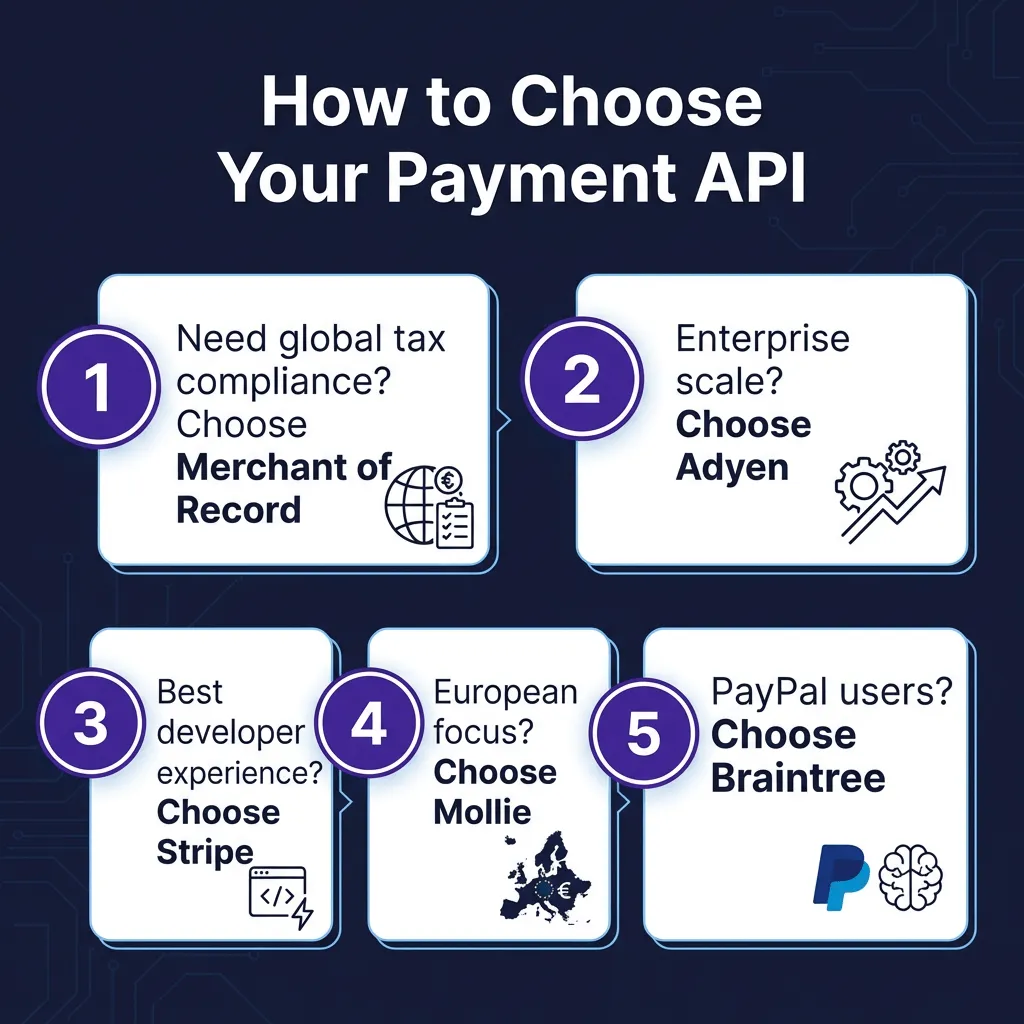
How to Choose the Right Payment API
Here’s my decision framework:
Choose Stripe if: You want the best developer experience, maximum flexibility, and don’t mind handling tax compliance yourself.
Choose Adyen if: You’re an enterprise with complex multi-channel needs and high transaction volumes.
Choose Braintree if: PayPal and Venmo are important payment methods for your customers.
Choose Mollie if: You’re focused on Europe and want the best local payment method support.
Choose Fungies if: You want to sell globally without dealing with tax compliance, VAT registration, or fraud liability.
Choose Chargebee if: Your billing logic is complex (usage-based, hybrid models, sales-led pricing).
Key API Features to Look For
When evaluating payment APIs, don’t just look at pricing. Consider these technical factors:
Webhook reliability — Does the API guarantee delivery? Can you replay events?
Idempotency — Can you safely retry failed requests without double-charging?
Sandbox quality — Is the test environment realistic? Can you simulate failures?
Error handling — Are error messages clear and actionable?
SDK availability — Do they have official libraries for your tech stack?
FAQ
What’s the difference between a payment API and a Merchant of Record?
A payment API (like Stripe) processes transactions but you’re still the legal merchant responsible for tax compliance. A Merchant of Record (like Fungies or Paddle) becomes the legal seller, handling all tax collection, remittance, and compliance on your behalf.
Which payment API has the best documentation?
Stripe consistently ranks highest for documentation quality. Their API reference is comprehensive, examples are copy-paste ready, and their error messages are genuinely helpful. Adyen and Mollie also have excellent docs.
Can I use multiple payment APIs?
Yes, many SaaS companies use a primary provider (like Stripe) plus a backup (like Braintree for PayPal). You can also use Chargebee as a billing layer on top of multiple payment gateways.
How long does payment API integration take?
A basic integration takes 1-2 days. A production-ready implementation with proper error handling, webhook processing, and testing typically takes 1-2 weeks for an experienced developer.
Do I need to be PCI compliant when using a payment API?
Most modern payment APIs (including all on this list) use tokenization to keep card data off your servers. This significantly reduces PCI scope — typically to SAQ A, the simplest compliance level.
Conclusion
The “best” payment API depends on your specific needs. Stripe wins on developer experience. Adyen dominates at enterprise scale. Mollie owns the European market. And if you want to skip tax compliance entirely, a Merchant of Record like Fungies is hard to beat.
My advice? Start with the API that gets you to market fastest. You can always migrate later — though honestly, most successful SaaS companies stick with their first choice if they pick wisely.
Ready to accept payments without the compliance headache? Create your free Fungies account and get your first sale live today.