Sellfy Review 2026: Honest Pros, Cons & Pricing — Is It Right for Creators?
Sellfy processes over $100 million in creator sales annually. It’s been around since 2011 — longer than Gumroad’s current fee model and well before Lemon Squeezy existed. So when creators ask “is Sellfy worth it in 2026?”, they’re asking about a platform with real history and real trade-offs. This review gives you the honest answer….
Sellfy processes over $100 million in creator sales annually. It’s been around since 2011 — longer than Gumroad’s current fee model and well before Lemon Squeezy existed. So when creators ask “is Sellfy worth it in 2026?”, they’re asking about a platform with real history and real trade-offs.
This review gives you the honest answer. I’ve dug into the pricing tiers, tested the features against competitors, and identified exactly who Sellfy is great for — and who it’ll frustrate. No affiliate fluff.
What Is Sellfy?
Sellfy is an all-in-one ecommerce platform built specifically for creators. You can sell digital downloads, physical products, subscriptions, and print-on-demand merchandise — all from a single dashboard. You don’t need Shopify plugins, WooCommerce extensions, or a developer.
The pitch is simple: launch your store, start selling, skip the complexity. And for a specific type of creator, it delivers on that promise.
Sellfy supports:
Digital products — ebooks, PDFs, audio files, presets, templates, video courses
Physical products — you handle fulfillment, Sellfy handles checkout
Print-on-demand — t-shirts, hoodies, mugs, hats; printed and shipped automatically
Subscriptions — recurring memberships or content subscriptions
Embed tools — buy buttons and product widgets you can add to any existing website
Payments flow through Stripe or PayPal — you connect your own account and own the customer relationship.
Sellfy Pricing in 2026: What You Actually Pay
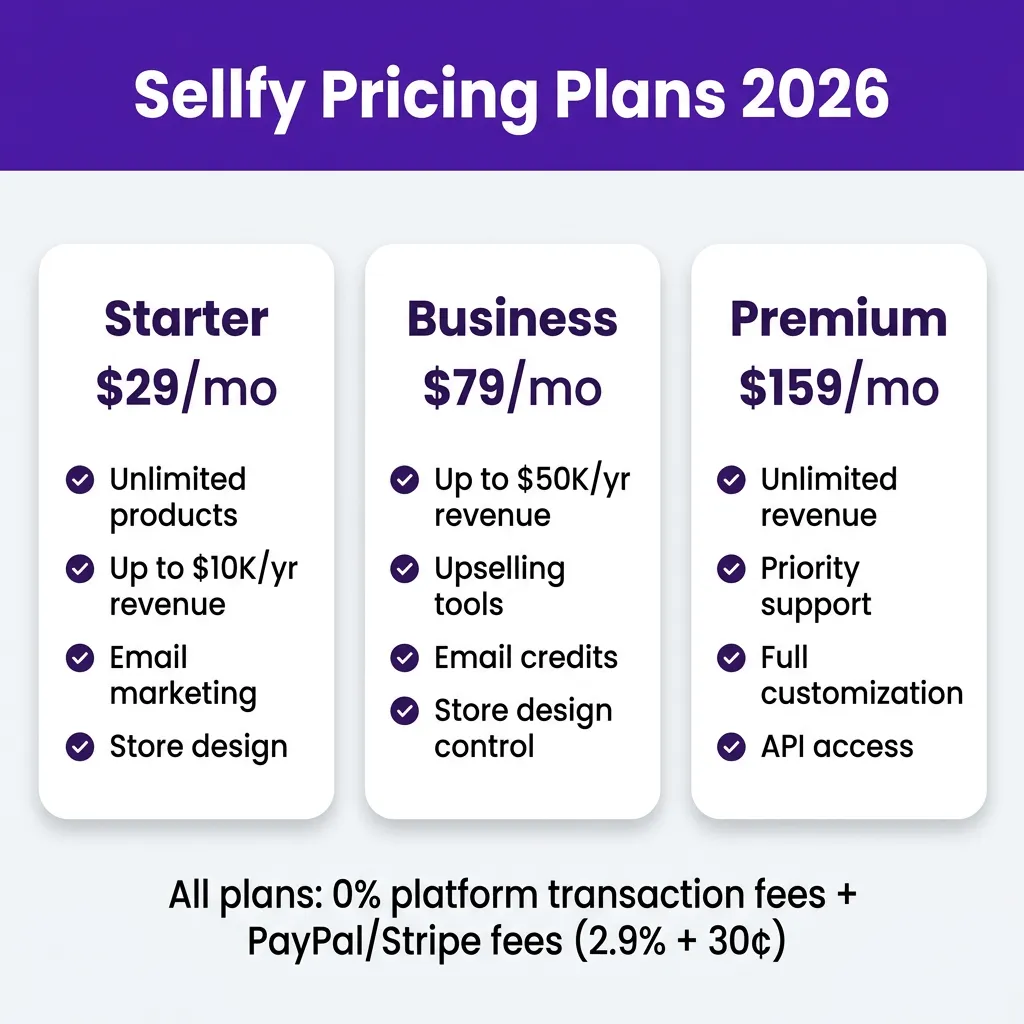
Sellfy charges a flat monthly fee with zero platform transaction fees on paid plans. You still pay standard payment processor fees (Stripe or PayPal at ~2.9% + 30¢ per transaction), but Sellfy itself takes nothing.
Here’s the full breakdown:
| Plan | Monthly Price | Annual Price | Revenue Limit | Key Features |
|---|---|---|---|---|
| Starter | $29/mo | $264/yr ($22/mo) | Up to $10K/year | Unlimited products, email marketing, digital delivery, store builder |
| Business | $79/mo | $684/yr ($57/mo) | Up to $50K/year | All Starter + upselling, email marketing credits, advanced store design |
| Premium | $159/mo | $1,428/yr ($119/mo) | Up to $200K/year | All Business + priority support, full customization, product migration |
| Custom/Enterprise | Contact sales | Contact sales | $200K+/year | Custom limits, dedicated support |
The revenue limits are the detail that catches people off guard. If your store generates $10,001 in a 12-month window, Sellfy will ask you to upgrade from Starter to Business. Hit $50,001? You move to Premium. This isn’t a one-time threshold — it’s a rolling 12-month calculation.
For most early-stage creators, the $29/month Starter plan is genuinely enough. But it also means Sellfy’s cost structure scales up fast once you hit traction. A creator doing $40K/year in digital product sales will be on the $79/month Business plan — paying $948/year for the platform alone, before payment processor fees.
Sellfy Features: What’s Actually Good
Digital delivery and file security
Sellfy handles digital file hosting on its own secure servers. Buyers get a download link immediately after payment. You can set download limits (how many times a file can be downloaded), which reduces unauthorized sharing.
For PDFs specifically, Sellfy supports PDF stamping — it adds the buyer’s email address to downloaded PDFs, discouraging redistribution. This is a feature most platforms don’t offer without add-ons.
Print-on-demand built in
This is genuinely rare. Most platforms require you to connect a third-party POD service. Sellfy has its own POD network — you upload designs, set prices, and orders get printed and shipped automatically. No inventory, no fulfillment headaches.
Available products: t-shirts, hoodies, mugs, phone cases, hats. Margins are reasonable but not exceptional — you’ll make $8–$15 on a $25–$35 t-shirt depending on the design.
Built-in email marketing
Sellfy includes an email marketing tool in every plan. You can send product announcements, newsletters, and discount codes to your customer list. On the Starter plan, you get a basic allowance of email sends; Business and Premium include email credits for larger campaigns.
It’s not Mailchimp. But for creators who just want to message their buyers without juggling another tool, it’s genuinely useful.
Embeddable buy buttons
You can embed Sellfy checkout as a buy button, product widget, or full storefront on any website. This matters for creators who have an existing blog or content site — you keep your audience on your own domain but process payments through Sellfy.
Sellfy Pros and Cons: The Honest Take
What Sellfy does well
Zero platform transaction fees on paid plans — you keep more of every sale vs. Gumroad (10% + 50¢) or Payhip (5% on free plan)
Print-on-demand built in — no need for Printful or Printify integrations
Digital delivery is solid — PDF stamping, download limits, secure hosting
Simple setup — live in under an hour, no coding required
Email marketing included — one less tool to pay for
Subscriptions supported — recurring memberships without extra plugins
Annual discount is meaningful — saves ~25% vs. monthly billing
Where Sellfy falls short
Revenue caps feel arbitrary — $10K/year on Starter is tight; hitting that limit forces a 2.7x price increase
Limited design customization — the store builder is constrained; you can change colors and logos but deep branding requires Business+
Analytics are basic — no cohort analysis, no LTV tracking, minimal conversion data
No built-in affiliate program on Starter — you need Business to unlock affiliate tools
No VAT/tax handling — Sellfy doesn’t act as a Merchant of Record; you’re responsible for sales tax, VAT, and GST compliance globally
No upsells on Starter — one-click upsells require Business tier
Limited integrations — compared to Shopify or WooCommerce, the app ecosystem is thin
That last point — no VAT/tax handling — is the biggest limitation for anyone selling internationally. If a creator in the US sells to buyers in Germany, the UK, and Australia, they’re technically responsible for collecting and remitting VAT and GST in those countries. Sellfy doesn’t touch that. Paddle, FastSpring, and Fungies.io do (they’re Merchants of Record who own the tax liability).
Sellfy vs. Competitors: Platform Comparison
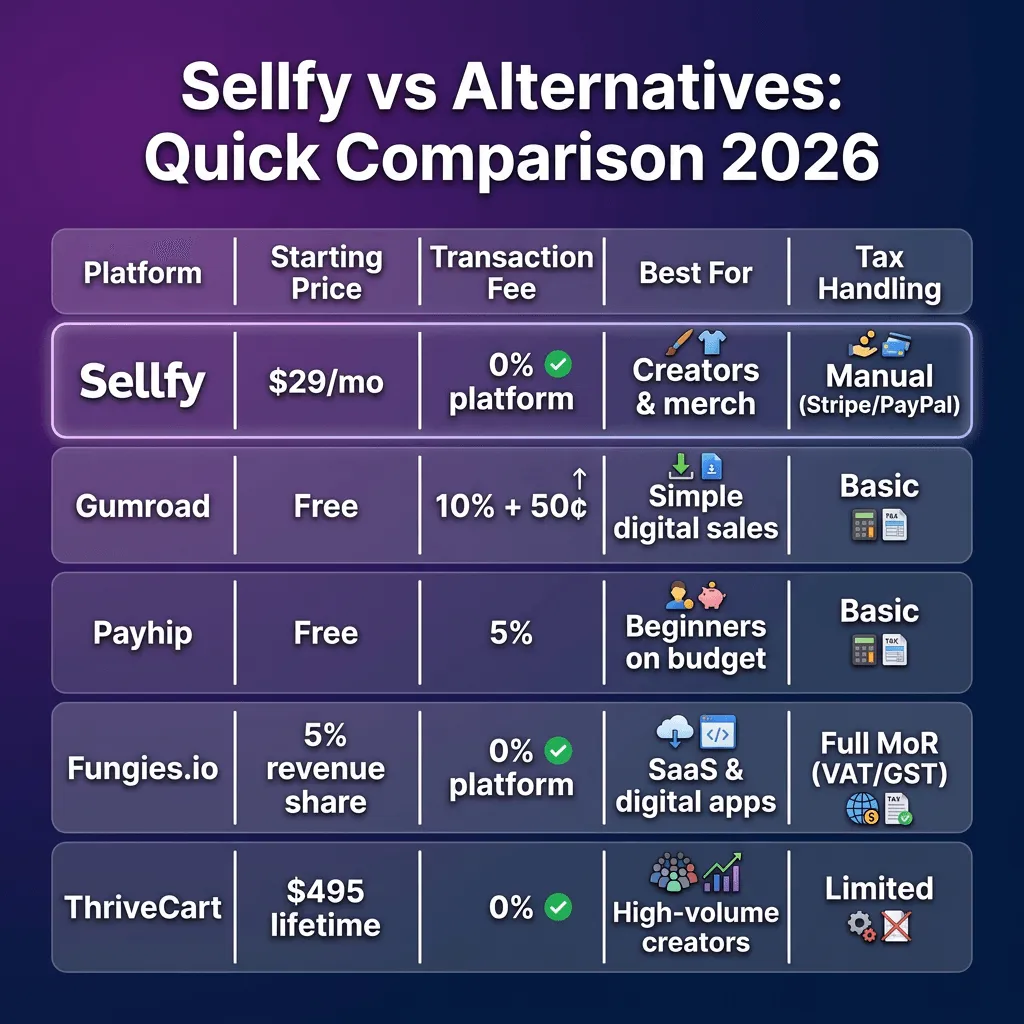
| Platform | Starting Price | Platform Transaction Fee | Tax Handling | Best For | Print-on-Demand |
|---|---|---|---|---|---|
| Sellfy | $29/mo | 0% | None (DIY) | Creators, POD, courses | ✅ Built-in |
| Gumroad | Free | 10% + 50¢ | Basic | Simple digital sales | ❌ |
| Payhip | Free (5% fee) | 5% or 0% ($99/mo) | Basic VAT | Beginners, ebooks | ❌ |
| ThriveCart | $495 lifetime | 0% | None (DIY) | High-volume creators | ❌ |
| Fungies.io | 5% rev share | 0% | Full MoR (VAT, GST, sales tax) | SaaS, digital apps, dev tools | ❌ |
| Paddle | 5% + 50¢/txn | 0% | Full MoR | B2B SaaS | ❌ |
| Lemon Squeezy | 5% + 50¢/txn | 0% | Full MoR | SaaS, digital products | ❌ |
Who Sellfy Is Actually Right For
Sellfy earns its place in a specific category: creators who want everything in one place and don’t need global tax compliance handled for them.
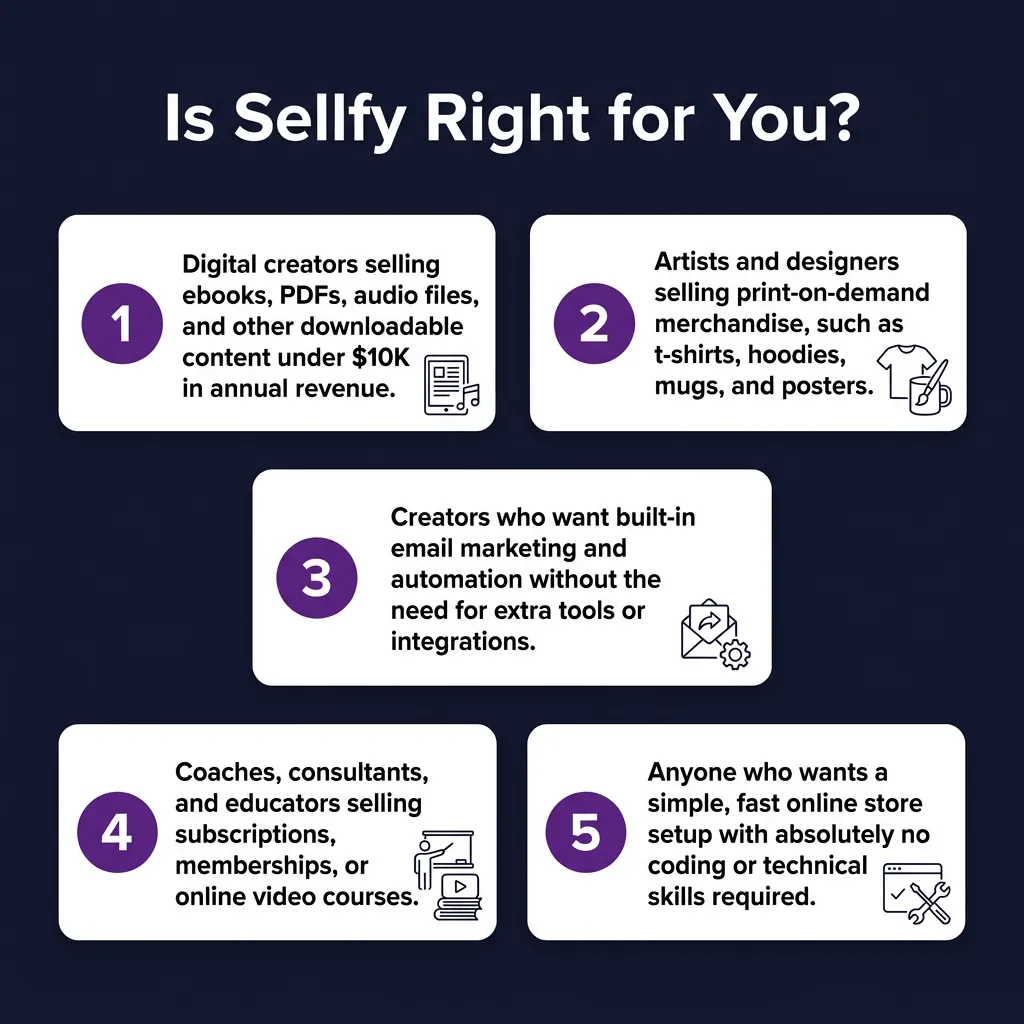
Sellfy makes sense if you’re:
A digital creator doing under $10K/year, where the Starter plan gives you a clean start
An artist or designer who wants to sell print-on-demand merch alongside digital files
A creator who wants email marketing bundled in and doesn’t want another SaaS subscription
Building a subscription community or membership around your content
Running a simple store where setup speed matters more than customization
Sellfy probably isn’t right if you’re:
Building a SaaS product or developer tool — you need licensing, API keys, and tax compliance that Sellfy doesn’t support
Selling internationally and worried about VAT/GST compliance — Sellfy leaves that entirely to you
Scaling past $50K/year quickly — the Premium tier at $159/month starts to look expensive vs. alternatives
Needing deep analytics or CRM integration — Sellfy’s data layer is lightweight
A developer who wants webhook-driven automation — the API is thin
If you’re a developer or SaaS founder monetizing an app, a tool, or API access, Sellfy isn’t built for you. Platforms like Fungies.io are specifically designed for digital products with code delivery, license keys, and full Merchant of Record tax coverage — so you don’t touch VAT or international sales tax at all.
Sellfy’s Real Cost at Different Revenue Levels
Let’s do the actual math — total platform cost (subscription + payment processing fees) at three revenue levels:
| Annual Revenue | Sellfy Plan | Platform Cost/Year | Payment Processing (2.9% + 30¢) | Total Cost | Net Revenue |
|---|---|---|---|---|---|
| $5,000 | Starter | $264 | ~$295 | ~$559 | ~$4,441 (88.8%) |
| $15,000 | Business | $684 | ~$585 | ~$1,269 | ~$13,731 (91.5%) |
| $40,000 | Business | $684 | ~$1,480 | ~$2,164 | ~$37,836 (94.6%) |
| $80,000 | Premium | $1,428 | ~$2,960 | ~$4,388 | ~$75,612 (94.5%) |
At low volumes, Sellfy’s flat fee is heavier proportionally. At $5K/year, you’re paying about 11% total. But by $40K+, the economics look solid — under 6% all-in. That’s competitive.
For comparison: Gumroad’s 10% platform fee on $40K/year = $4,000 in platform fees alone, before payment processing. Sellfy’s Business plan at $684/year starts looking quite good.
Key Takeaways
Sellfy’s zero platform transaction fee is real — on paid plans, Sellfy takes nothing. You pay Stripe/PayPal directly, which is typically 2.9% + 30¢.
The revenue caps are the biggest friction point — moving from Starter ($29/mo) to Business ($79/mo) the moment you hit $10,001/year is a steep jump for early-stage creators.
Print-on-demand built in is genuinely differentiated — most competitors require third-party integrations for merch.
Sellfy doesn’t handle taxes globally — if you sell to EU or Australian buyers, you’re legally responsible for VAT/GST unless you use a MoR platform.
Annual billing saves 25% — if you’re committing to Sellfy, pay annually. Starter drops to $22/month.
FAQ
Does Sellfy charge transaction fees?
Sellfy charges zero platform transaction fees on all paid plans (Starter, Business, Premium). However, you still pay payment processing fees directly to Stripe or PayPal — typically 2.9% + 30¢ per transaction. On the old free plan, Sellfy did charge a fee, but the current paid plans have eliminated this.
What are Sellfy’s revenue limits?
Sellfy’s Starter plan allows up to $10,000 in sales per rolling 12-month period. Business allows up to $50,000/year. Premium covers up to $200,000/year. If you exceed your plan’s limit, Sellfy will require you to upgrade to the next tier.
Is Sellfy better than Gumroad in 2026?
For creators doing over $3,000/year in sales, Sellfy is almost certainly better than Gumroad economically. Gumroad’s 10% + 50¢ fee structure costs more than Sellfy’s flat monthly plan once you have consistent volume. Sellfy also offers print-on-demand and better file security. Gumroad’s edge is zero upfront cost for brand new creators.
Does Sellfy handle VAT and sales tax?
No. Sellfy is not a Merchant of Record. It doesn’t collect, report, or remit VAT, GST, or US sales tax on your behalf. If you sell to buyers in the EU, UK, or Australia, you’re legally responsible for tax compliance. Creators with significant international sales should consider Merchant of Record platforms like Fungies.io, Paddle, or Lemon Squeezy, which handle all of this automatically.
Conclusion
Sellfy is a solid platform for creators who want one dashboard to handle digital downloads, POD merch, subscriptions, and email marketing — without paying per-transaction fees. It’s not trying to be Shopify, and it doesn’t need to be.
The $29/month Starter plan is genuinely good value for early-stage creators. The revenue caps push you up in price as you grow, but by the time you’re generating $15K–$40K/year, the per-transaction savings over Gumroad more than cover the subscription cost.
Where Sellfy falls short: global tax compliance (it leaves that entirely to you), limited analytics, and thin customization on lower tiers. If you’re building a SaaS product, API tool, or developer utility, Sellfy isn’t designed for your use case.
For software products and apps, Fungies.io is built exactly for that — it acts as a Merchant of Record handling VAT, GST, and sales tax globally, with licensing, webhook events, and a checkout you can embed directly in your app. Start free →