Top 20 GitHub Repositories for AI Agents in 2026 (Ranked by Stars)
Discover the 20 most popular open-source AI agent repositories on GitHub in 2026. Ranked by stars, with market insights, trends, and framework comparisons.
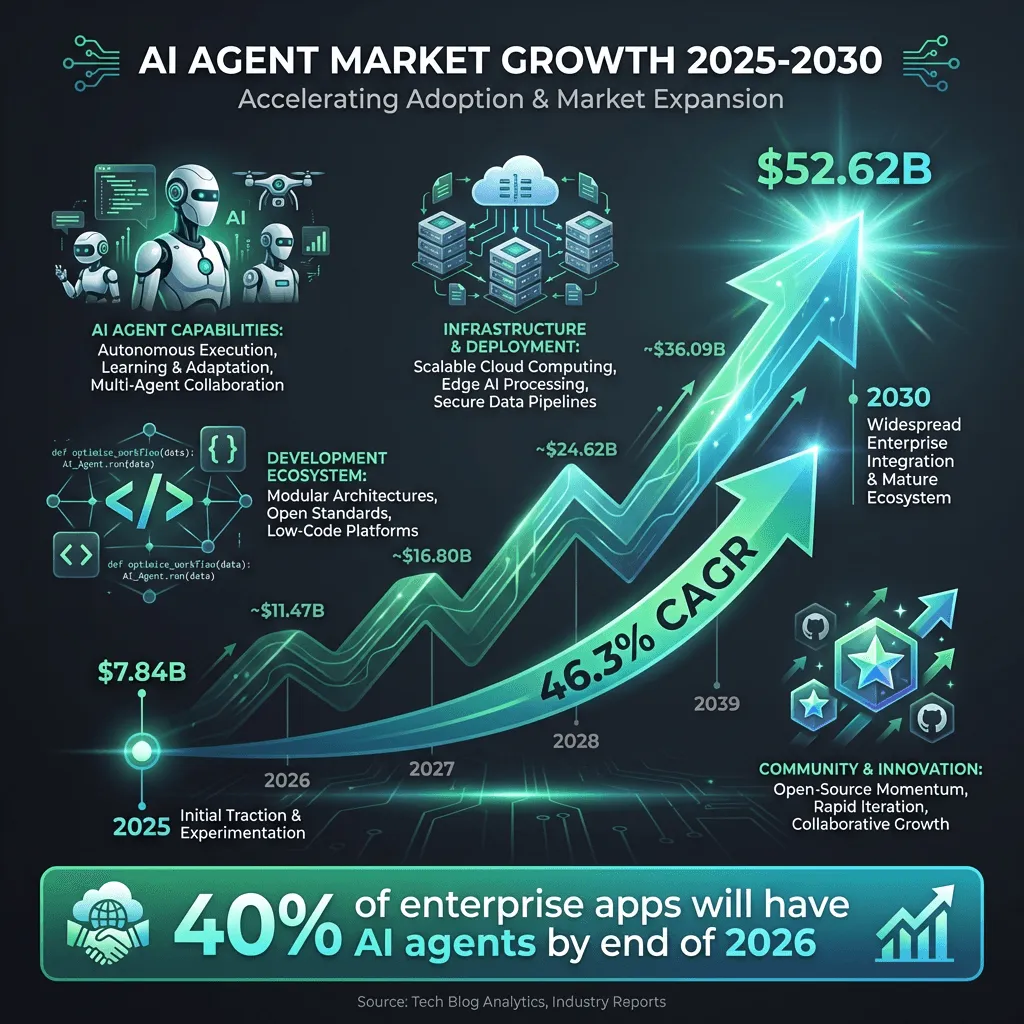
The AI agent landscape exploded in 2025 and shows no signs of slowing down. GitHub now hosts over 4.3 million AI-related repositories — a 178% year-over-year jump in LLM-focused projects. The global AI agent market reached $7.84 billion in 2025 and is projected to hit $52.62 billion by 2030, growing at a compound annual rate of 46.3%.
Whether you’re a developer looking to build your first AI agent or a tech leader evaluating frameworks for production, knowing which projects have the most traction matters. We analyzed the top 20 most-starred GitHub repositories for AI agents as of April 2026, using data from GitHub’s AI agent rankings and multiple industry sources.
What Makes a Great AI Agent Repository?
Before diving into the list, here’s what separates the top repos from the rest:
Developer adoption — GitHub stars, forks, and monthly download counts
Active development — regular commits, recent releases, and growing contributor base
Production readiness — real-world case studies from companies using the framework
Documentation quality — clear guides, tutorials, and API references
Ecosystem — integrations, plugins, and community extensions
Top 20 GitHub Repositories for AI Agents in 2026
Here are the most popular open-source AI agent projects on GitHub, ranked by stars. Data is current as of April 2026.
| # | Repository | ⭐ Stars | Language | What It Does |
|---|---|---|---|---|
| 1 | AutoGPT | 183,164 | Python | Autonomous AI agent framework — the pioneer of accessible AI for everyone |
| 2 | Langflow | 146,595 | Python | Visual drag-and-drop builder for AI-powered agents and workflows |
| 3 | Dify | 136,278 | TypeScript | Production-ready platform for building and deploying agentic workflows |
| 4 | LangChain | 132,476 | Python | The foundational agent engineering platform — chains, tools, and agents |
| 5 | Gemini CLI | 100,337 | TypeScript | Google’s open-source AI agent for terminal-based coding and queries |
| 6 | Browser-use | 86,164 | Python | Make websites accessible for AI agents — automate tasks in any browser |
| 7 | RAGFlow | 77,200 | Python | Open-source RAG engine fused with agent capabilities for knowledge-grounded AI |
| 8 | LobeHub | 74,778 | TypeScript | Multi-agent collaboration platform — build and manage agent teams |
| 9 | MetaGPT | 66,673 | Python | Multi-agent framework simulating a software company with role-based agents |
| 10 | OpenBB | 65,442 | Python | Financial data platform for analysts, quants, and AI agents |
| # | Repository | ⭐ Stars | Language | What It Does |
|---|---|---|---|---|
| 11 | AutoGen | 56,730 | Python | Microsoft’s multi-agent conversation framework for collaborative AI |
| 12 | AI Agents for Beginners | 56,002 | Jupyter | Microsoft’s 12-lesson course to get started building AI agents |
| 13 | Mem0 | 52,047 | Python | Universal memory layer for AI agents — persistent context across sessions |
| 14 | Flowise | 51,582 | TypeScript | Visual AI agent builder — drag, drop, and deploy agents without code |
| 15 | CrewAI | 48,117 | Python | Role-playing autonomous agent framework — agents work together as crews |
| 16 | LocalAI | 44,938 | Go | Open-source AI engine — run any model locally, no GPU required |
| 17 | Cherry Studio | 42,984 | TypeScript | AI productivity studio with smart chat, autonomous agents, and 300+ assistants |
| 18 | Agno | 39,189 | Python | Build, run, and manage agentic software at scale |
| 19 | MindsDB | 38,910 | Python | AI analytics query engine — build self-reasoning agents across live data |
| 20 | ToolJet | 37,717 | JavaScript | Open-source foundation for building internal tools, dashboards, and AI agents |
Key Trends in the AI Agent Ecosystem
Analyzing these 20 repositories reveals several clear patterns in where the AI agent space is heading:
1. Visual and Low-Code Builders Are Dominating
Three of the top five repos — Langflow (146k), Dify (136k), and Flowise (51k) — are visual builders. Developers want to prototype and deploy AI agents without writing extensive code. This trend mirrors what happened with web development: no-code tools democratized access, and the same is now happening with AI agents.
2. Multi-Agent Orchestration Is the New Frontier
Projects like MetaGPT, LobeHub, CrewAI, and AutoGen focus on coordinating multiple agents working together — not just building single agents. The future isn’t one AI doing everything; it’s teams of specialized agents collaborating on complex tasks.
3. AI Agent Memory Is Becoming Critical
Mem0 (52k stars) addresses a fundamental problem: AI agents need persistent memory to be truly useful. Without it, every interaction starts from scratch. The ability to remember context across sessions is what separates a toy agent from a production-ready one.
4. Browser Automation for Agents Is Exploding
Browser-use hit 86k stars by giving AI agents the ability to interact with websites like humans do — clicking, typing, navigating. Combined with tools like Vercel’s agent-browser (27k stars), this opens up massive automation potential for tasks that previously required human interaction.
5. Local AI Is Gaining Massive Traction
LocalAI (44k stars) lets you run any model — LLMs, vision, voice, image, video — on any hardware without a GPU. As data privacy concerns grow and API costs add up, the ability to run agents locally is becoming a major competitive advantage.
How to Choose the Right AI Agent Framework
With so many options, picking the right framework depends on your specific needs:
| Use Case | Best Frameworks |
|---|---|
| Quick prototyping (no-code) | Langflow, Dify, Flowise |
| Production multi-agent systems | LangChain, AutoGen, CrewAI |
| Browser automation | Browser-use, Vercel agent-browser |
| Knowledge-grounded agents (RAG) | RAGFlow, LangChain + Chroma |
| Local/self-hosted AI | LocalAI, Cherry Studio |
| Financial/data analysis agents | OpenBB, MindsDB |
| Developer productivity | Gemini CLI, Cherry Studio |
| Learning AI agents | AI Agents for Beginners (Microsoft) |
The Bottom Line
Gartner predicts that 40% of enterprise applications will feature task-specific AI agents by the end of 2026, up from less than 5% in 2025. The frameworks on this list are the ones powering that transformation.
Whether you’re building agents for internal automation, customer support, or product features, these open-source projects give you a massive head start. The community around each one is active, the documentation is improving, and the real-world results are getting better every month.
Our recommendation: start with Langflow or Dify if you want a visual approach, LangChain or CrewAI for code-based development, and always pair your agent with a good memory layer like Mem0 for production use.
References
GitHub Octoverse 2025 Report — octoverse.github.com
Markets And Markets: AI Agents Market Analysis — marketsandmarkets.com
Gartner: AI Agent Predictions 2026 — gartner.com
ODSC: Top Ten GitHub Agentic AI Repositories in 2025 — opendatascience.com
Firecrawl: Best Open Source Frameworks for Building AI Agents in 2026 — firecrawl.dev
GitHub Ranking AI: Top 100 AI Agents — yuxiaopeng.com
AutoGPT Repository — github.com/Significant-Gravitas/AutoGPT
LangChain Repository — github.com/langchain-ai/langchain
Microsoft AutoGen — github.com/microsoft/autogen
CrewAI Framework — github.com/crewAIInc/crewAI